Best Vertical Bike Racks for Small Garages
Last updated:
Disclosure: This article contains affiliate links. If you buy through these links, we may earn a commission at no extra cost to you. We do not claim hands-on testing unless clearly stated.
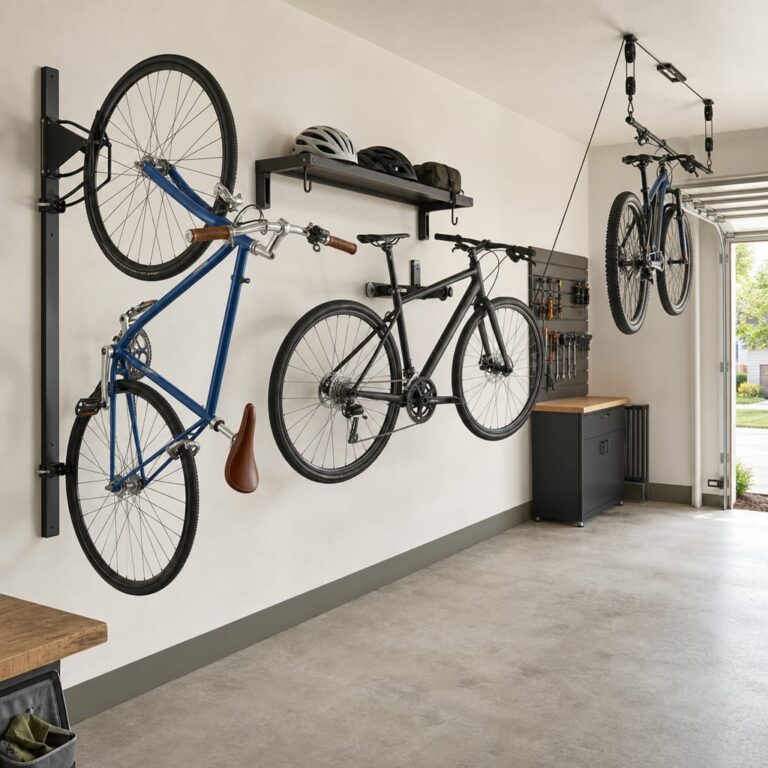
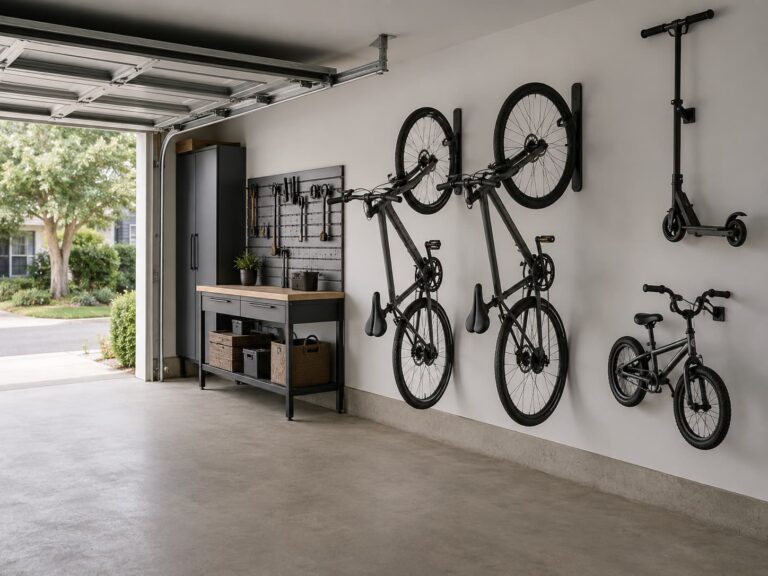
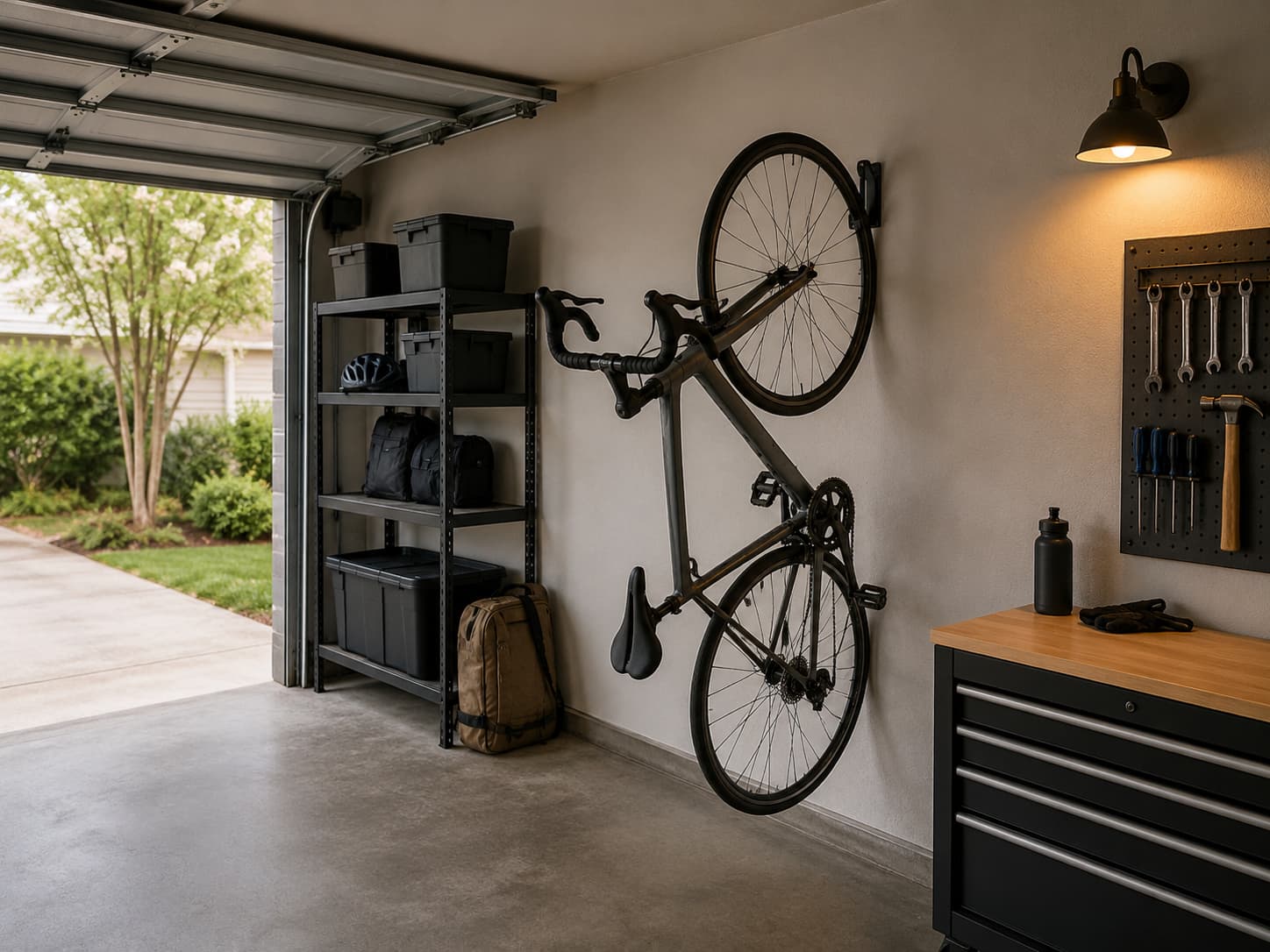
“Vertical bike storage” sounds like a single product category. It isn’t. Walk into a well-organized small garage and you’ll see at least four different vertical mechanisms doing the same job in subtly different ways: a fixed-arm wall hook holding a road bike, a swivel rack that pivots flush against the wall, a tension pole that wedges floor-to-ceiling without a single screw, and a horizontal rail with adjustable hooks for a family of cyclists. They all qualify as “vertical.” They are not interchangeable.
This article is the vertical-only deep dive that pairs with our main bike rack guide. We compare five picks across the four real mechanisms plus the narrow-garage flush-mount specialization. We do not cover horizontal hangers, ceiling hoists (covered separately), or freestanding floor stands.
Quick Picks
| Pick | Product | Best for | Watch out for | |
|---|---|---|---|---|
| Best Wall Vertical (Fixed Arm) | Wallmaster Bike Storage Rack (2-Pack) | One or two bikes, simplest install | Stud-only mount; sold as 2-pack | View on Amazon |
| Best Floor-to-Ceiling (No-Drill) | BikeHand 2-Bike Tension Pole | Renters, no-drill garages | Needs flat ceiling and level floor | View on Amazon |
| Best Swivel Vertical (Fender-Friendly) | Steadyrack Classic Fender | Bikes with fenders or mudguards | 2.4″ tire width hard ceiling | View on Amazon |
| Best for Multiple Bikes | Monkey Bars Bike Storage Rack 2.0 (6-Bike) | Family of 4-6 cyclists | Spans 3+ studs; map them first | View on Amazon |
| Best for Narrow Garages | Pro Bike Tool Swivel Bike Rack | Tight aisle next to parked car | Pedals still protrude ~8″ from wall | View on Amazon |
How We Selected These Vertical Bike Racks
We do not claim hands-on testing unless clearly stated. For this guide, we reviewed manufacturer specifications, retailer product pages, product documentation where available, and recurring patterns in public customer feedback.
Because vertical-rack performance depends entirely on how the rack interacts with the wall, ceiling, or floor, we prioritized products with clear capacity figures, clear mounting requirements, and a clear use case. We dropped any product where the listing didn’t specify tire-width limits, mounting hardware, or anchor points — vagueness in those three is the leading cause of buyers ending up with a rack their bike doesn’t fit or their wall can’t hold.
Selection criteria:
- Manufacturer-listed capacity stated clearly on either the Amazon listing or the brand’s product page
- Mounting requirements published — stud spacing for wall mounts, ceiling type considerations for tension poles
- Tire width and wheel diameter compatibility published
- Each product fills a distinct mechanism slot — we don’t list two products that are functionally identical
- Each pick maps to a specific small-garage use case, not “generally good”
What to Look for Before Buying a Vertical Bike Rack
The four vertical mechanisms (and which fits your garage)
The four mechanisms are: fixed-arm wall hook, swivel wall hook, floor-to-ceiling tension pole, and multi-bike horizontal rail. Fixed-arm hooks are the simplest — one bracket, one bike, no moving parts. Swivel hooks add a pivot so the bike rotates flush against the wall, which matters in narrow spaces. Tension poles wedge between floor and ceiling without drilling — right for renters and finished garages. Multi-bike rails put four to six bikes on one horizontal bar with sliding hooks.
Pick the mechanism first. The product picks below are the best in each mechanism, not “the best vertical rack overall” — that question has no useful answer.
Wall mounting — stud anchoring is non-negotiable
A bike on a vertical rack creates a lever-arm load. Drywall anchors — even rated ones — are not enough. Manufacturer-listed capacities assume mounting into structural studs.
Use a stud finder before drilling. If you can’t find a stud where you need one, install a wall-spanning mounting board across two studs, or pick a tension pole.
Ceiling clearance and joist contact (for tension poles)
Tension poles rely on contact pressure at both ends. A flat ceiling over joists works well. Popcorn ceilings, dropped tile, and finished basement panels reduce contact reliability and the pole can drift.
Most tension poles have a usable range of ~7 ft to 10 ft 10 inches. Bikes need 6-12 inches of headroom above the highest tire when hanging.
Tire width, wheel diameter, and fender clearance
Most vertical hooks accept tire widths up to 2.1-2.5 inches. Plus tires (2.4″+), full MTB tires, and fat tires need dedicated wide-tire variants. Bikes with fenders or mudguards need fender-clearance variants — standard hooks will scrape on every load and unload.
Look for an explicit tire-width limit on the product page. If the listing doesn’t state one, treat that as a flag.
Wall clearance when the bike is parked
Even hanging flush, pedals and cranks typically protrude six to eight inches from the wall. In a narrow garage, that’s the difference between opening the car door and not. Measure your aisle width — the path between the rack wall and the parked car — before installing.
Best Wall Vertical (Fixed Arm): Wallmaster Bike Storage Rack (2-Pack)
Best for: A household with one or two bikes, a stud wall, and a preference for the simplest possible vertical mount — one bracket, one hook, no moving parts.

Short verdict: A fixed-arm vertical bike hook sold as a 2-pack. The listing states a 50 lb capacity per hook, with anti-scratch rubber coating over steel. Each bracket is roughly 10″ × 4″ × 5″ — the smallest footprint of any rack in this guide.
This is the pure-hook category answer. No swivel, no tension cables, no adjustable arms — just a steel hook bolted into a stud. The 2-pack format makes the per-bike cost the lowest in this roundup.
Why it stands out
The bracket footprint is the differentiator. At under 5″ tall and 4″ wide, a Wallmaster hook disappears into the wall once installed — meaningful in a small garage. There’s nothing to break: no pivot bearings, no tensioner threads, no plastic clips. If the slot’s question is “what’s the simplest vertical mount?”, this is the answer.
It can work well for:
- A single bike in a small garage where bracket footprint matters
- A two-bike household where both bikes hang against the same stud wall
- Readers who want minimum hardware and minimum failure points
- Apartment garages or backup setups
Key specs to check
- Listed capacity: 50 lb per hook (verify before loading e-bikes)
- Pack format: 2-pack — confirm both brackets are in your cart
- Hook dimensions: roughly 10″ × 4″ × 5″ each
- Mounting hardware: 4 screws per bracket; into wood studs only
- Tire-width compatibility: not explicitly listed — measure before ordering
Recurring feedback patterns
Recurring positive feedback often centers on how unobtrusive the bracket is and how easy the bike loads — the rubber-coated hook holds the front wheel without scratching the rim. Common complaints typically involve install: buyers who used drywall anchors instead of stud screws report the bracket pulling out under load. Several buyers mention checking that both brackets in the 2-pack are level relative to each other.
Potential drawbacks
The fixed arm holds the bike perpendicular to the wall — no swivel to bring it flush. The 50 lb per hook capacity rules out heavier e-bikes. There’s no tire tray, so the rear wheel hangs free against the wall (a soft scuff guard or paint touch-up may be wanted over time). And the listing doesn’t explicitly state a tire-width limit — measure before ordering.
Buyer warning
Stud mounting is not optional. Drywall anchors fail under the lever-arm load of a bike on a vertical hook — use a stud finder, hit wood, or move the bracket. For two-bike installs, mark both stud locations before drilling and switch to staggered heights if the spacing doesn’t work along a single horizontal line.
Best Floor-to-Ceiling (No-Drill): BikeHand Floor to Ceiling 2-Bike Tension Pole
Best for: Renters, finished or popcorn ceilings where you can’t drill into joists, or anyone who wants to rearrange storage without leaving wall holes.

Short verdict: An aluminum tension pole that wedges floor-to-ceiling and holds two bikes on EVA-coated cradles. Manufacturer-listed 45 lb per cradle, 90 lb total. No drilling.
The BikeHand floor-to-ceiling pole is the canonical no-drill answer to vertical bike storage. The Amazon listing describes a 2-inch diameter aluminum alloy pole adjusted via a wheel mechanism to wedge between floor and ceiling, with two height-adjustable cradle arms that rotate to fit different frame styles. Maximum height 10.8 ft. Rubber feet protect the floor; the ceiling cup spreads pressure.
Why it stands out
This is the slot most vertical-rack buyers underestimate. Renters can’t drill ceiling joists. Finished basement ceilings or dropped panels can’t take a wall mount in the right position. A tension pole sidesteps both — it occupies vertical space without modifying the building. Frame-protection cradles plus rotating mounts handle mixed bike sizes.
It can work well for:
- Rental garages where wall damage is a problem
- Finished garages with non-structural ceiling surfaces
- Two-bike households where flexibility beats capacity
- Temporary storage during home renovations
Key specs to check
- Pole height adjustable up to 10.8 ft (330 cm)
- Per-cradle capacity 45 lb (20 kg); 90 lb total for 2 bikes
- EVA-coated cradle arms for frame protection
- 2-inch aluminum alloy pole with rubber non-slip end caps
- 90% pre-assembled; tool-free height adjuster
Recurring feedback patterns
Recurring positive feedback often centers on the no-drill convenience and how the EVA cradles protect frame paint. Common complaints typically involve installation on imperfect surfaces — a popcorn ceiling, a slightly bowed floor — where the pole drifts after a few days under load. Several buyers mention re-tensioning the wheel mechanism every month or two as routine maintenance.
Potential drawbacks
Tension poles cannot match wall mounts for absolute load security — they depend on contact friction, which varies with surface conditions. Two-bike capacity is the realistic limit; for four bikes, look at the premium Topeak Dual Touch (search on Amazon). The pole occupies a fixed footprint that can’t easily move once tensioned.
Buyer warning
Tension poles assume a level floor and a flat, structural ceiling. Popcorn ceilings, finished basement panels, dropped tile, and sloped ceilings all reduce contact reliability and the pole can drift. Verify your ceiling height fits the pole’s adjustment range — a too-short pole has nothing to wedge against. Premium 4-bike alternative: the Topeak Dual Touch on Amazon.
Best Swivel Vertical (Fender-Friendly): Steadyrack Classic Fender Bike Rack
Best for: Commuters, urban hybrid riders, and e-bike owners whose bikes have fenders or mudguards and need a vertical rack that won’t scrape them.

Short verdict: Steadyrack’s fender-clearance variant — same swivel mechanism as the Classic with hook geometry redesigned to clear front fenders. Manufacturer-listed 25 kg (55 lb).
Steadyrack lists this rack as designed for bikes with fenders or mudguards. The hook geometry sits the bike further from the wall than a standard Steadyrack so the front fender doesn’t contact during the roll-in motion. The pivot lets the bike swing nearly 180 degrees during access and sit flush during storage. This is a different ASIN from the Steadyrack Classic featured in our main bike rack guide.
Why it stands out
Most vertical hooks are designed for bare wheels. Add fenders — common on commuter bikes, urban hybrids, and most e-bikes sold today — and the standard hook either scrapes the fender or won’t fit. The Fender variant is geometry-specific to clear them. For a household with a daily commuter or a fender-equipped e-bike, this is the slot that prevents long-term fender damage.
It can work well for:
- Daily commuter bikes with full fenders
- Urban hybrids with permanent mudguards
- E-bikes with factory-fitted fenders
- Touring bikes with fender hardware
Key specs to check
- Manufacturer-listed 25 kg (55 lb) capacity
- Wheel diameter range 20″ to 29″
- Tire width up to 2.4″ maximum (hard ceiling)
- Vertical or horizontal mounting holes for wood vs masonry
- Carbon steel, nylon, UV-treated polymer construction
Recurring feedback patterns
Recurring positive feedback often centers on how the roll-in motion makes loading effortless even at the recommended high mounting point — a commuter parks the bike in seconds without lifting. Common complaints typically involve buyers ordering the Fender variant when their bike actually fits the standard Classic. Several buyers mention the swivel pivot is the wear point under heavy daily use.
Potential drawbacks
The 2.4″ tire ceiling rules out plus tires above that, full MTB tires, and fat bikes — those riders need ProFlex Wide or the Fat Bike Steadyrack variant. The 55 lb capacity is also lower than the Classic’s 77 lb, since the fender-clearance geometry changes the load profile.
Buyer warning
Tire width is the dealbreaker spec. Measure your widest tire before ordering; 2.4″ is the hard ceiling. The swivel pivot is the long-term wear point — manufacturer-listed capacity assumes correct mounting and reasonable use. Confirm the single-rack variant (the linked listing above), since 2-pack and 4-pack variants exist at different price points.
Best for Multiple Bikes (Vertical Rail): Monkey Bars Bike Storage Rack 2.0 (6-Bike)
Best for: A family of four to six cyclists or a shared garage where multiple bikes get parked daily and the wall has at least three studs in the right span.

Short verdict: A heavy-duty steel rail with six sliding hooks. Manufacturer-listed 75 lb per hook, 300 lb total with all three included brackets. Different brand and mechanism from the multi-bike pick in our main bike rack guide.
The Monkey Bars 2.0 is a 48-inch (4-foot) horizontal steel rail that mounts across multiple studs and carries up to six adjustable vertical hooks. The hooks slide along the rail without disconnecting, so spacing adapts to mixed bike sizes. The rack ships with three flush brackets; the third bracket is what supports the full 300 lb capacity per the listing.
Why it stands out
Multi-bike rails solve a problem individual hooks can’t: spacing flexibility. Six bikes need spacing based on handlebar widths, not a uniform grid. The sliding-hook design means a road bike sits next to a kids’ BMX without wasted space. The 75 lb per-hook capacity fits the realistic load of mixed adult bikes — most rails cap each hook at 50-60 lb.
It can work well for:
- Two-parent, two-kid households where everyone rides
- Shared cohousing or co-op garages
- Coaches or teams storing club bikes
- Families with mixed bike sizes that change as kids grow
Key specs to check
- 300 lb total capacity (with all three brackets)
- 75 lb per hook
- Rail width 48″ (4 feet)
- Six rubber-coated sliding hooks
- Industrial steel, gray or tan powder-coat
- Multi-stud wall mounting — three flush brackets included
Recurring feedback patterns
Recurring positive feedback often centers on how the sliding hooks let users reposition bikes as the fleet changes — a kid grows, a new bike arrives, spacing adapts without re-drilling. Common complaints typically involve buyers underestimating wall span and trying to mount on too-narrow stud spacing. Several buyers mention four bikes is the practical daily-use limit because of handlebar overlap.
Potential drawbacks
The 48″ rail spans at least three studs in standard 16″ on-center framing — non-standard framing or short wall sections may not work. Six bikes packed close creates handlebar interference unless drops or kids’ bars make up most of the lineup.
Buyer warning
Map studs across the rail length BEFORE ordering. A 48″ rail won’t fit between two studs in standard 16″ on-center framing — span at least three studs. Confirm the 6-bike model (the linked listing above), not the 4-bike or 3-bike variants — all three exist on Amazon with similar titles. Realistic daily-use cap is four bikes; reserve extras for static or guest bikes.
Best for Narrow Garages (Flush-to-Wall Swivel): Pro Bike Tool Swivel Bike Rack
Best for: A reader whose constraint is aisle width — the path between rack wall and parked car — not bike count or capacity.

Short verdict: A swivel rack with three pre-set positions (center, left, right). Manufacturer-listed 30 kg / 66 lb. The center position parks the bike fully flush against the wall.
The Pro Bike Tool Swivel uses a different mechanism than Steadyrack’s continuous pivot. Three pre-set positions hold the front wheel via a “wheel stopper” — the bike doesn’t drift when parked. The center position is the slot-defining feature: the bike sits parallel to the wall, rear wheel directly behind the front. The listing states 30 kg (66 lb) capacity with screws for concrete, masonry, and stud installs.
Why it stands out
In a narrow garage, the difference between protruding 8 inches and 14 inches is the difference between opening the car door and scraping it. Steadyrack’s continuous swivel lets the bike sit flush, but the three-position system here parks the bike at one of three consistent angles — no drift risk. For aisle-clearance constraints, the discrete positioning is worth the trade-off.
It can work well for:
- Single-car garages where door swing matters
- Two-car garages where one bay is dedicated to bikes
- Workshop garages where wall tools and bikes share space
- Apartments with narrow indoor bike storage
Key specs to check
- 30 kg / 66 lb manufacturer-listed capacity
- Three positions: center (flush), left, right
- Wheel-stopper holds the front wheel in position
- Mounting screws for concrete, masonry, stud included
- Fits road, MTB, cyclocross, hybrid, BMX, kids’ bikes
Recurring feedback patterns
Recurring positive feedback often centers on the discrete positions — buyers report the bike staying where they put it, even when bumped during car door opening. Common complaints typically involve buyers ordering the 2-pack ASIN when they wanted the single-pack. Several buyers mention the install instructions are clearer than competitor swivel racks.
Potential drawbacks
The three-position design has less granularity than Steadyrack’s continuous swivel — you can’t park at 30 degrees off the wall. 66 lb capacity is solid for most road and hybrid bikes but may not suit heavy e-bikes (50-70 lb). Single-bike capacity means narrow-garage families need multiple brackets.
Buyer warning
Even parked flush, pedals and cranks protrude 6-8 inches from the wall. Measure your narrowest aisle path BEFORE ordering — between the rack wall and the car’s widest point (usually a side mirror). Confirm the single-pack variant (the linked listing above); a 2-pack version exists and is easy to mix up at checkout.
Side-by-Side Comparison
| Product | Type | Listed capacity | Mounting | Tire width | Bikes | Main advantage | Main drawback |
|---|---|---|---|---|---|---|---|
| Wallmaster Bike Storage Rack (2-Pack) | Fixed-arm wall hook | 50 lb per hook | Wall stud | Not listed — verify | 1-2 | Smallest bracket footprint, 2-pack | No swivel; tire-width not listed |
| BikeHand 2-Bike Tension Pole | Floor-to-ceiling tension pole | 45 lb per cradle / 90 lb total | No-drill (tension) | Most road/MTB | 2 | No drilling required | Needs flat ceiling and level floor |
| Steadyrack Classic Fender | Swivel wall hook (fender-friendly) | 55 lb (25 kg) | Wall stud or masonry | Up to 2.4″ | 1 | Fits bikes with fenders | Hard 2.4″ tire ceiling |
| Monkey Bars 6-Bike Rail | Multi-bike horizontal rail | 75 lb per hook / 300 lb total | Multi-stud wall, 3 brackets | Most road/MTB | Up to 6 | 6 sliding hooks, flex spacing | 48″ span needs 3+ studs |
| Pro Bike Tool Swivel | Swivel wall hook (3-position) | 30 kg / 66 lb | Concrete / masonry / stud | Most road/MTB/hybrid | 1 | Center-position flush parking | Three positions only, no continuous swivel |
Choosing Between the Four Vertical Mechanisms
Most readers don’t need a single “best” vertical rack — they need the rack that fits their situation. The matrix below maps five common reader situations to the four vertical mechanisms.
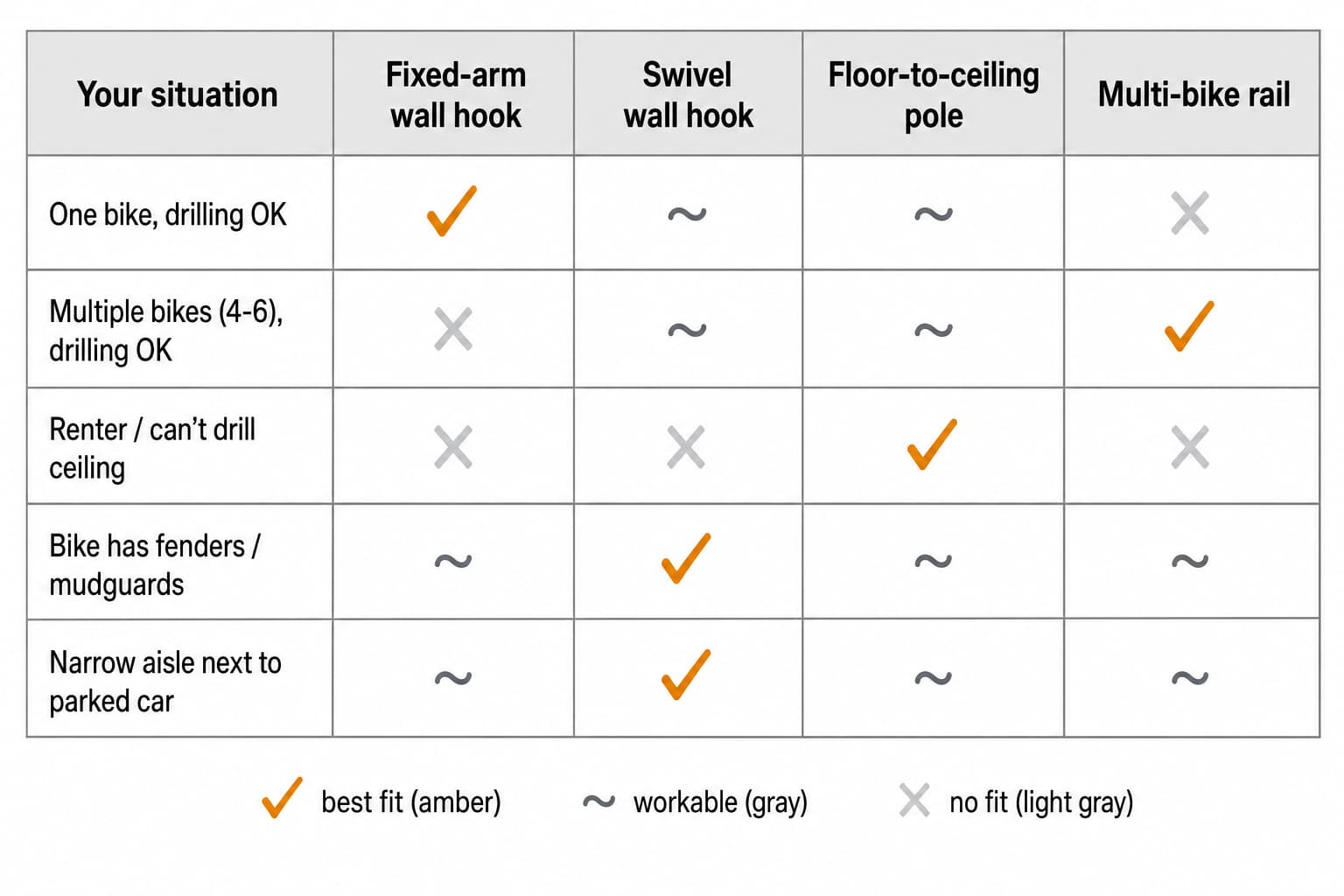
Use the frame this way:
- Choose a fixed-arm wall hook for one or two bikes on a stud wall when minimum complexity matters. Avoid if the bike is over 50 lb or aisle clearance demands flush parking.
- Choose a swivel wall hook for fender-equipped bikes (Steadyrack Fender) or narrow-aisle constraints (Pro Bike Tool). Avoid for fat tires or no-drill setups.
- Choose a floor-to-ceiling pole for renters, finished basements, or popcorn ceilings. Avoid if your floor is uneven, ceiling isn’t flat, or you need more than two bikes.
- Choose a multi-bike rail for 4-6 bikes on a wall spanning at least three studs. Avoid for single-bike households or walls with non-standard framing.
For broader wall organization systems, the rail-based Monkey Bars approach also pairs naturally with slatwall or pegboard above and below.
How to Measure Your Garage Before Buying a Vertical Bike Rack
Before ordering any vertical rack, take five measurements. Three are about the garage; two are about the bike. Get all five wrong and the wrong rack arrives.
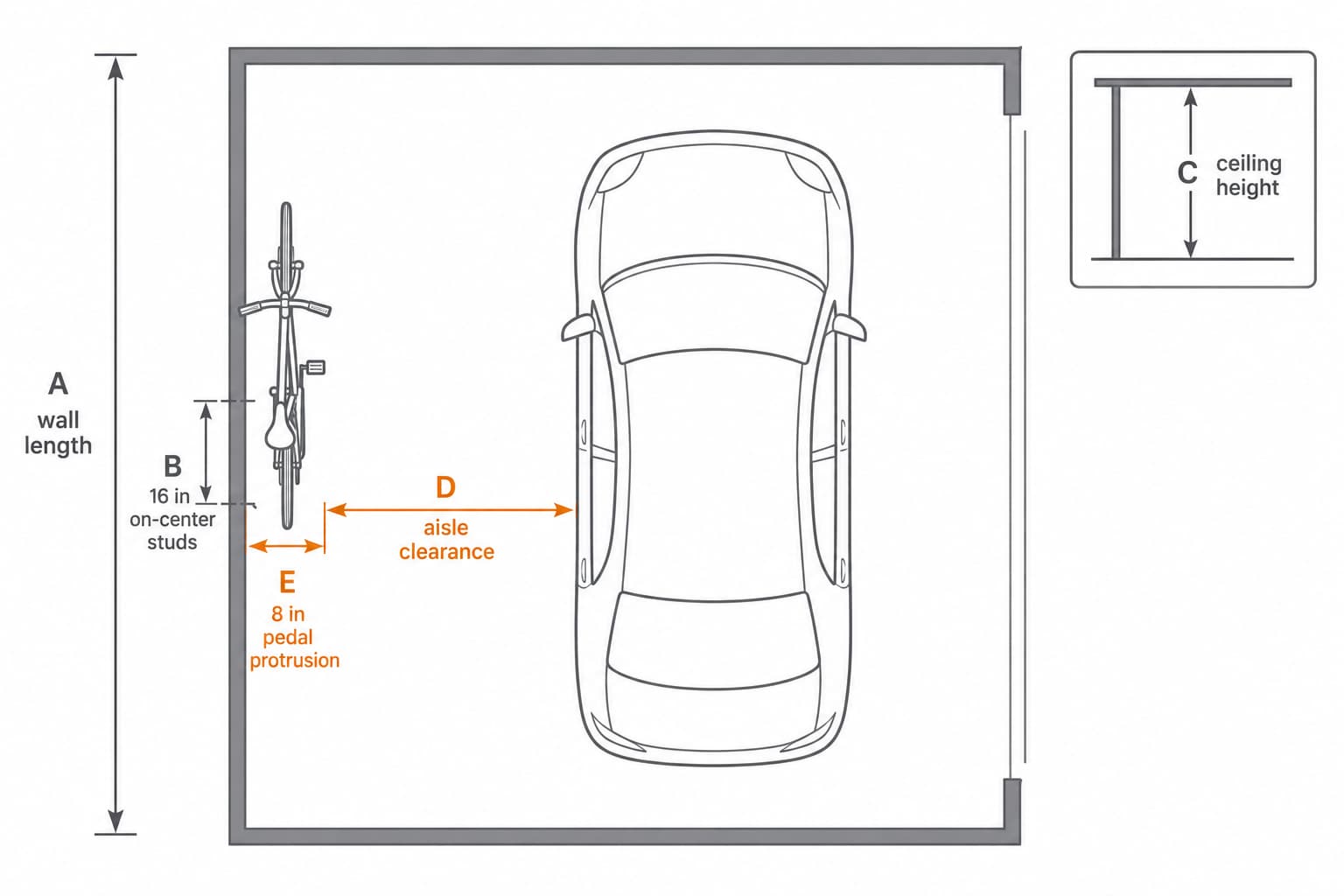
Measurement checklist:
- Wall length where the rack will go. Confirm the rack fits the available run, especially for multi-bike rails (48″ for the Monkey Bars 6-Bike).
- Stud locations across that wall. Use a stud finder. Map the studs onto the rack’s mount holes. For multi-bike rails, you need to span at least three studs.
- Ceiling height. Critical for tension poles (must fit pole’s adjustment range) and for any vertical rack (the bike needs 6-12 inches of headroom above the highest point).
- Aisle width when a bike is parked. Measure from the rack-side wall to the widest point of the parked car (usually the side mirror or door handle). Subtract the rack’s bike-protrusion (typically 8-14 inches depending on mechanism).
- Bike’s longest tube length. For fixed-arm racks, the bike hangs from the front wheel — the seat tube and rear wheel must clear the floor.
- Tire width and wheel diameter. Match the rack’s published tire-width and wheel-diameter limits exactly. A 2.4″ rack will not accept a 2.5″ tire.
- Whether the bike has fenders or mudguards. If yes, you need a fender-clearance variant — most standard hooks scrape.
- Floor levelness (for tension poles). A bowed concrete floor undermines pole tension. Use a long level along the pole’s intended footprint.
Common Complaints and Buyer Warnings
The recurring complaints across vertical bike racks fall into a few predictable categories. Knowing them in advance saves a return.
Drywall anchors are not enough
The most common failure mode for any wall-mounted vertical rack is mounting on drywall anchors instead of structural studs. The bike’s weight on the rack arm creates a lever-arm load — not a simple shear load like a picture frame. Even high-rated drywall anchors fail under repeated lever loading. If you can’t hit a stud where you want the rack, install a wall-spanning mounting board across two studs first, or pick a non-wall mechanism.
Tension poles need flat contact at both ends
A tension pole transfers load through friction at the floor and ceiling contact points. A popcorn ceiling, dropped tile, or finished panel reduces the contact area dramatically and the pole drifts. A bowed or sloped floor (common in older garages with drains) does the same at the bottom. Verify both surfaces with a level before ordering.
Swivel mechanisms wear under daily use
The swivel pivot is the long-term wear point on any swivel-style rack. Manufacturer-listed capacity assumes the pivot is correctly mounted and used as designed. Repeatedly slamming the bike into the wall, hanging accessories from a parked bike, or bouncing the rack all accelerate pivot wear. None of these are “abuse” in a household sense, but all of them shorten the rack’s life.
Who Should Avoid Vertical Bike Racks?
Vertical racks aren’t the right answer for every household. Pick a different form factor if any of the following apply:
- Bikes over the listed rack capacity. Most single-bike vertical racks list 40-66 lb. Heavy e-bikes (50-70 lb) and cargo bikes (70-100+ lb) need a rack with explicit e-bike rating — see our guide to garage storage for bikes and scooters — or a different mechanism.
- No stud-bearing wall and no flat ceiling. If the only wall is a finished partition with no studs, and the ceiling is dropped panels, a vertical rack has nothing to anchor to — pick a freestanding floor stand.
- Riders with mobility limits. Vertical lifting requires getting the front wheel up to head height. Shoulder, back, or grip limits often work better with horizontal hangers or freestanding gravity stands.
- Daily-use scenarios where lifting adds friction. If the bike comes in and out daily, the lift effort matters. Many commuters end up leaving the bike against the wall. Consider whether the lift will actually happen.
- Bikes with delicate paint that can’t tolerate occasional rim contact. Most vertical hooks contact the front rim. Painted rims or carbon rims with show finishes may pick up minor marks over time.
FAQ
Can I mount a vertical bike rack on drywall without a stud?
No. Vertical racks create a lever-arm load — the bike’s weight pulls outward at the rack arm end — that drywall anchors cannot hold reliably over time. Even rated anchors fail under repeated lever loading. If you can’t find a stud, install a wall-spanning mounting board across two studs first, or pick a tension-pole or freestanding mechanism.
How much does a typical vertical bike rack hold?
Single-bike vertical hooks typically list 40-66 lb manufacturer-stated. Multi-bike rails go up to 300 lb total across six bikes. Tension poles list 30-50 lb per arm. Treat these as manufacturer-listed figures that assume correct mounting; real-world capacity depends on the install.
Will a vertical rack fit a bike with fenders or a road bike with thin tires?
Most standard hooks accommodate thin road tires (1.0-2.1″). Fenders are the issue — standard geometry sits too close to the wall and the front fender scrapes during loading. For fender-equipped bikes, choose a fender-clearance variant like the Steadyrack Classic Fender (linked in the swivel-vertical card above).
How tall does my garage ceiling need to be for a vertical bike rack?
For a wall-mount, your ceiling needs to be roughly your bike’s hung tip-to-tip length (~5’10” for a typical adult bike) plus 6-12 inches headroom — about 7’6″ minimum. For a tension pole, check the pole’s adjustment range (typically 7′ to 10’10”) and confirm your ceiling fits within that range.
Is a tension-pole rack as secure as a wall-mounted rack?
A correctly tensioned pole on a flat floor and ceiling is reliable for two-bike loads, but relies on contact friction rather than mechanical fastening. A wall mount into studs has no friction component to lose. For renters or finished garages, tension is the right trade-off; for permanent installs with stud access, the wall mount is more secure.
Can I store an e-bike on a vertical rack?
Most single-bike racks list 40-66 lb. Many e-bikes weigh 50-70 lb, at or above that range. More important: lifting a 60 lb bike to head height is harder than a 25 lb road bike — consider whether the lift will actually happen day to day. Heavy e-bikes are often better served by horizontal hangers or freestanding gravity stands.
What’s the difference between a swivel rack and a fixed-arm rack?
A fixed-arm rack holds the bike perpendicular to the wall, protruding the full rack arm length. A swivel rack lets the bike rotate parallel to the wall when parked, reducing how far it sticks out. Pick fixed-arm for the simplest install; pick swivel when aisle clearance matters.
Sources Reviewed
For this guide, we reviewed manufacturer product information from Delta Cycle, BikeHand, Steadyrack, Monkey Bars, and Pro Bike Tool, retailer specifications on Amazon listings for each ASIN cited, public customer feedback patterns, and bike-storage-specific discussions. We focused on product details that matter for vertical bike storage in small garages, including manufacturer-listed capacity, tire width and wheel diameter compatibility, mounting requirements (stud spacing, no-drill alternatives, ceiling type considerations), swivel pivot mechanisms, and fender clearance.
Related Guides
- Best Bike Racks for Garage — the hub roundup covering all bike rack form factors (horizontal, vertical, ceiling hoist, freestanding)
- Best Garage Sports Equipment Organizers — for households storing bikes alongside sports gear
- Garage Wall Organization Systems — slatwall, pegboard, and rail systems that pair with vertical bike storage
- common garage organization mistakes
- How to Organize a Garage in One Weekend
- how to organize sports equipment in garage
- How to Start Organizing a Cluttered Garage
- Wall-Mounted Bike Rack vs Freestanding Bike Rack
- How to Choose Garage Cabinets