Best Garage Sports Equipment Organizers
Last updated:
Disclosure: This article contains affiliate links. If you buy through these links, we may earn a commission at no extra cost to you. We do not claim hands-on testing unless clearly stated.
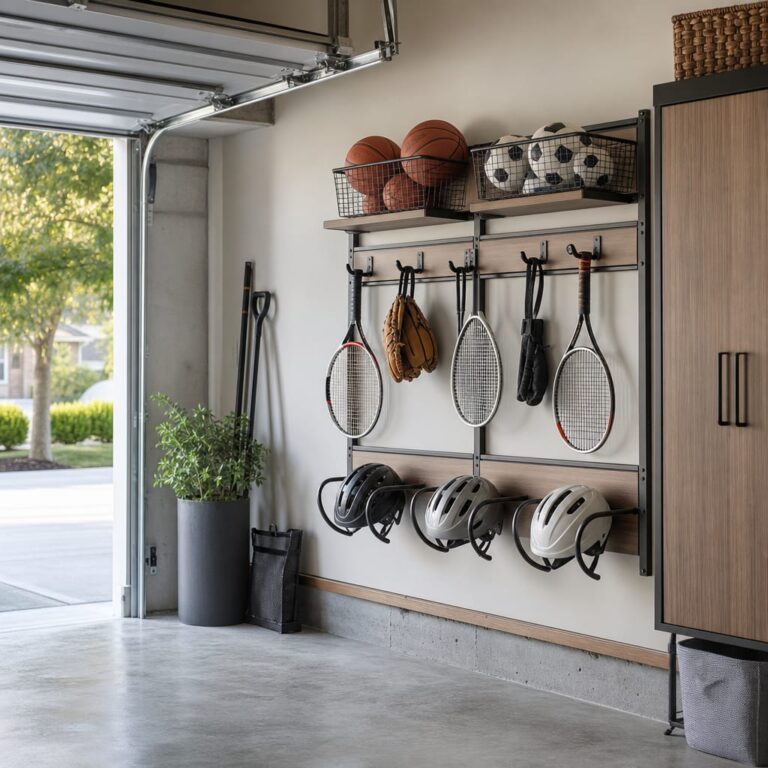
Sports gear consolidation matters more than gear-type optimization. Most families have a basketball or two, a soccer ball, a couple of baseball bats, a few helmets, maybe a golf bag — buying six different organizers (one per sport) wastes more floor than the gear ever did. The picks below cover the standard residential cases: one multi-sport rack that handles a mixed family collection, one rolling cart sized for kids, one ball-storage rack with bat holders, one dedicated golf rack, one stick-and-protective-gear locker, and one slatwall option for buyers who’d rather integrate sports gear with broader garage storage.
A note on brand: five of the six picks are Mythinglogic. That’s not because we ignored other brands — it’s because Mythinglogic dominates the dedicated sports-rack category on Amazon, with widely-purchased listings across multiple sub-categories (multi-sport, golf, ball storage, rolling carts). The sixth pick is the Proslat slatwall bundle — different brand, different approach, for buyers who want sports gear on a modular slatwall rather than a dedicated rack.
Quick Picks
| Pick | Product | Best for | Type | Main advantage | Watch out for | CTA |
|---|---|---|---|---|---|---|
| Best overall multi-sport rack | Mythinglogic Garage Sports Equipment Organizer | Mixed family gear | Bins + basket + ball rack | One unit covers 80% of family gear | Dedicated golf/hockey users may need the golf rack or hockey locker | View on Amazon |
| Best for kids gear | Mythinglogic Rolling Ball Cart with Wheels | Kid-managed gear pickup | Rolling indoor/outdoor cart | Mobility — kids can move it | Outdoor exposure tolerance is “indoor/outdoor” not “all-weather” | View on Amazon |
| Best ball storage | Mythinglogic Basketball Rack with Bat Holder | 12-ball + 4-bat collections | 4-tier rolling rack | 12 standard balls + 4 bats + 4 hooks | Footprint is mid-large | View on Amazon |
| Best for golf | Mythinglogic Golf Storage Garage Organizer | 1–2 golf bags + clubs | 2-bag rack with shelves + club stand | 2 bags + 12-club stand + 3 shelves + 4 hooks | Sized for golf-only — not a sports general-purpose | View on Amazon |
| Best for hockey/baseball | Mythinglogic Rolling Sports Ball Storage Locker | Stick-based gear + protective | Stackable rolling locker | Elastic straps, lockable, stackable | Locker form-factor not for daily-grab access | View on Amazon |
| Best modular | Proslat 33009 Ultimate Slat Wall Bundle | Sports gear on a wall system | 64 sq ft slatwall + 20 hooks + 2 shelves + 3 baskets | Modular wall integration | Larger up-front purchase | View on Amazon |
How We Selected These Sports Equipment Organizers
We do not claim hands-on testing unless clearly stated. For this guide, we reviewed manufacturer specifications from Mythinglogic and Proslat, retailer product pages on Amazon, install documentation where available, and recurring patterns in public buyer discussions about sports gear storage in residential garages.
Sports gear storage suffers from a specific buyer trap: families with multi-sport kids accumulate gear faster than they accumulate organizers, and the eventual fix is often “buy six different products, one per sport” — which spreads gear across the garage without solving consolidation. We prioritized products that handle multiple gear types in one unit (the multi-sport rack, the ball rack, and the slatwall bundle) plus dedicated picks for sports that don’t fit the multi-sport rack format (the golf rack and the hockey/baseball locker).
Selection criteria:
- Capacity is published or implied by the included accessory mix (the ball rack lists 12 balls + 4 bats; the golf rack lists 2 bags + 12 clubs).
- Mobility is honestly described — rolling carts vs. fixed organizers serve different families.
- Indoor/outdoor exposure tolerance is noted where it varies.
- Mixed-use is the right call for most multi-sport families; dedicated picks (the golf rack and the hockey/baseball locker) are right when one sport dominates.
- Brand concentration is acknowledged — Mythinglogic dominates the dedicated category; the Proslat bundle brings slatwall integration.
What to Look for Before Buying
Mobility — rolling vs. fixed
Rolling carts (the kids’ cart, the ball rack, and the hockey/baseball locker) move on lockable wheels. They’re useful when:
- Kids manage their own gear pickup
- The garage doubles as a workshop and storage needs to move out of the way
- Gear has to come out for use frequently (basketball pulled out for driveway play)
Fixed organizers (the multi-sport rack and the golf rack) sit in one place. They’re useful when:
- The gear stays put for long periods
- The location is dictated by walls or corners
- Stability matters more than mobility (a 2-bag golf rack with full bags is heavy)
Capacity — count of balls / bags / sticks
Read the listing for explicit counts. The picks here are explicit: the ball rack holds 12 balls + 4 bats; the golf rack holds 2 golf bags + 12 clubs; the Proslat slatwall is 64 sq ft. Buyers who can’t find a count are usually looking at vague-capacity products — skip those. Plan for 1.5× your current gear count to absorb future additions.
Mixed-use vs. dedicated
A multi-sport rack handles 60–80% of a typical mixed-sport family’s gear in one unit. Dedicated organizers handle 100% of one sport but require a separate unit for the rest. The right answer depends on the dominant sport: if one sport dominates (the golf bag is the centerpiece), a dedicated rack for that sport plus a multi-sport for everything else makes sense; if no sport dominates, a single multi-sport rack covers most of the family.
Indoor/outdoor exposure
Most picks are powder-coated steel — fine for indoor garages and covered carports. The kids’ rolling ball cart is explicitly indoor/outdoor; the others assume indoor placement. Garages with seasonal temperature swings and high humidity need the powder-coat finish to last; uncoated steel rusts within 1–2 years in those conditions.
Free-standing vs. wall-mounted
The five dedicated racks (multi-sport, kids’ cart, ball rack, golf rack, and hockey/baseball locker) are all free-standing — they sit on the floor and consume floor footprint. The Proslat slatwall is wall-mounted and consumes wall area instead. Free-standing is right when wall space is unavailable; wall-mounted is right when floor space matters more (1-car garages, garages where the floor doubles as a workshop).
Best Overall Multi-Sport Rack: Mythinglogic Garage Sports Equipment Organizer
Best for: A family with mixed sports interests — basketball + soccer + baseball + a few helmets and gloves — that wants one rack to handle the bulk.

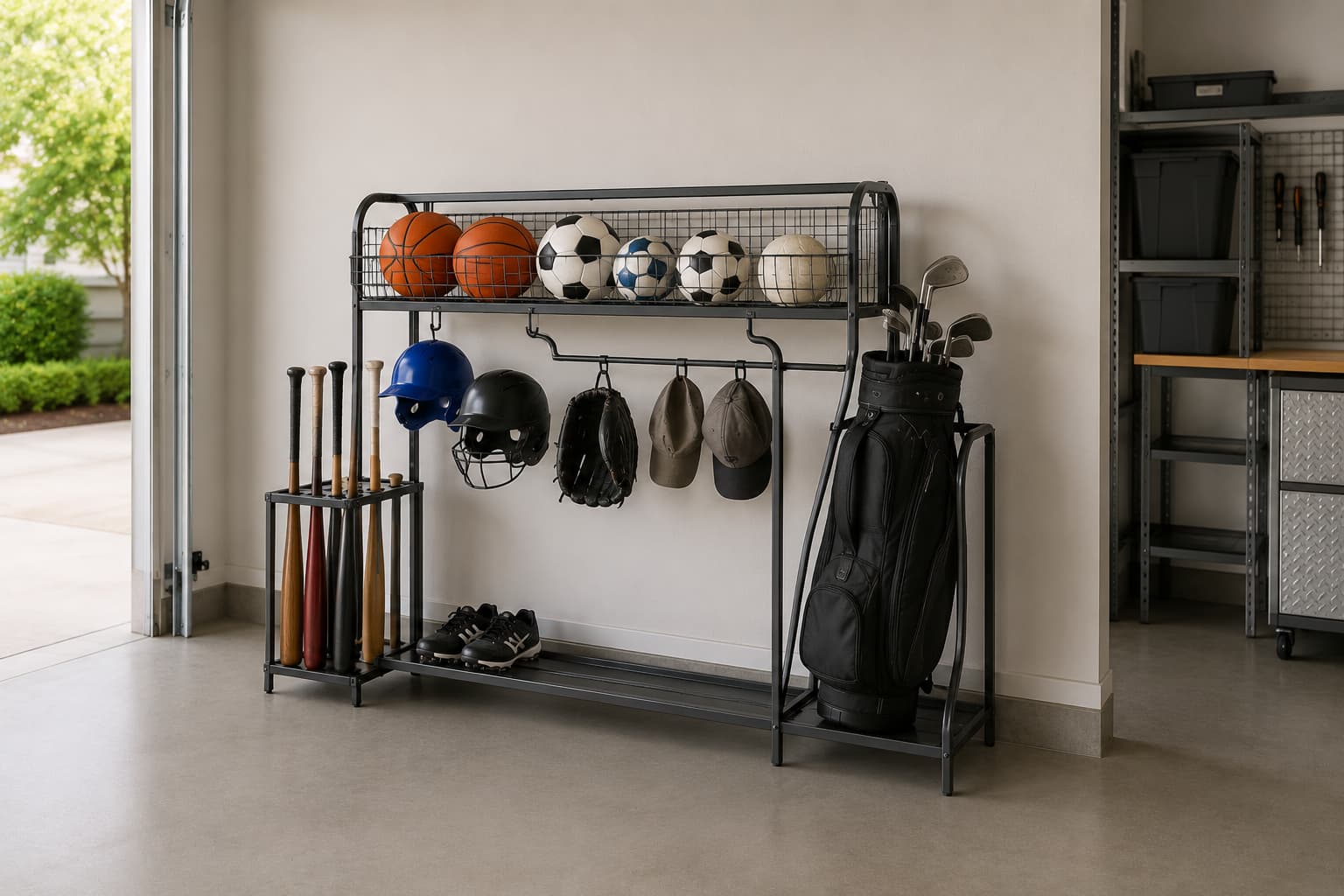
Short verdict: A combined sports organizer with 2 storage bins, 1 wire mesh basket, and 1 ball rack tier in a single unit. High-quality steel + powder-coat finish (scratch and rust resistant). The right rack for buyers who want one product to cover the multi-sport family without sourcing 4 separate organizers.
Balls go on the ball rack tier, helmets and protective gear in the wire mesh basket, gloves and small accessories in the bins. For pure ball-only collections, the dedicated ball rack below is more capacity-efficient; for stick-and-protective-gear-heavy collections, the hockey/baseball locker is a better fit.
Why it stands out
The biggest letdown in sports storage is buying multiple specialized organizers and watching the family use only the closest one. A combined rack solves that by making “the sports rack” a single destination, and the mixed accessory geometry covers roughly 80% of typical family gear types in one unit.
It can work well for:
- Multi-sport families (basketball + soccer + baseball + casual)
- Garages where one corner is the dedicated “sports zone”
- Households where the bulk of gear is mid-size and varied
- Buyers who’d rather have one product to clean and maintain
Key specs to check
- 2 storage bins + 1 wire mesh basket + 1 ball rack tier
- High-quality steel construction
- Powder-coat finish (scratch and rust resistant)
- Free-standing on floor
- Indoor garage use (covered exposure tolerated)
Recurring feedback patterns
Recurring feedback patterns suggest buyers value the one-destination consolidation most — the combined bins-plus-basket-plus-ball-tier layout tends to be described as covering the bulk of a mixed family’s gear without sourcing several separate units. Buyers often mention that assembly is straightforward but benefits from a second pair of hands.
Potential drawbacks
The mixed-geometry design trades capacity for versatility: no single zone is as deep as a dedicated unit, so a heavily ball-focused or stick-focused collection can outpace the matching section.
Buyer warning
The capacity is mid-size — fits most families but can fill quickly with active multi-sport households. If your gear count exceeds the typical (more than 6 balls, 4 bats, 4 helmets, 2 golf bags), plan to add a second unit or move to the Proslat slatwall for higher total capacity.
Best for Kids Gear: Mythinglogic Sports Equipment Garage Organizer (Rolling Ball Cart)
Best for: A family with younger kids managing their own gear pickup and putaway — the cart’s mobility lets kids move it to wherever they’re playing.
Mythinglogic Rolling Sports Equipment Organizer for Garage Gear and Toys
Short verdict: A rolling ball cart with wheels, sized for kids’ gear and rated for indoor/outdoor use. Steel construction with powder-coat finish. The rolling format makes it the right pick when kids are the primary users — they can move the cart themselves without adult help.
Adults can lift and carry sports gear; kids tend to drag and drop. The cart stores gear in one place, and when it comes out for use, it can be wheeled to the garage door or driveway for pickup — no adult help needed.
Why it stands out
The cart’s rolling format lets kids manage their own gear without parental setup, and the height is sized so kids can reach the contents without climbing. The indoor/outdoor build means the cart isn’t ruined by being left on the patio for an afternoon — useful when the plan is “play in the yard, then put it away later”.
It can work well for:
- Younger kids (ages 6–12) managing their own gear
- Driveway/yard sports where gear comes out frequently
- Multi-kid households where each kid has their own assortment
- Mid-size collections (3–6 balls, a couple of bats, gloves)
Key specs to check
- Rolling cart with wheels (typically lockable on Mythinglogic carts)
- Indoor/outdoor use rated
- Steel construction with powder-coat finish
- Sized for kids’ gear (lower height than adult-focused racks)
- Free-standing
Recurring feedback patterns
Recurring feedback patterns suggest the mobility is the standout for families with younger kids — buyers often mention that children can move and manage the cart themselves, which keeps gear circulating rather than piling up. Several buyers note the indoor/outdoor finish survives occasional patio trips without obvious wear.
Potential drawbacks
The kid-sized format means lower overall capacity than adult-focused racks, so multi-kid households tend to fill it faster. The rolling design also depends on the wheel locks holding on uneven floors.
Buyer warning
“Indoor/outdoor” doesn’t mean “all-weather”. The rating handles humidity and temperature variation but not direct rain or snow over time. If the cart lives outside permanently, expect powder-coat wear within 2–3 seasons.
Best Ball Storage: Mythinglogic Basketball Rack with Bat Holder
Best for: A ball-heavy collection (12+ balls in mixed sizes — basketball, soccer, volleyball, football) plus a few baseball bats.

Short verdict: A four-layer ball rack with casters, manufacturer-listed at 12 standard balls plus 4 baseball bats. Removable nylon mesh accommodates various ball sizes. 4 movable hanging hooks for bags/gloves/caps/jerseys. 4 heavy-duty lockable wheels.
The 4-tier layout lets you separate balls by sport (basketballs on one tier, soccer balls on another, footballs on a third) or by ownership. The removable nylon mesh is the practical detail — it lets the rack accommodate basketball-sized balls and smaller sizes without them falling through the tiers.
Why it stands out
12 balls is enough for most multi-sport families’ ball collection (typical = 4–8 balls in active rotation, 12 covers reserve plus older/deflated balls); 4 bats covers most baseball/softball collections. The casters with lockable wheels mean the rack can roll out for game-day pickup and lock in place during storage.
It can work well for:
- Active ball-sport families (basketball, soccer, volleyball, football, kickball)
- Multi-kid households with separate ball collections
- Coaches storing team gear at home (the 12-ball capacity covers a youth-team set)
- Garages where the ball collection is the dominant sports gear
Key specs to check
- 4-tier ball rack
- Manufacturer-listed 12 standard-size balls + 4 baseball bats
- Removable nylon mesh per tier (accommodates various ball sizes)
- 4 movable hanging hooks (bags, gloves, caps, jerseys)
- 4 heavy-duty lockable wheels
- High-quality steel + powder-coat finish
Recurring feedback patterns
Recurring feedback patterns suggest the removable nylon mesh is what buyers single out — it tends to be described as the detail that keeps smaller balls from slipping through tiers sized for basketballs. Buyers often mention the four-tier layout makes it easy to separate balls by sport or by child.
Potential drawbacks
The mid-large footprint is the main trade-off — the rack needs side clearance to load and roll, which is tight in narrow garages. The hooks and tiers are optimized for balls and bats, so it is less suited to bulky protective gear or long sticks than a dedicated locker.
Buyer warning
Measure before ordering: the cart needs walking-path clearance (~36″ recommended) on at least one side. The lockable wheels are reliable but on uneven garage floors (sloped concrete, expansion joints) the cart can roll despite locks — check your garage floor before relying on the lock.
Best for Golf: Mythinglogic Golf Storage Garage Organizer
Best for: 1–2 golf bags plus clubs, balls, shoes, accessories — a focused golf-only organizer that consolidates all the golf gear in one footprint.
Mythinglogic Single Golf Bag and Equipment Organizer for Garage
Short verdict: A 24″L × 15.7″W × 48″H golf-bag rack manufacturer-listed for 2 standard golf bags (or 1 large), with 3 medium shelves, a 12-club stand, and 4 removable hooks. Soft-edge design protects the bag from scratching against the rack. Steel + powder-coat finish.
Two bags plus 12-club stand handles a couple’s golf gear or one golfer with two seasonal sets. The 3 medium shelves hold golf shoes, balls, gloves, hats, towels — all the small accessories that otherwise scatter. The soft-edge design prevents bag fabric from scratching against the bare-metal frame.
Why it stands out
A multi-sport rack can fit a golf bag in a corner, but not 2 bags + 12 clubs + accessories in any organized way. Dedicated golf storage centralizes the gear so pre-round prep is faster and post-round cleanup is consistent — everything goes back to the same spot.
It can work well for:
- Golf-as-primary-sport households
- Two golfers in one household (couple or sibling golfers)
- Single golfer with seasonal bag sets
- Garages where the golf corner is its own dedicated zone
Key specs to check
- 24″L × 15.7″W × 48″H total footprint
- 2 standard golf bags (or 1 large bag)
- 3 medium shelves for shoes, balls, gloves, hats
- 12-club golf-club stand
- 4 removable hooks (bags, towels, accessories)
- Soft-edge design (prevents bag scratching)
- Steel + powder-coat finish
Recurring feedback patterns
Recurring feedback patterns suggest the soft-edge design earns the most praise — buyers often mention it as the detail that keeps bag fabric from scuffing against a bare-metal frame over time. Common feedback also points to the 12-club stand and shelf mix corralling the small accessories that otherwise scatter.
Potential drawbacks
The dedicated golf focus is also its limit — the geometry suits bags and clubs, not general sports gear, so a mixed collection still needs a second unit. The 2-bag rating is a stated maximum, and oversized cart bags may effectively reduce it to a single bag.
Buyer warning
Golf-only, not a general-purpose sports rack. Buyers who want golf-plus-other-sports should pair this with the multi-sport rack or move to the Proslat slatwall. The 2-bag spec is a maximum — if your bag is oversized, confirm the 1-large-bag interpretation works for your specific bag.
Best for Hockey/Baseball: Mythinglogic Rolling Sports Ball Storage Locker
Best for: Stick-based sports collections (hockey, baseball, lacrosse) plus protective gear (helmets, pads, gloves) that benefits from lockable storage.
Short verdict: A stackable lockable rolling cart with elastic straps. Designed to consolidate stick-based gear and protective equipment in a single mobile unit that keeps gear together (and visible) without scattering across the garage.
Hockey sticks, baseball bats, lacrosse sticks, paddles all need vertical-storage geometry that ball racks don’t provide. The elastic straps retain gear during transport, and the locker form-factor with locking option matters for households where shared gear needs accountability.
Why it stands out
Most multi-sport racks don’t have vertical stick-storage geometry; this one is sized for it. The elastic straps and lockable form-factor mean the cart can move gear from garage to car for game day without losing pieces along the way — a common letdown with open ball carts. The stackable design lets you add a second unit later if the collection grows.
It can work well for:
- Hockey families (sticks + pads + helmets + gloves + skates)
- Baseball/softball collections beyond a few bats
- Lacrosse households
- Game-day transport (gear stays together in the cart)
Key specs to check
- Stackable design (multiple units fit together)
- Lockable rolling wheels
- Elastic straps for gear retention
- Suitable for stick-based gear (hockey sticks, bats, paddles)
- Steel + powder-coat finish
Recurring feedback patterns
Recurring feedback patterns suggest the lockable, enclosed format is what stick-sport families value — buyers often mention it keeps borrowed gear accountable and stops loose pieces from scattering. Common feedback also points to the elastic straps holding gear in place while the cart rolls from garage to car.
Potential drawbacks
The enclosed locker geometry slows daily grab-and-go compared with an open rack, so it suits by-the-bag retrieval more than by-the-piece. Very long adult sticks may also approach the cart’s vertical clearance, so tall-gear households should confirm the fit.
Buyer warning
Not for daily-grab access — if you grab a basketball every afternoon for driveway play, the open-rack format of the dedicated ball rack is faster. The locker suits gear that comes out by the bag (game-day haul) rather than by the piece.
Best Modular: Proslat 33009 Ultimate Slat Wall Bundle
Best for: A buyer who wants sports gear integrated with a broader modular wall storage system rather than a dedicated rack — useful when the garage already has slatwall or the buyer plans to standardize on slatwall for all storage.

Short verdict: Twenty Proslat slatwall panels covering 16’×4′ (64 sq ft) bundled with a 20-piece hook kit, two wire shelves, and three wire baskets. Manufacturer lists 75 lb per square foot for the slatwall. The wire baskets handle helmets/balls/gloves; the hooks hold bats/sticks/jerseys; the shelves hold cleats and equipment bags. For broader context on this product family, see our roundup of wall-mounted garage storage systems.
Why it stands out
Where the dedicated sports racks consume floor footprint, slatwall consumes wall area instead — a meaningful trade for 1- and 2-car garages where floor space is at a premium. The 64 sq ft footprint is enough to consolidate sports gear plus general garage storage on the same wall, and accessory positions can change as the gear collection evolves.
It can work well for:
- Garages where floor space is the bottleneck
- Buyers planning a complete wall storage system
- Multi-purpose walls (sports + general garage gear in matched finish)
- Households that want unified visual aesthetics across storage
Key specs to check
- 20 Proslat panels covering 16′ × 4′ = 64 sq ft total
- 20-piece hook kit (12 × 4″ single hooks, 2 × 8″ double hooks, 2 × 4″ double hooks, 2 super-duty hooks, 2 heavy-duty U hooks)
- Two 12″ × 24″ wire shelves
- Three 15″ × 12″ wire baskets
- Manufacturer-listed slatwall capacity 75 lb per sq ft
- All accessories in matched white finish
- Wood-stud install
Recurring feedback patterns
Recurring feedback patterns suggest buyers value the flexibility of the slatwall most — hooks, shelves, and baskets can be repositioned as the gear collection changes. Buyers often mention the matched white finish ties sports gear into broader garage storage on one wall.
Potential drawbacks
The system asks more of the buyer up front: it requires wall-mounting into studs and a longer install than a free-standing rack. Capacity also depends entirely on correct anchoring rather than the floor doing the work.
Buyer warning
This is a larger up-front purchase than dedicated sports racks — it wins when you’re building out 64 sq ft of wall, not just the sports section. Install requires 16’+ of contiguous wall length; measure carefully before ordering.
Side-by-Side Comparison
| Product | Best for | Type | Capacity | Mobility | Mounting | Watch out for |
|---|---|---|---|---|---|---|
| Mythinglogic Multi-Sport rack | Mixed family | Bins+basket+ball tier | Mid-size mixed gear | Free-standing | Floor | Capacity caps at typical family |
| Mythinglogic Rolling Cart | Kids gear | Rolling cart | Kid-sized | Rolling indoor/outdoor | Floor | Not all-weather |
| Mythinglogic Basketball Rack | Ball storage | 4-tier rack | 12 balls + 4 bats | Lockable wheels | Floor | Mid-large footprint |
| Mythinglogic Golf rack | Golf | 2-bag rack + accessories | 2 bags + 12 clubs | Free-standing | Floor | Golf-only |
| Mythinglogic Hockey/Baseball locker | Stick sports | Stackable locker | Stick-based gear | Rolling lockable | Floor | Locker form-factor |
| Proslat 33009 bundle | Modular slatwall | 64 sq ft slatwall + accessories | 75 lb per sq ft (slatwall) | Wall-mounted | Wood studs | Larger purchase |
Multi-Sport Rack vs. Dedicated vs. Slatwall — Which Approach?
Three storage approaches serve four common gear mixes differently. Use this matrix to map your gear to the right approach before picking a specific product.
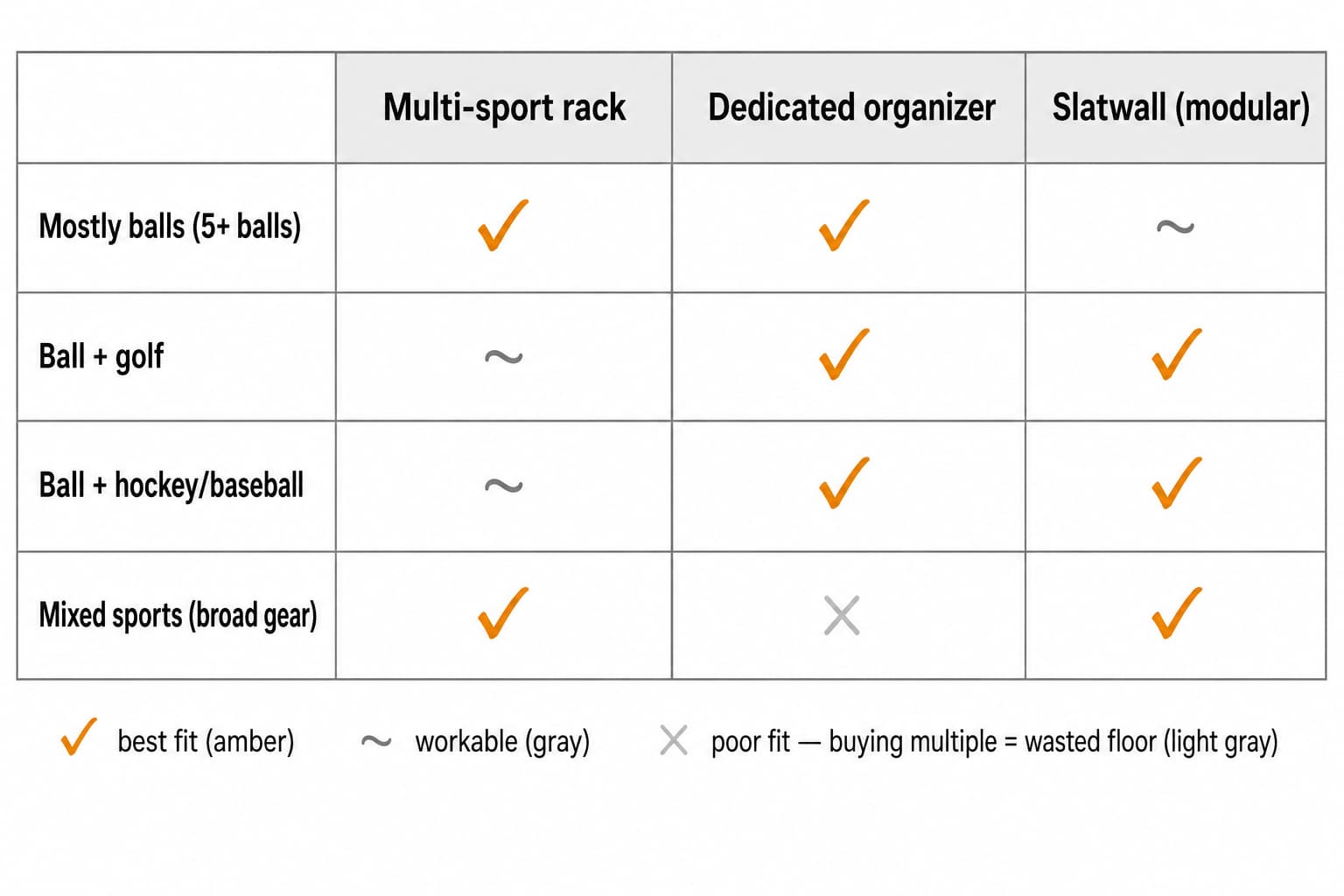
A few notes:
- Mostly balls — The multi-sport rack or the dedicated ball rack both work. The ball rack has higher ball capacity; the multi-sport rack absorbs other gear types if any.
- Ball + golf — A multi-sport rack barely accommodates a golf bag; the dedicated golf rack plus a small ball rack works better. The Proslat slatwall integrates both with hooks + baskets.
- Ball + hockey/baseball — The hockey/baseball locker handles stick gear; pair it with the dedicated ball rack for balls. The Proslat slatwall integrates both.
- Mixed sports (broad gear) — The multi-sport rack plus the Proslat slatwall covers the most ground. Buying multiple dedicated organizers (one per sport) wastes floor space without solving consolidation. For ceiling-mounted bike storage as part of the broader sports setup, see our roundup of best ceiling bike racks.
Ball diameters that decide rack fit
Sports governing bodies publish ball circumference, but the number that decides whether a ball fits a rack slot, a bungee opening or a bin is its diameter — and nobody publishes that. This table quotes each official circumference specification and derives the diameter from it, so you can measure an opening and know what will actually go into it.
| Ball | Official circumference | Diameter (derived) | Min. clear opening | Official weight | Specification source | Source checked |
|---|---|---|---|---|---|---|
| Basketball, size 7 (men’s / adult) | 29½–30 in | 9.4–9.5 in | 9.75 in | — (not stated in the cited source) | NCAA men’s basketball rules | 2026-09-15 |
| Soccer ball, size 5 (adult) | 68–70 cm (27–28 in) | 8.5–8.8 in | 9 in | 410–450 g (14–16 oz) at the start of the match | IFAB Laws of the Game, Law 2 | 2026-09-15 |
| Volleyball, indoor | 65–67 cm (25.6–26.4 in) | 8.1–8.4 in | 8.5 in | 260–280 g (9–10 oz) | USA Volleyball Indoor Rules 2025-2027, Rule 3.1 | 2026-09-15 |
How these numbers were produced: Diameter is derived from the governing body’s published circumference range as d = C / π, then rounded to 0.1 in. Minimum clear opening is the derived maximum diameter rounded up to the next 1/4 in — arithmetic only, not a manufacturer specification, and it assumes a rigid opening with no stretch. Circumference figures in inches are converted from the metric spec where the governing body publishes metric (1 in = 2.54 cm); where the body publishes both, its own figures are quoted.
- Sizes 6, 5, 4 and 3 balls are manufacturer conventions for youth play, not rules-body specifications, and vary between brands — measure the ball you actually own rather than assuming a nominal size.
- An American football is a prolate spheroid, so it has no single diameter: the girth figure is what a slot must clear, the long axis is what the slot depth must accommodate.
- Elastic-cord and bungee racks stretch, so a ball larger than the resting opening can still be held; the figures above are the rigid-opening case.
- A blank weight means the cited rulebook does not state one — we do not fill gaps with figures we could not source.
These are the entries that matter for this guide. The full table, with every row and its source, is in our ball storage rack guide.
How to Measure Before Buying
Before adding any of these to cart, count and measure:
- Total ball count — sum across all sports
- Bat/stick count — baseball bats + hockey sticks + lacrosse sticks
- Golf bag count — 0, 1, or 2 typical
- Helmet count — bike + sports helmets combined
- Available floor footprint — at least 24″×16″ for free-standing racks; 36″ walking-path clearance on at least one side
- Available wall length — for the Proslat slatwall, ≥16 ft of contiguous wall
- Stud spacing — 16″ or 24″ centers for the Proslat slatwall install
- Garage walking-path clearance — measure the path between the parked car and the proposed rack location
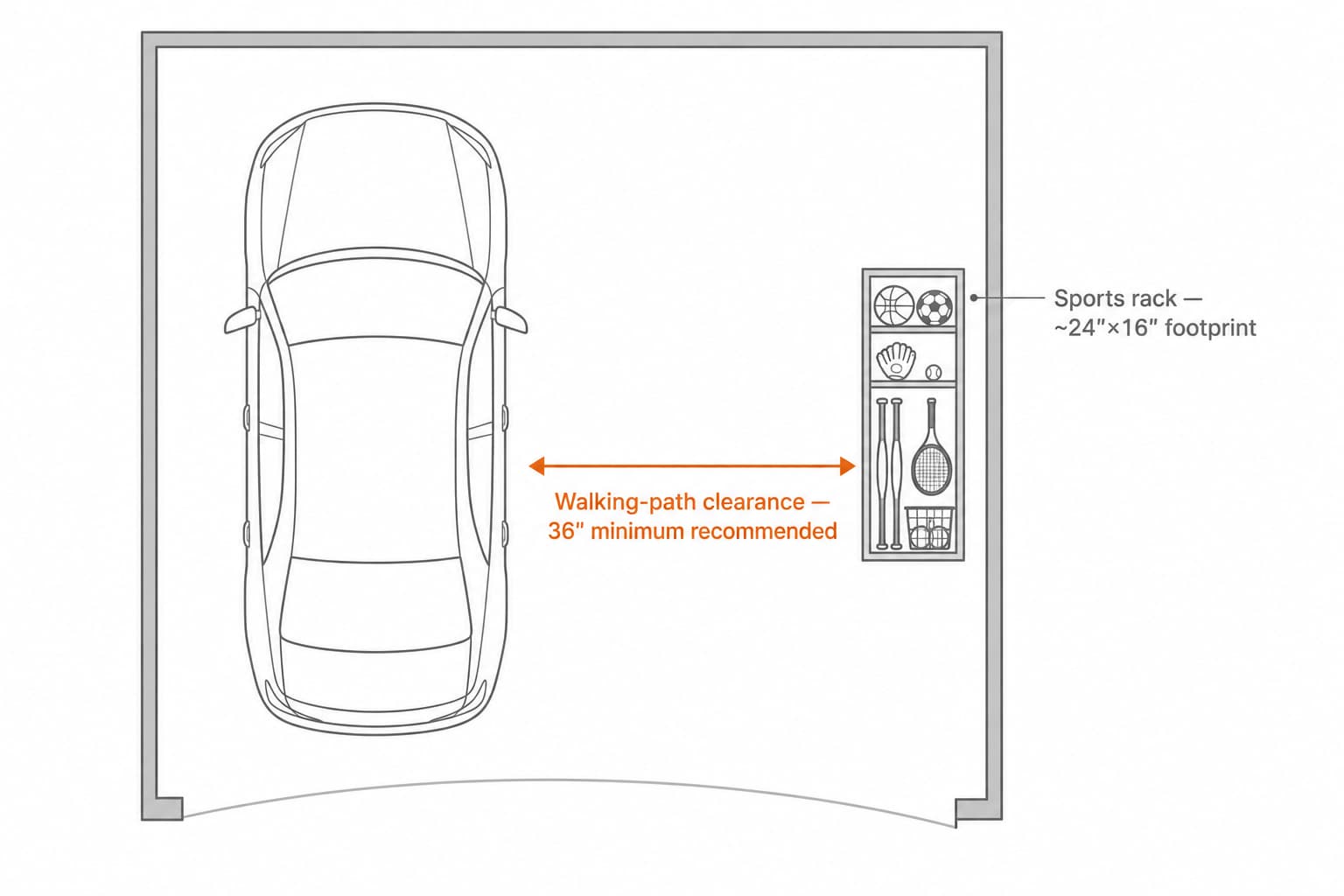
For users planning to keep gear visible (kids especially), the rack should sit where the family naturally walks past on entry — gear that’s out of sight stays out of mind, and gear-out-of-mind doesn’t get put back.
Common Complaints and Buyer Warnings
Buying multiple dedicated organizers when one covers all
This is the single most expensive mistake in this category. A family with mixed sports gear who buys a ball rack + a golf rack + a hockey locker + a helmet shelf ends up with 4 separate units consuming 4× the floor footprint of a single multi-sport rack — and the family ends up using whichever one is closest to the door, leaving the others empty. Plan first: if you have one dominant sport, buy the dedicated organizer; if no sport dominates, start with the multi-sport rack and add only as needed.
Indoor-only construction in outdoor exposure
Many sports organizers are sold as “indoor/outdoor use” but that means “covered exposure” — humidity, temperature variation, occasional rain spray. None of them mean “left in the rain”. For carports and uninsulated detached garages, the powder-coat finish handles humidity but expect 2–3-year visible wear on the finish from temperature swings. For wall-mounted alternatives that don’t sit on the floor, see our garage bike storage roundup which covers similar wall-mounted approaches.
Rolling carts on uneven garage floors
Garage floors slope toward the door (typically 1/8″ to 1/4″ per foot to drain water out). Rolling carts on lockable wheels can roll despite locks if the slope is significant — the lock prevents the wheel from spinning freely but doesn’t prevent the cart from creeping under load on a slope. For sloped floors, position the cart against a wall as a backstop, or choose free-standing non-rolling alternatives.
Who Should Avoid Standalone Sports Organizers
- Single-sport households. A house with just two basketballs and one bat doesn’t need an organizer — three wall hooks (garage hook recommendations) cover it.
- Garages with very limited floor space. 1-car garages where the floor doubles as a workshop are better served by the Proslat slatwall or other wall-mounted solutions.
- Buyers wanting a complete organizational system. If you’re rebuilding the entire garage’s storage approach, integrated slatwall saves more than five different dedicated racks.
FAQ
Should I buy one multi-sport rack or multiple dedicated ones?
Start with the multi-sport rack. Add a dedicated rack only when one specific sport’s gear collection exceeds what the multi-sport rack can hold. Most families with mixed sports interests are well-served by a single multi-sport rack for years; only families with a dominant sport (golf especially) benefit from a dedicated rack on day one.
Can I store sports gear on a slatwall instead of a dedicated rack?
Yes — the Proslat 33009 bundle is the article’s slatwall pick. Slatwall handles helmets/balls in baskets, sticks/bats on hooks, cleats and equipment bags on shelves. The trade-off: slatwall costs more up-front and requires wall installation; a dedicated free-standing rack is simpler to set up. Slatwall wins when you’re consolidating sports gear with broader garage storage; dedicated wins when sports is the only need.
Are rolling carts worth it for garage sports gear?
Worth it when the gear comes out frequently for use (driveway/yard sports), or when kids manage the gear themselves. Not worth it when the gear stays in the garage for long periods — fixed organizers are more stable and cheaper. Also: rolling carts on sloped garage floors need to lean against a wall as a backstop.
What’s the typical floor footprint of a multi-sport rack?
Most are 24″–32″ wide × 16″–20″ deep × 48″–60″ tall. The Mythinglogic golf rack is 24″L × 15.7″W × 48″H. Plan for the rack footprint plus 36″ walking-path clearance on at least one side — the rack can sit in a corner, but if both sides are walls, you can’t access the gear from the side.
Are the Mythinglogic locking wheels reliable on a sloped garage floor?
Reliable on flat floors, less so on sloped. Garage floors typically slope 1/8″ to 1/4″ per foot toward the door for drainage; a fully-loaded rolling cart on a sloped floor can creep over time despite locked wheels. For sloped floors, position the cart against a wall as a backstop or choose a non-rolling alternative.
Can sports organizers handle helmets and protective gear?
The multi-sport rack handles helmets in the wire mesh basket. The dedicated ball rack has 4 movable hooks for helmets and gloves. The hockey/baseball locker is sized specifically for protective gear plus sticks. The Proslat slatwall handles helmets in the wire baskets included.
Sources Reviewed
For this guide, we reviewed manufacturer product information from Mythinglogic and Proslat, retailer product pages on Amazon, install documentation where available, and recurring patterns in public buyer discussions about sports equipment storage in residential garages. We focused on details that change the install or use case: capacity counts (balls, bags, sticks, clubs), mobility (rolling vs. fixed), free-standing vs. wall-mounted footprint, indoor/outdoor exposure tolerance, and brand-concentration honesty (5 of 6 picks are Mythinglogic, the category-dominant brand).