Garage Wall Storage Load Capacity Database
How much weight can a garage wall storage system actually hold? Manufacturers rarely answer that in a way you can compare: pegboard is typically rated per panel, slatwall per square foot, rail per linear foot of channel. A “200 lb” panel and a “200 lb” square foot are not the same claim. This table converts every published rating below to one common unit — pounds per linear foot of a 4 ft high wall run — with the arithmetic shown, so you can check it. Rows were checked between 2026-08-14 and 2026-09-14.
How to Read This Table
Each row comes from one manufacturer’s own specification page, converted the same way every time.
- System — the specific product named on its own manufacturer page, not a category.
- Type — pegboard, slatwall, rail, or pegboard-system (a pre-sized track-and-panel kit).
- Rating as published — the manufacturer’s own figure, in its native unit: per panel, per square foot, or per linear foot of rail.
- Rating type — what kind of figure the published rating actually is: a distributed panel load (lb/sq ft), a panel recommendation (a “rule of thumb” figure the manufacturer itself frames as advisory, not a tested spec), a rail/channel rating (per linear foot of one channel), or a fixed system total for one pre-sized unit. The normalised column converts all four kinds onto one scale, but they are not the same kind of claim.
- Same rating, per linear foot of a 4 ft wall — every published rating converted to an area-normalised equivalent for a 4-ft-high reference wall — a comparison metric, not a tested installation capacity — so a pegboard panel and a slatwall panel land on the same scale.
- Working — the arithmetic behind the normalized figure, shown, not just asserted.
- Stud requirement — the mounting or stud-spacing constraint as published, or a note that the page doesn’t state one.
- Specification source — the exact manufacturer page the row is sourced to.
A blank cell usually means the manufacturer doesn’t publish that figure. One row is blank on purpose: Triton’s LocBoard system publishes a single fixed total for one pre-sized unit, not a rate, so it isn’t forced through a conversion the manufacturer never intended.
What garage wall systems actually hold, compared fairly
Pegboard is rated per panel, rails per linear foot, slatwall per square foot. Three different units means the published numbers cannot be compared as they stand — so nobody compares them, and a 200 lb figure on one product looks like a 200 lb figure on another. This table quotes each manufacturer’s rating and converts them all to pounds per linear foot of a 4 ft high wall run, with the arithmetic shown. Normalised values are comparison figures, not safe point-load limits. A system rated for 1,200 lb distributed across a wall section does not support a 1,200 lb hook.
| System | Type | Rating as published | Rating type | Same rating, per linear foot of a 4 ft wall | Working | Stud requirement | Specification source | Source checked |
|---|---|---|---|---|---|---|---|---|
| Wall Control metal pegboard (16 × 32 in panel) | pegboard | 200 lb per panel into studs (100 lb on drywall anchors) | panel recommendation | 225 lb per linear foot | 200 lb ÷ (16 in × 32 in panel = 3.56 sq ft) = 56.25 lb per sq ft; 56.25 × 4 ft high = 225 lb per linear foot (equivalently: a 4 ft × 4 ft section fits 3 panels across × 1.5 high = 4.5 panels × 200 lb = 900 lb ÷ 4 ft) | mounting holes on 16 in stud centres | Wall Control 16 × 32 in Metal Pegboard | 2026-09-14 |
| Gladiator GearTrack channel (rail) | rail | 75 lb per linear foot of channel | rail/channel rating | 150 lb per linear foot | 75 lb/ft per channel (published) × 2 channels (assumed common install) | mounts to bare wood studs or drywall over wood studs | Gladiator 4′ GearTrack Channels | 2026-09-14 |
| Gladiator GearWall slatwall panel | slatwall | 50 lb per square foot | distributed panel load | 200 lb per linear foot | 50 lb/sq ft × 4 ft high | not published on the product page | Gladiator 4′ GearWall Panels | 2026-09-14 |
| Proslat Classic PVC slatwall | slatwall | 75 lb per square foot | distributed panel load | 300 lb per linear foot | 75 lb/sq ft × 4 ft high | installs on 16 in stud centres | Proslat PVC Slatwall | 2026-09-14 |
| Proslat PROCORE aluminium-core slatwall | slatwall | 200 lb per square foot | distributed panel load | 800 lb per linear foot | 200 lb/sq ft × 4 ft high | engineered for 24 in stud centres, compatible down to 16 in | Proslat PROCORE PVC Slatwall | 2026-09-14 |
| NewAge Products PVC Slatwall (80 in × 12.3 in panel) | slatwall | 75 lb per square foot of evenly distributed weight when properly installed | distributed panel load | 300 lb per linear foot | 75 lb/sq ft × 4 ft high | installs to wood studs, drywall over wood studs, or masonry | NewAge Products PVC Slatwall | 2026-09-14 |
| storeWALL Standard Duty slatwall panel (8 ft panel, with SD InstallStrips) | slatwall | 250 lb per square foot at the panel surface with SD InstallStrips; 115 lb measured 4 in out from the surface (source states no per-area unit for this figure) | distributed panel load | 1000 lb per linear foot | 250 lb/sq ft × 4 ft high | not stated as a stud requirement on this page — mounts via InstallStrips | storeWALL Standard Duty Slatwall (8′ panel, InstallStrips) | 2026-09-14 |
| storeWALL Heavy Duty slatwall panel | slatwall | 300 lb per square foot | distributed panel load | 1200 lb per linear foot | 300 lb/sq ft × 4 ft high | not published on this page | storeWALL Heavy Duty Slatwall Panels | 2026-09-14 |
| Flow Wall panel (¾ in PVC) | slatwall | 100 lb per square foot | distributed panel load | 400 lb per linear foot | 100 lb/sq ft × 4 ft high | not stated in this source | Flow Wall FAQ | 2026-09-14 |
| Craftsman VersaTrack 4 ft rail (CMST82602VT) | rail | 75 lb per linear foot (300 lb total per 4 ft rail) | rail/channel rating | 150 lb per linear foot | 75 lb/ft per channel (published) × 2 channels (assumed common install) | installs to drywall, wall studs, or masonry | Craftsman VersaTrack 4-Foot Storage Rail | 2026-09-14 |
| Triton Products LocBoard single track-frame system (33 in W × 63 in H) | pegboard-system | 500 lb across the top track frame unit (fixed total for this pre-sized unit, not a published per-foot or per-square-foot rate) | fixed system total | Not converted to a per-linear-foot figure: Triton publishes this as one fixed total for the 33 × 63 in unit, not as a rate. Applying the 2-channel rail formula or the per-square-foot formula used elsewhere in this table would imply a rate the manufacturer did not publish. | not detailed on this page | Triton Products 33" L x 63" H Single LocBoard System | 2026-09-14 |
How these numbers were produced: Each published rating is quoted from the manufacturer’s own page on the date shown. Conversion to pounds per linear foot assumes a 4 ft high run of wall: a per-square-foot rating is multiplied by 4. A per-panel rating is first converted to an equivalent per-square-foot rate, using the panel’s own published width and height, then multiplied by 4 the same way — scaling a per-panel rating sideways only, at the panel’s own height, would normalise it to a taller or shorter slice of wall than the 4 ft reference every per-square-foot row uses, so the two steps (per-panel → per-sq-ft → per-4-ft-run) keep every row on the same footing. A per-foot-of-rail rating is different in kind: the manufacturer publishes a rate per channel, and this table doubles it to show a common two-channel install — that doubling is our own installation assumption, not a manufacturer-stated rate; the sourced figure is the single-channel rate. Where a manufacturer publishes a single fixed capacity for a whole pre-sized unit rather than a rate per foot or per square foot, that figure is quoted as published and left out of the per-linear-foot column rather than converted with an invented rate.
- These are manufacturer maximums for a correctly installed system, not a promise. Every one of them depends on hitting studs, using the specified fasteners, and spreading the load rather than hanging it all off one hook.
- The comparison assumes a 4 ft high run. A rail system does not gain capacity from wall height the way a panel does — it gains it from adding channels, which is why its normalised figure moves when you change the channel count, not the height.
- Stud spacing is a hard constraint, not a suggestion. Proslat’s PROCORE is the only system here with a published compatibility range — engineered for 24 in centres, rated compatible down to 16 in. Check whether your own system publishes a similar range before assuming it.
- Drywall anchors are not studs: Wall Control publishes 100 lb per panel on anchors against 200 lb into studs — a real number for that one product, not a ratio to assume for other systems here that don’t publish their own stud-vs-anchor split.
- Capacity drops the further a load sits from the wall: storeWALL publishes 250 lb per sq ft as a distributed rating at the panel surface, but only 115 lb as a point measurement 4 in out. That lever-arm principle is a reasonable general caution for hooks and brackets on any system, but storeWALL is the only brand here that publishes a number for it.
- A blank cell means the manufacturer does not publish that figure — we do not fill gaps with numbers we could not source.
- This list favors brands whose own specification pages state a capacity figure in a form we could verify directly. Some well-known brands are not yet in this table because their published pages did not state a load rating we could confirm on this pass — that is a sourcing gap, not a signal that the product is weaker.
Download the data (CSV) · last updated 2026-09-14 · version 1.4 · CC BY 4.0, attribution to GarageSpaceGuide.
How These Numbers Were Produced
Every figure in this table comes from a manufacturer’s own product or spec page, checked on the date shown in that row — no retailer listings, no forum numbers, no secondhand summaries. Sources checked so far: Wall Control, Gladiator GearWorks, Proslat (Classic and PROCORE lines), NewAge Products, storeWALL (Standard Duty and Heavy Duty), Flow Wall, Craftsman, and Triton Products.
The conversion to pounds per linear foot of a 4 ft wall run follows three rules, one per rating convention:
- A per-square-foot rating is multiplied by 4, the wall height — a unit conversion.
- A per-panel rating is converted using per-panel rating ÷ panel area in sq ft × 4 ft reference height: the panel’s own published width and height give its area in square feet, the rating is divided by that to get an equivalent per-square-foot rate, then multiplied by 4 ft — the same reference height every per-square-foot row uses. It’s the same two-step conversion shown in the Wall Control row’s Working column.
- A per-foot-of-rail rating is different in kind: the manufacturer publishes a rate per channel, and this table doubles it to show a common two-channel install. That doubling is our own installation assumption, not a manufacturer-stated rate — the sourced number is the single-channel figure.
Triton’s LocBoard track-frame system is the only row that skips this conversion, for the reason explained above.
Some well-known brands aren’t in this table yet: Rubbermaid FastTrack, Husky, WallPeg, Kobalt, and Elfa were checked, but their pages didn’t state a load figure that could be confirmed on this pass. That’s a sourcing gap, not a signal about the product. Manufacturers revise specs without notice, so treat every row as a point-in-time capture, not a permanent fact.
How to Use It — Three Decisions
Pegboard vs. slatwall for a 4 ft run of mixed hand tools
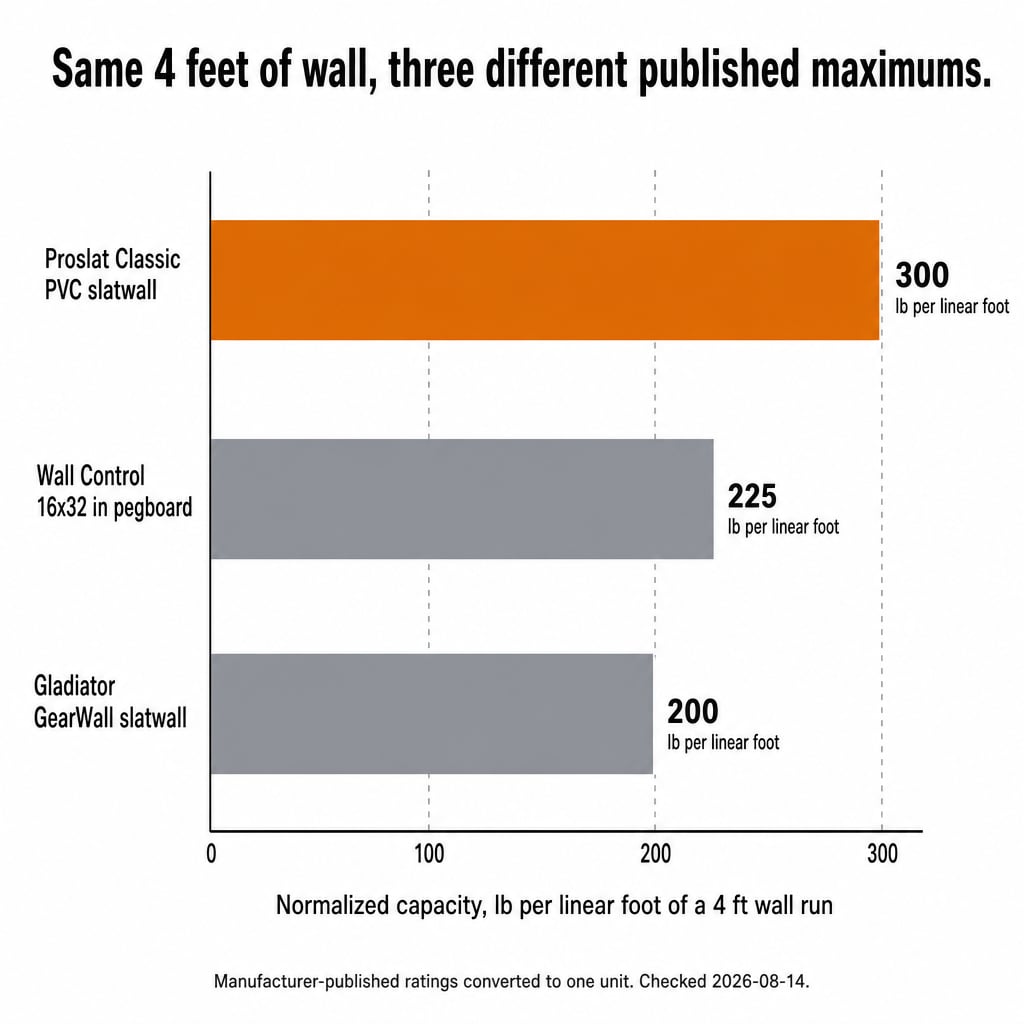
For a 4 ft run of wall holding mixed hand tools — the most common single-run install — three systems get compared constantly, and their raw published numbers don’t look ranked against each other: a 200 lb pegboard panel, a 75 lb per square foot slatwall, and another 75 lb per square foot slatwall from a different maker. Normalized to the same 4 ft run, the order becomes clear. Gladiator’s GearWall slatwall rates lowest at 200 lb per linear foot. Wall Control’s metal pegboard rates higher at 225 lb per linear foot into studs (200 lb per 16-in-wide panel, converted to a per-square-foot rate and scaled the same way as the slatwall rows); the same page publishes a separate per-panel figure for drywall anchors, covered in “Drywall anchors” below. Proslat’s Classic PVC slatwall rates highest at 300 lb per linear foot, also installed on 16 in stud centres. All three hold enough for ordinary hand tools; the gap matters more once the load includes anything heavy hung on a long reach.
Does a rail system need more wall than a slatwall for the same load?
Rail systems are rated differently again. Gladiator GearTrack and Craftsman VersaTrack both publish 75 lb per linear foot of channel — the manufacturer’s own rate for one channel. This table doubles that to 150 lb per linear foot to show a common two-channel install, which is our assumption about how the rail is mounted, not a second manufacturer figure. Even doubled, that’s lower than any slatwall panel here, including storeWALL’s Heavy Duty line, which normalizes to 1,200 lb per linear foot (manufacturer-published: 300 lb per square foot). Rail isn’t the weaker system — its capacity scales by adding channels to the run, the way a panel’s scales with wall height. For Gladiator and Craftsman specifically, a third channel would add roughly another 75 lb per linear foot, since both publish the same per-channel rate; a rail system that publishes a different per-channel figure would scale at its own rate, not this one.
What changes on drywall anchors instead of studs?
The biggest swing in this table isn’t between brands — it’s between studs and drywall anchors on the same product. Wall Control’s own page states 200 lb per panel into studs against 100 lb on drywall anchors: half the capacity, same panel — a Wall Control-specific number, not evidence that every system here loses half its rating on anchors. storeWALL shows a related but different effect: its Standard Duty slatwall holds a published 250 lb per square foot as a distributed rating across the panel surface, but only 115 lb measured 4 in out — a point figure for a load held away from the wall, not a second per-square-foot rate. Capacity dropping as a hook’s lever arm grows is a real, general mechanical effect, but the two numbers above are specific to Wall Control and storeWALL; no other system in this table publishes its own stud-vs-anchor split or distance-adjusted figure to confirm by how much.
What This Table Does Not Tell You
Manufacturer-listed capacity assumes correct assembly, level flooring, suitable mounting hardware where required, and proper weight distribution. Real-world performance can vary. Always follow the manufacturer’s installation instructions.
Stud spacing is a hard constraint, not a suggestion: Proslat’s PROCORE panel, the one system here that states a stud-spacing compatibility range, is engineered for 24 in centres and rated compatible down to 16 in — check whether your own system publishes the same before assuming it. Capacity also drops the further a load sits off the wall surface: storeWALL is the only system here that publishes a distance-adjusted figure (250 lb per sq ft at the panel surface vs. 115 lb measured 4 in out), and that pattern is a reasonable caution for hooks and brackets generally, not a number to apply to any other system in this table. No live testing was performed here; every figure is a manufacturer claim, sourced and dated, not independently verified. This table currently lists 11 systems and will grow as more manufacturers publish figures we can verify.
FAQ
How much weight can garage wall storage systems actually hold?
There’s no single answer. Capacity depends on the system type, whether the panel is anchored into studs, and how far the load sits off the wall surface. Use the table above to compare published maximums on one common unit, then check the row for the specific product you’re considering.
Is slatwall stronger than pegboard?
Not inherently — it depends on the product, not the category. Most slatwall panels in this table outrate Wall Control’s pegboard (225 lb per linear foot, into studs) once normalized — from Proslat’s Classic PVC at 300 lb per linear foot up to Proslat’s PROCORE aluminium-core slatwall at 800 lb per linear foot — but not all: Gladiator’s GearWall normalizes to 200 lb per linear foot, below the pegboard. That’s true for the specific products checked here, not a category rule — a lighter-duty slatwall elsewhere could rate below a heavier-duty pegboard, and here one already does.
Do I need to hit studs to mount garage wall storage?
Not always. Mounting requirements are product-specific: some systems require studs for their full published rating; others publish separate ratings or approved installations for drywall anchors or masonry (Wall Control lists 100 lb per panel on anchors against 200 lb into studs). Check the row for your system before assuming its full rating applies to your wall.
Why do manufacturers rate the same kind of product so differently — per panel, per square foot, per linear foot?
There’s no industry-standard unit for wall-storage load ratings. Pegboard tends to be rated per panel, slatwall per square foot, rail per linear foot of channel — three conventions that can’t be compared as published. That’s the reason this table exists: it converts all of them to one unit.
How often is this table updated?
Each row carries its own checked date, ranging from 2026-08-14 to 2026-09-14 as of this page’s last update. Manufacturers revise specs without notice, so treat any row as a point-in-time capture and check the source link before relying on it for a load-bearing decision.
Guides That Use This Data
- Best Wall-Mounted Garage Storage Systems — a ranked guide across track, slatwall, pegboard, and hook-kit systems.
- Best Garage Slatwall Systems — if the per-square-foot rows above point you toward slatwall.
- Best Garage Pegboards — if the per-panel rows fit your load better.
- Best Metal Pegboards for Garage Tools — for heavier per-panel loads than standard pegboard.
- Best Garage Tool Organizers — broader tool-organization systems beyond wall panels.
Sources
- Wall Control 16 × 32 in Metal Pegboard — Wall Control
- Gladiator 4′ GearTrack Channels — Gladiator GearWorks
- Gladiator 4′ GearWall Panels — Gladiator GearWorks
- Proslat PVC Slatwall — Proslat
- Proslat PROCORE PVC Slatwall — Proslat
- NewAge Products PVC Slatwall — NewAge Products
- storeWALL Standard Duty Slatwall — storeWALL
- storeWALL Heavy Duty Slatwall Panels — storeWALL
- Flow Wall FAQ — Flow Wall
- Craftsman VersaTrack 4-Foot Storage Rail — Craftsman
- Triton Products 33″ L x 63″ H Single LocBoard System — Triton Products