Best Storage Racks for Kids’ Sports Gear in the Garage
Last updated:
Disclosure: This article contains affiliate links. If you buy through these links, we may earn a commission at no extra cost to you. We do not claim hands-on testing unless clearly stated.
Kids’ sports gear is the hardest garage-storage problem there is. Inventory changes every season, items have wildly different shapes — round balls, long bats, awkward helmets, gritty cleats — and the kid who has to put it all away isn’t an adult-sized human. A six-year-old’s reach isn’t a twelve-year-old’s reach, and a rack an adult finds convenient can be the reason a child leaves gear on the floor.
This roundup covers six storage racks across the three form factors that matter for residential garages: rolling carts, wall-mounted racks, and free-standing organizers. Each pick is matched to a specific household profile, and the article walks through how to pick the right form factor before any product comparison. If your collection is ball-heavy, our dedicated ball-storage roundup goes further on that category.
This guide does not cover team-volume gear, general garage shelving, or bike storage. Those each have their own guide.
Quick Picks
| Pick | Product | Best for | Type | Main advantage | Watch out for | CTA |
|---|---|---|---|---|---|---|
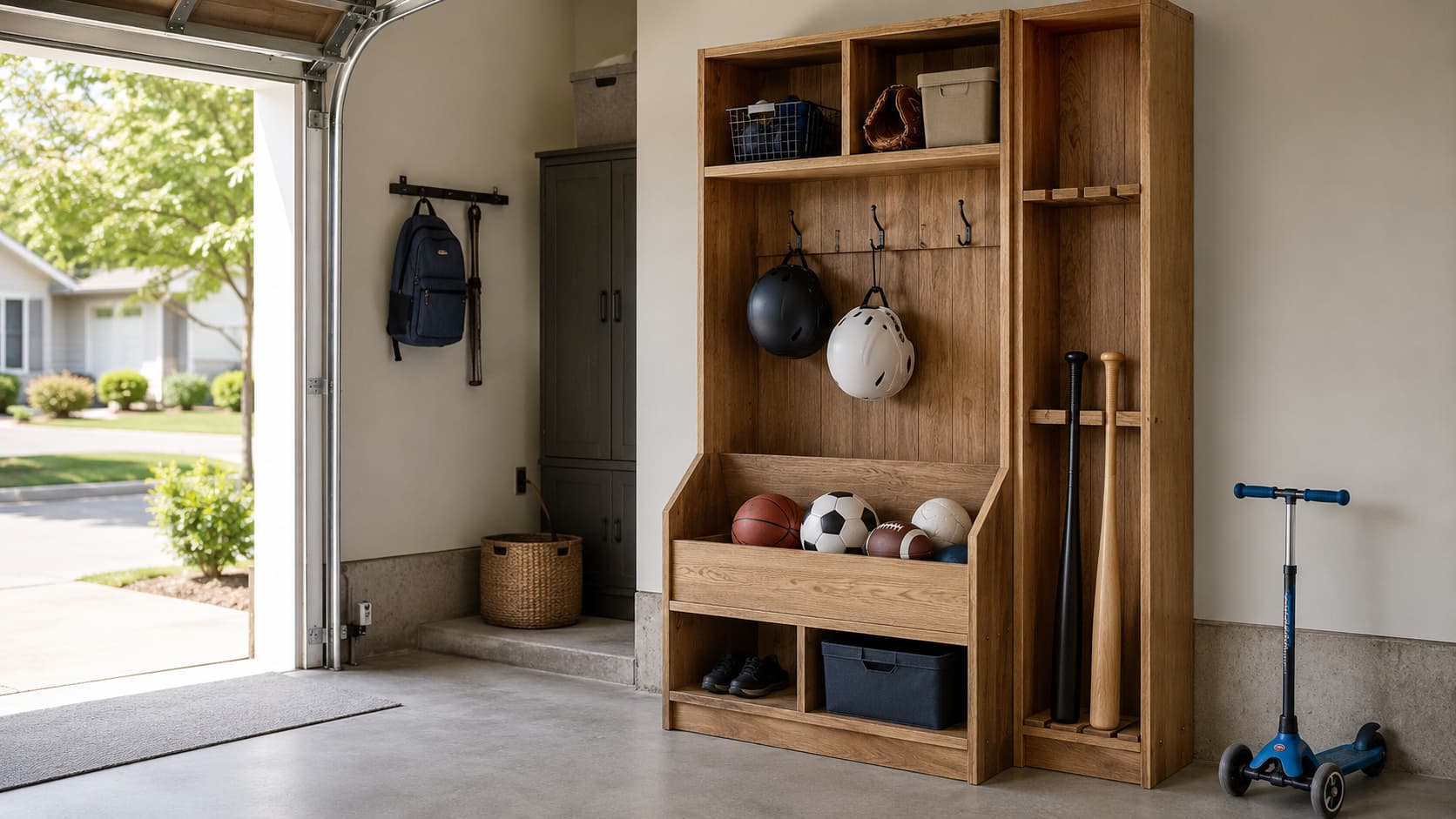
| Best Overall Kids Gear Rack | GoSports Premium Wooden Sports Equipment Organizer | Households who want a fixed station | Free-standing wooden multi-section | Looks like furniture, not industrial steel | Heavy; doesn’t roll | View on Amazon |
| Best for Multiple Sports | Kinghouse Rolling Sports Equipment Organizer | Families with 3+ active sports per kid | Rolling cart, multi-basket | Highest basket count of the rolling group | Top shelf high for younger kids | View on Amazon |
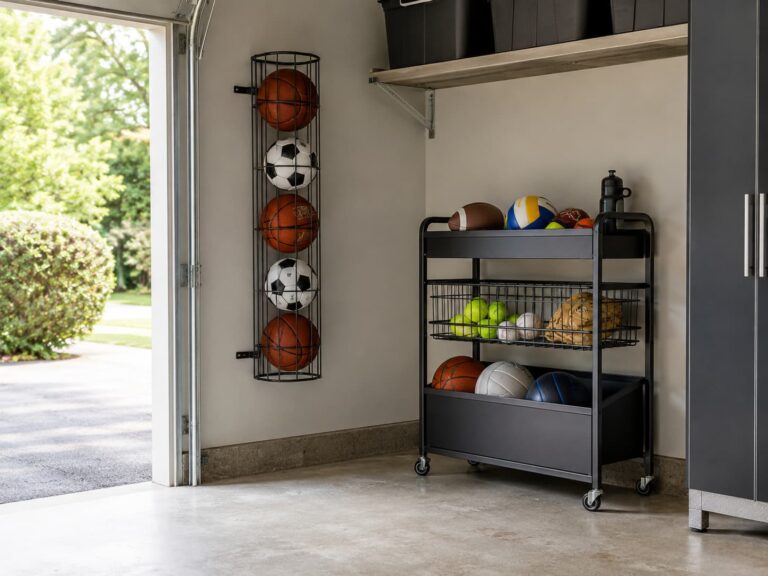
| Best Ball Storage | Compact elastic-strap vertical ball stand | Single-kid or two-kid households, ball-heavy gear | Compact vertical stand | Kid grabs balls without unstacking | Generic listing; verify configuration | View on Amazon |
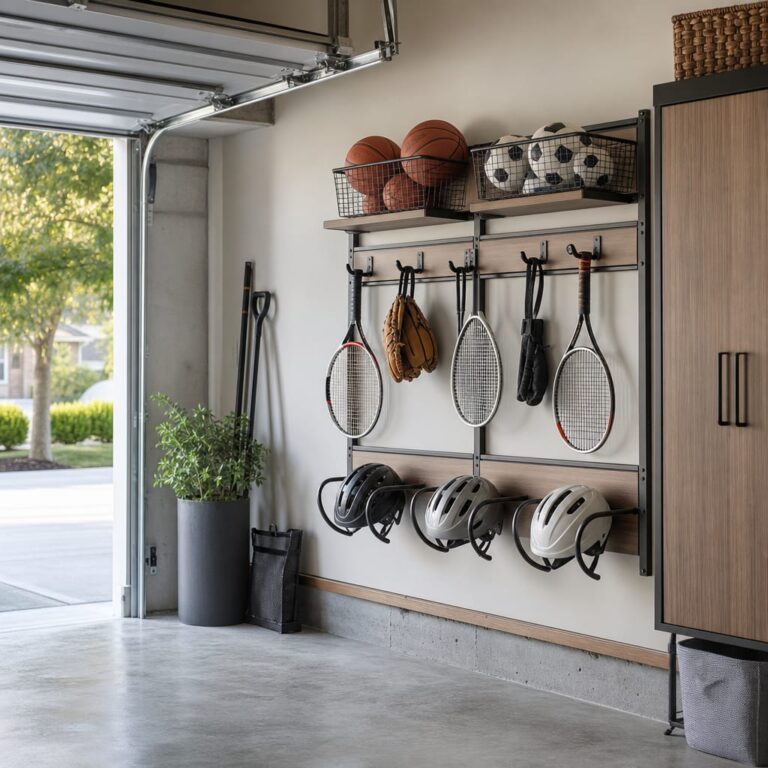
| Best for Helmets/Bats | LYNK Garage Sports Equipment Organizer (Wall Mount) | Households with multiple helmets and bats | Wall-mounted adjustable rack | Zero floor footprint; adjustable hooks | Requires drilling into studs | View on Amazon |
| Best Rolling Cart | VIVOHOME Garage Sports Equipment Organizer | Households who want gear mobile | Steel rolling cart | Narrower footprint than Kinghouse | Only 2 baskets | View on Amazon |
| Best Free-Standing for No-Drill | Insdiy Large Sports Organizer | Renters or no-drill households | Free-standing steel multi-zone (no wheels) | Integrated golf-bag bay; multi-purpose | Larger footprint; no mobility | View on Amazon |
How We Selected These Racks
We do not claim hands-on testing unless clearly stated. For this guide, we reviewed manufacturer specifications, retailer product pages, product documentation where available, product listings, and recurring patterns in public customer feedback.
Because kids’ sports gear is dominated by access ergonomics — whether the child can reach the gear and put it back without an adult — we prioritized products with clear manufacturer-listed dimensions, a defined form factor (rolling vs wall-mount vs free-standing), and adjustable or multi-zone storage so a household can adapt the rack as gear changes through the season.
Selection criteria:
- Multi-sport storage, not single-sport. A bat-only rack or ball-only stand is a separate category, covered in the ball-storage roundup.
- Form-factor diversity. We chose at least one rolling, one wall-mount, and one free-standing pick.
- Manufacturer-listed dimensions present on the product page (not vague “large enough for any garage”).
- Distinct from our broader multi-sport rack roundup and our ball-storage roundup so a parent reading across three guides gets meaningfully different options each time.
- Buyer-reachable price tier — no commercial dugout systems sized for 15-kid teams.
What to Look for Before Buying a Kids’ Sports Organizer
Match the form factor to the floor space
A rolling cart needs floor space to roll plus a parking spot. A wall-mount needs wall space and a drillable wall. A free-standing rack needs a corner deep enough that it doesn’t get clipped by a car door. Decide which form factor the garage accommodates before comparing features.
Match the height to the child
The rack’s storage zones — top hooks, middle baskets, bottom bins — define which child can self-serve. If the kid can’t reach the zone where their helmet lives, the helmet ends up on the floor. Measure the child’s reach height (fingertips with arm overhead) and pick a rack whose primary storage zones sit below that line.
Drilling vs no-drilling
Wall-mounts assume drywall plus studs in a configuration that lets you anchor through to wood. Older garages with concrete or cinder-block walls require masonry anchors, a different project. Renters typically can’t drill at all. If any of those apply, skip the wall-mount picks.
Basket count vs ball capacity
Two design philosophies: ball-capacity racks (lots of vertical or open shelving) versus basket-count racks (many small compartments for varied items). Ball-heavy collections want capacity; varied collections want baskets.
Materials and durability
Steel dominates this category. Wood appears in a few products and looks softer but is heavier and harder to relocate. Hybrid (steel frame with mesh or polymer baskets) is most common. Look for powder-coated finishes if the garage gets damp.
Best Overall Kids Gear Rack: GoSports Premium Wooden Sports Equipment Organizer
Best for: Households who want a fixed gear station that doesn’t look industrial — something kids treat as “their corner”.

Short verdict: A wooden multi-section organizer with manufacturer-listed dimensions of 44″ L × 20″ W × 47″ H. The wood body is what distinguishes it from every other product on this list.
The unit packs a main bin, three open shelves, a ball bin, a bat rack, and eight hooks into one piece. Each kid gets a defined zone — one shelf for helmets, one for cleats — rather than everything jumbled into a shared cart.
Why it stands out
The wooden body is genuinely different from the rest of the category. Most kids’-sports racks look like commercial steel storage that wandered into a residential garage; this reads more as functional furniture. That matters when the garage is visible from inside the house, or used as partial play space.
Three shelves plus a ball bin plus a bat rack plus eight hooks gives a parent enough sub-zones to assign each child their own area, which increases the odds of gear getting put back.
It can work well for:
- Two- or three-kid households with mixed sports
- Garages used as visible-from-the-house spaces
- Parents who want a fixed station rather than a moving cart
- Households whose gear inventory has stabilized
Key specs to check
- Manufacturer-listed dimensions: 44″ L × 20″ W × 47″ H
- Wood material — verify whether panels are solid wood, plywood, or particleboard
- Hook spacing against your specific helmets and bags
- Bat rack capacity — count slots against actual bats
- Assembled weight — heavier than steel competitors; relocation needs two adults
Recurring feedback patterns
Recurring positive feedback often centers on appearance — buyers consistently note the wooden look reads more like furniture than a typical garage rack. Common complaints typically involve assembly time (longer than steel competitors, benefits from a second person) and mentions of wobble if the surface isn’t level.
Potential drawbacks
The unit is heavy, has no wheels, and doesn’t fold flat — once positioned, it stays. The bat rack accommodates a fixed number of bats, a constraint for households whose bat collection grows. Some shelf spacings aren’t adjustable, so an oversized helmet may not fit the slot you wanted.
Buyer warning
Don’t buy this if you wanted “cart on wheels” — relocating after assembly is awkward. If gear travels regularly, the rolling picks below fit better. Confirm your garage corner is at least 24″ deep clear of car-door swing — at 20″ deep the rack plus buffer adds up to about 24″ of needed depth.
Best for Multiple Sports: Kinghouse Rolling Sports Equipment Organizer
Best for: Families where each kid plays three or more sports per year, and the gear inventory is varied (helmets, cleats, small balls, bats, water bottles, gloves) rather than concentrated.

Short verdict: A rolling cart whose calling card is basket count — two bins, four wire mesh baskets, a bat/racket basket, an open ball shelf, and bag/cap hooks — at a manufacturer-listed 46.5″ tall. When the problem is “many small items with no home”, basket count beats overall capacity.
This goes deeper on compartmentalization than the other rolling carts in our shortlist. Most stop at two bins plus two baskets; this adds two extra baskets plus a dedicated bat slot and several hooks.
Why it stands out
Basket count is the underrated spec for multi-sport households. When a kid plays soccer in fall, basketball in winter, and baseball in spring, the gear isn’t dominated by any single category — it’s a long tail of small items, each needing a defined home. Four baskets plus two bins lets a parent dedicate one to each season’s small items.
The rolling design lets the rack travel with the gear — load in the garage, push to the driveway.
It can work well for:
- Households where each kid plays three or more sports per year
- Garages with smooth concrete floors that allow easy rolling
- Parents who want one rack for all kids
- Households whose gear inventory shifts seasonally
Key specs to check
- Manufacturer-listed height: 46.5″
- Wheel lock mechanism — confirm whether all four wheels lock
- Basket and hook count (listing states two bins, four mesh baskets, one bat/racket basket, plus hooks)
- Assembly tools and approximate time
- Wheel size — small wheels struggle on rough concrete
Recurring feedback patterns
Recurring positive feedback often centers on basket count and the dedicated bat slot — buyers consistently mention that having a place for everything reduces gear-on-floor problems. Common complaints typically involve assembly difficulty (the listing says easy, but several buyers mention 30+ minutes), wheels that struggle on cracked driveway concrete, and the top shelf being out of reach for younger kids.
Potential drawbacks
At 46.5″ tall, the top open shelf is above most elementary-school kids’ reach without a stool. Wheels are functional but small. The unit is steel and can rust at the base if left on damp concrete — a piece of cardboard or a rubber mat underneath helps.
Buyer warning
If your kids are younger than seven or eight, plan for the top shelf to be parent-accessible only. Either assign that shelf to seasonal items or put a stool nearby. Forcing a kid to reach the top shelf without help defeats the point of an organizer.
Best Ball Storage: Compact Elastic-Strap Vertical Ball Stand
Best for: Single-kid or two-kid households whose gear is mostly balls — basketballs, footballs, soccer balls, volleyballs — with limited floor space.
Short verdict: A compact vertical ball stand that holds four to five large balls in an elastic-strap column, plus three side hooks for accessories. The elastic mechanism is the differentiator: a kid can pull a ball out of the middle of the stack without unstacking the others.
This is the lightest, smallest, most kid-ergonomic option in the roundup. Where a multi-tier rack forces a child to lift a top ball off to get a bottom ball, the elastic design lets the kid grab from any position.
Why it stands out
The ergonomics matter more than they sound. A six-year-old who has to lift a basketball off a stack to reach the soccer ball below will eventually stop putting balls back. The elastic column eliminates that step — the kid pulls a ball from the side, and the elastic re-tightens around the rest.
The compact footprint is the second feature worth flagging. Many garages have a corner that’s dead space because larger racks don’t fit. A small vertical stand often does, letting a household add ball storage without giving up real floor area.
It can work well for:
- Single-kid or two-kid households with mostly balls
- Garages with a viable corner under 12″ × 12″ of footprint
- Younger kids (5–9) who self-serve their gear
- Households who already have helmets and bats stored elsewhere
Key specs to check
- The listing states the column accommodates four to five large balls
- Verify maximum ball diameter the elastic accommodates (basketballs are larger than soccer balls)
- Stand stability when fully loaded — verify the listing photos show a wide base
- Side hook capacity — three hooks limits accessories
- Rust-resistant finish if the garage is damp
Recurring feedback patterns
Recurring positive feedback often centers on the kid-friendliness of the elastic mechanism — buyers mention their younger children put balls away without prompting once they figured out the column. Common complaints typically involve stability concerns when fully loaded, and several buyers mention the unit works better against a wall than free-standing in open space.
Potential drawbacks
Capacity is limited — four to five large balls plus three small accessory hooks isn’t enough for multiple kids in multiple sports. The unbranded nature means listing details can be sparse. The elastic itself is a wear part and may loosen over time, particularly in temperature-cycling garages.
Buyer warning
Verify the listing’s current photos show the same product configuration described in the title before ordering. Generic ball-storage listings flip configurations and sellers periodically. Also assume four large balls until verified otherwise.
Best for Helmets/Bats: LYNK Garage Sports Equipment Organizer (Wall Mount)
Best for: Households with multiple helmets (bike, baseball, hockey), several bats or sticks, and a wall they can drill into.

Short verdict: A wall-mounted ball-and-utility rack measuring a manufacturer-listed 39.5″ W × 9-3/8″ D × 28″ H, with adjustable hooks that let parents reconfigure the layout as the household’s gear changes season to season.
The LYNK is the form-factor winner when floor space is the constraint and the wall is available. Because it mounts at a height the parent chooses, it removes the “kid can’t reach” problem that affects taller free-standing racks. Adjustable hooks let the same rack work for a baseball-heavy summer and a hockey-heavy winter.
Why it stands out
Adjustable hooks are the underrated feature. Most racks bake the hook layout in at manufacturing time, so the rack works for whatever sports the designer envisioned and is awkward for everything else. The LYNK lets a parent move the hooks to fit the actual gear — a wider span for hockey sticks, a tighter span for short baseball bats, repositioning when a kid moves up to a longer stick.
The wall mount also gives back floor space, the limiting factor in most single-car or crowded two-car garages.
It can work well for:
- Single-car or crowded two-car garages
- Households where bikes or scooters live on the floor
- Multi-helmet households (one helmet per sport per kid adds up)
- Parents comfortable with basic drilling into studs
Key specs to check
- Manufacturer-listed dimensions: 39.5″ W × 9-3/8″ D × 28″ H
- Hardware type included (most installations assume drywall plus wood studs)
- Hook adjustment increments and hook count
- Manufacturer-listed load capacity per hook (tens of pounds, not hundreds)
- Stud spacing required (most US garages use 16″ centers)
Recurring feedback patterns
Recurring positive feedback often centers on the long product lifespan — buyers mention this listing has been around for years and the design hasn’t degraded. Adjustable hooks earn frequent praise versus competitors with fixed layouts. Common complaints typically involve installation challenges in non-standard wall types (concrete, cinder block), and mentions of hardware being lighter-duty than expected for heavy bat sets.
Potential drawbacks
The 28″ rack height plus installation height can put the top hooks above younger kids’ reach — though that’s adjustable in installation, not a fixed flaw. Included hardware suits drywall-and-stud installations only; concrete or block wall buyers must source their own anchors.
Buyer warning
Renters and households without drill access should skip this pick entirely and go to the free-standing alternative below — there’s no installation workaround. Confirm your wall has studs at standard 16″ centers before assuming the included hardware will work.
Best Rolling Cart: VIVOHOME Garage Sports Equipment Organizer
Best for: Households who want their gear mobile around the property (garage to driveway to backyard) and have a relatively simple gear inventory dominated by balls plus a couple of small-item bins.

Short verdict: A steel rolling cart at a manufacturer-listed 36″ L × 16.3″ W × 48.2″ H with two storage bins, two wire mesh baskets, and two movable S-hooks. Narrower than the Kinghouse, easier for a child to push around the garage.
This hits the rolling-cart sweet spot for households whose gear isn’t varied enough to need eight separate baskets. Two bins for bulk balls, two baskets for accessories, two hooks for jerseys or bags — clean and simple.
Why it stands out
The narrower footprint matters. A multi-basket cart that’s 20″+ deep can be awkward in a typical residential garage, where the aisle between the parked car and the back wall is often only 30-36″ of clear space. At 16.3″ deep, this cart pushes through that aisle without scraping, and a child can maneuver it without help.
Assembly time is also a real factor. The listing claims under 20 minutes for assembly, which is fast for this category. Twenty minutes versus 40 is the difference between “I’ll do it tonight” and “I’ll get to it next weekend”.
It can work well for:
- Two-kid households with simpler gear inventories
- Garages with narrow aisles between cars and walls
- Parents who want a quick assembly experience
- Households whose gear primarily moves between garage and driveway
Key specs to check
- Manufacturer-listed dimensions: 36″ L × 16.3″ W × 48.2″ H
- Wheel lock mechanism — confirm whether all four wheels lock
- Bin and basket dimensions versus your largest ball (a basketball is approximately 9.5″ in diameter)
- Hook adjustment range — only two S-hooks, both movable along their rails
- Assembly time and tool requirements
Recurring feedback patterns
Recurring positive feedback often centers on assembly speed and the narrower footprint — buyers consistently mention it fits in places the larger Kinghouse-class rolling carts don’t. Common complaints typically involve the two-basket limit (households with varied gear find it insufficient) and small wheels struggling on rough concrete.
Potential drawbacks
Only two baskets is the main limit. Households with many small-item categories (mouth guards, gloves, water bottles, small balls, knee pads) will mix categories in the same basket, defeating some of the organizational benefit. The 48.2″ height puts the upper hook range out of reach for younger kids.
Buyer warning
Don’t buy this expecting Kinghouse-class basket diversity — the design philosophy is “narrower and simpler”. If your household needs many small compartments, the Kinghouse pick is the better choice. Also confirm wheel size against your driveway condition.
Best Free-Standing for No-Drill Households: Insdiy Large Sports Organizer for Garage
Best for: Renters or no-drill households — and especially multi-sport families where one parent also plays golf, since the integrated golf-bag bay doubles the rack’s coverage.

Short verdict: A purely free-standing (no wheels) heavy-duty steel organizer with a dedicated golf-bag compartment that holds two bags, plus side racks for clubs, bats, and paddles, two-tier baskets, a large bottom bin for balls, and mesh shelves for dumbbells, shoes, and bags.
This is the no-install, fixed-corner cousin of the wall-mount the household can’t put up. It commits more floor space than a basic tower — but covers more zones than any other free-standing pick on this list.
Why it stands out
The golf-bag bay is the unusual feature. Most kids’-sports racks ignore the parent’s gear; Insdiy accommodates both — two golf bags in the dedicated compartment, plus separate areas for kids’ bats, balls, helmets, and shoes. Households where golf coexists with youth soccer or baseball often run two separate setups; this collapses them into one.
It can work well for:
- Renters or apartment-garage households with mixed-age sports inventories
- Households with at least one golfer alongside multi-sport kids
- Garages where the rack will park in a fixed corner and stay there
- Two-kid households whose gear mixes balls and equipment-heavy sports
Key specs to check
- Manufacturer-listed footprint — verify the corner fits the golf-bay plus side racks
- Golf-bag compartment dimensions vs your actual bags (carry vs cart bags differ)
- Two-tier basket interior vs your largest ball or helmet
- Side-rack length vs your longest bat or paddle
- Steel coating finish if the garage is damp
Recurring feedback patterns
Recurring positive feedback often centers on the multi-zone separation — buyers consistently mention having a defined home for each gear category (golf bay, side racks, baskets, bottom bin). Dual-use across kids’ and adult gear earns frequent praise from families who previously ran two racks. Common complaints typically involve assembly time and a footprint larger than a slim free-standing tower.
Potential drawbacks
The footprint is the main constraint — the golf-bag area adds depth that a basic tower doesn’t have, so small garages may not have a usable corner. With no wheels, the unit commits to a fixed location and is a two-person job to relocate after assembly. The golf-bag compartment is wasted space for households where nobody golfs.
Buyer warning
Confirm your corner fits the full footprint (golf bay + side racks) plus car-door swing clearance before ordering. If no one in the household plays golf, the compartment is dead space — a leaner free-standing tower without the golf bay is a better fit. And if gear needs to travel between garage, driveway, and backyard, the VIVOHOME above is the better pick — Insdiy doesn’t move once built.
Side-by-Side Comparison
| Product | Form factor | Best for | Approximate footprint | Standout feature | Drawback |
|---|---|---|---|---|---|
| GoSports Wooden Organizer | Free-standing | Fixed gear station | 44″ × 20″ | Wood look, multi-zone | Heavy, no wheels |
| Kinghouse Rolling Organizer | Rolling | Multi-sport households | 36.1″ × 16.5″ | Most baskets in roundup | Top shelf high for younger kids |
| Compact Elastic Ball Stand | Free-standing | Ball-heavy single-kid | small (~12″ × 12″) | Kid-ergonomic ball pull | Generic listing variability |
| LYNK Wall Mount | Wall-mount | Helmets, bats, no floor space | wall only | Adjustable hooks | Requires drilling |
| VIVOHOME Rolling Organizer | Rolling | Mobile gear, narrow aisles | 36″ × 16.3″ | Narrower than Kinghouse | Only 2 baskets |
| Insdiy Large Sports Organizer | Free-standing (no wheels) | Renters, no-drill, golf-and-kids combo | Multi-zone tower with golf bay | Integrated golf-bag compartment | Larger footprint; no mobility |
Wall-Mount vs Rolling vs Free-Standing — Choosing the Right Form Factor
Three form factors, three decision drivers. The right choice depends on your floor space, your wall situation, and whether your gear inventory needs to travel.
Rolling carts win when gear moves regularly — garage to driveway, garage to backyard, garage to van for an away game. They lose when the floor is already crowded or when the cart parks permanently anyway (in which case a free-standing rack is cheaper).
Wall-mounts win when floor space is the constraint and the wall is drillable. They give the parent control over installation height — the only way to perfectly match the rack to a specific kid’s reach. They lose when the household rents, when the wall is concrete or cinder block without proper anchors, or when the gear collection changes faster than the parent wants to re-drill.
Free-standing wins when neither of the above is right — wall-drilling is off the table but rolling isn’t needed. It’s the “middle path” choice and a common pick for renters. The trade-off is committing floor space without the mobility benefit of wheels.
If bikes are also competing for the same wall space, our overhead bike storage roundup covers the case where bikes go to the ceiling so wall-mount sports racks have room at child height.
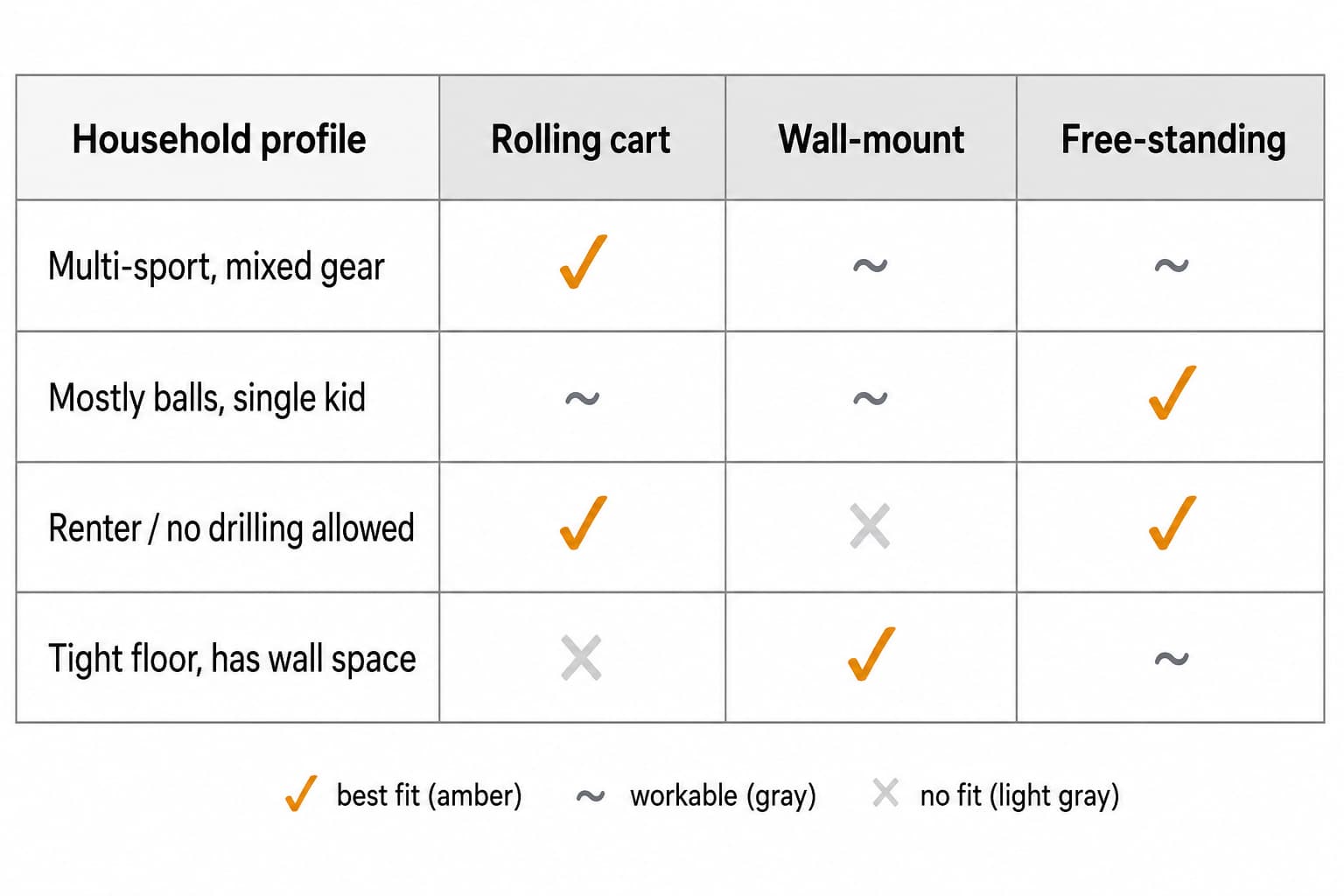
The matrix above scans household profile against form factor. A renter household reading the “Renter / no drilling allowed” row sees rolling and free-standing as strong fits while wall-mount is off the table. Tight floor with available wall space → wall-mount wins. Multi-sport household with mixed gear → rolling.
Two alternatives worth mentioning briefly: WALMANN sells a wall-mounted utility rack that also accommodates bikes and skis, useful when gear extends beyond traditional sports. WALMANN also offers a rolling cart with a similar feature set to the VIVOHOME — worth a look if the VIVOHOME is unavailable.
Ball diameters that decide rack fit
Sports governing bodies publish ball circumference, but the number that decides whether a ball fits a rack slot, a bungee opening or a bin is its diameter — and nobody publishes that. This table quotes each official circumference specification and derives the diameter from it, so you can measure an opening and know what will actually go into it.
| Ball | Official circumference | Diameter (derived) | Min. clear opening | Official weight | Specification source | Source checked |
|---|---|---|---|---|---|---|
| Basketball, size 7 (men’s / adult) | 29½–30 in | 9.4–9.5 in | 9.75 in | — (not stated in the cited source) | NCAA men’s basketball rules | 2026-08-14 |
| Soccer ball, size 5 (adult) | 68–70 cm (27–28 in) | 8.5–8.8 in | 9 in | 410–450 g (14–16 oz) at the start of the match | IFAB Laws of the Game, Law 2 | 2026-08-14 |
| American football, official size | 21–21¼ in around the middle; 28–28½ in end to end | 6.7–6.8 in | 7 in | 14–15 oz | Official Playing Rules of the NFL, Rule 2 | 2026-08-14 |
How these numbers were produced: Diameter is derived from the governing body’s published circumference range as d = C / π, then rounded to 0.1 in. Minimum clear opening is the derived maximum diameter rounded up to the next 1/4 in — arithmetic only, not a manufacturer specification, and it assumes a rigid opening with no stretch. Circumference figures in inches are converted from the metric spec where the governing body publishes metric (1 in = 2.54 cm); where the body publishes both, its own figures are quoted.
- Sizes 6, 5, 4 and 3 balls are manufacturer conventions for youth play, not rules-body specifications, and vary between brands — measure the ball you actually own rather than assuming a nominal size.
- An American football is a prolate spheroid, so it has no single diameter: the girth figure is what a slot must clear, the long axis is what the slot depth must accommodate.
- Elastic-cord and bungee racks stretch, so a ball larger than the resting opening can still be held; the figures above are the rigid-opening case.
- A blank weight means the cited rulebook does not state one — we do not fill gaps with figures we could not source.
These are the entries that matter for this guide. The full table, with every row and its source, is in our ball storage rack guide.
How to Measure Your Garage and Gear Before Buying
Most rack-buying mistakes are measurement mistakes. The rack itself is fine; it just doesn’t fit the garage, the kid, or the gear. Four measurements catch most of these errors.
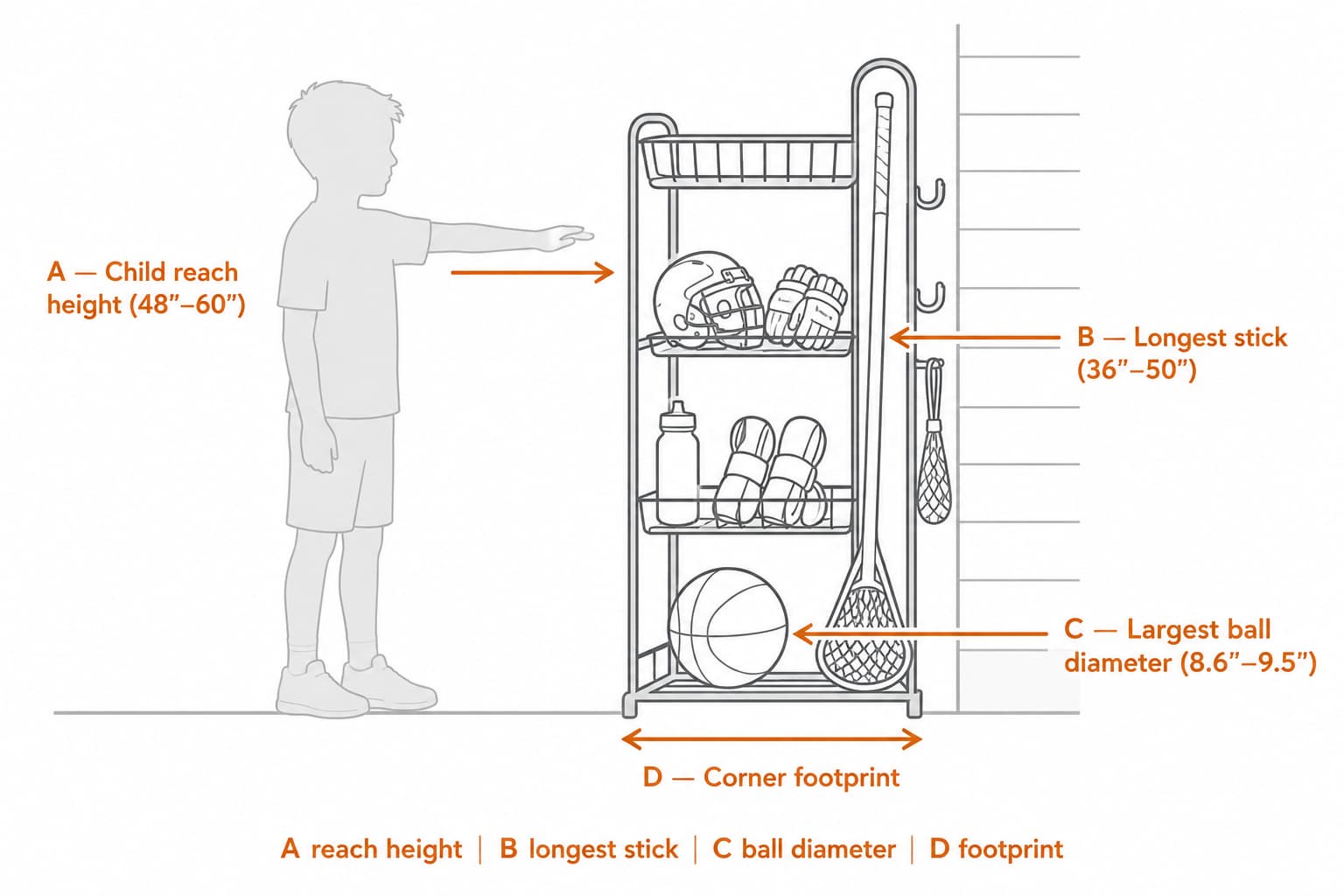
The measurement checklist:
- Measure the corner or wall where the rack will live. Free-standing and rolling need corner depth plus a buffer for car-door swing — typically 24″ minimum. Wall-mounts need wall length (the LYNK is 39.5″ wide) plus install access.
- Measure your largest ball. Basketballs are typically about 9.5″ in diameter; soccer balls about 8.6″. The rack’s bin or elastic must accommodate the largest, not the average.
- Measure your longest stick. Hockey and lacrosse sticks typically run 36-50″. Most kids’-sports racks accommodate up to about 36″; full-size sticks may need a different solution.
- Measure the kid — specifically their reach height. Stand them next to a wall, have them stretch overhead, and mark the wall. That’s the line above which they cannot self-serve.
- Note where bikes, scooters, and recycling bins already live. A rack that blocks the recycling bin is a daily annoyance.
- If wall-mounting, confirm wall type. Drywall plus wood studs is straightforward; concrete or cinder block needs masonry anchors not typically included.
Common Complaints and Buyer Warnings
Recurring patterns in public buyer feedback across this category:
- Generic listings ship with different basket configurations than pictured. One of our six picks (the elastic ball stand) is an unbranded listing where seller and configuration can change. Confirm current photos before ordering.
- Wheels on rolling carts struggle on rough concrete. Driveway expansion gaps and cracked garage floors challenge small-wheel carts. If your driveway is rough, look for larger wheel options or stick with free-standing.
- “Easy assembly” varies wildly. Some 20-minute claims hold up; others stretch past 45 minutes and need two adults. Plan a buffer.
- Wall-mount drilling sometimes goes through to the wrong layer. Drywall-only mounting (no stud anchor) is the most common installation mistake.
- Wood units are heavier than expected. The GoSports unit, in particular, is genuinely difficult to relocate alone after assembly.
The single most important warning: kids will not put gear back if the rack is too tall for them. Measure the child’s reach height first, then pick the rack. Overhead reach varies a lot between kids the same age, so don’t rely on an age-based number — measure your own child and pick a rack whose primary storage zones sit below that line. A rack that solves the parent’s organizational problem but doesn’t solve the child’s access problem ends up unused.
For households with adult-volume gear or team-coordinator situations, our broader multi-sport rack roundup covers larger commercial-style options.
Who Should Avoid This Type of Storage?
- Single-sport households. If your kid plays only baseball, a dedicated bat-and-helmet rack is more efficient than a multi-section organizer.
- Team coordinators or club-volume gear holders. Fifteen kids’ worth of equipment exceeds residential rack capacity. Look at commercial dugout or team storage solutions.
- Households dominated by very long sticks. If hockey or lacrosse is the primary sport and most sticks are 50″+, most kids’-sports racks won’t accommodate them. A dedicated tall-stick rack or wall-mount with extended hooks is a better fit. Our team-volume or adult-volume gear coverage in the broader multi-sport roundup goes deeper on these cases.
- Football or lacrosse helmet-heavy households. Those helmets sit noticeably wider and bulkier than the bike and motorcycle helmets these hook-based racks are generally sized for. None of the picks above are built around the bulkier profile — look for a shelf-style helmet rack instead of a hook-based one.
- Garages with no level floor surface. All free-standing and rolling racks assume reasonably level concrete. If the slab is significantly cracked or sloped, the rack will lean, baskets will slide, and stability suffers.
FAQ
At what age can a kid put their own sports gear away on these racks?
It depends on the rack height and the child’s reach, not the child’s age. Reach varies significantly between individual kids of the same age, so an age-based number isn’t a reliable stand-in for measuring — use the reach-height check in the measurement checklist above. Rolling carts at 46-48″ tall let elementary-school kids self-serve the lower zones; wall-mounts at 28-39″ off the floor are usually too high unless installed deliberately low. Measure the child first.
Should I get a rolling cart or a wall-mount for kids’ sports gear?
Rolling for households where gear travels (driveway, backyard, away games). Wall-mount when floor space is the binding constraint and the wall is drillable. If both apply — gear travels and floor space is tight — pick the rolling cart, because a wall-mount the kid never accesses for backyard games defeats the purpose.
How do I keep helmets from rolling around inside a bin?
Use a multi-tier rack with a dedicated hook or shelf for helmets, not a bin. Helmets shaped like baseball or hockey helmets do not stack well in bins — they tip, roll, and damage their straps. The LYNK wall-mount and the GoSports free-standing both have helmet-specific zones.
Can I use one rack for multiple kids’ gear?
Yes, but assign each kid a defined zone (a basket or shelf that’s “theirs”). Without assigned zones, gear gets mixed and arguments about whose cleats are whose follow. Multi-zone racks like the GoSports and Kinghouse work well for this; single-zone racks (the elastic ball stand) don’t.
What’s the difference between a “kids” rack and an adult sports rack?
Structurally, very little — most racks are sold as multi-purpose. The differences are height, weight, and access ergonomics. Pick by the child’s reach height and the gear they actually own, not by marketing labels.
Are these racks weatherproof for outside-the-garage use?
Most are not. Steel powder-coated finishes resist garage humidity but not direct rain. Wood units warp in outdoor conditions. The garage is the right place; outdoor patio storage requires a different category of weatherproof products.
How much weight can these typically hold?
Manufacturer-listed capacity varies by rack tier. Most residential-grade kids’ sports racks rate per-shelf capacity in tens of pounds (20-50 lb typical), not hundreds. The Safety note above applies: real-world capacity depends on assembly, leveling, and weight distribution, and the manufacturer’s installation instructions are the authoritative source.
How do I store wet or muddy gear without it growing mold?
Favor mesh or open-basket zones over enclosed bins for anything that comes home wet — cleats, shin guards, jerseys. Airflow matters more than concealment: gear sealed in a closed bin while still damp can start growing mildew well before it would in an open, ventilated space, while the same gear in a mesh basket dries out overnight. Several picks above include at least one mesh basket for this reason; reserve the enclosed bins for dry gear only.
Sources Reviewed
For this guide, we reviewed manufacturer product information, retailer specifications, Amazon product listings, public customer feedback patterns, and kids’-sports-equipment community discussions. We focused on product details that matter for residential garage storage of multi-sport kids’ gear, including dimensions, basket and bin counts, mounting style, manufacturer-listed capacity, material, and accessibility for child-height users.
Related Guides
- Best Multi-Sport Equipment Racks for the Garage — broader multi-sport coverage, including adult and team-volume gear
- Best Ball Storage Racks for the Garage — dedicated roundup focused on ball-only storage, with multi-tier and wall-mount ball racks
- Best Overhead Bike Storage Racks — get bikes off the wall and floor so sports racks have room
- Best Garage Shelves for Storage Bins — general garage shelving for the non-sports items that share the space
- How to Choose Bike Storage
- How to Organize a Garage Workbench
- How to Organize Sports Equipment in Your Garage
- How to Store Bikes in Your Garage
- best garage sports equipment organizer