Pegboard vs Slatwall for Garage Organization
Last updated:
Disclosure: This article contains affiliate links. If you buy through these links, we may earn a commission at no extra cost to you. We do not claim hands-on testing unless clearly stated.
The question is rarely “is one of these better?” It’s “which one matches the wall I have, the tools I’ll hang on it, and the time I want to spend installing it.” Pegboard wins on speed and cost; slatwall wins on per-hook capacity and finish quality. The honest decision turns on five real variables — wall material, the heaviest item you’ll hang, how often you’ll rearrange, your budget, and whether you might need to remove it cleanly. This guide covers head-to-head capacity, install effort, cost, and reconfigurability. It does not cover rail systems like Gladiator GearTrack or Rubbermaid FastTrack — that’s a third category, handled in our framework for choosing the right garage wall storage system.
Quick Answer
For mostly hand tools and frequent layout changes, pegboard is usually the better choice — it’s cheap, fast to mount, and pegs pop in and out in seconds. For heavy power tools, yard equipment, and once-and-done buildouts, slatwall is usually better because per-hook locking ratings of 50–75 lb are achievable on PVC slatwall but uncommon on pegboard. The decision often comes down to the heaviest single thing you’ll hang and how permanent the install needs to be.
Best Choice by Situation
| Situation | Better choice | Why |
|---|---|---|
| Mostly hand tools under 5 lb | Pegboard | Cheap, fast, easy to rearrange |
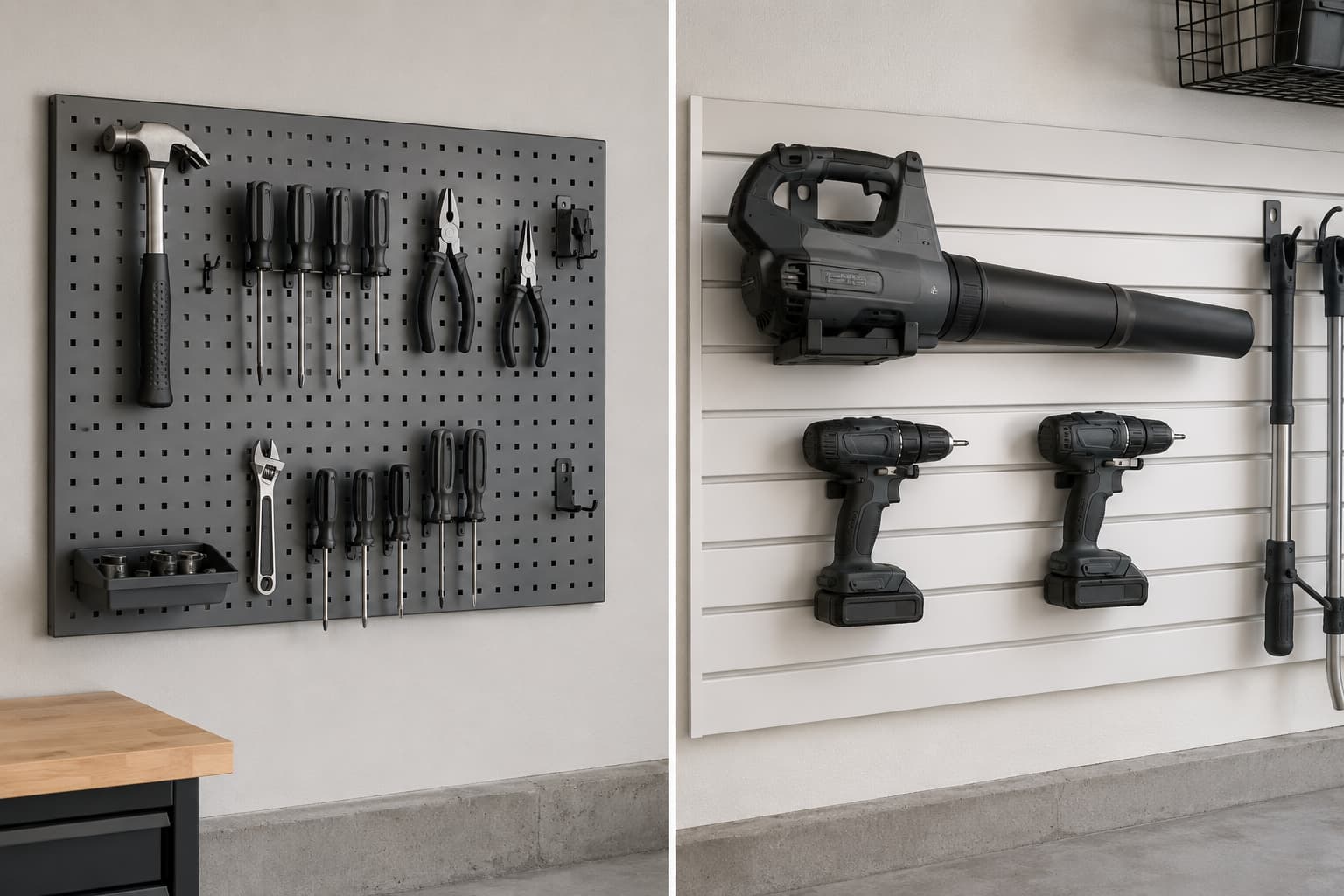
| Power tools 10–30 lb | Either — metal pegboard with slotted hooks closes most of the gap | Slotted hook lock-in matters more than panel material at this weight |
| Heavy yard gear (leaf blower, hedge trimmer, ladders) | Slatwall | Per-hook locking ratings of 50–75 lb |
| Renting and want to remove cleanly later | Pegboard | Smaller mounting footprint, easier patching |
| Whole-wall buildout with mixed inventory | Slatwall | Modular, scales across studs, finishes the wall |
Pegboard — Pros, Cons, Best Use Cases
What it is
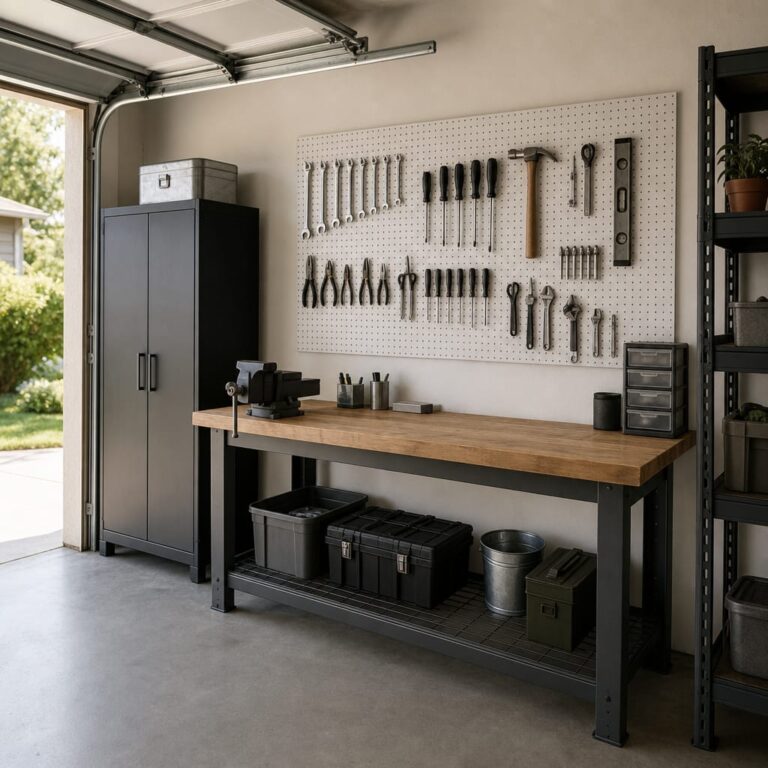
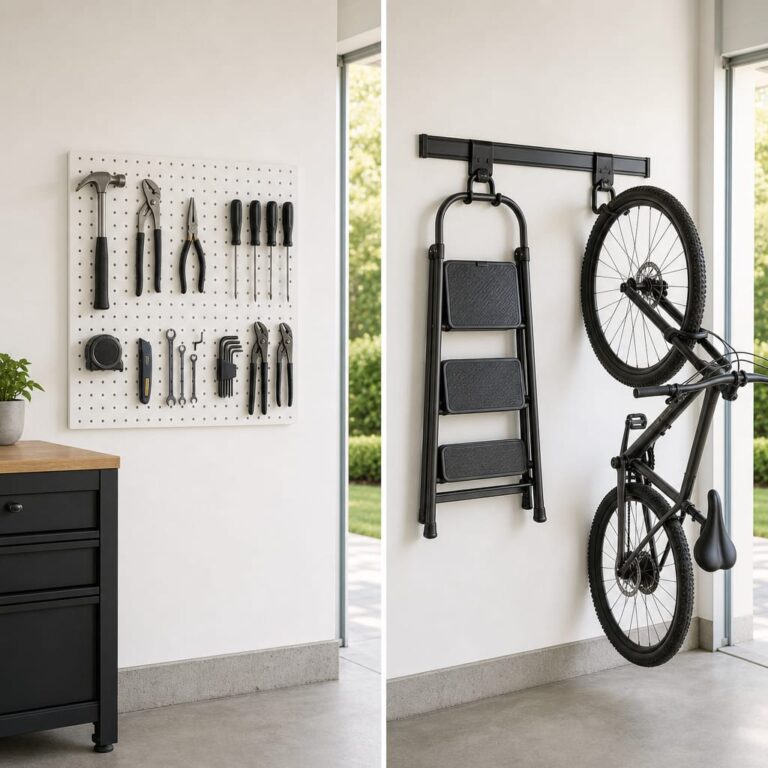
Pegboard is a flat panel with a regular grid of holes, into which you insert hooks, brackets, or shelves. Three formats matter for a garage: pressed hardboard (the cheap classic, prone to humidity sag), perforated steel (heavier-duty), and proprietary HDPE or steel systems like Wall Control that use slotted hooks instead of straight pegs. Per-hook capacity ranges from roughly 5 lb on hardboard with a straight peg to 50 lb on a metal panel with a slotted lock-in hook.
Where it works best
- Hand-tool walls where the layout changes monthly
- Limited-budget wall sections under 4 ft wide
- Renters who’ll patch and repaint when they move
- Workbench backsplashes — the standard 32″ × 16″ panel format fits behind most benches
- Hobby tables and kids’ garage zones
If you’re choosing between specific products, our roundup of the best garage pegboards covers the kits worth considering.
Where it falls short
- Heavy yard equipment — most pressed-hardboard pegboards bend or crack under sustained 25–30 lb loads
- High-vibration tools — straight pegs pop out when a tool is bumped repeatedly
- Long-handled tools — the panel is shorter than a leaf blower or extension trimmer needs
- Whole-wall scale — 32 × 16 panels don’t tile cleanly across a 16-ft wall
The fix for the weight problem is usually metal pegboards built for tool weight, which trade hardboard for galvanized steel and add slotted hook compatibility.
What manufacturers and retailers typically specify
Look for: panel material (steel beats hardboard for any garage with humidity), hook lock-in style (slotted or curved beats straight pegs for vibration resistance), board thickness, and whether mounting hardware and spacers are included. Some kits ship without spacers, and the panel won’t sit flat against the wall.
Buyer warnings specific to pegboard
- Drywall anchors only cuts capacity by half or more. Manufacturer load ratings assume the panel is screwed into wall studs.
- Wrong hook shape kills the hold. A J-hook fits curved tool handles; a straight peg fits looped handles. Order the hook style your specific tools need.
- “1200 lb total panel capacity” is not a per-hook number. That’s the panel’s theoretical max if every hook is loaded equally — not how anyone actually uses pegboard. Per-hook rating (5–50 lb depending on hook style) is what matters.
- Hardboard absorbs humidity in unconditioned garages. A pressed-hardboard pegboard in an uninsulated garage can sag visibly within a season or two. Steel pegboard or HDPE doesn’t.
Slatwall — Pros, Cons, Best Use Cases
What it is
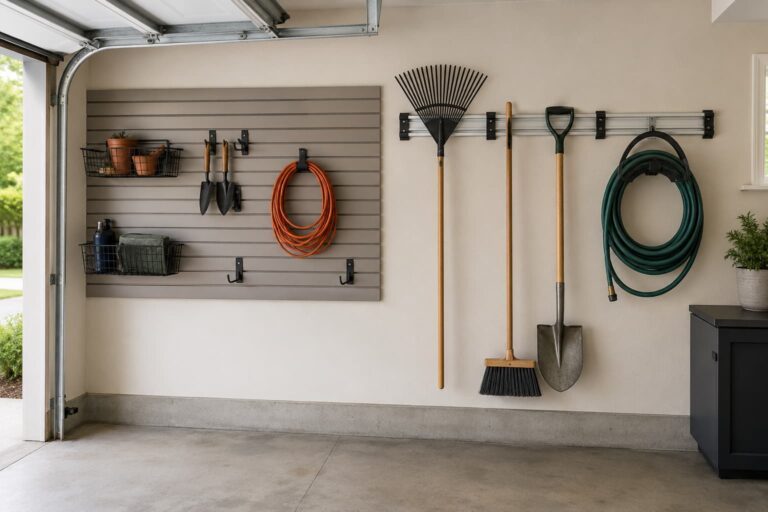
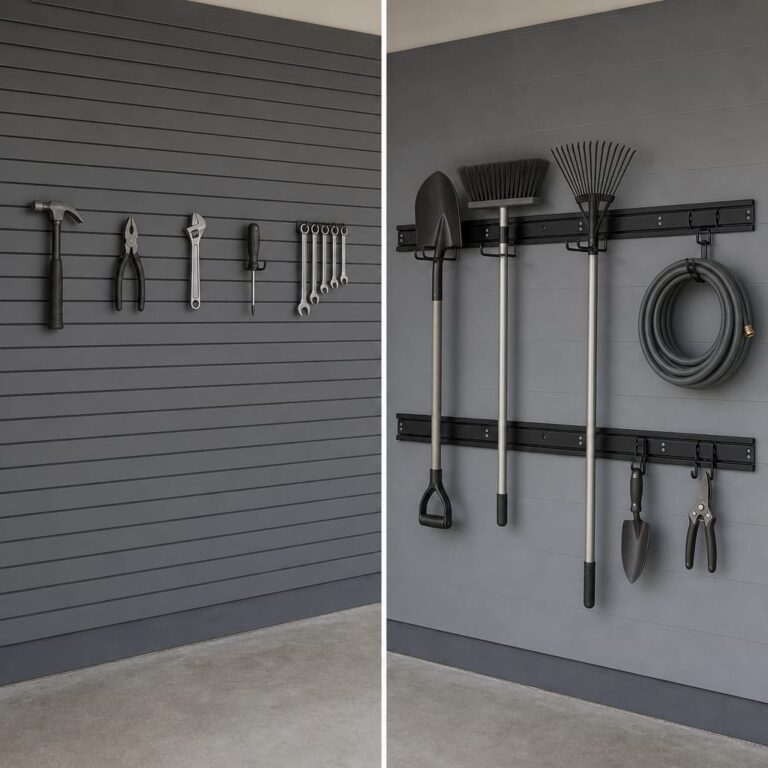
Slatwall is a panel with horizontal grooves running across it. Hooks, baskets, and shelves snap into the groove, often with a locking cam that prevents them from sliding under load. Common materials are PVC (moisture-tolerant, the default for residential garages), MDF with a laminate face (cheaper but absorbs humidity), and aluminum (heaviest-duty, commercial). Per-hook capacity is typically 50–75 lb on locking hooks. Manufacturer-listed panel capacity is usually expressed per square foot or per linear foot — Proslat lists 75 lb per square foot, CrownWall lists 150 lb per linear foot when properly installed.
Where it works best
- Power tool collections — drills, drivers, sanders, oscillating tools
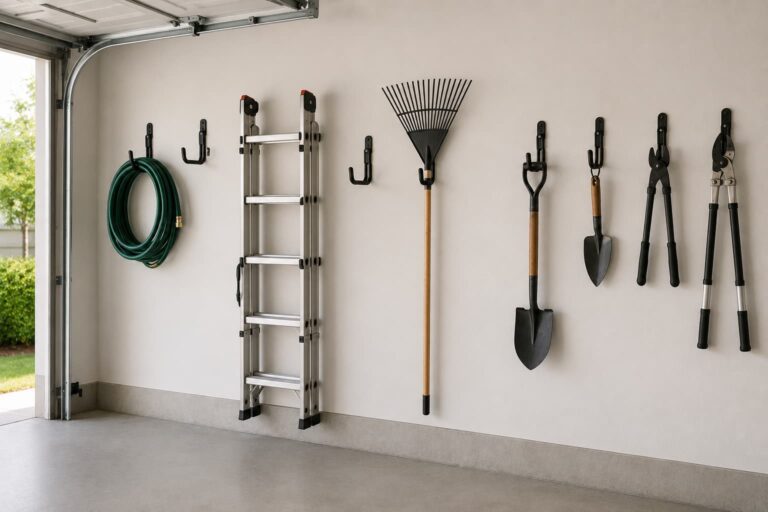
- Yard equipment — leaf blowers, weed trimmers, extension cord reels
- Bike and sport gear hung directly from locking hooks
- Whole-wall buildouts where finish quality matters
- Garages that double as workspaces
If you’re comparing finished-system options, our roundup of garage slatwall systems breaks down the panel kits worth considering.
Where it falls short
- Tight budgets — per-linear-foot cost is typically two to four times pegboard
- Frequent layout changes — locking hooks slide along the slat, slower than popping pegs
- Renters — the hidden-screw install pattern is more visible to patch
- Very small wall sections — most kits are sold in 8 ft × 4 ft sections, more than a tight workbench needs
What manufacturers and retailers typically specify
Look for: load rating with units (per linear foot vs per square foot — same number, very different meanings), panel material (PVC handles moisture, MDF doesn’t), included trim and screw count, and slat pitch (3-inch standard fits most accessory ecosystems; 6-inch wide affects hook spacing). Cross-check the rating against the brand’s manufacturer page — Amazon listings sometimes drop the “when properly installed” qualifier.
Buyer warnings specific to slatwall
- “150 lb per linear foot” assumes anchored studs. That’s a best-case figure assuming the panel is screwed into wall studs at the recommended interval. Drywall-only mounts won’t deliver it.
- Trim pieces sold separately on some kits. A first install with no trim looks unfinished, and the unfinished edges flex more.
- Hook compatibility isn’t universal across brands. Standard 3-inch pitch hooks usually swap between Proslat and CrownWall, but locking hooks have brand-specific cam mechanisms.
- MDF slatwall in a humid garage will swell. Spec PVC for any garage that isn’t climate-controlled. For broader wall storage options including rail systems, see our overview of wall-mounted garage storage systems.
Side-by-Side Comparison
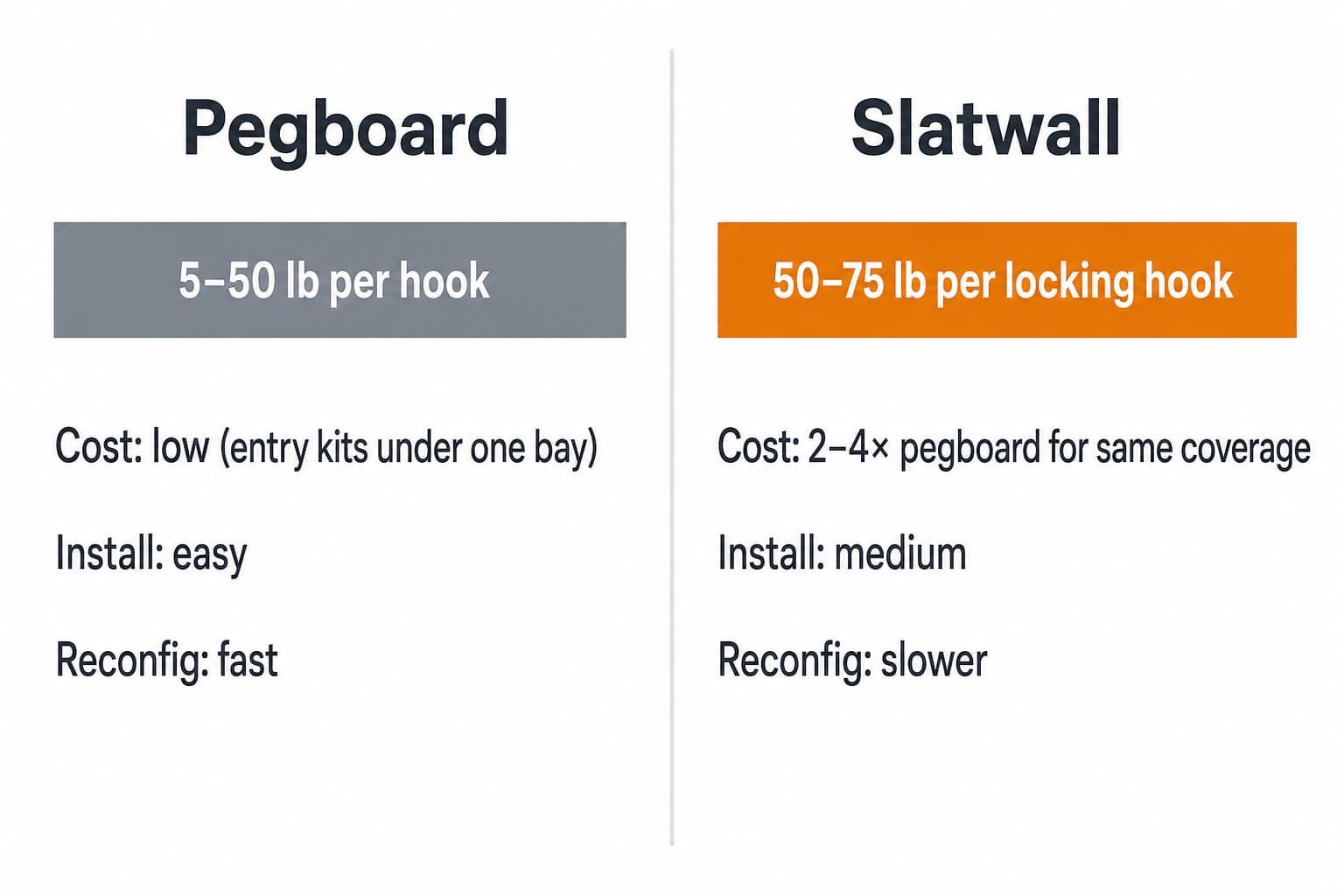
The shortest summary fits in one table — but the units matter, so read across rows carefully.
| Dimension | Pegboard | Slatwall |
|---|---|---|
| Manufacturer-listed weight capacity | 5–25 lb per hook on pressed hardboard; up to 50 lb on metal panels with slotted hooks | 50–75 lb per locking hook; 75 lb per square foot (Proslat) or 150 lb per linear foot when properly installed (CrownWall) |
| Cost per linear foot of wall | Low — entry kits cover 4 ft at the lowest budget tier | Two to four times pegboard for the same coverage |
| Install difficulty | Low — hang panel, screw into studs, insert hooks | Medium — level the first panel, tongue-and-groove the rest, install trim |
| Reconfiguration speed | Fast — pegs pop in and out in seconds | Slower — locking hooks slide along the slat |
| Rentable / removable | Yes — patches like a few small holes | Less so — extensive screw pattern, more visible repair |
| Best for | Hand tools, frequent reorganization, budget walls | Power tools, yard gear, permanent buildouts |
How to Decide for Your Garage
Three questions, in order, get most readers to a clear pick.
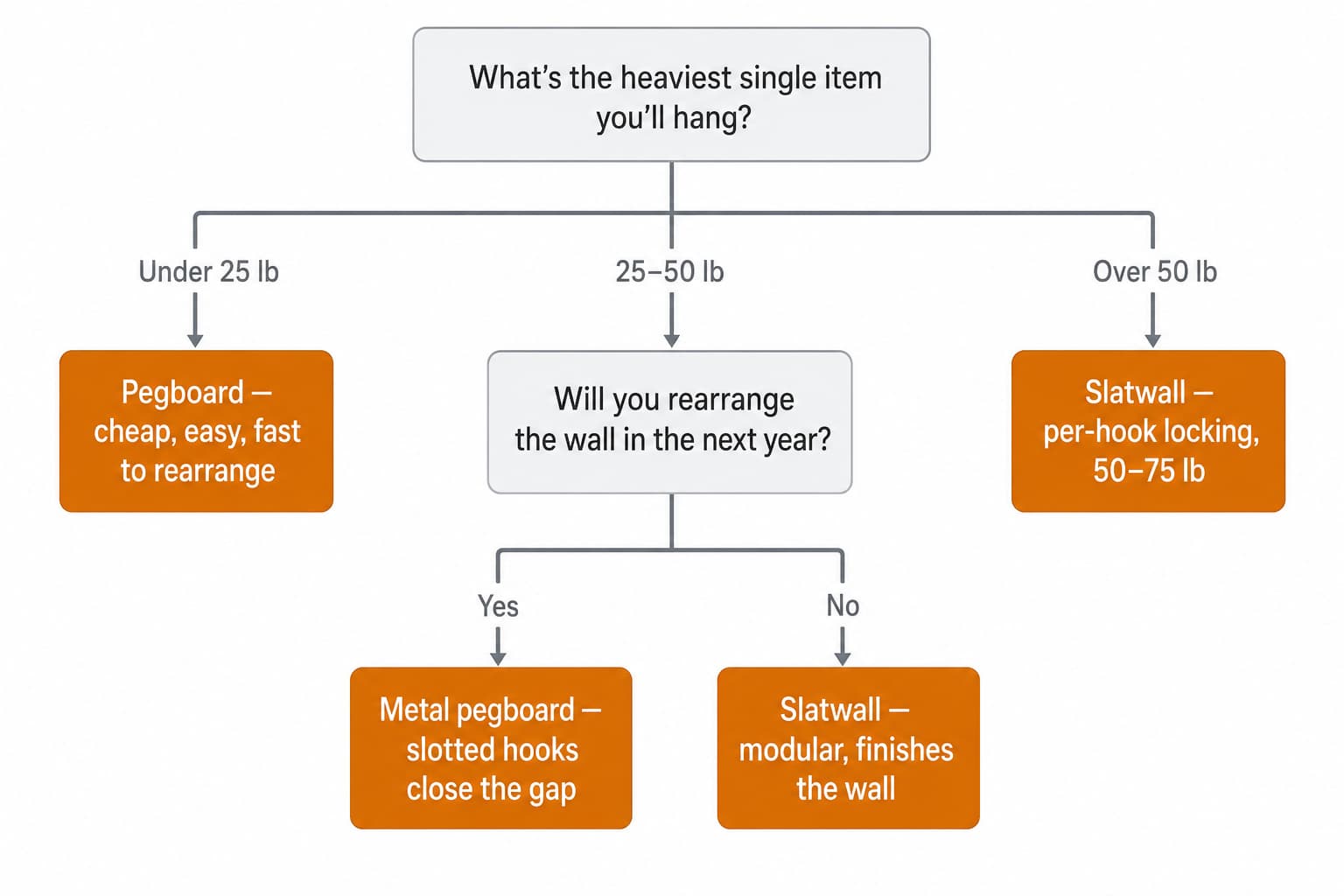
- What’s the heaviest single thing you’ll hang? Under 25 lb and either format works. Between 25 and 50 lb, metal pegboard with slotted hooks or any decent slatwall both hold up. Above 50 lb, slatwall is the answer — or a rail system if you’re hanging things over 75 lb (see rail systems and other heavy-duty wall storage).
- Do you expect to rearrange the wall in the next year? Yes points to pegboard. No points to slatwall.
- Are you covering a section or a whole wall? A section under 4 ft is pegboard territory by default. A whole wall of 8 ft or more scales better on slatwall.
If two of three questions point the same direction, that’s your pick.
Common Mistakes
Mistake: Treating “1200 lb total panel capacity” as a usable number. That figure is the panel’s theoretical maximum if every hook is loaded equally — not how anyone hangs tools. Always ask “per hook” when reading capacity claims.
Mistake: Mounting either system into drywall with anchors only. Capacity drops by half or more without studs. The panel isn’t the weak link — the wall is.
Mistake: Buying the wrong hook shape for the tool. A J-hook holds a curved handle; a straight peg holds a closed loop. Order the hook style your specific tools need, not the assortment that “looks complete”.
Mistake: Buying slatwall too short for the available wall. Panels are sold in 8 ft × 4 ft sections — buying one to cover an 8-ft wide wall leaves the upper or lower half empty. Measure first and compare full slatwall buildouts before committing to a single section.
Recommended Products for Each Side
Two picks per side — one accessible kit and one heavier-duty option.
For pegboard, entry-level: Ultrawall 48 x 36 Pegboard Wall Organizer (72-piece kit)

A complete pegboard purchase out of one box — panel, hooks, bins, mini-hooks. Best fit for first-time pegboard buyers who want hand tools hanging the same day.
For pegboard, heavy-duty: Wall Control 4 ft. Metal Pegboard Standard Tool Storage Kit

Galvanized steel panels with both standard 1/4″ peg and slotted-hook compatibility. Best fit for buyers who want pegboard but have power tools or vibration-prone items.
For slatwall, accessible: Proslat 88102 Heavy Duty PVC Slatwall (8 ft × 4 ft, White)

A 32 sq ft section, the most common single-bay slatwall buy. Proslat lists 75 lb per square foot; PVC handles unconditioned garage humidity.
For slatwall, heavy-duty: CrownWall PVC Slat Wall Panels (8 ft × 4 ft, White)

CrownWall’s product listing states 150 lb per linear foot when properly installed — the highest rating any manufacturer here states directly as a per-linear-foot figure. Proslat’s own rating, 75 lb per square foot, converts to a higher per-linear-foot figure once expressed in the same unit — see the wall-system-capacity table below. Best fit for whole-wall buildouts with mixed power tools and yard gear.
What garage wall systems actually hold, compared fairly
Pegboard is rated per panel, rails per linear foot, slatwall per square foot. Three different units means the published numbers cannot be compared as they stand — so nobody compares them, and a 200 lb figure on one product looks like a 200 lb figure on another. This table quotes each manufacturer’s rating and converts them all to pounds per linear foot of a 4 ft high wall run, with the arithmetic shown. Normalised values are comparison figures, not safe point-load limits. A system rated for 1,200 lb distributed across a wall section does not support a 1,200 lb hook.
| System | Type | Rating as published | Rating type | Same rating, per linear foot of a 4 ft wall | Working | Stud requirement | Specification source | Source checked |
|---|---|---|---|---|---|---|---|---|
| Wall Control metal pegboard (16 × 32 in panel) | pegboard | 200 lb per panel into studs (100 lb on drywall anchors) | panel recommendation | 225 lb per linear foot | 200 lb ÷ (16 in × 32 in panel = 3.56 sq ft) = 56.25 lb per sq ft; 56.25 × 4 ft high = 225 lb per linear foot (equivalently: a 4 ft × 4 ft section fits 3 panels across × 1.5 high = 4.5 panels × 200 lb = 900 lb ÷ 4 ft) | mounting holes on 16 in stud centres | Wall Control 16 × 32 in Metal Pegboard | 2026-09-14 |
| Gladiator GearTrack channel (rail) | rail | 75 lb per linear foot of channel | rail/channel rating | 150 lb per linear foot | 75 lb/ft per channel (published) × 2 channels (assumed common install) | mounts to bare wood studs or drywall over wood studs | Gladiator 4′ GearTrack Channels | 2026-09-14 |
| Gladiator GearWall slatwall panel | slatwall | 50 lb per square foot | distributed panel load | 200 lb per linear foot | 50 lb/sq ft × 4 ft high | not published on the product page | Gladiator 4′ GearWall Panels | 2026-09-14 |
| Proslat Classic PVC slatwall | slatwall | 75 lb per square foot | distributed panel load | 300 lb per linear foot | 75 lb/sq ft × 4 ft high | installs on 16 in stud centres | Proslat PVC Slatwall | 2026-09-14 |
How these numbers were produced: Each published rating is quoted from the manufacturer’s own page on the date shown. Conversion to pounds per linear foot assumes a 4 ft high run of wall: a per-square-foot rating is multiplied by 4. A per-panel rating is first converted to an equivalent per-square-foot rate, using the panel’s own published width and height, then multiplied by 4 the same way — scaling a per-panel rating sideways only, at the panel’s own height, would normalise it to a taller or shorter slice of wall than the 4 ft reference every per-square-foot row uses, so the two steps (per-panel → per-sq-ft → per-4-ft-run) keep every row on the same footing. A per-foot-of-rail rating is different in kind: the manufacturer publishes a rate per channel, and this table doubles it to show a common two-channel install — that doubling is our own installation assumption, not a manufacturer-stated rate; the sourced figure is the single-channel rate. Where a manufacturer publishes a single fixed capacity for a whole pre-sized unit rather than a rate per foot or per square foot, that figure is quoted as published and left out of the per-linear-foot column rather than converted with an invented rate.
- These are manufacturer maximums for a correctly installed system, not a promise. Every one of them depends on hitting studs, using the specified fasteners, and spreading the load rather than hanging it all off one hook.
- The comparison assumes a 4 ft high run. A rail system does not gain capacity from wall height the way a panel does — it gains it from adding channels, which is why its normalised figure moves when you change the channel count, not the height.
- Stud spacing is a hard constraint, not a suggestion. Proslat’s PROCORE is the only system here with a published compatibility range — engineered for 24 in centres, rated compatible down to 16 in. Check whether your own system publishes a similar range before assuming it.
- Drywall anchors are not studs: Wall Control publishes 100 lb per panel on anchors against 200 lb into studs — a real number for that one product, not a ratio to assume for other systems here that don’t publish their own stud-vs-anchor split.
- Capacity drops the further a load sits from the wall: storeWALL publishes 250 lb per sq ft as a distributed rating at the panel surface, but only 115 lb as a point measurement 4 in out. That lever-arm principle is a reasonable general caution for hooks and brackets on any system, but storeWALL is the only brand here that publishes a number for it.
- A blank cell means the manufacturer does not publish that figure — we do not fill gaps with numbers we could not source.
- This list favors brands whose own specification pages state a capacity figure in a form we could verify directly. Some well-known brands are not yet in this table because their published pages did not state a load rating we could confirm on this pass — that is a sourcing gap, not a signal that the product is weaker.
These are the entries that matter for this guide. The full table, with every row and its source, is in our What garage wall systems actually hold, compared fairly.
FAQ
Is slatwall always stronger than pegboard?
No. Metal pegboard with slotted locking hooks closes most of the per-hook weight gap, particularly for items under 50 lb. The difference becomes meaningful when you’re consistently hanging items above 50 lb.
Can I install either system on drywall without locating studs?
You can hang the panel on drywall alone, but the manufacturer’s load ratings assume anchoring into wall studs. Drywall-only installs deliver a small fraction of the rated capacity for both. For anything heavier than a few hand tools, locate the studs first.
Which one works better in a humid or unheated garage?
PVC slatwall and steel pegboard handle moisture without warping. Pressed-hardboard pegboard absorbs humidity and sags within one or two seasons. MDF slatwall has the same problem.
Can I mix pegboard and slatwall on the same wall?
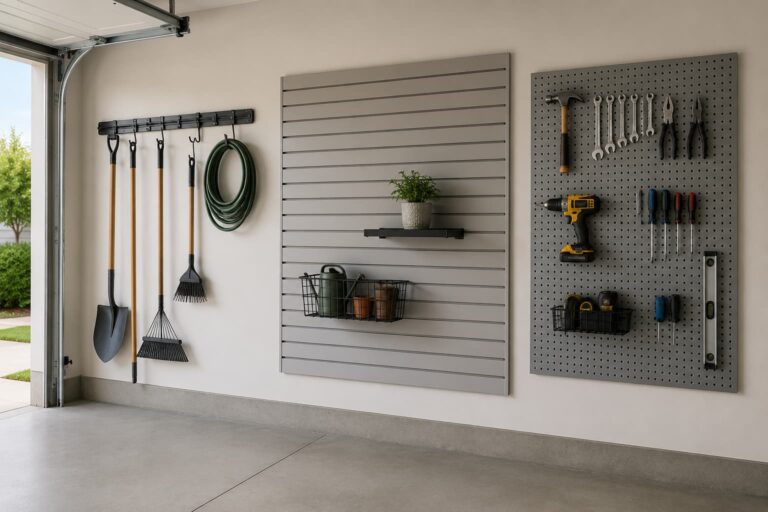
Yes — pegboard above the workbench for hand tools, slatwall on the open wall for power tools and yard gear is a common split. Each system does what it’s best at.
Will slatwall hooks from one brand fit another brand’s panels?
Mostly yes for standard 3-inch slat pitch — Proslat and CrownWall hooks are usually interchangeable across the basic hook shapes. Locking hooks with brand-specific cam mechanisms are the exception; verify per product before assuming a hook will lock in.
Sources Reviewed
For this comparison, we reviewed manufacturer pages and retailer specifications for both pegboard and slatwall systems, product listings on Amazon, recurring patterns in public customer feedback, and discussions where homeowners shared real-world experiences choosing between these options. We do not claim hands-on testing.