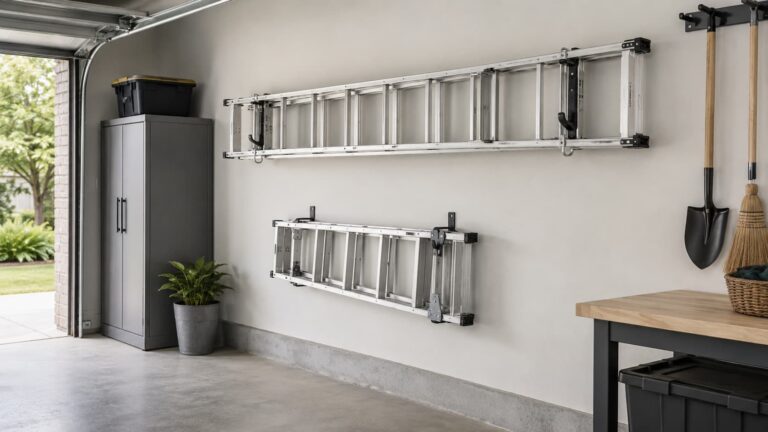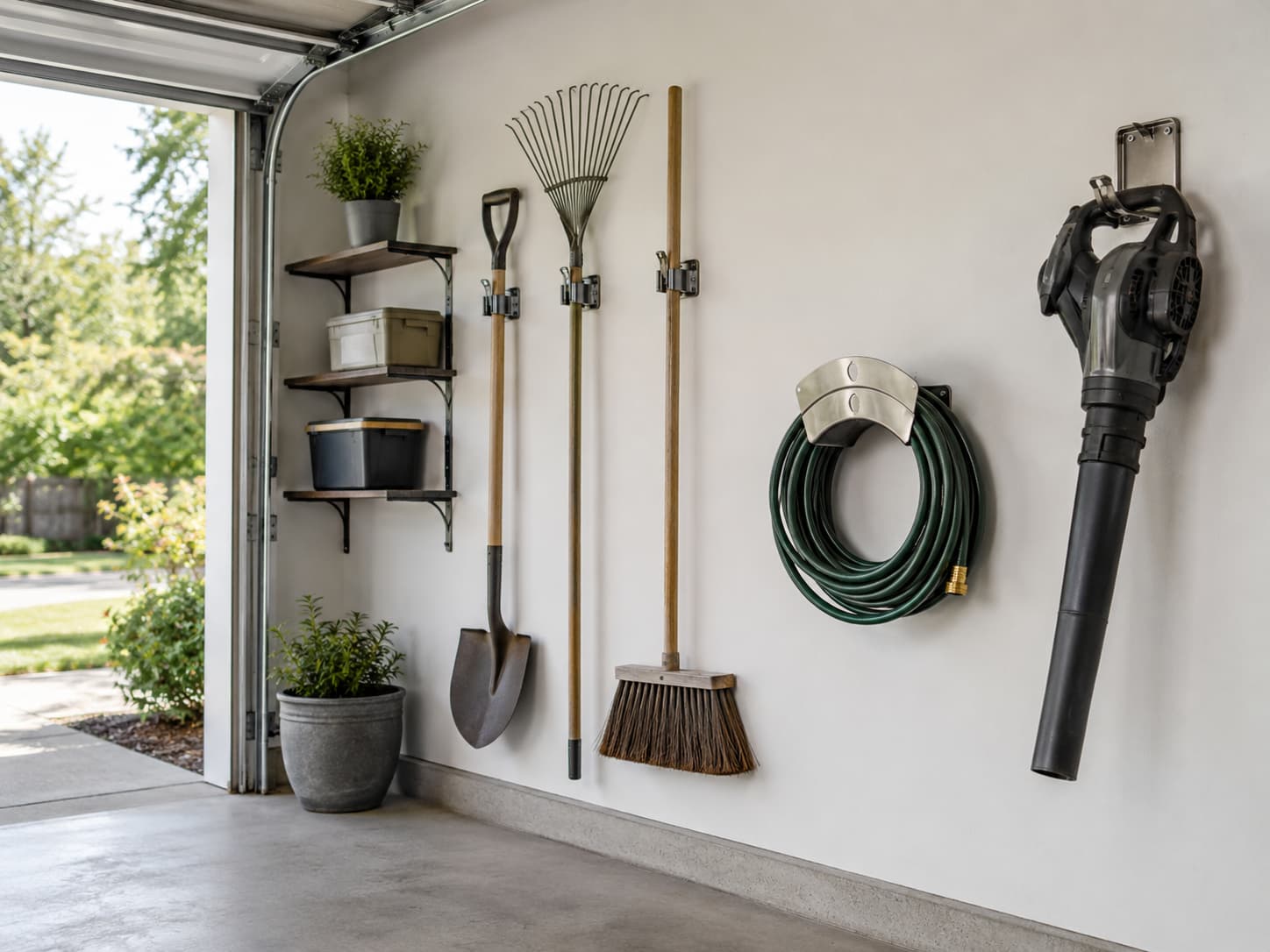
Best Garage Hooks for Garden Tools
Last updated:
Disclosure: This article contains affiliate links. If you buy through these links, we may earn a commission at no extra cost to you. We do not claim hands-on testing unless clearly stated.
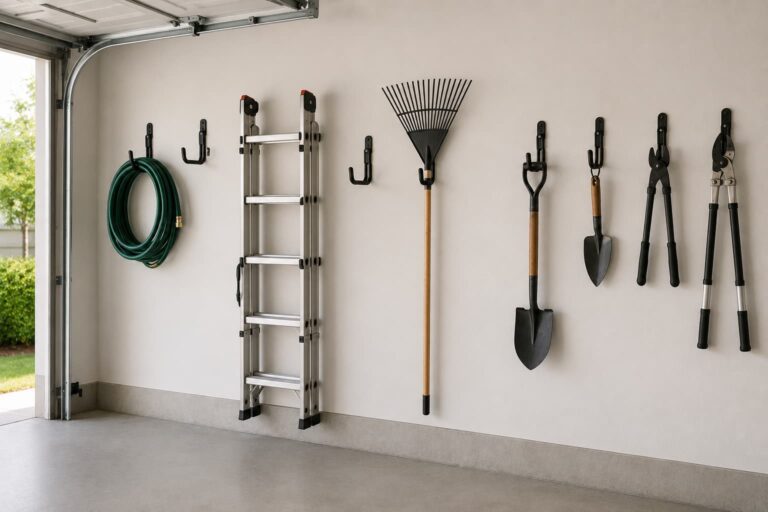
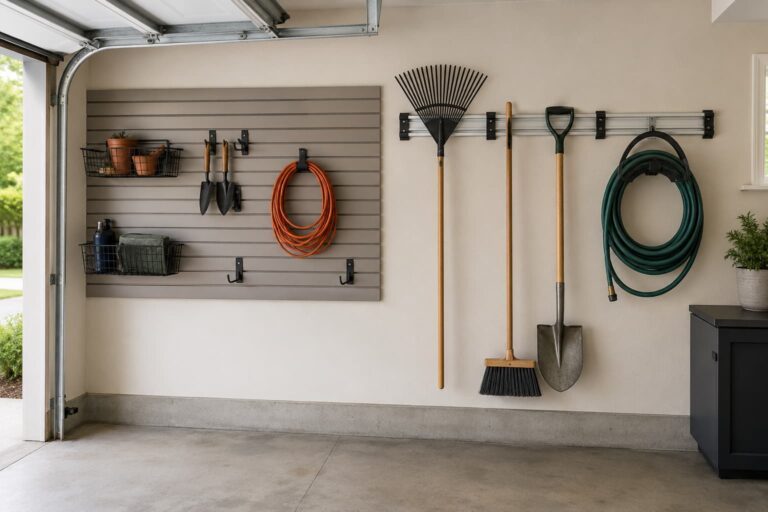
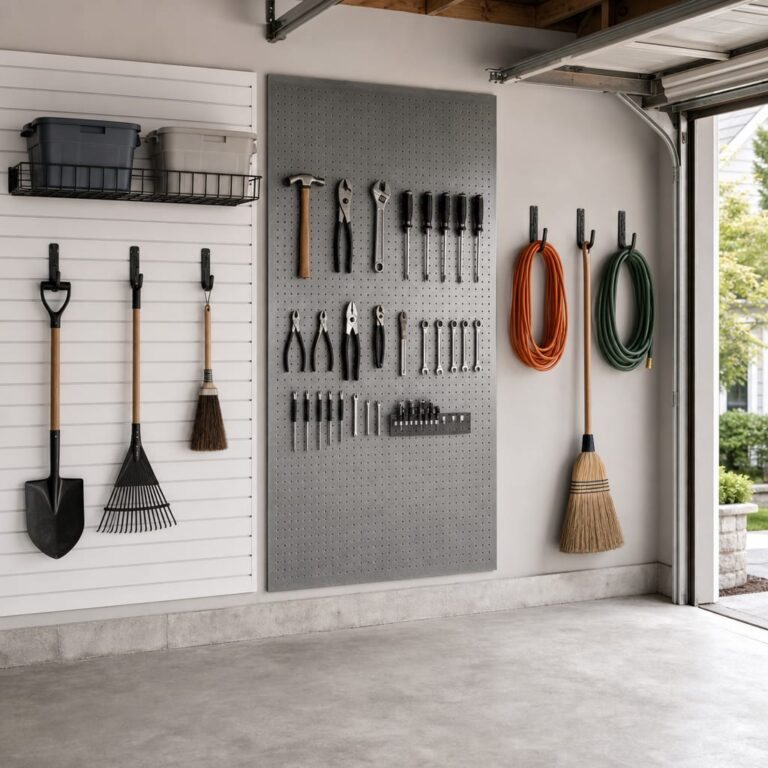
A shovel, a rake, a broom, a leaf blower, and a coiled garden hose don’t share a single hook style. Long-handle tools want spring grips that hold the handle directly. Bulky tools (leaf blower, hedge trimmer) want a heavy-duty utility hook. Coiled tools (hose, extension cord) want a wide-arc hanger that doesn’t crimp the coils. Most “garden tool hook” guides recommend a single multi-tool rack and stop there — and most readers end up with the wrong shape for at least one tool.
This guide splits picks across the actual tool shapes and adds a rail-system option for households who want a single mounting infrastructure across the whole garage. We don’t cover power-tool wall storage (that’s a different category), shed-only solutions, or commercial-grade tool walls. Everything below assumes a residential garage with at least one wall section you can drill into.
Quick Picks
| Pick | Product | Best for | Type | Watch out for | |
|---|---|---|---|---|---|
| Best Heavy-Duty Utility Hook | GURADESIGN 8-Pack Heavy Duty Garage Hooks (50 lb) | Bulky single-tool storage | Wall-mount J-hook | Amazon-storefront brand — verify | View on Amazon |
| Best for Shovels and Rakes | HORUSDY 10 Pack Spring Grip Mop and Broom Holder | Long-handle tools | Spring-grip clips | 10 lb per clip — not for gas tools | View on Amazon |
| Best Multi-Tool Holder | UUP 48″ Garage Tool Organizer (440 lb) | Mixed tool fleet | 48″ rail + 7 hooks | UUP is a niche brand | View on Amazon |
| Best with Rail | Rubbermaid FastTrack Multi-Purpose Hook | Modular rail-system households | Snap-in rail hook | 50 lb cap binds heavier items | View on Amazon |
| Best for Hose | KIVATA 304 Stainless Steel Hose Hanger 2-Pack | Coiled hose, indoor or outdoor | Stainless wall hanger | Hose weight when filled | View on Amazon |
How We Selected These Hooks
We do not claim hands-on testing unless clearly stated. For this guide we reviewed manufacturer specs, retailer pages, product documentation, and recurring patterns in public customer feedback.
Garden-tool storage is a shape problem. Long-handle, bulky, and coiled tools each need a different hook geometry — no universal “garden tool hook” exists in practice. We covered each shape category with one strong pick rather than ranking five generic hooks. Within each slot we preferred branded picks where the category had options.
Selection criteria:
- Each pick covers a distinct tool shape or mounting mode
- Manufacturer-listed capacity verifiable on the listing or brand page
- Branded preferred; generic listings flagged in card buyer warnings
- Mounting hardware compatible with standard 16″ or 24″ stud centers
- Material durability for indoor and outdoor garage walls
What to Look for Before Buying
Before drilling, inventory your garden tools by shape. Long-handle tools (shovel, rake, broom) need different hooks than bulky tools (leaf blower) and coiled tools (hose). The wrong hook for a tool means the tool falls off, scratches, or won’t fit at all. We recommend planning the garage layout first so garden-tool storage shares wall surface with other heavy gear.
Match the hook to the tool shape
Long-handle tools are best held by their handle directly with a spring-grip clip. Bulky tools want a single heavy-duty hook with a wide cradle. Coiled tools (hose, extension cord) need a hanger with a wide arc to prevent crimping. Each shape has a failure mode for the wrong hook — long-handle tools slip out of J-hooks, bulky tools won’t sit in spring grips, hoses crimp on narrow hooks.
Account for tool weight (a leaf blower exceeds 10 lb)
A typical electric leaf blower weighs 8–10 lb dry; gas blowers run 12–15 lb. A hedge trimmer is 6–10 lb. A weed whacker (gas) is 10–15 lb. A coiled garden hose is deceptively heavy when full of water — a 50-foot 5/8-inch hose holds about 6 gallons, weighing 50 pounds when filled. Match hook capacity to the tool’s wet/full weight, not just dry.
Decide single hook vs rail system
Single stud-mounted hooks work when the tool inventory is stable. Rail systems (FastTrack) work when the tool inventory changes — bikes in summer, snow shovels in winter, garden tools in spring. The rail repurposes the same wall surface without re-drilling.
Plan for the hose — it’s the awkward one
Hoses are the trickiest item because they’re heavy when wet, awkward when coiled, and prone to crimping if the hanger arc is too tight. Stainless steel is the right material for outdoor garages because of moisture exposure. Wide-arc hangers prevent the kinks that lead to leaks at the crimp points.
Stud mounting for any sustained load
Drywall alone holds nothing under repeated load. Garden-tool hooks must hit a stud. Toggle bolts and high-rated drywall anchors degrade under the lever-arm load of a tool pulled outward by gravity. The same studs that hold ladder hooks and bike mounts work here — plan multiple wall mounts in one stud-mapping pass.
Indoor garage walls vs outdoor walls vs sheds
Indoor garage walls (interior of an attached or detached garage with a closed door most of the year) tolerate powder-coated or painted hooks because moisture exposure is moderate. Outdoor walls — exterior of a shed, the outside of a detached garage, a fence used as a tool wall — require stainless steel because every rain or sprinkler-overspray cycle accelerates corrosion at any unsealed metal edge. Coastal or humid climates are even more demanding; the few extra dollars for stainless are repaid the first time you don’t have to repaint a rusted hook.
The seasonal-rotation test
Before committing to a fixed-hook layout, ask whether the tools on the wall today will be the same tools next March. Most yard fleets cycle: snow shovel and ice melt in winter, leaf rake and blower in fall, garden hose and pruner in spring, lawnmower handles and weed whackers in summer. A rail system absorbs that rotation by letting hooks slide; a fixed grid of stud-mounted hooks does not. If your tool inventory rotates by season, the rail system pays back its higher up-front cost in flexibility.
Best Heavy-Duty Utility Hook: GURADESIGN 8-Pack Heavy Duty Garage Hooks (50 lb)
Best for: Households with bulky garden tools (leaf blower, weed whacker, hedge trimmer) that need a single-tool hook rated for sustained 10–15 lb loads with safety margin.
GURADESIGN 8-Pack Heavy Duty Garage Hooks (50 lb)
Short verdict: 8-pack of metal J-hooks with a manufacturer-listed 50 lb capacity each. GURADESIGN is an Amazon-storefront brand, but the capacity number is what matters here — most utility hooks at this price ship with no clear capacity stated, leaving you guessing whether the leaf blower will hold.
The product page lists 50 lb manufacturer-listed capacity per hook, with 16 wall anchors and 16 wood screws included for the 8 hooks. The 8-pack covers a typical garage wall section without forcing a second order.
Why it stands out
Capacity transparency. Most utility hooks at this price point list “heavy duty” without a number — which means anything from 5 lb to 50 lb. The clearly stated 50 lb rating lets you match the hook to actual tool weight with confidence. Eight hooks in the pack also makes it cheap to over-buy slightly.
It can work well for:
- Leaf blowers, weed whackers, hedge trimmers
- Single-tool dedicated wall positions
- Households with 4+ bulky tools
- Buyers who want capacity-rated hooks without paying brand premium
Key specs to check
- 50 lb manufacturer-listed capacity per hook
- 8-pack quantity
- Wall anchors and wood screws included (verify lag-bolt-grade for heavier tools)
- Hook arc width vs your bulkiest tool
- Black-finish steel construction
Recurring feedback patterns
Recurring positive feedback often centers on the capacity holding up to actual leaf-blower and small-equipment loads. Common complaints typically involve mounting screws being shorter than ideal — several buyers mention swapping for 3-inch lag bolts before mounting heavy tools. Several buyers mention the hook arc is wide enough for medium-bulky items but tight for the largest commercial leaf blowers.
Potential drawbacks
GURADESIGN is an Amazon-storefront brand without a verified primary website outside Amazon — the same caveat that applies to HORUSDY and KIVATA elsewhere in this guide, so quarterly re-verification of the listing is sensible. ASIN format (B0D-prefix) indicates a 2024-or-later listing, so tenure is still short; flag attrition risk. Verify hardware grade before mounting heavier tools.
Buyer warning
Amazon-storefront brand; re-verify availability before ordering. The 50 lb rating is per hook, not per pack — don’t sum the ratings to claim 400 lb total wall capacity. Each hook is rated independently, and the binding load is whatever sits on a single hook.
Best for Shovels and Rakes: HORUSDY 10 Pack Spring Grip Mop and Broom Holder
Best for: Households with multiple long-handle tools (shovels, rakes, brooms, mops) that fall off generic J-hooks because the handles aren’t gripped — they’re balanced.

Short verdict: 10 zinc-plated steel spring-grip clips built for long-handle tools. The clip wraps the handle directly rather than relying on the tool to balance on a hook. The listing names shovel, rake, broom, and mop handles explicitly.
HORUSDY runs an active Amazon storefront with multiple tool SKUs. Mounting hardware is included on the listing; verify before drilling. The bright zinc plating is rated for indoor and outdoor garage use.
Why it stands out
Spring-grip geometry is the answer for long-handle tools. A J-hook engages the bottom of the handle by gravity — the handle balances on the hook, and any sideways push knocks it off. Spring grips wrap the handle and hold it actively, so a brush against the wall doesn’t drop the tool. The 10-pack covers a typical garage’s long-handle inventory.
It can work well for:
- Shovels, rakes, garden brooms, push brooms, mops
- Multi-tool households with 5+ long-handle items
- Walls where tools have been falling off existing hooks
- Buyers who tried J-hooks first and want a real grip
Key specs to check
- 10 spring-grip clips per pack
- 10 lb manufacturer-listed capacity per clip
- Bright zinc-plated steel (anti-rust, indoor/outdoor)
- Handle-diameter range (typical handles are 1–1.25″; verify your handle)
- Mounting hardware included (upgrade screws to lag bolts for stud mounting)
Recurring feedback patterns
Recurring positive feedback often centers on the spring-grip actually solving the falling-off-J-hooks problem and on the zinc finish holding up on humid or exterior walls. Common complaints typically involve spring tension feeling tight on the first install — several buyers mention the springs loosen slightly with use, which is a feature on this clip type rather than a defect. Several buyers also mention the supplied screws being short for stud-mounting heavier tools; longer wood screws or lag bolts are a common upgrade.
Potential drawbacks
HORUSDY is an Amazon-storefront brand without a verified primary website outside Amazon — quarterly re-verification of the listing is sensible. The 10 lb per-clip capacity is at the lower end of the category; the heavier the long-handle tool, the less safety margin remains. Spring-grip mechanism wears over many years of repeated use; expect 5–10 years before replacement.
Buyer warning
The manufacturer lists 10 lb capacity per spring-grip clip — adequate for shovels, rakes, and brooms (typically 3–8 lb each) with a thin safety margin, but not for heavier gas-powered tools. Don’t hang a gas weed whacker (12–15 lb), a backpack blower, or a battery-powered hedge trimmer from a spring grip just because it nominally fits — use the heavy-duty utility hook above for that load class.
Best Multi-Tool Holder: UUP 48″ Garage Tool Organizer (440 lb)
Best for: Households with a mixed tool fleet — long-handle, bulky, and coiled all on the same wall section — who want a single 48-inch unit handling everything.
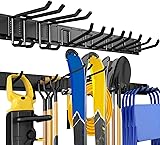
Short verdict: 48-inch rail with 7 hooks (3 tool, 2 double-layer, 2 single) and 3 sub-rails. Manufacturer-listed 440 lb total system capacity. UUP is a niche brand but the build quality and capacity numbers compete with FastTrack at lower cost.
The manufacturer lists premium quality, heavy-duty alloy steel materials throughout. The adjustable hook positions accommodate tool inventory changes without re-drilling — slide the hooks along the rail rather than removing and re-mounting them.
Why it stands out
System integration is the differentiator at this price point. Individual stud-mounted hooks force you to commit to a tool layout at install time; the UUP rail lets you reconfigure as the tool inventory changes. The 7 hooks plus 3 sub-rails handle everything from spring-grip-style long handles to single-hook bulky tools to small accessories.
It can work well for:
- Mixed tool fleets (long-handle + bulky + coiled)
- 48-inch wall sections with stud access on the back
- Households who want one rail system across the wall
- Buyers comparing FastTrack at higher price
Key specs to check
- 48″ rail length (verify available wall length first)
- 440 lb total system capacity (manufacturer-listed)
- 7 hooks: 3 tool, 2 double-layer, 2 single
- 3 sub-rails for accessory hooks
- Mounting hardware (lag bolts into studs preferred)
Recurring feedback patterns
Recurring positive feedback often centers on the 440 lb rating actually holding under realistic tool loads, and on the adjustable hook positions saving re-drilling. Common complaints typically involve assembly being more complex than the package suggests; several buyers mention the printed instructions being thin and watching the manufacturer’s video first. Several buyers mention upgrading mounting hardware to longer lag bolts for the heaviest tool loads.
Potential drawbacks
Niche brand without major distribution channels. ASIN tenure (2022) is moderate but not as established as Rubbermaid. The 48-inch rail won’t fit shorter wall sections; measure first.
Buyer warning
The 440 lb total system capacity is not the per-hook rating. Individual hooks have their own listed capacities (verify on the spec sheet) — distributing 5 tools at 80 lb each would exceed the system, but no single hook would. Match individual hook capacities to individual tool weights.
Best with Rail: Rubbermaid FastTrack Multi-Purpose Hook
Best for: Households who already use the Rubbermaid FastTrack rail (or are about to install it) for multiple gear types. Garden tools share the same rail as bikes and ladders.
Rubbermaid FastTrack Multi-Purpose Hook
Short verdict: Snap-in multi-purpose hook for the FastTrack rail system. 50 lb manufacturer-listed capacity. Cast aluminum gripper that locks into the rail without screws (after the rail is mounted to studs). Branded by Rubbermaid with full warranty system.
The manufacturer lists 50 lb capacity, which covers most garden tools individually. The hook is also direct-mountable to studs. The rail-system use is where it pays off — the FastTrack rail accepts bike hooks, ladder hooks, garden-tool hooks, and shelves all in one infrastructure.
Why it stands out
Cross-category modularity. Buying garden-tool-specific hooks locks you into garden-tool storage on that wall surface; buying the FastTrack rail unlocks the option to add the same rail-system handles ladders, bike hooks, and yard tools as the household needs evolve. Rubbermaid’s brand stability means the rail you install today will still accept new accessories in 5 years.
It can work well for:
- Households building out a long-term FastTrack system
- Multi-gear walls where garden tools are one category among many
- Garages where wall surface needs to flex with seasonal gear changes
- Buyers who prefer brand consistency across hooks
Key specs to check
- 50 lb manufacturer-listed capacity per hook
- FastTrack rail compatibility (32″ or 48″ rail sold separately)
- Direct-to-stud mounting alternative
- Cast aluminum gripper construction
- Pack quantity (single hook; buy multiple)
Recurring feedback patterns
Recurring positive feedback often centers on the snap-in mechanism and on Rubbermaid’s customer service when parts go missing. Common complaints typically involve the 50 lb cap being insufficient for the heaviest gas-powered yard tools; several buyers mention pairing the multi-purpose hook with the heavier-duty Rubbermaid utility hook on the same rail.
Potential drawbacks
50 lb capacity is the binding constraint for the heaviest tools. Higher up-front cost than a generic stud-mounted hook — value scales when the rail hosts multiple accessory types over time.
Buyer warning
50 lb manufacturer-listed capacity. Heavy gas-powered tools (commercial leaf blowers, larger weed whackers) can exceed this. For those, use the 8-pack J-hooks pick or a dedicated heavy-duty utility hook. The FastTrack hook is right for typical residential garden tools, not for commercial-grade equipment.
Best for Hose: KIVATA 304 Stainless Steel Garden Hose Hanger (2-Pack)
Best for: Households with a coiled garden hose (50–180 ft) who want it stored where it won’t crimp, weep, or rust the hanger over years of moisture exposure.

Short verdict: 304 stainless steel hose hanger, 2-pack. Manufacturer lists 180 ft of 1/2-inch hose capacity per hanger. Stainless construction is the right material for outdoor and humid-garage walls — painted steel hangers rust at the contact point and stain the wall.
The product page positions this as a heavy-duty wall-mount hose hanger for outdoor and indoor use. The 2-pack lets you store two hoses (front-yard hose plus back-yard hose) without re-buying.
Why it stands out
304 stainless steel is the differentiator. Most “heavy-duty” hose hangers in this price range are powder-coated steel that rusts at the wall contact point within a few seasons of moisture exposure. Stainless survives indefinitely. The 180-foot capacity also accommodates the longer hoses (150-foot pressure-washer hose, expandable hoses, multi-room garden setups) that don’t fit shorter hangers.
It can work well for:
- Garden hoses 50–180 ft of typical 1/2″ or 5/8″ diameter
- Outdoor garage walls or humid garage interiors
- Households who keep hoses connected and frequently retrieved
- Multi-hose setups (2 hangers cover front + back)
Key specs to check
- 304 stainless steel construction (manufacturer-listed)
- 180 ft of 1/2″ hose per hanger (manufacturer-listed)
- Mounting hardware included (verify lag-bolt-grade for stud mount)
- Wide arc to prevent hose crimping
- 2-pack quantity
Recurring feedback patterns
Recurring positive feedback often centers on the stainless construction surviving outdoor rain without rust, and on the wide arc preventing hose kinks. Common complaints typically involve installs being heavier than expected when the hose is full — several buyers mention upgrading to longer lag bolts for stud mount. Several buyers mention pairing this with a hose-storage tote on the floor for the most-used end of the hose.
Potential drawbacks
KIVATA is a niche brand without major distribution channels. ASIN tenure (2022) is moderate. Premium price relative to powder-coated alternatives — value comes from corrosion resistance and long-term durability.
Buyer warning
A coiled garden hose is heavy when full of water. A 50-foot 5/8-inch hose holds about 6 gallons, weighing approximately 50 pounds. The KIVATA’s 304 stainless construction handles that load, but the mounting bolts are the binding link. Drain the hose before storing if leaving it hung for long periods, or upgrade to lag bolts rated for the wet-hose weight.
Side-by-Side Comparison
| Product | Mount type | Listed capacity | Best tool shape | Pack quantity | Material |
|---|---|---|---|---|---|
| GURADESIGN 8-Pack Garage Hooks | Wall-mount J-hook | 50 lb per hook | Bulky single tools | 8 | Metal, black finish |
| HORUSDY 10-Pack | Wall-mount spring grip | 10 lb per clip | Long-handle | 10 clips | Zinc-plated steel |
| UUP 48″ Organizer | Wall-mount rail + 7 hooks | 440 lb total | Mixed | 48″ rail + 7 hooks | Heavy-duty alloy steel |
| Rubbermaid FastTrack Hook | Snap-in rail or stud | 50 lb | Mixed (modular) | 1 hook | Cast aluminum + steel |
| KIVATA Hose Hanger | Wall-mount stainless | 180 ft of 1/2″ hose | Coiled hose | 2 | 304 stainless steel |
Choose by Tool Shape — A Decision Matrix
Tool shape determines hook geometry. Long-handle, bulky, and coiled tools each fail on the wrong hook design — and the right hook varies even within shape category (a 50 ft hose has different hanger needs than a 180 ft hose).
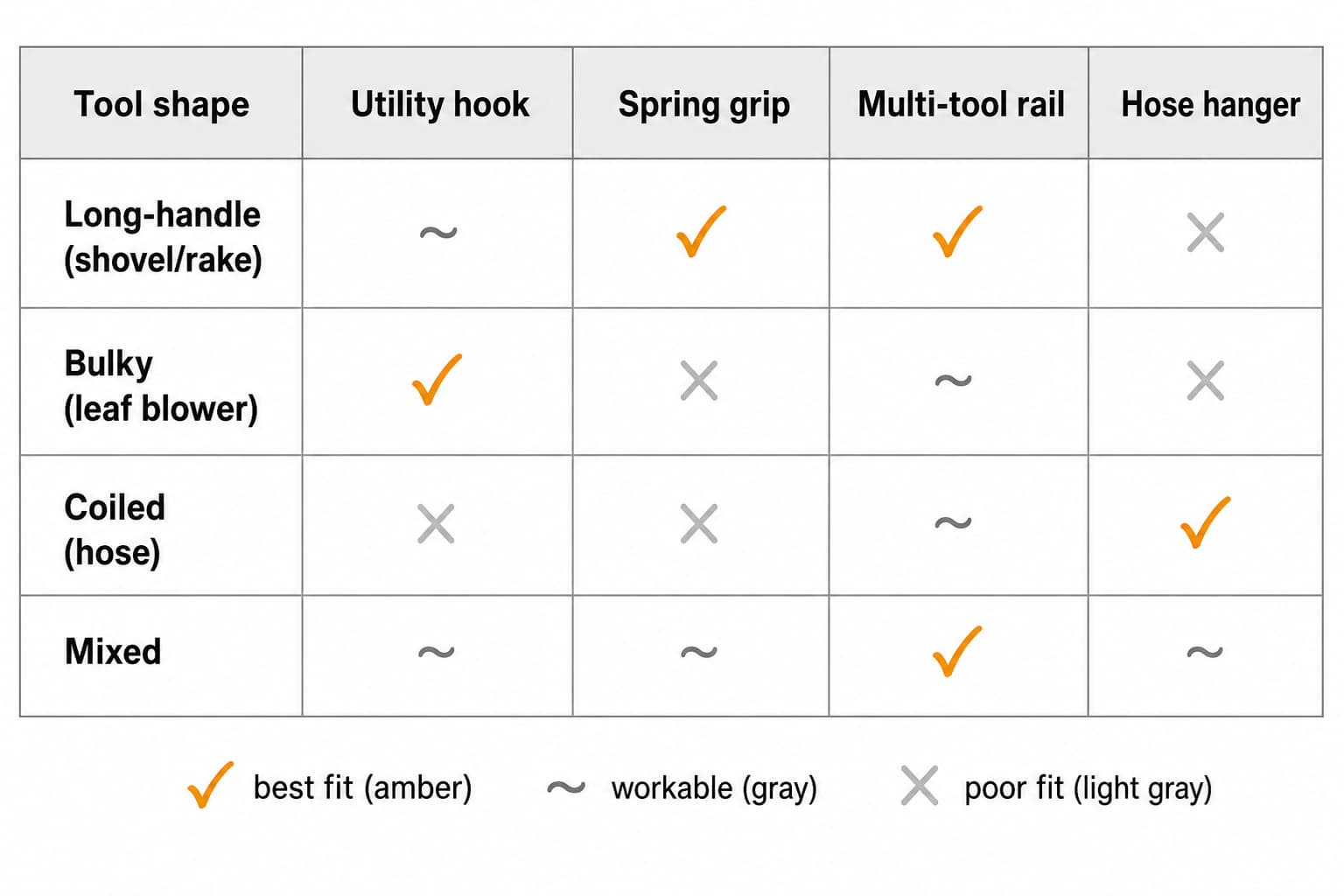
A long-handle-heavy household (mostly shovels and rakes) is best served by spring grips. A bulky-tool household (multiple leaf blowers, hedge trimmers) wants heavy-duty single hooks. A hose-and-coiled-cord household needs the dedicated stainless hose hanger. A mixed inventory benefits most from the UUP 48″ multi-tool rail or the Rubbermaid FastTrack system because both adapt to changing tool mixes without re-drilling.
What a garage hook actually holds — and what the wall behind it holds
A pegboard hook and a rail hook look like the same tool and are rated five times apart: Wall Control publishes 5–10 lb for a single-slot pegboard hook, Gladiator publishes 50 lb for a rail utility hook. This table puts the published per-hook ratings side by side, then works out how many of each a standard wall run supports at full load before the panel or rail — not the hook — becomes the limit.
| Hook | System it mounts to | Published rating | Backing capacity | Fully loaded hooks before the backing is the limit | Specification source | Source checked |
|---|---|---|---|---|---|---|
| Wall Control pegboard hook, single slot | Pegboard (Wall Control metal panel) | 5–10 lb per hook | 200 lb — 16 × 32 in panel into studs | 20 hooks | Wall Control pegboard how-to | 2026-08-14 |
| Wall Control pegboard hook, two slots | Pegboard (Wall Control metal panel) | 10–15 lb per hook | 200 lb — 16 × 32 in panel into studs | 13 hooks | Wall Control pegboard how-to | 2026-08-14 |
| Gladiator Utility Hook | Rail / slatwall (Gladiator GearTrack, GearWall) | 50 lb per hook | 300 lb — 4 ft GearTrack channel at 75 lb per linear foot | 6 hooks | Gladiator Utility Hook | 2026-08-14 |
How these numbers were produced: Per-hook ratings are quoted from the manufacturer’s own page or published guidance on the date shown. The last column is arithmetic: the backing system’s published capacity divided by the top of the hook’s rating range, rounded down. Pegboard hooks are measured against one 16 × 32 in Wall Control panel fixed into studs (200 lb); rail hooks against a 4 ft GearTrack channel at its published 75 lb per linear foot (300 lb). Substitute your own run length and the ratio moves with it.
- Ranges are published as ranges for a reason. Wall Control states outright that it will not publish ‘specific and idealistic laboratory load ratings’ because real capacity depends on installation quality, substrate, hook choice and load distribution — treat the top of a range as a ceiling you should not design against.
- Into studs or into drywall changes everything: Wall Control publishes 200 lb per panel into studs against 100 lb on drywall anchors. Halve the last column accordingly if you did not hit a stud.
- The counts assume every hook is loaded to its maximum at the same time, which is the worst case and the one worth planning for.
- A hook rating says nothing about leverage. A long-handled tool hung by its head puts far more load on the fixing than its weight suggests.
- A blank cell means the manufacturer does not publish that figure — we do not fill gaps with numbers we could not source.
These are the entries that matter for this guide. The full table, with every row and its source, is in our What a garage hook actually holds — and what the wall behind it holds.
How to Measure Wall Space and Plan Stud Access
Before drilling, walk the garage with a tape measure and inventory tools by shape. The same wall stud that anchors garden-tool hooks also anchors lawn-tool storage on the same wall — plan both at once.
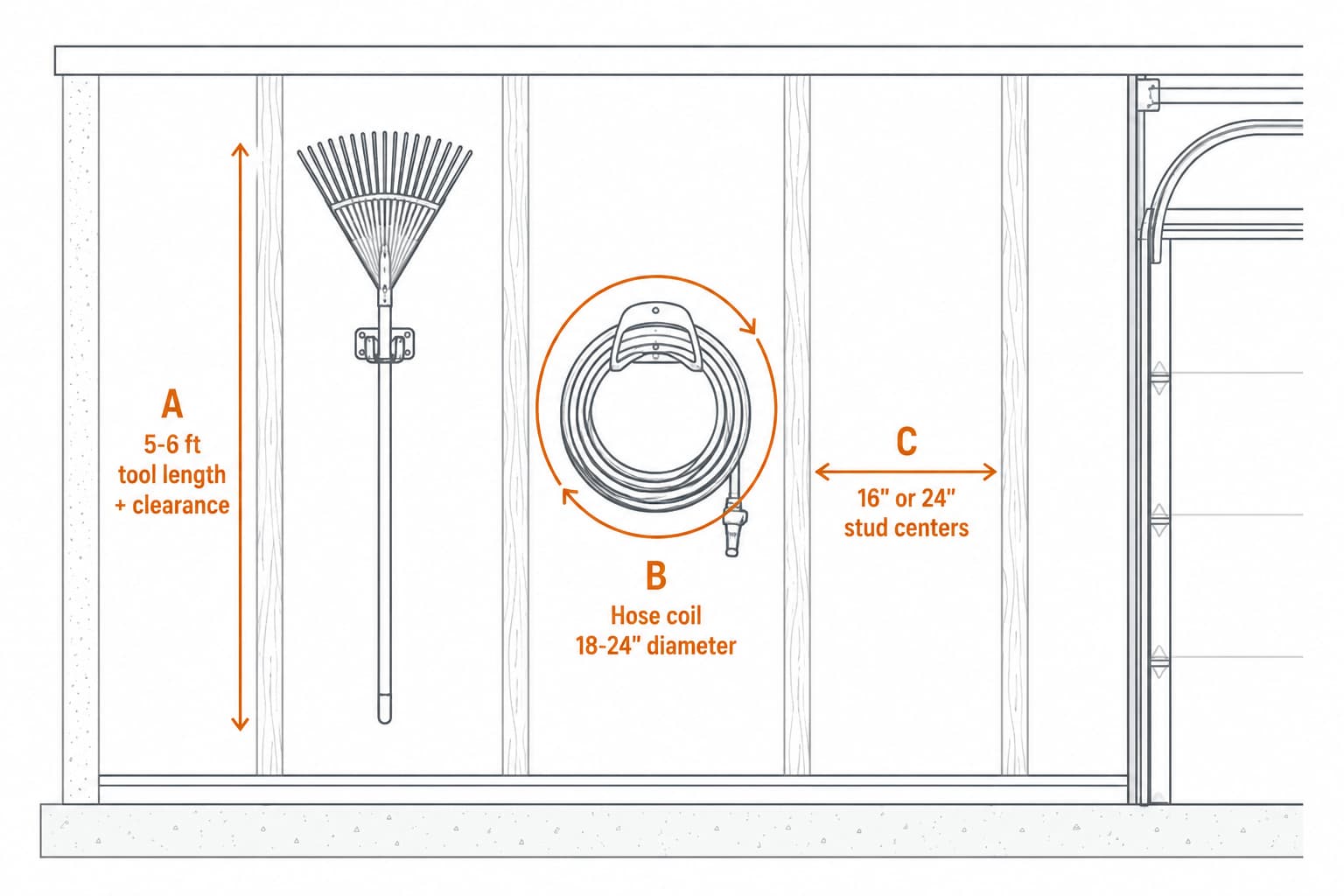
The measurement checklist:
- Wall stud spacing. Stud finder along the wall section. Most US homes use 16-inch on-center; some newer builds use 24-inch. Mark studs in pencil before drilling.
- Tool length for vertical reach clearance. A 5–6 foot rake mounted vertically needs that length plus 6 inches of clearance below for hand-grabbing.
- Hose-coil footprint. A coiled hose typically has 18–24 inch diameter. Wall projection on a hose hanger needs to accommodate the coil diameter without bumping into other items.
- Bulky tool wall projection. A leaf blower on a J-hook projects 8–12 inches; clear that depth before mounting other items adjacent.
- Hook spacing across the wall. Allow 12–18 inches between long-handle clips so handles don’t tangle.
Common Complaints and Buyer Warnings
The same complaints recur across the five hook types — and they all trace back to skipped sizing checks, undersized mounting hardware, or trying to use the wrong hook geometry for a given tool shape.
The single most important warning: wall hooks must hit a stud, not drywall alone. Drywall anchors degrade under sustained load, especially when the load is something heavy like a leaf blower or a wet hose pulled outward by gravity. Use a stud finder before drilling, and use lag bolts of appropriate length.
Hose-weight caveat: a coiled garden hose is far heavier when full of water than when empty. A 50-foot 5/8-inch hose at 6 gallons weighs approximately 50 pounds. The hook must support the wet weight, not the dry weight, especially if you typically leave the hose hung between uses without draining. The same caveat applies to expandable hoses (which are lightweight when collapsed but become quite heavy under pressure) and pressure-washer hoses (which often run higher pressures than garden lines and weigh more per foot).
Inspection cadence: walk the wall once a season and tug each hook outward. Any hook that flexes more than it did when you installed it has either lost stud-bolt torque or has begun bending under sustained load. Re-tighten the lag bolt; if torque doesn’t return, replace the hook before it fails. The ten minutes per season prevents the falling-tool incident.
Who Should Avoid These Hooks?
These picks aren’t right for everyone. Skip the entire list if any of these apply:
- Renters who can’t drill. All five picks require drilling into studs.
- Garages without stud access. Drywall-only walls aren’t safe for sustained loads.
- Single-tool households. A 50-cent utility hook handles a single shovel; the picks above are overkill.
- Households with commercial-grade equipment. Industrial yard tools and commercial leaf blowers exceed residential hook capacities.
FAQ
Can I store a wet hose on these hangers?
Yes for the KIVATA stainless pick — 304 stainless doesn’t rust under repeated moisture exposure. For powder-coated or painted hangers, draining the hose before storing extends both hose life and hanger life. A wet hose left coiled for months also grows mildew inside the coils, regardless of hanger material.
Will the hooks rust outdoors?
Stainless steel hooks (KIVATA 304 stainless) don’t rust under outdoor exposure. Powder-coated or painted hooks rust at the contact points within a few seasons of moisture, especially at any drilled or ground edge that exposes bare metal. For outdoor garage walls or humid coastal climates, stainless is the right material; for dry inland garages, powder-coat is acceptable for years.
How heavy is a typical leaf blower?
An electric corded leaf blower is 8–10 lb. A battery-powered electric is 9–12 lb. A gas leaf blower is 10–15 lb dry. A backpack gas blower is 18–25 lb. Match the hook capacity to the heaviest version you own; the 50 lb 8-pack J-hooks handle every residential blower including backpack gas, while the 50 lb FastTrack hook handles the smaller models cleanly.
Should the hose be drained before storing?
Yes for long-term storage and for cold-weather garages. Water inside the hose freezes and expands in winter, which can crack the hose internally even if no leak appears externally. For day-to-day in-season storage, leaving water in the hose is fine if the hanger is rated for the wet weight.
Can I mount these into garage drywall?
No — same rule as for any heavy wall mount. Drywall anchors, even high-rated toggle bolts, degrade under sustained load. The mounting standard for every product in this guide is into a wood stud with appropriately sized lag bolts. The same studs that hold bike storage on the same wall work for these hooks.
How do I prevent tools from tangling?
Space long-handle clips 12–18 inches apart so handles don’t bump. Hang the longest tools at the bottom of the wall, shorter tools at the top — this puts shorter tools at eye level (easier to grab) and longer tools where they’re physically reachable from the floor without a step stool. Coil the hose tightly before hanging; loose coils tangle on adjacent items.
Do I need different hooks for indoor vs outdoor garage walls?
Material matters more than indoor/outdoor. Stainless steel works anywhere. Powder-coat or painted steel is fine indoors and on walls protected from direct moisture; it’s marginal on outdoor walls and not recommended near sprinkler overspray, downspout overflow, or coastal salt air. The KIVATA 304 stainless hose hanger is the safe pick for any wall surface, indoors or out.
Can I mount hooks to a finished garage wall without ruining the paint?
Yes, with two precautions. First, drill pilot holes the size of the lag-bolt shank, not the threads — this prevents the hook back-plate from rotating against the paint as you tighten. Second, use a thin felt or rubber gasket between the hook back-plate and the wall finish; a 1/16-inch craft felt circle is enough to absorb minor wall texture and protect the paint. When you eventually move the hook, the paint repair is a tiny patch around the bolt holes rather than a full back-plate scuff to spackle.
Sources Reviewed
For this guide, we reviewed manufacturer product information from Rubbermaid, KIVATA, UUP, and GURADESIGN; retailer specifications on Amazon listings; product documentation from manufacturer websites where available; and recurring patterns in public customer feedback. We focused on product details that matter for residential garden-tool storage, including manufacturer-listed capacity, tool-shape compatibility (long-handle vs bulky vs coiled), mounting requirements, and material durability under typical garage humidity.
Related Guides
- Best garage hooks for ladders
- Best garage storage for lawn and garden tools
- Best garage storage for bikes and scooters
- How to plan a garage organization system
- Freestanding vs Wall-Mounted Garage Storage: Which Is Right for You?
- How to Organize Cleaning Supplies in Your Garage
- How to Organize Garage Wall Storage
- Slatwall vs Track Rail Garage Storage Systems