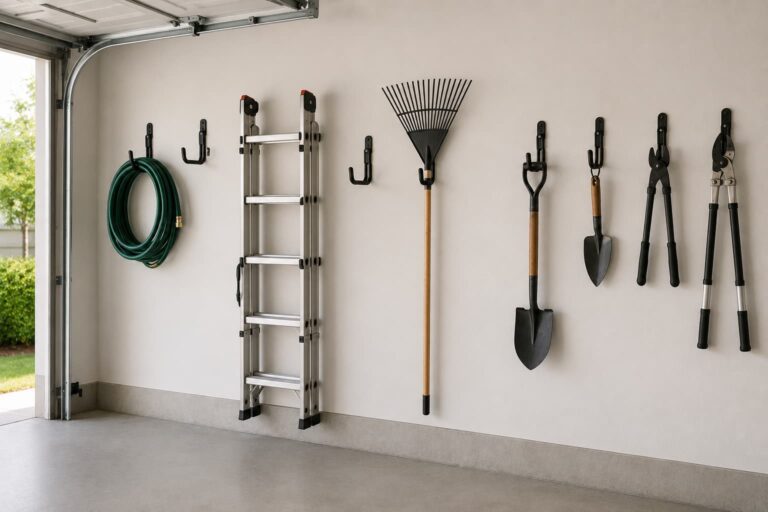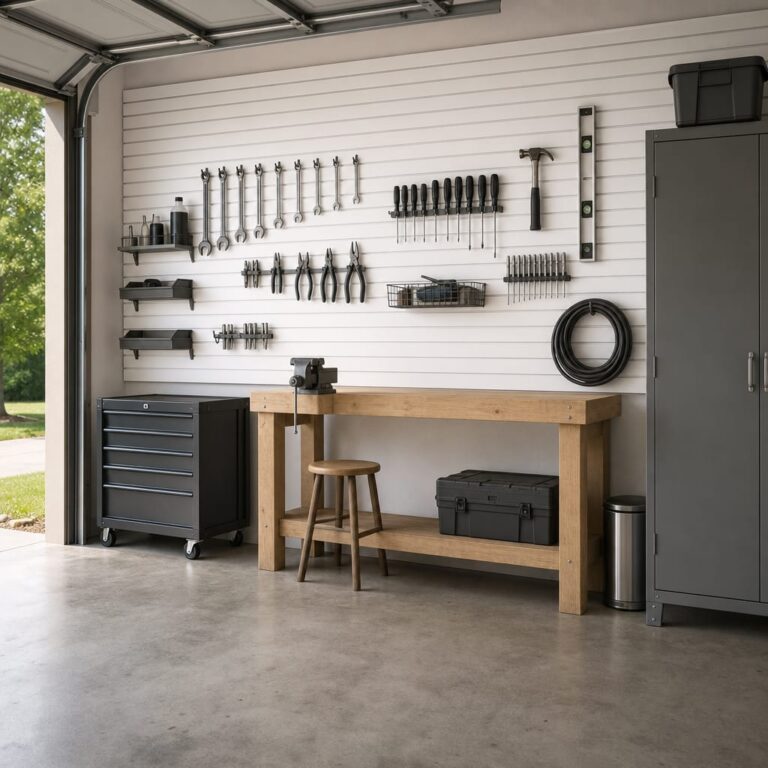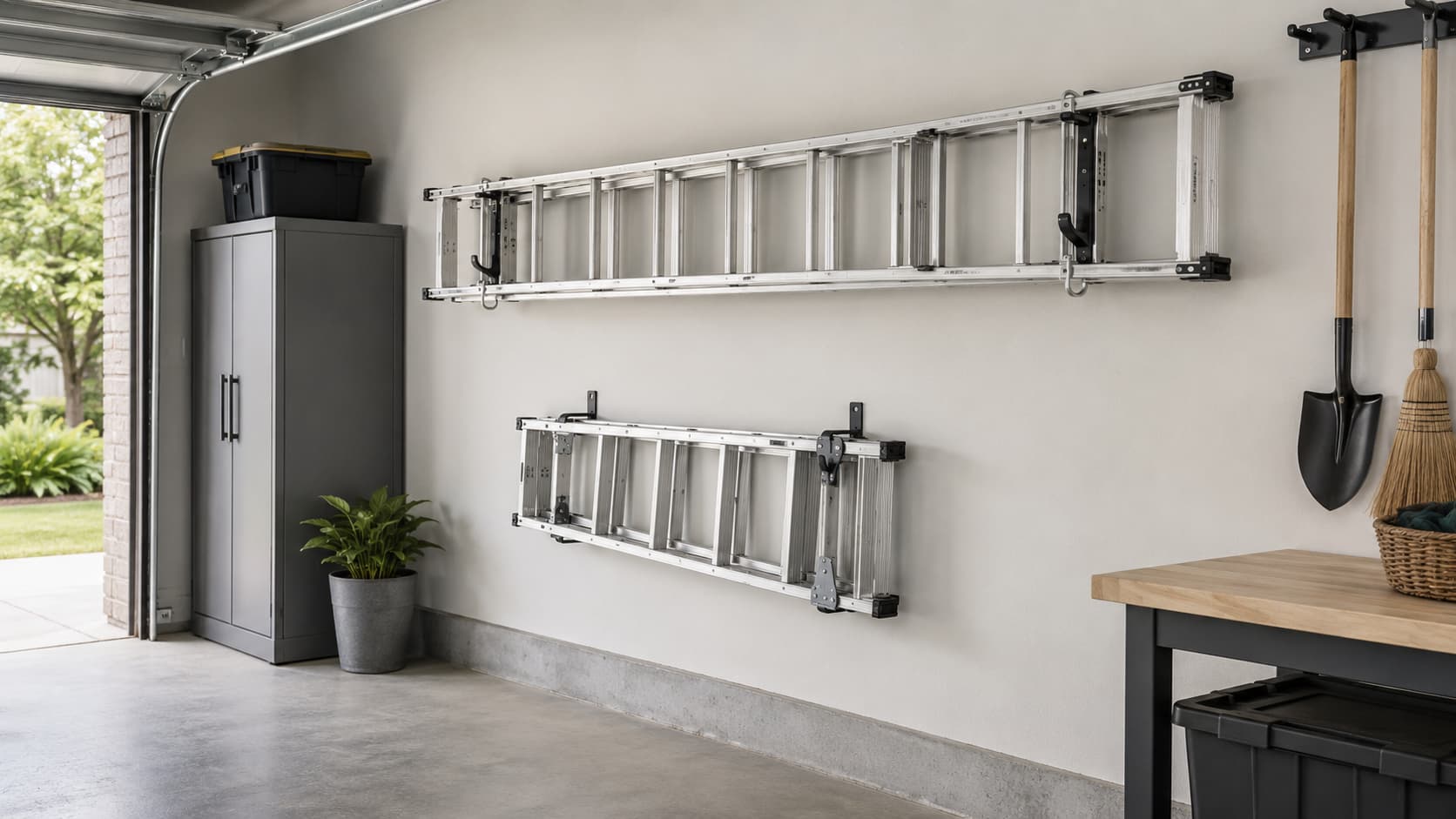
Best Ladder Hooks for Garage Walls
Last updated:
Disclosure: This article contains affiliate links. If you buy through these links, we may earn a commission at no extra cost to you. We do not claim hands-on testing unless clearly stated.
A 24 ft extension ladder leaning against a garage corner steals about three square feet of floor traffic, and tripping over it once is one time too many. Wall-mounting solves that problem — but the right hook depends on two questions: which ladder do you have (step, extension, multi-position), and what mounting geometry do you want (J-hook protruding from the wall, or flat-against-wall hanger)? Most “best ladder hook” lists pick five products that are all 6-pack J-hooks at slightly different price points. We organized this one around ladder type and mounting geometry instead.
The five picks cover the standard residential cases: a heavy-duty general-purpose J-hook (the HORUSDY 6-Pack Wall Hooks), a purpose-built pair for extension ladders with documented heavy-duty material specs (the Wall Mount Ladder Utility Hangers), a 2-pack at the right scale for step ladders (the Comfecto 2-Pack), a four-hook set for hanging ladders flat against the wall (the Ladder Hanger Set of 4), and the Rubbermaid FastTrack ladder hook for buyers with the FastTrack rail ecosystem.
Quick Picks
| Pick | Product | Best for | Type | Main advantage | Watch out for | CTA |
|---|---|---|---|---|---|---|
| Best heavy-duty | HORUSDY 6-Pack Wall Hooks | General-purpose ladder hanging | J-hook (6-pack) | 40 lb listed per hook | J-hook protrudes ~3″ from wall | View on Amazon |
| Best for extension ladders | Wall Mount Ladder Utility Hangers Pair | 16–28 ft extension ladders | Heavy bar-stock pair | 1/2″ solid bar stock pegs, USA-made | No published per-pair lb figure | View on Amazon |
| Best for step ladders | Comfecto 2-Pack Ladder Hook | 4–6 ft folding step ladders | 2-pack utility hook | Right scale + multipurpose | Per-hook lb not explicitly published | View on Amazon |
| Best horizontal hanger | Ladder Hanger Set of 4 | Flat-against-wall storage | Flat hanger set (4 hooks) | Hangs ladders flat — minimal protrusion | Set of 4 — overkill for one ladder | View on Amazon |
| Best with rail system | Rubbermaid FastTrack Ladder Hook | FastTrack rail owners | FastTrack OR wall stud (dual-mount) | 50 lb listed, padded contact, fold-flat | Single hook only — extension ladders need pair | View on Amazon |
How We Selected These Ladder Hooks
We do not claim hands-on testing unless clearly stated. For this guide, we reviewed manufacturer specifications, retailer product pages on Amazon, install documentation where available, and recurring patterns in public buyer discussions about ladder-storage installs in residential garages.
Ladder hooks fail in two common ways: undersized for the ladder weight, or wrong geometry for the ladder rail width. We prioritized products with explicit per-hook capacity (where published) and clear rail-spacing or geometry information that lets a buyer match the hook to their specific ladder.
Selection criteria:
- Capacity figure is published where available. Where not, the manufacturer’s material spec stands in (steel gauge, bar-stock thickness).
- Geometry fit for the declared ladder type — J-hooks and flat hangers serve different storage goals.
- Pair vs. single hook clarity — extension ladders need a pair, step ladders work with a single or pair depending on size.
- Padding for ladder rails — bare-metal hooks scratch aluminum or fiberglass over time; padded contact preserves the rail.
- Mounting flexibility — wall-stud is the standard; dual-mount (stud or rail) is a plus for buyers building out an ecosystem.
What to Look for Before Buying
Ladder type — step, extension, multi-position
The three common residential ladders have different storage geometries:
- Step ladders (4–6 ft, folding A-frame): fold to roughly the rail length × 4–6″. Hung horizontally, they rest cleanly on a 2-hook pair or even a single deep hook for the smallest 4 ft model.
- Extension ladders (16–28 ft, two-section telescoping): always need a pair of hooks. The ladder is too long for a single hook to support.
- Multi-position ladders (e.g., Little Giant style): heavy and reconfigurable. Need a pair, ideally with padded contact since the rails see frequent reconfiguration.
Match the hook to the ladder type, not to the cheapest pack of hooks.
Hook geometry — J-hook vs. flat hanger vs. rail-mount
Three geometries dominate:
- J-hook: a curved hook with the ladder rail resting in the hook’s curve. Ladder hangs ~3″ away from the wall (the hook depth). General purpose.
- Flat hanger (often sold as a set of 4): two hook pairs that hold the ladder flat against the wall, minimizing protrusion. Best for tight garages where walking-path clearance matters.
- Rail-mount hook: clamps into a FastTrack or GearTrack rail’s slot. Same J-hook curve as a stand-alone J-hook, but mount-style is rail-specific. Repositionable on the rail.
The flat hanger is the right choice when garage walking space is tight; the J-hook is the right choice when you want the ladder easily lifted off the hook (handy if the ladder comes down weekly).
Common mistake: a step ladder that keeps sliding off its hook. J-hooks are shaped to cradle a round rail or rung. A step ladder’s folded top step is wider and flatter than a rung, so a curved J-hook often can’t close around it — the ladder rocks loose and eventually drops. If that’s happening, the fix is to switch that ladder to a flat hanger (which holds the step against the wall rather than cradling it), not to buy a bigger J-hook.
Pair vs. single hook
A 6-pack J-hook product gives you 6 single hooks. An extension ladder needs 2 of them spaced 32″–36″ apart. A step ladder works with 1 (for short folding step ladders) or 2 (for taller step ladders). Plan the math before ordering — a 6-pack covers 1 extension ladder + 2 step ladders + 2 spares; a 2-pack covers 1 ladder.
Padding and rail contact
Bare metal hooks scratch aluminum ladder rails over months of mounting and dismounting. Look for a soft coating (rubber, EVA, or padded sleeve) on the contact surface. Fiberglass rails are less easily scratched but still benefit from padding to prevent gel-coat wear. The Rubbermaid FastTrack ladder hook and the HORUSDY 6-Pack Wall Hooks are the article’s two picks with explicitly padded contact (a cast-aluminum gripper pad and non-slip rubber tips, respectively); the others rely on powder-coat finish or anti-rust coating, which is finish-protective rather than ladder-protective.
Wall-stud vs. drywall-anchor mounting
Every product in this article requires anchoring into wood studs. The mounting hardware shipped with each is sized for wood-stud install. Drywall-anchor mounting is not appropriate for hung ladder loads — even a light step ladder concentrates that load onto the anchor, and ladder removal/replacement adds dynamic load that anchors handle poorly.
No exposed studs? Mounting on concrete or block walls
Everything above assumes a wood-stud wall, which is what most attached garages built with standard residential framing have. Detached garages, older homes, and any structure with concrete block, poured concrete, or brick walls don’t have studs to find — and the mounting hardware included with all five picks in this guide is sized for wood-stud installation. None of the five manufacturers publish a masonry-rated capacity.
If your garage wall is masonry, skip the stud finder and switch to masonry-rated hardware: a hammer drill with a carbide masonry bit sized to the anchor, and either sleeve anchors or concrete screws sized to the hook’s existing bolt holes. Because none of the five picks publish a masonry rating, size and space the anchors to your heaviest ladder yourself, rather than assuming the hook’s stud-mount rating carries over to masonry.
Best Heavy-Duty Ladder Hook: HORUSDY 6-Pack Heavy Duty Metal Wall Hooks
Best for: A general-purpose heavy-duty hook that can hang any of the three common ladder types — extension, step, multi-position — in a 6-pack that covers 2–3 ladders plus spares.
HORUSDY 6-Pack Heavy Duty Wall Hooks (40 lb)
Short verdict: Six carbon-steel J-hooks listed at 40 lb each, with rust-resistant powder coating, non-slip rubber tips, and 12 wall anchors plus 12 screws included. A solid baseline pack for a garage starting from zero ladder hooks and likely to acquire more ladders over time.
The 6-pack J-hook approach earns its place in this article because it solves the fleet problem: most homeowners with one ladder eventually acquire a second or third (a step ladder for the house plus an extension for the gutters plus a small folding ladder for the basement). Buying a 6-pack on day one means you don’t reorder, and the spare hooks become tool hooks elsewhere on the same wall later.
Why it stands out
The 40 lb per-hook published capacity is a manufacturer-listed number, which separates this from “heavy-duty” hooks that don’t list one. Six hooks at that rating comfortably cover step ladders and lighter multi-position ladders with spares to go around; a mounted pair totals 80 lb, enough for most ladders in this class but not the heaviest fiberglass extension ladders (see the buyer warning below). Thickened carbon-steel construction with rust-resistant powder coating and non-slip rubber tips at the contact point protects both the hook and the ladder rail from scratching — a detail the previous pick in this slot didn’t have.
It can work well for:
- Households with multiple ladders (step + extension + multi-position)
- Hooks that may move from ladder duty to general-purpose tool storage later
- General-purpose J-hook utility (fits hoses, cords, shovels, tools, and bikes alongside ladders)
- Garages where redundancy (a few extra hooks) is preferable to underspec
- Wood-stud walls with standard 16″ or 24″ centers
If garden tools — rakes, shovels, trimmers — are the main load rather than ladders, our dedicated roundup of garage hooks for garden tools covers hooks built specifically for long-handled tools.
Key specs to check
- 6 J-hooks per pack
- 40 lb manufacturer-listed per hook
- Thickened carbon-steel construction, rust-resistant powder coating
- Non-slip rubber tips at the contact point
- 12 wall anchors + 12 screws included; wall-stud install recommended for ladder loads
Recurring feedback patterns
Recurring feedback patterns for 6-hook multi-packs in this category tend to center on getting enough hardware to outfit a full wall in one order. The rubber-tipped contact points are the kind of detail buyers call out for keeping ladder rails and tool finishes scratch-free compared with bare-metal hooks. Common complaints in this category typically involve wanting a per-hook rating closer to 50 lb for heavier gear, and buyers mounting into brick or block finding pre-drilling necessary despite the included anchors.
Potential drawbacks
The fixed J-curve depth still holds the ladder a few inches off the wall, which is the least space-efficient geometry in this guide. The hooks are sold as a 6-pack rather than matched pairs, so spacing them evenly is on the buyer. At 40 lb per hook, the published rating is lower than the Rubbermaid FastTrack hook’s 50 lb — buyers who want the single highest per-hook number should compare the two.
Buyer warning
J-hook geometry sits the ladder roughly 3″ away from the wall. For tight garages where walking-path clearance matters, the flat Ladder Hanger Set of 4 is the better choice. At 40 lb per hook (manufacturer-listed), a mounted pair totals 80 lb — comfortable for step ladders and most multi-position ladders, but buyers with a heavy fiberglass extension ladder — the heaviest common residential ladder type — should size up to the Wall Mount Ladder Utility Hangers’ dedicated pair instead. The 6-pack count is right for buyers planning to hang multiple ladders or with general-purpose hook needs; for a single ladder, 6 hooks is overkill — buy a 2-pack instead. For broader general garage hooks across multiple categories, the dedicated hook roundup covers more geometries.
Best for Extension Ladders: Wall Mount Ladder Utility Hangers Garage Storage Rack (Pair)
Best for: A single extension ladder (16–28 ft) where you want the heaviest-duty pair available, with documented material specs.
Short verdict: A USA-made pair of ladder hangers built from 1/4″ × 2″ × 8″ steel back plates and 1/2″ solid bar stock pegs, TIG welded and powder-coated. The material spec is the manufacturer’s selling point — this is the pair that doesn’t bend under a fully-extended 28 ft ladder.
Extension ladders are the heaviest common residential ladder type, and a fiberglass extension ladder is heavier than an aluminum one of the same length. That weight, hung on a single hook, exceeds most J-hook capacities. A pair distributes the load and the heavier-bar-stock construction handles the cantilever moment without flexing. The 1/2″ solid bar stock + 1/4″ plate spec is meaningfully thicker than the typical bent-rod hook in 99-cent bins.
Why it stands out
USA-made + welded + powder-coated is the construction quality buyers historically pay premium for, and this product publishes the material specs explicitly. The pair geometry is the right configuration for extension ladders — single-hook hanging stresses the rail in places it isn’t designed to take and can ding aluminum rails over time. With a pair, the ladder rests on two contact points spaced wide enough to support the ladder’s own structural geometry.
It can work well for:
- Single extension ladders (16, 20, 24, 28 ft)
- Heavy fiberglass extension ladders that exceed 80 lb
- Multi-position ladders configured for hanging
- Buyers prioritizing build quality over headline lb figures
- Long-term installs where the hook pair lives on the wall for years
Key specs to check
- Pair (2 hooks) per box
- 1/4″ × 2″ × 8″ steel back plates
- 1/2″ solid bar stock pegs
- TIG welded + powder-coated finish
- Made in USA per manufacturer description
- Wall-stud install with included hardware
Recurring feedback patterns
Recurring feedback patterns suggest the build quality is the headline takeaway — buyers often describe the bar stock as noticeably more substantial than bent-rod hooks, and the welded construction tends to be mentioned as confidence-inspiring under heavy extension ladders. The USA-made framing comes up frequently as a reason buyers chose this over cheaper imports. Common complaints typically involve the absence of a stated weight rating leaving some buyers guessing, and a few mention that the powder-coat finish can chip if the ladder rail is dragged across it during mounting.
Potential drawbacks
There is no published per-pair capacity figure, so buyers who want a hard number have to infer it from the material spec. The heavy steel makes these less forgiving to reposition once mounted, and the pegs sit at a fixed depth that suits rails but is not adjustable for unusually wide ladders.
Buyer warning
The manufacturer doesn’t publish a single per-pair lb figure — the selling point is the material spec, not the headline number. Buyers who want a specific lb claim should look at the HORUSDY 6-Pack Wall Hooks (40 lb per hook) or the Rubbermaid FastTrack hook (50 lb) instead. The material thickness here implies high real-world capacity but isn’t equivalent to a published rating. For multi-position ladders or dedicated extension ladder storage approaches including wall + ceiling combinations, see the focused roundup.
Best for Step Ladders: Comfecto 2-Pack Ladder Hook for Garage Organizer
Best for: A 4–6 ft folding step ladder where a pair of hooks at the right scale is more useful than a 6-pack of full-size J-hooks.
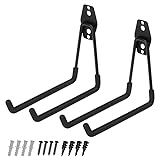
Short verdict: A 2-pack of multi-purpose ladder hooks at the right scale for step ladders, with included mounting screws. Multipurpose: also handles extension cords, garden hoses, folding chairs, ski equipment.
The Comfecto 2-pack is sized for the smaller end of the ladder spectrum. A folded 4 ft step ladder is roughly 4 ft × 14″ × 4″ — small enough that a single hook can support it, but a pair distributes the load better and prevents the ladder from rotating during dismount. Multi-purpose use is the value-add: when you upgrade ladders or move the ladder to a different wall, the hooks aren’t wasted — they become hose hooks, chair hooks, or extension-cord hangers.
Why it stands out
Right scale + multipurpose. A 6-pack of full-size J-hooks is overkill for a single step ladder; a 2-pack at this scale gets you the right hardware without leftover hooks. The multi-purpose framing matters because step ladders frequently get sold or replaced — a hook that has a second life as a hose hanger keeps the install useful.
It can work well for:
- 4 ft and 6 ft folding step ladders
- Multi-fold compact ladders (telescoping aluminum)
- Mixed-use installs where the ladder hook also stores a hose or extension cord
- Garages with limited wall length where 2 hooks fit but 6 don’t
- Renovation projects where the install is intentionally minimal
Key specs to check
- 2 hooks per pack
- Heavy-duty steel construction
- Included mounting screws
- Wall-stud install
- Multipurpose use beyond ladders (chairs, hoses, garden tools)
Recurring feedback patterns
Recurring feedback patterns suggest buyers appreciate the versatility most — the two-hook format gets repurposed for hoses, cords, and folding chairs, and that flexibility is a recurring positive theme. Several buyers mention the vinyl-coated arms holding items without scratching as a welcome touch at this price. Common complaints typically involve the hooks being on the smaller side, so very thick step-ladder rails can be a tight fit, and a few note that the coating can compress over time under repeated heavy loads.
Potential drawbacks
The compact arm length that makes these ideal for step ladders also limits how bulky an item they can cradle. Capacity is communicated only as “heavy-duty” with no lb figure, which leaves heavier loads a judgment call. Being a two-pack, they suit a single ladder rather than a multi-ladder wall.
Buyer warning
Per-hook capacity is not explicitly published in lb. The hooks are sized appropriately for step ladders and similar mid-weight items but should not be used for full-weight extension ladders — those need the Wall Mount Ladder Utility Hangers’ heavier-bar-stock pair. Buyers who need an explicit lb rating should choose the HORUSDY 6-Pack Wall Hooks (40 lb published) instead.
Best Horizontal Ladder Hanger: Ladder Hanger Set of 4 for Garage Wall
Best for: A garage where walking-path clearance is tight and the ladder needs to sit flat against the wall.

Short verdict: A 4-hook set (= two pairs) designed for hanging ladders flat against the wall. Black powder-coated heavy-duty steel. Multipurpose: also handles wheelbarrows, folding chairs, patio furniture.
The “horizontal” or “flat” hanger geometry is what differentiates this slot. Where a J-hook holds the ladder ~3″ off the wall (the hook’s depth), a flat hanger pair holds the ladder rail directly against the wall — the only protrusion is the hook itself, typically about 1″ deep. For a 24 ft extension ladder hung 4 ft above the floor with 8 ft of vertical wall above, the flat-mount approach saves ~3 ft of walking-path depth. That matters in 1- and 2-car residential garages.
Why it stands out
Wall-clearance optimization. The 4-hook set is enough for two ladders side-by-side (one extension + one step ladder, or two step ladders) without ordering a second pack. Multipurpose use means the same hooks can hold a wheelbarrow on one wall section, ladders on another — the steel construction is generic enough to handle both.
It can work well for:
- Tight 1-car residential garages
- 2-car garages where the second bay is heavily used and clearance matters
- Multiple ladders + multipurpose items (wheelbarrow, chairs)
- Workshops where wall clutter accumulates and clearance is a recurring problem
- Buyers planning a flush-mount aesthetic
Key specs to check
- Set of 4 hooks (= two pairs)
- Black powder-coated heavy-duty steel
- Wall-stud install
- Flat-against-wall geometry minimizes protrusion
- Multipurpose: ladders + wheelbarrows + folding chairs
Recurring feedback patterns
Recurring feedback patterns suggest the space savings is what buyers notice first — the flat-mount geometry reclaiming walking-path depth is a recurring positive theme, especially in tight single-car garages. Buyers often mention the four-hook count being enough to hang two items without a second order. Common complaints typically involve the hooks needing careful spacing to balance a ladder, since a misaligned pair lets the ladder slide, and a few note that the black finish shows scuffs where metal rails rub.
Potential drawbacks
The flat geometry assumes the ladder rails sit relatively close together, so it stabilizes wide-spread older ladders less cleanly than a J-hook would. There is no published lb rating, only a heavy-duty descriptor. For a buyer with just one ladder, four hooks is more hardware than the job needs.
Buyer warning
A 4-hook set is overkill for a single ladder. Buyers with one extension ladder need a single pair (2 hooks) — the Wall Mount Ladder Utility Hangers’ USA-made pair is the right product for that use case, with documented heavier material specs. Choose this 4-hook set when you have multiple items to mount or want spare hardware for future installs. Also note: the flat-against-wall geometry assumes the ladder rails sit relatively close together; older ladders with wider rail spreads may not stabilize as cleanly on this hook style as on a J-hook. If you have an unusual ladder, measure the rail width before ordering and confirm the hook’s published spread (where listed) matches.
Best with Rail System: Rubbermaid FastTrack Ladder Hook
Best for: A reader who already owns or plans to install a Rubbermaid FastTrack rail and wants the rail-system version of a ladder hook.
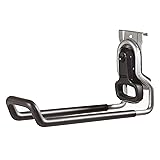
Short verdict: A 50 lb manufacturer-listed ladder hook with padded ladder contact and dual-mount hardware (cast aluminum gripper for FastTrack rail OR wood-stud screws for direct wall-mount). Folds flat when not in use.
The FastTrack Ladder Hook combines a published lb figure (50 lb), padded ladder contact, dual-mount hardware, and a fold-flat design — no other pick in this article combines all four. The padding matters more than people expect — aluminum extension ladders develop visible scratches on the rails after a year of repeated mounting on bare-metal hooks, and fiberglass rails see gel-coat wear. The padded contact preserves both. The dual-mount design means buyers without a FastTrack rail can still use the hook on a wall stud directly, then add the FastTrack rail later if they expand the storage system. For more on FastTrack and the broader ecosystem, see our roundup of wall-mounted garage storage systems.
Why it stands out
The combination of dual-mount + padded contact + fold-flat + 50 lb published is unique in this article. Other picks bring some of those features but not all. The fold-flat feature is a small thing that adds up: the hook tucks against the wall when no ladder is hanging, freeing the wall area for other uses or just looking cleaner.
It can work well for:
- FastTrack-equipped garages adding ladder storage to the rail
- Single ladders where the dual-mount future-proofs the install
- Aluminum or fiberglass ladders sensitive to rail scratching
- High-traffic walls where the fold-flat feature reclaims clearance
- Buyers building out the FastTrack accessory ecosystem incrementally
Key specs to check
- 50 lb manufacturer-listed capacity
- Cast aluminum gripper (FastTrack rail) OR direct wall-stud screws
- Padded ladder contact surface
- Folds flat against wall when not in use
- Satin nickel powder-coat finish
- Compatible with Rubbermaid FastTrack rails — NOT Gladiator GearTrack
Recurring feedback patterns
Recurring feedback patterns suggest buyers already invested in the FastTrack system value how cleanly this hook clicks into the rail and repositions without tools — that integration is a recurring positive theme. The padded contact protecting ladder rails is frequently mentioned as a differentiator over bare-metal hooks. Common complaints typically involve confusion at purchase over the single-hook quantity, with several buyers expecting a pair, and occasional mentions that the fold-flat hinge feels light relative to the loads people want to hang.
Potential drawbacks
It ships as one hook, so any extension-ladder install means buying two. The dual-mount versatility is tied to the FastTrack ecosystem and explicitly excludes Gladiator GearTrack rails, narrowing compatibility. The fold-flat hinge adds a moving part that a fixed hook does not have.
Buyer warning
This is a single hook. Extension ladders need a pair — buy two FastTrack ladder hooks for an extension ladder, or use the Wall Mount Ladder Utility Hangers’ USA-made pair instead. The hook does NOT fit Gladiator GearTrack rails (different track profile). For general garage hooks across multiple geometries and brands, the dedicated hook roundup covers wider options.
Side-by-Side Comparison
| Product | Best for | Type | Capacity | Mounting | Main advantage | Watch out for |
|---|---|---|---|---|---|---|
| HORUSDY 6-Pack Wall Hooks | Heavy-duty general-purpose | J-hook (6) | 50 lb each | Wall stud | Right baseline pack | Protrudes ~3″ |
| Wall Mount Ladder Utility Hangers Pair | Extension ladders | Heavy-pair | Heavy bar-stock (no published lb) | Wall stud | USA-made, 1/2″ solid bar | No published lb figure |
| Comfecto 2-Pack | Step ladders | 2-pack utility hook | Heavy-duty (no lb published) | Wall stud | Right scale + multipurpose | Per-hook lb not published |
| Ladder Hanger Set of 4 | Horizontal storage | Flat hanger set (4) | Heavy-duty | Wall stud | Flat-against-wall, ~1″ protrusion | Set of 4 — overkill for one ladder |
| Rubbermaid FastTrack Ladder Hook | Rail-system ladder hook | FastTrack OR wall stud | 50 lb | Wall stud or FastTrack rail | Padded + fold-flat | Single hook only; FastTrack-only ecosystem |
Step vs. Extension vs. Multi-Position — Which Hook Geometry?
Three ladder types map to four hook geometries differently. Use this matrix to pick the geometry first, then the specific product.
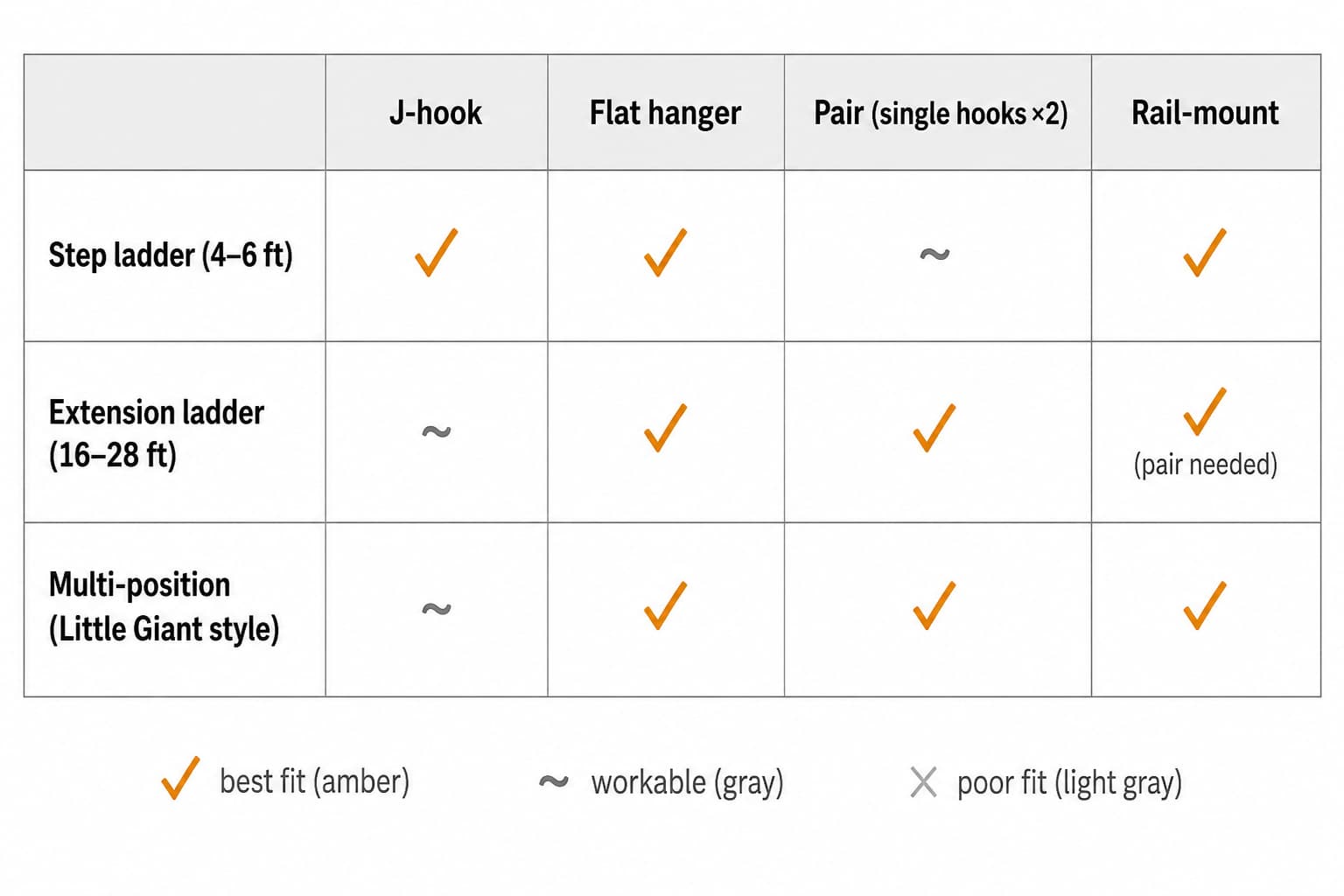
A few notes on the mapping:
- Step ladders (4–6 ft) are flexible — any of the four geometries work. Choose based on wall clearance preference and aesthetics.
- Extension ladders (16–28 ft) need a pair regardless of geometry. Single-hook installs stress the rails wrongly and add risk.
- Multi-position ladders (Little Giant style) are heavy and reconfigurable; they need a pair, ideally with padded contact since the rails see frequent reconfiguration.
What a garage hook actually holds — and what the wall behind it holds
A pegboard hook and a rail hook look like the same tool and are rated five times apart: Wall Control publishes 5–10 lb for a single-slot pegboard hook, Gladiator publishes 50 lb for a rail utility hook. This table puts the published per-hook ratings side by side, then works out how many of each a standard wall run supports at full load before the panel or rail — not the hook — becomes the limit.
| Hook | System it mounts to | Published rating | Backing capacity | Fully loaded hooks before the backing is the limit | Specification source | Source checked |
|---|---|---|---|---|---|---|
| Wall Control pegboard hook, single slot | Pegboard (Wall Control metal panel) | 5–10 lb per hook | 200 lb — 16 × 32 in panel into studs | 20 hooks | Wall Control pegboard how-to | 2026-08-14 |
| Wall Control pegboard hook, two slots | Pegboard (Wall Control metal panel) | 10–15 lb per hook | 200 lb — 16 × 32 in panel into studs | 13 hooks | Wall Control pegboard how-to | 2026-08-14 |
| Gladiator Utility Hook | Rail / slatwall (Gladiator GearTrack, GearWall) | 50 lb per hook | 300 lb — 4 ft GearTrack channel at 75 lb per linear foot | 6 hooks | Gladiator Utility Hook | 2026-08-14 |
How these numbers were produced: Per-hook ratings are quoted from the manufacturer’s own page or published guidance on the date shown. The last column is arithmetic: the backing system’s published capacity divided by the top of the hook’s rating range, rounded down. Pegboard hooks are measured against one 16 × 32 in Wall Control panel fixed into studs (200 lb); rail hooks against a 4 ft GearTrack channel at its published 75 lb per linear foot (300 lb). Substitute your own run length and the ratio moves with it.
- Ranges are published as ranges for a reason. Wall Control states outright that it will not publish ‘specific and idealistic laboratory load ratings’ because real capacity depends on installation quality, substrate, hook choice and load distribution — treat the top of a range as a ceiling you should not design against.
- Into studs or into drywall changes everything: Wall Control publishes 200 lb per panel into studs against 100 lb on drywall anchors. Halve the last column accordingly if you did not hit a stud.
- The counts assume every hook is loaded to its maximum at the same time, which is the worst case and the one worth planning for.
- A hook rating says nothing about leverage. A long-handled tool hung by its head puts far more load on the fixing than its weight suggests.
- A blank cell means the manufacturer does not publish that figure — we do not fill gaps with numbers we could not source.
These are the entries that matter for this guide. The full table, with every row and its source, is in our What a garage hook actually holds — and what the wall behind it holds.
How to Measure Before Buying
Before adding any of these to cart, measure (and write down):
- Ladder rail width — outer-to-outer dimension between the two rails (typical 17″–19″ for residential extension ladders)
- Ladder weight — empty weight plus any attached accessories
- Ladder length — full extended length and folded length (extension ladders fold to roughly half their extended length)
- Available wall length — horizontal run available for mounting hooks
- Stud direction & spacing — vertical studs, 16″ or 24″ on center
- Walking-path clearance — how much the protruding ladder + hook can take from the walking path
- Ceiling height above the proposed mount — important for the flat hanger set, where the ladder hangs vertically along the wall
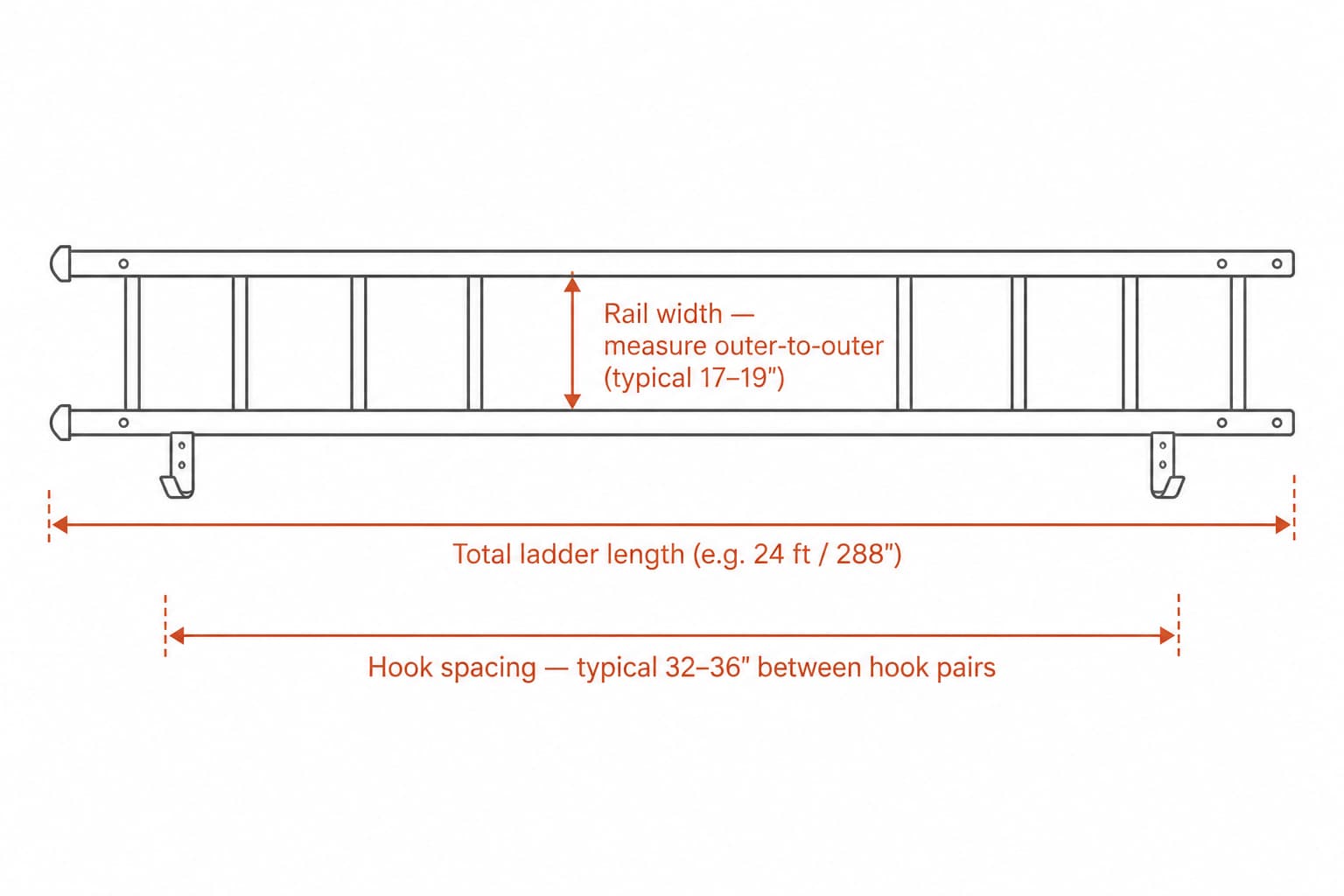
For most wall-mount installs, a hook spacing of 32″–36″ between the two hooks of a pair is the standard. Tighter spacing concentrates load; wider spacing leaves the ladder rails unsupported in the middle.
Common Complaints and Buyer Warnings
Single hook for an extension ladder
A 24 ft extension ladder hung on a single hook is a liability. The rail flexes, the hook bends, and over time the install fails — sometimes catastrophically when the ladder finally drops while you’re under it. Always use a pair for extension ladders.
Drywall-anchor mounting
Drywall anchors are not for ladder hooks. Even a light folding step ladder concentrated on a single anchor exceeds typical drywall-anchor static-load capacity, and the dynamic load from removing/replacing the ladder makes it worse. Always anchor into wood studs. If your wall has no accessible studs, add wood blocking before installing. For more on garage hook capacity claims and mounting types, the broader hook roundup covers the full taxonomy.
Hook spacing wrong for ladder rail width
Hooks spaced too close don’t support the ladder; spaced too wide leaves rails unsupported in the middle. The right spacing for most extension ladders is 32″–36″ between hooks. Measure the ladder rail width first, then plan the hook spacing on the wall accordingly. Standard 16″ stud spacing means hooks land at 16″, 32″, 48″, 64″, etc. — pick the spacing closest to your ladder’s geometry.
Who Should Avoid Wall-Mounted Ladder Storage
- Renters who can’t drill into walls. Wall-mount hardware requires permanent install. Renters without permission to drill should use free-standing ladder racks or store ladders against a wall with rubber feet to prevent slipping.
- Garages with metal-framed walls. The hardware shipped with these products is sized for wood studs. Metal framing requires different anchors.
- Ladders heavier than the listed capacity. Confirm your ladder weight before relying on a published lb figure. Extension ladders are the heaviest common type, aluminum is lighter than fiberglass of the same length, and length itself is the biggest factor — check the manufacturer’s spec sheet for your specific model rather than assuming a weight.
- Buyers who want a complete wall storage system. A standalone ladder hook is a single-purpose tool. For broader wall-mounted garage storage systems, the dedicated systems roundup includes ladder accessories within larger ecosystems.
FAQ
How much weight can a ladder hook hold?
It depends on the specific product. The hooks in this article range from 40 lb (the HORUSDY 6-Pack Wall Hooks) to 50 lb manufacturer-listed (the Rubbermaid FastTrack hook) to undocumented heavy-duty material specs (the Wall Mount Ladder Utility Hangers, the Comfecto 2-Pack, and the Ladder Hanger Set of 4). Always check the listing for an explicit per-hook or per-pair lb figure where available, and use the material spec (1/2″ solid bar stock vs. bent rod) as a secondary signal.
Do extension ladders need two hooks or one?
Two. An extension ladder is too long and heavy for single-hook hanging — the rails flex, the hook bends, and the install fails over time. The standard configuration is a pair of hooks spaced 32″–36″ apart.
Can I use ladder hooks for other items too?
Most ladder hooks in this article are multi-purpose. The Comfecto 2-Pack and the Ladder Hanger Set of 4 explicitly support folding chairs, wheelbarrows, hoses, garden tools, and patio furniture. The HORUSDY 6-Pack Wall Hooks are general-purpose. The Rubbermaid FastTrack Ladder Hook is ladder-specific because of the padded contact.
Will the hook scratch my ladder?
Bare-metal hooks scratch aluminum rails over months of mounting and dismounting. Fiberglass rails are less easily scratched but still benefit from padding. The Rubbermaid FastTrack Ladder Hook and the HORUSDY 6-Pack Wall Hooks are the article’s two featured picks with explicit padded contact. The other picks rely on powder-coat finish (which protects the hook, not the ladder rail).
Can I mount ladder hooks on drywall without studs?
Not reliably. Drywall anchors are not for ladder loads — even a light step ladder concentrates that load onto a single anchor. Always anchor into wood studs, or add wood blocking behind the drywall before installing.
Can I mount these hooks on a concrete or block garage wall?
Not with the hardware included in the box — that’s sized for wood studs. You’ll need separate masonry anchors (concrete screws or sleeve anchors) matched to the wall material, installed with a hammer drill and a carbide masonry bit. None of the five picks in this guide publish a masonry-specific capacity, so size the anchor to your ladder’s weight yourself rather than assuming the stud rating applies.
What’s the difference between a J-hook and a flat hanger?
J-hooks have a curved hook that holds the ladder rail in the curve, with the ladder protruding ~3″ from the wall. Flat hangers hold the ladder rail directly against the wall, minimizing protrusion to about 1″. Flat hangers are better for tight garages where walking-path clearance matters; J-hooks are better when you want to lift the ladder off the hook easily.
Sources Reviewed
For this guide, we reviewed manufacturer product information from each of the brands featured, retailer specifications on Amazon and brand sites, install documentation where available, and recurring discussions in garage organization communities. We focused on details that change the install or use case: per-hook capacity figures (where published), geometry fit for declared ladder type, pair vs. single hook configuration, padded ladder contact, and dual-mount flexibility (wall stud OR rail system).
Related Guides
- Best garage hooks for wall storage
- Best wall-mounted garage storage systems
- Best extension ladder storage approaches
- Best garage bike storage
- Best free-standing garage shelving
- Garage Organization Products
- How to Choose Seasonal Garage Storage Solutions
- How to Organize Garage Tools Without a Pegboard
- how to start organizing a cluttered garage
- Pegboard