Best Garage Hooks for Wall Storage
Last updated:
Disclosure: This article contains affiliate links. If you buy through these links, we may earn a commission at no extra cost to you. We do not claim hands-on testing unless clearly stated.
Hook capacity claims are slippery. A box labeled “heavy-duty 100 lb hook” sometimes lists 30 lb when you read the spec; “industrial-strength” without a number means whatever the seller wants it to mean. We picked six hooks across six use cases — heavy-duty utility, ladders, bikes, hoses, multi-purpose mixed packs, and rail-system accessories — and only featured products with manufacturer-published per-hook capacity. Where two products share a brand (HORUSDY 6-pack vs. 10-pack; Rubbermaid FastTrack ladder hook vs. bike hook), we explain why both earn a place here.
Two questions before picking a hook: do you have a rail system already (FastTrack, GearTrack, or slatwall), and what’s the heaviest single thing the hook will hold? The first question splits the picks into stand-alone and rail-mount; the second tells you which capacity tier to look for. Get those two right and the rest is matching geometry to gear.
Quick Picks
| Pick | Product | Best for | Type | Main advantage | Watch out for | CTA |
|---|---|---|---|---|---|---|
| Best heavy-duty utility | HORUSDY 6-Pack Heavy Duty Metal Wall Hooks | Mid-weight tools, cords, bags | Stand-alone J-hook (6-pack) | 30–40 lb listed per hook | Generic geometry; specialized items may need purpose-built hooks | View on Amazon |
| Best for ladders | Rubbermaid FastTrack Ladder Hook | Single ladder hung horizontally | Stand-alone OR FastTrack rail | 50 lb listed; padded contact; folds flat | Single hook only; extension ladders may need a pair | View on Amazon |
| Best for bikes | Delta Cycle Leonardo Da Vinci Single Bike Hook | Standard bikes vertically wall-mounted | Stand-alone wall-stud hook | 40 lb listed; rubber-coated rim contact + tire tray | Fat-tire bikes need the XL variant (separate ASIN) | View on Amazon |
| Best for hoses | Yard Butler IHCWM-1 Deluxe Wall Mount Hose Hanger | 5/8″ hoses up to 125 ft | Stand-alone wall-stud hose hanger | 12-gauge powder-coated steel; lifetime warranty | Geometry sized for 5/8″ hose; 3/4″ hoses fit but not optimal | View on Amazon |
| Best multi-purpose hook kit | HORUSDY 10-Pack Garage Hooks (9″ + 6″ Mix) | Mixed gear in one purchase | Stand-alone (10-pack mixed sizes) | 6 × 9″ (66 lb each) + 4 × 6″ (40 lb each) | Two sizes only — no specialty geometries | View on Amazon |
| Best with rail system | Rubbermaid FastTrack Vertical Bike Hook | Bike storage on a FastTrack rail | FastTrack-compatible | 50 lb listed; cast aluminum gripper | NEEDS a FastTrack rail (or wall-stud install) | View on Amazon |
How We Selected These Garage Hooks
We do not claim hands-on testing unless clearly stated. For this guide, we reviewed manufacturer specifications from HORUSDY, Rubbermaid, Delta Cycle, and Yard Butler; retailer product pages; product documentation where available; and recurring patterns in public buyer discussions about residential garage hook installs.
Hook capacity is the field most often misrepresented in this category, so we prioritized products with explicit per-hook lb figures published on either the Amazon listing or the manufacturer page. We also weighted dual-mount flexibility (a hook that works on wall studs OR a rail covers more readers than a rail-only accessory) and matched the editorial label to the product’s real geometry.
Selection criteria:
- Per-hook capacity is published — not just total-pack capacity or “heavy-duty” without a figure.
- Geometry matches the declared use (J-hook, vertical bike hook, hose-spiral hanger, ladder-padded hook, rail-gripper hook).
- Mounting clarity — the listing tells you whether the hook needs a stud, an anchor, or a rail.
- Coating and rim contact is appropriate (rubber for bikes; powder-coat for hoses to resist water; bare steel acceptable for tools).
- Pack composition is honestly described — single product or mixed pack, with the count and sizes per box.
What to Look for Before Buying
Per-hook capacity vs. total pack capacity
A “10-pack 100-pound hooks” box can mean 100 lb per hook (1,000 lb total) or 100 lb total spread across 10 hooks (10 lb each). The difference is enormous. Read the per-hook capacity, not the pack total. Where both numbers are published, use the per-hook figure for planning.
Hook geometry
There are five common shapes, and they’re not interchangeable:
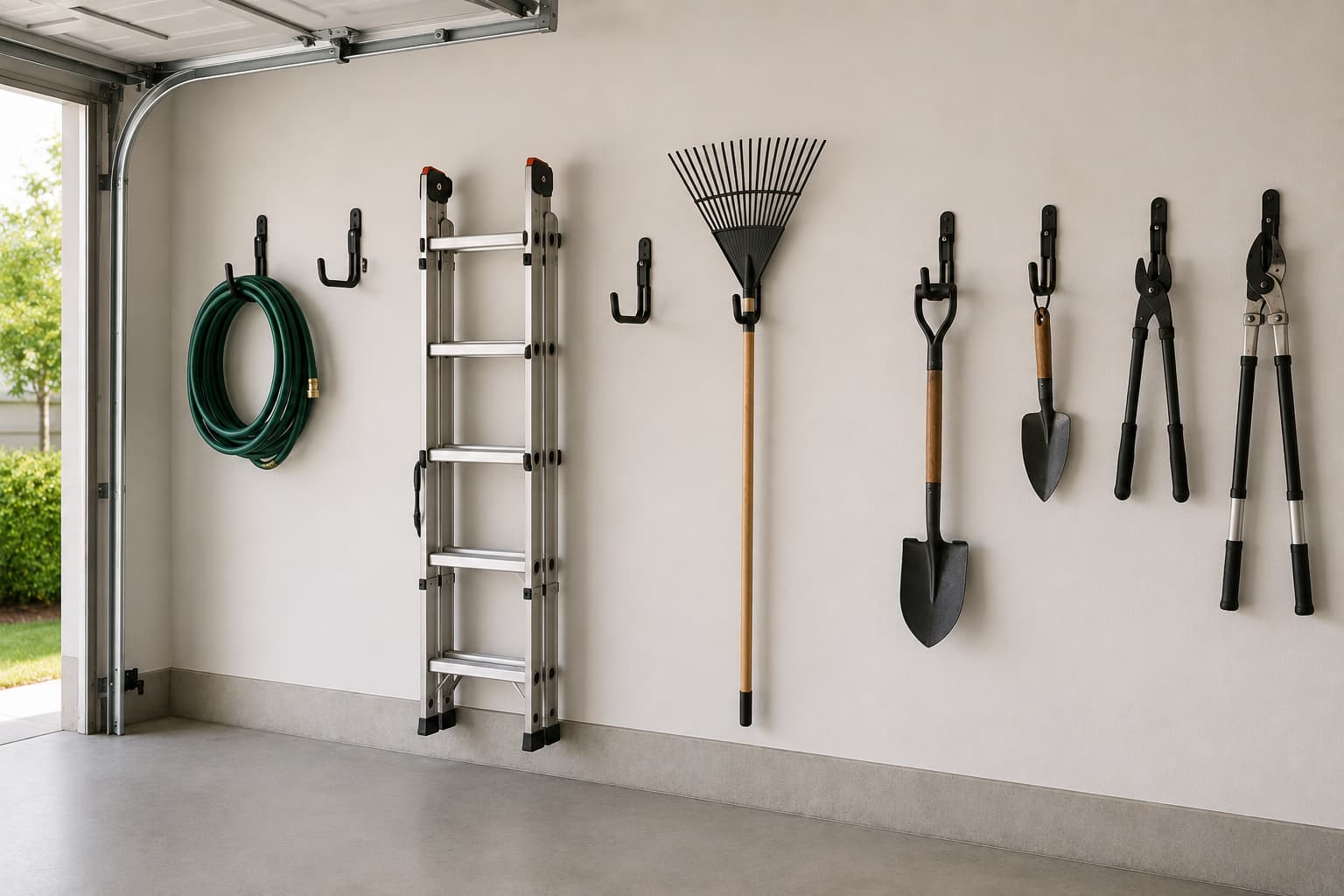
- J-hook (a curved hook): general purpose, fine for hoses if no spiral, fine for tools, fine for cords.
- Utility hook (J-hook with longer arm): fits longer items, slightly more capacity per hook.
- Vertical bike hook: a single hook angled to hold the front rim of a bike vertically; almost always padded.
- Hose hanger (a spiral or wide-curve hanger): designed to coil 50–125 ft of garden hose without crimping.
- Rail-mount hook: fitted with a clamp/gripper to fit a specific rail profile (FastTrack, GearTrack, slatwall).
Match the geometry to the gear. A J-hook can hold a hose, but the spiral on a dedicated hose hanger handles 100 ft of hose without kinks the way a J-hook can’t.
Mounting style
Every product in this article requires either a wood stud, a wall anchor, or a rail. The mounting style sets your install:
- Wall-stud hooks are the default — most reliable, holds the published capacity figure when anchored into solid wood.
- Drywall-anchor hooks work for light items (under ~20 lb) and small décor; not for the heavy gear most buyers come here for.
- Rail-mount hooks require the matching rail (FastTrack, GearTrack, slatwall) — a rail-mount bike hook in a garage with no rail won’t mount.
Coating and rim contact
For bikes, look for rubber-coated hook surfaces — bare metal scratches rim paint over months of repeated mounting/unmounting. For hoses, powder-coated steel resists water-stain rust longer than bare steel. For tools, EVA padding is nice but optional; bare steel is fine for hand tools that don’t have soft surfaces against the hook.
Pack size vs. piece-by-piece purchase
Bulk packs (6, 10, 20+) are cost-effective when you need that many hooks. Piece-by-piece purchases of specialty hooks (a single bike hook, a single ladder hook) are right when you need exactly one geometry and don’t need bulk. Don’t buy a 10-pack for the discount if you only need 3 hooks — the rest will accumulate in a drawer.
Best Heavy-Duty Utility Hooks: HORUSDY 6-Pack Heavy Duty Metal Wall Hooks
Best for: A reader who needs roughly half a dozen general-purpose wall hooks for tools, extension cords, bags, and mid-weight gear.

Short verdict: Six large J-hooks in thick carbon steel with anti-rust coating, listed at 30–40 lb per hook, with EVA tube protective layer. The right baseline pack for a reader starting from zero garage hooks.
The HORUSDY 6-pack is the category’s broadly-recommended starter pack. Each hook is a J-shape with a flat mounting plate and two screw holes — standard wall-stud install with the included screws and anchors. The carbon-steel construction is heavier than the bent-rod hooks you find in 99-cent bins, and the EVA layer over the metal tube prevents abrasion against tool handles, hose reels, and bag straps stored on the hook for long periods.
Why it stands out
J-hook geometry is general purpose without being mediocre at any of its uses. A long-handle rake, a coiled extension cord, a tool tote with a strap, a folding chair — all hang from this hook. The 6-pack count is right for one wall section (roughly 4–6 feet of wall covered, with hooks spaced 8–12 inches apart). Upgrading to the HORUSDY 10-pack mixed-size kit makes sense once you’ve used these and want more variety.
It can work well for:
- Long-handled yard tools (rakes, brooms, leaf blowers)
- Extension cords and air hoses
- Tool totes with hanging straps
- Folding chairs and step stools
- Sports gear with a hanging loop (helmets via strap, gym bags)
Key specs to check
- 6 hooks per pack, J-hook geometry
- Carbon steel construction with EVA protective tube layer
- Black anti-rust coating
- Manufacturer-listed 30–40 lb per hook
- Wall-stud install with included screws and anchors
Recurring feedback patterns
Owners consistently point to the heft of the carbon steel relative to thin bent-rod hooks, and the EVA tube layer comes up often as the reason tool handles and straps don’t get chewed up over time. The recurring complaint involves the included drywall anchors being treated as a substitute for studs — buyers who skip the stud and rely on the plastic anchors report sag under heavier loads, which is consistent with the manufacturer’s wall-stud install guidance. Several buyers also note the J-hook depth is shallow for bulky bagged items, so loose totes can slip off if not looped properly.
Potential drawbacks
The generic J-hook geometry is a jack-of-all-trades, master of none: it handles cords, rakes, and strapped gear well but is not optimized for any single specialty item. The depth of the hook curve limits how securely a wide or smooth-bottomed item sits, and the six-count pack covers only one short wall section, so larger garages will need a second pack.
Buyer warning
J-hook geometry doesn’t fit every use case. A bike rim won’t hang stably on a generic J-hook the way it does on the Delta Leonardo bike hook; a 75-foot garden hose won’t coil cleanly on a J-hook the way it does on the Yard Butler hose hanger. For specialty gear, buy the purpose-built hook even if you already have these.
Best for Ladders: Rubbermaid FastTrack Ladder Hook
Best for: A reader hanging a single ladder horizontally and wants a purpose-built ladder hook that mounts to wall studs OR (if you already have one) a FastTrack rail.
Short verdict: Rubbermaid’s dedicated ladder hook with a 50 lb manufacturer-listed capacity, padded ladder-contact surface, satin nickel powder-coat finish, and dual-mount flexibility — wall studs or FastTrack rail, included hardware for both.
The FastTrack Ladder Hook is the rare hook that ships with two mounting options in the same box. Cast aluminum gripper for FastTrack rails, plus standard screw holes for direct wall-stud install. The hook itself folds flat against the wall when not in use, which matters when you’re hanging the hook in a high-traffic area like above a workbench.
Why it stands out
The padded ladder contact is what separates this from a generic J-hook. Aluminum or fiberglass ladder rails get scratched fast on bare-metal hooks; the soft coating on the FastTrack ladder hook avoids that. The 50 lb listed capacity is generous for a single ladder — most residential extension ladders weigh 20–35 lb empty. The fold-flat feature is a small touch that adds up over a year of use.
It can work well for:
- Single-section step ladders (4 ft, 6 ft, 8 ft)
- Multi-section extension ladders (with a second hook for the bottom rail — most install in pairs)
- Aluminum or fiberglass ladders
- Wall storage where the ladder needs to come off frequently
- FastTrack-equipped garages where the hook can move along the rail
Key specs to check
- 50 lb manufacturer-listed capacity
- Cast aluminum gripper for FastTrack rail OR direct wall-stud screws
- Padded ladder contact surface (won’t scratch rails)
- Folds flat against wall when not in use
- Satin nickel powder-coat finish
Recurring feedback patterns
The dual-mount design draws the most consistent praise — owners appreciate that the same hook works whether or not they already run a FastTrack rail, and the padded contact surface is often praised for keeping fiberglass and aluminum ladder rails scratch-free. Where buyers run into trouble is expectations: assuming a single hook will cradle a long extension ladder, which tips or rolls until a second hook is added, exactly as the manufacturer recommends. A few buyers also mention the FastTrack gripper feels loose until the locking screw is fully tightened.
Potential drawbacks
It is a single hook, so anything long or top-heavy realistically needs two, doubling the cost for extension-ladder owners. The fold-flat hinge and gripper add a few more parts than a plain screw-in hook, which means a slightly longer install, and the satin-nickel finish is more decorative than industrial if you want a uniform black hook wall.
Buyer warning
This is a single hook. Extension ladders that exceed 50 lb (or are awkward to carry on one arm) need a pair — buy two. For dedicated ladder-storage roundups including extension-ladder pairs and horizontal multi-ladder racks, see our best ladder hooks for garage walls guide.
Best for Bikes: Delta Cycle Leonardo Da Vinci Single Bike Hook
Best for: A reader hanging a single standard bike vertically against a garage wall, with anti-scratch padding and a tire tray that protects the wall.

Short verdict: The most-recommended vertical wall-mount bike hook in the category. 40 lb manufacturer-listed capacity, rubber-coated front-rim contact, peel-and-stick rear tire tray, single-stud install. Holds a standard bike vertically by the front wheel.
The Leonardo Da Vinci hook is purpose-built around two failure modes generic J-hooks have: rim scratches and wall scuff. The rubber coating on the hook itself means the front rim stays unmarked through repeated daily use; the rear tire tray (a small adhesive-mounted shelf) catches the rear tire’s contact point and prevents the wheel from leaving rubber marks on drywall or paint.
Why it stands out
Vertical hanging is the right answer for residential garages because it stores a bike in roughly 12 inches of wall depth — much less than horizontal hanging. The Leonardo’s hook geometry is angled correctly for the front rim to settle into a stable position without rolling forward, and the included peel-and-stick rear tray takes about thirty seconds to install. The single-stud mount is the simplest install in this article — find a stud, drive in two screws, hang.
It can work well for:
- Standard road bikes
- Standard mountain bikes (non-fat-tire)
- Hybrid commuters
- Children’s bikes (the same hook scales down)
- Bikes that come down at least once a month (frequent removal benefits from the rubber rim contact)
Key specs to check
- 40 lb manufacturer-listed capacity (standard model)
- Single wood-stud mount, included hardware
- Rubber-coated rim hook (won’t scratch rims)
- Peel-and-stick rear tire tray included
- Anti-scratch coating throughout
Recurring feedback patterns
The rubber-coated rim contact is the detail buyers mention most — owners storing a bike that comes down frequently note the rim stays unmarked, and the rear tire tray is often called out for keeping wall paint clean. Installation is where the pattern of complaints concentrates: buyers who mount into drywall without finding a stud report the hook pulling loose, which tracks with the wood-stud requirement. It’s also worth noting that heavier bikes approach the listed 40 lb figure quickly once accessories are added, so weight headroom is thinner than it first appears.
Potential drawbacks
The 40 lb listed capacity leaves little margin for e-bikes or heavily accessorized frames, pushing those buyers to the separate XL variant. Vertical hanging by the front wheel also puts the full bike weight on one rim, which is fine for standard bikes but not ideal for wheels with delicate rims, and the single-bike design means a multi-bike household needs one hook per bike.
Buyer warning
This is the standard 40 lb Leonardo. Fat-tire bikes (5″+ tires, e-bikes with heavy frames) need the XL variant — Delta sells a Leonardo Hook & Tray version with 50 lb capacity (separate ASIN). E-bikes especially can exceed 40 lb empty before adding battery and accessories; weigh your bike before assuming the standard hook fits. For a wider bike-storage roundup including ceiling-mount and floor-stand options, see our best garage bike storage guide.
Best for Hoses: Yard Butler IHCWM-1 Deluxe Wall Mount Hose Hanger
Best for: A reader with a 50–125 ft garden hose who wants a dedicated hose hanger that handles the full hose length without sagging.

Short verdict: A 12-gauge powder-coated steel wall-mounted hose hanger with patented heavy-duty bracing. Manufacturer lists capacity at 125 ft of 5/8″ hose. Decorative weathered Verdigris finish is the standard variant; multiple decorative finishes available under similar SKUs.
Coiling a 100-foot garden hose on a generic J-hook is a recipe for kinks, slow water flow, and a hose that gets a permanent set. Yard Butler’s spiral-bracket design holds the hose in wide loops that keep the inner diameter open and let the hose retain shape over years. The 12-gauge powder-coated steel resists rust in damp garages and outdoor patio installs alike.
Why it stands out
The patented bracing is the difference. A generic flat-plate hose hanger sags under the weight of a 100-foot hose because the bracket has only one connection point to the wall. Yard Butler’s design has extra bracing that triangulates the load — the wall takes the weight at two points, and the hose loop stays parallel to the wall instead of pulling outward. The lifetime warranty against material defects is notable in a category where most competitors offer 1–2 years.
Unlike the multi-purpose hooks elsewhere in this article, this hanger doesn’t ask you to weigh which item it fits — the spiral bracket is built for one job. It handles 50 ft, 75 ft, 100 ft, or 125 ft of 5/8″ hose and similar-diameter hot-water washdown hoses, holds up in an outdoor patio install thanks to the powder coat, mounts as easily next to a hose bib as anywhere else on the wall, and pairs naturally with other Yard Butler garden tools if the brand is already on your wall.
Key specs to check
- 12-gauge powder-coated steel construction
- Patented heavy-duty bracing
- Manufacturer-listed capacity 125 ft of 5/8″ hose
- Lifetime warranty against material defects
- Wall-stud or masonry mount, included hardware
Recurring feedback patterns
What stands out across buyer feedback is the heavy 12-gauge steel and patented bracing — owners with long 100 ft hoses note the hanger holds the full coil without bending away from the wall, unlike lighter flat-plate hangers. The lifetime warranty is frequently cited as a confidence factor in a category full of disposable parts. Where the pattern breaks down is mounting hardware: buyers installing into masonry or brick often mention the supplied screws suit wood studs better, so a separate masonry anchor kit is sometimes needed.
Potential drawbacks
The spiral geometry is optimized for 5/8″ hose, so owners with 3/4″ or thicker hoses find the wrap tight and the coil harder to seat. The decorative Verdigris finish is a styling choice that won’t match an all-black utilitarian hook wall, and the robust steel construction makes this heavier and bulkier than a simple hose hook — overkill if you only store a short 25 ft hose.
Buyer warning
The geometry is sized for 5/8″ hose. Larger 3/4″ hoses fit but the spiral wrap is tighter, and over time the hose may take a permanent loop set that’s hard to undo. For 3/4″ hoses, look at oversized hose hangers or a dedicated garage hose storage approach with a reel instead.
Best Multi-Purpose Hook Kit: HORUSDY 10-Pack Garage Hooks (9″ + 6″ Mix)
Best for: A reader covering most of a garage’s hook needs in one purchase — six big hooks plus four medium hooks, two geometries, ten total.

Short verdict: A 10-pack mixed kit: six 9-inch hooks (manufacturer-listed 66 lb each) and four 6-inch hooks (40 lb each). Tubular steel with an EVA protective layer and anti-rust coating. The most versatile single-box hook purchase in this article.
The 9-inch hooks handle big items: snowboards, kayaks, surfboards, ladders, longer-handle tools, multi-loop coiled cords. The 6-inch hooks handle the rest: shorter tools, gym bags, smaller bins, mid-weight gear that doesn’t need the long arm. Together they cover roughly 90% of typical garage hook use cases without forcing you to buy two separate packs.
Why it stands out
The capacity differentiation between the two sizes is the value. A 10-pack of identical hooks would lock you into one geometry; this kit gives you the flexibility to handle big items on the long hooks and small items on the short hooks without compromise on either. The EVA protective layer matters more than it sounds — repeated mounting and dismounting wears bare metal against tool handles and gear straps, and the EVA layer extends both the gear’s life and the hook’s appearance.
It can work well for:
- Whole-garage hook layouts (1–2 walls’ worth of hooks)
- Mixed gear collections (yard tools + sports gear + cords + bags)
- Workshop walls combining short and long item storage
- Garages where the storage mix evolves over time
- Renters in single-family rentals (with permission to drill into stud walls)
Key specs to check
- 6 × 9-inch hooks: manufacturer-listed 66 lb per hook
- 4 × 6-inch hooks: manufacturer-listed 40 lb per hook
- Tubular steel construction with EVA protective layer
- Anti-rust coating, black finish
- 12 pairs of screws and wall plugs included for plasterboard, wood studs, or masonry
Recurring feedback patterns
The value-per-hook and the two-size mix draw the most positive comments from buyers — owners outfitting a whole wall in one purchase note the 9-inch hooks swallow bulky gear (snowboards, kayaks) while the 6-inch hooks handle the everyday clutter. The included assortment of screws and wall plugs for different wall types is often mentioned as a convenience. On the downside, the larger 9-inch hooks flex if loaded near their listed limit, and some buyers note that ten hooks is more than a small garage needs, leaving spares unused.
Potential drawbacks
You commit to exactly two geometries, so the kit can’t cover specialty needs like a padded bike rim or a hose spiral. The long 9-inch hooks project well off the wall, which can intrude on walking clearance in a tight garage, and a value mixed pack like this favors versatility over the heavier single-purpose build of a dedicated hook.
For a pegboard or rail-mounted alternative covering similar mixed gear, see our roundup of garden tool organizers for garage walls where the dedicated tool-rack approach handles the same use cases differently.
Buyer warning
Two sizes only. If you need a specialty geometry — a vertical bike hook, a hose-specific spiral hanger, a ladder-padded hook — neither the 9-inch nor the 6-inch covers it. Buy the relevant purpose-built hook covered elsewhere in this article, not this kit. The 10-pack is the right answer for general-purpose mixed gear; not for specialty needs.
Best with Rail System: Rubbermaid FastTrack Vertical Bike Hook
Best for: A reader who already owns a Rubbermaid FastTrack rail and wants to add bike storage to it.

Short verdict: A FastTrack-compatible vertical bike hook with a cast-aluminum gripper that snaps into the FastTrack rail’s C-channel slot. 50 lb manufacturer-listed, designed for 12″–26″ frame bikes. Distinct from the wall-stud-mount Delta Leonardo bike hook covered above.
The cast-aluminum gripper is what makes this a rail-only product. Slide the hook along the FastTrack rail, snap it into position, and tighten the locking screw — the hook is fixed at that horizontal position but can be repositioned later by loosening and sliding. That repositionability is the rail’s value: as your gear collection changes, you reorganize the wall without re-drilling. For more on the FastTrack ecosystem and how a rail compares to standalone hooks, see our roundup of wall-mounted garage storage systems.
Key specs to check
- 50 lb manufacturer-listed capacity
- Cast aluminum gripper sized for FastTrack rail’s C-channel slot
- Designed for 12″–26″ bike frame range per Rubbermaid
- Compatible only with Rubbermaid FastTrack — NOT Gladiator GearTrack
- Black powder-coat finish
The rail requirement above is the one spec that decides whether the rest of this card applies to you at all — worth checking before reading why it stands out.
Why it stands out
Repositionability + dedicated geometry. A standalone bike hook is fixed once you screw it into a stud — to move it, you patch and re-drill. The FastTrack version slides along the rail to wherever the bike best fits, which matters when you re-arrange the garage seasonally or add a second bike. The 50 lb capacity is higher than the standard Leonardo (40 lb) — useful for slightly heavier e-bikes if your e-bike is under the 50 lb limit.
It can work well for:
- FastTrack-equipped garages adding bike storage
- Mixed FastTrack rails where a bike hook sits alongside ladder hooks and utility hooks on the same rail
- Garages where the bike hook position needs to change occasionally
- E-bikes and slightly heavier bikes (under 50 lb)
- Buyers who want a single ecosystem with broad accessory variety
Recurring feedback patterns
What FastTrack owners value most is the repositionability — being able to slide the hook along the rail and re-lock it without patching drywall comes up repeatedly as the reason buyers chose the rail version over a fixed stud hook. The cast-aluminum gripper is often described as solid once the locking screw is set. Complaints almost always trace back to the rail requirement: buyers who order it without owning a FastTrack rail discover it won’t mount standalone, which is consistent with its rail-specific design.
Potential drawbacks
The hook is useless without the matching FastTrack rail, so the true cost includes the rail system if you don’t already own it. It is locked to the Rubbermaid ecosystem and will not fit Gladiator GearTrack or slatwall, and while the 50 lb listed capacity edges out the standard Leonardo, it is still a single-bike hook rather than a multi-bike solution.
Buyer warning
This hook needs the FastTrack rail. Without the rail, it does not mount. Some retailers ship the hook with a wall-stud bracket adapter as a fallback, but that adapter is sold separately by Rubbermaid as well — confirm what’s in your specific shipment. The most expensive mistake here is buying the FastTrack bike hook expecting it to work standalone, then discovering you also need the rail (additional purchase). If you don’t already own FastTrack, the Delta Leonardo bike hook is the right standalone bike pick for the same use case.
Side-by-Side Comparison
| Product | Best for | Type | Capacity (manufacturer-listed) | Mounting | Main advantage | Watch out for |
|---|---|---|---|---|---|---|
| HORUSDY 6-Pack J-Hooks | Heavy-duty utility | Stand-alone (6) | 30–40 lb each | Wall stud or anchor | Right starter pack | Generic geometry |
| FastTrack Ladder Hook | Ladders | Stand-alone OR FastTrack rail | 50 lb | Wall stud or rail | Padded ladder contact, fold-flat | Single hook only |
| Delta Leonardo | Bikes | Stand-alone | 40 lb | Single wood stud | Rubber rim coating + tire tray | Fat-tire needs XL |
| Yard Butler IHCWM-1 | Hoses | Stand-alone | 125 ft of 5/8″ hose | Wall stud or masonry | Patented bracing, lifetime warranty | Sized for 5/8″ |
| HORUSDY 10-Pack Mix | Multi-purpose | Stand-alone (6 + 4) | 66 lb / 40 lb | Wall stud, anchor, masonry | Two sizes in one box | Two sizes only |
| FastTrack Vertical Bike Hook | Bikes on rail | FastTrack rail | 50 lb | FastTrack rail | Repositionable on rail | Needs rail |
Stand-Alone Hooks vs. Rail-System Hooks — Which Do You Need?
The biggest mistake in this category is buying a rail-system hook without owning the rail. Use this matrix to map your current garage setup to the right hook category before picking a specific product.
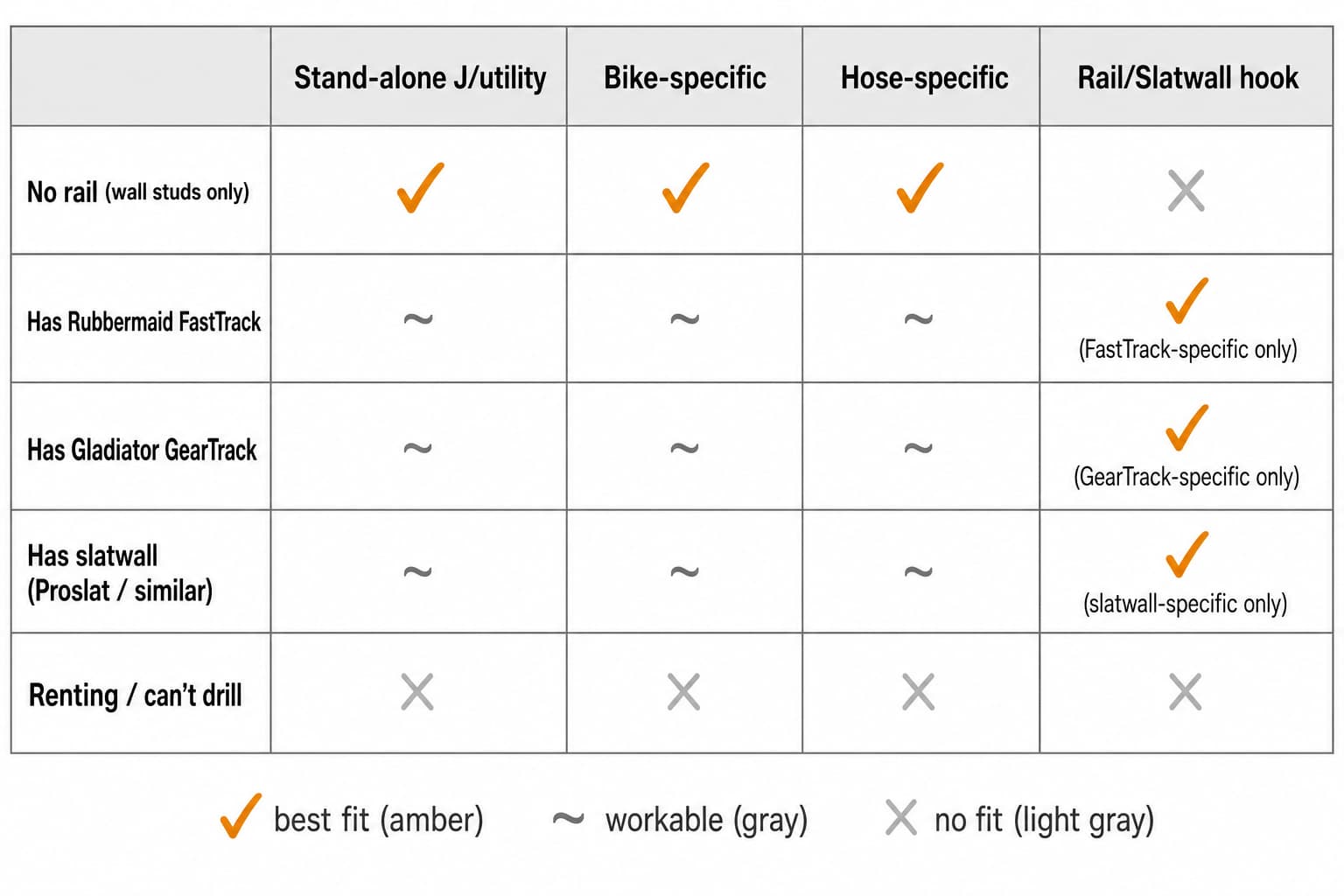
A few notes on the mapping:
- No rail (just wall studs) is the most common case. Stand-alone J/utility hooks, bike-specific hooks, and hose-specific hooks all work. Rail-mount hooks need a rail you don’t have.
- FastTrack rail owners get full access to FastTrack-specific hooks (like the FastTrack vertical bike hook) plus the option to use stand-alone hooks elsewhere on the wall. Don’t buy GearTrack hooks — they won’t fit.
- GearTrack rail owners get GearTrack-specific hooks plus stand-alone option. Don’t buy FastTrack hooks.
- Slatwall owners use slatwall-specific hooks (Proslat, Gladiator GearWall, etc.) — different mounting again. See our garage bike storage guide for slatwall-compatible bike hooks.
- Renting / can’t drill is the case where this whole category struggles. Command-strip hooks and tension-rod alternatives exist but don’t carry the loads this article addresses.
What a garage hook actually holds — and what the wall behind it holds
A pegboard hook, a slatwall hook, an adhesive strip hook and a screw-in hook all look like the same idea and are rated wildly apart: Wall Control publishes 5–10 lb for a single-slot pegboard hook, National Hardware publishes 290 lb for a heavy-duty screw hook driven into a joist. This table puts the published per-hook (or per-fastener) ratings side by side. Where the same page that publishes the hook’s rating also publishes the backing’s total capacity, we work out how many hooks it takes before the panel — not the hook — becomes the limit; where the backing’s total lives on a different page than the one we cite for the hook, is a distributed per-square-foot rating, an adhesive strip, or a screw driven straight into wood, that comparison does not hold up and the table says so instead of forcing one.
| Hook | System it mounts to | Published rating | Backing capacity | Fully loaded hooks before the backing is the limit | Specification source | Source checked |
|---|---|---|---|---|---|---|
| Command X-Large Utility Hook | Adhesive strip (no panel or rail) | 10 lb per hook | Not applicable — mounts by adhesive strip directly to the wall surface | Not applicable — the 10 lb rating is the full-system limit; there is no separate backing to divide against | Command X-Large Utility Hook (product packaging, via retailer listing) | 2026-09-21 |
| National Hardware Large Storage Screw Hook (N112-022) | Direct screw-in (into stud or joist, no panel or rail) | 50 lb safe working load | Not applicable — screws directly into wood, no separate backing panel | Not applicable — the rating already is the fastener’s own limit | National Hardware Large Storage Screw Hook product page | 2026-09-21 |
| National Hardware Heavy Duty Screw Hook (N220-830 / 2154BC) | Direct screw-in (into stud or joist, no panel or rail) | 290 lb safe working load | Not applicable — screws directly into wood, no separate backing panel | Not applicable — see method | National Hardware Heavy Duty Screw Hook product page | 2026-09-21 |
How these numbers were produced: Per-hook ratings are quoted from the manufacturer’s own page or published guidance on the date shown. Where that same page also publishes a fixed total capacity for a specific panel length, the last column divides that total by the top of the hook’s rating range, rounded down: pegboard hooks against one 16 × 32 in Wall Control panel fixed into studs (200 lb). Gladiator’s GearTrack channel is separately published at 75 lb per linear foot (300 lb for a 4 ft channel) on Gladiator’s own channel page, but not on the individual hook pages this table cites for their ratings, so no panel-level count is computed for Gladiator rail hooks either — the figure is real, it just isn’t carried by the row’s own source. Slatwall hook ratings (Proslat, storeWALL) are quoted as the manufacturer’s own ‘maximum recommended weight capacity’ — a figure that already assumes correct panel or InstallStrip installation — so no separate panel-level division is done for these; dividing a per-square-foot distributed rating by a single point-load hook would overstate what the panel is actually rated for, so we don’t. Adhesive strip hooks (Command) and screw-in hooks (National Hardware) mount with no separate backing panel or rail to divide against, so the published rating is the full-system limit as-is.
- Ranges are published as ranges for a reason. Wall Control states outright that it will not publish ‘specific and idealistic laboratory load ratings’ because real capacity depends on installation quality, substrate, hook choice and load distribution — treat the top of a range as a ceiling you should not design against.
- Into studs or into drywall changes everything: Wall Control publishes 200 lb per panel into studs against 100 lb on drywall anchors. Halve the last column accordingly if you did not hit a stud.
- The panel counts assume every hook is loaded to its maximum at the same time, which is the worst case and the one worth planning for.
- A hook rating says nothing about leverage. A long-handled tool hung by its head puts far more load on the fixing than its weight suggests.
- Not every hook in this table has a panel-level count. Where the manufacturer’s own number is already the full-system limit — slatwall hooks, adhesive strip hooks, screw-in hooks — or where the backing’s total is published on a different page than the one we cite for the hook’s own rating — Gladiator’s rail hooks — the ‘before the backing is the limit’ column says so rather than inventing a count the row’s own source doesn’t support.
- Slatwall hook ratings from Proslat and storeWALL assume the panel is installed the way the manufacturer specifies (Proslat’s own panel hardware; storeWALL’s InstallStrips). Mounting the same panel by screwing through its face into studs instead is documented by storeWALL as reducing capacity — check the manufacturer’s own installation guidance before relying on the number in this table.
- Adhesive strip hooks (Command) depend entirely on the mounting surface — the published rating assumes a clean, smooth, properly primed surface at room temperature. Painted cinderblock, textured drywall, cold garages, and previously-used adhesive spots all reduce real-world hold.
- A blank cell means the manufacturer does not publish that figure — we do not fill gaps with numbers we could not source.
These are the entries that matter for this guide. The full table, with every row and its source, is in our What a garage hook actually holds — and what the wall behind it holds.
How to Measure Before Buying
Before adding any hook to cart, measure (and write down):
- Stud-finder pattern along the proposed mounting wall — confirm regular 16″ or 24″ centers
- Wall material — drywall (1/2″), drywall over OSB or plywood, or bare framing
- Item dimensions that will go on the hook (width, depth, weight)
- Item attachment point — is there a hanging loop, a rim, a handle, or a strap that will sit on the hook?
- Ceiling clearance above the hook (for items that hang vertically — bikes, ladders, snowboards)
- Door clearance if the hook is near a garage door or interior door
- Rail spec if you already own a rail (FastTrack vs. GearTrack vs. slatwall — they’re not interchangeable)
For longest items (extension ladders, snowboards, surfboards), pre-measure the hung length and confirm it doesn’t intrude into walking paths or vehicle clearance.
Common Complaints and Buyer Warnings
“Heavy-duty” labels without published per-hook capacity
This is the single most common letdown. A box that says “heavy-duty” or “industrial-strength” but doesn’t publish a per-hook lb figure is a hook the seller doesn’t want measured. Skip it. Every hook in this article has its capacity figure on the manufacturer’s page or the Amazon listing — that’s the bar. Check the listing description, not the marketing copy.
Buying rail-mount hooks without owning a rail
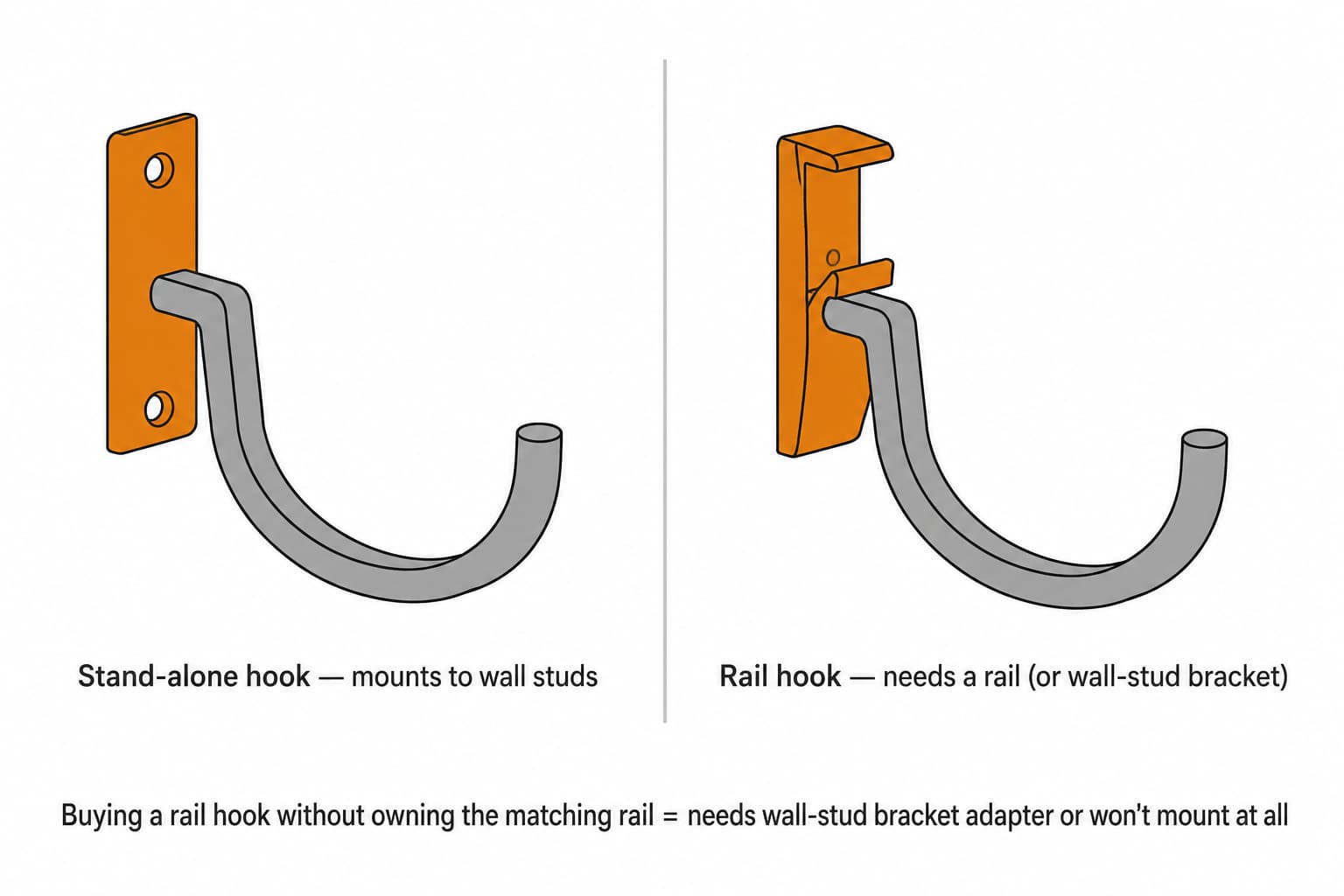
The FastTrack and GearTrack hooks ship with a gripper, not a flat mounting plate. The gripper is designed to clamp into a rail’s profile slot — it has no wall-mount capability on its own. Some hooks (like the Rubbermaid FastTrack ladder hook) ship with both options; most don’t. Read the product page carefully, and if you don’t see “wall stud” listed as a mounting option, assume you need the matching rail.
Drywall-anchor mounting for anything over 20 lb
Drywall anchors are not for heavy garage gear. The toggle-bolt and butterfly-anchor families have published capacities of 25–50 lb in 1/2″ drywall, but those are static-load capacities — not the loads garage hooks see when you yank a tool down with one hand or hang a freshly-loaded bag. Always anchor into wood studs for anything that will see real-world use beyond decorative weight.
For dedicated garage hose storage, including reel-based systems that don’t depend on a single hook, see our roundup of garage hose storage approaches.
Who Should Avoid Standalone Garage Hooks?
- Apartment renters who can’t drill into walls. Command-strip hooks and over-door hangers are the right answer for the kind of weight a rental apartment garage stores; the picks in this article are too heavy for adhesive-only mounts.
- Garages with metal-stud walls. The mounting hardware in every product here is sized for wood studs. Metal framing requires different anchors — check with the framing supplier.
- Buyers who need 20+ hooks of varied geometry. At that point, a complete rail or slatwall system (see our roundup of wall-mounted garage storage systems) is more cost- and time-efficient than 20 separate hooks.
FAQ
How much weight can a “heavy-duty” garage hook actually hold?
It depends entirely on what the manufacturer publishes. The 6 hooks in this article range from 30 lb (HORUSDY 6-pack J-hooks) to 125 ft of 5/8″ hose (Yard Butler) per manufacturer figures. “Heavy-duty” without a number is marketing copy. Always check the listing for an explicit per-hook lb figure before buying.
Can I use any hook with a FastTrack or GearTrack rail?
No. Each rail brand has its own profile, and hook grippers are sized for that specific profile. A FastTrack hook (cast aluminum gripper) does not fit a Gladiator GearTrack rail (curved PVC slot). Buy the hook that matches your rail — or buy a stand-alone hook that mounts directly to wall studs and ignore rail compatibility.
Are drywall anchors enough for garage hooks?
For light items under ~20 lb, yes. For anything heavier, no. The hooks in this article are sized for gear that exceeds drywall-anchor capacity — anchor into wood studs. If your wall has no accessible studs, consider adding wood blocking behind the drywall before installing.
Do bike hooks scratch the rim?
Generic J-hooks can scratch rim paint over months of repeated mounting and dismounting. Purpose-built bike hooks (like the Delta Leonardo) have rubber-coated rim contact specifically to prevent this. If you mount and dismount the bike weekly, choose a rubber-coated hook; if it’s permanent storage, a coated J-hook is also acceptable.
How do I store a 50-foot vs. 100-foot hose?
A 50-foot hose fits on most generic J-hooks if coiled in tight loops. A 100-foot or 125-foot hose needs a dedicated hose hanger (like the Yard Butler hose hanger) — the spiral wrap geometry keeps the loops wide enough to avoid kinks and permanent set. Reel-based systems are a third option; they cost more but eliminate kinks entirely.
Can hooks handle stuff hanging from the ceiling, not the wall?
Wall hooks and ceiling hooks are different. Wall hooks transfer load horizontally into the wall; ceiling hooks transfer load vertically through joists. The hooks in this article are wall-mount only — for ceiling-mounted bike hoists or other ceiling-storage approaches, see a dedicated ceiling-storage roundup.
Sources Reviewed
For this guide, we reviewed manufacturer product information from HORUSDY, Rubbermaid, Delta Cycle, and Yard Butler; retailer specifications on Amazon and brand sites; product documentation including install guides where available; and recurring discussions in garage organization communities. We focused on details that change the install or use case: per-hook capacity figures, geometry fit for declared use, mounting flexibility (wall stud vs. drywall anchor vs. rail), and rim/handle contact materials.
Related Guides
- Best wall-mounted garage storage systems
- Best ladder hooks for garage walls
- Best garden tool organizers for garage walls
- Best garage bike storage
- Best garage hose storage
- best garage organization products for beginners
- How to Choose Seasonal Garage Storage Solutions
- How to Organize a Garage on a Budget
- How to Set Up a Tool Wall in Your Garage
- best pegboard for heavy tools garage