How to Choose a Garage Pegboard, Slatwall, or Rail System
Last updated:
Disclosure: This article contains affiliate links. If you buy through these links, we may earn a commission at no extra cost to you. We do not claim hands-on testing unless clearly stated.
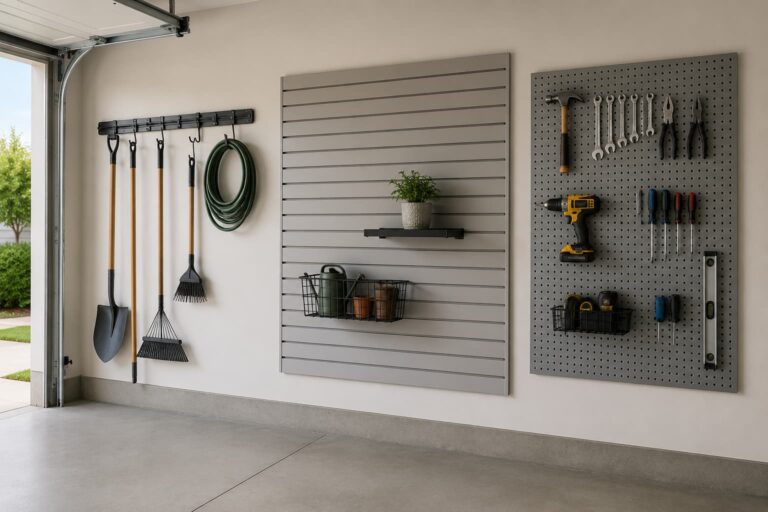
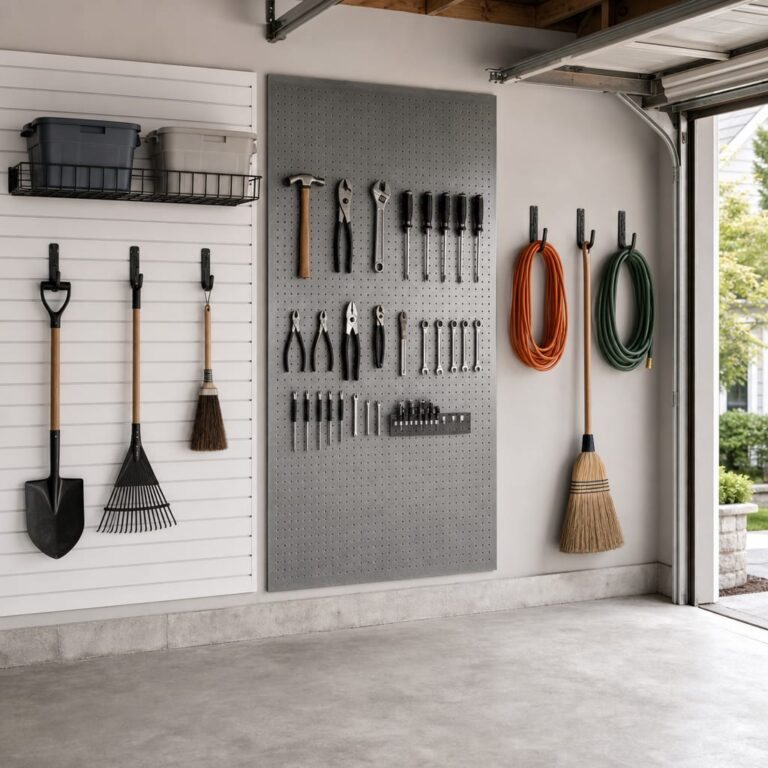
Pegboard is cheap and limited. Slatwall is flexible but commits you to a full wall. Rail is the middle ground — slim, accessory-rich, but not for heavy bulk. Picking the right one starts with what you store, not with what looks tidy in photos. This guide covers the three main wall-storage systems on the market, what each does well, where each fails, and a decision frame for matching system to inventory. We don’t pick specific products here — for those, see our wall-mounted systems roundup, the slatwall roundup, or the pegboard guide — but you’ll be able to read any of those roundups with confidence by the time you finish reading.
Quick Recommendation by Use Case
| Use case | Best system | Why |
|---|---|---|
| Hand tools, light items, weekend tinkerer | Pegboard | Cheapest entry; lowest install commitment |
| Mixed tools + bikes + sports gear + bins | Slatwall | Hooks anywhere; full-wall flexibility |
| Garden tools, brooms, slim accessories | Rail / track | Slim profile, accessory-rich, easy install |
| Heavy bulk (paint, fluids, tool cases) | Wall-mounted shelving (different category) | Pegboard, slatwall, and rail all overload |
| Renter avoiding major drilling | Pegboard (smallest hole pattern) | Easiest to patch on move-out |
| Coastal / humid garage | Slatwall PVC or steel rail | Hardboard pegboard absorbs moisture |
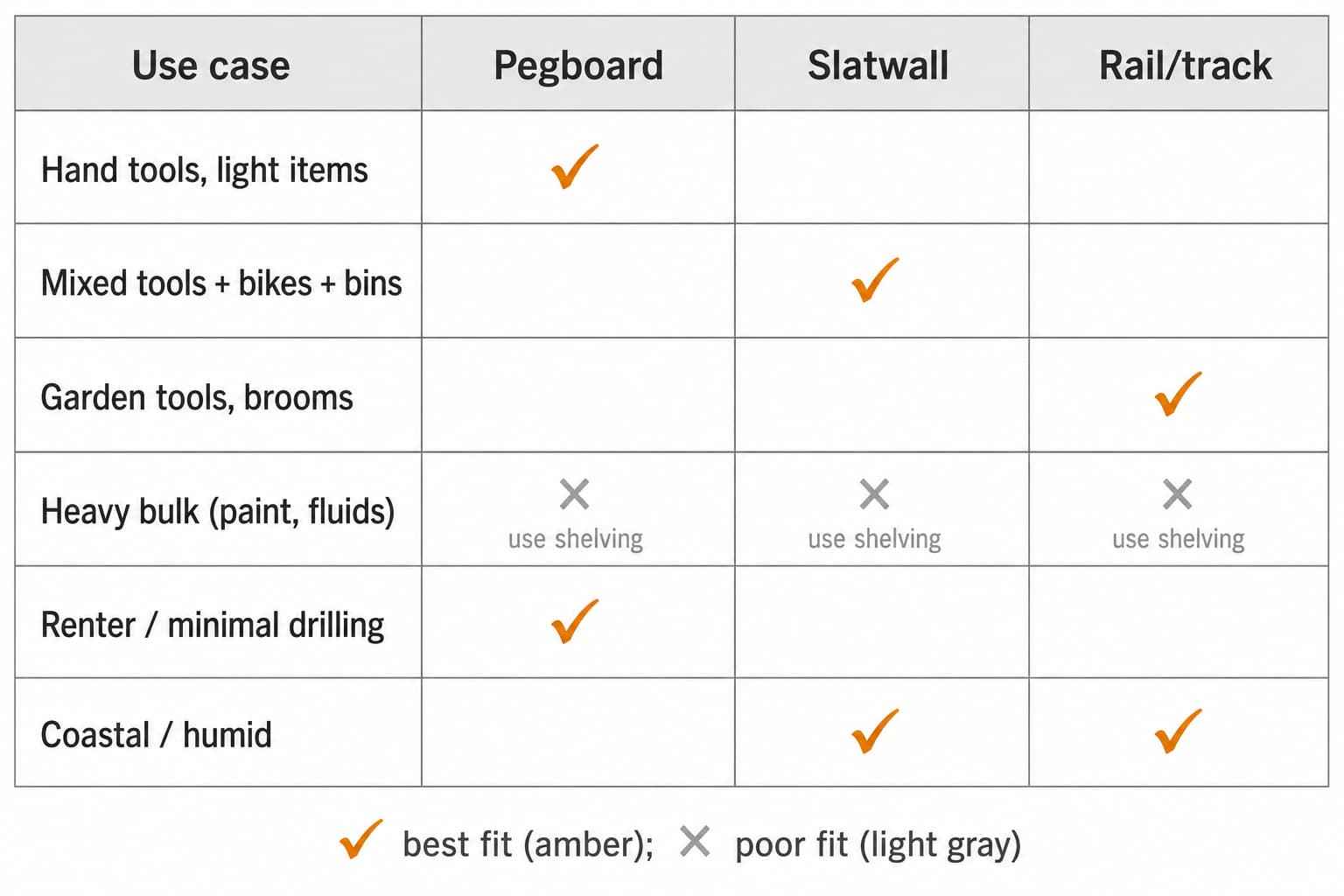
For full per-product picks behind each row, our slatwall roundup covers slatwall-specific picks and the pegboard-vs-slatwall comparison goes deeper on the first two options.
Key Factors to Consider
Capacity per square foot vs per hook
Pegboard’s binding constraint is usually per-hook capacity, not the board’s overall rating — the hook itself bends or rotates out of the hole under load well before hardboard pegboard fails outright, and hardboard specifically doesn’t carry a per-square-foot capacity we could verify on a manufacturer page. Slatwall capacity is sourced and higher: Gladiator’s GearWall panels are manufacturer-listed at 50 lb per square foot on drywall over wood studs, Proslat’s PVC slatwall is manufacturer-listed at 75 lb per square foot. Rail or track systems are usually rated by the hook, not by the rail itself — the rail just holds whatever the hook can carry, typically 25 to 50 lb per hook for standard Gladiator GearTrack accessories. The takeaway: per-square-foot ratings are headline numbers; what you can actually hang is bounded by the individual hook spec.
Install effort and wall commitment
Pegboard installs fastest. A 4-by-8 hardboard sheet takes 30 to 45 minutes, anchored every 16 inches into studs, with 1/4-inch spacers behind the board so hooks have room to seat. Slatwall takes 60 to 90 minutes for an 8-by-4 section, hidden-screw or trim-piece mounted, requires a level reference along the wall. Rail or track is the fastest at the segment level — 15 to 20 minutes per 48-inch rail — but you typically install multiple rails for full coverage. For a renter, pegboard has the smallest patch-on-move-out hole pattern of the three.
Accessory ecosystem
Pegboard uses generic universal hooks — any hardware store stocks them, the system is open. Slatwall accessories are usually brand-specific: Gladiator slatwall accepts Gladiator hooks and baskets, Proslat slatwall accepts Proslat (and most generic slatwall-profile) accessories. Rail and track systems are almost always brand-locked: Gladiator GearTrack only accepts Gladiator-compatible hooks. Budget the accessory cost — a bare panel or rail stores nothing.
Material durability in unheated garages
Hardboard pegboard absorbs moisture; over years it swells or sags. Metal pegboard (sheet steel) is immune to humidity and can carry more weight per hook. PVC slatwall (Proslat) is moisture-immune; steel slatwall is durable but heavier and more expensive. Steel rail and track are durable with no moisture concern. The pattern: in coastal or persistently humid garages, choose PVC slatwall, metal pegboard, or steel rail — not hardboard pegboard.
Reconfigurability
Slatwall reconfigures fastest because hooks slide along the slats without re-mounting hardware. Pegboard re-pegging is also fast — pull and replace, no tools. Rail and track systems are slower because hooks lock at specific points along the rail (Gladiator’s GearTrack uses 1- to 2-inch spacing depending on the accessory); slightly less granular than slatwall but still reconfigurable.
Wall coverage area
Pegboard comes in 2-by-4 (8 sq ft) or 4-by-4 (16 sq ft) panels, with a 4-by-8 (32 sq ft) option for full coverage. Slatwall typically ships in 8-by-4 sections (32 sq ft from Proslat) or smaller multi-pack panels (Gladiator GearWall ships 4-foot panels in 2-packs covering 8 linear feet). Rail and track are linear — 48 inches per channel, bands at one height rather than coverage area.
Product Types Explained
Pegboard
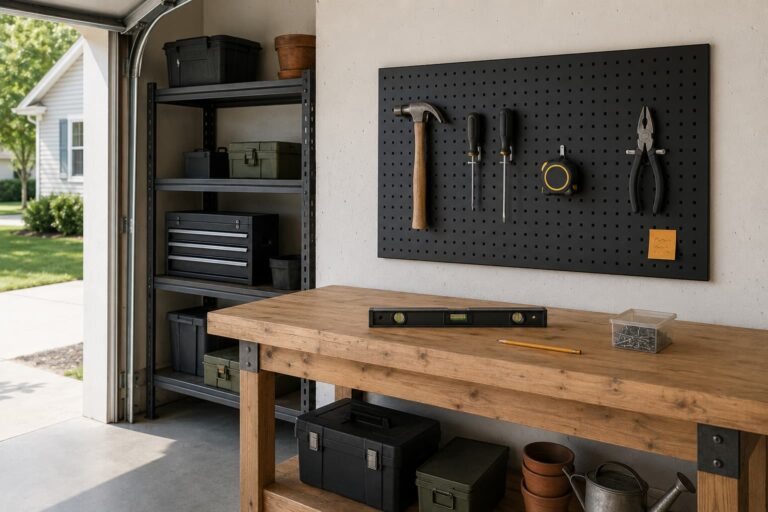
The original wall organization system: 1/4-inch or 1/8-inch board (hardboard or metal sheet) with a regular 1-inch hole grid. Hooks press into the holes. Best for hand tools, light items, weekend organization, and renters where minimal-hole installation is a plus. Limitations: hardboard absorbs moisture; per-hook capacity falls off above 20 lb. What to look for: metal pegboard if humidity is a concern; thicker board (1/4 inch) if hanging anything substantial; wall standoffs to give the board a 1/4-inch gap so hooks seat fully.
For full pegboard picks, see our pegboard roundup and the metal pegboard guide.
Slatwall (PVC, steel, or composite panel)
Horizontal-slat panel system. Hooks and baskets slide into the slats from above or by tilting in. Material varies: PVC (Proslat), steel (commercial slatwall), or composite (Gladiator GearWall, panel-based). Best for mixed inventory at varied heights, full-wall makeovers, and scenarios where reconfiguration happens often. Limitations: high commitment because 8-by-4 minimum sections are the common SKU; brand-specific accessories. What to look for: per-sq-ft manufacturer-listed capacity (on drywall over wood studs), hook compatibility, finish that suits the garage climate.
For full slatwall picks, see the slatwall roundup and the pegboard-vs-slatwall comparison.
Rail / track system
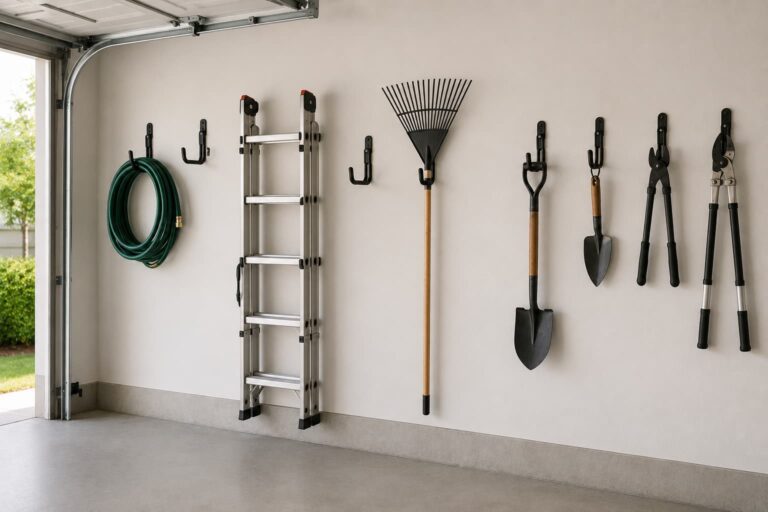
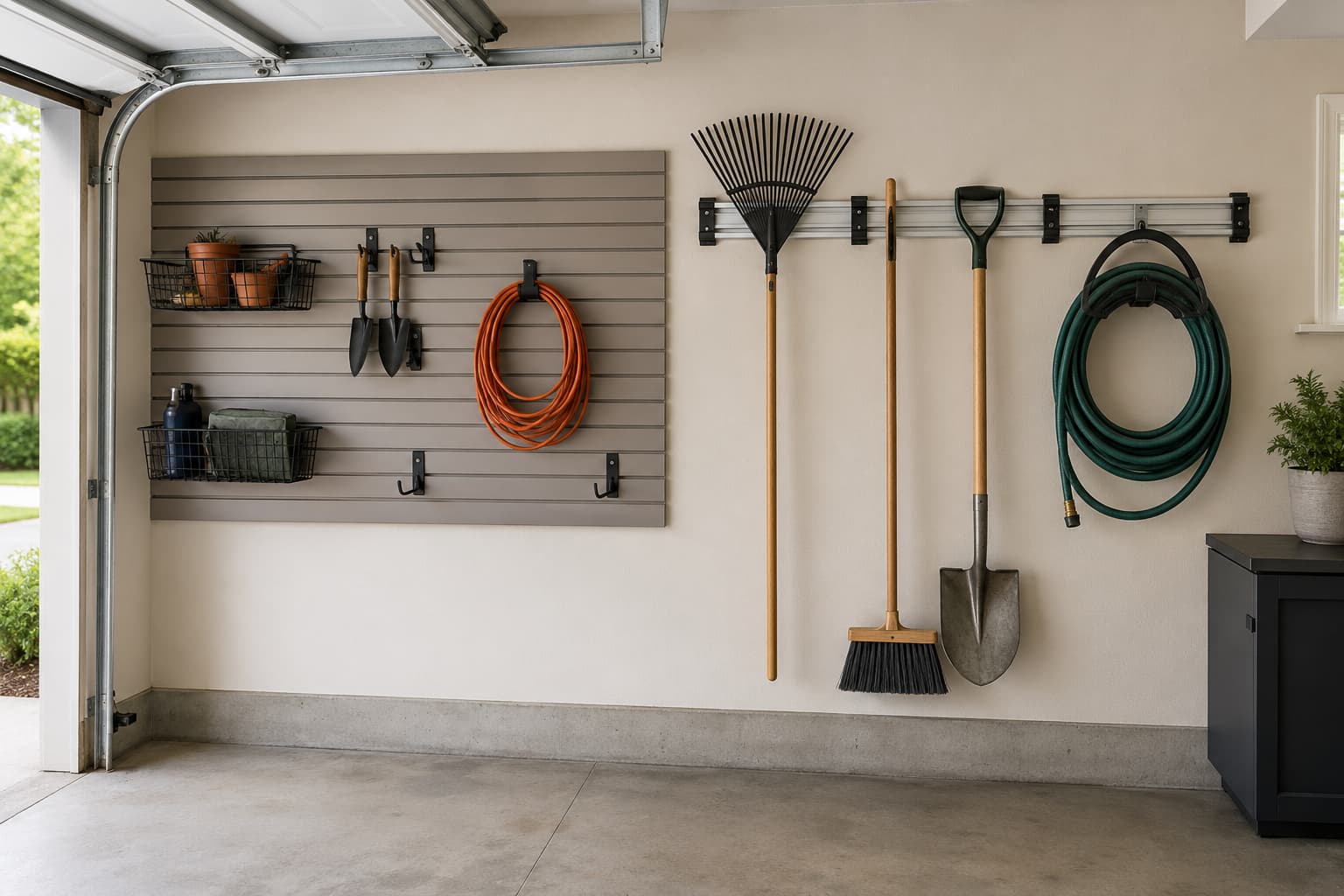
A horizontal steel rail or channel mounted on studs. Hooks lock onto the rail at fixed positions along its length. Slim profile (1 to 2 inches deep), low wall commitment per rail. Best for a band of accessories at one height — rakes, brooms, garden tools, light bikes — and for garages with limited wall area. Limitations: only one height-band per rail; brand-specific accessories; the rail itself doesn’t hold anything without a hook. What to look for: rail material (steel is the standard), stud compatibility (16- or 24-inch on-center mounting), and the breadth of the brand’s hook lineup.
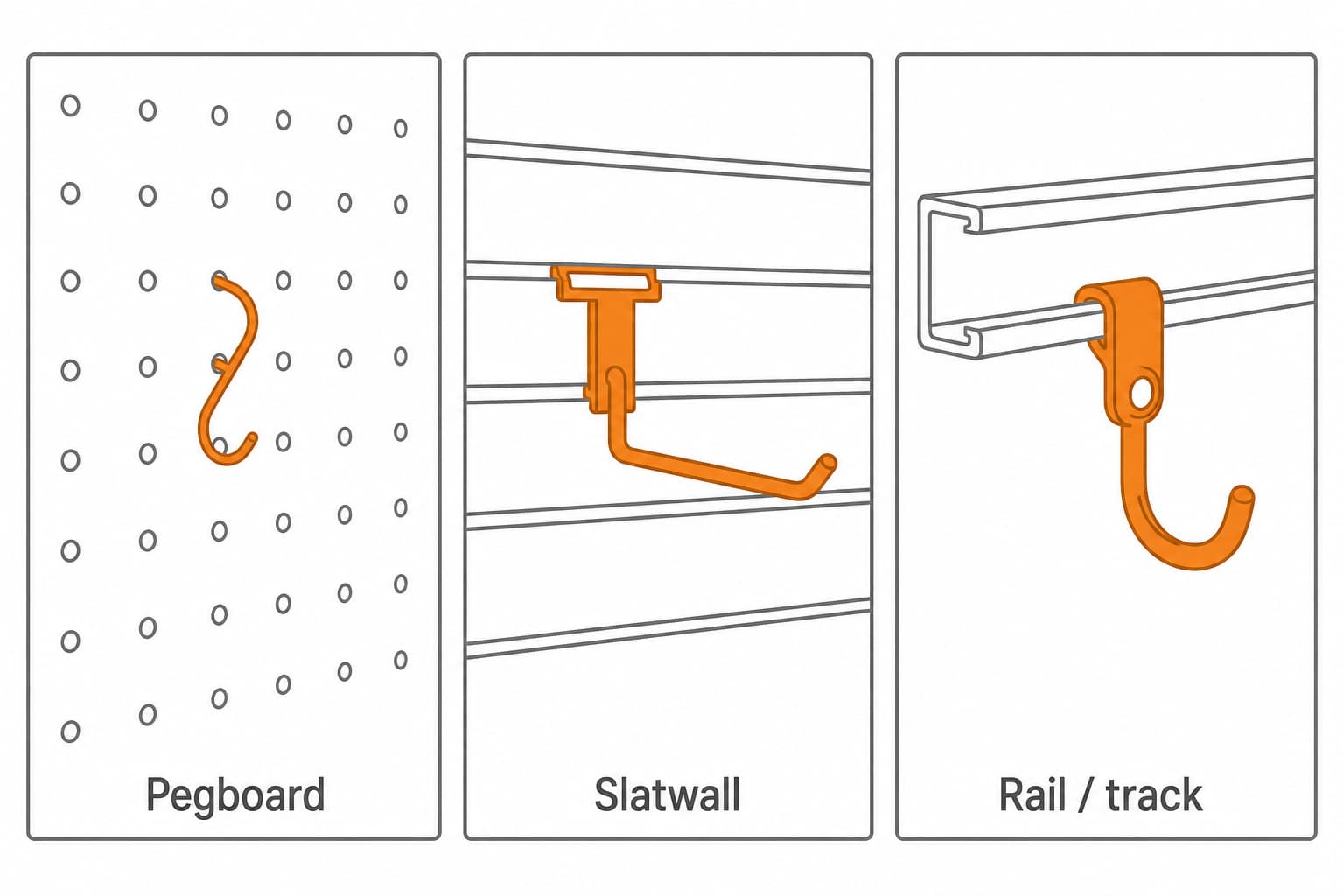
For full rail and track picks, see the wall-mounted systems roundup and the slatwall-vs-track comparison.
When to Choose Each Type
Three steps cover most decisions:
Step 1 — Inventory. List what you intend to hang. Hand tools and light items only? Mixed varied-height gear including bikes? A horizontal band of garden tools?
Step 2 — Skill and budget. Pegboard is cheapest and easiest. Slatwall costs more and commits you to a full wall. Rail is the middle ground.
Step 3 — Reconfiguration frequency. Often → slatwall. Sometimes → rail. Rarely → pegboard (or any system, since reconfiguration is fast on pegboard too).
For garages where freestanding shelving is the alternative, the freestanding-vs-wall-mounted comparison covers that decision.
What garage wall systems actually hold, compared fairly
Pegboard is rated per panel, rails per linear foot, slatwall per square foot. Three different units means the published numbers cannot be compared as they stand — so nobody compares them, and a 200 lb figure on one product looks like a 200 lb figure on another. This table quotes each manufacturer’s rating and converts them all to pounds per linear foot of a 4 ft high wall run, with the arithmetic shown. Normalised values are comparison figures, not safe point-load limits. A system rated for 1,200 lb distributed across a wall section does not support a 1,200 lb hook.
| System | Type | Rating as published | Rating type | Same rating, per linear foot of a 4 ft wall | Working | Stud requirement | Specification source | Source checked |
|---|---|---|---|---|---|---|---|---|
| Gladiator GearTrack channel (rail) | rail | 75 lb per linear foot of channel | rail/channel rating | 150 lb per linear foot | 75 lb/ft per channel (published) × 2 channels (assumed common install) | mounts to bare wood studs or drywall over wood studs | Gladiator 4′ GearTrack Channels | 2026-09-14 |
| Gladiator GearWall slatwall panel | slatwall | 50 lb per square foot | distributed panel load | 200 lb per linear foot | 50 lb/sq ft × 4 ft high | not published on the product page | Gladiator 4′ GearWall Panels | 2026-09-14 |
| Proslat Classic PVC slatwall | slatwall | 75 lb per square foot | distributed panel load | 300 lb per linear foot | 75 lb/sq ft × 4 ft high | installs on 16 in stud centres | Proslat PVC Slatwall | 2026-09-14 |
| Proslat PROCORE aluminium-core slatwall | slatwall | 200 lb per square foot | distributed panel load | 800 lb per linear foot | 200 lb/sq ft × 4 ft high | engineered for 24 in stud centres, compatible down to 16 in | Proslat PROCORE PVC Slatwall | 2026-09-14 |
How these numbers were produced: Each published rating is quoted from the manufacturer’s own page on the date shown. Conversion to pounds per linear foot assumes a 4 ft high run of wall: a per-square-foot rating is multiplied by 4. A per-panel rating is first converted to an equivalent per-square-foot rate, using the panel’s own published width and height, then multiplied by 4 the same way — scaling a per-panel rating sideways only, at the panel’s own height, would normalise it to a taller or shorter slice of wall than the 4 ft reference every per-square-foot row uses, so the two steps (per-panel → per-sq-ft → per-4-ft-run) keep every row on the same footing. A per-foot-of-rail rating is different in kind: the manufacturer publishes a rate per channel, and this table doubles it to show a common two-channel install — that doubling is our own installation assumption, not a manufacturer-stated rate; the sourced figure is the single-channel rate. Where a manufacturer publishes a single fixed capacity for a whole pre-sized unit rather than a rate per foot or per square foot, that figure is quoted as published and left out of the per-linear-foot column rather than converted with an invented rate.
- These are manufacturer maximums for a correctly installed system, not a promise. Every one of them depends on hitting studs, using the specified fasteners, and spreading the load rather than hanging it all off one hook.
- The comparison assumes a 4 ft high run. A rail system does not gain capacity from wall height the way a panel does — it gains it from adding channels, which is why its normalised figure moves when you change the channel count, not the height.
- Stud spacing is a hard constraint, not a suggestion. Proslat’s PROCORE is the only system here with a published compatibility range — engineered for 24 in centres, rated compatible down to 16 in. Check whether your own system publishes a similar range before assuming it.
- Drywall anchors are not studs: Wall Control publishes 100 lb per panel on anchors against 200 lb into studs — a real number for that one product, not a ratio to assume for other systems here that don’t publish their own stud-vs-anchor split.
- Capacity drops the further a load sits from the wall: storeWALL publishes 250 lb per sq ft as a distributed rating at the panel surface, but only 115 lb as a point measurement 4 in out. That lever-arm principle is a reasonable general caution for hooks and brackets on any system, but storeWALL is the only brand here that publishes a number for it.
- A blank cell means the manufacturer does not publish that figure — we do not fill gaps with numbers we could not source.
- This list favors brands whose own specification pages state a capacity figure in a form we could verify directly. Some well-known brands are not yet in this table because their published pages did not state a load rating we could confirm on this pass — that is a sourcing gap, not a signal that the product is weaker.
These are the entries that matter for this guide. The full table, with every row and its source, is in our What garage wall systems actually hold, compared fairly.
Measurement Checklist
Before ordering anything, walk the wall with a tape measure. Note:
- Wall length available
- Wall height (slatwall sections are 4 ft tall; budget headroom for the top edge)
- Stud spacing (16 or 24 inches on-center — all three systems work with both, but rail is the most flexible)
- Vehicle clearance (car doors can swing into pegboard hook ends if the wall is too close to the parking zone)
- Garage door open path (overhead doors swing into the ceiling cavity; slatwall has to end below the door track)
- Power outlets and switches (don’t cover; route accessories around them)
- Breaker panel and water shut-off positions
- Stud-finder reading fresh on the day of install (humidity and seasonal expansion shift stud detection slightly)
Mistakes to Avoid

Mistake 1: Pegboard for heavy items. Hardboard pegboard hooks bend and pull out of the hole before the board itself gives way; the board can also deform under sustained heavy load over time. Neither failure point carries a manufacturer-published number for hardboard specifically. For paint cans, tool cases, or anything heavier than a typical hand tool, use a wall-mounted shelf instead.
Mistake 2: Slatwall without accessory budget. The 32-sq-ft section is the cheap part. Hooks, baskets, and shelves typically double the system cost; sometimes triple it for a fully-accessorized wall. Budget the full system before buying the panels.
Mistake 3: Rail mounted to drywall alone. Manufacturer-listed capacity assumes studs. Drywall anchors, even the heavy-duty ones, void the rating. Use a stud finder, drill into at least two studs per rail.
Mistake 4: Mixing systems randomly on the same wall. Pegboard above slatwall above rail looks chaotic and creates accessory confusion — which hooks fit what. Pick one system per wall section; if you must mix, separate by full vertical breaks.
Featured Picks
Two anchor picks, one for rail and one for slatwall. Pegboard picks are in the pegboard roundup. Pegboard vs slatwall covers that comparison in depth.
For rail / track — Gladiator GearTrack Pack

The best-known rail and track system on Amazon, long-tenured listing (B000 prefix dates to 2007), Whirlpool-owned Gladiator brand with a full accessory ecosystem. The starter pack covers about 8 ft of wall with 2 channels + 8 hooks; larger walls need additional packs. Mount into wall studs.
For slatwall — Proslat 88102 PVC Slatwall (8’×4′)

An 8-by-4 foot PVC slatwall section, 32 sq ft total coverage, manufacturer-listed at 75 lb per square foot, lifetime warranty. PVC is moisture-resistant — important for unheated garages. Hidden-screw design plus included trim. Budget the accessory cost separately.
FAQ
What’s the difference between pegboard and slatwall?
Pegboard is a hole grid; slatwall is a horizontal-slat panel. Pegboard is cheaper but lower capacity; slatwall is more flexible (hooks slide anywhere along a slat) and higher capacity, at a higher install cost and commitment.
Can I install slatwall myself?
Yes. An 8-by-4 section takes 60 to 90 minutes with standard tools and a level. Hidden-screw mounting plus included trim is the typical pattern. Plan for a partner if the section is awkward to lift solo.
Will pegboard hold a bicycle?
Generally no. Pegboard hooks aren’t manufacturer-listed for bike-frame weights, and the board itself can deform under the sustained pull. Use a slatwall-mounted bike hook or a dedicated wall-mount bike rack instead.
Can I mix pegboard and slatwall on the same wall?
Possible but rarely ideal. Mixing the two creates accessory confusion (which hooks fit what) and a visually chaotic wall. If you do mix, separate the systems by full vertical breaks — full pegboard on one side, full slatwall on the other.
Do rail and track systems work with non-brand accessories?
Mostly no. Rail systems use proprietary hook profiles. Gladiator GearTrack only accepts Gladiator-compatible accessories. The slatwall ecosystem is more open — most slatwall accessories fit any standard slatwall-profile panel.
What should I budget for a full-wall makeover?
Panels or rails are the cheap part. Accessories — hooks, baskets, shelves — typically double the system cost for a fully-loaded wall, sometimes more. The pegboard category is the lowest total cost; slatwall sits in the middle; full-rail with many hook types is the most expensive.
What’s the most renter-friendly option?
Pegboard, because of the smallest screw-hole pattern. The board itself screws to a few studs through wall spacers; on move-out the holes patch with standard spackle.
Sources Reviewed
For this buying guide, we reviewed manufacturer documentation from Gladiator (Whirlpool brand), Proslat, and the major pegboard suppliers; retailer specifications on Amazon listings; the published Gladiator installation sheet for GearWall (document W11087876) and equivalent Proslat install documentation; and recurring patterns in public buyer discussions about pegboard, slatwall, and rail systems across the wall-storage subcategory. We do not claim hands-on testing.
Related Guides
- Best Wall-Mounted Garage Storage Systems — full roundup
- Best Garage Slatwall Systems — slatwall-specific picks
- Best Garage Pegboards — pegboard roundup
- Best Metal Pegboards for Garage Tools — metal pegboard option
- Pegboard vs Slatwall — direct comparison
- Slatwall vs Track Rail — direct comparison
- Freestanding vs Wall-Mounted Garage Storage — when to skip walls entirely
- How to Organize Garage Wall Storage — post-install organization