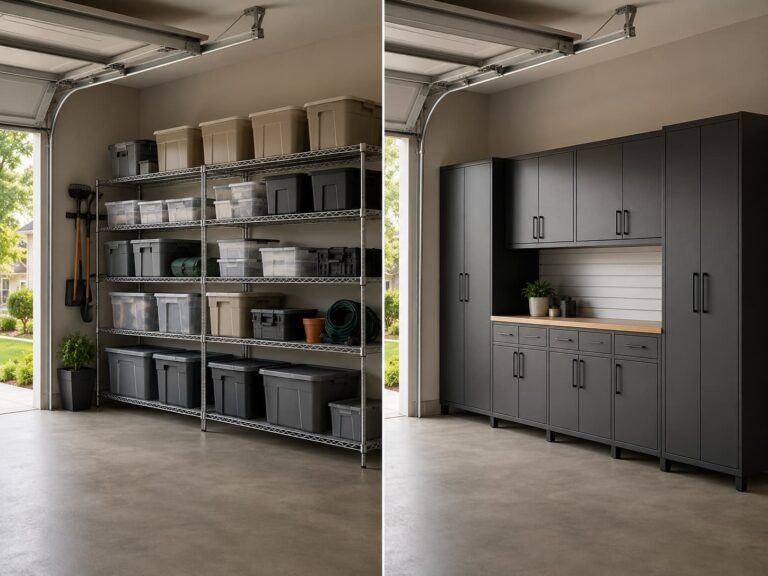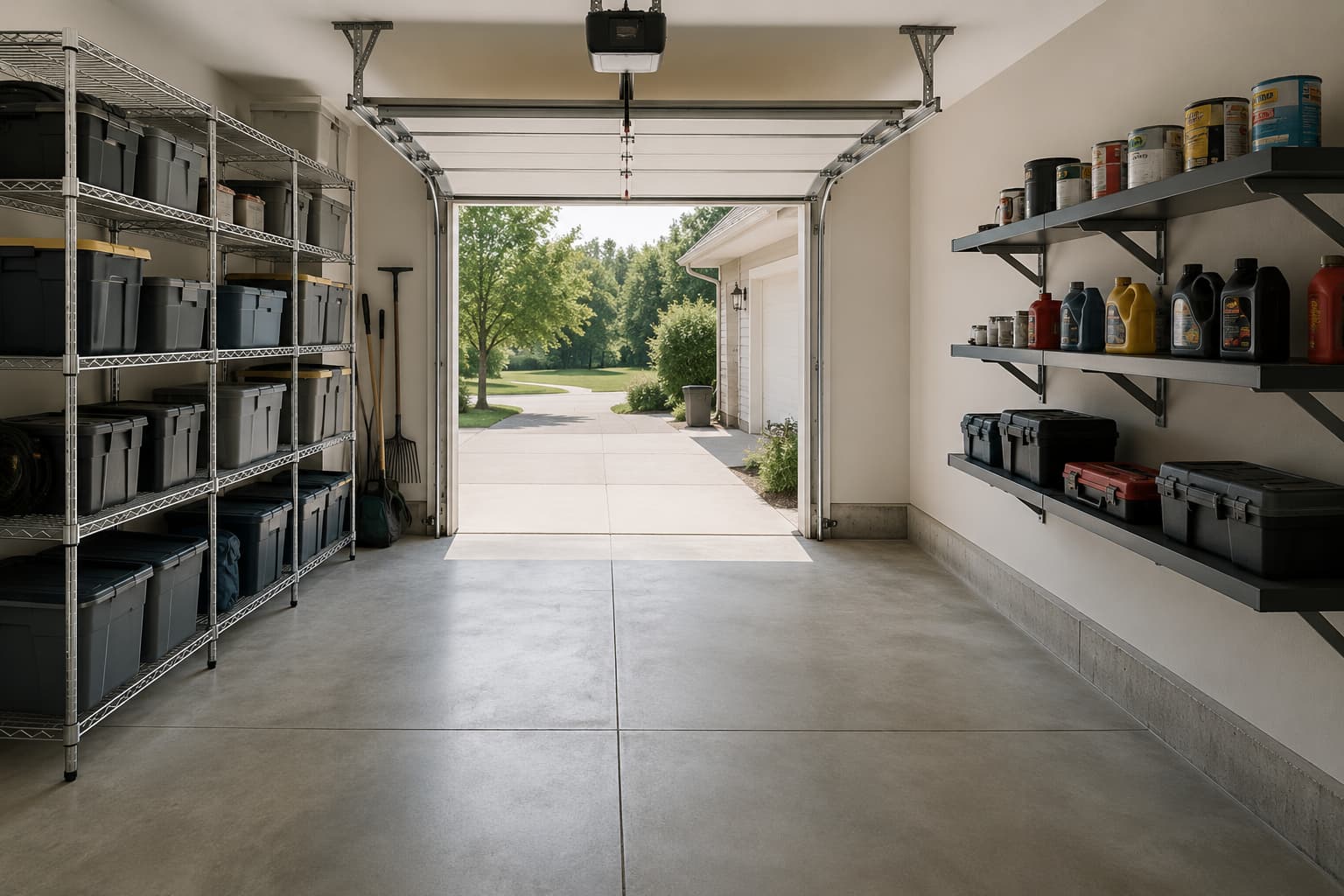
How to Choose Garage Shelving for Your Space
Last updated:
Disclosure: This article contains affiliate links. If you buy through these links, we may earn a commission at no extra cost to you. We do not claim hands-on testing unless clearly stated.
Most garage-shelving regrets start with the wrong dimensions, not the wrong brand. A 24-inch-deep shelf in a one-car garage overhangs the parking zone. A 14-inch shelf can’t hold the 27-gallon totes you actually own. A “1,000-pound capacity” rating quietly assumes leveling feet, not the casters you bought the unit for. This guide is about reading those specs before they bite, picking the depth that matches your totes, and matching the product type to your garage’s binding constraint. We don’t cover specific picks here — for those, see our garage shelves for storage bins roundup or the heavy-duty shelves guide — but you’ll know how to read either roundup with confidence by the time you finish reading.
Quick Recommendation by Use Case
| Use case | Best product type | Why |
|---|---|---|
| 27-gallon totes, frequently accessed | Wire or metal shelving, 18-24″ deep | Tote fit plus load distribution |
| Boxed inventory (paint, oil, batteries) | Metal wall-mounted shelving | Frees floor; off the ground for spills |
| Heavy bulk (tools, fluids, batteries) | Heavy-duty steel, 1,000+ lb total | Headroom on capacity |
| Light bulk (sports gear, holiday decor) | Plastic injection-molded shelving | Cheap, moisture-immune |
| One-car garage, narrow clearance | 14″-deep wire shelving | Fits 18-24″ wall-to-car gap |
| Renter who can’t drill | Freestanding wire on casters | Mobile, no holes |
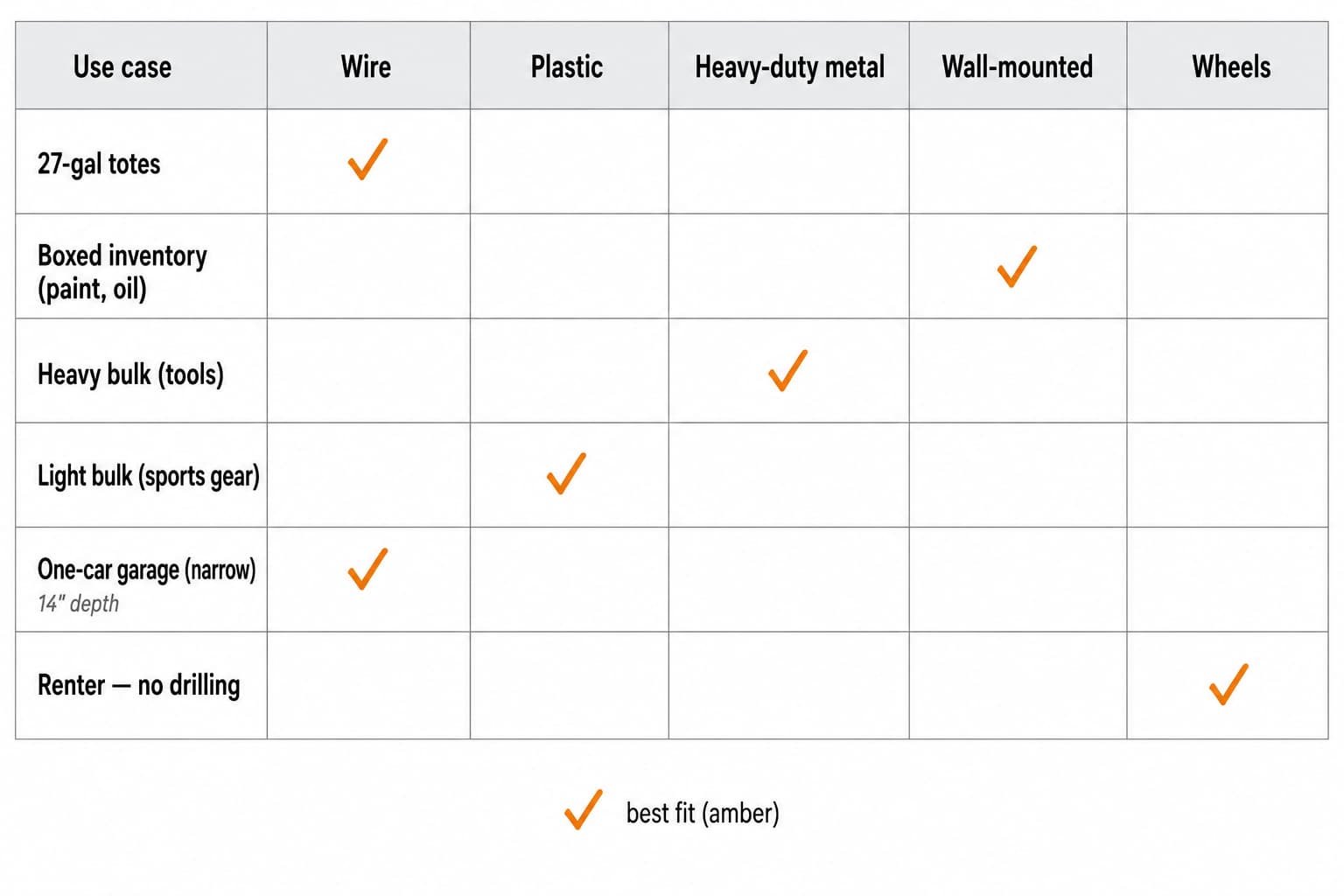
For the full per-product picks behind each row, our garage shelves for storage bins roundup covers the 27-gallon and wall-mount rows in depth.
Key Factors to Consider
Shelf depth (the binding constraint)
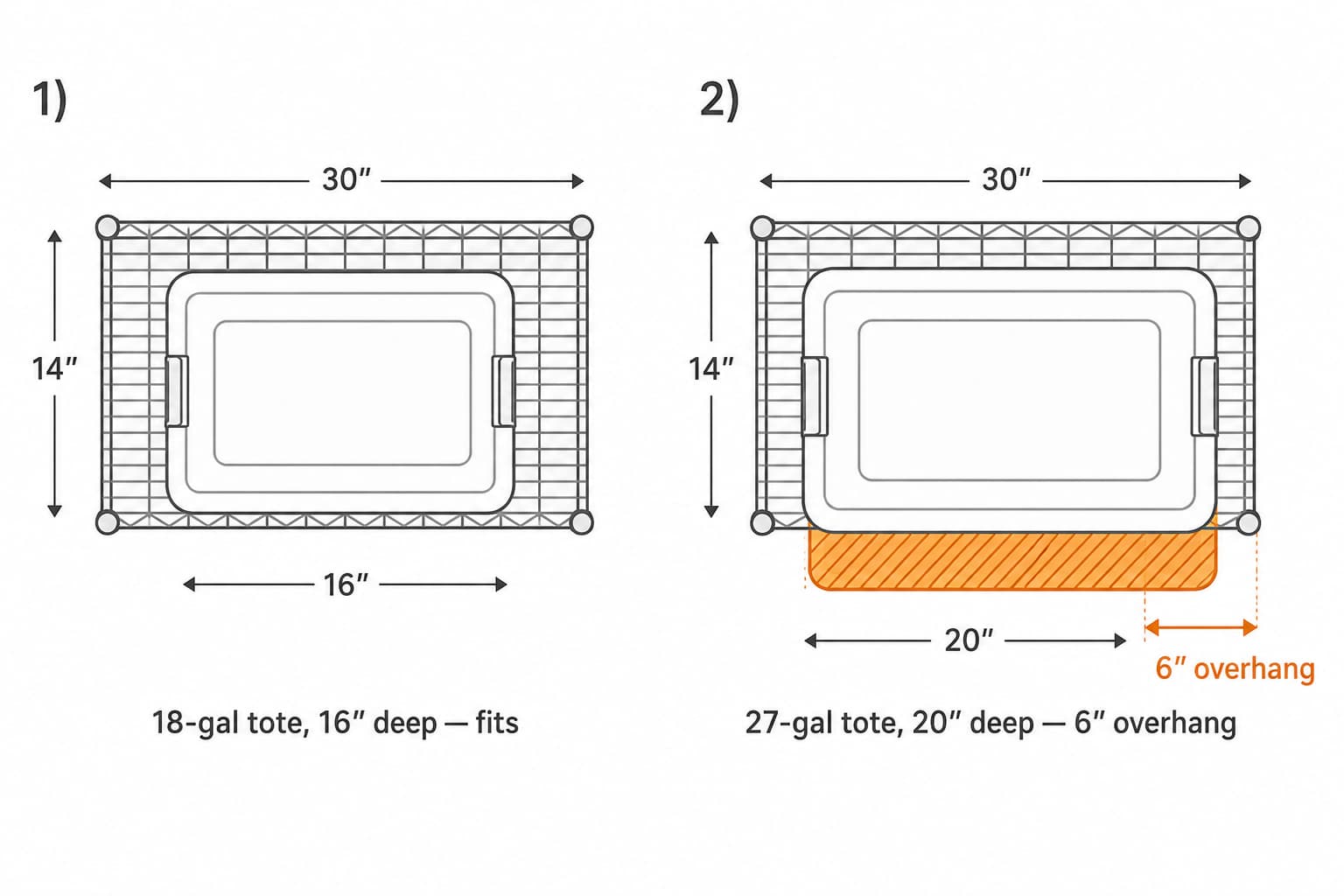
Depth comes first because it’s the spec most readers get wrong. Mainstream depths are 12, 14, 16, 18, 24, and 36 inches. Tote sizes don’t all align: an 18-gallon tote runs about 23⅞ × 15⅞ inches — the Rubbermaid Roughneck 18 Gal. Storage Box, per its Ace Hardware listing. Exact footprints for 27-gallon and 32-gallon totes vary too much by brand to pin to one manufacturer spec here; as a rough, unsourced guide, expect a 27-gallon tote in the high-20s-by-high-teens-inches range and a 32-gallon tote in the low-30s-by-low-20s-inches range — check the specific listing for your model before buying shelving. A 14-inch shelf fits an 18-gallon tote cleanly but a 27-gallon tote overhangs the front by several inches and becomes unstable. An 18-inch shelf fits 27-gallon totes but is still tight against 32-gallon. For a one-car garage, measure wall-to-car clearance first (typically 18 to 24 inches per side after parking) — the shelf can’t be deeper than that minus a walking-headroom margin.
Manufacturer-listed load capacity
Listings usually show two ratings: per-shelf and total system. The per-shelf rating assumes the load is distributed evenly across the shelf, not concentrated under one tote. The total rating assumes the unit is on leveling feet on level concrete — on casters the rated total typically drops by 80 to 90 percent (a Seville Classics unit manufacturer-listed at 1,500 lb on feet drops to 165 lb on wheels, for example). Realistic household loads: a 27-gallon tote with mixed contents is around 50 pounds, a gallon paint can is around 12 pounds, a car battery is around 40 pounds. You rarely need 1,000-plus pounds of total capacity unless you’re storing tools, fluids in bulk, or workshop hardware.
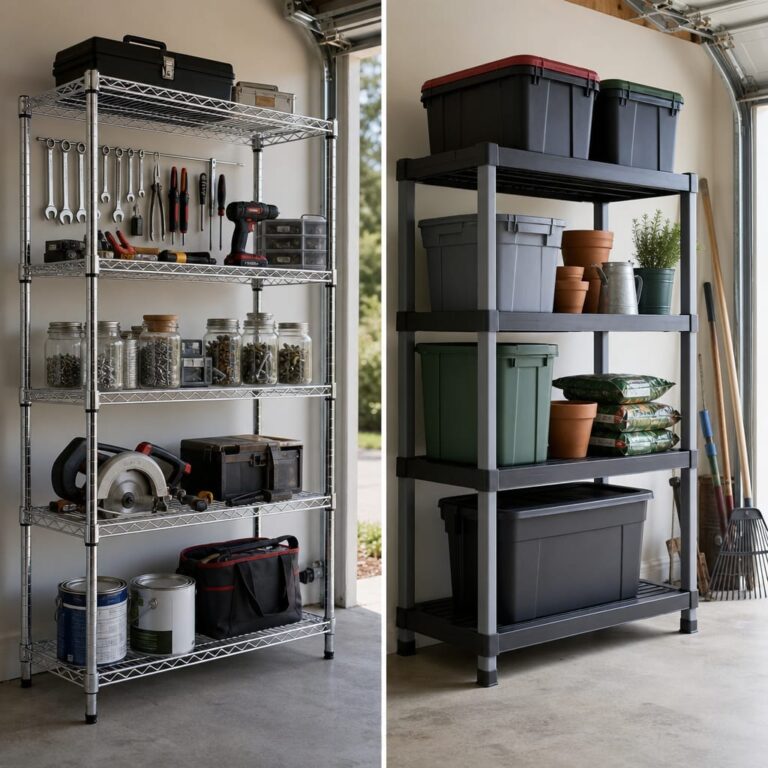
Material — wire, metal, plastic
Wire shelving (chrome or zinc plated) gives high capacity and ventilation, which matters in humid garages where trapped moisture rusts a solid shelf top. The downside: small items fall through the grid unless you add a liner. Solid metal shelving (sheet steel or particle-board top) holds small items and looks workshop-tidy, at a higher cost and more weight. Plastic injection-molded shelving is the cheapest option, immune to humidity, but tops out around 100 to 150 pounds per shelf. Chrome plating shows surface oxidation in coastal or sustained-humidity garages over two to three years of use; zinc plating is more rust-resistant; the metal-vs-plastic comparison covers the trade-off in more depth.
Adjustability
The 1-inch shelf-spacing increment is the wire-shelving standard — adjust the spacing to fit paint cans on one tier and flat boxes on another. Fixed-position particle-board shelves don’t adjust, so they only work if your storage profile is locked in. Adjustability matters when the inventory mixes irregular-height items (tall jugs, short boxes, mid-height totes).
Floor footprint and walking clearance
Freestanding shelves commit floor space they keep committed — once loaded, they don’t move easily without unloading. Wall-mounted shelves take zero floor footprint but require studs or solid masonry. Plan at least 24 inches of walking clearance between a freestanding unit and the next obstacle (car, opposite wall, workbench), or you end up sidling past the shelves every time you reach for something.
Assembly complexity
Tool-free wire shelving assembles in 30 to 45 minutes for a 5-tier unit; the wider tiers (48 inches or more) are easier with a partner. Bolt-together steel shelving takes 1 to 2 hours; a rubber mallet is often required, and the assembled unit is heavy enough to make relocation a project. Wall-mounted shelving requires stud-finding, drilling, and leveling — budget 30 to 60 minutes per shelf.
Stability and anti-tip considerations
Tall narrow freestanding shelves (60 inches or taller, 14 to 18 inches deep) can tip if loaded top-heavy. The remedy is sequencing — heavy items on bottom shelves, light on top — and, in extreme cases, an anti-tip wall strap. Wall-mounted shelves don’t tip, but they have their own failure mode: drywall pull-out if not mounted into studs.
Tote and item compatibility
The single most common buyer regret is depth that doesn’t match the largest tote in the inventory. Measure your totes with the lid on — totes are wider with the lid than without, and the lid is the part that overhangs. For mixed-tote inventories, pick depth equal to your largest tote plus 1 inch.
Product Types Explained
Wire shelving (chrome or zinc plated steel)
Open-grid wire shelves on adjustable poles, tool-free assembly. The Seville Classics form factor. Best for household storage, light-to-medium loads, garages with humidity (the grid ventilates), and renters (no drilling for freestanding). Limitations: small items fall through; chrome plating oxidizes in coastal environments over years. What to look for: total system capacity of 1,000 lb or more on leveling feet, 200 to 300 lb per shelf, depth matched to your largest tote, locking casters if mobility matters.
Solid metal shelving (steel sheet or particle-board top)
Bolt-together steel uprights with solid shelf surfaces. The Edsal or Husky form factor. Best for heavy loads (1,000 to 4,000 lb total), workshop use, and small-items storage where wire’s grid is a problem. Limitations: heavier assembly; particle-board tops can warp in unheated garages; weight makes relocation difficult. What to look for: verified per-shelf and total ratings, powder-coat finish for humid environments, reinforced corners. For the full per-product roundup, see our heavy-duty shelves guide.
Plastic injection-molded shelving (Sterilite, Husky)
One-piece plastic shelves with snap-together legs. Visible as utility shelving at Costco and Home Depot. Best for light bulk storage, moisture-prone environments, and low-budget setups. Limitations: per-shelf capacity typically 100 to 150 lb; less rigid than steel; UV-degrades if stored near a sunlit window. What to look for: ribbed-shelf design (stronger than flat), foot pads for floor protection.
Wall-mounted shelving (heavy-duty brackets + shelf top)
Wall brackets bolted into studs, holding a steel or particle-board shelf. The FLEXIMOUNTS WR26 or ClosetMaid form factor. Best for boxed inventory at chest-to-shoulder height; frees floor for vehicles. Limitations: drilling required (not for renters); capacity depends entirely on stud quality; can’t be moved. What to look for: per-shelf capacity at your install pattern (16 vs 24 inches on-center matters), bracket count, manufacturer-listed total assumes proper stud install. See the wall-mounted systems roundup for full picks.
When to Choose Each Type
Three steps cover most decisions:
Step 1 — Where will the shelves live? Wall (studs accessible and you’ll commit to a permanent location) versus floor (you may relocate or rent).
Step 2 — What are you storing? Heavy (more than 500 lb total) means solid metal. Medium (100 to 500 lb) means wire. Light (under 100 lb per shelf) means plastic. Mixed bulk plus boxed inventory means wire is the most flexible. For specific picks, see our garage shelves for storage bins roundup and the heavy-duty shelves guide.
Step 3 — Will you reconfigure often? Yes means adjustable wire. No means solid metal or wall-mounted are fine.
How many totes actually fit on a garage shelf
Tote makers publish dimensions and shelving makers publish dimensions, but nobody puts the two together — so people buy shelving, then discover their totes overhang it. This table takes the published external size of totes from the brands people actually buy for garage storage — Sterilite, Rubbermaid Roughneck, and IRIS USA — and works out how many fit per shelf on the two garage shelving depths you can actually buy, 18 in and 24 in.
| Tote | Published dimensions (source order) | Footprint | Height | Fits an 18 in deep shelf? | Per 48 × 18 in shelf | Per 48 × 24 in shelf | Specification source | Source checked |
|---|---|---|---|---|---|---|---|---|
| Sterilite 6 Qt. Storage Box | 13 5/8" x 8" x 4 5/8" | 13⅝ in × 8 in | 4⅝ in | Yes | 6 | 9 | Sterilite 6 Qt. Storage Box | 2026-09-14 |
| Sterilite 16 Qt. Storage Box | 17 1/8" x 11 7/8" x 6 3/4" | 17⅛ in × 11⅞ in | 6¾ in | Yes | 4 | 4 | Sterilite 16 Qt. Storage Box | 2026-09-14 |
| Sterilite 27 Qt. ClearView Latch Box | 17" x 11 1/8" x 12 3/4" | 17 in × 11⅛ in | 12¾ in | Yes | 4 | 4 | Sterilite 27 Qt. ClearView Latch Box | 2026-09-14 |
| Sterilite 60 Qt. Wheeled Underbed Latch Box | 35 1/2" x 18 7/8" x 7" | 35½ in × 18⅞ in | 7 in | No — it overhangs | 0 | 1 | Sterilite 60 Qt. Wheeled Underbed Latch Box | 2026-09-14 |
How these numbers were produced: External dimensions are quoted on the date shown per row. Sterilite rows are quoted from Sterilite’s own product pages (L x W x H order). Rubbermaid Roughneck rows are quoted from Ace Hardware’s retailer listing, which prints the manufacturer’s SKU-linked dimensions in H x W x D order on each product page. IRIS USA rows are quoted from IRIS USA’s own product pages (L x W x H order). All figures are the external/overall assembled dimensions with the lid on. The counts are computed, not estimated: totes are placed in a single layer, all in the same orientation, with no overhang and no gap; both orientations (the tote’s long side along the shelf’s 48 in run, or along its depth) are tried and the better one is kept. Shelf width is 48 in in both cases — the two depths are real Husky shelving footprints: 48 in. W x 18 in. D (Husky 86 in. H x 48 in. W x 18 in. D 6-Shelf Steel Shelving Unit, model MR481886W6B, https://www.homedepot.com/p/Husky-86-in-H-x-48-in-W-x-18-in-D-Black-Steel-6-Shelves-Shelving-Unit-MR481886W6B/306062319) and 48 in. W x 24 in. D (Husky 5-Tier Steel Shelving Unit, 48 in. W x 78 in. H x 24 in. D, model 426007, https://www.homedepot.com/p/Husky-5-Tier-Riveted-Steel-Garage-Storage-Shelving-Unit-in-Silver-48-in-W-x-78-in-H-x-24-in-D-426007/303241694); neither product page states a clear opening between posts. 48×18 and 48×24 are unobstructed reference surfaces, not guaranteed usable dimensions of every nominal 48×18 or 48×24 rack — posts and lips can reduce the clear opening (one retailer answer for a Husky 48×24 gives about 45.5 × 21.5 in between posts). Round the result down again if your shelving has corner posts that intrude, and leave room to get a hand in.
- A tote that fits the shelf footprint still needs vertical room: check the tote height against your shelf spacing, and leave clearance to lift it in and out rather than sliding it flush.
- Counts assume a flat, full-depth shelf. Wire shelving with a lip, or posts at the corners, will cost you the last tote in a row.
- Lids overhang the base on most totes; the figures here are the manufacturer’s overall assembled dimensions, which already include the lid.
- Capacity in quarts or gallons tells you nothing about whether it fits — and "27" doesn’t mean the same thing twice. The Sterilite 27 Qt. ClearView Latch Box (17 in x 11-1/8 in) fits an 18 in shelf; the Sterilite 108 Qt. Stacker Box (25-3/4 in x 18-3/8 in) — 27-gallon-equivalent by volume (108 qt = 27 gal), though Sterilite sells it as "108 Qt.," not "27 Gal." — does not.
- Manufacturers and retailers don’t all publish dimensions in the same order. Ace Hardware lists Rubbermaid Roughneck as Height x Width x Depth, where Sterilite and IRIS USA publish Length x Width x Height. This table normalises every row to footprint (the two horizontal dimensions) and height so they compare directly regardless of the order they were published in.
- Rubbermaid Roughneck’s 10 gal and 18 gal totes share the same footprint (23⅞ in x 15⅞ in) — only the height changes, so stepping up in capacity in that range costs no extra shelf space, only vertical clearance.
- A blank cell means the manufacturer does not publish that figure — we do not fill gaps with numbers we could not source.
These are the entries that matter for this guide. The full table, with every row and its source, is in our How many totes actually fit on a garage shelf.
Measurement Checklist
Walk the garage with a tape measure before ordering anything. Note:
- Wall length available
- Wall-to-car clearance, per side, after parking
- Ceiling height plus headroom for tall shelves
- Garage door open path (tall shelves can intrude)
- Stud spacing for wall-mount (16 or 24 inches on-center)
- Floor slope (drainage typically tilts toward the door)
- Tote dimensions with the lid on — the largest tote sets the depth requirement
- Walking clearance between shelves and parked car
- Driver door swing space
- Workbench and other obstacle positions
Mistakes to Avoid
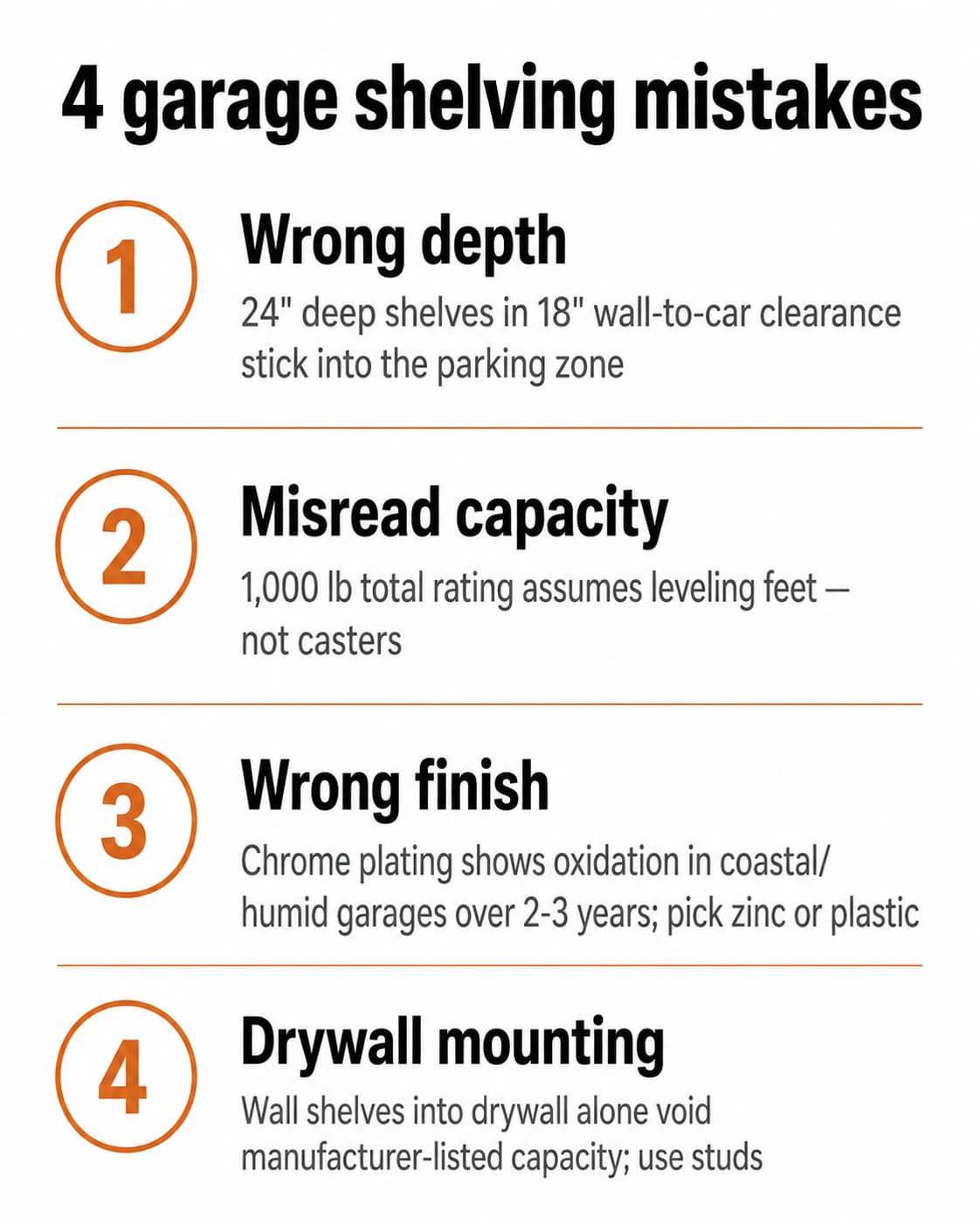
Mistake 1: Buying 24″-deep shelves for a one-car garage. 24 inches of depth in 18 inches of wall-to-car clearance is a recipe for hitting the shelves with the car door. Measure first.
Mistake 2: Trusting “1,000 lb total capacity” without reading the fine print. That rating typically assumes leveling feet on level concrete. On casters the rated total can drop by 80 to 90 percent — same shelf, very different number.
Mistake 3: Buying chrome shelving for a coastal or humid garage. Chrome plating shows surface oxidation in salt air or sustained humidity over two to three years. Zinc plating or powder-coated metal lasts longer; plastic is immune to humidity entirely.
Mistake 4: Drilling wall shelves into drywall alone. Manufacturer-listed capacity assumes studs. Drywall anchors, even the “heavy-duty” ones, void the published rating. If you can’t hit studs, use freestanding instead — for one-car garage layouts, see how to organize a small garage for stud-free options.
Featured Picks
Two anchor picks, not a roundup. For the full list see the storage-bins roundup and the heavy-duty roundup. Picking shelves over cabinets? The shelves vs cabinets comparison covers that trade-off.
For renters and compact garages — Seville Classics 5-Tier Wire Shelving with Wheels

Compact 14″D × 30″W footprint fits one-car garages and tight wall-to-car clearance; 5 tiers at manufacturer-listed 300 lb per shelf give 1,500 lb total on leveling feet (only 165 lb total on wheels — surface this in your planning). Locking casters let renters reposition without drilling.
For wall-mounted heavy-duty — FLEXIMOUNTS WR26 2’×6′ Wall Shelf (2-Pack)

Two heavy-gauge cold-rolled steel wall shelves, 24 in deep × 72 in wide each — roughly 12 linear feet at chest height. Mounts into wall studs or solid concrete. Manufacturer-listed capacity depends on bracket spacing and stud span; verify against your install pattern before loading.
FAQ
What depth of garage shelving fits 27-gallon totes?
18 inches or deeper. A 14-inch shelf overhangs by ~6 inches and becomes unstable. For mixed-tote inventories, pick depth equal to your largest tote plus 1 inch.
Wire versus solid metal — which is better for a humid garage?
Wire with zinc plating is the strongest combination for humidity. Chrome plating still works but shows surface oxidation over years. Particle-board-top solid shelves are the worst choice for unheated garages — the wood swells.
Can I mount wall shelves into drywall without studs?
No. Manufacturer-listed capacity assumes stud mounting. Hollow-wall anchors are sized for picture frames, not bins of paint cans. If you can’t hit studs, use freestanding shelves instead.
How do I know if my garage can hold a 1,000-pound shelving unit?
Concrete floors handle the load easily. The question is shelf-by-shelf distribution and floor slope. Most residential garages tilt slightly toward the door for drainage — level the unit before loading.
Are plastic shelves strong enough for tools?
Hand tools and light power tools, yes. Bulk material (gallon paint, salt, soil) tops out around 100 to 150 lb per shelf — exceeded easily by a few cases of canned goods or paint.
Should I buy shelving with wheels?
For renters and seasonal-rotation use cases, yes. For sustained heavy loads, leveling feet give roughly 10× the rated total capacity vs casters on the same unit.
What’s the difference between Seville UltraDurable, UltraZinc, and chrome plating?
Tiers within Seville Classics’ line. UltraDurable is commercial-grade and explicitly NSF-certified on the listings that carry it; UltraZinc and chrome have similar corrosion resistance per Seville’s marketing copy, though UltraZinc tends to age better in humid environments. The storage-bins roundup covers the specific Seville picks per use case.
Sources Reviewed
For this buying guide, we reviewed manufacturer product information from Seville Classics, FLEXIMOUNTS, Husky, Edsal, Sterilite, and Gladiator, retailer specifications on Amazon and Home Depot listings, installation documentation where available, and recurring patterns in public buyer discussions about garage shelving across the storage-bin, heavy-duty, metal, and plastic shelving subcategories. We do not claim hands-on testing.
Related Guides
- Best Garage Shelves for Storage Bins and Totes — full roundup for tote-driven storage
- Best Heavy-Duty Garage Shelves — workshop and bulk-storage picks
- Best Metal Shelving Units for Garage Storage — metal-specific roundup
- Best Plastic Shelving Units for Garage Storage — plastic-specific roundup
- Garage Shelving vs Garage Cabinets — when to pick shelves over cabinets
- Metal vs Plastic Garage Shelving — the material comparison
- How to Organize Bins on Garage Shelves — post-purchase organization