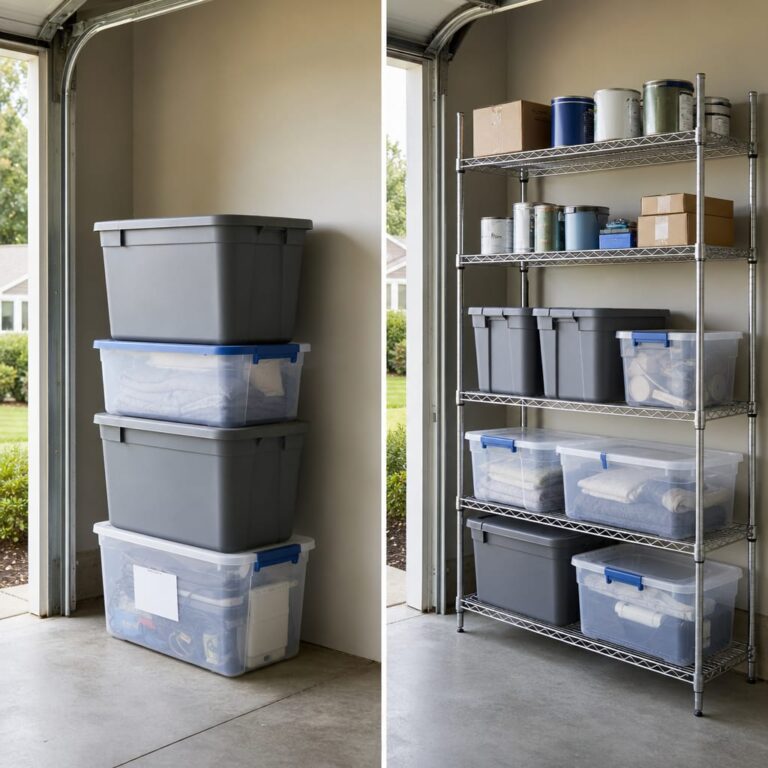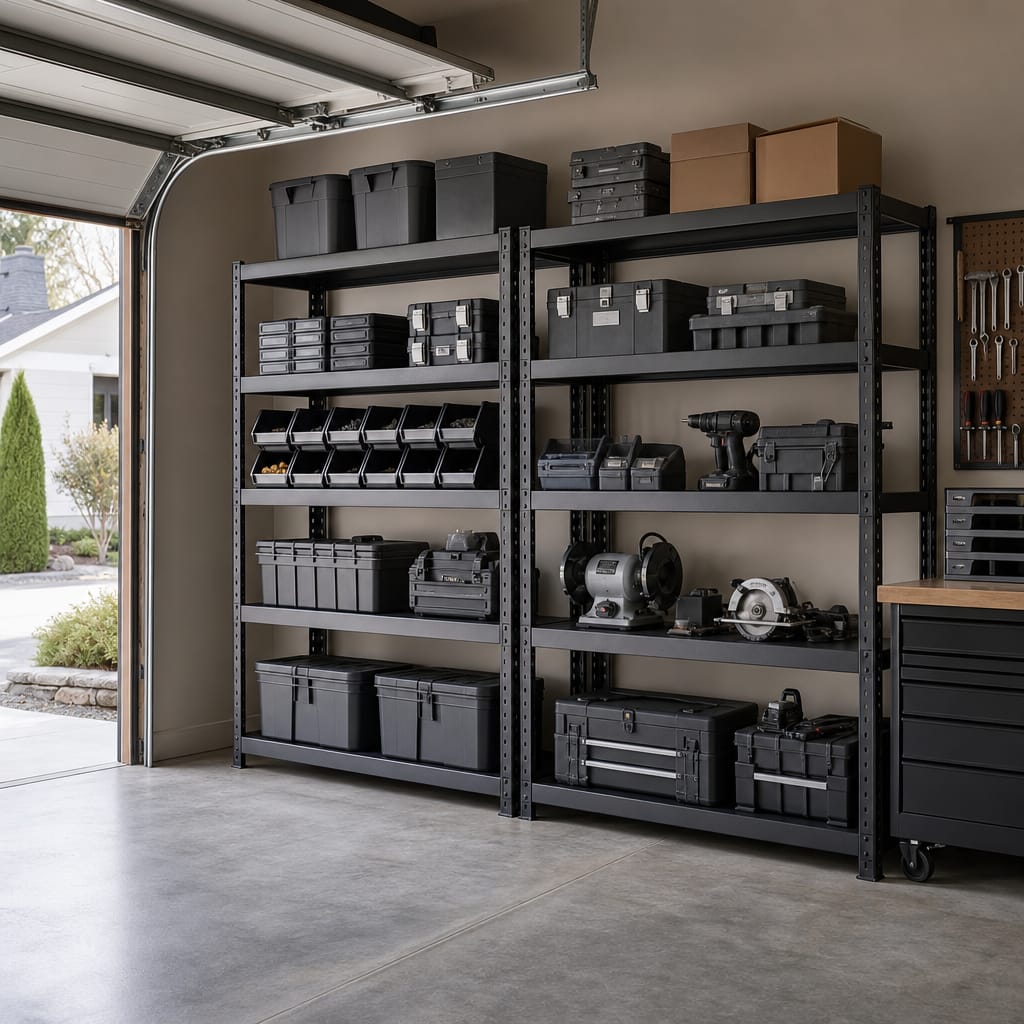
Best Heavy-Duty Garage Shelves: 5 Picks for Bulky Storage
Last updated:
Disclosure: This article contains affiliate links. If you buy through these links, we may earn a commission at no extra cost to you. We do not claim hands-on testing unless clearly stated.
A “1,000 lb per shelf” sticker on a heavy-duty rack does not tell you whether the rack can hold a 200-pound engine block parked on one corner of one shelf — and that’s the question most garage owners actually have when they start shopping. Heavy-duty capacity headlines almost always assume leveling feet, evenly distributed weight, perfect floor levelness, and a specific variant of the SKU. Real garage loads rarely meet all four conditions.
This guide compares five branded heavy-duty freestanding racks across the most common garage use cases — what each is best for, and which capacity figures are worth trusting on each. It does not cover wall-mounted shelving, overhead ceiling racks, or garage cabinets (covered separately in our open shelving versus enclosed cabinets comparison).
Quick Picks
| Pick | Product | Best for | Build type | Watch out for | |
|---|---|---|---|---|---|
| Best Overall Heavy-Duty | Seville Classics UltraDurable 5-Tier NSF | NSF wire workhorse storage | Chrome wire on leveling feet | Capacity drops on casters | View on Amazon |
| Best for Garage Workshops | FLEXIMOUNTS Heavy-Duty 5-Tier Shelving | Workshop layouts with deeper decks | Boltless steel with snap-in decks | Per-shelf rating lower than chrome wire flagships | View on Amazon |
| Best Metal Heavy-Duty (Mobile) | TRINITY EcoStorage 5-Tier NSF with Wheels | Heavy-duty wire that needs to roll | Chrome wire with wheels + feet levelers | Wheels-rated capacity, not total, is the ceiling | View on Amazon |
| Best Industrial-Style | Muscle Rack 5-Shelf Steel Boltless | Warehouse-aesthetic boltless rivet rack | Steel posts with particleboard decks | Particleboard sags under concentrated loads | View on Amazon |
| Best for Tools and Parts | SafeRacks NSF Steel Wire 5-Tier | Small parts and tool visibility | NSF zinc-plated wire with wheels + feet | Small parts fall through wire grids | View on Amazon |
How We Selected These Shelves
We do not claim hands-on testing unless clearly stated. For this guide we reviewed manufacturer specifications, retailer product pages, NSF certification listings where applicable, brand product documentation, and recurring patterns in public buyer feedback for each candidate rack.
Because heavy-duty capacity figures vary by variant, by deck material, and by base configuration (leveling feet vs wheels), we prioritized racks whose manufacturer pages publish clear per-shelf and total capacity figures we could cross-check against the Amazon listing, and where the brand has a verifiable identity outside Amazon.
Selection criteria:
- Manufacturer-listed per-shelf capacity sourced from the brand’s own product page where possible.
- Brand has a manufacturer website outside Amazon (no white-label-only listings).
- ASIN has accumulated public reviews and stable tenure on Amazon (no brand-new SKU drift).
- Deck material is explicitly documented (wire, particleboard, or snap-in steel) rather than inferred from photos.
- Assembly method is explicitly documented (boltless rivet, bolted, or welded).
What to Look for in a Heavy-Duty Garage Shelf
The five buying decisions below are where most heavy-duty shopping goes wrong. None of them are about the headline capacity number on the listing.
Manufacturer-listed capacity vs real-world capacity
Every rack on this list has a listed per-shelf or total capacity in pounds. That number assumes correct assembly, level flooring, evenly distributed weight, and a specific base configuration. The moment any of those conditions change, working capacity drops — sometimes by a quarter, sometimes by three quarters. Treat the listed number as a ceiling, not a target.
Wire deck vs particleboard deck vs steel deck
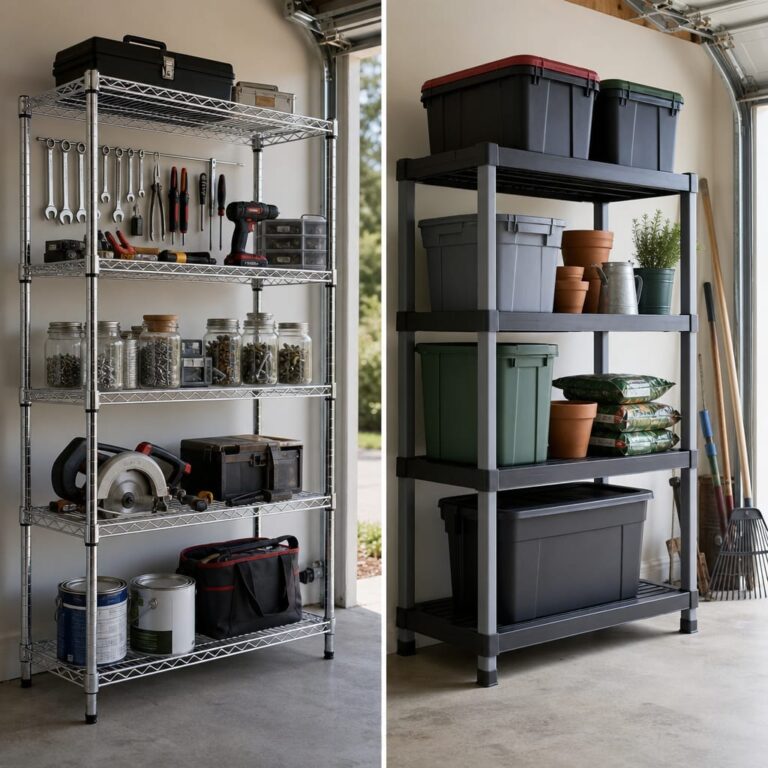
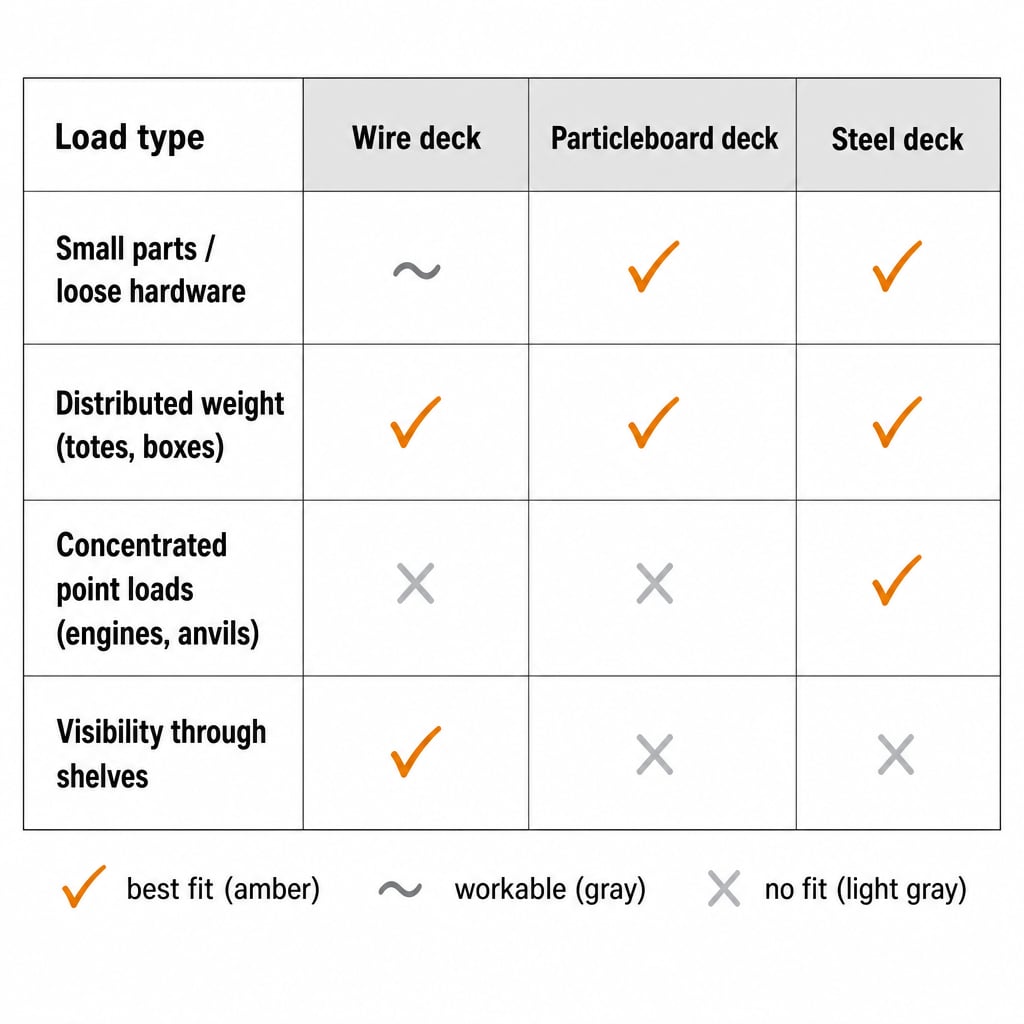
The deck is what you put weight on, and the three common materials behave differently. Wire decks help with visibility and air flow but let small parts fall through. Particleboard decks distribute weight well across the deck face but sag locally under point loads. Steel decks handle point loads but cost more. See the wire vs solid deck comparison for a deeper look at why this choice matters more than the capacity figure.
Leveling feet vs casters (capacity loss math)
This is the single biggest source of “the rack feels weaker than the listing said” complaints. The same rack on leveling feet and on casters can have very different working capacities — caster-mounted bases shift load to the wheels, which are rated independently of the rack itself.
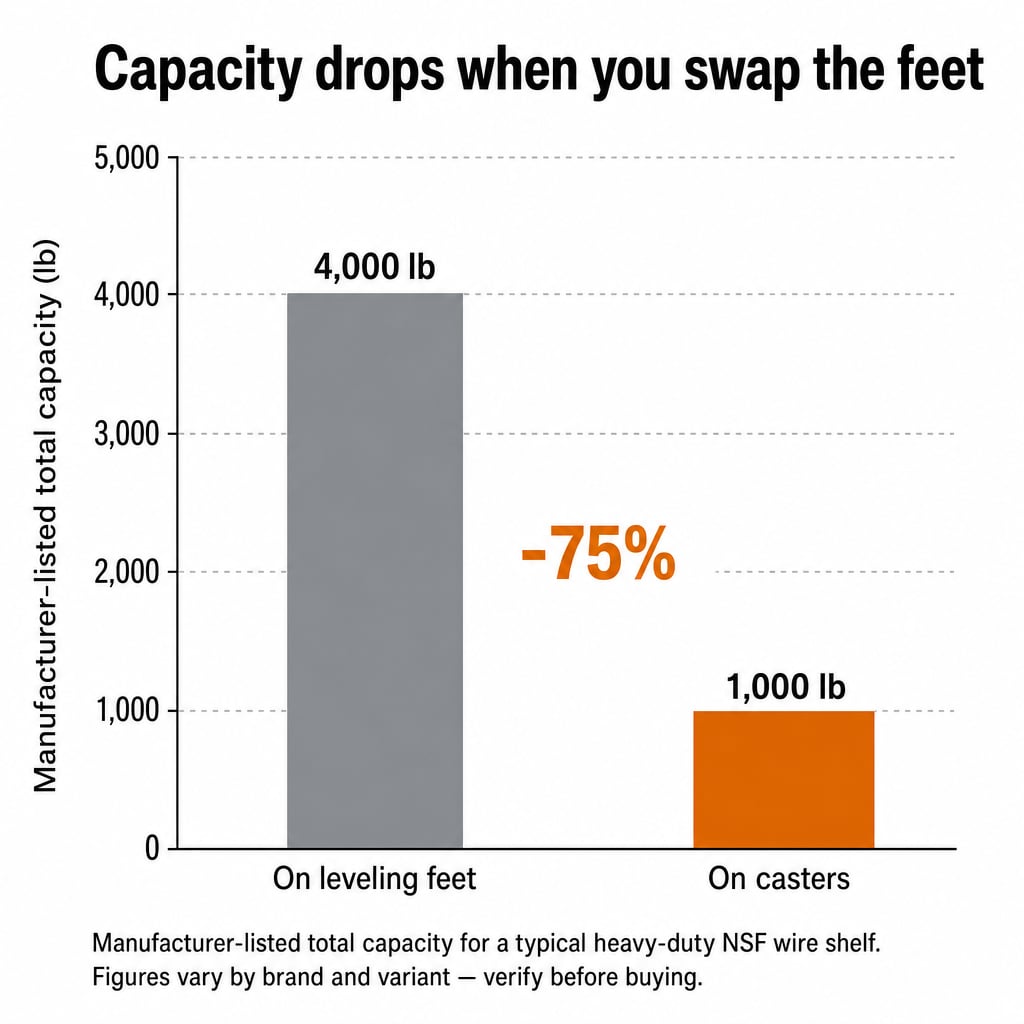
If you convert a leveling-feet rack to casters with aftermarket wheels, the caster rating becomes the new ceiling. If a rack ships with casters from the factory, the listed capacity should be the caster-rated figure — but isn’t always. Check the spec page carefully.
Boltless rivet vs bolted vs welded assembly
Boltless rivet assembly uses tapered rivets that drop into keyhole slots — no fasteners, fast to set up. Bolted assembly uses hex bolts at each joint — slower, mechanically locked. Welded is strongest but ships in larger boxes and can’t be reconfigured. For most garage owners boltless is fine; for vibration-prone loads, bolted or welded is worth the upcharge.
Footprint and ceiling clearance
Most racks on this list are 72 inches tall. Measure your garage ceiling height first — accounting for garage door tracks, openers, and the working room to load the top shelf. Then measure floor footprint with at least 6 inches of clearance on every side for walk paths.
Best Overall Heavy-Duty: Seville Classics UltraDurable 5-Tier NSF
Best for: garage owners storing dense, heavy items on chrome wire shelving where 18-inch depth fits the footprint and an NSF-certified rack is worth the brand premium.
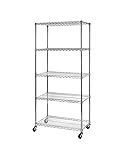
Short verdict: The long-tenured Seville UltraDurable line is the default heavy-duty NSF wire pick — branded, well-documented, and built around manufacturer-listed 4,000 lb total capacity on leveling feet at the 36″×18″×72″ 5-shelf configuration.
Seville Classics has built this product family for years. The UltraDurable Commercial-Grade tier is a chrome-plated steel wire shelving unit with NSF certification, leveling feet, and five adjustable shelves. The 3-inch rubber casters ship in the box as an alternative base.
Why it stands out
Three things make this the default pick for heavy-duty NSF wire in a residential garage. First, brand stability — Seville Classics has a manufacturer site at sevilleclassics.com. Second, NSF certification indicates a documented build standard and finish testing. Third, the per-shelf capacity is high for chrome wire — manufacturer-listed at 800 lb on leveling feet.
It can work well for:
- Dense items in moderate shelf depth (paint cans, ammo cans, full toolboxes)
- Garage zones where wire decks help with dust-through and visibility
- Buyers who want a brand with a real manufacturer page and warranty
Key specs to check
- 36″W × 18″D × 72″H, 5-shelf (manufacturer-listed)
- Chrome-plated steel wire decks with NSF certification (manufacturer-listed)
- 800 lb per shelf / 4,000 lb total on leveling feet (manufacturer-listed)
- Leveling feet standard; 3-inch rubber casters included as an alternative base
- Adjustable shelf heights via keyhole slots on the corner posts
Recurring feedback patterns
Recurring positive feedback often centers on stability once correctly leveled and on the chrome finish holding up over time. Common complaints typically involve assembly difficulty on the lowest shelf and confusion about which Seville variant the buyer received — the UltraDurable line shares model numbers with thinner Seville lines that look similar. Buyers often mention checking the box label against the listing to confirm the heavy-duty tier.
Potential drawbacks
The 18-inch depth is too shallow for some workshop layouts and for storing larger plastic totes — for shelving sized specifically for storage totes the 24-inch-deep options are a better starting point. Chrome wire also lets small loose parts fall through, limiting its usefulness for small-hardware storage without bins or liners.
Buyer warning
UltraDurable has multiple SKUs across 3-, 4-, and 5-tier configurations, chrome and black finishes, with or without included casters. The 4,000 lb total figure applies to the leveling-feet base; mounting the included casters lowers the working capacity to the caster-rated figure. Confirm which base configuration you plan to use before loading the rack.
Best for Garage Workshops: FLEXIMOUNTS Heavy-Duty 5-Tier Shelving
Best for: garage workshops where deck depth and easy boltless assembly matter more than NSF certification, especially for layouts where 18-inch chrome wire is too shallow.
FLEXIMOUNTS Garage Shelving, 60" W x 72" H x 24" D, Black, 5 Tier | Heavy Duty
Short verdict: A heavy-duty boltless rack from a brand positioned for garage use, with deeper deck options than most NSF wire shelving and a manufacturer-listed total capacity of 2,000 lb across five shelves.
FLEXIMOUNTS publishes their heavy-duty shelving specs on fleximounts.com — carbon steel frame with rust-proof paint, snap-in deck panels, and boltless assembly. The unit linked here is the 60-inch-wide, 24-inch-deep, 72-inch-tall configuration.
Why it stands out
FLEXIMOUNTS sits in a useful middle ground: deeper decks than NSF chrome wire shelving (24-inch is common in their heavy-duty line), manufacturer presence outside Amazon, and a snap-in deck system that assembles in around 10 minutes. The rack can also split into two shorter units if the layout calls for it. For how this compares to other shelving categories, see the broader garage-shelving selection guide.
It can work well for:
- Workshop layouts where 24-inch deck depth fits larger toolboxes and bigger totes
- Garage spaces that need a tall rack assembled without bolt-by-bolt fastening
- Buyers who want a brand with manufacturer-side warranty support
Key specs to check
- Carbon steel frame with rust-proof paint coating (manufacturer-listed)
- 60″W × 24″D × 72″H configuration (per the Amazon listing for this product)
- 400 lb per shelf / 2,000 lb total capacity (manufacturer-listed)
- Boltless snap-in deck panels
- 5 shelves at adjustable heights
Recurring feedback patterns
Recurring positive feedback often centers on the deck depth being usable for workshop storage where 18-inch racks felt cramped, and on the ease of boltless assembly compared to bolted alternatives. Common complaints typically involve the snap-in deck panels deflecting under concentrated point loads — buyers placing engine parts or heavy single-point items on a single deck location experience visible deflection over time. Several mention adding a plywood overlay on the bottom shelf as a workaround.
Potential drawbacks
The 400 lb per-shelf rating is lower than the NSF chrome wire flagships on this list — fine for distributed weight (totes, boxes, paint cans) but a constraint to plan around if you have a 600-plus-pound item earmarked for a single shelf. FLEXIMOUNTS also has multiple variants at different sizes and capacities, so cross-checking the exact ASIN against fleximounts.com is essential.
Buyer warning
The FLEXIMOUNTS heavy-duty line spans several SKUs at different widths, depths, and capacities. Capacity figures on listings sometimes carry across variants, so a 36-inch unit may display the 48-inch unit’s number. Cross-check fleximounts.com for the exact variant before assuming the per-shelf figure applies. And distribute heavy items across deck space — the snap-in panels respond badly to point loads.
Best Metal Heavy-Duty (Mobile): TRINITY EcoStorage 5-Tier NSF with Wheels
Best for: garage owners who need heavy-duty chrome wire shelving that rolls — for workshop layouts where the rack moves between workstations or seasonal reorganizations.

Short verdict: Factory-equipped wheels on an NSF chrome wire rack with feet levelers in the box — the answer for heavy-duty mobility without the steep capacity drop of converting a leveling-feet rack to aftermarket wheels.
TRINITY’s EcoStorage commercial line publishes specs at trinityii.com: NSF-certified chrome-plated steel wire, two locking and two non-locking 3-inch swivel wheels, and four feet levelers. The current 5-tier with wheels is the 36″×18″×72″ configuration.
Why it stands out
When a heavy-duty rack needs to move, the typical compromise is screwing aftermarket casters into a leveling-feet rack. That works mechanically — but caster-rated capacity becomes the new ceiling. The TRINITY EcoStorage ships with wheels rated for the rack from the factory, plus feet levelers for static use. NSF certification indicates the same documented build standard as the other commercial wire picks.
It can work well for:
- Workshop layouts where the rack moves between stations
- Garages that need to be cleared periodically (vehicle in / vehicle out)
- Buyers who want one rack that handles static and rolling configurations via the included feet levelers
Key specs to check
- 36″W × 18″D × 72″H, 5-tier (manufacturer-listed)
- Chrome-plated steel wire decks with NSF certification (manufacturer-listed)
- 500 lb total on wheels / 1,350 lb total on feet levelers (manufacturer-listed)
- Two locking and two non-locking 3-inch swivel wheels
- Each shelf adjustable along the corner posts
Recurring feedback patterns
Recurring positive feedback often centers on the convenience of true mobility — once the locking wheels are engaged, the rack stays put, and once unlocked, a fully loaded shelf rolls smoothly on a level garage floor. Common complaints typically involve floor levelness: sloped concrete floors (toward a drain) make rolling racks harder to control and harder to lock in a consistent spot. Several buyers mention rough or pitted concrete making the wheels work harder.
Potential drawbacks
The wheels-rated total capacity (500 lb) is meaningfully lower than the feet-levelers figure (1,350 lb) on the same rack — this is physics, not a brand-specific issue. Only two of the four wheels lock, so the rack relies on diagonal locking rather than full four-wheel braking. Wheel bearings also accumulate dust and debris in a garage environment.
Buyer warning
Manufacturer-listed capacity for wheel-mounted operation is the 500 lb total figure, not the 1,350 lb feet-levelers figure. Do not load this rack as if it were a leveling-feet rack — the wheels set the ceiling. Switch to the included feet levelers for static configurations to unlock the higher capacity.
Best Industrial-Style: Muscle Rack 5-Shelf Steel Boltless
Best for: buyers who want the warehouse-rack aesthetic, no-fastener assembly, and a long-running industrial brand at a price point typical of consumer heavy-duty.

Short verdict: The classic boltless rivet rack — powder-coated steel posts and beams with particleboard deck panels, assembled with a rubber mallet and no fasteners. The small-business stockroom archetype.
Muscle Rack (the Edsal-built consumer rivet line) has built variants of this rack for years. It’s an industrial boltless rivet shelving unit — steel posts, beams that lock into post slots via tapered rivets, and particleboard shelf panels. The current listing is the 48″W × 24″D × 72″H Silver Vein 5-shelf configuration with a 4,000 lb total capacity.
Why it stands out
Boltless rivet assembly is the standout: no bolts, no nuts, no hex key. The posts have rows of keyhole slots; the beams have tapered rivets that drop in and lock under load. A rubber mallet seats the rivets and the rack is up in 20 minutes. The aesthetic is the small-business stockroom — exposed posts and beams, visible powder coat.
It can work well for:
- Garages where the visual stays workshop rather than showroom
- Quick assembly without fasteners — useful in tight spaces where torquing bolts is awkward
- Storing distributed weights (boxes, bins, cans) on particleboard decks
Key specs to check
- 48″W × 24″D × 72″H, 5-shelf configuration (manufacturer-listed)
- Powder-coated steel posts and beams (silver vein finish)
- Particleboard deck panels
- 800 lb per shelf / 4,000 lb total evenly distributed (manufacturer-listed)
- Boltless rivet assembly with rubber mallet, 1.5-inch height-adjustment increments
Recurring feedback patterns
Recurring positive feedback often centers on assembly speed — a fully loaded rack can be up in under half an hour — and on stability once the rivets are seated. Common complaints typically involve particleboard sag under concentrated point loads; buyers who place engine blocks, anvils, or single-point heavy items see visible deflection over time. Several mention swapping the particleboard for plywood or steel sheet as a workaround.
Potential drawbacks
Particleboard is the structural compromise of boltless rivet racks at this price point — it works for distributed weight but is the wrong material for concentrated point loads. The 24-inch depth is generous, but the rack relies on the particleboard panels rather than reinforced steel decks.
Buyer warning
Manufacturer-listed 800 lb per shelf assumes evenly distributed weight across the deck face. Concentrated point loads — engine parts, anvils, single dense items in one corner — exceed that assumption and cause local deflection. For point loads, top the relevant decks with 3/4-inch plywood overlays or pick a steel-deck rack instead. The particleboard is a design choice for distributed loads only.
Best for Tools and Parts: SafeRacks NSF Steel Wire 5-Tier
Best for: garage owners storing tools and small parts where wire-deck visibility matters more than enclosure or aesthetics.

Short verdict: NSF zinc-plated wire shelving from a brand with strong manufacturer presence, useful where bin-level and tool-level visibility through the deck speeds up daily retrieval.
SafeRacks publishes specs at saferacks.com — primarily known for overhead garage racks, the brand also offers an NSF-certified wire shelving line. The 5-tier 36″W × 18″D × 72″H configuration ships with both wheels and feet levelers.
Why it stands out
Wire decks are the difference. Particleboard and steel decks block your view of what’s on the shelf below; wire decks don’t. For a garage organized around tools and small parts, that visibility is worth real money over time — you find the wrench, you grab the box of screws, you don’t dig. SafeRacks also sells overhead racks, which means the brand isn’t a single-SKU operation. For metal versus plastic shelving, this is one of the clearer metal choices.
It can work well for:
- Tool storage where you scan the rack rather than dig through it
- Small parts in labeled bins where you see contents without removing the bin
- Air-flow-sensitive storage (paint cans, batteries, items that benefit from ventilation)
Key specs to check
- 36″W × 18″D × 72″H, 5-tier configuration (manufacturer-listed)
- Zinc-plated steel wire decks with NSF certification (manufacturer-listed)
- 600 lb per shelf / 3,000 lb total (manufacturer-listed)
- Includes both wheels and adjustable feet levelers — pick the configuration at assembly
- Adjustable shelf heights along the corner posts
Recurring feedback patterns
Recurring positive feedback often centers on the wire-deck visibility advantage and on the zinc plating holding up in humid garages. Common complaints typically involve small parts falling through the wire grid; buyers storing loose hardware (screws, washers, small fittings) without bins or liners end up vacuuming around the rack regularly. Several mention pairing the rack with grid-fitting plastic bins.
Potential drawbacks
Small parts fall through wire grids — this is the inherent compromise of wire-deck shelving. The 18-inch depth is also too shallow for some bin sizes and for stacking larger items. SafeRacks’ wire-shelving line is less prominent than their overhead-rack line, so manufacturer support is more brand-overall than product-specific.
Buyer warning
Pair this rack with shelf liners or bins for any item smaller than a fist — loose hardware on bare wire decks ends up on the floor. And confirm the SKU before checkout: SafeRacks’ product mix is dominated by overhead racks, so the wire shelving line has fewer variants and the listing can be confused with similar third-party chrome wire racks.
Side-by-Side Comparison
The comparison below makes the deck-material trade-off explicit alongside the use-case-fit decision. Use it as a quick filter before deciding which card to read more carefully.
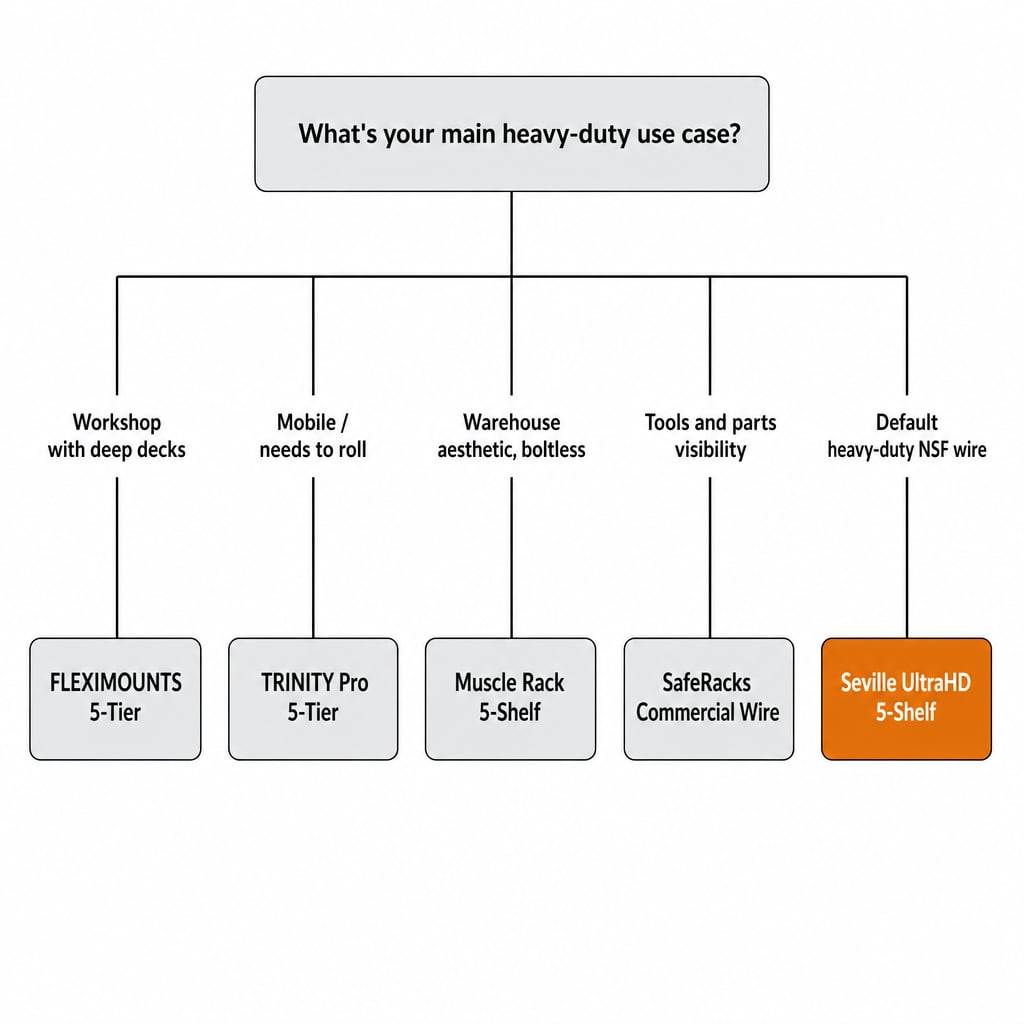
| Product | Best for | Deck type | Per-shelf capacity (manufacturer-listed) | Mobility | Main advantage | Main drawback |
|---|---|---|---|---|---|---|
| Seville UltraDurable | NSF wire workhorse | Chrome wire | 800 lb on leveling feet | Leveling feet (3″ casters included) | Brand tenure + NSF cert | 18″ depth limits some loads |
| FLEXIMOUNTS Heavy-Duty | Garage workshops | Snap-in panels on steel frame | 400 lb (2,000 lb total) | Leveling feet | Deeper 24″ decks, garage-specific brand | Lower per-shelf rating than chrome wire flagships |
| TRINITY EcoStorage | Mobile heavy-duty | Chrome wire | 500 lb total on wheels / 1,350 lb total on levelers | Wheels + feet levelers in box | Factory wheels rated for the rack | Wheels math sets a lower ceiling |
| Muscle Rack 5-Shelf | Industrial-style | Particleboard | 800 lb evenly distributed | Leveling feet | Boltless rivet assembly | Particleboard deflects on point loads |
| SafeRacks NSF Wire | Tools and parts | Zinc-plated wire | 600 lb (3,000 lb total) | Wheels + feet levelers | Wire-deck visibility | Small parts fall through |
Wire Decks vs Particleboard Decks vs Steel Decks
Wire, particleboard, and steel decks behave very differently under real garage loads. The right choice depends on what you actually store, not on which deck looks “heavy-duty” in the product photo.
| Deck type | Best for | Avoid for |
|---|---|---|
| Wire | Visibility, ventilation, tool/parts storage with bins | Loose small parts without liners or bins |
| Particleboard | Distributed weight (boxes, totes, paint cans) | Concentrated point loads (engines, anvils, single-point dense items) |
| Steel | Point loads, automotive parts, dense single items | Cost-sensitive builds (steel decks add meaningful price) |
If you don’t know which loads dominate, particleboard is a fine default — it handles the typical mix of garage loads (distributed weight) and the failure mode (sag) is visible early enough to plan around.
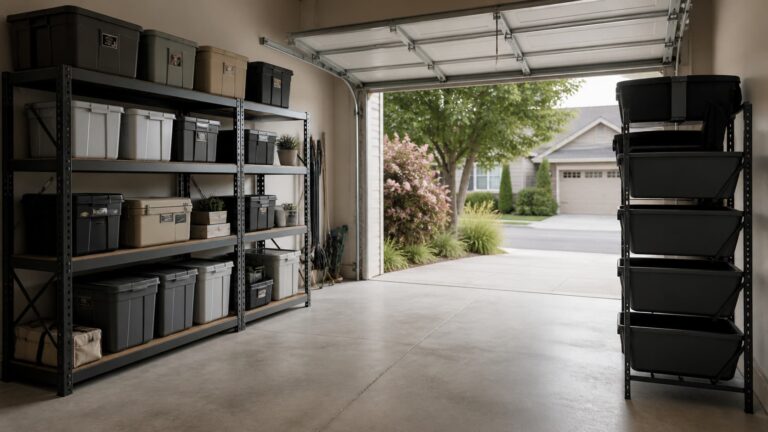
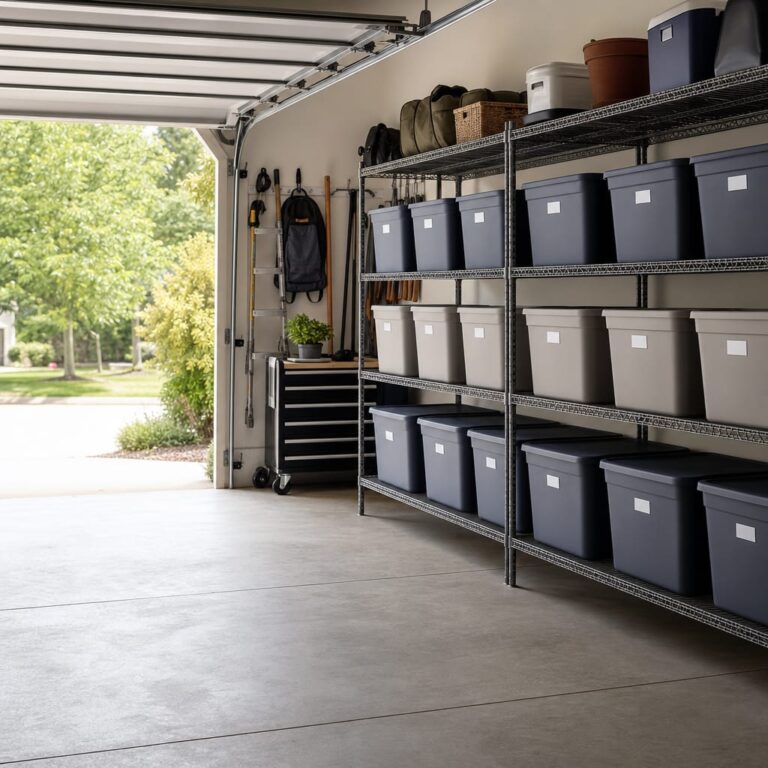
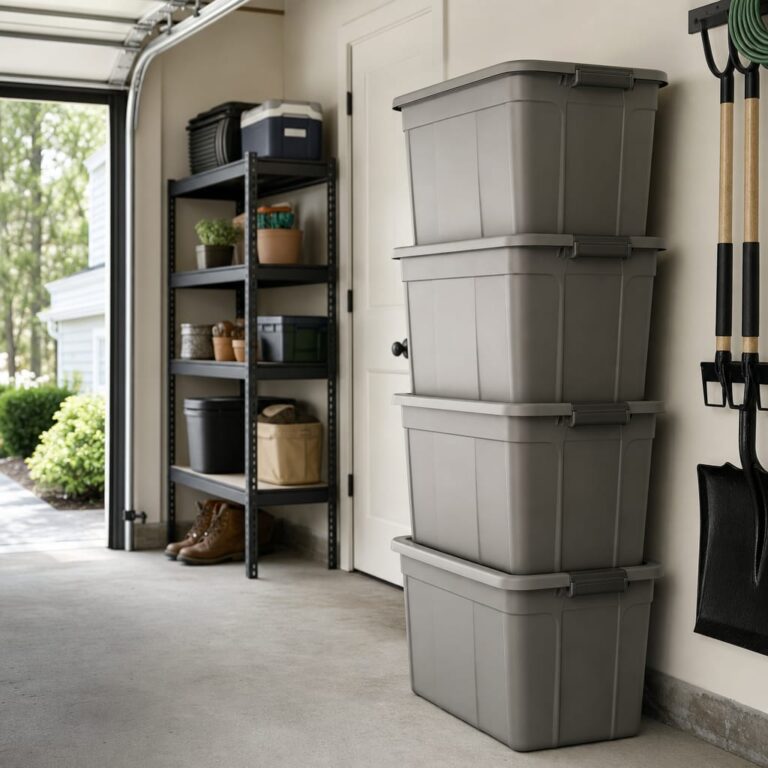
How many totes actually fit on a garage shelf
Tote makers publish dimensions and shelving makers publish dimensions, but nobody puts the two together — so people buy shelving, then discover their totes overhang it. This table takes the published external size of totes from the brands people actually buy for garage storage — Sterilite, Rubbermaid Roughneck, and IRIS USA — and works out how many fit per shelf on the two garage shelving depths you can actually buy, 18 in and 24 in.
| Tote | Published dimensions (source order) | Footprint | Height | Fits an 18 in deep shelf? | Per 48 × 18 in shelf | Per 48 × 24 in shelf | Specification source | Source checked |
|---|---|---|---|---|---|---|---|---|
| Sterilite 6 Qt. Storage Box | 13 5/8" x 8" x 4 5/8" | 13⅝ in × 8 in | 4⅝ in | Yes | 6 | 9 | Sterilite 6 Qt. Storage Box | 2026-09-14 |
| Sterilite 16 Qt. Storage Box | 17 1/8" x 11 7/8" x 6 3/4" | 17⅛ in × 11⅞ in | 6¾ in | Yes | 4 | 4 | Sterilite 16 Qt. Storage Box | 2026-09-14 |
| Sterilite 27 Qt. ClearView Latch Box | 17" x 11 1/8" x 12 3/4" | 17 in × 11⅛ in | 12¾ in | Yes | 4 | 4 | Sterilite 27 Qt. ClearView Latch Box | 2026-09-14 |
| Sterilite 60 Qt. Wheeled Underbed Latch Box | 35 1/2" x 18 7/8" x 7" | 35½ in × 18⅞ in | 7 in | No — it overhangs | 0 | 1 | Sterilite 60 Qt. Wheeled Underbed Latch Box | 2026-09-14 |
How these numbers were produced: External dimensions are quoted on the date shown per row. Sterilite rows are quoted from Sterilite’s own product pages (L x W x H order). Rubbermaid Roughneck rows are quoted from Ace Hardware’s retailer listing, which prints the manufacturer’s SKU-linked dimensions in H x W x D order on each product page. IRIS USA rows are quoted from IRIS USA’s own product pages (L x W x H order). All figures are the external/overall assembled dimensions with the lid on. The counts are computed, not estimated: totes are placed in a single layer, all in the same orientation, with no overhang and no gap; both orientations (the tote’s long side along the shelf’s 48 in run, or along its depth) are tried and the better one is kept. Shelf width is 48 in in both cases — the two depths are real Husky shelving footprints: 48 in. W x 18 in. D (Husky 86 in. H x 48 in. W x 18 in. D 6-Shelf Steel Shelving Unit, model MR481886W6B, https://www.homedepot.com/p/Husky-86-in-H-x-48-in-W-x-18-in-D-Black-Steel-6-Shelves-Shelving-Unit-MR481886W6B/306062319) and 48 in. W x 24 in. D (Husky 5-Tier Steel Shelving Unit, 48 in. W x 78 in. H x 24 in. D, model 426007, https://www.homedepot.com/p/Husky-5-Tier-Riveted-Steel-Garage-Storage-Shelving-Unit-in-Silver-48-in-W-x-78-in-H-x-24-in-D-426007/303241694); neither product page states a clear opening between posts. 48×18 and 48×24 are unobstructed reference surfaces, not guaranteed usable dimensions of every nominal 48×18 or 48×24 rack — posts and lips can reduce the clear opening (one retailer answer for a Husky 48×24 gives about 45.5 × 21.5 in between posts). Round the result down again if your shelving has corner posts that intrude, and leave room to get a hand in.
- A tote that fits the shelf footprint still needs vertical room: check the tote height against your shelf spacing, and leave clearance to lift it in and out rather than sliding it flush.
- Counts assume a flat, full-depth shelf. Wire shelving with a lip, or posts at the corners, will cost you the last tote in a row.
- Lids overhang the base on most totes; the figures here are the manufacturer’s overall assembled dimensions, which already include the lid.
- Capacity in quarts or gallons tells you nothing about whether it fits — and "27" doesn’t mean the same thing twice. The Sterilite 27 Qt. ClearView Latch Box (17 in x 11-1/8 in) fits an 18 in shelf; the Sterilite 108 Qt. Stacker Box (25-3/4 in x 18-3/8 in) — 27-gallon-equivalent by volume (108 qt = 27 gal), though Sterilite sells it as "108 Qt.," not "27 Gal." — does not.
- Manufacturers and retailers don’t all publish dimensions in the same order. Ace Hardware lists Rubbermaid Roughneck as Height x Width x Depth, where Sterilite and IRIS USA publish Length x Width x Height. This table normalises every row to footprint (the two horizontal dimensions) and height so they compare directly regardless of the order they were published in.
- Rubbermaid Roughneck’s 10 gal and 18 gal totes share the same footprint (23⅞ in x 15⅞ in) — only the height changes, so stepping up in capacity in that range costs no extra shelf space, only vertical clearance.
- A blank cell means the manufacturer does not publish that figure — we do not fill gaps with numbers we could not source.
These are the entries that matter for this guide. The full table, with every row and its source, is in our How many totes actually fit on a garage shelf.
How to Measure Your Garage Before Buying Heavy-Duty Shelves
Before buying any rack on this list, take five measurements and compare against the rack’s spec page.
- Floor footprint with 6″ clearance: Measure the wall length where the rack will sit. Subtract 6 inches on each end for walk paths and air flow. The rack’s listed width must be smaller than the remaining length.
- Ceiling height vs 72″ rack height: Most heavy-duty racks are 72 inches tall. You need clearance above the rack for loading the top shelf — at least 6 inches, often more if the top shelf will hold tall items.
- Garage door track clearance: If the rack sits along the same wall as the garage door tracks, check that the rack’s top doesn’t intersect the open-door track height.
- Floor levelness: Put a long level on the floor where the rack will sit. Garages slope toward a drain by design — out-of-level floors limit wheel use and make leveling feet harder to adjust.
- The heaviest single item you’ll store + where it goes: Identify the heaviest item you plan to load, decide which shelf it lives on, and confirm the rack’s per-shelf capacity covers it with margin.
Common Complaints and Buyer Warnings
Heavy-duty rack complaints cluster around three recurring failure modes. Two are predictable from the spec page; one isn’t.
- Capacity figures often reflect a leveling-feet variant rather than the wheels variant received.
- Particleboard decks visibly sag under concentrated point loads.
- Out-of-level garage floors make wheel use harder and limit leveling-feet adjustment range.
The single most important warning: the capacity number on the listing usually applies to one specific variant of the SKU. Confirm the variant before assuming the figure applies.
Capacity-variant confusion
The listing shows 4,000 lb total, the buyer selects a wheels or different-size variant, and working capacity is lower — sometimes substantially. The fix is editorial discipline at purchase: cross-check the manufacturer’s product page for the variant figure, and assume the headline applies to leveling feet unless stated otherwise.
Particleboard sag under point loads
Particleboard handles distributed weight well. An 800-lb load spread across a 48″×24″ deck transfers cleanly to the posts. The same load on one corner concentrates force on a small area, and particleboard deflects. Either pick a steel-deck rack or top decks with 3/4-inch plywood overlays.
Out-of-level garage floors and wheel wobble
Most residential garages slope 1/8 inch per foot toward the door for drainage. A 48-inch-wide rack on a sloped floor with wheels wants to roll downhill; a leveling-feet rack at the same location needs longer feet on the low side. Check the floor before committing to wheels.
Who Should Avoid Heavy-Duty Garage Shelves?
Heavy-duty racks are overbuilt for many garages. Skip this category if any of the following apply.
- You only store light, bulky items (totes, holiday decor, seasonal sports gear). A lightweight wire rack is fine, costs less, and assembles faster.
- You’re renting and can’t commit to a 72-inch-tall rack you may need to disassemble at move-out. Consider a shorter modular alternative.
- Your garage is too narrow for an 18-inch-deep freestanding unit. Wall-mounted shelving fits narrower bays.
- You need cabinet doors or dust enclosure. See open shelving versus enclosed cabinets for the cabinet alternative.
- You only need part-time storage and the rack will be empty most of the year. Heavy-duty cost is wasted on light occasional use.
FAQ
How much weight can heavy-duty garage shelves actually hold?
Manufacturer-listed per-shelf capacity for the racks in this guide ranges from about 400 lb to 800 lb on leveling feet. Real-world capacity depends on assembly, floor levelness, weight distribution, and the base configuration — wheels-rated capacity is typically a fraction of leveling-feet capacity. Treat the listed number as a ceiling and stay well below it.
Are NSF-certified racks worth it for a garage?
NSF is a food-safety certification, not a garage requirement. But because NSF testing covers weld quality, finish durability, and structural load standards, an NSF-certified rack is generally a better-built rack than a non-certified equivalent at the same price tier. It’s a useful proxy for build quality.
Are wire shelves better than particleboard shelves for heavy items?
It depends on the load type. For distributed weight (boxes, totes, paint cans), particleboard handles loads as well as wire and gives a flat surface. For concentrated point loads (engine blocks, anvils), wire deflects through the grid, particleboard sags locally, and steel decks are the right answer. For visibility and ventilation, wire wins.
Can I add wheels to a heavy-duty rack later?
Yes, most racks accept aftermarket wheels in place of the leveling feet. But the wheel rating becomes the new working capacity — it’s a property of the wheel, not the rack. Adding aftermarket wheels typically lowers working capacity by half or more compared to the leveling-feet figure.
What height should I plan for ceiling clearance?
Plan for rack height plus at least 6 inches of overhead working room for loading the top shelf. A 72-inch rack in a garage with 84-inch ceilings leaves 12 inches — tight if the top shelf holds taller items. Also confirm the rack doesn’t intersect open-door track height.
Do I need to bolt heavy-duty shelves to the wall?
Most freestanding heavy-duty racks are stable when correctly loaded (heavier items low, evenly distributed). Tall narrow racks loaded high benefit from wall anchoring; wide racks on level floors usually don’t need it. Follow the manufacturer’s installation instructions.
How do I distribute weight across shelves?
Heaviest items on the bottom one or two shelves, never on the top. Spread point loads across deck faces. Keep weight balanced front-to-back — don’t load only the front edge of every shelf. Once loaded, walk around the rack and confirm it doesn’t visibly lean.
Sources Reviewed
For this guide we reviewed manufacturer product information from Seville Classics, FLEXIMOUNTS, TRINITY, Edsal/Muscle Rack, and SafeRacks; retailer specifications on Amazon listings; NSF certification listings where applicable; product documentation where the brand publishes installation guides; and recurring patterns in public buyer feedback. We focused on product details that matter for heavy-duty freestanding shelving — manufacturer-listed per-shelf and total capacity, deck material, base configuration (leveling feet vs wheels), assembly method, and shelf adjustability.