Stackable Bins vs Shelving for Garage (Honest Comparison)
Last updated:
Disclosure: This article contains affiliate links. If you buy through these links, we may earn a commission at no extra cost to you. We do not claim hands-on testing unless clearly stated.
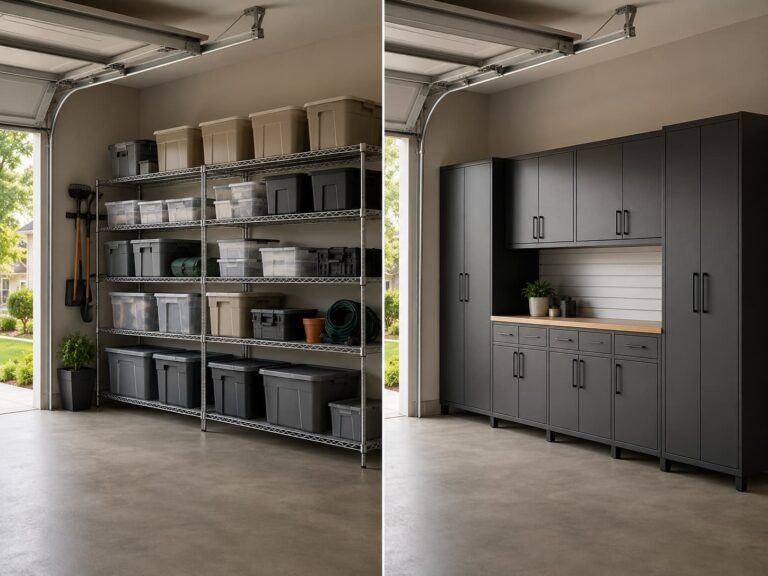
You stare at the cluttered corner of stacked totes next to a half-loaded wire shelf and ask the question every homeowner asks: buy more bins, or buy more shelving? Listings are no help — both promise “modular, scalable, garage-friendly” in nearly identical words. This article walks through a three-variable decision frame — access frequency, item shape and weight, garage climate — and points to four picks (two bins, two shelving) as honest exemplars of each side. We do not crown one universally better; they solve different problems.
Quick Answer
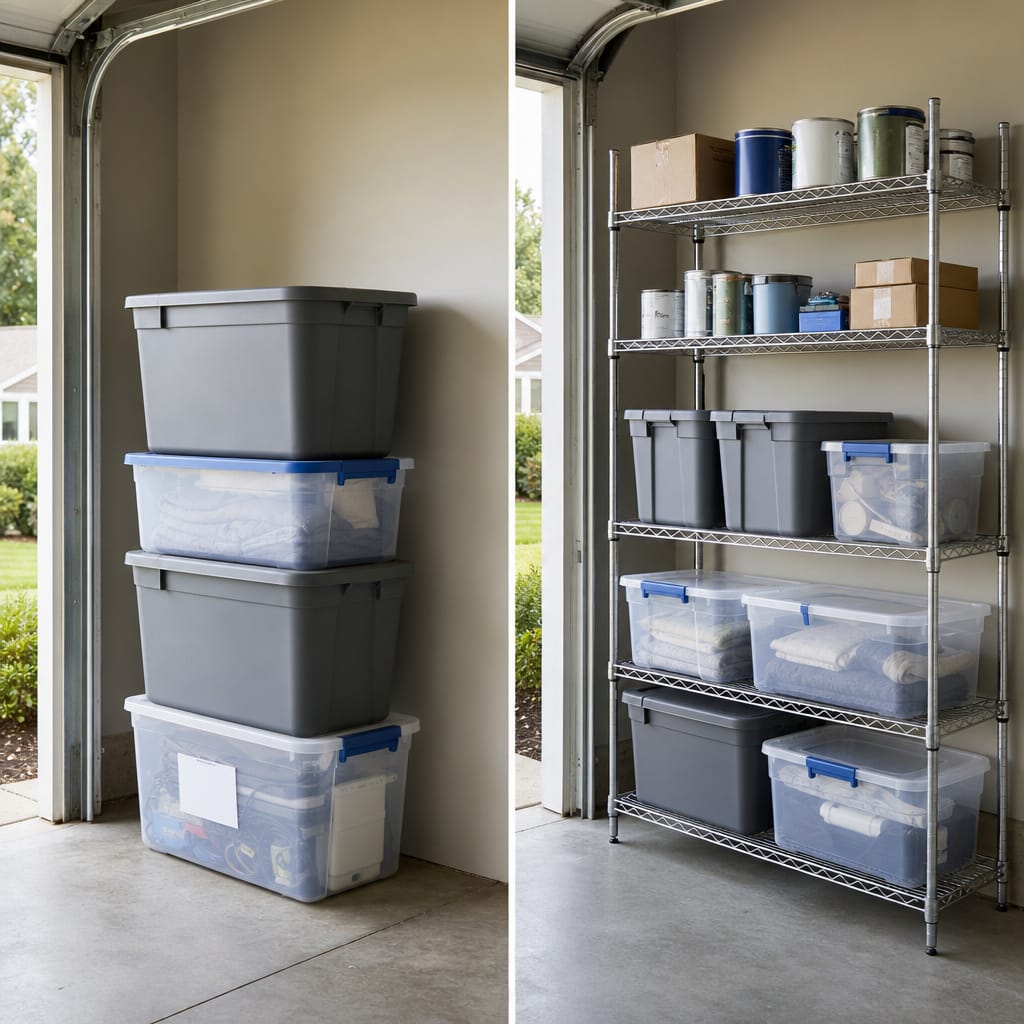
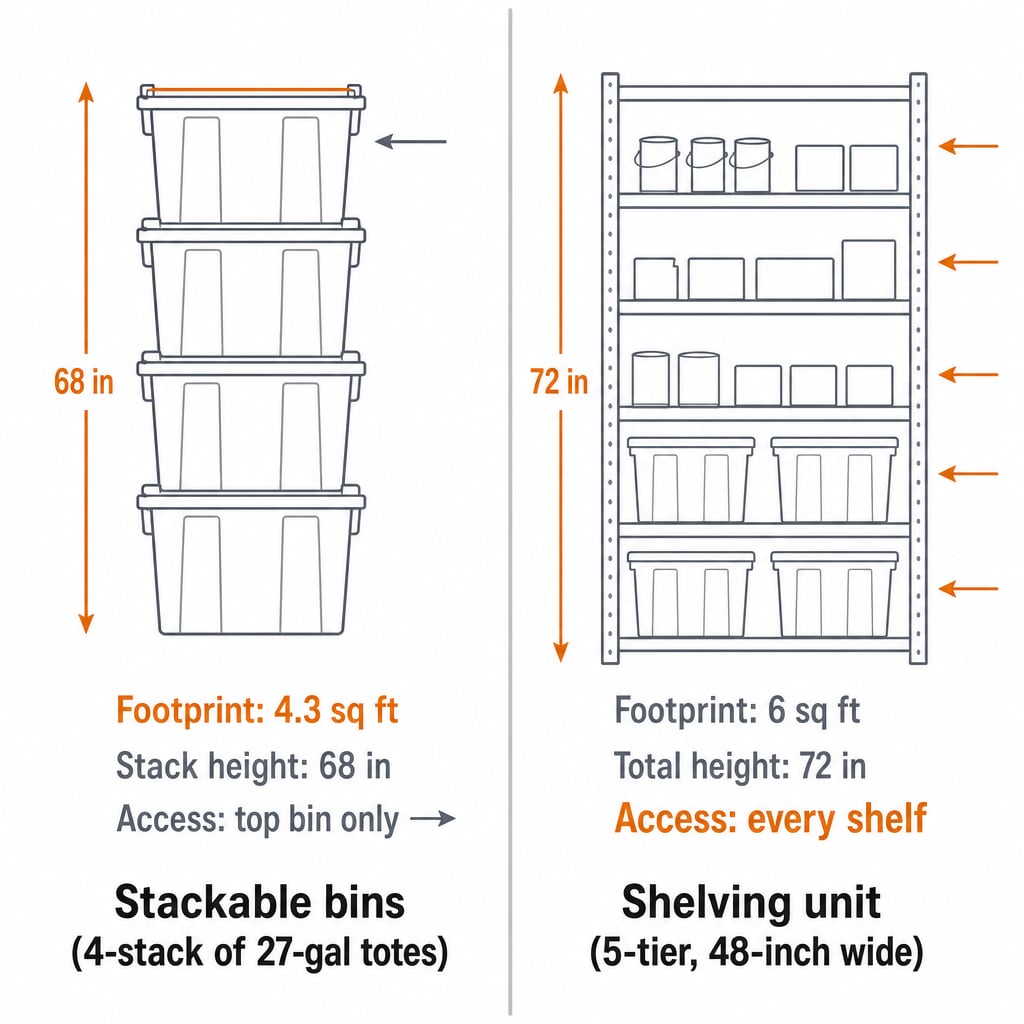
For low-frequency, light, uniform items — seasonal decor, out-of-rotation sports gear, kids’ outgrown clothes — stackable bins usually win. They cost less per cubic foot, reconfigure easily, and protect from dust and pests. For heavy, irregular, or frequently-accessed items — daily-use tools, paint cans, current-season equipment — shelving wins. Items stay visible and access is one motion instead of an unstack-and-restack ordeal. Access frequency drives the call more than item type alone.
Best Choice by Situation
| Situation | Better choice | Why |
|---|---|---|
| Seasonal decor (Christmas lights, summer toys) | Bins | Low access frequency, dust protection matters |
| Daily-use tools and chargers | Shelving | Grab-and-go, full visibility |
| Paint cans, oil, automotive fluids | Shelving (solid deck) | Can’t stack safely, need stable surface |
| Kids’ outgrown clothes and toys | Bins | Labeled, stacked, low access |
| Sports equipment in active rotation | Shelving | Irregular shapes, frequent access |
| Bulk paper goods, dry storage | Bins | Pest and dust barrier |
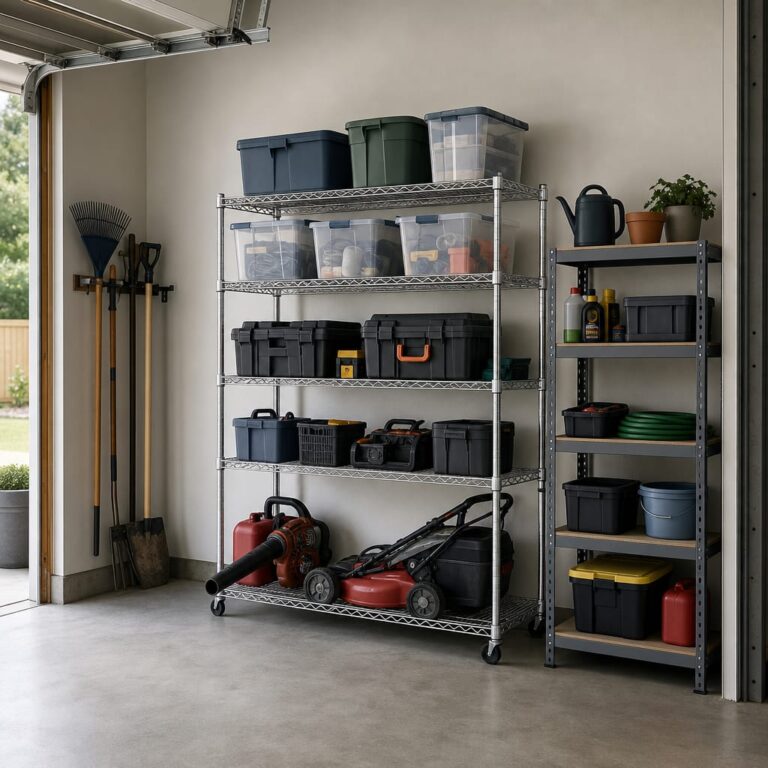
| Mix of seasonal totes plus current items | Hybrid | Bins on lower shelves of a shelving unit |
Stackable Bins — Pros, Cons, Best Use Cases
What they are
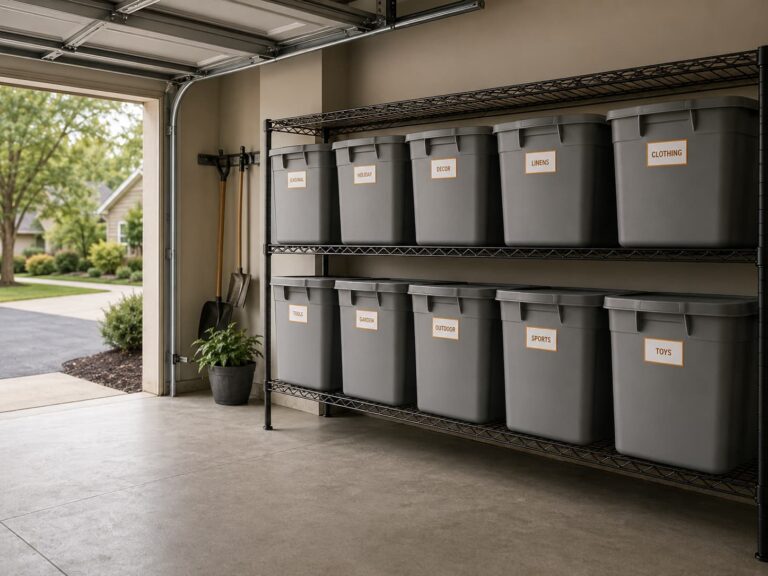
Plastic containers designed to interlock or sit flat when stacked. Common residential sizes: 19 quarts to 70 gallons. Lid types vary — stack-and-lock recessed, side-latch, or hinged front-access (the IRIS WeatherPro pattern).
Where they work best
- Low-frequency items, especially seasonal
- Uniform-shape items that pack predictably
- Items needing dust, pest, or moisture protection
- Spaces that reconfigure across seasons
Where they fall short
- Heavy items — the lower bin compresses and warps over time
- Frequently-accessed items — every retrieval is an unstack-and-restack ordeal unless the lid opens from the front
- Irregular shapes — a chainsaw or leaf blower wastes most of the interior volume
- Visibility — opaque bins demand labels; clear bins yellow and embrittle
If you’ve outgrown loose stacking, our stackable bin roundup covers specific models in more depth.
What manufacturers and retailers typically specify
Volumetric capacity (quarts or gallons) is almost always listed. The more useful specs rarely are: per-bin compression rating when stacked, maximum stack height, and lid interlock type. “Heavy duty” without a load rating means “marketed as heavy duty,” not load-rated.
Buyer warnings specific to bins
- “Stackable” is marketing. Many bins stack but lose access to lower units. Look for hinged front-access lids if access matters.
- Opaque bins need labels applied immediately.
- “Heavy duty” varies wildly across SKUs from the same brand — Sterilite Industrial is not the same line as Sterilite Stack & Carry.
Shelving Units — Pros, Cons, Best Use Cases
What they are
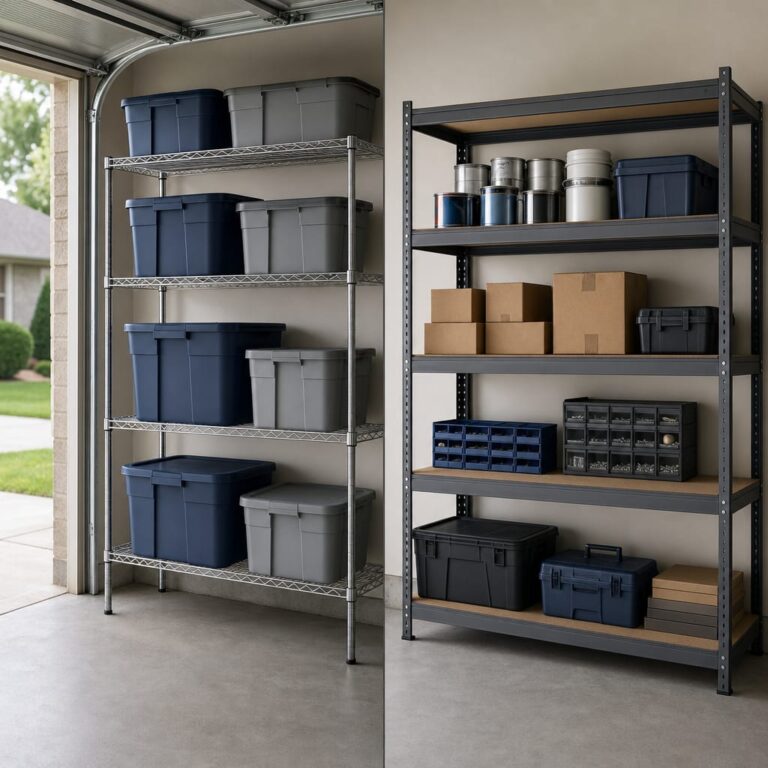
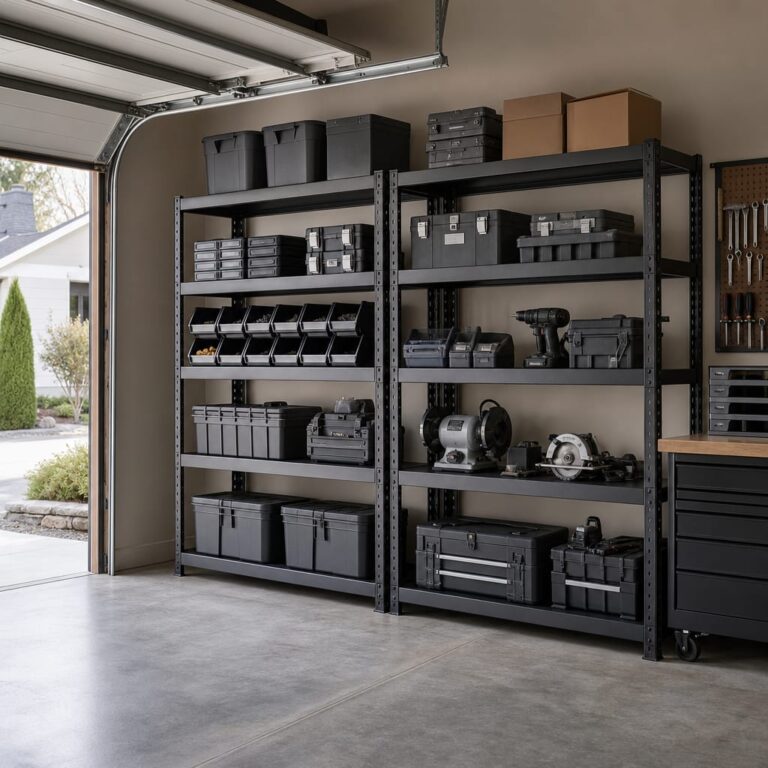
Four- or five-tier free-standing units, typically 18 to 24 inches deep and 36 to 48 inches wide. Decks are wire (open grid), solid (particleboard or steel), or hybrid. Frames are chrome-plated steel, powder-coated steel, or boltless rivet construction.
Where they work best
- Heavy items (paint cans, batteries, mulch, fluids)
- Irregular shapes (power tools, sporting equipment, odd-sized cans)
- Items in active rotation — grab-and-go
- Visibility-critical items — open wire reveals contents at a glance
Where they fall short
- Open units accumulate garage dust on every shelf
- Wire grids let small items fall through — solid liners or solid-deck units fix this
- Once loaded, shelving doesn’t reconfigure easily
- Floor footprint is committed; the unit doesn’t compress when half-empty
What manufacturers and retailers typically specify
Per-shelf manufacturer-listed capacity is always published, but the Amazon listing and the manufacturer page can disagree — the manufacturer page wins. NSF certification, deck type, shelf-spacing range, and whether casters are included are the other useful specs. If the listing doesn’t disclose whether the per-shelf rating assumes leveling feet or casters, the difference matters — the caster figure is sometimes roughly half. For shelves sized around standard totes, the wire shelving roundup we recommend pairing with totes covers the depth-and-overhang math.
Buyer warnings specific to shelving
- Per-shelf capacity is configuration-dependent. Casters cut the rating; uneven floor cuts it; anchored vs. free-standing changes it.
- Wire grids leak small items. Solid liners (corrugated plastic cut to shelf size) cost a few dollars; solid-deck shelves are the alternative.
- Particleboard decks swell in humid garages — wire or sealed steel is safer.
- Inspect for shipping damage before assembly — bent corner posts are the most common return reason.
Side-by-Side Comparison
| Dimension | Stackable Bins | Shelving Units |
|---|---|---|
| Cost per cubic foot stored | Lower | Higher |
| Visibility (closed) | Poor (opaque) to fair (clear) | Excellent |
| Access frequency tolerance | Poor (unstack required) | Excellent |
| Reconfiguration ease | High | Low (once loaded) |
| Heavy or irregular items | Poor | Excellent (solid deck) |
| Dust and pest protection | Excellent | None (without bins on shelves) |
| Humid-climate suitability | Excellent (sealed) | Wire OK, particleboard not |
| Small-parts containment | Built-in | Needs liner or bin on top |
How to Decide for Your Garage
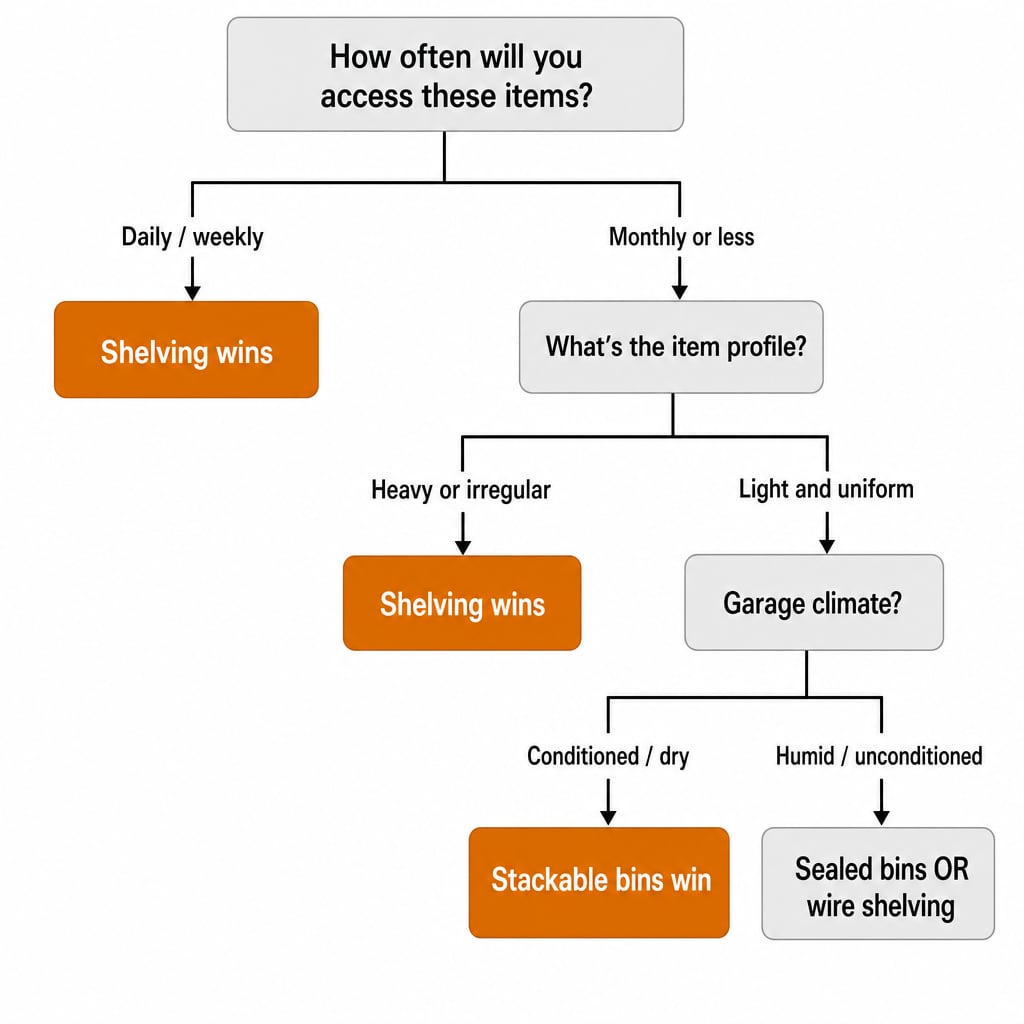
Three variables drive the call: access frequency, item shape and weight, and garage climate. The first does most of the work; the others break ties.
Step 1 — Map your items by access frequency
Daily or weekly: shelving. Monthly: lean shelving. Seasonal: bins. If you can’t remember the last time you opened a tote, it belongs in a bin. For in-between items, the next variable decides.
Step 2 — Check item shape and weight
Heavy and irregular (power tools, paint cans, partial bags): solid-deck shelving. Light and uniform (clothing, decor, paper goods): bins. Heavy and uniform (a 6-pack of motor oil): either, but a solid-deck shelf beats a 4-stack of small bins for stability. For bins sized to pair with shelves, bins specifically sized to fit standard 18-inch shelves is the targeted guide.
Step 3 — Account for climate
Conditioned (HVAC-served): either works. Humid unconditioned (coastal, Gulf Coast): wire shelving or sealed bins, never particleboard. Dry unconditioned (interior West): either; bins add dust and rodent protection.
The hybrid setup most readers end up with
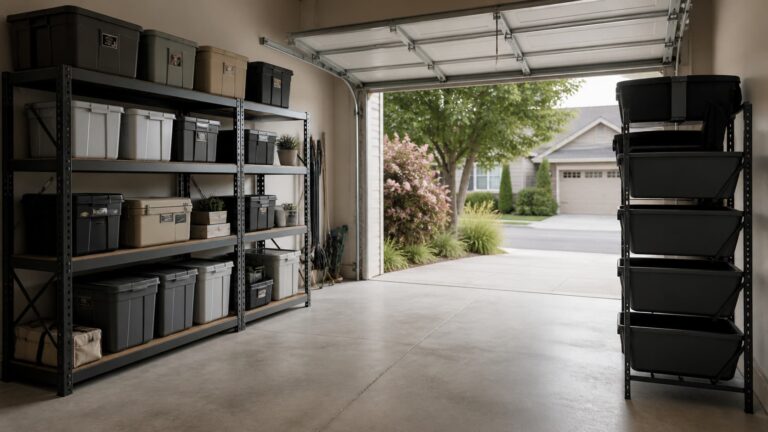
Most real garages settle into a hybrid — shelving as the structure plus stackable bins on the lower shelves for low-frequency items. Bins-only and shelving-only both tend to look like mistakes a year in.
Common Mistakes
Mistake: Buying “stackable” bins without checking lid access type. Stack-and-lock means you cannot reach lower bins without unstacking. Front-access hinged lids solve this at a higher per-cubic-foot cost. Stacking 3 high and reaching twice a year? Regular stack-and-lock is fine. Stacking 4 high or reaching weekly? Front-access is mandatory.
Mistake: Treating per-shelf capacity as a single number. Manufacturer-listed capacity assumes leveling feet, level floor, even load distribution, and proper assembly. Casters cut the rating, sometimes by half. Corner-loading cuts it. Skipping the diagonal cross-brace cuts it. The catalog number is the ceiling, not the typical.
Mistake: Choosing particleboard shelving for an unconditioned humid garage. Particleboard absorbs moisture and swells; decks warp or delaminate. Wire or sealed-coated steel is the right call for humid spaces.
Mistake: Going all-in on one system. Most real garages are hybrids. Shelving designed for stacked totes is the most efficient end state — open shelving as the structure, totes on the lower 1-2 tiers, irregular items on the upper tiers.
Recommended Products for Each Side
Four picks, two per side. Each rationale is tied to the comparison frame, not a full roundup-style review.
For the bins side: IRIS USA WeatherPro 19-Quart
Best for: Dust-, moisture-, and pest-sensitive items in unconditioned garages — paper goods, fabric, holiday decor, anything that needs a sealed barrier.

The IRIS WeatherPro 19-quart bin is a top-loading clear plastic tote with a gasket-sealed lid and multi-buckle latches. Clear walls confirm contents at a glance; the gasket keeps out dust, moisture, and pests. This listing sells the bin as a 6-pack, not individually — check the pack quantity and work out the true per-bin price before buying. Each 19-quart bin holds about one season of one category. IRIS doesn’t publish a per-bin compression rating, so treat 4 stack as the practical ceiling for typical loads.
For the bins side: Sterilite Heavy-Duty Industrial Latching Tote
Best for: Bulk seasonal storage where volume matters more than per-bin access, and where the tote needs to sit on a standard 18-inch garage shelf.

The default USA garage tote. Recessed lid means 4 stack without slipping. Fits most 18-inch shelves with a small front overhang. Opaque walls — label everything immediately.
For the shelving side: Seville Classics UltraDurable 5-Tier Wire Shelving
Best for: Open visibility and grab-and-go access for items in current rotation, in conditioned or humid unconditioned garages.
NSF-certified chrome-plated wire. The manufacturer lists per-shelf capacity around 600 pounds on leveling feet; the Amazon listing sometimes shows higher. We use the manufacturer page as authoritative. Wire grid lets small items fall through — pair with a corrugated-plastic shelf liner, or keep small parts in bins on the shelf. Standard config is 5-tier 48″×18″×72″.
For the shelving side: Muscle Rack 5-Tier with Particle-Board Decks
Best for: Heavy or small-parts items that fall through wire grids — paint cans, automotive fluids, fastener bins — in a conditioned or dry-climate garage.

Solid particleboard decks catch every small part that wire grids leak. The manufacturer lists 800 lb per shelf with a 4,000 lb total capacity for this 48″×24″×72″ 5-tier unit, with bolt-free Z-beam assembly. Caveat: particleboard swells in humid garages. For unconditioned humid spaces, the Seville wire option above is safer.
How many totes actually fit on a garage shelf
Tote makers publish dimensions and shelving makers publish dimensions, but nobody puts the two together — so people buy shelving, then discover their totes overhang it. This table takes the published external size of totes from the brands people actually buy for garage storage — Sterilite, Rubbermaid Roughneck, and IRIS USA — and works out how many fit per shelf on the two garage shelving depths you can actually buy, 18 in and 24 in.
| Tote | Published dimensions (source order) | Footprint | Height | Fits an 18 in deep shelf? | Per 48 × 18 in shelf | Per 48 × 24 in shelf | Specification source | Source checked |
|---|---|---|---|---|---|---|---|---|
| Sterilite 106 Qt. Latching Box | 33 7/8" x 18 3/4" x 13" | 33⅞ in × 18¾ in | 13 in | No — it overhangs | 0 | 1 | Sterilite 106 Qt. Latching Box | 2026-09-14 |
| IRIS USA WeatherPro Storage Container, 30 Qt. | 19.70" L x 15.75" W x 7.75" H | 19.7 in × 15.75 in | 7.75 in | Yes | 2 | 3 | IRIS USA WeatherPro Storage Container, 30 Qt. — Gasket Box | 2026-09-14 |
| IRIS USA WeatherPro Storage Container, 74 Qt. | 23.6" L x 17.8" W x 14.5" H | 23.6 in × 17.8 in | 14.5 in | Yes | 2 | 2 | IRIS USA WeatherPro Storage Container, 74 Qt. — Gasket Box (3-pack) | 2026-09-14 |
| IRIS USA WeatherPro Storage Box, 82 Qt. | 30.00" L x 16.00" W x 15.40" H | 30 in × 16 in | 15.4 in | Yes | 1 | 1 | IRIS USA Heavy-Duty Storage Box WeatherPro, 82 Qt. — Gasket Box | 2026-09-14 |
How these numbers were produced: External dimensions are quoted on the date shown per row. Sterilite rows are quoted from Sterilite’s own product pages (L x W x H order). Rubbermaid Roughneck rows are quoted from Ace Hardware’s retailer listing, which prints the manufacturer’s SKU-linked dimensions in H x W x D order on each product page. IRIS USA rows are quoted from IRIS USA’s own product pages (L x W x H order). All figures are the external/overall assembled dimensions with the lid on. The counts are computed, not estimated: totes are placed in a single layer, all in the same orientation, with no overhang and no gap; both orientations (the tote’s long side along the shelf’s 48 in run, or along its depth) are tried and the better one is kept. Shelf width is 48 in in both cases — the two depths are real Husky shelving footprints: 48 in. W x 18 in. D (Husky 86 in. H x 48 in. W x 18 in. D 6-Shelf Steel Shelving Unit, model MR481886W6B, https://www.homedepot.com/p/Husky-86-in-H-x-48-in-W-x-18-in-D-Black-Steel-6-Shelves-Shelving-Unit-MR481886W6B/306062319) and 48 in. W x 24 in. D (Husky 5-Tier Steel Shelving Unit, 48 in. W x 78 in. H x 24 in. D, model 426007, https://www.homedepot.com/p/Husky-5-Tier-Riveted-Steel-Garage-Storage-Shelving-Unit-in-Silver-48-in-W-x-78-in-H-x-24-in-D-426007/303241694); neither product page states a clear opening between posts. 48×18 and 48×24 are unobstructed reference surfaces, not guaranteed usable dimensions of every nominal 48×18 or 48×24 rack — posts and lips can reduce the clear opening (one retailer answer for a Husky 48×24 gives about 45.5 × 21.5 in between posts). Round the result down again if your shelving has corner posts that intrude, and leave room to get a hand in.
- A tote that fits the shelf footprint still needs vertical room: check the tote height against your shelf spacing, and leave clearance to lift it in and out rather than sliding it flush.
- Counts assume a flat, full-depth shelf. Wire shelving with a lip, or posts at the corners, will cost you the last tote in a row.
- Lids overhang the base on most totes; the figures here are the manufacturer’s overall assembled dimensions, which already include the lid.
- Capacity in quarts or gallons tells you nothing about whether it fits — and "27" doesn’t mean the same thing twice. The Sterilite 27 Qt. ClearView Latch Box (17 in x 11-1/8 in) fits an 18 in shelf; the Sterilite 108 Qt. Stacker Box (25-3/4 in x 18-3/8 in) — 27-gallon-equivalent by volume (108 qt = 27 gal), though Sterilite sells it as "108 Qt.," not "27 Gal." — does not.
- Manufacturers and retailers don’t all publish dimensions in the same order. Ace Hardware lists Rubbermaid Roughneck as Height x Width x Depth, where Sterilite and IRIS USA publish Length x Width x Height. This table normalises every row to footprint (the two horizontal dimensions) and height so they compare directly regardless of the order they were published in.
- Rubbermaid Roughneck’s 10 gal and 18 gal totes share the same footprint (23⅞ in x 15⅞ in) — only the height changes, so stepping up in capacity in that range costs no extra shelf space, only vertical clearance.
- A blank cell means the manufacturer does not publish that figure — we do not fill gaps with numbers we could not source.
These are the entries that matter for this guide. The full table, with every row and its source, is in our How many totes actually fit on a garage shelf.
How to Measure Before You Buy
A short measurement pass saves a return.
Measure available floor space
Length, depth, and clearance height. Account for the garage door swing path, the car’s mirror clearance, and wall-mounted features (electrical panel, water heater) that need access.
Measure the items you intend to store
Largest tote dimensions matter — a 27-gallon tote isn’t a single standard size; the Sterilite 27-gallon is around 30.5 inches long, others vary. Heaviest single item weight drives the per-shelf math. Tallest item height drives shelf spacing — a paint can is 7-8 inches, a motor-oil jug around 10.
Decide bin or shelf spacing
Adjustable-shelf units let you reconfigure for tote height; fixed shelves lock you in. Front-access bins need a few inches of clear front overhang. In tight corners, predictable fixed spacing is easier to plan around.
FAQ
Can I stack bins on top of shelving units?
Yes, with two caveats. Check the per-shelf manufacturer-listed capacity including the stacked bins and contents, and check ceiling clearance — a 4-bin stack on a 72-inch shelf is over 11 feet of total height, exceeding many residential ceilings.
How tall can I safely stack bins in a residential garage?
Four bins is the typical practical ceiling for lines without a published compression rating. Five or more requires the manufacturer to specify one — rare in residential SKUs. Seismic regions argue for fewer-and-anchored.
Are stackable bins safe for storing paint or chemicals?
Only if rated for chemical contact. Most general-purpose plastic totes are not — paint cans on solid-deck shelving is safer because cans stay upright, ventilation is better, and a leak doesn’t pool inside an enclosed container.
Do I need anchored shelving in earthquake regions?
Yes for any free-standing shelving over 4 feet tall, especially when loaded. Most manufacturers include a wall-anchor strap; use it. Bins stacked on the floor are also a tipping risk above 3 high in seismic zones.
What about wall-mounted shelving as a third option?
Legitimate, but a different decision tree — joist study, weight rating, mounting hardware, and stud spacing all enter. Wall-mounted shelving suits items you reach often; it doesn’t replace bins or free-standing shelving for bulk storage.
Do clear bins last as long as opaque ones in a garage?
In unconditioned garages, no. UV plus temperature cycling yellows and embrittles clear plastic over a few years. Opaque holds up longer. In conditioned garages, both last comparably.
Sources Reviewed
For this comparison, we reviewed manufacturer pages for IRIS USA, Sterilite, Seville Classics, and Edsal/Muscle Rack, the relevant Amazon listings, and recurring patterns in public buyer discussions on stackable-bin failure modes and shelving-capacity configuration. We did not hand-stack or load-test any of these products. We do not claim hands-on testing.