Best Stackable Storage Bins for Garage Organization (2026)
Last updated:
Disclosure: This article contains affiliate links. If you buy through these links, we may earn a commission at no extra cost to you. We do not claim hands-on testing unless clearly stated.
Stacking is the most space-efficient storage strategy for a residential garage — until the tower falls. The bin you pick decides whether the tower stays up. Most stackable-bin roundups treat the category as one product class and rank by capacity or value, but a buyer storing hand tools needs a different bin from a buyer storing off-season clothing, and “stackable” means different things in each case. This guide covers five stackable bins that map to five different storage profiles: heavy-duty open-front for dense items you reach into often, clear-walled with snap-fit lid for inventory you need to identify without opening, secure snap-on lid for general-purpose protection, small-parts organizer for hardware and screws, and Ultra Stack & Hang workshop bins that work as either a tower or a wall-mounted system. Match the bin to what you’re storing before you match it to a brand.
Quick Picks
| Pick | Product | Best for | Pack size | Watch out for | |
|---|---|---|---|---|---|
| Best heavy-duty | IRIS USA Jumbo Open-Front | Tools, sports gear, dense items reached often | 6 bins | No lid — dust enters | View on Amazon |
| Best clear stackable | 27 Gal Clear w/ Yellow Lid | Inventory you need to identify without opening | 4 totes | Generic listing — variant rotation possible | Affiliate link pending — human review required. |
| Best with lids | 18 Gal Snap-On Lid | General storage protected from dust/moisture | 8 totes | Snap-on lid security degrades over many cycles | Affiliate link pending — human review required. |
| Best small parts | Akro-Mils 30210 Clear | Screws, bolts, beads, hardware | 6 bins | Open-front; parts visible but exposed | View on Amazon |
| Best modular | Quantum QUS260 Ultra Stack & Hang | Workshop with shelf + wall flexibility | 4 bins | Hanging needs separate rail or louvered panel | Affiliate link pending — human review required. |
How We Selected These Bins
We do not claim hands-on testing unless clearly stated. For this guide, we reviewed manufacturer specifications, retailer product pages, brand documentation, Amazon product listings, and recurring patterns in public buyer discussions on garage and workshop forums.
Stackable bins fail in three predictable ways: forward shift (tower leans, bins slide off), lid buckling (a lower-tier lid collapses under stack weight), and bin-wall flex (sides bow under heavy contents). We prioritized products whose listings explicitly address at least one of these failure modes — anti-slide ledges, recessed lids, channeled walls, interlocking grooves. Generic listings without structural specifics were filtered out unless their price-pack value was meaningfully better than a branded alternative, and we flag the two generic listings in the final set so the reader knows their attrition risk.
Selection criteria, in priority order:
- Stack-stability feature explicitly stated (interlocking, anti-slide ledge, recessed lid, channeled walls)
- Manufacturer-listed capacity per bin published, where applicable
- Brand has retail beyond Amazon, OR the product is a specialty mainstream listing whose specs match the slot
- Pack size delivers a complete stack column rather than forcing the reader to buy multiple times
- Bin design fits one specific contents profile, not “all storage needs”
Stackable Doesn’t Mean Stable — What Really Holds a Tower Together
A bin labeled “stackable” only stacks securely if it has at least one of three structural features. Buyers who skip this check end up with towers that lean, shift, or topple — and the failure isn’t always immediate. It’s three months later, when the third bin from the top has migrated forward an inch and the column is no longer plumb.
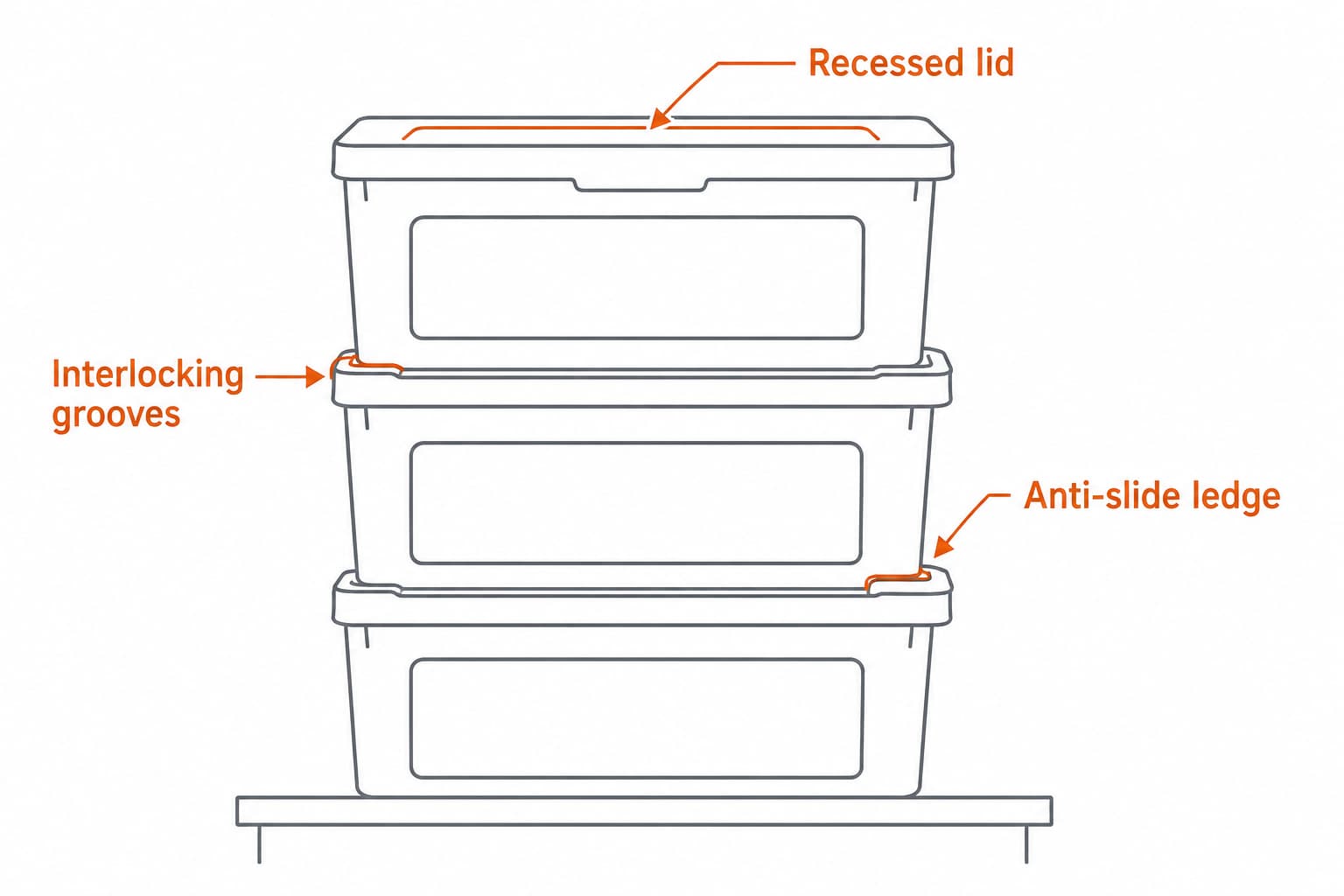
Interlocking grooves are molded into the top and bottom of bins so each bin nests into the one below. They prevent both forward shift and rotational drift. The IRIS USA Jumbo and the Quantum Ultra Stack & Hang both use this approach.
Anti-slide ledges are extra-wide front ledges on the bottom of a bin that fall behind the front rim of the bin below — when a stacked bin tries to slide forward, the ledge catches. Akro-Mils builds this into every AkroBin, and Quantum’s Ultra Stack & Hang line adds an explicit anti-slide lock on the front edge for the same purpose.
Recessed lids are indented into the top of a closed tote, creating a positive register that the next tote’s bottom drops into. The 27-gallon and 18-gallon listings in this guide both use recessed lids; without recessed lids, lidded totes stack unstably.
For the full bin-stacking safety guide covering load distribution, height limits, and what happens when bins from different brands are mixed, our dedicated guide goes deeper.
What to Look for Before Buying
Lid type — open-front, snap-on, or no lid
Open-front bins (IRIS USA Jumbo, Akro-Mils, Quantum) skip the lid entirely. You see contents at a glance and reach in without removing anything. Snap-on lids (27-gallon clear, 18-gallon snap-on) protect contents from dust and moisture but require lifting the lid every access. Pick by how often you reach into the bin: more than weekly = open-front; less = lidded.
Stack-stability features
Confirm the listing names at least one of: interlocking grooves, anti-slide stop, recessed lid, channeled walls. Listings that describe a bin only as “stackable” without naming the feature are the most likely to disappoint at install time.
Material gauge and crush resistance
A heavier-gauge plastic resists deflection under stack load. Cheap stackable bins often advertise capacity per bin but never test what happens when 4 of those bins are stacked. Channeled walls — vertical or horizontal ribs molded into the side panels — are the single most reliable stand-in for crush resistance you can spot in product photos.
Visibility — clear vs. opaque
Clear bins let you skip a labeling system but yellow over time in unheated garages and craze under UV exposure. Opaque bins last longer but require labels — see our bin-and-shelf compatibility guide for label-pattern recommendations.
Pack size value
Most stackable bin SKUs are sold in multi-packs (4, 6, 8, 12). Pick a pack size that delivers a full stack column, not a single bin you’ll have to re-buy. The 18-gallon 8-pack in this guide is sized for buyers building a complete multi-bin column from scratch.
What a good product page should specify
A trustworthy stackable-bin listing publishes per-bin capacity, exact dimensions (especially lid-recess depth for stacked totes), stack-stability feature names, and material gauge. Pages that omit any of these, or hide them behind marketing language like “professional-grade”, are gambling that you won’t ask. Skip them.
Best Heavy-Duty Stackable: IRIS USA Jumbo Open-Front Storage Bins
Best for: Buyers who store dense items they reach into often — hand tools, hardware, sports gear — and need a stack that won’t shift forward over months of repeated access.

Short verdict: IRIS USA’s Heavy-Duty Open Front Jumbo bin (30.88×15.88×14.5″) is the strongest interlocking stack in the candidate set. Made in USA, durable rust-resistant plastic, large grip handles, 6-pack delivers a full storage system. Pick this if you’re storing items you reach into more than once a week.
The IRIS USA brand has been in the plastic-storage category long enough that its product family stretches across many sizes — drawer organizers, parts bins, jumbo open-front. The Heavy-Duty Open Front Jumbo is the version we’d take for a garage that stores active-use items rather than archival storage.
Why it stands out
What separates this IRIS bin from generic open-front competitors is the interlocking design and the rust-resistant USA-made plastic. Interlocking means each bin’s bottom slides into a positive register on the bin below — forward shift is mechanically blocked, not just held by friction. Generic bins often rely on the bin’s own weight to hold the stack, which works at install time and fails six months later. The bins also nest together when not in use — useful for off-season storage of the bins themselves.
It can work well for:
- Hand tools you reach into weekly
- Sports gear that rotates seasonally
- Hardware reels and electrical components
- Garage cleaning supplies in regular rotation
Key specs to check
- Dimensions: 30.88″L × 15.88″W × 14.5″H per bin
- Pack size: 6 bins
- Material: Rust-resistant plastic, made in USA
- Stack-stability feature: Interlocking design
- Handles: Large grip handles for full-load lifting
- Lid: None (open-front)
- Manufacturer-listed capacity per bin: not explicitly published on listing — verify before loading near limit
Recurring feedback patterns
Recurring positive feedback often centers on the interlock holding through long-term use — buyers describe stacks remaining plumb after a year of weekly access. Common complaints typically involve buyers expecting a lid (the listing photos clearly show open-front, but some buyers still order without reading), and a few buyers mention the jumbo size being larger than expected on shelves designed for 18-gallon totes. Several buyers mention using the bins as both garage storage and basement workshop storage interchangeably, which works because the open-front design is venue-neutral.
Potential drawbacks
The open-front design lets dust enter freely. Items stored long-term will accumulate dust on top — not a problem for tools, but a problem for fabric or paper items that will need cleaning before reuse. The 30.88″ length is too long for some standard 24″-deep utility shelves, requiring either a deeper shelf or accepting that the bin will overhang.
Buyer warning
Verify your shelf depth before ordering. The 30.88″L bin overhangs a standard 18″ or 24″ deep shelf, which compromises stack stability. If your shelving is fixed at 24″ deep or shallower, look at the smaller IRIS USA bins in the brand family or the Quantum QUS260 (18″L) instead.
Best Clear Stackable: 27 Gallon Clear with Yellow Snap-Fit Lid
Best for: Buyers who store inventory they need to identify without opening — costumes, holiday decorations, off-season clothing, kids’ toys — and want clear-walled visibility plus secure lid protection.
27 Gallon Clear Industrial Storage Tote with Snap-Fit Yellow Lid (4-Pack)
Affiliate link pending — human review required.
Short verdict: A 27-gallon clear-walled industrial tote with snap-fit yellow lid, deep recessed top for stable tower stacking, and channeled walls for crush resistance. 4-pack. Pick this when you need to know what’s in the bin without opening it, and when contents need protection from dust.
The 27-gallon size is a mainstream tote volume — most home-organization systems and ceiling-rack tote rails are sized for it. The yellow lid is a deliberate visibility cue (lid color signals “lid here, not glass top”), and the snap-fit closure resists accidental opening when the tote is moved.
Why it stands out
Clear walls are the slot’s binding feature. The combination of clear bin walls with a colored snap-fit lid is the right design for a bin that needs to be identified at a glance but also protected — a fully transparent tote with a clear lid is harder to spot in low light. Channeled walls give crush resistance for stacking; deep recessed lid creates positive register for the next bin’s bottom.
It can work well for:
- Holiday decorations rotated seasonally
- Off-season clothing and bedding
- Kids’ supplies (visible labeling without opening)
- Inventory where contents change but the bin doesn’t move often
Key specs to check
- Capacity: 27 gallons
- Pack size: 4 totes (with lids)
- Material: Heavy-duty clear plastic body, yellow snap-fit lid
- Stack-stability features: Deep recessed lid, channeled walls
- Approximate dimensions: ~28.5″L × 19.625″W × 15.5″H (industrial 27-gal standard)
Recurring feedback patterns
Recurring positive feedback often centers on the visibility paying off when stacks have to be re-organized — buyers describe locating a specific tote in 30 seconds vs. opening 4 in sequence. Common complaints typically involve clear-bin yellowing in unheated garages over multiple summers; this is a category-wide issue with clear plastic, not a defect of this specific listing. Several buyers mention using the bins for office records and craft supplies in addition to garage storage, which works because the snap-fit lid is rated heavy-duty.
Potential drawbacks
This is a generic listing — the brand is not attributed clearly on the listing page, and similar-looking sister listings exist for nearby tote sizes. The risk is that a future variant could rotate to a slightly different design without warning. We flag this in the comparison table footnote so the buyer knows to verify they’re getting the listing they expect at order time.
Buyer warning
Clear bins yellow over years in unheated garages exposed to UV. If your garage gets direct afternoon sunlight through a window or door, the cosmetic degradation will start in year 2-3. Functionally, the bins still stack and seal — but the visual visibility they were chosen for fades. Buyers in fully-shaded garages don’t see this issue.
Best With Lids: 18 Gallon Storage Totes with Snap-On Lids
Best for: Buyers building a complete multi-bin storage column from scratch — general-purpose storage of items that need protection from dust and moisture, with the value of an 8-pack delivering the whole column in one order.
18 Gallon Storage Totes with Snap-On Lids (8-Pack, Light Blue)
Affiliate link pending — human review required.
Short verdict: Heavy-duty plastic 18-gallon stackable totes with secure snap-on lids, integrated carry handles molded into both ends, and a recessed stacking design that locks bins together without sliding. 8 to a pack — ships a complete multi-bin column in one delivery.
The snap-on lid is what defines the slot. Open-front bins are great for active-use items but useless for anything that needs to stay clean or dry; a snap-on lid is the protective option that costs nothing structural at the bin level.
Why it stands out
The 8-pack value framing is the slot’s differentiator. Most stackable-bin listings sell 4-packs; building an 8-bin column requires two purchases plus the risk of a variant change between orders. This 8-pack ships a complete column in one delivery, which makes it the right pick for buyers starting from scratch (new garage, post-move, complete reorganization). The recessed stacking design — bins lock into the bin below without sliding — combines with sturdy impact-resistant plastic for tower stability.
It can work well for:
- General-purpose storage where contents vary
- Buyers building a complete storage column from scratch
- Items that need protection from dust and humidity
- Mid-volume storage (between small parts and 27-gallon mainstream)
Key specs to check
- Capacity: 18 gallons per tote
- Pack size: 8 totes (with snap-on lids)
- Material: Heavy-duty impact-resistant plastic, light blue body, snap-on lid
- Stack-stability feature: Recessed stacking design
- Handles: Integrated carry handles on both ends
- Approximate dimensions: ~22″L × 15″W × 11″H (typical 18-gal standard) — verify on listing
Recurring feedback patterns
Recurring positive feedback often centers on the 8-pack value — buyers describe getting an entire shelving unit’s worth of bins in one order. Common complaints typically involve snap-on lid security degrading after many open-close cycles; the lid stays snapped after 50 cycles but feels less secure than at install. Several buyers mention using the bins in basement and shed storage in addition to garage, which works because the snap-on lid is rated for moderate humidity exposure.
Potential drawbacks
This is a generic listing. The variant currency risk is similar to slot 2 — the listing exists in this configuration today, but a future variant could shift dimensions or material gauge without changing the ASIN. Specific manufacturer-listed capacity per bin is not published on the listing.
Buyer warning
Snap-on lid security degrades with heavy use. After 100+ open-close cycles, the snap weakens. For bins you’ll access weekly, the snap-on lid format is wrong — pick the IRIS USA open-front instead. For bins accessed monthly or less, the 18-gallon snap-on stays secure for years.
Best Small Stackable Bins: Akro-Mils 30210 AkroBins Clear
Best for: Hardware, screws, nuts, bolts, beads — small parts that need separation by category and visibility through clear walls. Workshop and craft-room organization.

Short verdict: The Akro-Mils 30210 is the tenured clear AkroBin (5″×4″×3″) with anti-slide stops, 10 lb manufacturer-listed capacity per bin, 6-pack. Industrial one-piece plastic. Pick this for organizing small parts where you need to see what’s inside without flipping a bin around.
Akro-Mils has been making AkroBins for decades; the 30210 is the small-bin pillar of the lineup. Anti-slide stops on the front of each bin lock into the back of the bin below — the failure mode of “small bins shifting forward” that plagues generic look-alikes is structurally prevented.
Why it stands out
The anti-slide stop is the differentiator. Small bins are particularly vulnerable to forward shift because their light weight means friction alone doesn’t hold them — and a tower of forward-shifted small bins doesn’t fall, it just becomes useless because each bin sits at a slightly different angle. Akro-Mils’ lock-in mechanism prevents this entirely. The clear plastic on this 30210 variant adds visibility for parts identification; opaque AkroBin variants exist if you prefer label-only.
It can work well for:
- Hardware (screws, bolts, nuts, washers)
- Electronic components and small connectors
- Beads, jewelry findings, craft notions
- Workshop pegs, dowels, and small fasteners
Key specs to check
- Dimensions: 5″L × 4″W × 3″H per bin
- Pack size: 6 bins
- Manufacturer-listed capacity: 10 lb per bin
- Material: Heavy-duty industrial plastic, one-piece molded, clear
- Stack-stability feature: Anti-slide stop on each bin’s front
Recurring feedback patterns
Recurring positive feedback often centers on the anti-slide stop performing as advertised — buyers describe stacks remaining stable through many years of daily access. Common complaints typically involve the bins being smaller than expected; the 5″×4″×3″ footprint is genuinely small, suited for parts not for tools, and buyers expecting a tool-storage bin pick the wrong size. Several buyers mention buying multiple 6-packs to scale a workshop wall of bins, which works because the anti-slide system is consistent across pack sizes.
Potential drawbacks
The open-front design means parts are visible but exposed to dust and shop air. For long-term storage (years), this is fine for metal hardware that won’t degrade in air, but bad for moisture-sensitive items (paper labels, cardboard packaging, certain electronics). Pair with the Akro-Mils 26-drawer cabinet (separate SKU) if you need closed storage.
Buyer warning
The 10 lb per-bin manufacturer-listed capacity is real — the bins are not for storing dense metal hardware in volume. A bin filled with brass fittings or hex bolts hits the limit fast. If your storage profile is dense metal parts in bulk, look at the Quantum Storage Ultra Stack & Hang or larger AkroBin variants in the Akro-Mils family.
Best Modular Stackable: Quantum QUS260 Ultra Stack & Hang
Best for: Workshop or garage organizers who want one bin design that works as both a stack on a shelf AND a hung set on a wall rail or louvered panel — flexibility to redeploy as the storage layout changes.
Quantum Storage QUS260 Ultra Stack & Hang (18″×11″×10″, Green 4-Pack)
Affiliate link pending — human review required.
Short verdict: Quantum’s QUS260 Ultra Stack & Hang bin (18″×11″×10″, green, 4-pack) does what its name says: stacks AS bin towers, AND hangs on a wall rail or louvered panel via the back hang feature. Wide front ledge with anti-slide lock prevents forward shifting on the stack side; FDA-approved materials make the bins workshop-grade and autoclavable for shared-tooling environments. Pick this when your storage layout might change — same bins work in both deployment modes.
The Ultra Stack & Hang line is a long-running Quantum Storage product family that spans many bin sizes (QUS221 small, QUS230 medium-small, QUS250 wide, QUS260 large covered here). The 4-pack at the QUS260 size is the right starting set for a workshop with both shelving and wall-mount potential.
Why it stands out
The dual-mode design is the slot’s differentiator. Most stackable bins commit to one deployment: tower-only or wall-only. Quantum’s Ultra Stack & Hang accepts both — the same bin nests into a stack column today and clips onto a louvered panel tomorrow if you decide to wall-mount. The wide front ledge plus anti-slide lock keeps the stack steady on the shelf side, and back-and-side grips make full-load handling practical. For a reader whose garage layout is still evolving (renovation, growing tool collection, changing use cases), the flexibility is genuinely useful.
It can work well for:
- Workshop tool and parts organization with potential wall-mount migration
- Buyers planning a Quantum louvered-panel system long-term
- Mid-size storage (bigger than Akro-Mils, smaller than IRIS Jumbo)
- Garages with both shelf and wall storage zones
- Workshops handling food-prep or shared-tool environments where autoclavable bins matter
Key specs to check
- Dimensions: 18″L × 11″W × 10″H per bin
- Pack size: 4 bins
- Material: Heavy-duty industrial plastic, FDA-approved, water/corrosion/rust proof, autoclavable to 250°F
- Stack-stability features: Wide front ledge + anti-slide lock; back grip + side grips
- Hang mode: Rear hanger for louvered panel or wall rail
- Color: Green (other Quantum colors exist in sister SKUs)
Recurring feedback patterns
Recurring positive feedback often centers on Quantum brand reliability — buyers in the workshop and warehouse community describe Quantum as a known, established brand with consistent product quality. Common complaints typically involve the green color being more saturated than the listing photos suggest; sister SKUs offer red, ivory, and clear variants. Several buyers mention pairing the QUS260 with a Quantum louvered panel system, which works because the brand engineers compatibility across the full Ultra Stack & Hang line.
Potential drawbacks
The hanging mode requires either a Quantum-branded louvered panel (sold separately) or a third-party rail compatible with the back-mount feature. Buyers who only want a stack tower pay for the dual-mode design without using it. Manufacturer-listed capacity per bin is not clearly stated on the Amazon listing — verify on Quantum’s own retail site if loading near a presumed limit.
Buyer warning
Don’t pick this for a stack-only workflow. If you know you’ll never wall-mount, the Akro-Mils or IRIS USA picks deliver more value. The Ultra Stack & Hang’s premium is justified only when the dual-mode flexibility actually gets used.
Side-by-Side Comparison
Each bin solves a different storage problem. Use this table to map the bin to your use profile.
| Product | Best for | Pack size | Lid | Stability feature | Per-bin capacity | Main drawback |
|---|---|---|---|---|---|---|
| IRIS USA Jumbo | Tools, dense items, weekly access | 6 | None | Interlocking | Not on listing | 30.88″L overhang on standard shelves |
| 27 Gal Clear | Visible-content storage | 4 | Snap-fit yellow | Recessed lid + channeled walls | 27 gal volume | Generic listing, variant rotation risk |
| 18 Gal Snap-On | General-purpose, full column | 8 | Snap-on | Recessed stacking design | 18 gal volume | Snap-on lid degrades over many cycles |
| Akro-Mils 30210 | Small parts, hardware | 6 | None (open) | Anti-slide stop | 10 lb | Open-front; parts exposed |
| Quantum QUS260 | Stack + wall mount | 4 | None (open) | Wide ledge + anti-slide lock + rear hang | Not clearly stated | Hang mode needs separate rail |
The closest mainstream alternative not picked is the Husky Garage Storage Bins (4-pack), a Home Depot house-brand small-parts stackable with anti-slide lock — a reasonable second choice for the small-parts slot if Akro-Mils is unavailable. For broader bin-and-shelf compatibility coverage including 27-gallon tote sizing relative to standard wire shelving, our general garage-bin guide covers the dimensional considerations.
Choose by What You’re Storing
Use this matrix to pick the bin that matches your contents profile rather than picking by brand or capacity.
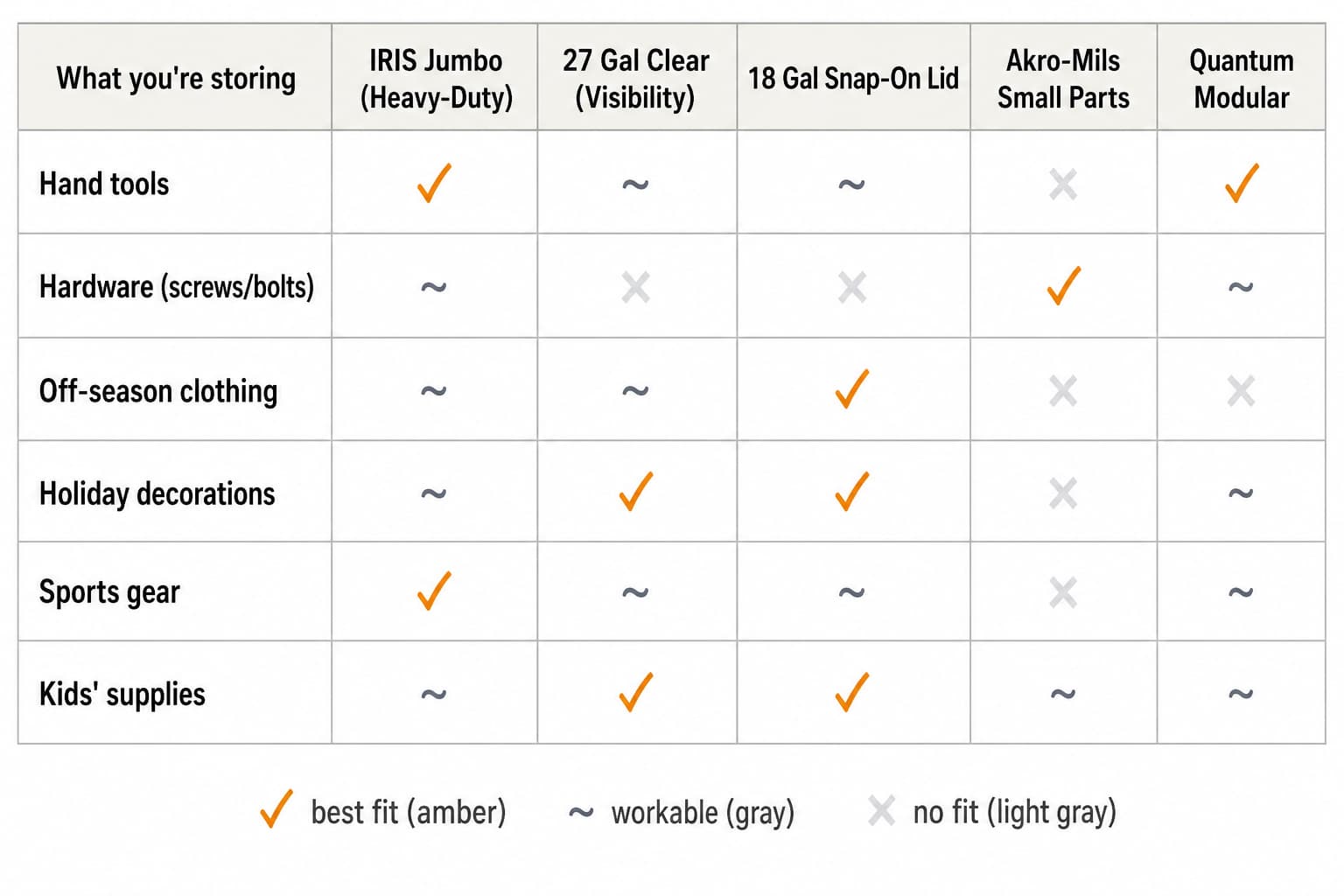
| What you’re storing | IRIS Jumbo | 27 Gal Clear | 18 Gal Snap-On | Akro-Mils Small | Quantum Modular |
|---|---|---|---|---|---|
| Hand tools | ✓ | ~ | ~ | ✗ | ✓ |
| Hardware (screws/bolts) | ~ | ✗ | ✗ | ✓ | ~ |
| Off-season clothing | ~ | ~ | ✓ | ✗ | ✗ |
| Holiday decorations | ~ | ✓ | ✓ | ✗ | ~ |
| Sports gear | ✓ | ~ | ~ | ✗ | ~ |
| Kids’ supplies | ~ | ✓ | ✓ | ~ | ~ |
The matrix surfaces a non-obvious pattern: there’s no single “best overall” stackable bin. The right pick for hand tools is different from the right pick for off-season clothing, and a roundup that ranks them on a single capacity axis misses the structure of the actual decision.
How to Build a Bin Tower That Stays Up
The bin you pick is half the story. The other half is how you assemble the tower.

Heaviest at the floor. A tower’s failure mode is always either the bottom bin’s walls flexing under accumulated weight, or the joint between bin 2 and bin 3 shifting under leverage. Both fail less often when the heaviest bins are on the floor and the lightest on top. A 50 lb tool bin at the bottom and a 5 lb decoration bin at the top is a stable pyramid; the inverse is a slow-motion collapse waiting to happen.
Decrease weight as you go up. No single jump should exceed about 15 lb between adjacent bins. A bin holding 40 lb under a bin holding 10 lb means the lower bin is doing 4x the work of the bin above it; better to redistribute so each bin shoulders roughly proportional load.
Maximum stack height by bin type:
- Mainstream totes (18-27 gallon): 5 bins maximum
- Akro-Mils small bins (5″×4″×3″): 6 bins (lighter contents and mechanical anti-slide tolerate more)
- Jumbo bins (IRIS USA 30″+ length): 4 bins maximum (the lever arm of a tall tower of long bins amplifies any forward shift)
Don’t mix bin brands in a single stack. Interlocking grooves are not standardized across manufacturers. A 27-gallon tote from one brand will sit on top of a 27-gallon tote from another brand, but the interlock won’t engage — you lose the structural feature you paid for.
Verify the floor. Garage floors slope toward the door for drainage, and a bin tower built on a sloped floor leans permanently. Use a level on the bottom bin before stacking; if needed, shim the back side with a thin plywood scrap to bring the tower plumb.
Common Complaints and Buyer Warnings
Three patterns surface across nearly every set of public discussions on stackable bins.
Tote-lip incompatibility with T-rail systems. Buyers who run both a stackable-bin tower AND a ceiling T-rail tote system discover that “27-gallon” totes from different brands have lips of different widths. The same bin that anchors your floor tower may slip through your ceiling T-rail. Match brands across both systems, or measure tote-lip width before mixing.
Snap-on lids that snap once and never close securely after. This is a category-wide pattern with cheap snap-on totes. The first snap is firm; by the 50th open-close cycle, the lid feels loose; by the 200th, it pops open under stack weight. Heavy-duty branded lids hold up; generic listings are less reliable. The 18-gallon snap-on in this guide is rated heavy-duty but not infinite — for bins accessed weekly, pick an open-front design instead.
Clear bins that yellow or craze in unheated garages. UV exposure plus temperature swings degrade clear plastic over years. Functionally the bin still stacks and seals; visually, the visibility you paid for fades. Buyers with fully shaded garages don’t see this; buyers with windowed or south-facing garages should plan to replace clear bins every 5-7 years.
The single most important warning: Anti-slide stops only work in the correct bin orientation. Akro-Mils AkroBins and Quantum’s Ultra Stack & Hang both have a clear front (the side with the anti-slide ledge) and back; if a bin is stacked backward, the ledge is in the wrong position and the bin shifts freely. Most users get this right by reading the listing photos — but a small minority don’t, and their towers fail. Confirm orientation on every bin in the stack.
Who Should Avoid Stackable Bins?
Stackable bins are not the right answer for everyone. If any of these describes you, look elsewhere:
- Frequent bin re-organizers. Interlocking towers resist mid-tower changes. Pulling out bin 3 of 5 means lifting the top 2 bins off, then lifting bin 3 out, then restacking. Drawers handle frequent reorganization better.
- Buyers with humid garages. Plastic bin walls absorb humidity over time and warp slightly, which compromises lid seals and stack stability. Coastal climates and shared-wall garages with laundry rooms are the most affected.
- Items that need airflow. Untreated leather goods, certain wooden tools, and some electronics need ventilation. Sealed bins create microclimate problems for these items.
- Anyone reaching into bins more than weekly. Open-front beats lidded for active-use items; drawers beat both for items reached daily.
FAQ
How high can I safely stack storage bins?
Mainstream totes (18-27 gallon) cap at 5 bins. Small parts bins (Akro-Mils class) cap at 6 bins. Jumbo bins (IRIS USA 30″+) cap at 4 bins. Beyond those numbers, the cumulative weight on the bottom bin’s walls exceeds what the listed capacity assumes. Always put heaviest at floor; never mix bin brands in a single stack.
Do I need bins with lids if I’m storing tools?
For tools you use weekly or more, no — open-front bins (IRIS USA Jumbo, Akro-Mils, Quantum) are faster to access and the dust accumulation isn’t an issue for tools used regularly. For tools stored for months at a time, lids help protect against rust on humid-climate steel and against dust accumulation on tool surfaces.
What’s the difference between an open-front bin and a tote with a removable lid?
An open-front bin has no lid at all — the front of the bin is cut down to give angled access. A tote with a removable lid has a full top lid that lifts off completely. Open-front is faster to access; lidded protects contents better. For frequently-accessed items, pick open-front. For seasonal storage, pick lidded.
Will any 27-gallon tote stack interlocked with another 27-gallon tote?
No. Interlocking grooves are not standardized across manufacturers. A 27-gallon tote from one brand will sit on top of a 27-gallon tote from another brand, but the interlock won’t engage. Pick a single brand for any single stack and don’t mix.
Are clear stackable bins as durable as opaque ones?
The plastic is structurally similar. Clear bins yellow or craze under prolonged UV exposure, which is cosmetic — the bins still stack and seal. Opaque bins don’t show this degradation but require a labeling system to identify contents. For UV-protected garages, clear bins last as long as opaque; for sun-exposed garages, plan a 5-7 year replacement cycle on clear.
Can stackable bins go on a wall rail or pegboard?
Some can. Quantum Storage’s Ultra Stack & Hang line (covered in slot 5) has a back-mount feature designed to hang on a louvered panel or wall rail. Most other stackable bins are stack-only and won’t mount cleanly on a wall. If you need wall-mount flexibility, pick a bin in the Ultra Stack & Hang family or its equivalents.
Sources Reviewed
For this guide, we reviewed manufacturer product information from IRIS USA, Akro-Mils, and Quantum Storage; retailer specifications on Amazon and the brands’ own retail sites; product listings; public customer feedback patterns on garage and workshop forums; and stackable-bin specific discussions on home improvement and tool-organization communities. We focused on product details that matter for stacked storage: stack-stability features, manufacturer-listed capacity per bin, lid format, dimensions, pack size, and material gauge.
Related Guides
- Best Garage Storage Bins for Shelves — broader bin guide with shelf-compatibility framing
- Best Clear Storage Bins for Garage — dedicated clear-bin roundup
- Best Garage Shelves for Storage Bins — shelving sized for stackable bin towers
- How to Stack Garage Storage Bins Safely — stacking safety walkthrough
- How to Organize Bins on Garage Shelves — organization patterns for bin-on-shelf systems
- clear vs opaque storage bins garage
- How to Label Garage Storage Bins
- How to Store Seasonal Items in a Garage
- stackable bins vs shelving garage
- Wire Shelving vs Solid Shelving
- best heavy-duty garage shelves
- how to choose garage shelving