How to Stack Garage Storage Bins Safely (Without a Tip-Over)
Last updated:
Disclosure: This article contains affiliate links. If you buy through these links, we may earn a commission at no extra cost to you. We do not claim hands-on testing unless clearly stated.
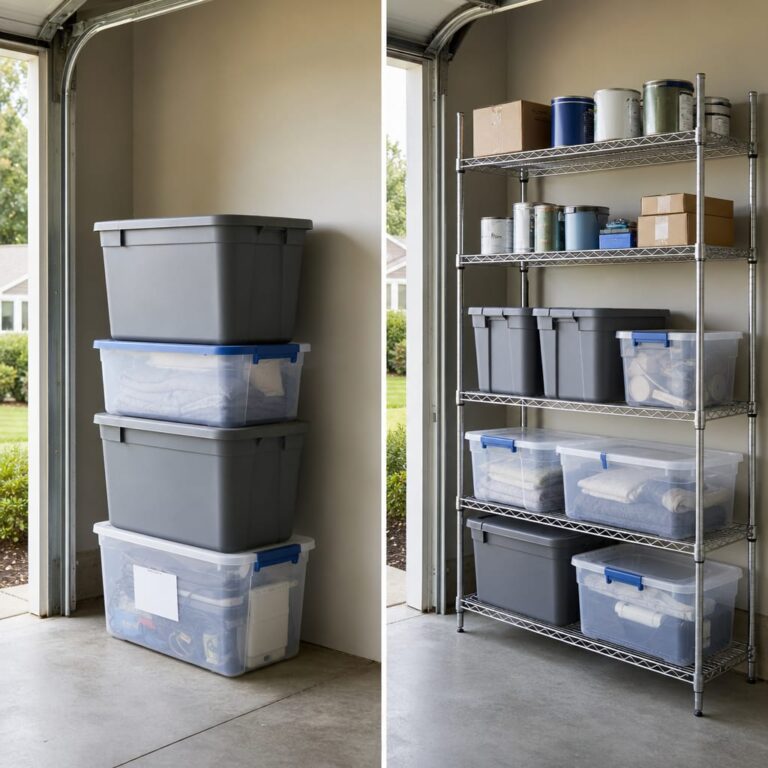
Tote stacks tip more often than most garage owners admit. You reach for the holiday lights at the bottom of a five-high tower, the lid above flexes, and the whole column shifts forward.
This guide walks through the five rules that keep a stack standing, the three failure modes that bring stacks down, and a height-vs-risk frame for when to stop adding bins. It does not cover how to choose storage bins for garage shelves or the best garage storage bins for shelves — those are separate buying guides.
Quick Answer: The 5-Point Stacking Rule
If you only read one section, read this. A stack stays up when all five are true:
- Same brand, same size bins within a single stack. Lid-to-base geometry varies between brands.
- Heaviest at the bottom, lightest at the top. Always. No exceptions for convenience.
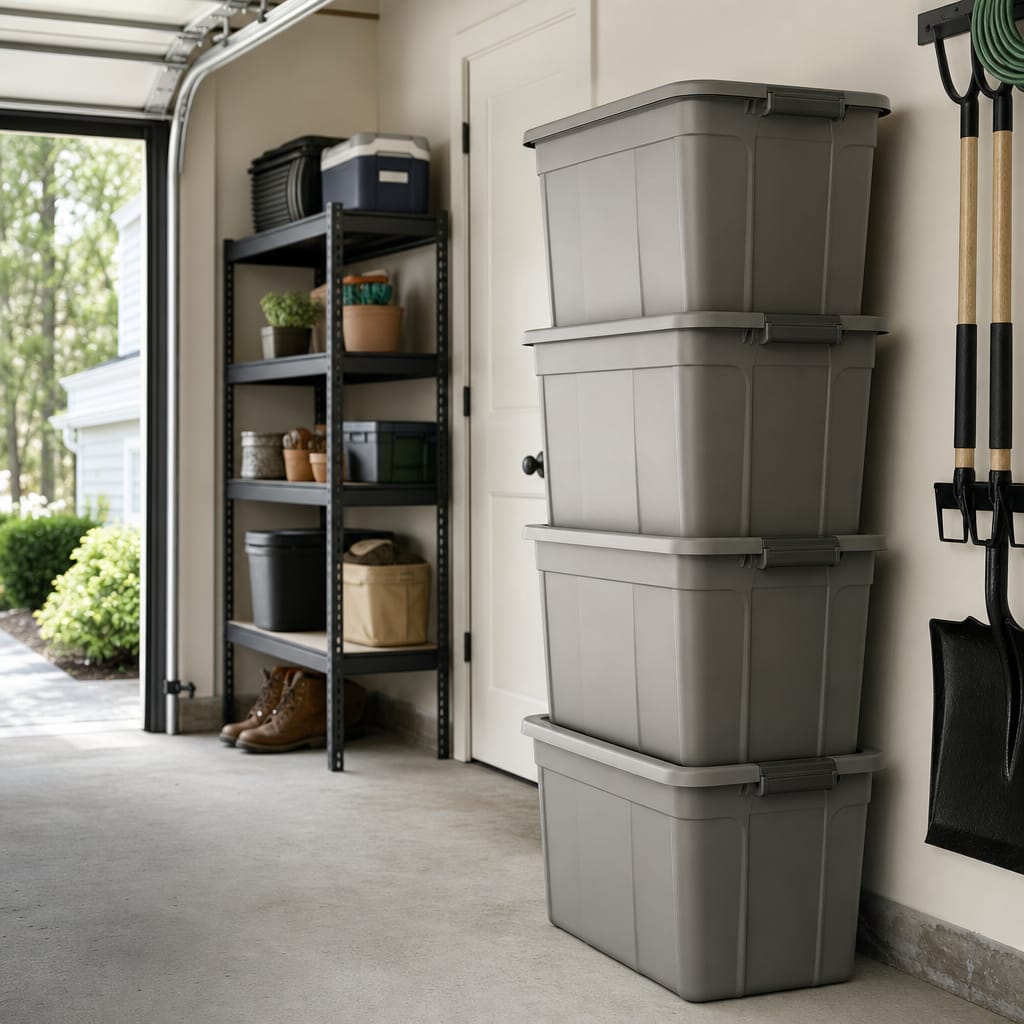
- Maximum 4 bins high without an anchor. Above 4, strap to a shelf upright or wall.
- The lid recesses fully into the base above — no overhang, no rocking when you press the top corner.
- The bin’s footprint sits fully on its shelf or surface. No overhang at the front edge.
Most stack failures are one of these five rules being quietly broken. The rest of the guide explains why each rule matters and what happens when it doesn’t.
Why Bin Stacks Fail (Three Real Failure Modes)
Most online advice stops at “heaviest on the bottom”. That’s the right starting point but misses the three failure modes that actually take stacks down in residential garages.
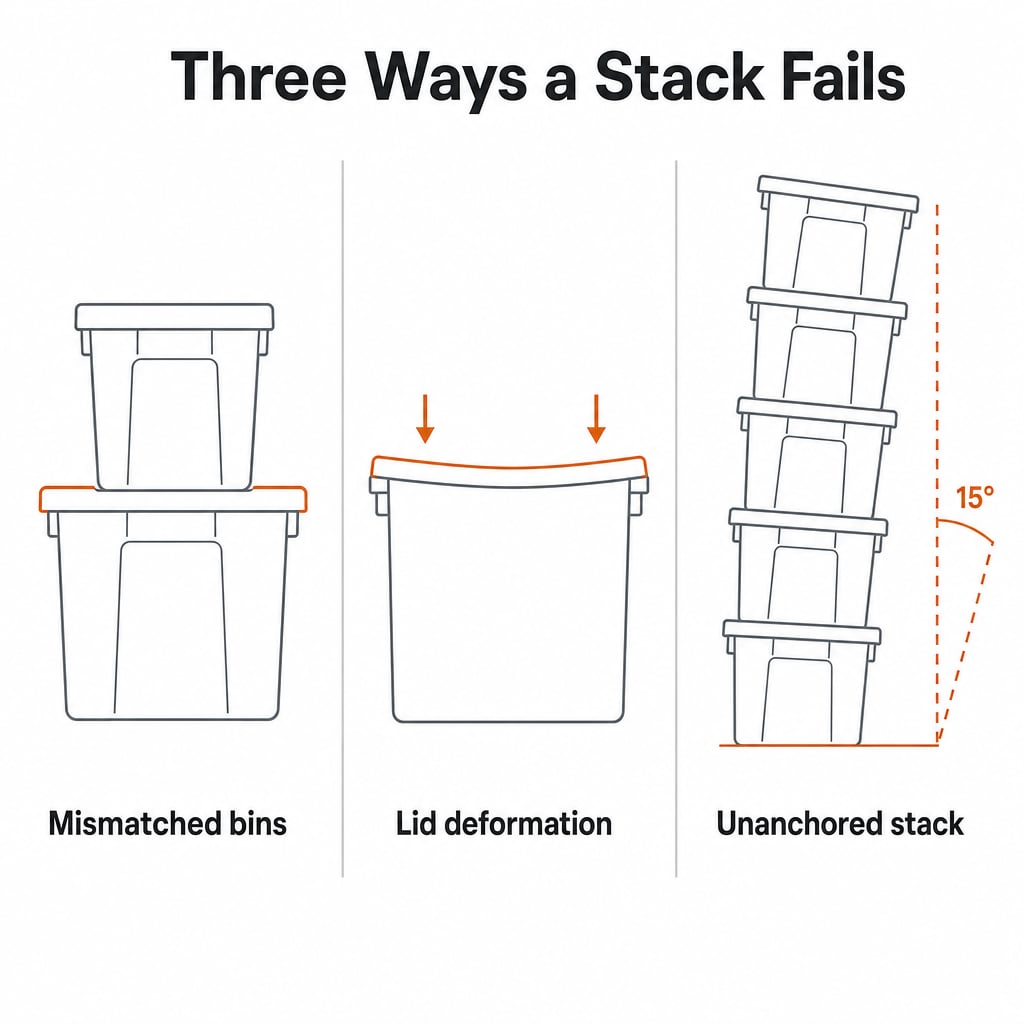
Failure 1 — Mismatched bins (lid-base geometry breaks)
Storage tote brands engineer the lid recess to match their own base. Stack a Sterilite lid under a Rubbermaid base, or an 18-gallon under a 27-gallon, and the base rides on the lip rather than seating into the recess. A small wobble at the bottom amplifies at the top. The stack looks fine when built; it tips three months later when something bumps it.
Fix: same brand, same size, same orientation per stack. If you have a mix, build separate stacks. Stackable storage bins designed to interlock — like the IRIS jumbo line below — solve this with mechanical tabs instead of lid geometry.
Failure 2 — Lid deformation under sustained load
Plastic tote lids are rated to support a bin of similar weight above — but lids creep under sustained load. A lid that has bowed even a quarter-inch shifts the upper bin off center. Inspect the bottom bin’s lid every three months; if it no longer sits flat when the upper bins are off, retire that bin to single-tier use.
Failure 3 — Tall stacks without a wall or upright anchor
Four bins is the ceiling for an unanchored stack in a residential garage. Above that, the lever arm at the top is long enough that a normal bump — a car door, a kid’s bike — produces enough lateral movement to topple the tower. Manufacturers don’t publish a maximum stack height for plastic totes, so this is a conservative residential rule of thumb, not a manufacturer-listed limit.
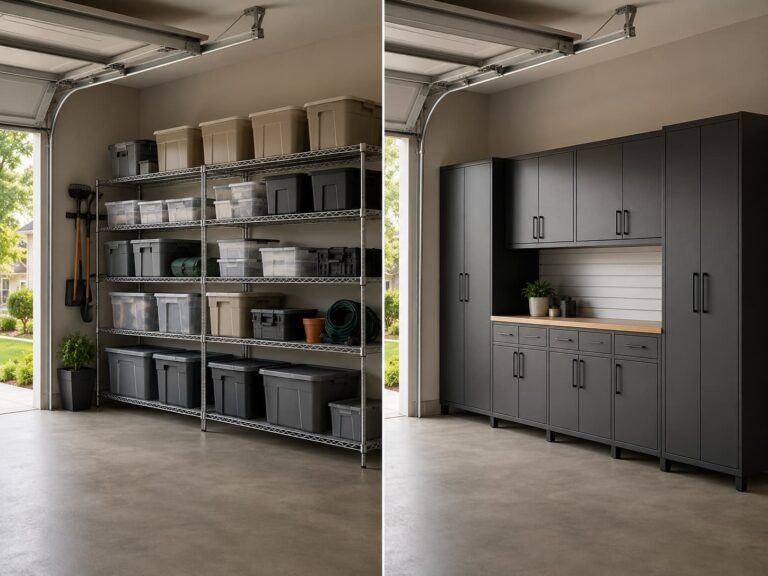
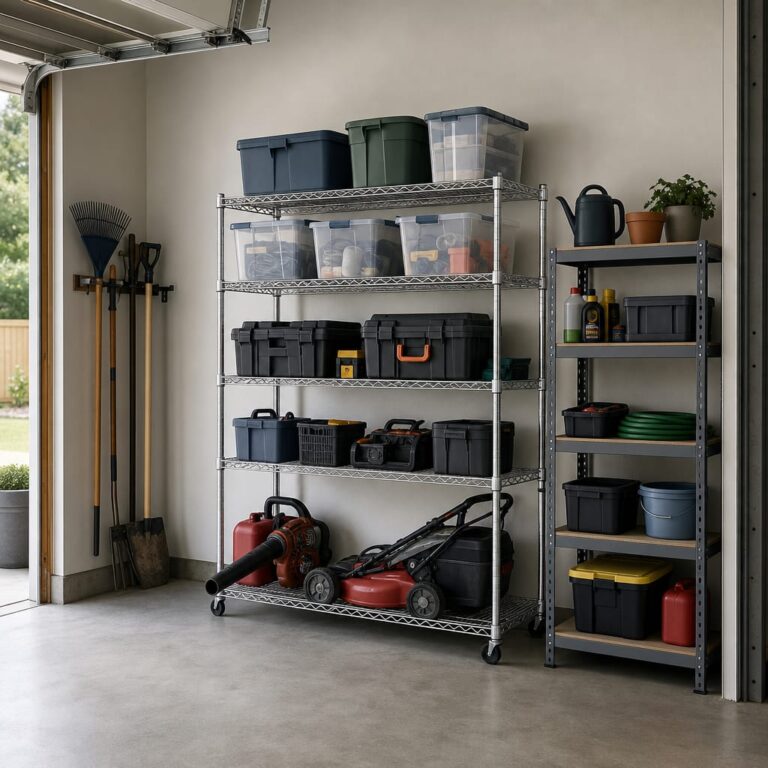
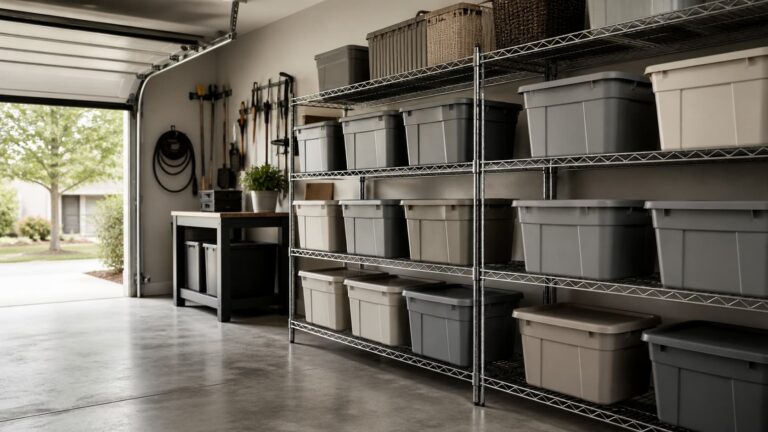
If you need more than four high, the answer is shelves that fit common bin footprints, with each tier carrying its own bins independently.
Step-by-Step: Build a Stack That Stays Up
Step 1 — Match your bins
Pull every bin you plan to stack into the open and confirm same brand, same size, same lid type. Two stacks of four matching bins is much safer than one stack of eight mixed bins.
Step 2 — Sort contents by weight
Estimate each bin’s loaded weight — a luggage scale or just lifting each in turn works. Heaviest on the bottom, lightest on top. Don’t trust how contents look: a bin of glass ornaments can weigh more than a bin of camping gear.
Step 3 — Place the heaviest bin on the bottom
The bottom bin carries the cumulative weight of every bin above through its lid. If the heaviest bin is in the middle or top, you’ve inverted the load path.
Step 4 — Cap stack height at 4 bins (or anchor)
If your stack hits four and you still have bins, stop. Either start a second stack alongside, or anchor the existing tower to a shelving upright. A single cargo strap through the lid tie-down channels (the Sterilite 27 gallon has these molded in) cinched to a vertical post holds a 5-high tower steady.
Step 5 — Verify the lid sits flat
After setting each new bin, press down on the top corner. If it rocks even slightly, the lid below isn’t fully recessed. Re-seat it. If it still rocks, the bins aren’t compatible.
Step 6 — Inspect the base bin every 3 months
The base bin’s lid is the most stressed component. Set a calendar reminder, lift the upper bins off, and check that the lid still sits flat. If it bows, retire that bin from stack-base duty.
Bins That Actually Stack Well
These three picks are engineered for stable stacks — not “the best totes overall”. Each fits a different reader path. For broader bin selection, see our guide to garage storage bins for shelves.
General-purpose stackable — Rubbermaid Roughneck 18 Gal (6-pack). The default residential garage tote. Integrated carry handles, USA-made, snap-on stay-tight lids. A loaded 18-gallon tote typically falls in a manageable weight range.

Lid geometry is consistent across the line, so towers of Roughnecks behave predictably — but the stay-tight lid is not gasket-sealed, so moisture-sensitive contents belong in a different bin family.
Heavy-duty interlocking — IRIS USA Open-Front Jumbo Stackable Bins (6-pack). Purpose-built for stable towers carrying dense items. Integrated tabs lock each bin to the one below, so the stack doesn’t shift forward. Open-front access means you reach the bottom bin without dismantling the tower.

Trade-off: dust enters freely, so not the bin for fabric, paper, or electronics. For organizing bins on garage shelves, open-front jumbos pair well with closed totes.
Large channeled-wall opaque — Sterilite 27 Gal Industrial Tote (4-pack). The reference 27-gallon tote. Channeled walls add rigidity under load. The lid has tie-down channels molded in, which makes anchoring a tall stack to a shelving upright straightforward.
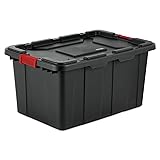
The 30-by-20-inch footprint exceeds the depth of a standard 18-inch wire shelf — you get overhang at the front edge if you stack these on a basic shelf. Measure your shelving depth before buying.
Common Mistakes
Mistake 1 — Stacking different bin brands together
The most common silent failure. The stack looks fine when you build it; it tips weeks later. Same brand, same size, every time.
Mistake 2 — Putting the lightest box at the bottom because it’s the smallest
Small does not mean light. A small bin of canned goods weighs more than a large bin of pillows. Estimate loaded weight, not bin size, when sorting bottom-to-top.
Mistake 3 — Building a 6-high tower against a leaning wall
The wall isn’t actually helping. Bins lean toward the wall, contact it at the top, and create a fulcrum at the contact point — the worst possible mechanical setup. If you need to anchor a tall stack, strap to a vertical post that runs floor-to-ceiling, not a wall surface.
Stack Height vs Risk
| Stack height | Safe configuration | When to use shelves instead |
|---|---|---|
| 1–2 bins | Safe everywhere on a level floor | — |
| 3 bins | Safe with matched bins on a level floor | If contents are heavy (>40 lb per bin) |
| 4 bins | Safe with matched bins AND level floor AND clear surroundings | If kids or pets pass close to the tower |
| 5+ bins | Anchor to shelf upright or wall stud — never unanchored | Almost always — shelves that fit common bin footprints outperform a 5-high tower |
For most residential garages, the answer past four bins is shelving. See our guide to choosing the right shelving for the practical decision.
How many totes actually fit on a garage shelf
Tote makers publish dimensions and shelving makers publish dimensions, but nobody puts the two together — so people buy shelving, then discover their totes overhang it. This table takes the published external size of totes from the brands people actually buy for garage storage — Sterilite, Rubbermaid Roughneck, and IRIS USA — and works out how many fit per shelf on the two garage shelving depths you can actually buy, 18 in and 24 in.
| Tote | Published dimensions (source order) | Footprint | Height | Fits an 18 in deep shelf? | Per 48 × 18 in shelf | Per 48 × 24 in shelf | Specification source | Source checked |
|---|---|---|---|---|---|---|---|---|
| Rubbermaid Roughneck 3 Gal. Storage Box | 7 in. H x 10.625 in. W x 15.687 in. D | 15.687 in × 10.625 in | 7 in | Yes | 4 | 6 | Rubbermaid Roughneck 3 gal Storage Box, Mfr# RMRT030003 | 2026-09-14 |
| IRIS USA WeatherPro Storage Container, 30 Qt. | 19.70" L x 15.75" W x 7.75" H | 19.7 in × 15.75 in | 7.75 in | Yes | 2 | 3 | IRIS USA WeatherPro Storage Container, 30 Qt. — Gasket Box | 2026-09-14 |
| IRIS USA WeatherPro Storage Container, 74 Qt. | 23.6" L x 17.8" W x 14.5" H | 23.6 in × 17.8 in | 14.5 in | Yes | 2 | 2 | IRIS USA WeatherPro Storage Container, 74 Qt. — Gasket Box (3-pack) | 2026-09-14 |
| IRIS USA WeatherPro Storage Box, 82 Qt. | 30.00" L x 16.00" W x 15.40" H | 30 in × 16 in | 15.4 in | Yes | 1 | 1 | IRIS USA Heavy-Duty Storage Box WeatherPro, 82 Qt. — Gasket Box | 2026-09-14 |
How these numbers were produced: External dimensions are quoted on the date shown per row. Sterilite rows are quoted from Sterilite’s own product pages (L x W x H order). Rubbermaid Roughneck rows are quoted from Ace Hardware’s retailer listing, which prints the manufacturer’s SKU-linked dimensions in H x W x D order on each product page. IRIS USA rows are quoted from IRIS USA’s own product pages (L x W x H order). All figures are the external/overall assembled dimensions with the lid on. The counts are computed, not estimated: totes are placed in a single layer, all in the same orientation, with no overhang and no gap; both orientations (the tote’s long side along the shelf’s 48 in run, or along its depth) are tried and the better one is kept. Shelf width is 48 in in both cases — the two depths are real Husky shelving footprints: 48 in. W x 18 in. D (Husky 86 in. H x 48 in. W x 18 in. D 6-Shelf Steel Shelving Unit, model MR481886W6B, https://www.homedepot.com/p/Husky-86-in-H-x-48-in-W-x-18-in-D-Black-Steel-6-Shelves-Shelving-Unit-MR481886W6B/306062319) and 48 in. W x 24 in. D (Husky 5-Tier Steel Shelving Unit, 48 in. W x 78 in. H x 24 in. D, model 426007, https://www.homedepot.com/p/Husky-5-Tier-Riveted-Steel-Garage-Storage-Shelving-Unit-in-Silver-48-in-W-x-78-in-H-x-24-in-D-426007/303241694); neither product page states a clear opening between posts. 48×18 and 48×24 are unobstructed reference surfaces, not guaranteed usable dimensions of every nominal 48×18 or 48×24 rack — posts and lips can reduce the clear opening (one retailer answer for a Husky 48×24 gives about 45.5 × 21.5 in between posts). Round the result down again if your shelving has corner posts that intrude, and leave room to get a hand in.
- A tote that fits the shelf footprint still needs vertical room: check the tote height against your shelf spacing, and leave clearance to lift it in and out rather than sliding it flush.
- Counts assume a flat, full-depth shelf. Wire shelving with a lip, or posts at the corners, will cost you the last tote in a row.
- Lids overhang the base on most totes; the figures here are the manufacturer’s overall assembled dimensions, which already include the lid.
- Capacity in quarts or gallons tells you nothing about whether it fits — and "27" doesn’t mean the same thing twice. The Sterilite 27 Qt. ClearView Latch Box (17 in x 11-1/8 in) fits an 18 in shelf; the Sterilite 108 Qt. Stacker Box (25-3/4 in x 18-3/8 in) — 27-gallon-equivalent by volume (108 qt = 27 gal), though Sterilite sells it as "108 Qt.," not "27 Gal." — does not.
- Manufacturers and retailers don’t all publish dimensions in the same order. Ace Hardware lists Rubbermaid Roughneck as Height x Width x Depth, where Sterilite and IRIS USA publish Length x Width x Height. This table normalises every row to footprint (the two horizontal dimensions) and height so they compare directly regardless of the order they were published in.
- Rubbermaid Roughneck’s 10 gal and 18 gal totes share the same footprint (23⅞ in x 15⅞ in) — only the height changes, so stepping up in capacity in that range costs no extra shelf space, only vertical clearance.
- A blank cell means the manufacturer does not publish that figure — we do not fill gaps with numbers we could not source.
These are the entries that matter for this guide. The full table, with every row and its source, is in our How many totes actually fit on a garage shelf.
FAQ
How high can I stack plastic storage bins in a garage?
Four bins is the practical residential ceiling for an unanchored stack. Above four, anchor the tower to a shelf upright or wall stud, or move the contents to shelving. Manufacturers don’t publish a specific maximum stack height — this is a conservative residential rule based on lever-arm physics, not a manufacturer claim.
Can I mix bin brands in the same stack?
No. Lid-to-base geometry varies between brands. A mismatched stack often looks fine when built, then tips weeks later when the upper bin shifts off the lid recess below.
What goes on the bottom of a bin stack?
The heaviest bin. The base bin carries the cumulative weight of every bin above through its lid; if the heaviest is in the middle, the lid below deforms over time.
Should I strap a bin stack to a wall?
If above four bins, yes — but strap to a vertical post or stud, not a flat wall surface. A single cargo strap through the lid tie-down channels (where the tote has them) cinched to a vertical post is enough.
Are clear bins safe to stack like opaque ones?
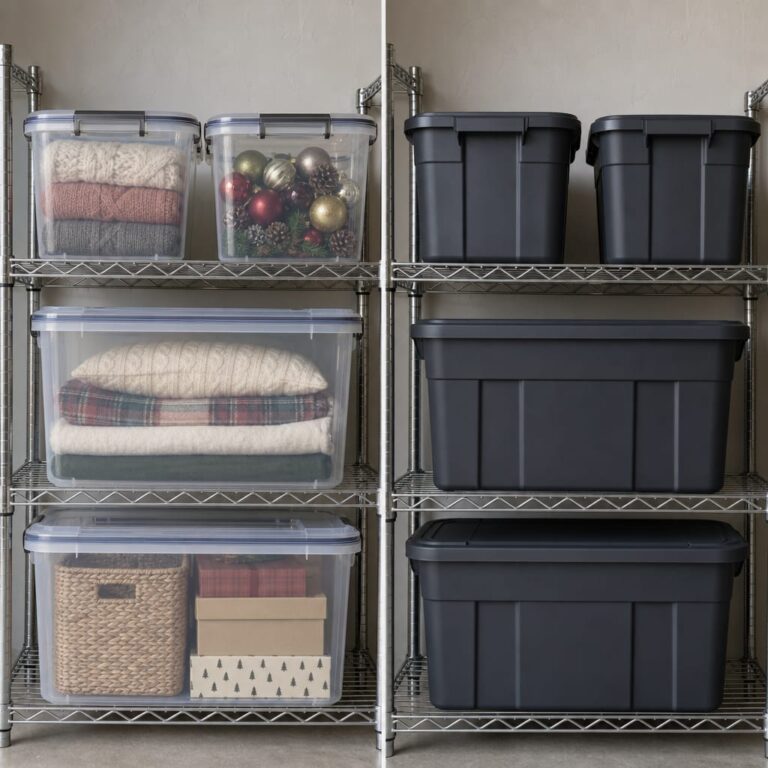
Yes, with the same five rules. Clear bins have the same lid geometry as the opaque versions in the same brand line. For labeling your storage bins on a stack of any color, the same lid-and-side rules apply.
What if my bins are different sizes?
Build multiple short stacks of matching sizes, not one tall mixed stack. If floor space is tight, that’s the moment shelving starts paying for itself.
Sources Reviewed
This article synthesizes manufacturer product pages (Rubbermaid Roughneck, IRIS USA Heavy-Duty Stackable, Sterilite Industrial Tote), public garage organization discussions, and retailer product listings. We do not claim hands-on testing unless clearly stated. Stack height guidance is conservative residential framing; no manufacturer publishes a specific maximum stack height for plastic totes.
Related Guides
- Best Garage Storage Bins for Shelves — the bin-selection guide this article sits next to
- How to Choose Storage Bins for Garage Shelves — buyer’s decision framework
- Best Stackable Storage Bins for Garage — the stackable-specific roundup
- Clear vs Opaque Bins for Garage — material choice
- Best Clear Storage Bins for Garage — clear-tote roundup
- Best Garage Shelves for Storage Bins — when stacks stop scaling and shelves take over