Best Garage Storage Products for One-Car Garages (2026)
Last updated:
Disclosure: This article contains affiliate links. If you buy through these links, we may earn a commission at no extra cost to you. We do not claim hands-on testing unless clearly stated.
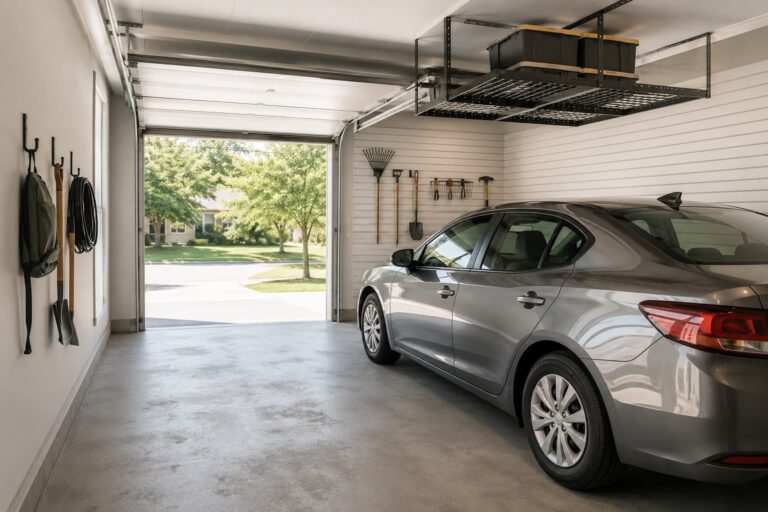
A one-car garage is roughly half the footprint of the two-car garage that most “best garage storage” roundups assume. Wall-to-car clearance is 18-24 inches per side after parking, ceiling height is often 7-9 feet, and the driver door swing eats another 30 inches on one side. Products designed for two-car garages dominate the space when retrofitted — a 4×8 ceiling rack dangles into headspace, a 24″-deep utility shelf overhangs the parking zone, a wall storage system sized for 8 feet of open wall doesn’t fit. This guide covers five product categories specifically picked for one-car garage constraints: a slim wall-track storage system that mounts flat to studs, a compact ceiling rack with the shortest drop in the category, a vertical bike rack that pivots flush against the wall, narrow-depth shelving sized to fit between car and wall, and modular slatwall that reconfigures as the storage profile changes. Compact-and-narrow first; capacity and feature count second.
Quick Picks
| Pick | Product | Best for | Footprint | Watch out for | |
|---|---|---|---|---|---|
| Best wall storage | Gladiator GearTrack Pack | Slim wall track + 8 hook starter set | 2x 48″ channels (~8 ft of wall) | One pack covers 8 ft — larger garages need multiple sets | View on Amazon |
| Best overhead | HyLoft 80842-10 | Compact ceiling rack for 7-9′ ceilings | 33×34″ deck, 17″-26″ drop | 250 lb cap; not for jumbo loads | View on Amazon |
| Best vertical bike rack | Steadyrack Classic | Single-bike vertical wall mount with 180° pivot | Wall-mounted, folds flat | Fits 20″-29″ wheels (not fat tire) | View on Amazon |
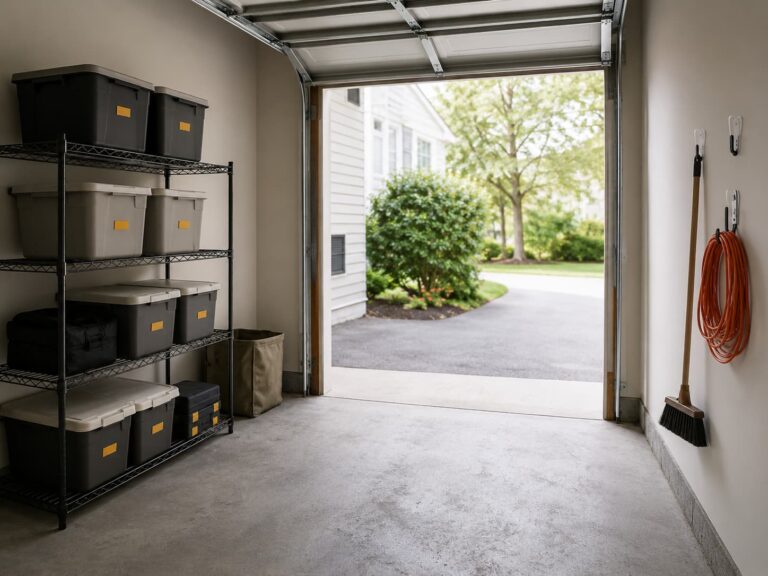
| Best compact shelving | Seville Classics 5-Tier Wire Shelving with Wheels (14×30×61.75) | Narrow-depth wire shelf with mobility for tight wall clearance | 14″D × 30″W × 61.75″H | 14″ depth limits 27-gal totes; 165 lb total on wheels vs 1,500 lb on feet | View on Amazon |
| Best modular | Proslat 88102 PVC Slatwall (8’x4′) | Reconfigurable wall system | 32 sq ft per section | Sold as 8×4 ft commitment | View on Amazon |
How We Selected These Products
We do not claim hands-on testing unless clearly stated. For this guide, we reviewed manufacturer specifications, retailer product pages, brand documentation, Amazon product listings, and recurring patterns in public buyer discussions on small-garage forums and home-organization communities.
Because a one-car garage’s binding constraint is footprint, not capacity, we filtered out otherwise-strong products that exceed the typical clearance envelope. A 4×8 ceiling rack is a great product in a two-car garage and the wrong product in a one-car garage; an 18-24″ deep utility shelf is mainstream sizing and the wrong sizing for 18-24″ total wall clearance. The five picks here all fit a one-car footprint without retrofitting.
Selection criteria, in priority order:
- Footprint depth ≤ 16-18 inches (or wall-mounted to take zero floor)
- Compact deck or narrow profile sized for one-car-garage wall-to-car clearance
- Mounting style that doesn’t conflict with car door swing
- Brand has retail beyond Amazon (helps when accessories or replacement parts are needed)
- Modular or expandable design (lets the system grow if you upgrade to a two-car garage later)
One-Car Garage Constraints — What You’re Working With
A one-car garage is structurally different from a two-car garage in three ways that change which products work. Understanding these constraints before shopping saves the return-process pain of a product that arrives and won’t fit. For small-garage layout strategy covering zone-by-zone planning and sequencing, our dedicated guide goes deeper.
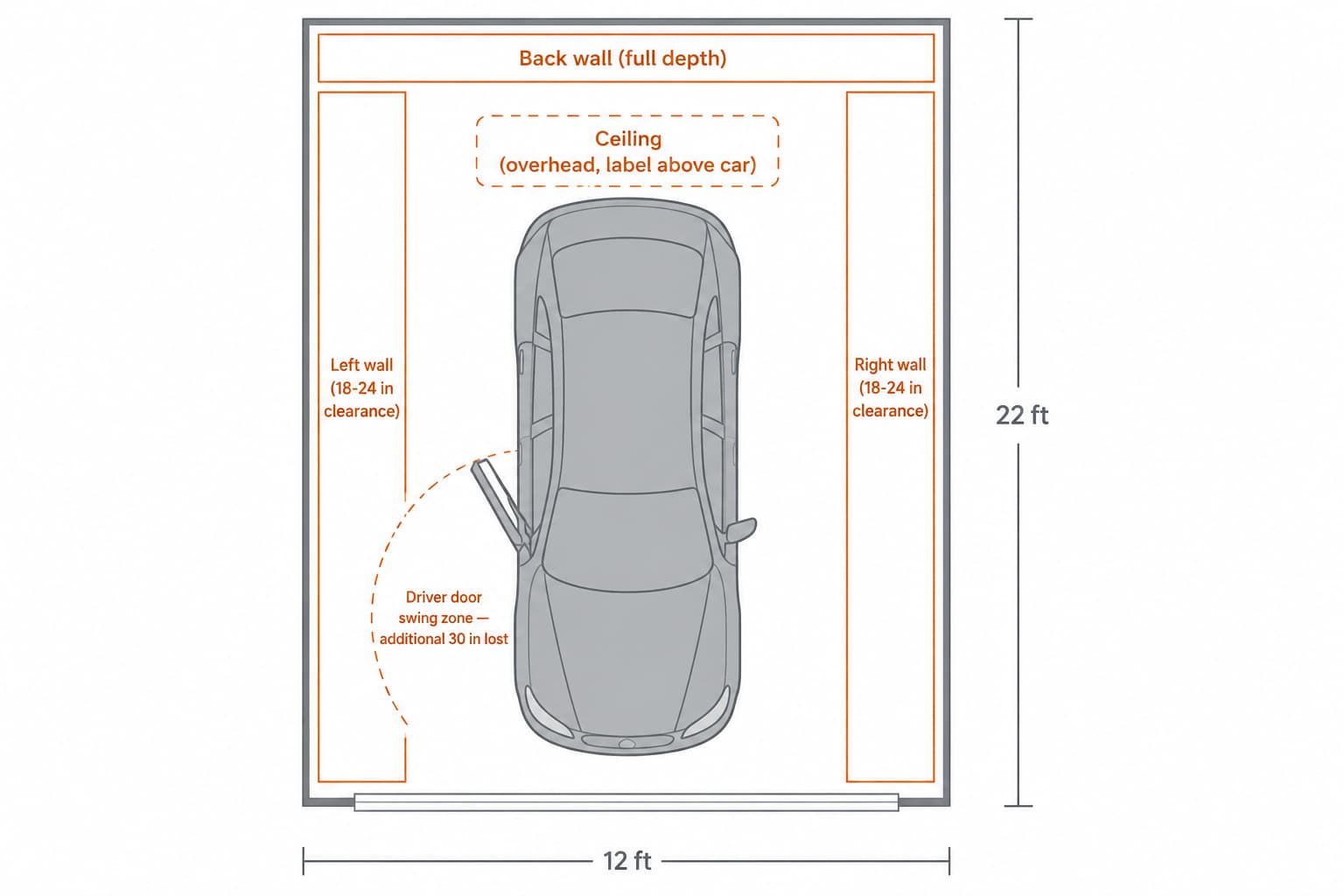
Footprint and clearance. A typical one-car garage runs 10-12 feet wide × 18-22 feet deep — about 220 sq ft. After parking a typical sedan or compact SUV (roughly 6 ft wide × 16 ft long), wall-to-car clearance is 18-24 inches per side and ~3-4 feet at the back. A storage product deeper than that clearance forces the buyer to either park the car partially outside or accept that the product overhangs the parking zone. Either compromise undermines the storage value.
Door swing zone. The driver-side door, when fully opened, sweeps another 30+ inches into the side clearance. A wall-mounted product placed in the door swing zone gets clipped every time the driver gets out — and a sharp metal hook, slatwall, or shelving edge in that zone is a real injury risk. Plan the driver-side wall around the door arc, not just around the parked car.
Ceiling height. One-car garages, particularly older ones (pre-1980 detached, converted carports, additions), often have 7-8 ft ceilings rather than the 9-10 ft of modern two-car builds. A 24″-45″ drop ceiling rack in a 7-foot garage either dangles into headspace or blocks the garage door’s travel zone. Match drop range to ceiling height before anything else.
What to Look for Before Buying
Footprint depth ≤ 16-18 inches
Mainstream utility shelving comes in 18″, 24″, and 36″ depths. In a one-car garage with ~20″ total wall clearance, a 24″-deep shelf overhangs by 4-6 inches. Pick 14″-16″ depth as the maximum, or pick wall-mounted products that take zero floor depth.
Mounting: wall vs. ceiling vs. freestanding
A one-car garage favors wall + ceiling. Freestanding shelving uses floor space that’s already constrained. Wall-mounted track systems and ceiling racks recover space that would otherwise be unused.
Modularity vs. fixed installs
Modular wins for one-car garages because the storage profile evolves. A buyer who starts with hand tools and adds bikes, then sports gear, then a workshop, needs the storage to expand. Fixed-mount cabinets work in a finalized layout; modular slatwall and track systems work during the layout’s evolution.
Brand ecosystem
Compatible accessories matter when wall space is tight. Gladiator’s GearTrack and GearWall accessories interchange. Proslat’s slatwall accepts a wide range of slatwall hooks. Picking a brand with an ecosystem means future expansion costs less per slot.
Material durability in unheated garages
Powder-coated steel and PVC outlast painted-over steel in unheated garages with humidity swings. Avoid raw-steel or thin-paint products if your garage isn’t climate-controlled.
What a good product page should specify
A trustworthy garage-product listing publishes exact dimensions including depth, manufacturer-listed weight capacity, mounting requirements, and material gauge. Pages that omit any of these — or hide depth behind a single “compact” descriptor — are gambling that you won’t measure.
Best Wall Storage: Gladiator GearTrack Pack
Best for: One-car garage owners who want to start with a complete wall-track system in a single purchase, with enough hooks to organize 8 ft of wall on day one.

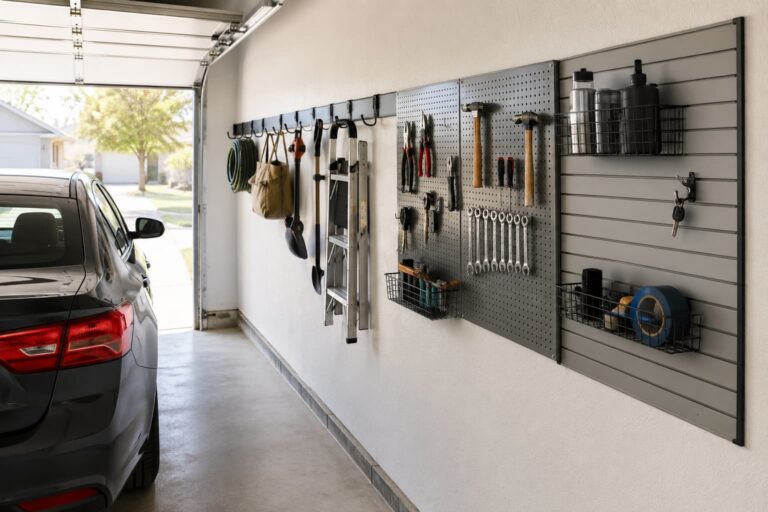
Short verdict: Gladiator’s GearTrack Pack (GAGPUB2PPY) ships two 48″ steel channels and eight assorted hooks (utility, scoop, tool, twin, J, L) — a complete starter wall system that mounts to studs, holds items 5-50 lb each, and slides accessories left-or-right at any time. Pick this for a one-car garage where you want one purchase to cover the working wall.
Gladiator (a long-tenured garage-storage brand with its own retail at gladiatorgarageworks.com) builds GearTrack and GearWall as interchangeable accessory ecosystems. Hooks designed for GearTrack also fit GearWall panels; future hooks/baskets/shelves slide into the same channels.
Why it stands out
The “complete starter system in one purchase” framing is the slot’s differentiator. Most wall track systems sell channels and hooks separately, which means a one-car garage owner has to spec a complete system before ordering — picking the right hook count, the right channel length, the right mix of hook types. The GearTrack Pack solves that by shipping a curated set: enough hooks to cover the common items in a garage (rakes, hoses, ladders, tools, sports gear) and enough channel length to span an 8-ft wall section, which is roughly the full working wall of a one-car garage’s side wall.
It can work well for:
- Garden tools (J hooks, L hooks)
- Sports gear (utility hooks, twin hooks)
- Cleaning supplies (scoop hooks)
- Long-handled tools (tool hooks)
- A starting wall system that grows with future Gladiator accessories
Key specs to check
- Includes: 2x 48″ GearTrack channels + 8 assorted hooks + end caps + screws + driver bit
- Per-hook capacity: 5-50 lb (manufacturer-listed; varies by hook style)
- Mounting: wall studs (16″ or 24″ centers — channel spans both)
- Compatible: with Gladiator GearWall panels, additional GearTrack accessories
- Material: powder-coated steel
Recurring feedback patterns
Recurring positive feedback often centers on the system being expandable — buyers describe starting with the Pack and adding additional hooks or baskets over months as they learn what they need. Common complaints typically involve buyers expecting the channels to span longer than 48″ each (some buyers misread the listing and order a single Pack for a 16-ft wall). Several buyers mention pairing the GearTrack Pack with Gladiator’s modular cabinets, which works because the brand engineers visual and functional compatibility across the line.
Potential drawbacks
Two channels (96″ total) is roughly one wall of a one-car garage; larger garages or buyers with two working walls need a second Pack. Per-hook capacity tops out at 50 lb — buyers needing to hang a heavy bicycle or a 60-lb extension ladder need a different hook design or a vertical bike rack like the Steadyrack covered later in this guide.
Buyer warning
Mount channels into wall studs, not drywall anchors. Drywall anchors fail under repeated load and don’t handle the lever arm of a long-handled tool hung from a hook. Use a stud finder, mark the studs, and align the channel mounting holes to studs before drilling. The included screws are sized for stud mounting; using them in drywall-anchor-only mode will not provide the listed capacity.
Best Overhead Storage: HyLoft 80842-10 Adjustable Ceiling Storage Rack
Best for: One-car garages with 7-8′ ceilings where larger 4×8 racks won’t fit — and storage needs are compact rather than maxed out.

Short verdict: A 33″x34″ deck with a 17″-26″ drop range and 250 lb manufacturer-listed capacity. The 17″ minimum drop is the shortest in the ceiling-rack category — purpose-built for low-ceiling garages where a 24″-45″ deck would either dangle into headspace or block the garage door. Pick this when ceiling height is the binding constraint.
This rack also appears in our broader overhead garage storage racks roundup — it’s the right pick when you need a small, low-profile rack that doesn’t dominate the ceiling, which is exactly the one-car-garage profile.
Why it stands out
The 17″ minimum drop puts the deck close enough to the ceiling that a 7′ garage retains 5’+ of usable headroom underneath — enough for a parked vehicle, enough for the rack to stay clear of a sectional door’s travel zone. Width adjusts 24″-34″ to fit non-standard joist setups, which buyers in older one-car garages with non-16″ centers often need.
It can work well for:
- Seasonal clothing tubs (out-of-season storage)
- Sports gear in compact totes
- Holiday decorations stored in 18-gallon bins
- One-car garages with 7-8′ ceilings where larger racks won’t fit
Key specs to check
- Manufacturer-listed capacity: 250 lb evenly distributed
- Drop range: 17″-26″
- Deck size: 24″-34″W × 34″D (width adjustable)
- Material: heavy-duty powder-coated steel, white
- Joist-spacing compatibility: adjustable width accommodates non-standard joists
Recurring feedback patterns
Recurring positive feedback often centers on the rack genuinely solving low-ceiling install problems that the 4×8 mainstream cannot — buyers describe a 7′ garage that no other rack fit. Common complaints typically involve the deck size being smaller than listing photos suggest; the 33″ max width is clearly stated in the title but the photos can mislead. Several buyers mention the hardware being upgrade-worthy for thicker drywall on finished ceilings.
Potential drawbacks
The 250 lb capacity is genuinely lower than the 4×8 category. Buyers with both low ceilings AND heavy storage needs do not have a great option — they need wall storage, not ceiling. The 33″x34″ max footprint is too small for many holiday-decoration sets that families accumulate.
Buyer warning
This is a small-load rack. If your storage need is multiple full-size 27-gallon totes or dense seasonal cargo, the 250 lb listed capacity will be the binding constraint. Plan storage by total weight before ordering. Manufacturer-listed capacity assumes correct assembly into wood joists, level joist install, suitable mounting hardware, and proper weight distribution.
Best Vertical Bike Rack: Steadyrack Classic Vertical Bike Rack
Best for: One-car garage owners with a single bike (or two) who need vertical wall storage that pivots flat against the wall when the car is parked — and rolls in/out without lifting.
![Steadyrack Bike Rack for Road Bikes - The Original Wall Mounted Vertical Bike Storage - Fits Narrow Tires - Space Saving Pivot Design - Heavy-Duty Steel Rack for Indoor Garage, Apartment or Home Use 1-Pack Road Bike Rack - Chrome [S]](https://m.media-amazon.com/images/I/71y6yZhsINL._SL160_.jpg)
Short verdict: Steadyrack Classic mounts to a wall stud or masonry, accepts 20″-29″ wheel bikes up to 35 kg / 77 lb manufacturer-listed, and uses a patented roll-in/roll-out design that avoids the “lift the bike to a hook” failure mode of cheap competitors. The 180° SteadyPivot lets the bike park flush against the wall when the car is in.
Steadyrack has been the tenured brand in the vertical-bike-rack category since 2009. The Classic SKU is the mainstream pick (Fat Tire and ProFlex Wide variants exist for non-standard bikes — confirm your bike’s tire width before ordering).
Why it stands out
The roll-in/roll-out design is the differentiator. Cheap “vertical bike racks” are often just a single hook that requires lifting the bike to head height — fine for a 20-lb road bike, painful for a 50-lb e-bike or kid’s MTB. The Steadyrack lets the bike’s rear wheel roll into a tray, then the SteadyPivot swings the bike up vertical with the rider’s weight doing the work. The 180° pivot then lets the bike park flat against the wall — critical in a one-car garage where 6 inches of bike protrusion into the parking zone is the difference between fitting the car and not.
It can work well for:
- Single bike or two bikes mounted on adjacent racks
- Daily-use commuter bikes that need easy access
- Heavier e-bikes that are too heavy for a single hook
- Garages where the bike must park flush against the wall
Key specs to check
- Manufacturer-listed capacity: 35 kg / ~77 lb per rack
- Compatible wheel size: 20″-29″
- Tire width: up to 2.4″ (Classic SKU; ProFlex Wide for fat tires)
- Pivot range: 180°
- Mounting: timber or masonry (fixings included for both)
- Material: steel + UV-treated polymer
Recurring feedback patterns
Recurring positive feedback often centers on the Steadyrack performing exactly as advertised — buyers describe the roll-in mechanic as effortless even for heavier e-bikes. Common complaints typically involve buyers ordering the Classic for a fat-tire bike (the Fat Tire SKU exists separately and is the right pick for tires over 2.4″). Several buyers mention installing two adjacent Steadyracks for a couple’s bike pair, which works because the swivel arc of each is independent.
Potential drawbacks
77 lb per rack is the binding number — heavy cargo e-bikes (some exceed 80 lb) are at the edge or over. The Classic doesn’t fit fat tires; check the Fat Tire variant for tires over 2.4″. One rack handles one bike; multi-bike garages need multiple Steadyracks (which works, but raises cost).
Buyer warning
Confirm the swing arc against the parked car before mounting. The bike, when pivoted out for use, needs ~36 inches of clearance perpendicular to the wall. If your one-car garage parks a tall vehicle (SUV, van) on that side, the swing arc may collide with the vehicle. Mount on the side wall opposite the driver door, or above the hood line, to avoid this.
Best Compact Shelving: Seville Classics 5-Tier Wire Shelving with Wheels (14×30×61.75)
Best for: One-car garage owners who need freestanding shelving with ~14-18″ wall-to-car clearance — wider shelving overhangs the parking zone.

Short verdict: A 5-tier chrome-plated wire shelving unit, 14″D × 30″W × 61.75″H on casters (60.6″H on leveling feet). Manufacturer-listed 300 lb per shelf, 1,500 lb total on leveling feet — only 165 lb total on the wheels. 4 casters (2 locking) + 4 leveling feet, 1″ shelf spacing, tool-free assembly.
Seville Classics has its own retail at sevilleclassics.com and a long wire-shelving product family.
Why it stands out
The 14″ depth is the slot’s binding feature. Mainstream 18-36″ shelving overhangs a typical 18-24″ wall-to-car clearance; 14″ fits with walkway headroom. 30″ width is more compact than mainstream 36″/48″, preserving clearance at either end. 5 tiers at 300 lb per shelf give 1,500 lb total on leveling feet, and the casters let you roll the unit out for cleaning.
It can work well for:
- 18-gallon storage totes (fit cleanly on 14″ depth)
- Hand tools, small power tools, cleaning supplies, sports gear
- Renters and finished-garage owners who don’t want to drill
- Garages where parking shifts seasonally (casters reposition without unloading)
Key specs to check
- Dimensions: 14″D × 30″W × 61.75″H on casters, 60.6″H on leveling feet
- 5 wire shelves, 1″ shelf-spacing increments
- Capacity: 300 lb per shelf, 1,500 lb total on leveling feet; 165 lb total on the casters
- Mobility: 4 casters (2 locking) + 4 adjustable leveling feet
- Material: chrome-plated steel wire; tool-free assembly
Recurring feedback patterns
Recurring positive feedback centers on the tool-free assembly and the casters letting the loaded unit roll out for cleaning. Common complaints involve assembly going slower than listing photos suggest — several buyers mention working with a partner for the larger tiers. Several note chrome plating showing surface oxidation in coastal garages; an annual rust-inhibitor wipe-down helps.
Potential drawbacks
The 14″ depth limits totes — most 27-gallon totes overhang and become unstable; 18-gallon and smaller fit. The dual capacity rating is the real catch: 1,500 lb on feet is generous, but on wheels total drops to 165 lb — a gap most buyers miss on the listing.
Buyer warning
If you plan to load heavily, use the leveling feet, not the wheels — the rated total drops from 1,500 lb to 165 lb on casters. Lock both locking casters before loading even if you intend to roll later, and verify the unit is level. For 27-gallon totes the 14″ depth is too shallow; pick 18-24″ or use 18-gallon totes instead.
Best Modular System: Proslat 88102 PVC Slatwall
Best for: One-car garage owners who want a fully modular wall system that reconfigures as the storage profile evolves — and who are willing to commit to a wall section’s worth of slatwall (8×4 ft).

Short verdict: Proslat’s 88102 is an 8’x4′ PVC slatwall section (32 sq ft total coverage) with 75 lb per square foot manufacturer-listed weight rating, lifetime warranty, and 90% recycled materials. PVC is moisture-resistant — important in unheated one-car garages. Hidden screw design + included trim. Reconfigurable accessories (hooks, baskets, shelves) slide along the slats.
For narrow-wall storage options including alternative track and rail systems sized for narrow garages, our dedicated guide covers the trade-offs.
Why it stands out
The full-wall coverage is the differentiator. A track system like Gladiator GearTrack covers a band of wall at one height; slatwall covers the full wall area, top to bottom, which means accessories can mount at any height the user needs. Reconfiguration is sliding-only — no remounting hardware required when the storage profile changes. The PVC material outlasts wood slatwall in unheated garages where humidity swings warp wood over time.
It can work well for:
- Garage owners who want one wall as a complete storage system
- Storage profiles that change seasonally (winter sports stored where summer sports are)
- Buyers building toward a Proslat-system garage long-term
- Unheated garages where moisture resistance matters
Key specs to check
- Section dimensions: 8’L × 4’H = 32 sq ft per section
- Manufacturer-listed capacity: 75 lb per square foot
- Material: PVC, 90% recycled, made in North America
- Includes: panels + all trim + mounting screws
- Warranty: lifetime
- Reconfigurable: accessories slide along slats without remounting
Recurring feedback patterns
Recurring positive feedback often centers on the visual upgrade — buyers describe the slatwall transforming the look of the garage in addition to the function. Common complaints typically involve install time (the 8×4 section requires careful alignment to studs and a partner). Several buyers mention buying multiple sections to cover two walls of a one-car garage, which works because the system’s accessory ecosystem stays consistent across sections.
Potential drawbacks
8×4 is a real wall commitment. Buyers who want 4 sq ft of slatwall for a small workbench area are paying for 32 sq ft. The hidden-screw design means the slatwall can’t be relocated easily — once mounted, moving it requires re-trimming. The cost-per-square-foot is higher than basic pegboard or a track system.
Buyer warning
Measure your wall before ordering. The 8×4 section requires 8 feet of unobstructed wall length and 4 feet of vertical clearance. In a one-car garage, the most common mounting wall is the 18-22 ft side wall — but the section also has to clear windows, light fixtures, garage door tracks, and outlet boxes. Plan the install layout with painter’s tape on the wall before ordering.
Side-by-Side Comparison
Each pick maps to a different category of one-car-garage storage. Use this table to identify which categories you actually need, not which products rank “best overall”.
| Product | Category | Footprint | Listed capacity | Mount type | Main drawback |
|---|---|---|---|---|---|
| Gladiator GearTrack Pack | Wall track | 2x 48″ channels | 5-50 lb per hook | Wall studs | Single Pack covers ~8 ft |
| HyLoft 80842-10 | Overhead | 33″x34″ deck, 17″-26″ drop | 250 lb | Ceiling joists | Smaller deck, lower capacity |
| Steadyrack Classic | Vertical bike | Wall, folds flat | 77 lb per bike | Wall studs / masonry | Classic doesn’t fit fat tires |
| Seville Classics 5-Tier 14×30×61.75 (Wheels) | Compact shelving | 14″D × 30″W × 61.75″H | 300 lb/shelf, 1,500 lb total on feet (165 lb on wheels) | Freestanding | 14″ depth limits 27-gal totes |
| Proslat 88102 | Modular slatwall | 8’L × 4’H = 32 sq ft | 75 lb/sq ft | Wall studs | 8×4 commitment |
Choose by What You’re Storing
Use this matrix to pick the categories that match your actual storage profile.
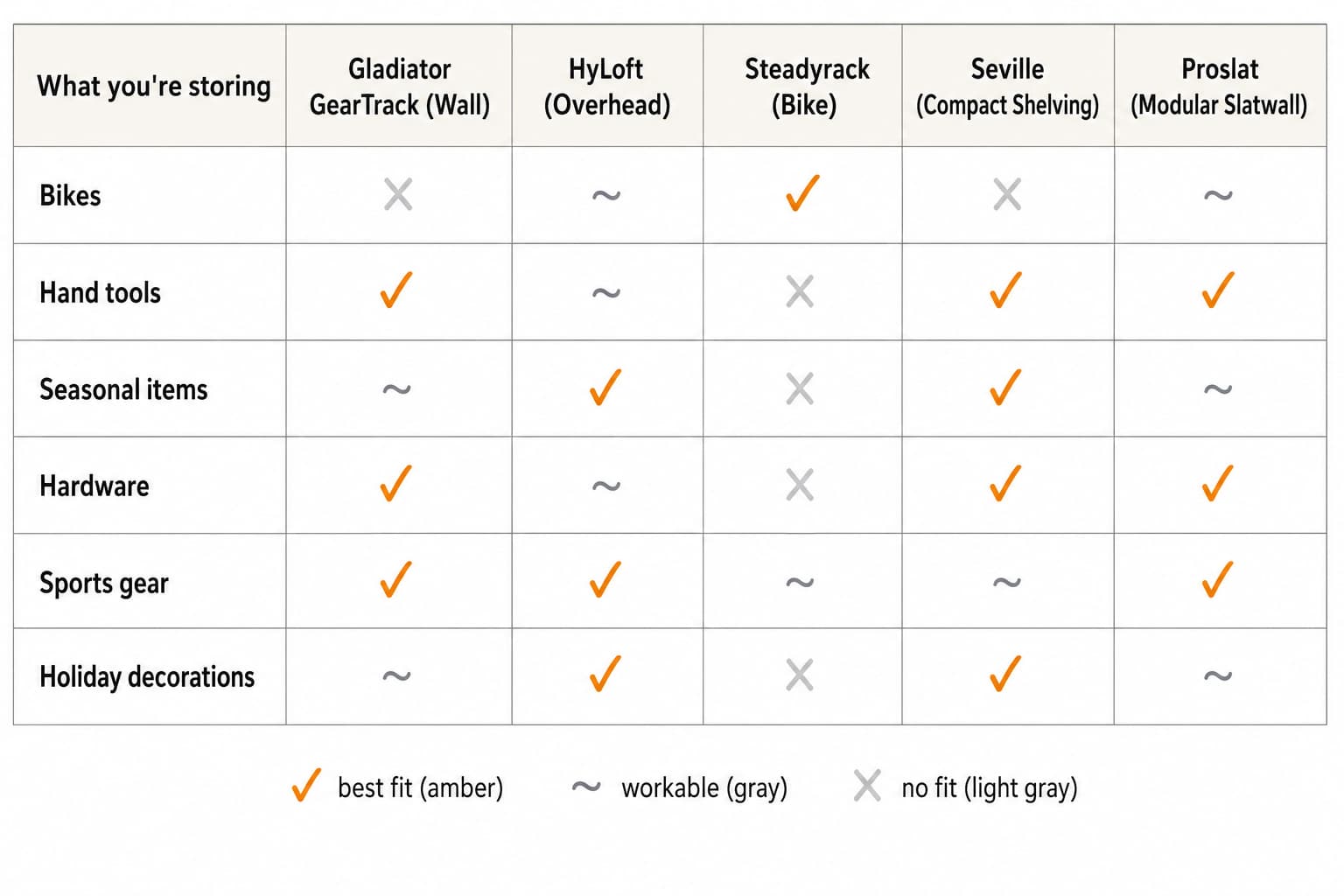
| What you’re storing | GearTrack | HyLoft | Steadyrack | Seville Shelving | Proslat |
|---|---|---|---|---|---|
| Bikes | ✗ | ~ | ✓ | ✗ | ~ |
| Hand tools | ✓ | ~ | ✗ | ✓ | ✓ |
| Seasonal items | ~ | ✓ | ✗ | ✓ | ~ |
| Hardware | ✓ | ~ | ✗ | ✓ | ✓ |
| Sports gear | ✓ | ✓ | ~ | ~ | ✓ |
| Holiday decorations | ~ | ✓ | ✗ | ✓ | ~ |
The matrix surfaces a non-obvious pattern: most one-car garage owners need 2-3 categories, not all 5. Pick by what you actually store, not by which products are “best” in a generic sense. Bikes call for Steadyrack; bulk seasonal items call for HyLoft and shelving; mixed daily-access items call for GearTrack or Proslat.
How to Plan Your One-Car Garage Storage Zones
Before you order any of these products, plan the zones they’ll live in. Most one-car-garage storage failures trace to skipping this step.

1. Park the car first. Pull the car into its normal parking position. Open both doors fully. The clearance you measure now is the real clearance — it’s smaller than what you’d estimate from the empty garage.
2. Measure side clearances and door swing. From the side of the parked car to each wall. From the open door’s outermost point to the wall. From the front bumper to the back wall. From the highest point of the car to the ceiling.
3. Identify zones. Left wall (passenger side), right wall (driver side, smaller after door swing), back wall (full depth), ceiling (overhead). Note any conflicts: light fixtures, outlet boxes, garage door tracks, windows.
4. Plan vertical priority. Daily-access items at eye level (3-5 ft up the wall). Weekly-access items below or in shelving. Seasonal items overhead or at top shelf. The Steadyrack bike rack mounts where the wall has a clear 36″ arc; the GearTrack mounts at eye level on the working wall; the HyLoft goes overhead in a position that doesn’t conflict with the garage door’s travel zone; the Seville shelving fits the back wall or a side wall section without door swing.
A one-car garage works best as 4 storage zones: walls (eye level for daily access), ceiling (overhead for seasonal/bulk), back wall (full-height shelving), and floor (kept clear for parking). Floor storage in a one-car garage is the wrong call — it competes with the car.
Common Complaints and Buyer Warnings
Three patterns surface across nearly every set of public discussions on one-car garage storage installs.
Two-car-garage products in a one-car garage. Buyers see a glowing review of a 4×8 ceiling rack and order one without checking ceiling height — then discover at install that the 24″-45″ drop dangles into headspace. The fix is matching product scale to garage scale before ordering. Don’t trust product reviews from owners with different garage sizes.
Vertical bike rack swing arc colliding with car door. The Steadyrack pivots out 180° for use, which means the bike sweeps a 36″ arc perpendicular to the wall. If that arc overlaps the open car door, the bike clips the door every time it’s pivoted. Mount the Steadyrack on the wall opposite the driver door, or above the hood line, to avoid this.
Wall track + ceiling rack conflicting. A buyer installs GearTrack at eye level and a HyLoft overhead, then discovers that the GearTrack’s tallest hooked items (a long-handled rake, an 8′ ladder) extend up into the HyLoft’s space. The fix is sequencing the install: ceiling rack first, then mark the rack’s footprint, then install the wall track in a position where stored items don’t reach the rack.
Slatwall 8×4 commitment in a small garage. The Proslat 88102 is 32 sq ft — that’s a working wall in a one-car garage. Buyers who want 4 sq ft for a small workbench wall pay for 32 sq ft. If your wall area is genuinely small, pick the GearTrack pack instead.
Who Should Avoid These Products?
These products are not the right answer for everyone. If any of the following describes you, look elsewhere:
- Renters. Most picks here require drilling into studs or joists, which leases typically prohibit. See our no-drill storage for renters guide for tension-mount and freestanding alternatives.
- Workshop-primary garages. If your garage is a workshop with no vehicle, you’re not constrained by parking clearance — you can use larger products and don’t need the compact-and-narrow filter that drove these picks.
- Buyers needing two-car-garage capacity. If your storage volume genuinely exceeds what a one-car garage can hold, the answer is a storage shed or a larger garage, not retrofitting two-car-garage products into a one-car footprint.
- Owners with severely-constrained ceilings (under 7 ft). Even the HyLoft 80842-10’s 17″ minimum drop is too much in a sub-7-ft garage. Wall storage only.
How many totes actually fit on a garage shelf
Tote makers publish dimensions and shelving makers publish dimensions, but nobody puts the two together — so people buy shelving, then discover their totes overhang it. This table takes the published external size of totes from the brands people actually buy for garage storage — Sterilite, Rubbermaid Roughneck, and IRIS USA — and works out how many fit per shelf on the two garage shelving depths you can actually buy, 18 in and 24 in.
| Tote | Published dimensions (source order) | Footprint | Height | Fits an 18 in deep shelf? | Per 48 × 18 in shelf | Per 48 × 24 in shelf | Specification source | Source checked |
|---|---|---|---|---|---|---|---|---|
| Sterilite 6 Qt. Storage Box | 13 5/8" x 8" x 4 5/8" | 13⅝ in × 8 in | 4⅝ in | Yes | 6 | 9 | Sterilite 6 Qt. Storage Box | 2026-09-14 |
| Sterilite 16 Qt. Storage Box | 17 1/8" x 11 7/8" x 6 3/4" | 17⅛ in × 11⅞ in | 6¾ in | Yes | 4 | 4 | Sterilite 16 Qt. Storage Box | 2026-09-14 |
| Sterilite 27 Qt. ClearView Latch Box | 17" x 11 1/8" x 12 3/4" | 17 in × 11⅛ in | 12¾ in | Yes | 4 | 4 | Sterilite 27 Qt. ClearView Latch Box | 2026-09-14 |
How these numbers were produced: External dimensions are quoted on the date shown per row. Sterilite rows are quoted from Sterilite’s own product pages (L x W x H order). Rubbermaid Roughneck rows are quoted from Ace Hardware’s retailer listing, which prints the manufacturer’s SKU-linked dimensions in H x W x D order on each product page. IRIS USA rows are quoted from IRIS USA’s own product pages (L x W x H order). All figures are the external/overall assembled dimensions with the lid on. The counts are computed, not estimated: totes are placed in a single layer, all in the same orientation, with no overhang and no gap; both orientations (the tote’s long side along the shelf’s 48 in run, or along its depth) are tried and the better one is kept. Shelf width is 48 in in both cases — the two depths are real Husky shelving footprints: 48 in. W x 18 in. D (Husky 86 in. H x 48 in. W x 18 in. D 6-Shelf Steel Shelving Unit, model MR481886W6B, https://www.homedepot.com/p/Husky-86-in-H-x-48-in-W-x-18-in-D-Black-Steel-6-Shelves-Shelving-Unit-MR481886W6B/306062319) and 48 in. W x 24 in. D (Husky 5-Tier Steel Shelving Unit, 48 in. W x 78 in. H x 24 in. D, model 426007, https://www.homedepot.com/p/Husky-5-Tier-Riveted-Steel-Garage-Storage-Shelving-Unit-in-Silver-48-in-W-x-78-in-H-x-24-in-D-426007/303241694); neither product page states a clear opening between posts. 48×18 and 48×24 are unobstructed reference surfaces, not guaranteed usable dimensions of every nominal 48×18 or 48×24 rack — posts and lips can reduce the clear opening (one retailer answer for a Husky 48×24 gives about 45.5 × 21.5 in between posts). Round the result down again if your shelving has corner posts that intrude, and leave room to get a hand in.
- A tote that fits the shelf footprint still needs vertical room: check the tote height against your shelf spacing, and leave clearance to lift it in and out rather than sliding it flush.
- Counts assume a flat, full-depth shelf. Wire shelving with a lip, or posts at the corners, will cost you the last tote in a row.
- Lids overhang the base on most totes; the figures here are the manufacturer’s overall assembled dimensions, which already include the lid.
- Capacity in quarts or gallons tells you nothing about whether it fits — and "27" doesn’t mean the same thing twice. The Sterilite 27 Qt. ClearView Latch Box (17 in x 11-1/8 in) fits an 18 in shelf; the Sterilite 108 Qt. Stacker Box (25-3/4 in x 18-3/8 in) — 27-gallon-equivalent by volume (108 qt = 27 gal), though Sterilite sells it as "108 Qt.," not "27 Gal." — does not.
- Manufacturers and retailers don’t all publish dimensions in the same order. Ace Hardware lists Rubbermaid Roughneck as Height x Width x Depth, where Sterilite and IRIS USA publish Length x Width x Height. This table normalises every row to footprint (the two horizontal dimensions) and height so they compare directly regardless of the order they were published in.
- Rubbermaid Roughneck’s 10 gal and 18 gal totes share the same footprint (23⅞ in x 15⅞ in) — only the height changes, so stepping up in capacity in that range costs no extra shelf space, only vertical clearance.
- A blank cell means the manufacturer does not publish that figure — we do not fill gaps with numbers we could not source.
These are the entries that matter for this guide. The full table, with every row and its source, is in our How many totes actually fit on a garage shelf.
FAQ
What’s the maximum shelf depth that works in a one-car garage?
14-16 inches. Mainstream 18″, 24″, and 36″ depths overhang the typical 18-24″ wall-to-car clearance and either get hit by car doors or force the car to park outside its normal position. The Seville Classics 14″D pick in this guide is sized for that constraint.
Can I mount a vertical bike rack on the same wall as the open car door?
Not safely. The bike’s 36″ swing arc when pivoted out for use overlaps the door swing zone, which means the bike gets clipped every time the driver gets out. Mount the bike rack on the passenger-side wall, or on the back wall above the hood line.
How much overhead storage can a one-car garage realistically support?
A 33″x34″ rack at 250 lb evenly distributed (HyLoft 80842-10) fits the typical one-car-garage ceiling without conflicting with the garage door’s travel zone. Larger 4×8 racks usually don’t fit either dimensionally or by joist load — most one-car garages have lighter framing.
Should I use freestanding shelving or wall-mounted shelving in a one-car garage?
Wall-mounted, where possible. Freestanding shelving uses floor space that’s already constrained. The Seville Classics freestanding pick in this guide is for buyers who don’t want to drill (renters, finished-garage owners) — for everyone else, wall-mount.
Is 8×4 slatwall really worth committing to in a small garage?
If your storage profile is varied and evolving, yes — the reconfigurability pays off over years. If your storage profile is fixed and small, a Gladiator GearTrack Pack covers the same need with less wall commitment.
Can I install all 5 of these products in one one-car garage?
Yes, but only with careful zone planning. The GearTrack and Proslat can’t share the same wall surface (they conflict). The HyLoft and Steadyrack can both live in the same garage if their swing arcs and ceiling positions don’t overlap. The Seville shelving fits the back wall. Most one-car garages support 3-4 of these, not all 5.
Sources Reviewed
For this guide, we reviewed manufacturer product information from Gladiator, HyLoft, Steadyrack, Seville Classics, and Proslat; retailer specifications on Amazon and the brands’ own retail sites; product listings; public customer feedback patterns on small-garage forums and home-organization communities; and one-car-garage layout discussions on residential storage forums. We focused on product details that matter for one-car garage decisions: footprint, depth, mounting style, manufacturer-listed capacity, and brand ecosystem.
Related Guides
- Best Garage Storage Ideas and Products for Small Garages — broader small-garage roundup
- Best Wall Storage for Narrow Garages — dedicated narrow-wall storage guide
- Best Overhead Garage Storage Racks — full overhead-rack roundup including motorized lift options
- Best Wall-Mounted Garage Storage Systems — wall-mount system guide
- How to Organize a Small Garage — small-garage organization strategy
- garage organization checklist for renters
- how to choose garage storage for renters
- how to choose garage storage for small spaces
- how to maximize storage in a one-car garage
- how to organize a garage with no walls available
- how to organize garage for a family of four
- Garage Shelving vs Garage Cabinets: Which Is Better?