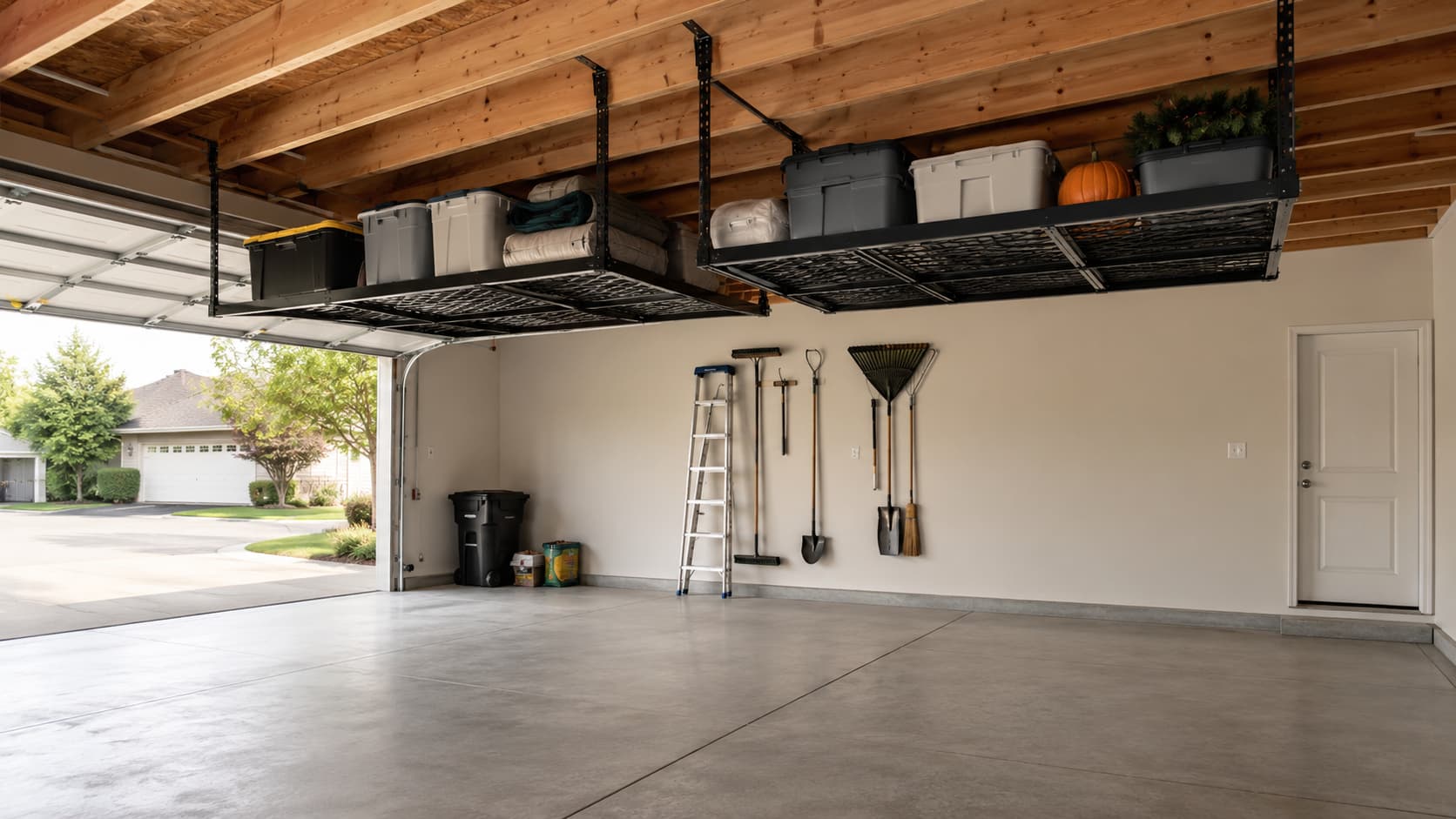
Best Overhead Garage Storage Racks (2026)
Last updated:
Disclosure: This article contains affiliate links. If you buy through these links, we may earn a commission at no extra cost to you. We do not claim hands-on testing unless clearly stated.
The best overhead garage storage racks share one trait: in this category the buyer’s biggest risk isn’t choosing the wrong product — it’s installing the right product wrong. Capacities across the picks below span a wide range — from a 50-pound single-item motorized hoist up to 800-pound heavy-duty fixed racks — and every one of those manufacturer-listed numbers assumes correct installation into wood ceiling joists, with even load distribution, on a residential garage ceiling structure. Drywall-only mounting fails. Mounting to steel I-beams or concrete ceilings without engineered hardware fails. The rack itself is rarely the part that breaks.
This guide covers seven overhead garage storage picks split across five real design constraints: ceiling drop range (low-profile 12-inch vs standard 24″–45″), capacity (600 pounds standard, 800 pounds heavy-duty), grid stability (integrated grid for bins vs separate frame plus wire deck), footprint (one large 4×8 deck vs several smaller zones), and product class (fixed rack vs motorized hoist). Whether you searched for overhead garage storage, garage overhead racks, or simply the best ceiling rack for your space, the decision comes down to those five constraints. For floor-standing alternatives that don’t depend on joists, see our broader floor-shelf roundup.
This article does not cover wall-mounted shelving, slat-wall systems, or DIY ceiling builds — those are different categories with different decisions.
Updated June 2026: deepened product cards with recurring-feedback and potential-drawbacks detail, refreshed head-term coverage.
Quick Picks
| Pick | Product | Best for | Type | Main advantage | Watch out for | |
|---|---|---|---|---|---|---|
| Best Overall | SafeRacks 4×8 24″-45″ 2-Pack | Standard 8-9 ft ceilings, mature brand | Fixed ceiling rack | 14-gauge C-channel beams, installer network | Joist-only mounting | View on Amazon |
| Best Adjustable Height | eShelf 4×8 22″-40″ | Retrofits with non-standard ceilings | Fixed ceiling rack | Six vertical bars adjustable in fine increments | Generic Amazon brand — verify ASIN | View on Amazon |
| Best for Low Ceilings | SafeRacks 4×8 12″-21″ White | 7-8 ft ceilings or under door tracks | Low-profile rack | 12-inch minimum drop is the shortest mass-market | Still requires headroom for stored items | View on Amazon |
| Best Heavy-Duty | SunsGrove 4×8 800 lb | Dense loads (camping gear, automotive) | Fixed ceiling rack | 800 lb listed capacity | Generic brand — listing-only framing | View on Amazon |
| Best for Bins | FLEXIMOUNTS 4×8 750 lb 2-Pack | Plastic totes and storage bins | Integrated-grid rack | Bins don’t catch on a separate wire deck | Verify integrated-grid variant | View on Amazon |
| Best Modular | Gladiator GearLoft 2×4 | Several small ceiling zones instead of one big deck | Modular fixed rack | Multi-zone layout flexibility, Gladiator ecosystem | Higher cost per sq ft, 350 lb per-unit cap | View on Amazon |
| Best Motorized Hoist | MyLifter Basic Lifter | Items accessed frequently (kayaks, bikes) | Motorized hoist | App-controlled raise/lower | 50 lb base capacity, app-dependence | View on Amazon |
Read This First — Overhead Racks Need Joists
Every rack in this article is designed to be lag-bolted into wood ceiling joists. The capacity number on the listing is the manufacturer’s figure for installation that locates each lag screw into the centre of a joist, with the screw long enough to embed at least 2.25 inches of wood thread. Drywall is not a structural ceiling — anchoring into drywall alone is the most dangerous mistake in this category and is the single failure mode behind nearly every overhead-rack injury report.
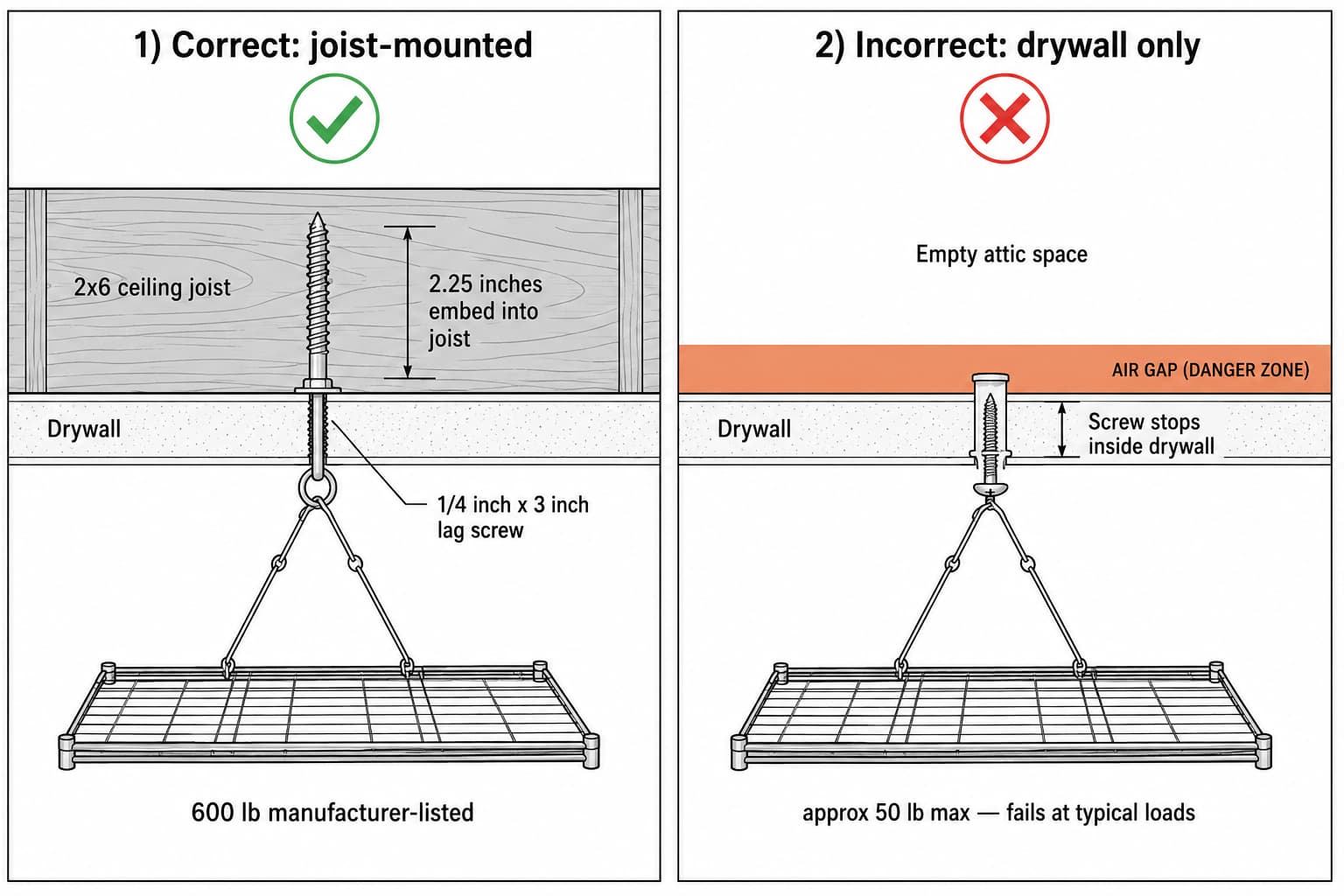
Standard residential garage ceilings have wood joists at 16-inch or 24-inch on-center spacing. Locate them with a stud finder, mark the centre line of each joist, and align the rack’s mounting holes with those marks. If your garage has a steel-beam ceiling, an open-truss ceiling without solid joist faces, a concrete ceiling, or a finished-room-above ceiling with engineered I-joists, stop and consult a contractor. None of the racks in this article are rated for those structures without engineered modifications, and the manufacturers are explicit about the limit.
Locating a joist confirms it’s there — it doesn’t confirm it can carry the load. Older framing, water-damaged or termite-affected wood, and undersized joists in additions or converted spaces should be treated as disqualifying regardless of what the rack is rated for. If you have any doubt about joist condition rather than just joist location, get a contractor’s opinion before drilling.
If you can’t reach joists at all — typical for renters, apartment garages, and some basement conversions — the overhead-storage category is the wrong answer entirely. Our guide to choosing overhead storage safely walks through how to assess your ceiling before you buy anything.
How We Selected These Racks
We do not claim hands-on testing unless clearly stated. For this guide, we reviewed manufacturer specifications, retailer product pages, product documentation where available, and recurring patterns in public customer feedback.
Because overhead-rack failures are almost always installation failures rather than product failures, we prioritized products that publish clear capacity figures with the installation conditions named, that specify wood-joist-only mounting on the listing or the manufacturer page, and that have either a recognizable brand presence or a fully spelled-out spec sheet. Racks with vague “heavy-duty” capacity language and no installation guidance were dropped.
Selection criteria:
- A manufacturer-listed capacity figure with the installation condition named (joist-mounted, evenly distributed, etc.)
- 4 ft × 8 ft platform footprint as the standard residential size, with at least one short-drop alternative
- A clear ceiling-drop range that can be matched to a ceiling height
- Available on Amazon (not discontinued)
- Recurring buyer feedback that addresses installation concerns rather than only the rack itself
What to Look for in Overhead Garage Storage Racks Before Buying
The four specs below are what actually determine whether a rack fits your garage and your storage needs. Capacity is the headline number, but it’s not the only one that matters.
Capacity — 600 lb is standard, 800 lb is the heavy-duty bracket
Most 4×8 overhead racks in the residential market list 600 pounds as the manufacturer-listed capacity, evenly distributed, joist-mounted. The 800-pound bracket is a smaller subset of products — typically with extra cross-bracing, slightly thicker steel, or both. The number itself is less useful than the configuration it assumes: a 600-pound rack installed into drywall holds a fraction of that, and a 600-pound rack with weight piled on one corner is well past the safe range regardless of total weight.
Ceiling drop range — what the numbers mean
Ceiling drop is the distance from the ceiling surface to the top of the rack platform. A 24-to-45-inch range gives you flexibility on standard 8-to-9-foot ceilings; a 12-to-21-inch range is for shorter ceilings, garage-door track clearance, or installations where the rack must sit close to the ceiling. The drop number does not change the rack’s capacity — it changes how much vertical clearance you have between the rack platform and any vehicle or person below.
Frame design — integrated grid vs separate frame plus wire deck
Two construction patterns dominate. Separate frame plus wire deck is the older, cheaper design — the rack frame supports a wire deck that lifts off for cleaning, and bins can occasionally catch in the deck gaps if the deck spacing is wide. Integrated grid welds the deck into the frame as a single unit; bins sit flat without catching, and the structure is stiffer for the same steel weight. For storage that is mostly plastic totes and bins, integrated grid is meaningfully better.
Fixed rack vs motorized hoist — which problem are you solving?
A fixed rack is set-and-forget storage: kayak or holiday-decor totes go up, stay up for months, come down once or twice a year. A motorized hoist raises and lowers cargo on demand — much smaller capacity (typically 50 to 100 pounds for a single-motor consumer unit), but useful for items you actually access weekly, like a single bike, a kayak you paddle in summer, or a stroller. The two solve different problems and should not be compared on capacity alone.
What a good product page should specify clearly
If the listing doesn’t tell you all of the following, treat it as incomplete: manufacturer-listed capacity with installation conditions named, ceiling-drop range, exact platform dimensions, mounting hardware included (lag screws, washers, drop-tubes), joist-spacing compatibility (16 inches and 24 inches on-center), and the structural ceiling types the rack is rated for. The good listings spell these out in a table; the weak ones bury them in marketing language.
Best Overall Overhead Rack: SafeRacks 4×8 24″-45″ Adjustable (2-Pack White)
Best for: standard 8-to-9-foot residential garage ceilings where the buyer wants a recognized brand with a professional installer network as a backup option

Short verdict: The mature-brand pick — 14-gauge industrial steel C-channel beams, 600-pound manufacturer-listed capacity, and a network of insured installers in 40+ cities for buyers who’d rather hire than DIY.
SafeRacks publishes a 600-pound capacity figure for the 4-foot by 8-foot platform on each rack, with the installation requirement explicitly stated as wood joists only — not steel I-beams, not concrete ceilings, not engineered I-joists. The 14-gauge C-channel beams are the structural feature that earns the capacity number; thinner-gauge boltless racks bow under the same load.
Why it stands out
Two racks in one purchase is the typical garage build, and SafeRacks’ two-pack ships with everything to install both racks side-by-side. The 24-to-45-inch drop range covers most 8-to-9-foot ceilings with margin to clear vehicles parked underneath, and the white powder coat makes loaded racks blend into the ceiling rather than dominating the visual. SafeRacks also offers a paid professional install — useful for buyers who don’t want to lift two 4×8 platforms into place alone, and one of the few brands in the category to make that service available across most US metros.
It can work well for:
- Standard 8-to-9-foot ceiling residential garages
- Buyers who want a recognized brand with installer-network backup
- Two-rack initial builds (the typical “fill the ceiling” purchase)
- Garages where the existing visual is white drywall and matching the ceiling is a plus
Key specs to check
- 600-pound per-rack manufacturer-listed capacity, joist-mounted, evenly distributed
- 14-gauge industrial steel C-channel beam construction
- 24-to-45-inch ceiling drop range
- Wood joist mounting only — not for steel I-beams or concrete ceilings
- Installation hardware (lag screws, washers, drop tubes) included in the box
- Lag-screw length included in the kit — confirm it’s long enough for your joist depth (2×6 vs 2×8) plus drywall thickness, with at least 2.25 inches of wood thread engagement
Recurring feedback patterns
Recurring feedback patterns suggest owners value the rigidity of the C-channel beams once installed, with the rack holding level over time rather than sagging under sustained load. Buyers frequently note that the included instructions and pre-drilled hole layout make a two-person install manageable in an afternoon. Common complaints tend to involve the weight and awkwardness of maneuvering the long beams overhead solo, and a recurring theme is that buyers who hired the brand’s installer network were satisfied with the result but flagged that the service adds meaningfully to the total cost.
Potential drawbacks
The two-pack ships as long, heavy steel sections that are genuinely difficult for one person to hold against the ceiling while starting lag screws — most installs realistically need a helper or a temporary support prop. The fixed 24-to-45-inch drop range is too deep for ceilings under about 8 feet, so short-ceiling garages need the dedicated low-profile variant instead. The white powder coat shows scuffs and drill-swarf marks from installation more readily than darker finishes.
Buyer warning
The capacity number assumes wood joists. SafeRacks’ product page is explicit that the rack is not for I-beams, steel joists, concrete ceilings, or any non-traditional materials. If your garage has any of those structures, do not assume the rack will work with adapter hardware — call a contractor first or pick a wall-mounted alternative.
Best Adjustable Height: eShelf 4×8 Overhead 22″-40″ Black
Best for: retrofits where the ceiling height isn’t a standard 8 or 9 feet — older garages, finished-room conversions, or garages with HVAC ductwork eating part of the headroom

Short verdict: Six vertical support bars adjustable in fine increments give this rack a wider effective fit window than racks with two or four fixed-position drop tubes.
The eShelf rack uses six adjustable vertical bars rather than the typical four drop tubes, which means each side of the rack can be tuned to a different height — useful if your ceiling slopes, if a duct or pipe forces one corner of the rack lower than the others, or if you want the rack pitched slightly to match a ceiling beam. The 750-pound listed capacity matches FLEXIMOUNTS’ rated figure at the same size class and is higher than the standard SafeRacks racks (600 lb).
Why it stands out
The fine-increment adjustability is the differentiator. Most racks in the category step in 1-inch or 2-inch jumps; eShelf’s design lets you settle the rack at a precise height to match an irregular ceiling. The black powder coat hides dust and grease over time better than white finishes — useful in garages used for any actual work.
It can work well for:
- Older garages where the ceiling height is non-standard
- Installations where ducts, pipes, or beams force part of the rack to a different height
- Workshop garages where black-finish racks blend with darker tool-storage aesthetics
- Buyers who don’t need a name-brand and want adjustability over brand recognition
Key specs to check
- 750-pound listed capacity, joist-mounted
- 22-to-40-inch drop range with six adjustable support bars
- Heavy-duty metal frame, black powder coat finish
- Joist-mount hardware included (verify lag screw length matches your joist depth)
- Adjustability increment per the listing
Recurring feedback patterns
Owners frequently note that the six-bar adjustment system is the rack’s standout, letting them dial in a level platform on ceilings where a fixed-tube competitor would have sat crooked. Recurring feedback patterns suggest the black finish wears well in working garages and hides grime better than white racks. Common complaints typically involve hardware: buyers mention that the supplied lag screws felt short for deeper joists and that the assembly instructions for a generic-brand product are thinner than what name brands provide, leaving first-time installers to work out the bar sequence themselves.
Potential drawbacks
The extra adjustment bars add steps and fasteners to the build, so this rack takes longer to install than a simpler four-tube design — the flexibility comes at the cost of fiddlier assembly. As a generic Amazon brand, there is no manufacturer support line, so any defect or missing-part issue routes through an Amazon return rather than brand customer service. The 22-inch minimum drop also rules it out for genuinely low ceilings.
Buyer warning
eShelf is a generic Amazon brand without a recognized manufacturer page. Treat the capacity and adjustability claims as listing-stated rather than independently verified — most generic-brand racks ship correctly, but the lack of a manufacturer customer-service path means warranty issues are an Amazon return rather than a brand support call. Verify the ASIN before clicking buy and screenshot the listing for your records.
Best for Low Ceilings: SafeRacks 4×8 12″-21″ White
Best for: garages with 7-to-8-foot ceilings, installations under garage-door tracks, or any setup where the rack must sit close to the ceiling
Short verdict: 12-inch minimum drop is the shortest mass-market overhead rack — the right pick when other racks would push down into headroom or hit the door track.
Most overhead racks start their drop range at 22 to 24 inches, which is too much for short-ceiling residential garages. SafeRacks’ 12-to-21-inch variant is the same 4×8 platform and 600-pound listed capacity as the brand’s standard rack, just with much shorter drop tubes — the 12-inch minimum buys back nearly two feet of vertical space relative to a standard rack on the same ceiling.
Why it stands out
The short drop is the whole point. The arithmetic spells out the difference: on an 8-foot ceiling, a 24-inch-drop rack lands the platform at 6 feet — bumping head height for an average-height adult. A 12-inch drop on the same ceiling lands the platform at 7 feet, which clears most adults walking under it. On a 7-foot ceiling — common in older homes and apartment conversions — the standard 24-inch drop lands at 5 feet, which is unworkable; the 12-inch drop lands at 6 feet and stays usable. For garages with the rack mounted under or alongside the garage-door track, the short drop also avoids interference when the door opens.
It can work well for:
- 7-to-8-foot ceiling residential garages
- Installations under or alongside garage-door tracks
- Apartments above garages where headroom is constrained
- Buyers replacing an existing low-profile rack with a higher-capacity one
Key specs to check
- 12-to-21-inch ceiling drop range (the white-finish variant; SafeRacks also sells a 12″-24″ Hammertone variant if you want a slightly higher max drop with a darker finish)
- 600-pound listed capacity, joist-mounted, evenly distributed
- 4-foot by 8-foot platform
- Wood joist mounting only
- Drop tube length and whether spare drop tubes are sold for additional adjustment
Recurring feedback patterns
Buyers often mention that this low-profile variant solved a problem no standard rack could — recovering usable ceiling storage in a short garage where a 24-inch-drop rack would have been head-height. Recurring feedback patterns suggest the build quality matches SafeRacks’ taller racks, since it shares the same C-channel platform and only the drop tubes differ. A common theme is buyers double-checking before purchase that the short tubes still cleared their stored totes, with some noting after the fact that they had less working room above the platform than they expected.
Potential drawbacks
The short drop range that defines this rack is also its main limitation: at a 12-to-21-inch drop there is little vertical room between the platform and the ceiling, so tall items simply will not fit on top. It is purpose-built for low ceilings and is the wrong choice for an 9-foot-plus garage where the deeper standard rack would put items at a more reachable height. As with the standard SafeRacks, the platform must land on wood joists, and the short tubes give less leeway to dodge a duct or pipe.
Buyer warning
Even at the 12-inch minimum drop, the rack still needs ceiling-to-rack-bottom clearance for the items you intend to store. A rack mounted at 12-inch drop on a 7-foot ceiling has roughly 6 feet of usable height below it — measure your tallest stored item before buying. For a deeper treatment of the low-ceiling decision specifically, see our low-ceiling overhead picks.
Best Heavy-Duty: SunsGrove 4×8 800 lb 22″-40″ Hammertone Black
Best for: dense loads — camping gear with cast-iron, automotive spares, full storage totes packed with hardware, or two-rack systems where the bottom platform takes the heaviest items

Short verdict: 800-pound listed capacity is the highest at the 4×8 platform size — cold-rolled steel with extra bracing relative to the standard 600-pound class.
The SunsGrove rack pushes capacity above the 600-pound standard by using cold-rolled steel for the platform and additional bracing for the frame. The hammertone black finish is the same finish profile used on SafeRacks’ premium variants — useful when matching ceiling racks across multiple bays in a multi-rack build. The 22-to-40-inch drop range works for standard 8-to-9-foot ceilings.
Why it stands out
For buyers genuinely loading dense items — full tool boxes, vehicle-storage spares, campers’ coolers full of canned goods — the 800-pound figure provides margin over the 600-pound class. The margin matters less for the math (most users don’t actually pile 600 pounds onto an 8-foot platform) and more for the load distribution: an 800-pound-rated rack with 600 pounds of asymmetric load is closer to its design centre than a 600-pound rack with 600 pounds of perfect-distribution load.
It can work well for:
- Loads with dense items rather than bulky-but-light totes
- Buyers who want margin for asymmetric or off-centre loading
- Multi-rack installations where the bottom rack takes the heaviest items
- Garages where the ceiling already has confirmed wood joists at 16-inch on-center
Key specs to check
- 800-pound listed capacity (Amazon-listing figure — the listing states this number; SunsGrove is a generic Amazon brand and the manufacturer page is not authoritative)
- 22-to-40-inch ceiling drop range
- Cold-rolled steel construction
- Joist-mount only — verify lag-screw length included matches your joist depth
- Hammertone black finish
Recurring feedback patterns
Recurring feedback patterns suggest buyers are drawn to this rack specifically for the headline capacity and report feeling reassured by the visibly heavier-gauge steel relative to budget racks. Owners frequently note that the hammertone finish looks more premium than the price bracket would imply. Common complaints typically involve the generic-brand experience around the edges — packaging that arrived dented in transit, and a recurring wish for clearer documentation on how the 800-pound figure is meant to be distributed across the platform rather than concentrated.
Potential drawbacks
The 800-pound figure is the published listing capacity, but with no authoritative manufacturer page behind it there is no independent spec sheet detailing the load-distribution assumptions, so the margin over a 600-pound rack is harder to verify than the number alone suggests. Being a generic brand, warranty and missing-part recourse runs through Amazon rather than a dedicated support channel. The 22-inch minimum drop also makes it unsuitable for low-ceiling garages.
Buyer warning
SunsGrove is a generic Amazon brand. The 800-pound capacity is listed-stated, not independently verifiable on a manufacturer customer-support channel. The figure assumes correct joist installation with even load distribution — overloading by 50 pounds in one corner is much worse than underloading the rack by 200 pounds overall. If brand confidence matters more than the extra 200 pounds, consider FLEXIMOUNTS’ 750-pound 4×8 variant as a name-brand alternative.
Best for Bins: FLEXIMOUNTS 4×8 Overhead 750 lb 2-Pack Black (Integrated Grid)
Best for: garages where most overhead storage is plastic totes and bins — kids’ outgrown clothing, holiday decor, sports equipment

Short verdict: Integrated-grid design rather than separate frame plus wire deck — bins sit flat without catching, and FLEXIMOUNTS double-load tests at 1,200 pounds for the 750-pound spec.
FLEXIMOUNTS’ 4×8 rack uses a welded integrated-grid platform: the wire deck and frame are one assembly rather than a deck dropped into a separate frame. For storage that is mostly plastic totes and bins, this is a meaningful structural improvement — bins don’t catch in deck gaps when sliding in, and the unit is stiffer at the same steel weight. The 1,200-pound double-load test is FLEXIMOUNTS’ published quality-assurance method for the 750-pound listed capacity: every rack is tested at 1.6 times the rated load before shipping, which is more rigorous than the typical “passes design load” claim from generic brands. The 2-pack also ships with eight hooks for hanging tools or bikes underneath the platforms, and the line carries a lifetime warranty handled by FLEXIMOUNTS directly rather than through Amazon returns.
Why it stands out
Most overhead-rack failure photos in buyer feedback show one of two things: drywall mounting (always the cause) or a tote that caught in the deck gap and pulled the rack out of level. The integrated-grid design eliminates the second problem. Combined with the double-load test methodology, this rack is the right pick when you know the contents will be tote-heavy rather than mixed.
It can work well for:
- Garages storing primarily plastic totes (5+ at a time)
- Bin sizes from 17-gallon utility totes up to 27-gallon class
- Two-rack installations where bin counts run high
- Buyers replacing a separate-deck rack that has a bin-catching problem
Key specs to check
- 750-pound per-rack manufacturer-listed capacity (1,200-pound double-load tested)
- Integrated-grid platform vs separate frame + wire deck
- 22-to-40-inch ceiling drop range
- 4-foot by 8-foot platform (96″ L × 48″ W × 40″ H assembled)
- 8 hooks included for hanging tools or bikes underneath
- Joist-spacing compatibility: ≤24″ on-center (or 48″ if joists are wider apart)
- Joist-mount only, lifetime warranty backed by FLEXIMOUNTS
Recurring feedback patterns
Owners frequently note that the integrated-grid platform is the practical difference-maker, with bins sliding on and off without snagging the way they do on separate wire decks. Recurring feedback patterns suggest buyers appreciate that FLEXIMOUNTS operates a real manufacturer support channel and honors its warranty directly rather than routing problems through Amazon. Common complaints typically involve the assembly time — a recurring theme is that the welded-grid sections are heavier and more numerous than a simple frame, so the build runs longer, and some buyers mention wishing the included hardware came better sorted and labeled.
Potential drawbacks
The integrated-grid construction makes for a heavier, more involved overhead install than a lighter frame-plus-deck rack, which is harder to lift into position single-handed. Because FLEXIMOUNTS sells several similar-looking 4×8 listings, it is easy to land on a variant without the integrated grid, defeating the main reason to buy this one. The 22-to-40-inch drop range also keeps it out of low-ceiling garages.
Buyer warning
FLEXIMOUNTS sells multiple 4×8 variants — some with integrated grid, some with separate frame plus wire deck, and the listing photos can look similar. Verify the integrated-grid design is what’s shipping before clicking buy. If you load the wrong variant with bins expecting them to sit flat, you’ll get the deck-catching problem the integrated grid was supposed to solve.
Best Modular: Gladiator GearLoft Storage Rack 2 x 4 (GALS24M1KG)
Best for: garages with several small ceiling zones rather than one open expanse — buyers who want to spread storage across multiple positions instead of committing to a single large deck
Gladiator Overhead GearLoft™ Storage Rack 2 x 4, GALS24M1KG
Short verdict: A compact 24″L × 48″W ceiling rack with a 350-pound manufacturer-listed capacity, 23-to-37-inch adjustable drop, and roughly 25 cubic feet of storage volume — built as part of the wider Gladiator garage system of hooks, baskets, and GearTrack rail accessories. Pick this when one large rack doesn’t fit your ceiling layout and two or three smaller racks in different zones would.
The 2×4 footprint unlocks a layout pattern the 4×8 racks in this guide can’t: one unit above the garage door for seasonally accessed items, a second over the workbench for tools and supplies, a third by the side door for outdoor gear — storage that scales horizontally across zones rather than stacking vertically in one spot. Gladiator’s ecosystem of compatible wall and ceiling accessories means the rack can be the start of a coordinated system rather than a single standalone purchase.
Why it stands out
Brand strength is the real differentiator. Gladiator maintains an established garage-storage product family — wall-mounted GearTrack rails, modular cabinets, hook accessories — all designed to work together visually and functionally, and the GearLoft 2×4 is the ceiling-storage piece of that system. Its 23-to-37-inch drop range sits in the same band as the mainstream 4×8 adjustable racks above; the differentiator here is footprint and ecosystem fit, not drop flexibility, so this pick makes sense for layout-and-system reasons rather than needing a wider drop band. EZ Connect assembly hardware speeds up each unit’s install, which matters more when you’re mounting several.
It can work well for:
- Garages with a multi-zone ceiling layout where one large rack doesn’t fit
- Buyers planning a longer-term Gladiator-system build (cabinets, GearTrack, hooks)
- Smaller storage needs that don’t justify a full 4×8 rack
- Buyers willing to pay more per square foot for layout flexibility
Key specs to check
- Manufacturer-listed capacity: 350 lb, evenly distributed, per unit
- Drop range: 23-to-37-inch adjustable
- Deck size: 24″L × 48″W (2×4 footprint)
- Storage volume: approximately 25 cubic feet at full drop
- Material: heavy-gauge steel, hammered granite finish
- Assembly: EZ Connect hardware
- Mounting: wood ceiling joists (same requirement as every other rack in this guide)
Recurring feedback patterns
Recurring positive feedback often centers on the rack matching the visual style of other Gladiator products already in the buyer’s garage — owners describe a coherent look across wall storage and ceiling storage once both are Gladiator. Common complaints typically involve the higher cost per square foot compared with a single 4×8 rack from a generic brand — a real trade-off, but one weighed against the brand-ecosystem benefit. Several buyers mention installing two or three units to cover the same total area as one 4×8 rack, which works as intended but adds install time even with EZ Connect hardware.
Potential drawbacks
Cost per square foot runs meaningfully higher than a generic 4×8 rack. The 350-pound per-unit capacity is well below the 600-pound class that’s standard elsewhere in this guide, so buyers with one large, dense load (a decade of holiday totes, bulk paper goods) are better served by the SafeRacks or SunsGrove picks above. The 350-pound figure is the binding number per unit, not a combined system total — each rack is independently anchored and rated on its own.
Buyer warning
Don’t buy this rack expecting one unit to replace a full-size 4×8 deck — it’s built for buyers who have decided their garage ceiling is a multi-zone storage system, not a single large expanse. If your storage is dominated by one big, dense load, the cost per square foot of the 2×4 modular path will exceed an equivalent-area 4×8 rack, and the 350-pound per-unit cap will limit how densely you can pack any one zone.
Best Motorized Hoist: MyLifter Basic Lifter (Garage Smart)
Best for: items you actually access frequently — a kayak you paddle in summer, a single bike, a stroller, or a large tote that comes down weekly

Short verdict: A different category — motorized ceiling-mounted hoist with smartphone app control and force feedback when the weight limit is reached. Entry-level capacity: 50 pounds standalone, 100 pounds with the optional pulley accessory.
MyLifter (sold under the Garage Smart brand) is the dominant smartphone-controlled motorized hoist on Amazon. Wireless control via iOS or Android, programmable stop points, and force feedback on the motor when the weight limit is reached. The Basic Lifter is the entry point in the line — 50 pounds standalone, 100 pounds with the optional pulley accessory (sold separately). Higher-capacity SKUs in the Garage Smart line (Universal Lifter at 100 pounds standalone, platform lifters that link multiple motors up to 400 pounds) exist for buyers who need more.
Why it stands out
For a kayak, a single bike, or a stroller — items typically in the 30-to-50-pound range — a fixed overhead rack is the wrong answer because you need access. Lifting a 50-pound kayak overhead manually is the failure mode. The motorized hoist does the lift for you, lands the cargo at a programmed height, and lets you check the weight via the app’s force-feedback display before committing. The capacity is much lower than a fixed rack, but the use case is different.
It can work well for:
- Kayaks, paddleboards, and other long single-item cargo (verify the weight first — a fishing kayak with a seat installed can exceed 50 lb)
- A single mountain bike or road bike (~25-30 lb typically) that needs frequent access
- Strollers, large totes, or seasonal gear retrieved weekly rather than yearly
- Two-car garages where one vehicle’s parking spot needs to be cleared frequently
Key specs to check
- 50-pound standalone capacity / 100-pound with optional pulley
- iOS / Android compatibility (current OS support)
- Programmable stop points and force-feedback behaviour at weight limit
- What’s in the box on this base SKU
- Wood-joist mounting requirement (same as fixed racks)
Recurring feedback patterns
Owners frequently note that the motorized, app-controlled lift genuinely changes how often they use stored gear, since raising and lowering a kayak or bike no longer means an overhead manual lift. Recurring feedback patterns suggest the force-feedback weight readout is reassuring for staying within the limit. Common complaints typically involve the app and connectivity layer rather than the motor itself — a recurring theme is buyers reporting pairing hassles after a phone OS update, and several mention that the base unit’s modest capacity pushed them toward the pulley accessory or a higher SKU sooner than expected.
Potential drawbacks
The 50-pound standalone capacity is far below any fixed rack here, so it suits single items rather than bulk storage, and reaching 100 pounds requires the separately sold pulley accessory. App control introduces failure modes a mechanical rack does not have — Wi-Fi outages, OS-update breakage, and motor calibration drift — meaning the convenience depends on a working phone and network. The base SKU is the lift mechanism only, with no platform included.
Buyer warning
Confirm your use case fits 50 pounds before buying. A typical road bike fits; a heavily-loaded fishing kayak or beach cruiser with cargo racks can exceed it. If you need more capacity, factor the pulley accessory or step up to the Universal Lifter (100 lb standalone) or a multi-motor platform lifter. App control adds failure modes — Wi-Fi outages, OS update breaks, motor calibration drift — so plan for a manual fallback. The lift still mounts to wood joists like the fixed racks.
Side-by-Side Comparison
| Product | Best for | Capacity | Ceiling drop | Type | Joist-mount only? | Main advantage | Main drawback |
|---|---|---|---|---|---|---|---|
| SafeRacks 4×8 24″-45″ 2-Pack | Standard ceilings | 600 lb each | 24″-45″ | Fixed | Yes | 14-gauge C-channel + installer network | Verify joist structure first |
| eShelf 4×8 22″-40″ | Non-standard ceilings | 750 lb (listed) | 22″-40″ (fine increments) | Fixed | Yes | Six adjustable bars | Generic brand — listing-only framing |
| SafeRacks 4×8 12″-21″ | Low ceilings | 600 lb | 12″-21″ | Low-profile fixed | Yes | Shortest mass-market drop | Limited drop range |
| SunsGrove 4×8 800 lb | Heavy-duty / dense loads | 800 lb (listed) | 22″-40″ | Fixed | Yes | Highest capacity at this size | Generic brand |
| FLEXIMOUNTS 4×8 750 lb 2-Pack | Bins | 750 lb each (1,200 lb test) | 22″-40″ | Integrated-grid fixed | Yes | Bins sit flat + lifetime warranty | Verify integrated-grid variant |
| Gladiator GearLoft 2×4 | Multi-zone modular layouts | 350 lb per unit | 23″-37″ | Modular fixed | Yes | Multi-zone flexibility + Gladiator ecosystem | Higher cost per sq ft, lower per-unit capacity |
| MyLifter Basic Lifter | Frequently-accessed items | 50 lb standalone / 100 lb with pulley | n/a (lift) | Motorized hoist | Yes | App-controlled, force feedback | Low capacity, app dependency |
Fixed Rack vs Motorized Hoist — How to Pick
The most consequential decision in this category is which product class fits your access pattern. Fixed racks are storage; motorized hoists are access. Treating them as if they’re the same thing produces predictable disappointment — a kayak owner who buys a fixed rack and then dreads paddle weekends, or a holiday-decor storer who buys a motorized hoist and pays five times the price for capacity they don’t need.
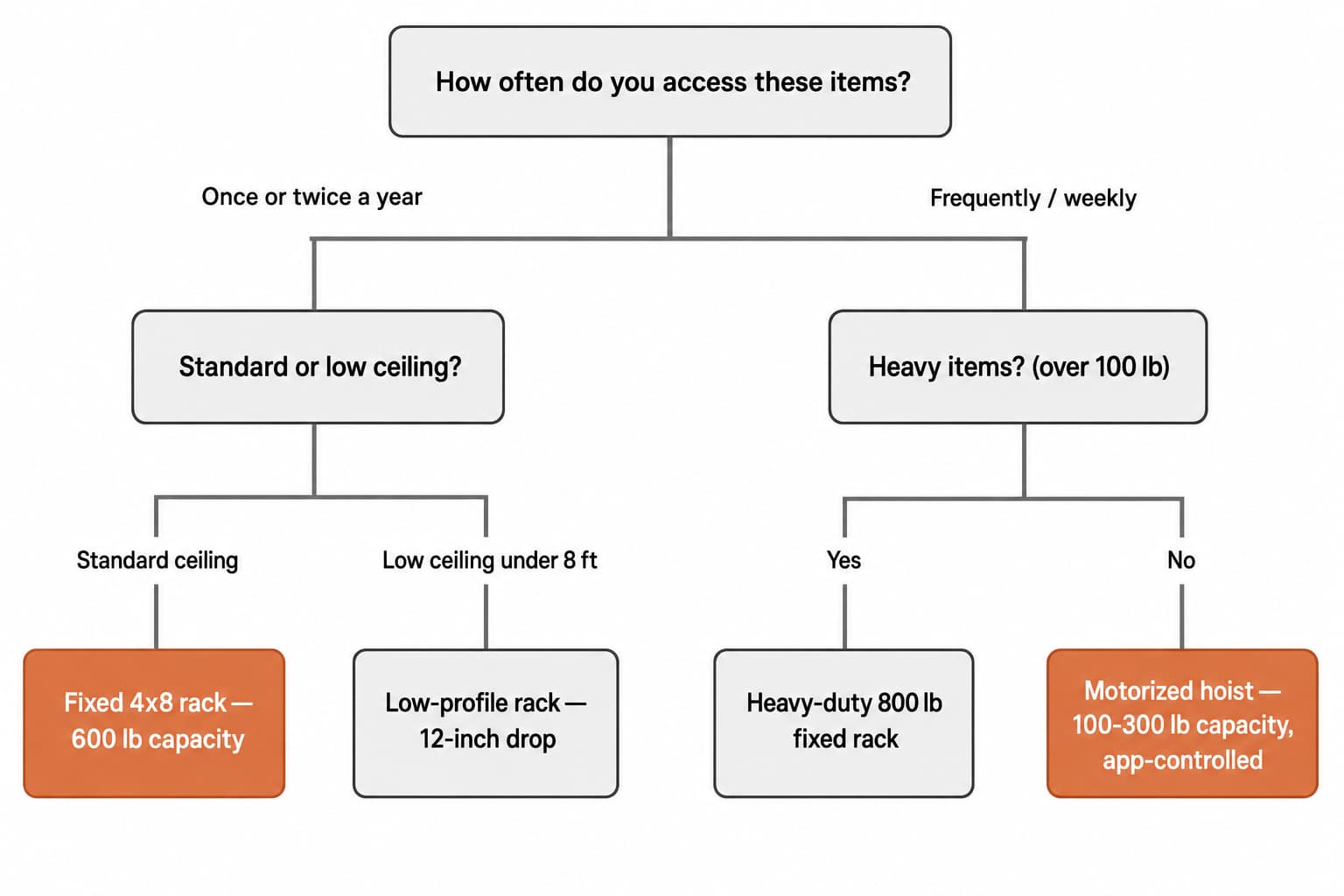
| Need | Fixed rack | Motorized hoist |
|---|---|---|
| Storing seasonal items 1-2 times a year | ✓ | ✗ (overkill) |
| Accessing a kayak weekly in summer | ✗ (lifting risk) | ✓ |
| Loads over 100 lb | ✓ | ✗ (capacity too low for single motor) |
| Limited budget | ✓ (cheaper per pound) | ✗ |
| Want app integration | ✗ | ✓ |
| Need very low drop / 7 ft ceiling | ✓ (low-profile rack) | varies |
If your overhead storage is “things I see twice a year”, a fixed rack is correct and the only further decision is capacity, drop range, and grid design. If your overhead storage is “the kayak I use every weekend”, a motorized hoist is correct and capacity is the constraint that decides which one.
How much room an overhead rack leaves under it
Rack makers publish how far the unit hangs below the ceiling. What they never publish is the number you actually need: how much headroom is left underneath once it is up — which is what decides whether your car still fits, or whether the garage door can still swing open. This table restates each rack’s published drop and works out the remaining clearance for the two ceiling heights most American garages have.
| Rack | Published ceiling drop | Clearance under it — 8 ft ceiling | Clearance under it — 9 ft ceiling | Deck size | Stated capacity | Joist requirement | Specification source | Source checked |
|---|---|---|---|---|---|---|---|---|
| SafeRacks 4 ft × 8 ft | 12–45 in | 51–84 in | 63–96 in | 48 × 96 in | 600 lb | brackets span two wood joists; not for I-beams | SafeRacks 4×8 Overhead Rack | 2026-08-14 |
| FLEXIMOUNTS GR48 Classic 4 ft × 8 ft | 22–40 in | 56–74 in | 68–86 in | 96 × 48 in | 600 lb | joist spacing ≤ 24 in; if spacing > 24 in, only 48 in spacing | FLEXIMOUNTS GR48 Classic 4′ × 8′ | 2026-08-14 |
| Gladiator Overhead GearLoft 4 ft × 8 ft | 23–37 in | 59–73 in | 71–85 in | 48 W × 96 D in | 1,000 lb per unit | ceiling mounted, assembly required (spacing not published) | Gladiator Overhead GearLoft 4 × 8 | 2026-08-14 |
| Gladiator Overhead GearLoft 2 ft × 8 ft | 23–37 in | 59–73 in | 71–85 in | 96 W × 24 D in | 500 lb per unit | ceiling mounted, assembly required (spacing not published) | Gladiator Overhead GearLoft 2 × 8 | 2026-08-14 |
How these numbers were produced: Ceiling drop, deck size, capacity and joist requirements are quoted from each manufacturer’s own product page on the date shown. Clearance underneath is arithmetic: ceiling height minus the published drop, at 8 ft (96 in) and 9 ft (108 in). The range runs from the rack’s lowest setting (least clearance) to its highest. The calculation treats the published drop as the distance from ceiling to deck and ignores deck thickness, so treat the result as the optimistic figure and measure before you drill.
- Measure where you will actually mount it. The garage door track, the opener rail and the door in its open position occupy the ceiling near the door — the clearance that matters there is not the clearance mid-garage.
- Clearance is to the underside of the deck. Anything hanging below the deck, and the deck’s own thickness, eats into it.
- Joist spacing is a hard constraint, not a preference: these racks are rated only when fixed into wood joists at the spacing the manufacturer states.
- Capacity figures are the manufacturer’s stated maximum for a correctly installed rack. Real-world performance depends on assembly, the fixings used, joist condition and how the load is distributed.
- A blank cell means the manufacturer does not publish that figure — we do not fill gaps with numbers we could not source.
These are the entries that matter for this guide. The full table, with every row and its source, is in our How much room an overhead rack leaves under it.
How to Measure Your Garage Before Buying
Skipping these measurements is the second-most-common buyer mistake (after drywall mounting). Five minutes with a tape measure and a stud finder avoids returning a rack that won’t fit.
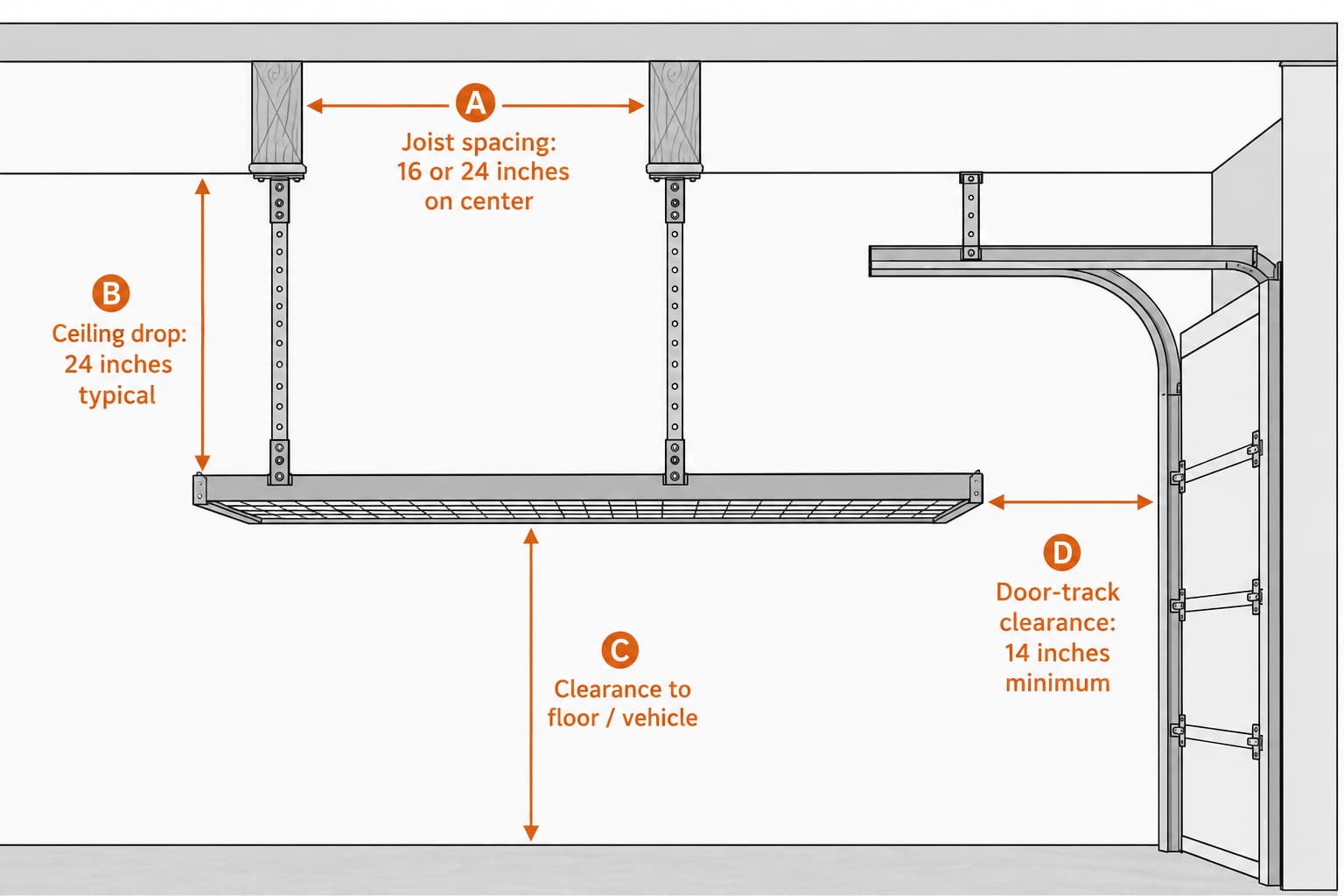
- Locate ceiling joists with a stud finder. Mark the centre line of at least four joists across the planned rack location.
- Measure on-center spacing between joists — most modern construction is 16 inches or 24 inches. Confirm the rack you’re considering accepts your spacing.
- Measure ceiling height from floor to ceiling surface where the rack will mount.
- Subtract the rack’s planned ceiling drop (e.g. 24 inches) to find the rack platform height.
- Subtract item height (the tallest tote or kayak you’ll store) from the platform height to confirm clearance to the floor or vehicle.
- Measure the distance from the planned rack edge to any garage-door track or HVAC duct — minimum 14 inches of clearance for door-track operation.
- Confirm joist depth (typical 2×6 or 2×8) and verify the included lag screws are long enough to embed at least 2.25 inches into the joist after passing through drywall.
Common Complaints and Buyer Warnings
Recurring feedback patterns across this category cluster around three issues. First, drywall-only mounting is reported in nearly every overhead-rack failure thread — buyers who skipped joist location, used drywall anchors, and watched the rack pull out of the ceiling within months. Second, capacity numbers are evaluated under perfect distribution; piling 400 pounds in one corner of a 600-pound rack is much worse than spreading 500 pounds evenly. Third, motorized hoist owners report Wi-Fi-related app failures, smartphone OS update incompatibilities, and motor calibration drift over time — the app is convenient but introduces failure modes a fixed rack doesn’t have.
The single most important warning in this category: NEVER mount any of these racks to drywall alone. Drywall-only mounting fails at 50 pounds or less; the rack and everything on it can come down without warning. If you can’t reach joists, an overhead rack is not the right product — pick a wall-mounted or floor-standing alternative.
Who Should Avoid Overhead Storage?
Renters who can’t drill into their ceiling joists are first — without lag-bolting into joists, the racks aren’t safe at any capacity. Apartments above living spaces are second — drop risk plus noise transmission make overhead storage a poor neighbour. Garages with concrete or steel-joist ceilings are third — without wood joists, the standard residential racks aren’t rated for the structure, and engineered alternatives are a contractor conversation, not an Amazon purchase. Households where someone could be standing under the rack during use (kids, pets) should also reconsider — even properly installed racks should not be loaded or unloaded with someone underneath.
Climate-sensitive items (paint, electronics, certain medications) shouldn’t live overhead in the first place — temperature near the ceiling is hottest in summer, coldest in winter, and the rack platform is open to garage air.
FAQ
Can I mount an overhead rack to drywall alone?
No, never. Drywall has no structural strength for overhead loads — drywall anchors fail at well below 50 pounds, and a fully loaded 600-pound rack can come down without warning when the drywall pulls. Every overhead rack in this guide must be lag-bolted into wood ceiling joists. If you can’t reach joists, the overhead category isn’t the right answer.
How do I find joists?
Use a stud finder with deep-scan mode (most consumer stud finders work for ceilings). Modern garages typically have joists at 16 inches or 24 inches on-center. Mark the centre line of each joist across the planned rack footprint, then align the rack’s mounting holes with those marks. If the stud finder isn’t returning consistent readings, drilling small pilot holes to confirm wood feel is acceptable.
What’s the difference between 600 lb and 800 lb racks in real terms?
For most residential storage, the 600-pound class is enough — total weight on a 4×8 platform packed with seasonal items rarely exceeds 300 pounds in practice. The 800-pound class buys margin for two scenarios: dense loads (cast-iron, automotive parts), and asymmetric loading where weight isn’t perfectly distributed. If you’re worried about exceeding 600 pounds total, you’re probably loading wrong; if you’re worried about loading unevenly, the 800-pound class is the right answer.
What if my garage ceiling is concrete?
Standard residential overhead racks are not rated for concrete ceilings. Engineered concrete-anchor systems exist but require contractor specification, drilled inserts, and higher-load anchors than what ships with these racks. Don’t try to retrofit a wood-joist-rated rack onto concrete — call a contractor or pick a wall-mounted or floor-standing alternative.
Are motorized hoists safe?
When properly installed (joist-mounted, capacity-respected), motorized hoists are safe for their listed capacity. The added risks vs fixed racks are app dependence (Wi-Fi outage, OS updates, smartphone failure) and motor calibration drift over time. Plan for a manual fallback, never load the hoist beyond its listed capacity, and don’t stand under it during raise or lower cycles.
Can I install one myself?
Yes, if you can confidently locate ceiling joists and use a drill. The actual install is straightforward — mark joists, drill pilot holes, lag-bolt the drop tubes, attach the platform. The two reasons to hire a professional are: ceilings other than wood-joist (concrete, steel-joist, finished room above), or buyers without comfort using power tools at ceiling height. SafeRacks offers paid installation in 40+ cities for buyers in the second category.
What happens if I exceed the listed capacity?
Best case, the rack bows visibly under load and you remove items before damage. Worst case, the lag screws shear or pull out of the joists and the whole rack drops onto whatever is below. Don’t test capacity — the listed number assumes perfect installation and even distribution, and real garages always have some installation imperfections. Stay well under the listed capacity, especially for items that can’t take a drop.
How does ceiling drop affect what I can store?
Ceiling drop is the gap between ceiling and rack platform top. A 24-inch drop on an 8-foot ceiling lands the platform at 6 feet — clearance underneath depends on what (or who) is there. Add the height of the items you’re storing on the rack to find the total ceiling occupancy. If your item-stack height plus the ceiling drop exceeds your ceiling height minus the floor-clearance you need, the rack is too tall for the space.
Sources Reviewed
For this guide, we reviewed manufacturer product information, retailer specifications, Amazon product listings, public customer feedback patterns, and overhead-storage-specific discussions. We focused on product details that matter for ceiling-mounted overhead racks, including manufacturer-listed weight capacity, ceiling-drop range, frame design (integrated grid vs separate frame plus wire deck), platform dimensions, mounting hardware specifications, and the structural ceiling types each product is rated for.