Overhead vs Wall Garage Storage: Which Is Better?
Last updated:
Disclosure: This article contains affiliate links. If you buy through these links, we may earn a commission at no extra cost to you. We do not claim hands-on testing unless clearly stated.
An overhead rack holds 600 pounds. A wall shelf holds 200. So overhead wins, right? Only if you plan to climb a ladder to reach what’s up there. The real choice isn’t about which one carries more weight — it’s about which one matches how often you reach for what you’re storing. We won’t cover freestanding shelving (see our guide to garage shelves for storage bins) or cabinets — just the wall-or-ceiling decision.
Quick Answer
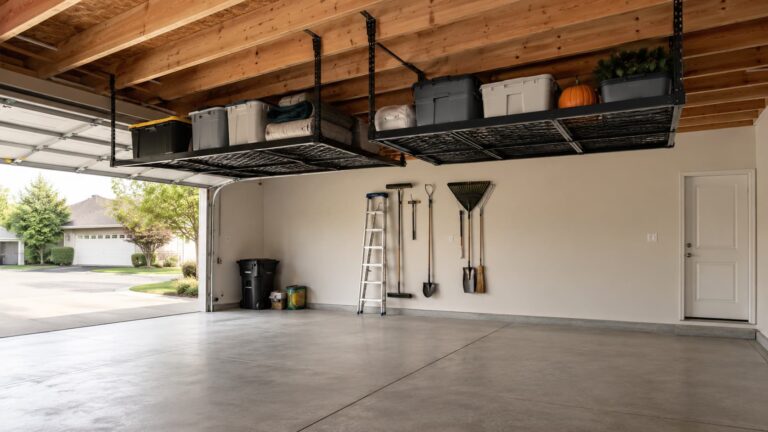
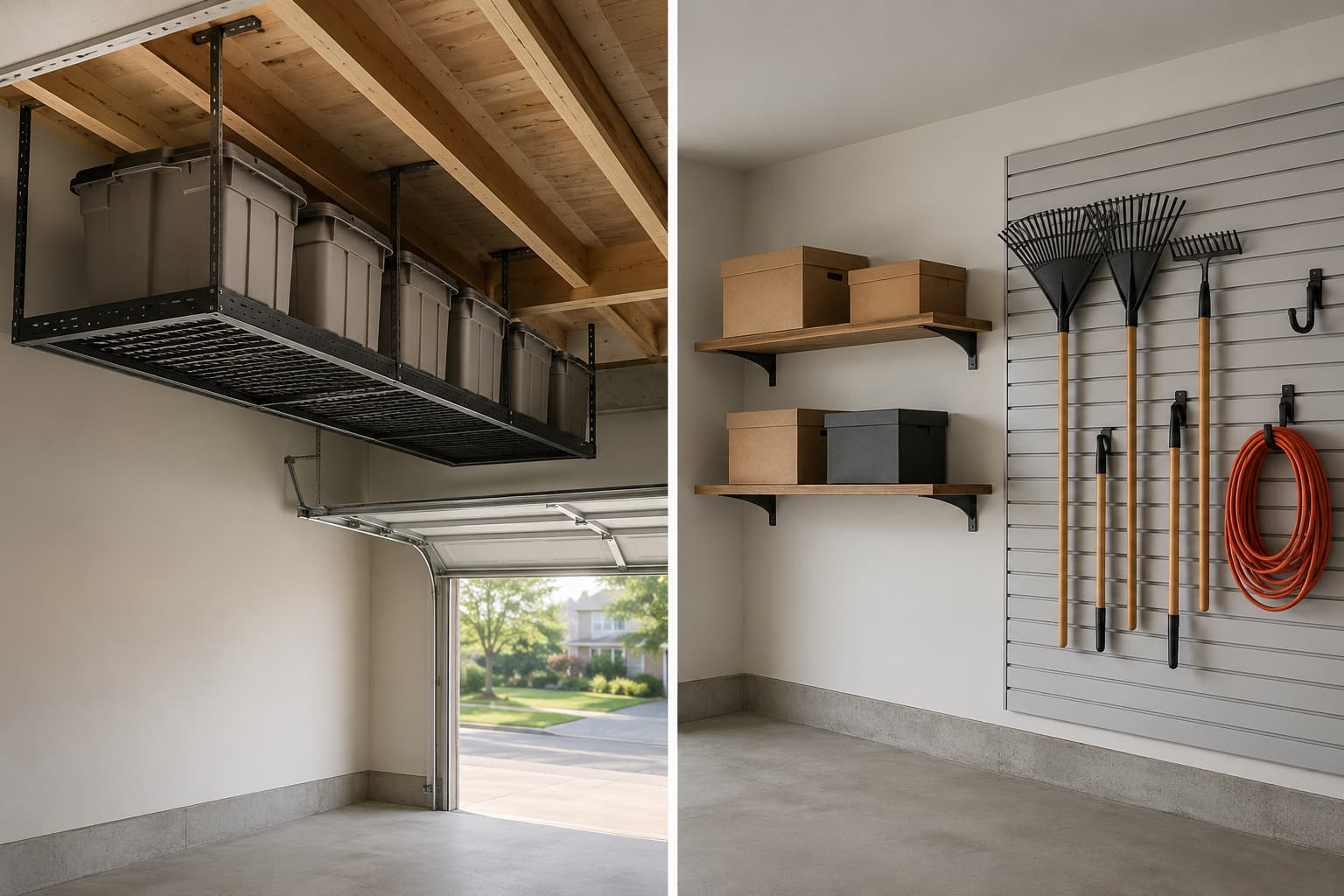
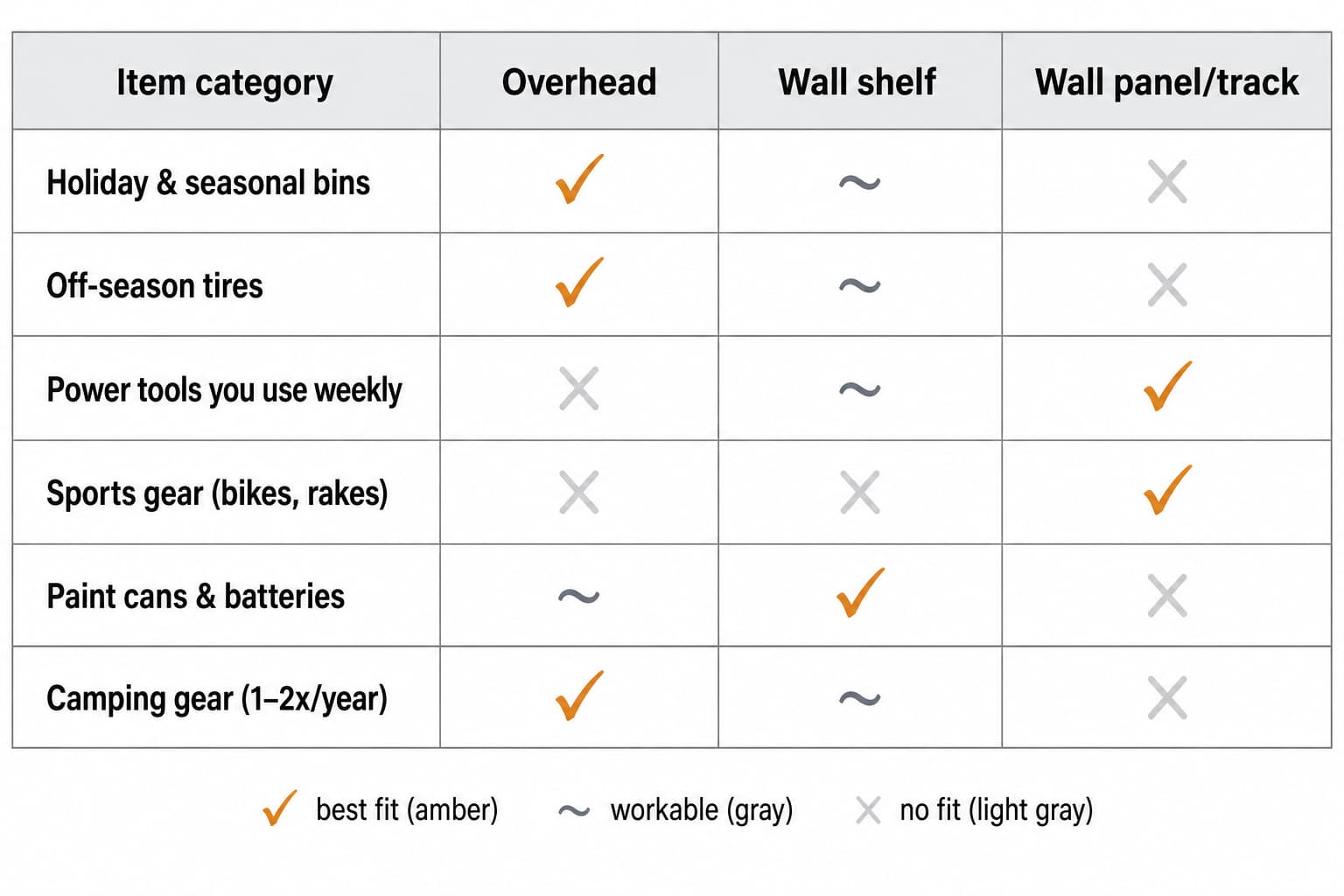
For bulky seasonal items you touch once or twice a year — holiday decor, camping gear, off-season tires — overhead racks usually win because they free both floor and wall. For tools, sports gear, and bins you reach for monthly, wall storage usually wins because the ladder cost is too high for frequent access. The decision rarely needs to be either/or; most well-organized garages use both, divided by access frequency, not by item size.
Best Choice by Situation
| Situation | Better choice | Why |
|---|---|---|
| Bulky bins accessed 1–2× per year (holiday, camping) | Overhead | Frees floor and wall; rare access means the ladder cost is acceptable |
| Tools and gear you reach for weekly | Wall | Eye-level access; no ladder fatigue |
| Heavy boxed items (paint cans, oil, batteries) | Wall shelving | Stays at chest height; off the floor; easy to inventory |
| Garage with less than 8 ft ceiling | Wall | Overhead would block headroom or vehicle clearance |
| Parking a tall vehicle (SUV, truck) under the bay | Wall (for the parking bay) | Overhead may interfere with door tracks or roofline |
| Sports equipment (bikes, skis, rakes) | Wall panel / track | Hooks and panels are made for irregular shapes |
| Renter or HOA restricting ceiling holes | Wall (into studs) | Stud-mounted holes are easier to patch than ceiling lag bolts |
For a fuller treatment of the overhead side specifically, see the overhead-rack roundup; for the wall side, see the wall-mounted systems roundup.
Overhead Garage Storage — Pros, Cons, Best Use Cases
What it is
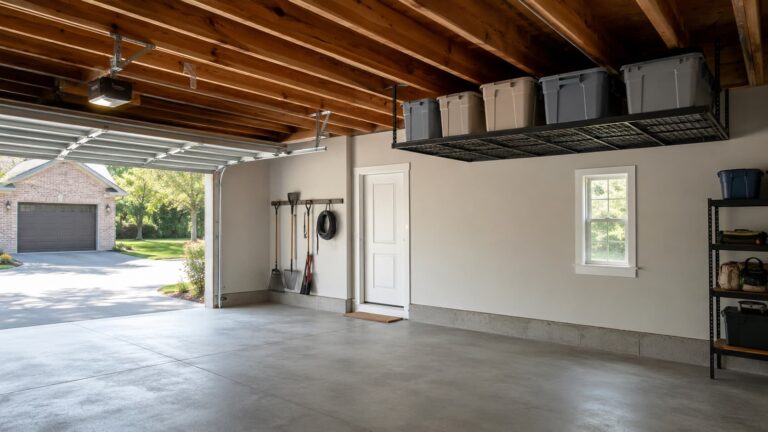
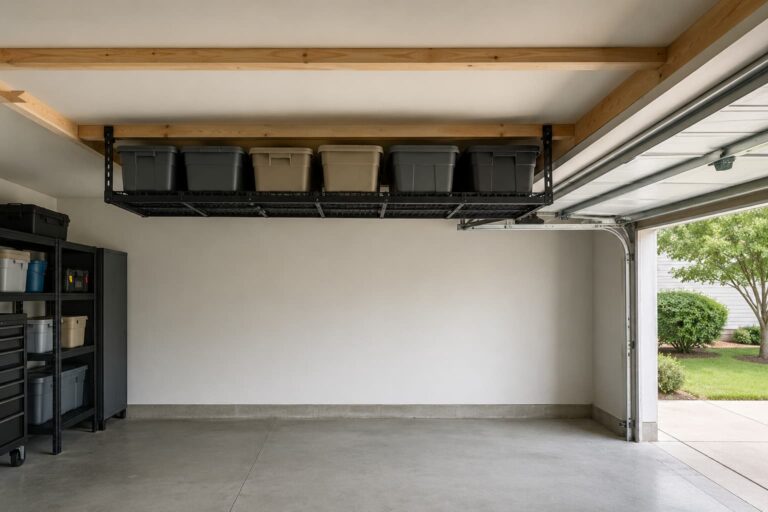
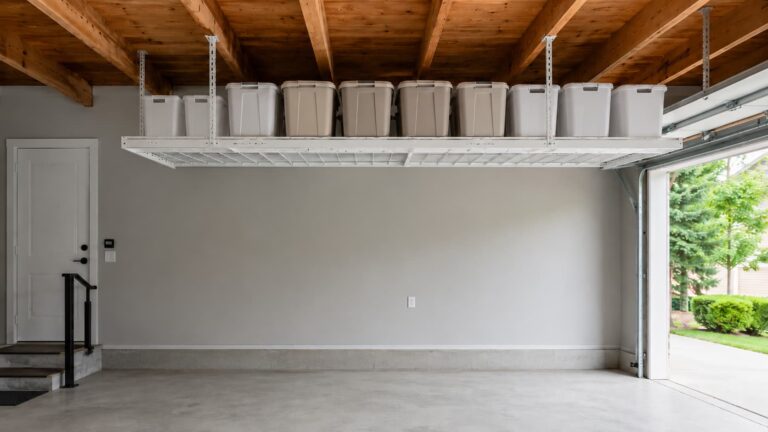
A ceiling-joist-mounted steel rack that hangs above head height, holding a flat deck — usually plywood you supply — that you load with bins. Drop range is adjustable, typically 22 to 45 inches below the joists. Brackets are lagged into solid lumber joists; the deck is what your bins sit on.
Where overhead works best
- Bulk and seasonal items you don’t need monthly — holiday lights, off-season tires, camping gear
- Garages with 9 ft or more of ceiling so the drop plus bin height plus headroom underneath all fit
- Stackable bins of similar size (a flat overhead deck rewards uniformity)
Where overhead falls short
- Anything you’ll touch more than a few times a year — ladder fatigue is real
- Loose or odd-shaped gear (rakes, bikes, extension cords) that doesn’t fit cleanly in bins
- Low ceilings, exposed garage-door tracks, or HVAC ducts running below the joists
- Renters or HOAs where ceiling lag bolts are off-limits
If the ladder cost is the dealbreaker but you still want overhead capacity, motorized lifting racks — like the FLEXIMOUNTS GL1, which uses a hand crank or drill-driven lift — let you lower the deck without a ladder, at lower manufacturer-listed capacity (around 350 lb on the 4×4 model).
What manufacturers and retailers typically specify
A good overhead-rack product page lists four things you should find before buying:
- Total manufacturer-listed capacity for the assembled rack — not just the deck
- Drop range between the joist and the bottom of the deck, in inches
- Joist spacing compatibility — typically 12, 16, or 24 in OC. Non-standard framing (19.2 in, or older 18 in) may not be supported. The FLEXIMOUNTS Classic 4×8 listing specifies 24 in or less, or exactly 48 in for unusual framing.
- Whether decking is included — most racks ship without; you supply 3/8 to 3/4 in plywood
Buyer warnings specific to overhead
Measure joist spacing before ordering: a rack designed for 16 or 24 in OC won’t safely attach to engineered trusses at 19.2 in. Confirm the drop doesn’t intrude into your garage door’s open path — a 7 ft door open height plus 4 in of headroom plus a 22 in rack drop with bins on top can easily put your storage in the door’s swing zone. Sketch the elevation before drilling.
For ceilings under 9 ft, see overhead storage for low ceilings.
Wall Garage Storage — Pros, Cons, Best Use Cases
What it is
Anything attached to the wall — floating shelves on heavy-duty brackets, slatwall-style panel systems, tool tracks, pegboards. All depend on wall studs or solid masonry. Wall storage is more flexible than overhead in shape and access, but more component-based: a panel without hooks doesn’t store anything until you buy accessories.
Where wall storage works best
- Anything you reach for monthly or more — tools, cleaning supplies, sports gear
- Items that don’t stack into bins — bikes, rakes, garden hoses, extension cords
- Heavy boxed items at chest or shoulder height — paint cans, oil jugs, batteries
- Garages with ceilings under 9 ft where overhead isn’t viable
- Renters who can patch stud-mounted holes more easily than ceiling lag bolts
Where wall falls short
Wall is a finite resource. Most two-car garages have one or two usable walls before windows, side doors, breaker panels, and water heaters interrupt them. Bulk seasonal storage on walls also eats space you could use for accessible gear — and seldom-touched bins eventually climb above shoulder height, no easier to reach than a ladder-accessed overhead.
What manufacturers and retailers typically specify
- Manufacturer-listed capacity — per shelf (shelving) or per linear/square foot (panels)
- Stud spacing assumption — most products assume 16 in OC; some support 24 in with documented bracket positions
- What’s included — for shelves, whether decking is in the box; for panels, that mounting screws and trim are typically included but hooks, baskets, and shelves are not
- Per-square-foot rating for panels — Gladiator GearWall specifies 50 lb per sq ft when mounted to drywall over wood studs, per the published installation sheet (document W11087876)
Buyer warnings specific to wall
Wall systems are only as good as the studs behind them. Drilling into drywall alone, or into drywall with hollow plastic anchors, voids the manufacturer-listed capacity — use studs or solid masonry. Stud spacing matters: a 24 in OC wall in an older home limits which products will safely span between supports. For panel systems, budget the full system — hooks and baskets are sold separately and easily double the panel cost.
Side-by-Side Comparison
| Dimension | Overhead | Wall |
|---|---|---|
| Typical manufacturer-listed capacity | 400–750 lb total (4×8 racks) | 50 lb/sq ft (panel) or 200–400 lb per shelf |
| Access without a ladder | No — typically 6–8 ft above floor | Yes — waist to shoulder height |
| Best for | Bulky seasonal bins | Tools, frequent-access bins, irregular gear |
| Ceiling requirement | 9 ft preferred; joist spacing ≤24 in | None — uses wall |
| Wall requirement | None | Studs (16 or 24 in OC) or solid masonry |
| Renter-friendly | Low — ceiling lag bolts | Higher — fewer holes, easier patching |
| Decking / accessories included | Usually no — supply plywood | Shelf: usually yes; panel: hooks sold separately |
| Vehicle clearance impact | Possible — verify drop vs door open path | None |
| Typical extension into the room | 22–45 in below joists | 12–24 in off the wall (shelf depth) |
How to Decide for Your Garage
Three steps, once you stop arguing capacity against capacity:
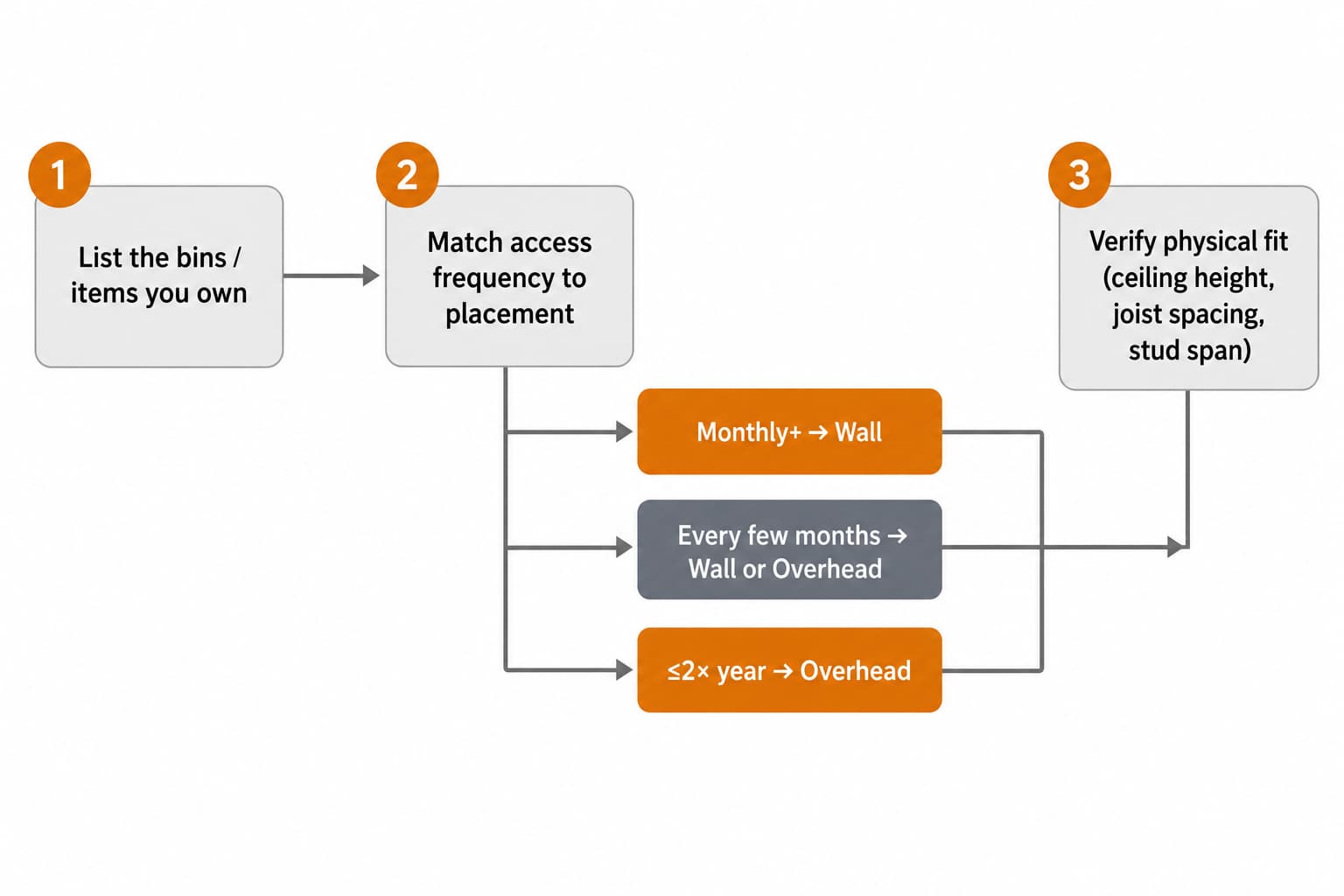
Step 1 — List what you actually own. Sort it into three groups: items you touch monthly or more, items you touch every few months, and items you touch twice a year or less. Don’t plan around hypothetical future stuff.
Step 2 — Match access frequency to placement. Monthly-plus belongs on walls. Twice-a-year-or-less belongs overhead. The middle group is the genuine “either” — wall if you have wall length to spare, overhead if you don’t.
Step 3 — Verify physical fit. Measure ceiling height and joist spacing for overhead, clear wall length and stud span for wall. Confirm manufacturer-listed specs match what you measured, not what you assumed. For the overhead side specifically, how to choose overhead garage storage safely covers the joist and headroom math.
Common Mistakes
Mistake: Putting frequently-accessed bins overhead because “they fit.” Capacity tempts people into using overhead as a primary storage zone. Three months later the rack is full of stuff you’ve stopped reaching for, because climbing a ladder for paper towels is a tax you pay reluctantly. Match access frequency, not capacity.
Mistake: Treating wall and overhead as competing systems. They’re complementary. Most well-organized garages divide storage by frequency — bulk overhead, access on walls. If you’re picking only one to start, see how to organize a small garage.
Mistake: Ignoring vehicle and door clearance. A 22 in drop plus 1/2 in plywood plus 14 in bins on top can easily intrude into a garage door’s open path or hit an SUV roofline. Sketch the elevation in inches before drilling.
Recommended Products for Each Side
Two anchor products per side, picked as category representatives rather than as winners.
For overhead — FLEXIMOUNTS 4×8 Classic Overhead Rack

The standard 4×8 overhead rack at manufacturer-listed 750 lb total capacity, heavy-duty cold-rolled steel, 22–40 in adjustable drop. Listing specifies joist spacing of 24 in or less (or exactly 48 in). Decking sold separately.
For overhead — SafeRacks 4×8 Heavy Duty Overhead Rack

Same form factor as the FLEXIMOUNTS pick, at manufacturer-listed 600 lb capacity, hammertone powder-coat finish, 24–45 in adjustable drop. Multiple SafeRacks variants exist on Amazon — read the listing’s drop range before ordering.
For wall — FLEXIMOUNTS WR26 2’×6′ Wall Shelf (2-Pack)

Two heavy-gauge steel wall shelves, 24 in deep × 72 in wide each — roughly 12 linear feet of chest-height storage. Mounts into wall studs or solid concrete. Manufacturer-listed capacity depends on bracket spacing and stud span; verify against your install pattern before loading.
For wall — Gladiator 4′ GearWall Panels (2-Pack)

The slatwall pattern, not a shelf — a substrate for hooks, baskets, and small shelves sold separately. Manufacturer-listed 50 lb per sq ft on drywall over wood studs. Useful when “wall storage” means tools and bikes more than boxed inventory. Budget the accessory cost.
How much room an overhead rack leaves under it
Rack makers publish how far the unit hangs below the ceiling. What they never publish is the number you actually need: how much headroom is left underneath once it is up — which is what decides whether your car still fits, or whether the garage door can still swing open. This table restates each rack’s published drop and works out the remaining clearance for the two ceiling heights most American garages have.
| Rack | Published ceiling drop | Clearance under it — 8 ft ceiling | Clearance under it — 9 ft ceiling | Deck size | Stated capacity | Joist requirement | Specification source | Source checked |
|---|---|---|---|---|---|---|---|---|
| SafeRacks 4 ft × 8 ft | 12–45 in | 51–84 in | 63–96 in | 48 × 96 in | 600 lb | brackets span two wood joists; not for I-beams | SafeRacks 4×8 Overhead Rack | 2026-08-14 |
| FLEXIMOUNTS GR48 Classic 4 ft × 8 ft | 22–40 in | 56–74 in | 68–86 in | 96 × 48 in | 750 lb rated (1,200 lb tested) | joist spacing ≤ 24 in; if spacing > 24 in, only 48 in spacing | FLEXIMOUNTS GR48 Classic 4′ × 8′ | 2026-08-14 |
| Gladiator Overhead GearLoft 4 ft × 8 ft | 23–37 in | 59–73 in | 71–85 in | 48 W × 96 D in | 1,000 lb per unit | ceiling mounted, assembly required (spacing not published) | Gladiator Overhead GearLoft 4 × 8 | 2026-08-14 |
| Gladiator Overhead GearLoft 2 ft × 8 ft | 23–37 in | 59–73 in | 71–85 in | 96 W × 24 D in | 500 lb per unit | ceiling mounted, assembly required (spacing not published) | Gladiator Overhead GearLoft 2 × 8 | 2026-08-14 |
How these numbers were produced: Ceiling drop, deck size, capacity and joist requirements are quoted from each manufacturer’s own product page on the date shown. Clearance underneath is arithmetic: ceiling height minus the published drop, at 8 ft (96 in) and 9 ft (108 in). The range runs from the rack’s lowest setting (least clearance) to its highest. The calculation treats the published drop as the distance from ceiling to deck and ignores deck thickness, so treat the result as the optimistic figure and measure before you drill.
- Measure where you will actually mount it. The garage door track, the opener rail and the door in its open position occupy the ceiling near the door — the clearance that matters there is not the clearance mid-garage.
- Clearance is to the underside of the deck. Anything hanging below the deck, and the deck’s own thickness, eats into it.
- Joist spacing is a hard constraint, not a preference: these racks are rated only when fixed into wood joists at the spacing the manufacturer states.
- Capacity figures are the manufacturer’s stated maximum for a correctly installed rack. Real-world performance depends on assembly, the fixings used, joist condition and how the load is distributed.
- A blank cell means the manufacturer does not publish that figure — we do not fill gaps with numbers we could not source.
These are the entries that matter for this guide. The full table, with every row and its source, is in our How much room an overhead rack leaves under it.
FAQ
Can I lag an overhead rack into engineered trusses instead of solid joists?
Manufacturer guidance is dimensional lumber. Engineered trusses can sometimes work, but check both the truss manufacturer’s load spec and the rack listing — many overhead racks explicitly require dimensional lumber for the published capacity.
Can I mount wall shelves into drywall anchors if I miss the studs?
Drywall-only mounting voids the manufacturer-listed capacity. Use studs or solid masonry. Hollow-wall anchors are sized for picture frames, not bins of paint cans.
What’s the minimum ceiling height for overhead racks?
No universal minimum, but practical comfort needs about 9 ft so the drop (22–40 in), bin height (about 24 in), and headroom underneath (~6 ft 4 in) all fit. Lower ceilings push you to shallower drops or wall storage.
Do overhead racks block garage door tracks?
They can. Garage doors swing up into the ceiling cavity; verify the rack position is clear of the open-door path before drilling. Also confirm headroom for SUV and truck rooflines parked underneath.
Are GearWall-style panels worth it over plain pegboard?
For load capacity and accessory variety, yes — manufacturer-listed 50 lb per sq ft on the panels vs. typically 25 lb or less for hardboard pegboard, with a more flexible hook ecosystem. Pegboard is significantly cheaper if light hand tools are all you need.
Sources Reviewed
For this comparison, we reviewed manufacturer product pages and Amazon listings for FLEXIMOUNTS, SafeRacks, and Gladiator overhead and wall storage systems, the published GearWall installation sheet (document W11087876), and recurring patterns in public customer feedback where homeowners shared their experience choosing between ceiling and wall storage. We do not claim hands-on testing.
Related Guides
- Best Overhead Garage Storage Racks — full roundup of ceiling-mounted options
- Best Wall-Mounted Garage Storage Systems — the wall side, in depth
- Best Overhead Garage Storage for Low Ceilings — what works when 9 ft isn’t there
- How to Choose Overhead Garage Storage Safely — joist and drop math
- How to Organize a Small Garage — phased setup guide