How to Store Seasonal Items in a Garage (Without Burying Them)
Last updated:
Disclosure: This article contains affiliate links. If you buy through these links, we may earn a commission at no extra cost to you. We do not claim hands-on testing unless clearly stated.
Seasonal stuff has the worst storage profile of anything in the house. It’s heavy and bulky for eleven months of the year, and you actually use it for one. That ratio is what makes the Christmas tree end up wedged behind the lawnmower every May and the cooler buried under bins of holiday lights every July.
This guide is a placement system, not a product list. It walks through the four real seasonal categories, the access-frequency rule that tells you where each one belongs, and the climate caveats specific to an unconditioned garage. It does not cover choosing the bins themselves or designing wall storage from scratch — those are separate guides. It also does not get into what’s safe to store in a garage from a chemicals, paint, or electrical standpoint; that’s a separate topic and we keep this one strictly to dry goods.
The Four Seasonal Categories
Almost everything seasonal in a typical American garage falls into one of four buckets, and each bucket has different storage requirements.
- Holiday decor (Christmas, Halloween, Easter, July 4th) — used one to three weeks per year, fragile, often awkwardly shaped.
- Sports & recreation (camping gear, beach stuff, skis, hockey bags) — used four to eight weeks per year, often weather-dependent, varying in size.
- Lawn & garden (spreader, garden hose, leaf bags, snow blower in colder climates) — used two to four months per year, seasonally rotated.
- Off-season clothing & bedding (winter coats, summer comforters, seasonal blankets) — used zero months while in storage, soft and compressible.
The fastest mistake is to treat these as one undifferentiated pile and stack them all on the cheapest shelves you can find. They want different places.
Placement by Access Frequency (the decision rule)
There are three placement zones in a typical garage, and the rule for which zone a category lives in is access frequency:
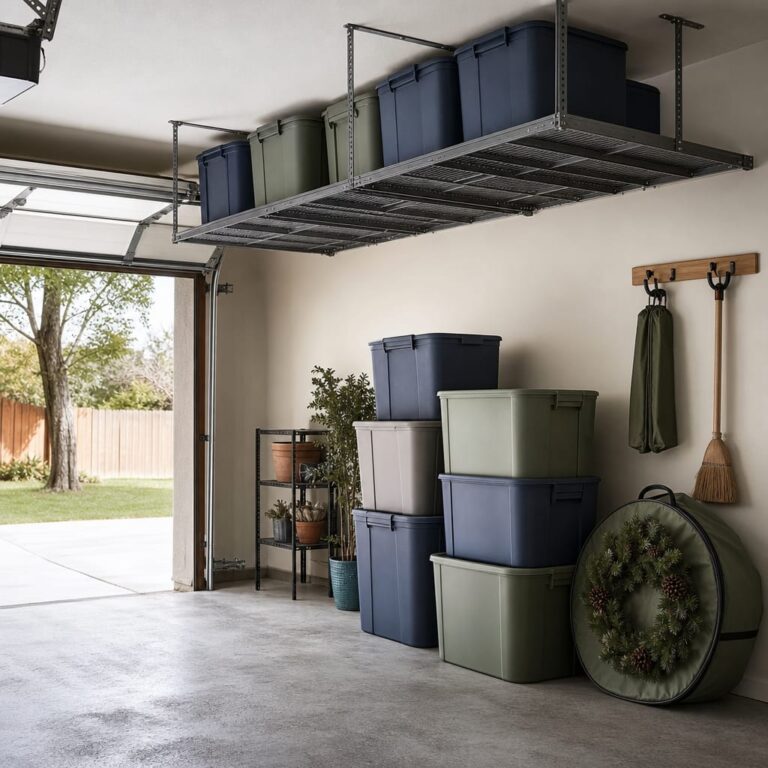
- Used 1–3 weeks per year → ceiling. Out of sight, out of the daily path. Worth the once-a-year ladder trip.
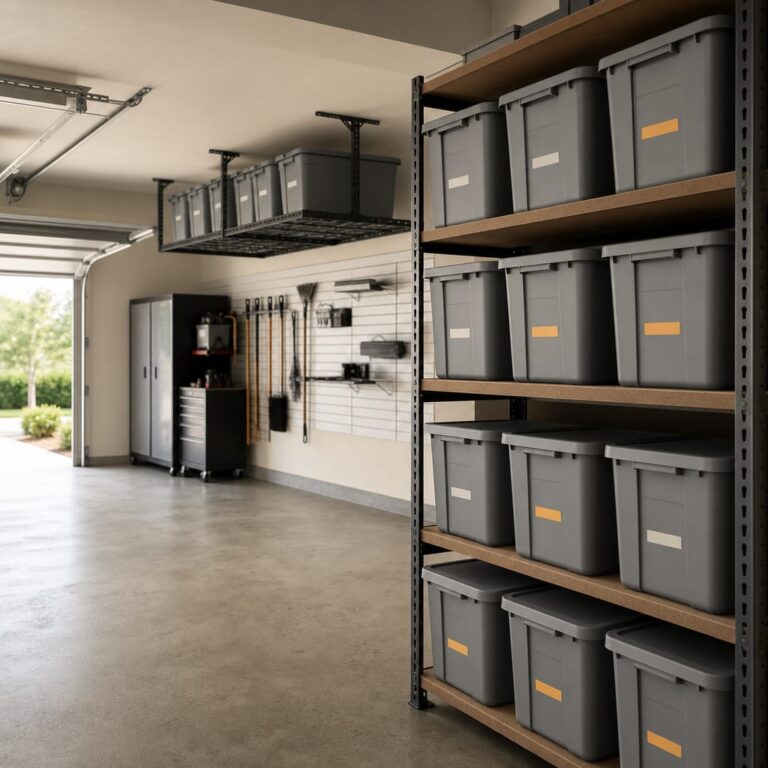
- Used 4 weeks – 4 months per year → eye-level shelf or wall hooks. Within reach without a ladder, but not consuming floor space when not in use.
- Used continuously or weather-dependent week-to-week → floor or low shelf. Snow shovel in February, hose reel in July, leaf blower in October.
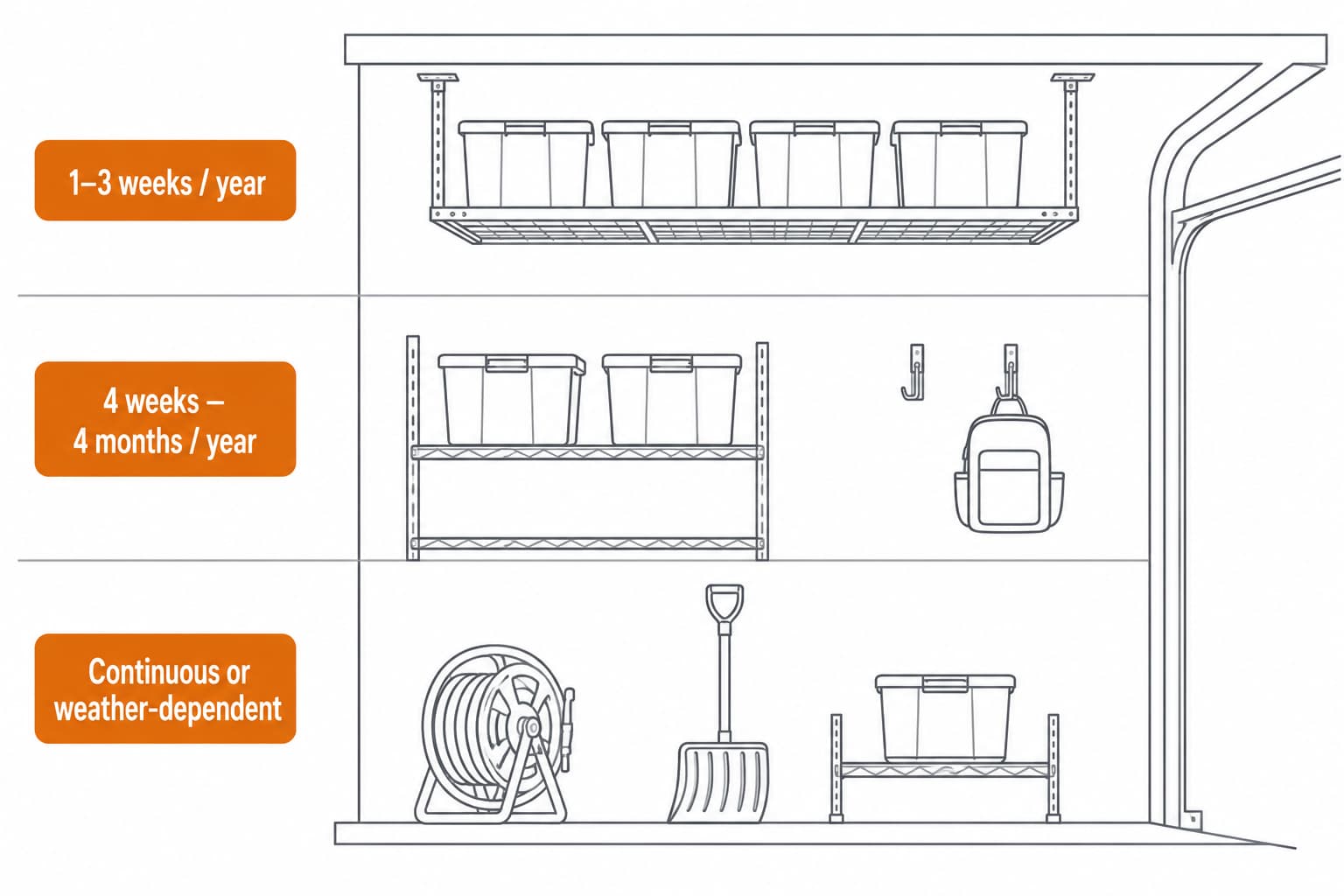
The four categories map cleanly onto these zones. Holiday decor wants the ceiling. Sports and recreation gear splits between the wall (skis, bikes, kayaks) and the eye-level shelf (camping bins, beach bins). Lawn and garden goes to the wall and the floor, with the active-season tool living near the door. Off-season clothing, once compressed, can live anywhere — it’s so small it follows whichever zone has room.
Climate Considerations
An unconditioned garage is not a climate-controlled storage unit, and a few categories of seasonal item do not survive it well.
Heat. An attached garage in a summer-heat region can hit 110°F+ near the ceiling. Avoid storing candles (warp and fuse), batteries (degrade and leak), electronics rated “store below 80°F”, and some PVC inflatables (delaminate). Pull these out of the seasonal pile and find them an indoor closet.
Humidity and moisture. Lidded bins with gasket seals are the standard for fabrics, paper holiday cards, photo albums, and anything that absorbs moisture. Plain cardboard storage in a humid climate becomes a mold problem within one summer.
Pests. Lidded bins, no exceptions. Mice get into anything open in two days, and they prefer fabric. If you’re compressing seasonal clothes (a good idea), the compressed bags still go inside a bin — not stacked free.
Step-by-Step: Demote Seasonal Items in One Weekend
Step 1 — Pull everything seasonal into one pile
Walk the garage, attic, basement closets, and any “miscellaneous” hall closet. Anything you have not touched in six or more months that has a seasonal trigger goes in the pile. Be conservative: if you genuinely use it once a year, it’s seasonal.
Step 2 — Sort by category, then count bins
Sort the pile into the four buckets. Count how many bins each will fill. This count is what determines how much ceiling rack and shelf real estate you actually need to buy — a typical household ends up with two to four bins per category.
Step 3 — Compress what compresses
Off-season comforters, winter coats, summer blankets, the rotating clothes pile — into vacuum bags. Stack the compressed cubes inside the lidded bins. Compression bags reduce volume by roughly 80% per manufacturer claims; the gain is real, and it’s the cheapest space win in the seasonal system.
Step 4 — Pack, label, and consolidate
Lidded bins with gasket seals. Label each clearly on the long side near the top — see our step-by-step labeling guide for the placement rules. Group within each ceiling row by category so November-you can find October-you’s stash without ladder gymnastics.
Step 5 — Install the ceiling rack and load top-down
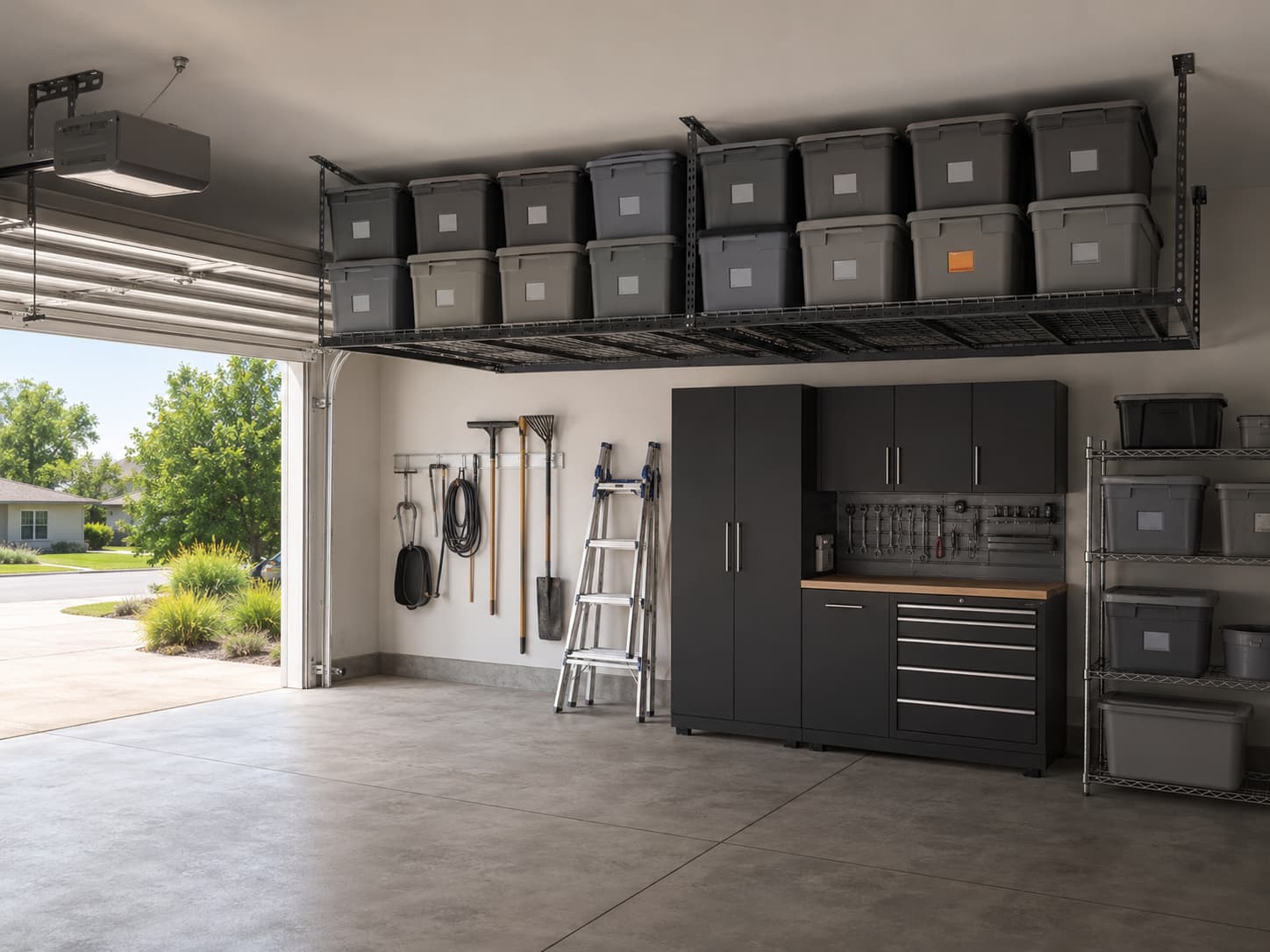
If you don’t already have an overhead rack, install it before you start loading. Mount into ceiling joists with the manufacturer’s hardware. Load the heaviest bins (typically holiday decor with light strands and ornaments — heavier than it looks) low on the rack, and lighter bins above. The ceiling rack is the single most useful piece of hardware to add for seasonal storage; for medium-frequency items, see our wall storage systems guide.
Tools and Products That Help
Two pieces of hardware do most of the work across all four categories.
Ceiling overhead rack — The FLEXIMOUNTS 2×8 is a sensible footprint for a single seasonal bay: two feet deep, eight feet wide, mountable into standard 16- or 24-inch on-center joists. The manufacturer lists a 400 lb capacity, contingent on correct joist installation and proper weight distribution — a critical caveat. For a broader look at overhead rack options, see our overhead storage racks guide.

Vacuum compression bags — The TAILI Jumbo 6-pack uses a cube shape that stacks cleanly inside standard storage bins, which matters when you’re trying to fit compressed bedding next to the labeled holiday bin. The manufacturer states an 80% volume reduction; in practice, what you actually get back is the closet space the comforters used to consume year-round.

For the bins themselves, see our storage bins for shelves guide. Gasket-sealed lidded bins are the seasonal-grade standard; stay away from open totes for anything spending more than three months in storage.
Common Mistakes
Mistake 1: Storing the bulkiest item where it’s hardest to reach
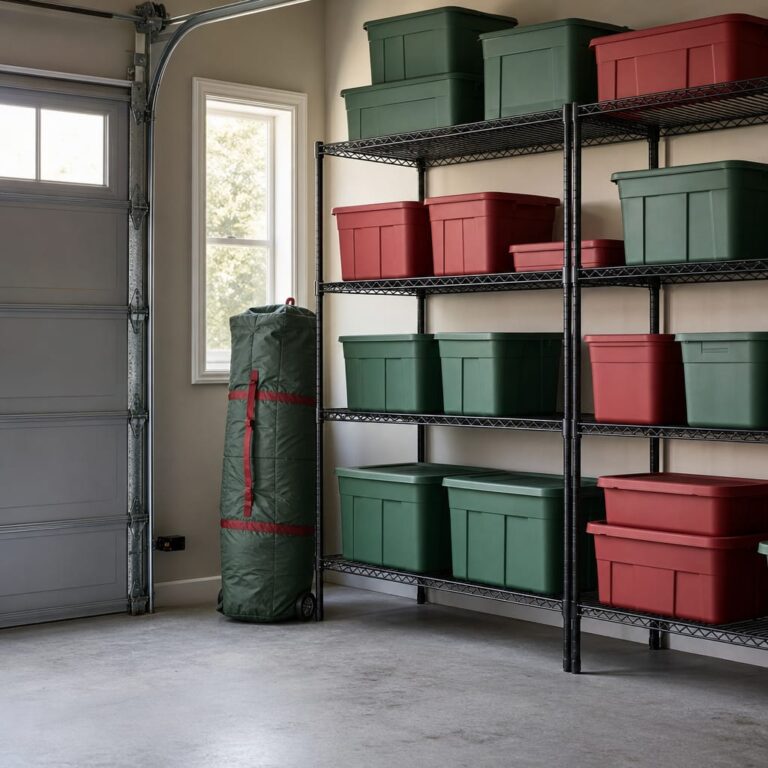
The Christmas tree always seems to end up at the back of the bottom shelf, behind the cooler and under the patio cushions. It should be on the ceiling (in a dedicated bag) or in a corner near the garage door — somewhere a single person can lift it without unstacking three other things first.
Mistake 2: Skipping the lid
Open totes invite mice, dust, and humidity. For seasonal storage, lidded with a gasket seal is the standard. If you already own open totes, repurpose them for active-season floor storage (current month’s sports gear, hose reel) and buy lidded bins for the seasonal pile.
Mistake 3: Storing temperature-sensitive items in an unconditioned garage
Candles, certain electronics, batteries, some PVC inflatables, and anything labeled “store below 80°F” degrade faster than you expect at summer attic temperatures. Pull these out of the seasonal pile and find them an indoor closet — even a tight one.
Mistake 4: Compressing the wrong things
Down jackets, down pillows, and memory foam lose loft and structure after extended vacuum compression. Use vacuum bags for synthetic fills, woven cotton, fleece, and wool. Down and memory foam go in lidded bins without compression.
FAQ
Can I store Christmas lights in a hot garage?
LED strands tolerate heat well and are rated for wide temperature ranges. Older incandescent strands can develop brittle wire insulation after several hot summers; inspect each fall and discard any with cracked sheathing.
How long can clothes stay in vacuum bags?
Six months is fine for synthetics and woven cotton. Past a year, even sturdy fabrics develop creases that won’t iron out. Down and memory foam should not be vacuum-stored long-term.
Should I label bins by year or by category?
By category. Year stamping is fine in pencil as a “last reviewed” date, but the bin name itself should be “Christmas — lights & garlands”, not “Christmas 2024”. Year-based labels collapse the moment you skip a year.
Is a ceiling rack safe for 400 lb of holiday decor?
The manufacturer-listed 400 lb capacity for an overhead rack applies only when the rack is anchored into structural ceiling joists with the manufacturer’s hardware AND weight is distributed evenly. Trusses, metal ceilings, drywall-only ceilings, and free-floating mounts do not safely hold this load. Confirm your ceiling type and follow the installation instructions before loading.
What’s the single most useful piece of hardware for seasonal storage?
An overhead ceiling rack, for any household with four or more seasonal bins. It removes the bulkiest, lowest-frequency stuff from the floor zone in one weekend.
Sources Reviewed
This article synthesizes manufacturer product pages (FLEXIMOUNTS 2×8 overhead rack, TAILI vacuum compression bags), public seasonal-storage discussions on home-organization forums, and GSG editorial. We do not claim hands-on testing unless clearly stated.
Related Guides
- Best Garage Overhead Storage Racks — broader comparison of overhead rack options
- Best Garage Storage Bins for Shelves — choosing seasonal-grade bins
- How to Label Garage Storage Bins — labeling system that survives multi-year cycles
- Best Garage Wall Storage Systems — wall hooks and panels for medium-frequency items
- How to Organize a Small Garage Step by Step — broader context if seasonal is part of a bigger reorganization
- Garage Storage Tote Sizes and Shelf Fit Chart — check whether your bins fit the shelf before you buy it