How to Choose Seasonal Garage Storage Solutions
Last updated:
Disclosure: This article contains affiliate links. If you buy through these links, we may earn a commission at no extra cost to you. We do not claim hands-on testing unless clearly stated.
Off-season storage is the one category where the wrong container in May becomes a ruined ornament set in December. A snap-lid tote lets humidity migrate through the lid, a soft wreath bag collapses under a stack of cushions, or a pre-lit tree’s rigid mid-section refuses to fit in the bag you just bought.
This guide is built around the three decisions that actually matter before you spend money: climate tolerance, rotation pattern, and accessibility. We then map six product categories to those decisions, with one specific pick per category.
Quick Recommendation by Use Case
| Use case | Best product type | Why |
|---|---|---|
| Decor stored in unheated or damp garage | Gasket-sealed weathertight tote | Blocks humidity, dust, and pests |
| Christmas decor needing visual rotation cues | Color-coded holiday bin set | No label-reading in a dim garage |
| Artificial tree, 7-9 ft, dragged out yearly | Rolling tree bag in 600D fabric | Wheels save the dead-lift |
| Wreath with delicate ornaments or ribbons | Hard-shell wreath container | Prevents crush from stacking |
| Glass ornaments and fragile beadwork | Divider-tray ornament box | Per-ornament pocket protection |
| Bin sets parked 6+ months per year | Overhead ceiling rack | Frees the floor for active items |
The Three Decisions Before You Buy
Most readers grab the cheapest 27-gallon tote on the shelf and find out the hard way that “heavy-duty” does not mean “weather-sealed.” Decide three things first. This decision frame also feeds rotating seasonal items in and out of your garage, which is the operational habit that makes the system pay off.
Climate tolerance: gasket vs snap-lid
Snap-lid totes are organization bins, not weather-sealed containers. They keep large dust out and that is it. Gasket-sealed totes — rubber strip around the lid plus four buckle latches — block humidity, dust, and pests, at roughly 2-3x the cost. Buy gasket only for items damaged by moisture: fabric, paper, electronics. Everything else can live in snap-lid bins.
Rotation pattern: visual cue vs label
If decor rotates seasonally, color-coding beats text labels. In a dim garage you spot a green or red lid from across the bay; labels need a walk and a squint. Static long-storage (camping gear stored 11 months) is fine with labels. Color-coding is for frequent retrieval.
Accessibility: floor vs overhead vs shelf
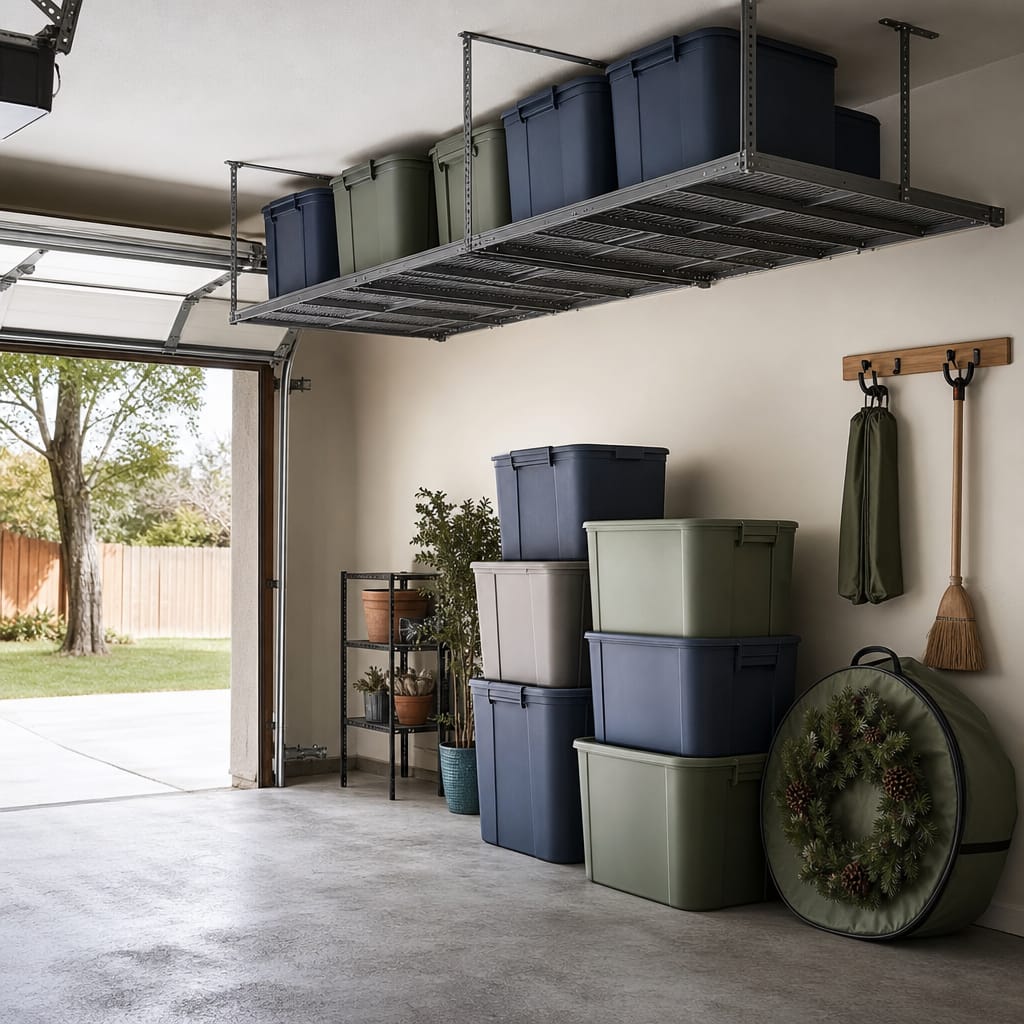
Bins used more than twice a year stay on the floor or on shelves. Bins parked six months or more belong overhead. Overhead racks are the highest-leverage upgrade in any garage with ceiling clearance — they turn unused vertical space into useful storage.
Key Factors to Consider
Listed capacity vs actual lid sealing
A 27-gallon “heavy-duty” tote is structurally rated, but most have snap-on lids. Read the listing for “gasket,” “WEATHERTIGHT,” or “weather seal” wording. If those terms are absent, assume the tote is not sealed against moisture.
Stacking stability
Recessed lids interlock with the body of the tote above. Flat lids slide. Stack three or four high — common in vertical garages — only with recessed lids.
Material brittleness in cold
Cheap polypropylene cracks when impacted below roughly 20°F. Garages dropping into the teens at night will eat through bargain totes in a few seasons. Look for industrial-grade or WEATHERTIGHT-rated material for cold-climate use.
Latch durability
Snap-fit lids loosen after roughly 50 open-and-close cycles. Buckle latches last several times longer. Hinged lids with zip-tie or padlock provisions are the most secure.
Category-specific protection
Generic totes will not protect a wreath’s shape, a glass ornament’s fragility, or a 9-foot tree’s disassembled length. Category-specific containers cost more but solve damage modes no generic tote addresses.
Product Types Explained
Gasket-sealed weathertight totes
Polypropylene tote with a rubber gasket around the lid and four buckle latches. The IRIS WEATHERTIGHT line is the category benchmark. Best for: items damaged by humidity, dust, or pests. Limitations: 2-3x the cost of snap-lid totes; buckles can crack if over-tightened on frozen contents. What to look for: gasket visible in listing photos, four buckle latches, recessed lid for stacking.
Color-coded holiday bin sets
Pack of plastic totes in seasonal colors (red and green for Christmas, orange for fall). Best for: visual rotation of holiday decor. Limitations: not gasket-sealed; pair with sealed totes for humidity-sensitive items. What to look for: 18-27 gallon capacity, recessed lids, full-body color (not just colored lids). For deeper coverage, the seasonal decoration bin roundup has the broader picks.
Rolling tree bags
Long fabric bag with dual zipper, wheels, and dual carry handles. Best for: artificial trees 7-12 ft disassembled. Limitations: pre-lit trees with rigid mid-sections may exceed bag length. What to look for: 600D Oxford fabric, metal-axle wheels, interior length matching your disassembled tree’s longest section.
Hard-shell wreath containers
Round zippered container with hard-walled panels. Best for: wreaths up to 30 in. outer diameter (including bow). Limitations: one wreath per case; takes shelf space year-round. What to look for: walls that hold shape when squeezed, dual zipper, interior pockets, hang loop.
Ornament boxes with adjustable dividers
Rigid box with removable trays and divider grids. Best for: glass and beaded ornaments. Limitations: pockets typically sized for 3-in. ornaments; oversized pieces eat into listed capacity. What to look for: removable trays, adjustable dividers, metal frame.
Overhead ceiling racks
Steel platform mounted to ceiling joists via lag bolts. Best for: parking 6-8 bins off-season plus bulky gear. Limitations: joist-spacing requirement (typically ≤24 in. on center or exactly 48 in.); drywall anchors are never acceptable. What to look for: manufacturer-listed weight capacity, platform dimensions matching your tote footprint, brackets sized for your joist spacing.
Featured Picks for Seasonal Storage
One pick per category. Each card follows the standard schema so you can scan or read in depth.
Best for Climate-Tolerant General Seasonal Storage: IRIS USA WEATHERTIGHT 82 Quart Storage Box
Best for: Homeowners with an unheated or damp garage who store fabric, paper decor, or electronics off-season and have lost items to mildew or pests in the past.
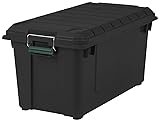
Short verdict: The category benchmark for gasket-sealed storage. A rubber gasket plus four buckle latches that compress the seal against the body, blocking the moisture, dust, and pest infiltration that destroys off-season items in unsealed totes.
This is the tote to pick when you have learned the hard way that a “heavy-duty” snap-lid bin is not a sealed container.
Why it stands out
The 82-quart capacity is the sweet spot for seasonal storage — large enough to hold a meaningful chunk of decor, small enough that the full tote is still liftable by one person. The four buckle latches are the over-center kind — they compress the gasket consistently and stay closed even when the box is on its side. IRIS USA maintains a manufacturer website outside Amazon and a long-tenured product family, so listings stay stable and replacement parts remain available.
It can work well for:
- Photo albums, gift wrap, and paper decor that mildew destroys
- Fabric items (linens, costumes, soft seasonal decor) that absorb humidity
- String lights and electronic decor where corrosion ends the product’s life
- Anything you do not want a mouse to find
Key specs to check
- Manufacturer-listed capacity: 82 quart volume (~20.5 gallons)
- Gasket-sealed lid with four buckle latches
- BPA-free polypropylene body suitable for cold-garage use
- Recessed lid (interlocks when stacked)
- Listed as WEATHERTIGHT — the gasket seal is the differentiating feature
Recurring feedback patterns
Recurring positive feedback often centers on the gasket actually doing its job — buyers mention opening totes after a year in a damp basement and finding the contents dry. Common complaints typically involve the buckle latches cracking when over-tightened on frozen contents. Several buyers mention that latches need to be opened indoors after the box warms up.
Potential drawbacks
The 82-quart variant is one of several sizes IRIS sells, and the variants can be confusing — confirm the 82-quart WEATHERTIGHT specifically. The buckle latches are the part that fails first.
Buyer warning
Do not over-tighten the buckle latches with frozen contents inside. The plastic catches can crack when forced. Confirm the listing shows “WEATHERTIGHT” — IRIS migrated some lines to “WeatherPro” branding with the same gasket design, but the SKUs differ. The Amazon listing title for this ASIN currently reads “87.4 Quart” rather than “82 Quart” — both figures describe the same product family under different measurement conventions (Newegg and Lowes still list the identical SKU as 82 quart / 20.5 gallons), so seeing 87.4 Quart on the page does not mean you’ve landed on the wrong listing.
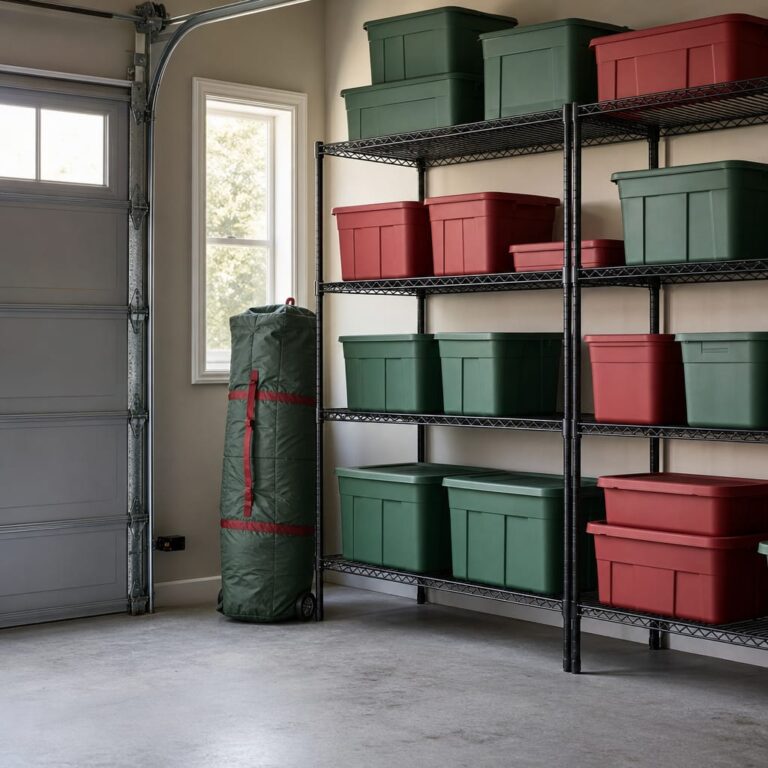
Best for Color-Coded Holiday Rotation: HOMZ 4-Pack Holiday Storage Containers, 18 Gallon, Green/Red
Best for: Households with a clear seasonal decor rotation who want to spot the Christmas bins from across a dim garage without reading a label.
HOMZ 4-Pack Holiday Storage Containers, 18 Gallon, Green/Red
Affiliate link pending — human review required.
Short verdict: Two red and two green 18-gallon bins, recessed snap-on lids, full-body color rather than colored lids on neutral bodies. HOMZ is a long-established US manufacturer and the 4-pack covers ornaments, lights, and smaller decor with one set.
These are organization bins, not weather-sealed totes — pair with the IRIS WEATHERTIGHT pick above for items that must stay dry.
Why it stands out
The full-body color is the detail that makes color-coding actually work. Plenty of “holiday” bins sell colored lids on neutral bodies; when the lid gets swapped during a chaotic unload, the color signal disappears. HOMZ ships the bodies in red or green to match. 18 gallons is the right capacity for holiday decor — large enough for ornaments and lights, small enough to lift up to an overhead rack without becoming a back-injury risk.
It can work well for:
- Christmas ornaments (less fragile pieces — use the ornament box below for delicate ones)
- String lights, garland, smaller wreath alternates
- Holiday tableware and table linens
- Halloween or fall decor in a separate orange-coded set (HOMZ ships the colorway variants)
Key specs to check
- Manufacturer-listed capacity: 18 gallons per bin
- Recessed snap-on lids (interlock when stacked)
- Full-body color in red or green (not just colored lids)
- Molded plastic body, recycled content per HOMZ marketing
- 4-pack: typically 2 red + 2 green per shipment
Recurring feedback patterns
Recurring positive feedback often centers on the visual rotation working in practice — buyers mention identifying their Christmas bin set immediately after a year in storage. Common complaints typically involve snap-on lids loosening after a couple of seasons. Several buyers mention color fading in direct sun.
Potential drawbacks
Not gasket-sealed. If your garage is humid or pest-prone, do not rely on them to protect moisture-sensitive items. Snap-on lids are not as crush-resistant as WEATHERTIGHT designs — stack three high maximum.
Buyer warning
Color-coding only works if the body is colored, not just the lid. Confirm the listing photos show solid-color bodies in red and green. Lid swaps happen during rapid unloading; label the body in addition to using color so a swapped lid does not break the signal.
Best for Artificial Christmas Tree Storage: ZOBER 600D Oxford Rolling Christmas Tree Storage Bag, 9 Ft
Best for: Owners of a 7-to-9-foot artificial Christmas tree who drag the disassembled tree from a garage corner to overhead storage every January.
ZOBER 600D Oxford Fabric Rolling Christmas Tree Storage Bag (9 Ft)
Short verdict: A 600D Oxford fabric bag with metal-axle wheels and dual carry handles, sized for a 9-foot disassembled artificial tree. 600D Oxford is the tear-resistance benchmark; wheels remove the dead-lift problem.
Why it stands out
A 9-foot disassembled tree weighs 30 to 50 pounds. In a bag without wheels, that is a one-person lift through narrow attic stairs that fails badly by the third or fourth time you try it. ZOBER’s bag has two oversized wheels at one end and a sturdy carry handle at the other, so you tilt the bag onto its wheels and walk it where it needs to go. The 600D Oxford fabric resists the abrasion that destroys cheaper polyester bags within two or three off-seasons.
It can work well for:
- 7-to-9-foot artificial trees disassembled into 2 or 3 sections
- Garland coils stored alongside tree sections (interior space is generous)
- Pre-lit trees with rigid mid-sections under approximately 60 inches
- Trees moved between garage floor and an overhead rack or attic
Key specs to check
- Manufacturer-listed compatibility: artificial trees up to 9 feet tall, disassembled
- 600D Oxford fabric exterior, dual zipper
- Metal-axle wheels (not plastic), dual carry handles
- Interior length roughly 65 in. (verify against your tree’s longest rigid section)
- Available in red and black colorways
Recurring feedback patterns
Recurring positive feedback often centers on the wheels working over rough garage floors and the 600D fabric holding up to repeated drags. Common complaints typically involve pre-lit trees with rigid mid-sections being too long to fit. Several buyers mention the dual zipper makes loading manageable for one person.
Potential drawbacks
Pre-lit trees often have a single rigid mid-section that exceeds the bag’s usable length. The bag fits most 9-foot trees, but the longest disassembled section must be under approximately 60 inches.
Buyer warning
Fully disassemble your tree and measure the longest single rigid section before ordering. If it exceeds approximately 60 inches, this bag and most 9-foot tree bags will not fit. Confirm the variant — ZOBER sells 7.5-ft and 9-ft versions in red and black; pick by tree size, not preference.
Best for Wreath Protection: Hearth & Harbor Hard Shell Christmas Wreath Storage Container, 30 Inch
Best for: Owners of a single high-value wreath — real evergreen, hand-decorated, or heirloom — who have lost a wreath shape to crushing once.

Short verdict: A round zippered container with hard-shell walls that hold shape when stacked or kicked, unlike soft bags that always collapse. Interior pockets accept hooks, ribbons, and accessories.
Why it stands out
Wreaths are the seasonal item most often damaged by ordinary garage life. Soft wreath bags fold flat under any stack, crushing the wreath’s shape; cardboard boxes warp in humidity. A hard-shell container keeps the circular form even when a stack of summer chair cushions ends up on top of it. The dual zipper opens the full circumference so you can lift the wreath in and out without snagging delicate ornaments on the way through.
It can work well for:
- Real evergreen wreaths with delicate ornaments
- Hand-decorated or heirloom wreaths
- Wreaths with bows or ribbons needing protection from compression
- Door-sized wreaths up to 30 in. outer diameter
Key specs to check
- Manufacturer-listed outer diameter: 30 in.
- Hard-shell wall construction (verify on the listing — some variants are soft-sided)
- Dual zipper around the full circumference
- Interior pockets for accessories, hooks, ribbons
- Hang loop for wall-mounted off-season storage
Recurring feedback patterns
Recurring positive feedback often centers on the wreath emerging the next year looking exactly like it did the prior December. Common complaints typically involve the listed outer diameter being misleading: the 30-inch outer measurement leaves a smaller usable interior, so a wreath with a bow that crowds the listed dimension may not fit. Several buyers mention the hard shell takes more shelf space than a soft bag.
Potential drawbacks
One wreath per container. The hard shell occupies shelf space year-round, including when empty. Soft bags collapse for off-season storage of the storage; hard shells do not.
Buyer warning
Measure your wreath’s actual outer diameter, including the bow, before buying. The 30-inch listed dimension is the container’s outer size, not its interior. A wreath at 28 in. plain and 31 in. with bow will not fit. Confirm the listing advertises a hard-walled structure — some variants are soft-sided.
Best for Fragile Ornament Storage: HOLDN’ STORAGE Christmas Ornament Storage Box, Holds 72
Best for: Households with a meaningful collection of glass or beaded ornaments where chipping during the round trip to overhead storage is the actual failure mode.
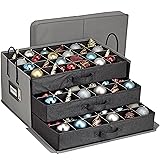
Short verdict: A durable non-woven fabric exterior with reinforced structure and three removable trays, each holding 24 ornaments at three inches diameter. Adjustable acid-free dividers give every ornament its own pocket.
Why it stands out
Glass ornaments stored loose in a tote chip when adjacent pieces collide during a lift. HOLDN’s box solves it by giving every ornament a divided pocket and by splitting the box into three removable trays, so you carry one tray at a time — dumping the whole collection is not the failure mode. The reinforced structure keeps the box from collapsing under a stack above it, and the acid-free dividers protect delicate finishes from cardboard chemistry that yellows over years.
It can work well for:
- Standard 3-inch glass or beaded ornaments
- Mixed-size collections (the dividers are adjustable)
- Households unloading the tree fast at season’s end and needing organized re-storage
- Storage in an overhead rack where the box may be jostled getting it down
Key specs to check
- Manufacturer-listed capacity: up to 72 ornaments at 3 in. diameter
- 3 removable trays with adjustable acid-free dividers
- Durable non-woven fabric exterior with reinforced structure
- Dimensions ~19.5 × 13.5 × 9.5 in.
- Dual handles for carrying
Recurring feedback patterns
Recurring positive feedback often centers on glass ornaments coming out chip-free after several seasons — a contrast against loose-in-a-tote storage. Common complaints typically involve oversized hand-blown or asymmetric ornaments not fitting standard 3-inch pockets. Several buyers mention removable trays as the practical feature.
Potential drawbacks
Listed 72 capacity assumes uniform 3-inch round ornaments. Large hand-blown or asymmetric pieces drop the effective capacity. The non-woven fabric exterior is abrasion-resistant but not waterproof; do not store in a damp garage corner.
Buyer warning
Measure your largest ornament’s diameter before relying on the 72 capacity. Anything larger than 3 in. across will occupy two divider pockets, cutting the effective count. For a mixed collection, plan for closer to 50 protected ornaments per box rather than the listed 72.
Best for Overhead Seasonal Bin Parking: FLEXIMOUNTS GR48 Classic 4 x 8 ft Overhead Garage Storage Rack
Best for: Homeowners with adequate garage ceiling height (8-12 ft) who want to free floor space by parking off-season totes overhead.

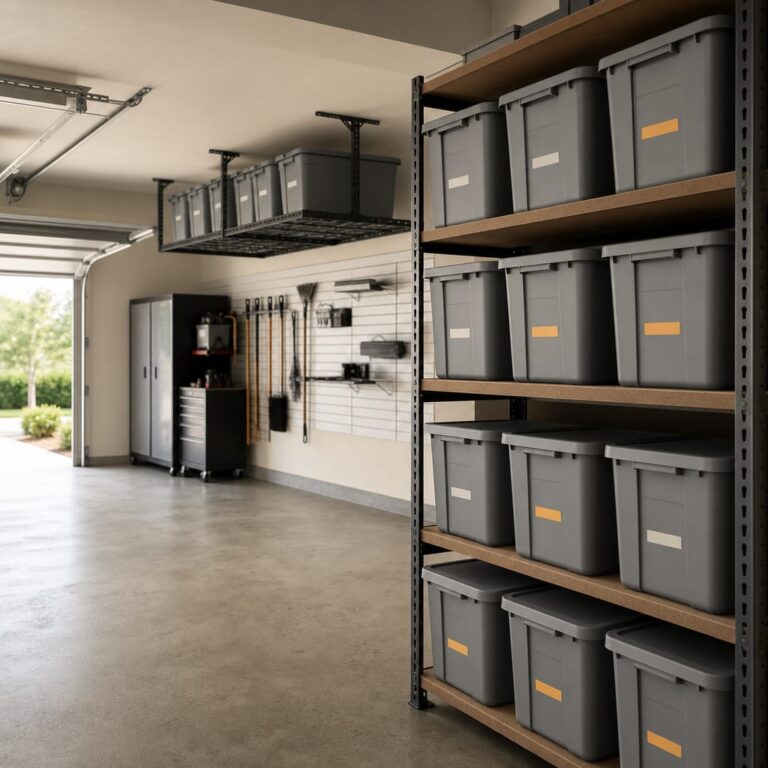
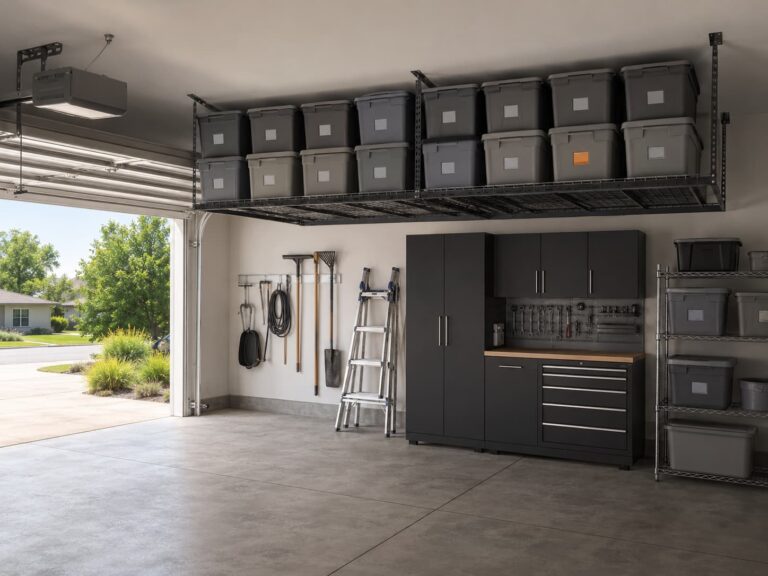
Short verdict: A 4-by-8-foot steel platform that mounts to ceiling joists via long brackets and lag bolts, with adjustable drop height. Parks six to eight 27-gallon totes overhead and frees the floor space equivalent of a small bookcase.
Why it stands out
Overhead racks are the highest-leverage organization upgrade in any garage with vertical space, and the FLEXIMOUNTS Classic GR48 is the long-tenured, brand-registered version that has stayed available across many years of Amazon listing changes. The 4-by-8 size matches the standard footprint of stacked 27-gallon totes, the adjustable drop height handles realistic ceiling variations, and the cold-rolled steel construction handles the load without flex. For overall garage planning around overhead storage, see storing seasonal items in a garage.
It can work well for:
- 6-8 stacked 27-gallon totes parked off-season
- Bulky seasonal gear (suitcases, holiday inflatables, larger camp gear)
- Households with a single annual rotation cycle (Christmas down, summer up)
- Garages with 9-foot or taller ceilings where the dropped platform still leaves walking clearance
Key specs to check
- Manufacturer-listed weight capacity: 600 lb
- Platform: 4 x 8 ft (96 x 48 in.)
- Adjustable drop height: roughly 22-40 in. below ceiling
- Cold-rolled steel, powder-coated finish
- Joist-spacing requirement: ≤24 in. on center, or exactly 48 in.
Recurring feedback patterns
Recurring positive feedback often centers on the installation being approachable for a confident DIY-er and the rack staying stable over years of use. Common complaints typically involve joist-spacing mismatches discovered during install. Several buyers mention that the included brackets are designed for 24-in. spacing; off-spacing setups need verification.
Potential drawbacks
Hard requirement on joist spacing. Older houses or DIY conversions may not accept the rack as designed. Installation requires a stud finder, ladder work, and torque specs on lag bolts.
Buyer warning
Confirm joist spacing and orientation before ordering. Map at least three joists with a stud finder, measure on-center spacing, confirm joists run perpendicular to the rack’s long axis. Drywall anchors are never acceptable; the rack must mount to structural lumber. Manufacturer-listed capacity assumes torqued bolts into solid joists. Amazon’s listing title shows 750 lb; we use the manufacturer’s own 600 lb figure.
Decision Matrix — Climate × Rotation × Accessibility
The three decisions interact. A reader in a damp garage with high rotation needs different products than a reader in a climate-controlled garage with low rotation. The matrix below maps the three dimensions to recommended container types.
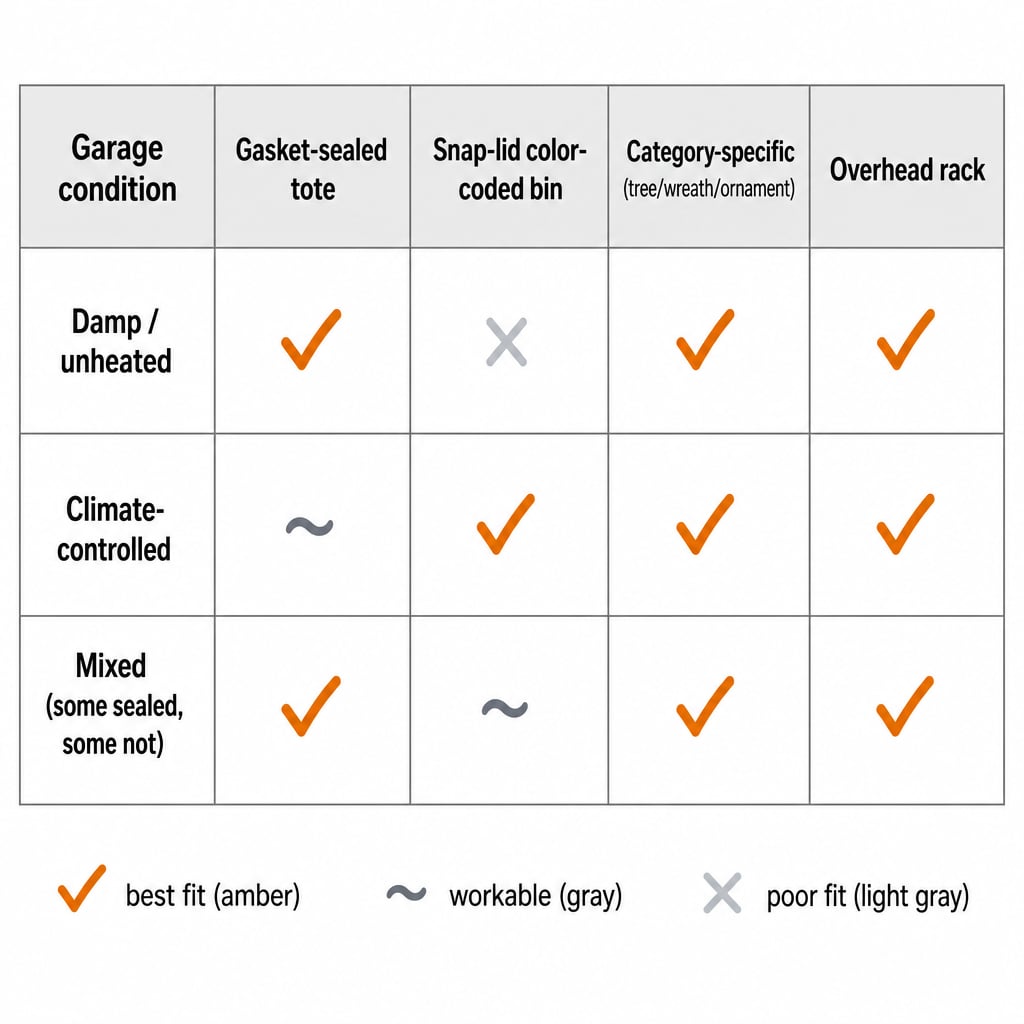
Read the row matching your garage condition, then read across the columns. Amber check marks show best-fit product types. Most homes need at least two types — a sealed tote for climate-sensitive items plus color-coded bins for everything else.
Measurement Checklist Before You Buy
Most seasonal-storage purchase mistakes trace back to a missed measurement. Run through this list before ordering.
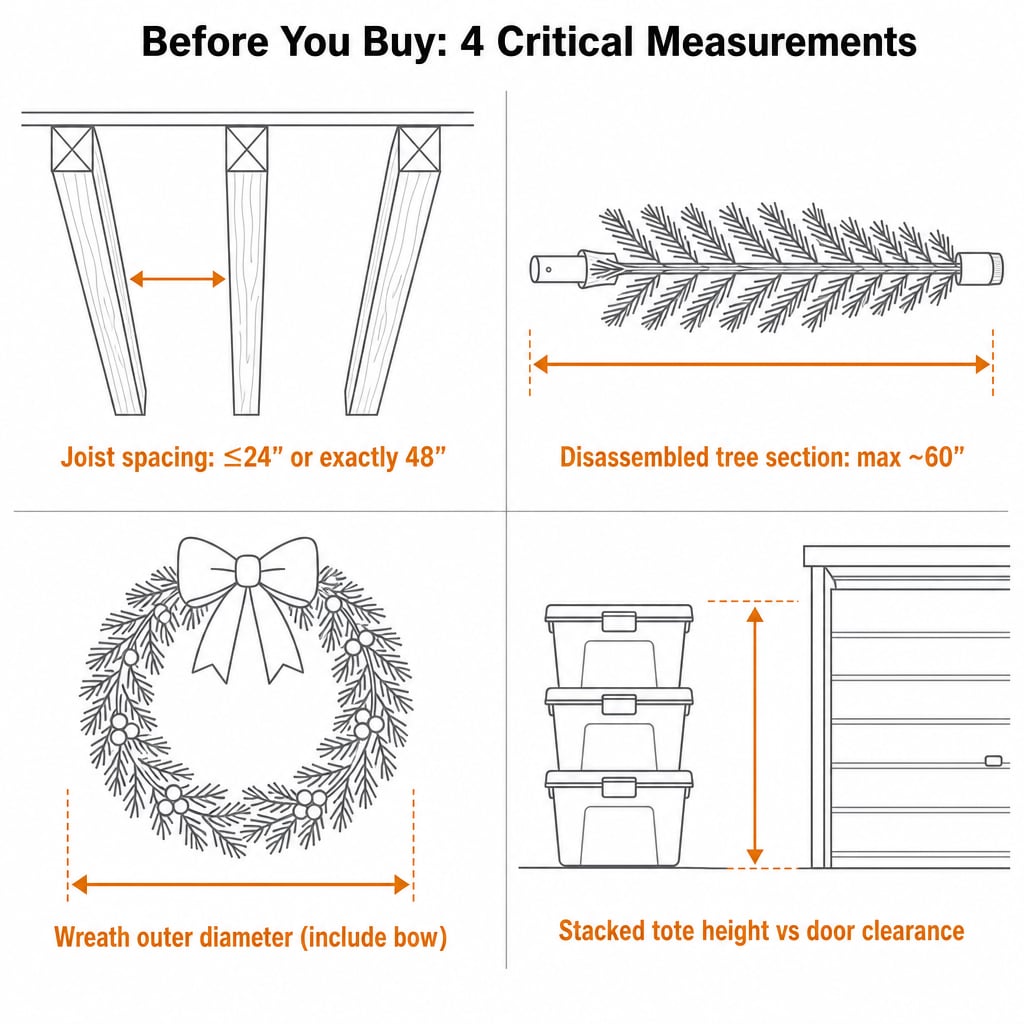
Measure:
- Joist spacing (for overhead racks) — on-center, in at least three locations; confirm orientation.
- Disassembled tree’s longest rigid section — pre-lit trees often have a permanent mid-section that exceeds bag length.
- Wreath outer diameter, including bow — the listed container diameter is outer size, not interior.
- Stacked tote height vs garage door clearance — totes near the door can foul the door’s path.
- Available wall depth for shelf-mounted totes.
- Largest ornament diameter — oversized pieces eat into divider-box capacity faster than listed counts suggest.
For totes specifically, measure with the lid on. Lids often add 1-2 in. to the height that does not appear in the bare-body listing.
Common Mistakes to Avoid
Six recurring mistakes drive most of the “we lost it in the garage” stories. Worth pairing with organizing Christmas decorations, which covers the placement side once containers are sorted.
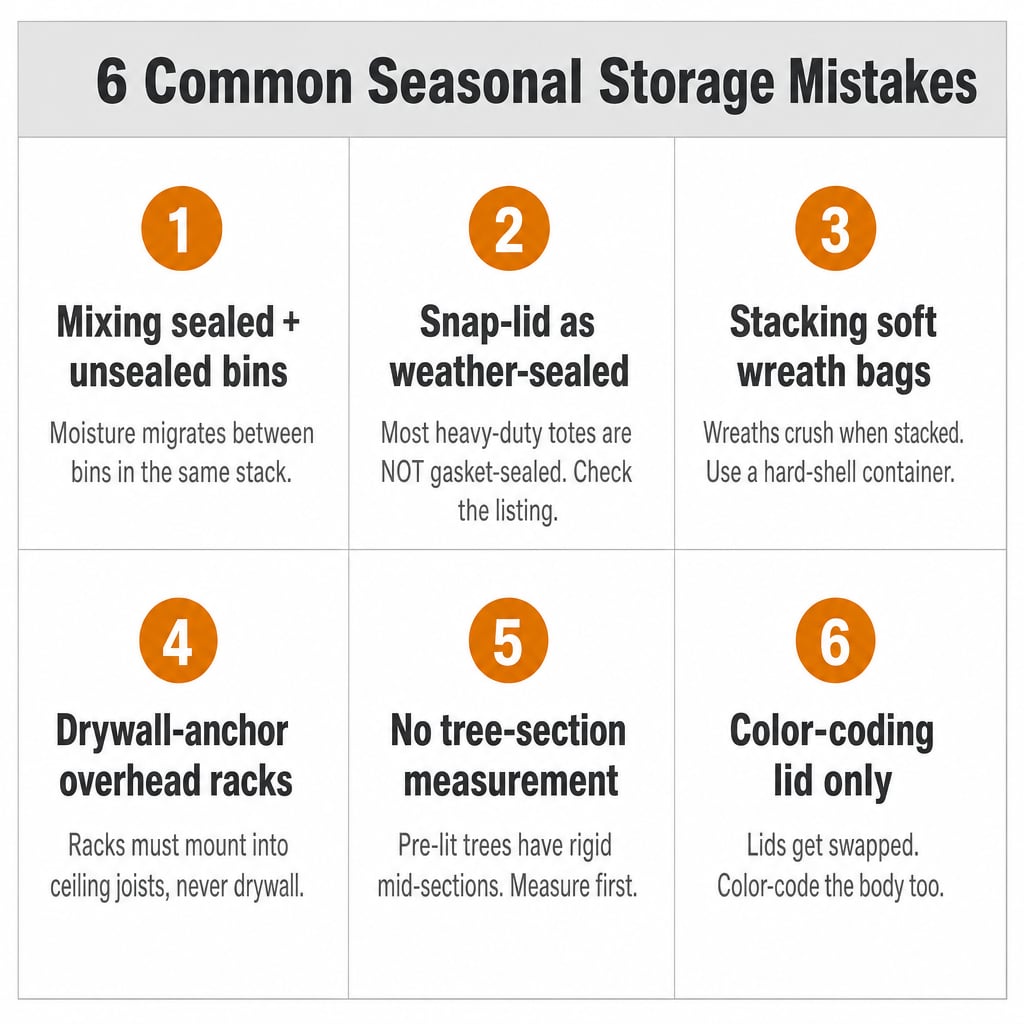
The six:
- Mixing weathertight and snap-lid bins in the same stack — moisture migrates between adjacent bins.
- Buying snap-lid totes expecting weather-sealed performance — read for “gasket” or “WEATHERTIGHT” explicitly.
- Stacking soft-sided wreath bags — wreaths in soft bags always collapse under the second layer.
- Hanging an overhead rack from drywall anchors — the rack must mount into structural joists.
- Buying a tree bag without measuring the disassembled tree section — pre-lit trees have rigid mid-sections.
- Color-coding by lid only — lids get swapped during rapid unloading; color the body too.
Safety and Installation Notes
Overhead racks specifically require structural joist mounting. Use a stud finder, confirm joist direction and on-center spacing, follow the manufacturer’s hardware list, torque lag bolts to spec. Drywall anchors and toggle bolts are not acceptable.
How many totes actually fit on a garage shelf
Tote makers publish dimensions and shelving makers publish dimensions, but nobody puts the two together — so people buy shelving, then discover their totes overhang it. This table takes the published external size of totes from the brands people actually buy for garage storage — Sterilite, Rubbermaid Roughneck, and IRIS USA — and works out how many fit per shelf on the two garage shelving depths you can actually buy, 18 in and 24 in.
| Tote | Published dimensions (source order) | Footprint | Height | Fits an 18 in deep shelf? | Per 48 × 18 in shelf | Per 48 × 24 in shelf | Specification source | Source checked |
|---|---|---|---|---|---|---|---|---|
| IRIS USA Remington Weathertight Storage Tote, 19 Qt. | 17.50" L x 11.75" W x 7.88" H | 17.5 in × 11.75 in | 7.88 in | Yes | 4 | 4 | IRIS USA Remington Weathertight Heavy Duty Storage Tote, 19 Qt. (6-pack) | 2026-09-14 |
| IRIS USA WeatherPro Storage Container, 30 Qt. | 19.70" L x 15.75" W x 7.75" H | 19.7 in × 15.75 in | 7.75 in | Yes | 2 | 3 | IRIS USA WeatherPro Storage Container, 30 Qt. — Gasket Box | 2026-09-14 |
| IRIS USA WeatherPro Storage Container, 74 Qt. | 23.6" L x 17.8" W x 14.5" H | 23.6 in × 17.8 in | 14.5 in | Yes | 2 | 2 | IRIS USA WeatherPro Storage Container, 74 Qt. — Gasket Box (3-pack) | 2026-09-14 |
| IRIS USA WeatherPro Storage Box, 82 Qt. | 30.00" L x 16.00" W x 15.40" H | 30 in × 16 in | 15.4 in | Yes | 1 | 1 | IRIS USA Heavy-Duty Storage Box WeatherPro, 82 Qt. — Gasket Box | 2026-09-14 |
How these numbers were produced: External dimensions are quoted on the date shown per row. Sterilite rows are quoted from Sterilite’s own product pages (L x W x H order). Rubbermaid Roughneck rows are quoted from Ace Hardware’s retailer listing, which prints the manufacturer’s SKU-linked dimensions in H x W x D order on each product page. IRIS USA rows are quoted from IRIS USA’s own product pages (L x W x H order). All figures are the external/overall assembled dimensions with the lid on. The counts are computed, not estimated: totes are placed in a single layer, all in the same orientation, with no overhang and no gap; both orientations (the tote’s long side along the shelf’s 48 in run, or along its depth) are tried and the better one is kept. Shelf width is 48 in in both cases — the two depths are real Husky shelving footprints: 48 in. W x 18 in. D (Husky 86 in. H x 48 in. W x 18 in. D 6-Shelf Steel Shelving Unit, model MR481886W6B, https://www.homedepot.com/p/Husky-86-in-H-x-48-in-W-x-18-in-D-Black-Steel-6-Shelves-Shelving-Unit-MR481886W6B/306062319) and 48 in. W x 24 in. D (Husky 5-Tier Steel Shelving Unit, 48 in. W x 78 in. H x 24 in. D, model 426007, https://www.homedepot.com/p/Husky-5-Tier-Riveted-Steel-Garage-Storage-Shelving-Unit-in-Silver-48-in-W-x-78-in-H-x-24-in-D-426007/303241694); neither product page states a clear opening between posts. 48×18 and 48×24 are unobstructed reference surfaces, not guaranteed usable dimensions of every nominal 48×18 or 48×24 rack — posts and lips can reduce the clear opening (one retailer answer for a Husky 48×24 gives about 45.5 × 21.5 in between posts). Round the result down again if your shelving has corner posts that intrude, and leave room to get a hand in.
- A tote that fits the shelf footprint still needs vertical room: check the tote height against your shelf spacing, and leave clearance to lift it in and out rather than sliding it flush.
- Counts assume a flat, full-depth shelf. Wire shelving with a lip, or posts at the corners, will cost you the last tote in a row.
- Lids overhang the base on most totes; the figures here are the manufacturer’s overall assembled dimensions, which already include the lid.
- Capacity in quarts or gallons tells you nothing about whether it fits — and "27" doesn’t mean the same thing twice. The Sterilite 27 Qt. ClearView Latch Box (17 in x 11-1/8 in) fits an 18 in shelf; the Sterilite 108 Qt. Stacker Box (25-3/4 in x 18-3/8 in) — 27-gallon-equivalent by volume (108 qt = 27 gal), though Sterilite sells it as "108 Qt.," not "27 Gal." — does not.
- Manufacturers and retailers don’t all publish dimensions in the same order. Ace Hardware lists Rubbermaid Roughneck as Height x Width x Depth, where Sterilite and IRIS USA publish Length x Width x Height. This table normalises every row to footprint (the two horizontal dimensions) and height so they compare directly regardless of the order they were published in.
- Rubbermaid Roughneck’s 10 gal and 18 gal totes share the same footprint (23⅞ in x 15⅞ in) — only the height changes, so stepping up in capacity in that range costs no extra shelf space, only vertical clearance.
- A blank cell means the manufacturer does not publish that figure — we do not fill gaps with numbers we could not source.
These are the entries that matter for this guide. The full table, with every row and its source, is in our How many totes actually fit on a garage shelf.
FAQ
Are gasket-sealed totes worth the extra cost over snap-lid totes?
For items damaged by moisture or pests — fabric, paper, electronics — yes. The gasket and buckle latches add 2-3x the cost but prevent the moisture-driven failure modes that destroy off-season decor in unsealed bins. For non-moisture-sensitive items, snap-lid bins are fine.
Can I use overhead racks if my joists are 30 inches apart?
Most racks list a joist-spacing requirement of ≤24 in. on center, or exactly 48 in. A 30-in. spacing falls between and most racks will not mount safely as designed. Options: choose a rack designed for wider spacing, install a ledger board across multiple joists (consult a contractor), or use wall-mounted shelving instead.
How do I keep ornaments from chipping during the trip to overhead storage?
Use a divider-tray ornament box with per-ornament pockets. The HOLDN’ STORAGE box’s three removable trays let you carry one tray at a time, limiting the consequence of a stumble on a ladder. Never store ornaments loose in a 27-gallon tote.
What’s the best way to store a pre-lit artificial Christmas tree?
A rolling 600D Oxford tree bag sized for your tree’s height, after you confirm the disassembled tree’s longest rigid section fits in the bag’s interior. Pre-lit trees often have a single rigid mid-section that defines the minimum bag length. If the section exceeds the bag’s interior length, see camping-gear-friendly garage racks for longer-format options.
Do color-coded holiday bins really help, or is it marketing?
They help, but only if the body is colored, not just the lid. Colored lids on neutral bodies break the signal as soon as a lid is swapped. Full-body colored bins survive lid swaps; label the body in addition if you ever expect to mix in a second colorway.
How long do seasonal storage containers actually last in an unheated garage?
Cheap snap-lid totes typically last 2-4 seasons before clasps loosen. WEATHERTIGHT-rated totes last 5-10 years. 600D Oxford tree bags last 4-6 seasons. Overhead racks installed into joists are effectively permanent — limited by the wood substrate, not the steel.
Sources Reviewed
For this buying guide, we reviewed manufacturer documentation, retailer product pages, installation manuals where available, and recurring patterns in public buyer discussions about seasonal storage containers, tree bags, wreath containers, ornament boxes, and overhead garage racks. We do not claim hands-on testing of these specific units.