Common Garage Organization Mistakes to Avoid
Last updated:
Disclosure: This article contains affiliate links. If you buy through these links, we may earn a commission at no extra cost to you. We do not claim hands-on testing unless clearly stated.
Most garage organization fails happen before the first product is bought. The shelves are the wrong depth, the totes don’t fit, the label maker never gets used because every bin already looks the same. The fix is sequencing — measure first, plan layout second, buy storage third, label fourth. Below are seven mistakes in roughly the order they tend to happen, with what to do instead. For the broader plan, see our pillar guide on choosing a garage storage system.
Mistake 1: Buying storage before measuring
What it looks like: ordering a 48″-wide shelving unit on Tuesday, opening the box on Saturday, discovering the wall it was meant for is 44″ wide.
Why it’s a problem: returning oversized garage products is a hassle. Mismatched units sit in their boxes for months, gradually transitioning from “I’ll figure it out” to “I should have measured.”
What to do instead: measure wall length, available floor depth (account for door swing if cabinets are involved), ceiling height, and outlet positions before any purchase. Note any obstructions — breaker panels, garage door tracks, hose bibs. The whole exercise takes ten minutes and saves a return shipping label. For tight spaces specifically, our step-by-step guide to organizing a small garage walks through the layout-first approach.
Mistake 2: Storing things in cardboard boxes
What it looks like: eight cardboard boxes from old moves, half of them sagging, two of them with mouse-chewed corners.
Why it’s a problem: moisture wicks up from concrete floors and softens cardboard from below. Pests chew through it for nesting material. Boxes collapse under stacked load — and in a garage, everything ends up stacked eventually.
What to do instead: swap to lidded plastic totes with a standard footprint. Replace all boxes at once if budget allows; doing it gradually means you keep the cardboard around longer than you should.
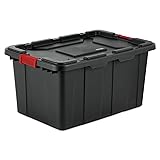
The Sterilite 27-gallon industrial totes (4-pack, model 14669004) are the standard footprint our shelving roundups are sized to fit — note this is the 27-gallon Industrial Tote, not the smaller 27 Qt. ClearView box shown in the tote-shelf-fit table further down this page. Latching lids, made in USA, stackable. Match them with shelves at least 24″ deep — see our best garage shelves for storage bins for verified-depth picks.
Mistake 3: Not labeling bins
What it looks like: ten identical opaque bins on a wire shelf, no contents written anywhere. You open the first three to find the holiday lights, then forget which two you’ve already opened.
Why it’s a problem: every search becomes a 15-minute open-and-close routine. Anyone besides you can’t find anything. Bins drift in purpose over years — what started as “kids’ summer toys” gradually becomes “miscellaneous”, which means functionally lost.
What to do instead: put a label on every bin, on the SHORT side so it stays readable when bins are stacked or pushed against a wall. Update labels when contents change.

The DYMO LetraTag LT-100H is the long-running default handheld label maker. Battery-operated, plastic tape, ABC keyboard — nothing fancy, gets the job done. Buy one or two extra tape cassettes alongside; the per-cassette cost adds up over time.
Mistake 4: Using shelves too shallow for your bins
What it looks like: 27-gallon totes overhanging the front edge of an 18″-deep shelf by an inch or two, looking off-balance and feeling unstable.
Why it’s a problem: unstable stacking, ugly visual, often unsafe with heavy contents. The overhang also blocks access to lower shelves.
What to do instead: match shelf depth to your bin’s short dimension. A standard 27-gallon tote is roughly 20″ wide on the short side, so 24″-deep shelves are the safe pick. 18″ shelves work for smaller bins and boxed dry goods. See our verified-depth picks for 27-gallon totes for shelves we have confirmed will hold the standard tote flat.
Mistake 5: Putting weekly-use items on overhead racks
What it looks like: the lawnmower oil and the kids’ sports gear bag stowed on a 96″-high overhead platform.
Why it’s a problem: every retrieval requires a stepladder, and once retrieval is annoying enough, items slowly stop being used. Overhead is the most expensive storage real estate per minute of access — wasted on weekly items.
What to do instead: overhead is for archival storage only — holiday decorations, off-season tires, camping gear used once or twice a year. Anything you grab weekly belongs on wall shelves at chest height or on accessible hooks. See best overhead garage storage racks for ceiling-mount picks built for genuinely archival loads.
Mistake 6: Mixing categories on one shelf
What it looks like: paint cans next to camping gear next to a box of old electronics, with a leaking weed-killer container at the back that nobody’s noticed in two years.
Why it’s a problem: chemical fumes can affect adjacent items over time. Nothing has a logical “home” so reorganization becomes triggered every time a category grows. And mixing chemicals with sports gear is a child-safety problem if kids share the garage.
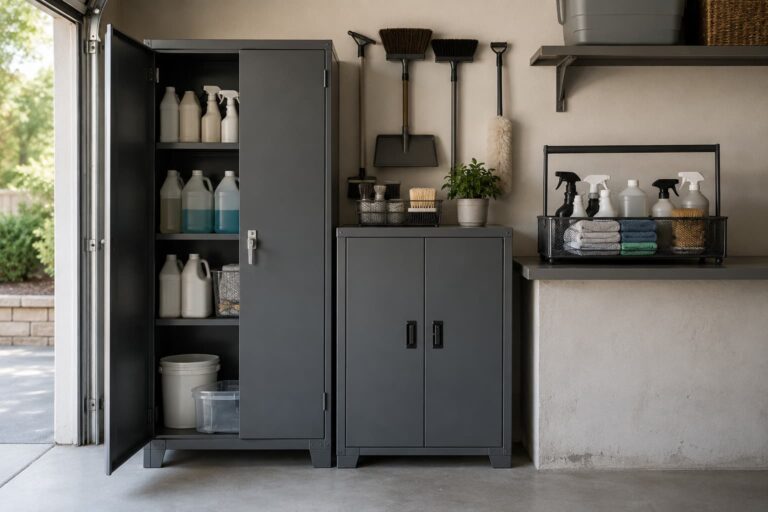
What to do instead: group by category — chemicals together, sports together, seasonal together. Keep paints, sharps, and pool chemicals in a lockable cabinet, not on open shelves. For the bigger decision between open shelving and closed cabinets, see our garage shelving vs garage cabinets comparison.
Mistake 7: Leaving the floor as primary storage
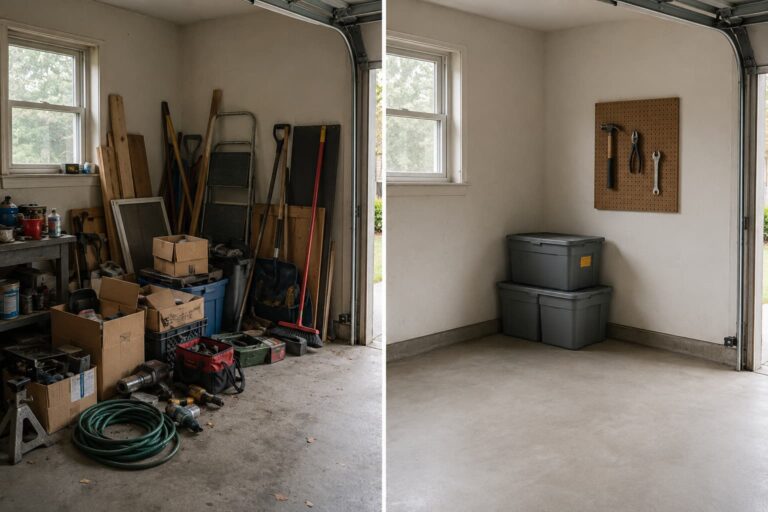
What it looks like: stacks of items on the concrete, walking paths reduced to 18 inches, the car squeezing in sideways.
Why it’s a problem: concrete floors transfer moisture into anything sitting on them. The car can’t enter (or scrapes against piles when it does). Tripping hazards multiply, especially in low-light. And once the floor is full, the wall space behind it stops being usable too.
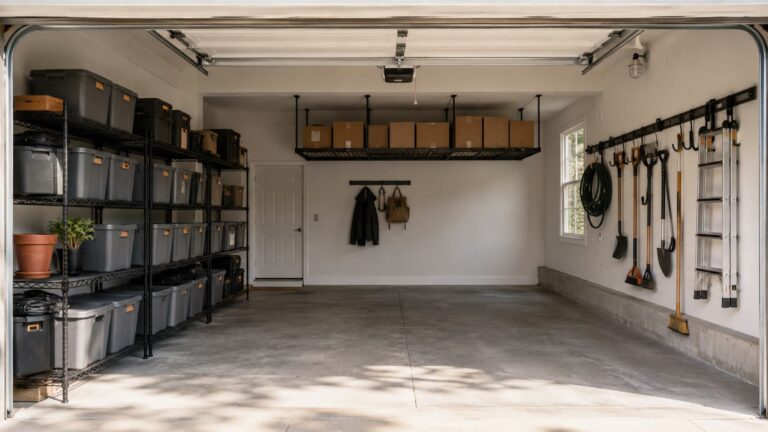
What to do instead: wall and ceiling first, floor last. Aim for roughly 80% of garage storage on wall shelves, ceiling racks, or hooks; reserve floor for items too heavy or oddly shaped to lift safely (lawnmower, large tool chest, the bag of mulch you’ll use this weekend). Start with best wall-mounted garage storage systems for hooks, slatwall, and rails.
Tools and products that help
For the two mistakes that have a direct product fix:
- Labeling: a handheld label maker (the DYMO above) takes the bin-search problem off the table permanently. Costs about as much as one disorganized hour.
- Containers: the 27-gallon Sterilite totes above are sized to fit the shelves we recommend. Buying a 4-pack lets you replace the worst cardboard boxes immediately.
For the rest, the right product depends on your specific layout:
- Shelves to hold those totes: see best garage shelves for storage bins
- Wall-mounted hooks and rails: see best wall-mounted garage storage systems
- Overhead archival storage: see best overhead garage storage racks
Pick whatever fits your specific layout. Measure first.
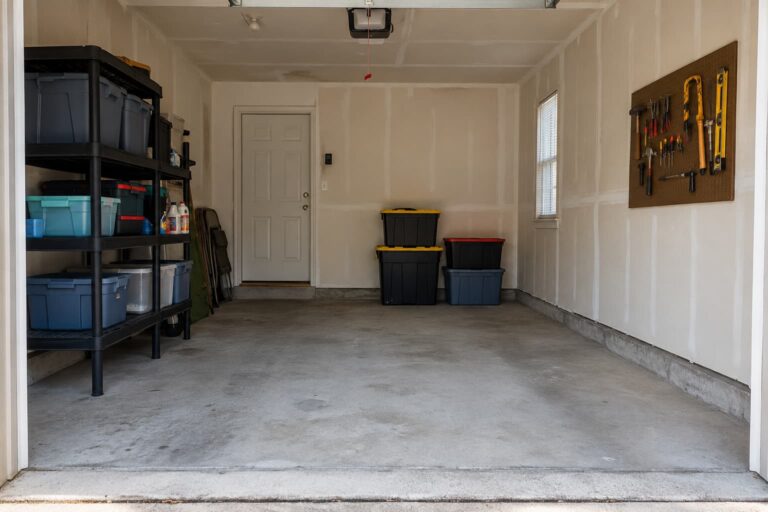
What a working garage looks like
A few attributes shared by garages that stay organized over time:
- Everything was measured before it was bought. Receipts confirm one return per project, not five.
- Cardboard boxes are gone or moving toward gone.
- Every bin has a label, on the short side, readable from the aisle.
- Weekly items are at chest height. Seasonal items are above 7 feet.
- The floor holds maybe 20% of total storage — the heaviest items, plus walking paths.
- One section of one wall is the workshop wall (or none — but it’s decided, not accidental).
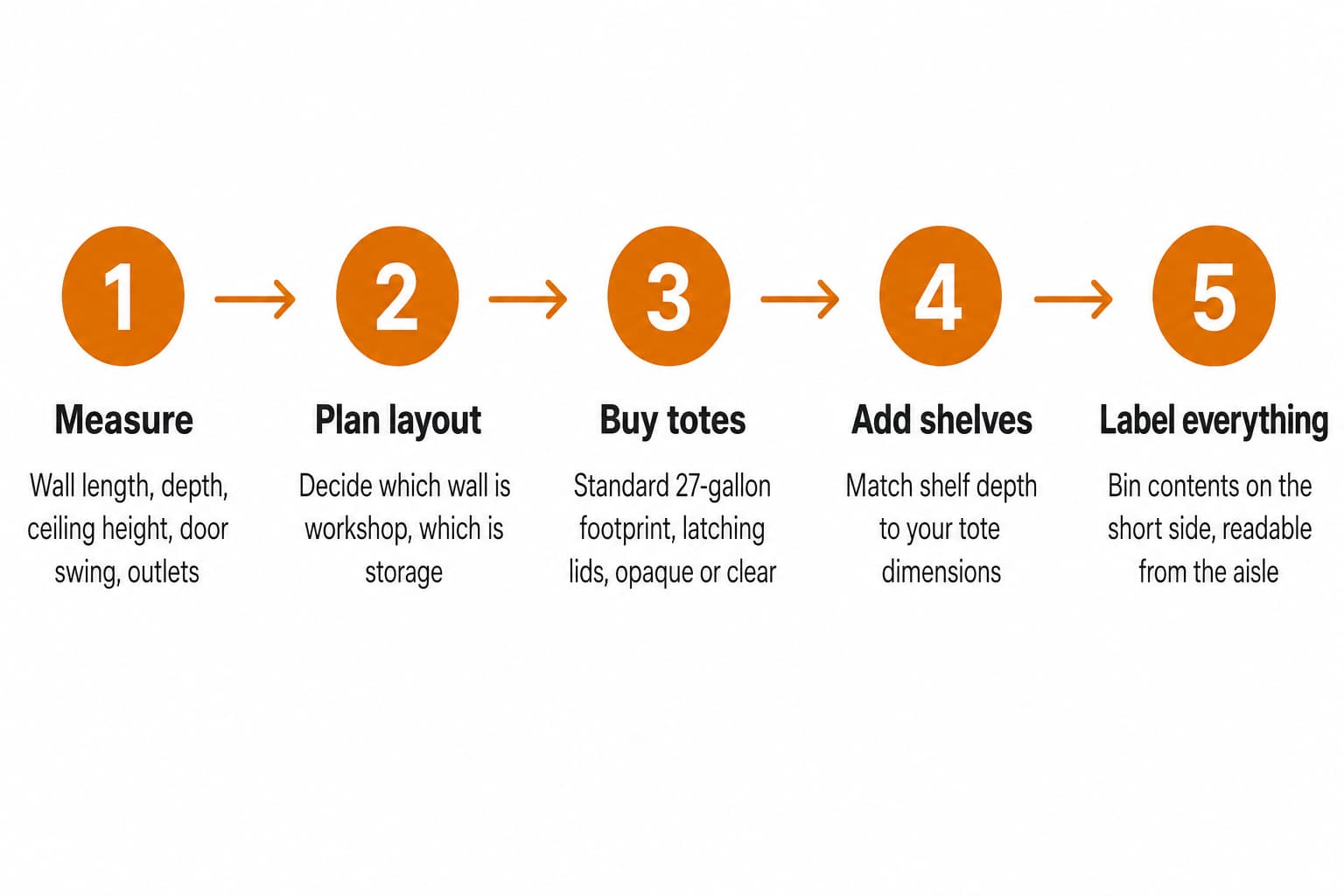
The flow above is the order most successful organizing projects follow. Most failures happen because steps are skipped — usually 1 or 2.
How many totes actually fit on a garage shelf
Tote makers publish dimensions and shelving makers publish dimensions, but nobody puts the two together — so people buy shelving, then discover their totes overhang it. This table takes the published external size of totes from the brands people actually buy for garage storage — Sterilite, Rubbermaid Roughneck, and IRIS USA — and works out how many fit per shelf on the two garage shelving depths you can actually buy, 18 in and 24 in.
| Tote | Published dimensions (source order) | Footprint | Height | Fits an 18 in deep shelf? | Per 48 × 18 in shelf | Per 48 × 24 in shelf | Specification source | Source checked |
|---|---|---|---|---|---|---|---|---|
| Sterilite 6 Qt. Storage Box | 13 5/8" x 8" x 4 5/8" | 13⅝ in × 8 in | 4⅝ in | Yes | 6 | 9 | Sterilite 6 Qt. Storage Box | 2026-09-14 |
| Sterilite 16 Qt. Storage Box | 17 1/8" x 11 7/8" x 6 3/4" | 17⅛ in × 11⅞ in | 6¾ in | Yes | 4 | 4 | Sterilite 16 Qt. Storage Box | 2026-09-14 |
| Sterilite 27 Qt. ClearView Latch Box | 17" x 11 1/8" x 12 3/4" | 17 in × 11⅛ in | 12¾ in | Yes | 4 | 4 | Sterilite 27 Qt. ClearView Latch Box | 2026-09-14 |
| Sterilite 60 Qt. Wheeled Underbed Latch Box | 35 1/2" x 18 7/8" x 7" | 35½ in × 18⅞ in | 7 in | No — it overhangs | 0 | 1 | Sterilite 60 Qt. Wheeled Underbed Latch Box | 2026-09-14 |
How these numbers were produced: External dimensions are quoted on the date shown per row. Sterilite rows are quoted from Sterilite’s own product pages (L x W x H order). Rubbermaid Roughneck rows are quoted from Ace Hardware’s retailer listing, which prints the manufacturer’s SKU-linked dimensions in H x W x D order on each product page. IRIS USA rows are quoted from IRIS USA’s own product pages (L x W x H order). All figures are the external/overall assembled dimensions with the lid on. The counts are computed, not estimated: totes are placed in a single layer, all in the same orientation, with no overhang and no gap; both orientations (the tote’s long side along the shelf’s 48 in run, or along its depth) are tried and the better one is kept. Shelf width is 48 in in both cases — the two depths are real Husky shelving footprints: 48 in. W x 18 in. D (Husky 86 in. H x 48 in. W x 18 in. D 6-Shelf Steel Shelving Unit, model MR481886W6B, https://www.homedepot.com/p/Husky-86-in-H-x-48-in-W-x-18-in-D-Black-Steel-6-Shelves-Shelving-Unit-MR481886W6B/306062319) and 48 in. W x 24 in. D (Husky 5-Tier Steel Shelving Unit, 48 in. W x 78 in. H x 24 in. D, model 426007, https://www.homedepot.com/p/Husky-5-Tier-Riveted-Steel-Garage-Storage-Shelving-Unit-in-Silver-48-in-W-x-78-in-H-x-24-in-D-426007/303241694); neither product page states a clear opening between posts. 48×18 and 48×24 are unobstructed reference surfaces, not guaranteed usable dimensions of every nominal 48×18 or 48×24 rack — posts and lips can reduce the clear opening (one retailer answer for a Husky 48×24 gives about 45.5 × 21.5 in between posts). Round the result down again if your shelving has corner posts that intrude, and leave room to get a hand in.
- A tote that fits the shelf footprint still needs vertical room: check the tote height against your shelf spacing, and leave clearance to lift it in and out rather than sliding it flush.
- Counts assume a flat, full-depth shelf. Wire shelving with a lip, or posts at the corners, will cost you the last tote in a row.
- Lids overhang the base on most totes; the figures here are the manufacturer’s overall assembled dimensions, which already include the lid.
- Capacity in quarts or gallons tells you nothing about whether it fits — and "27" doesn’t mean the same thing twice. The Sterilite 27 Qt. ClearView Latch Box (17 in x 11-1/8 in) fits an 18 in shelf; the Sterilite 108 Qt. Stacker Box (25-3/4 in x 18-3/8 in) — 27-gallon-equivalent by volume (108 qt = 27 gal), though Sterilite sells it as "108 Qt.," not "27 Gal." — does not.
- Manufacturers and retailers don’t all publish dimensions in the same order. Ace Hardware lists Rubbermaid Roughneck as Height x Width x Depth, where Sterilite and IRIS USA publish Length x Width x Height. This table normalises every row to footprint (the two horizontal dimensions) and height so they compare directly regardless of the order they were published in.
- Rubbermaid Roughneck’s 10 gal and 18 gal totes share the same footprint (23⅞ in x 15⅞ in) — only the height changes, so stepping up in capacity in that range costs no extra shelf space, only vertical clearance.
- A blank cell means the manufacturer does not publish that figure — we do not fill gaps with numbers we could not source.
These are the entries that matter for this guide. The full table, with every row and its source, is in our How many totes actually fit on a garage shelf.
FAQ
How long should I plan before buying any storage?
A week or two of observation. Watch what you actually grab from the garage, where it lives now, and how often. The patterns become obvious. Then measure once, then buy.
Should I label every bin, or just the bins I forget?
Every bin. The “I’ll remember this one” exception is how the labeling system erodes — within a year, three or four bins are unlabeled and you’re back to opening them all.
Are clear plastic totes better than opaque ones?
Clear is easier to identify at a glance and reduces the labeling problem (slightly). Opaque is cheaper, stacks more uniformly, and hides visual clutter. For organized garages we lean opaque + good labels; for low-volume hobby storage, clear is fine.
How often should I reorganize the garage?
Once a year as a baseline audit, plus after any life change that adds storage demand (new baby, new hobby, kids leaving for college, etc.). Skipping a year is fine; skipping three usually means starting over.
Can I do this in one weekend?
Only if measuring and layout planning are already done. The physical part — bins, shelves, labels — is genuinely a weekend project. The decision part takes longer than people expect, which is why most weekend attempts fail or get half-finished.
Sources Reviewed
For this article we reviewed manufacturer pages and Amazon listings for the two products mentioned (Sterilite 14669004 industrial tote family and the DYMO LetraTag LT-100H), plus recurring patterns in homeowner discussions about garage organization sequencing and common project failures. We do not claim hands-on testing unless clearly stated.