Best Garage Storage for Kids’ Sports Equipment
Last updated:
Disclosure: This article contains affiliate links. If you buy through these links, we may earn a commission at no extra cost to you. We do not claim hands-on testing unless clearly stated.
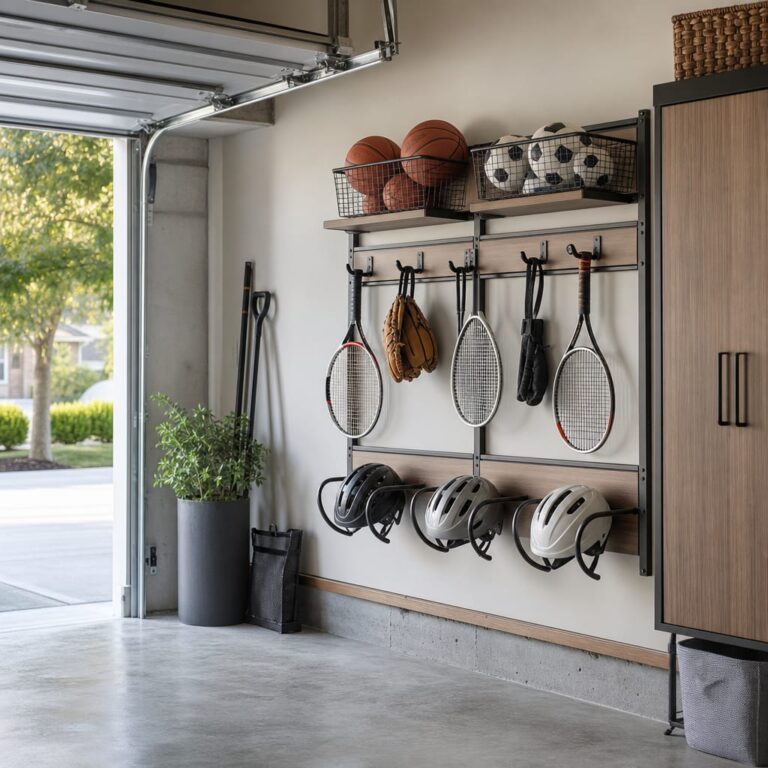
A youth soccer kid plus a Little League baseball kid means six pairs of cleats, two helmets, three balls, two bats, a glove, and a hockey stick from last year — and the garage floor. Most “sports storage” guides treat this with a single multi-sport rack and call it solved. Real youth-sports families end up needing three different storage modes: an everyday multi-sport organizer, a dedicated wall-mount for bats and sticks (which slip out of multi-sport hooks), and proper helmet storage that keeps liners from being crushed.
This guide splits the picks across those modes and adds a rolling cart option for practice-heavy families. We don’t cover indoor playroom storage, sport-specific lockers, or commercial-grade equipment lockers. Everything below assumes a residential garage with at least one wall section you can drill into.
Quick Picks
| Pick | Product | Best for | Type | Watch out for | |
|---|---|---|---|---|---|
| Best Multi-Sport Rack | PLKOW Sports Equipment Organizer | Mixed-sport households | Free-standing | Ball-tier sized for regulation balls | View on Amazon |
| Best Rolling Cart | HOME IT Rolling Sports Organizer | Practice-heavy families | Mobile cart | Sloped floors let cart drift | View on Amazon |
| Best Ball Storage | Wall-Mounted Ball Storage | 4+ balls of mixed sizes | Wall + floor combo | Generic listing — verify before ordering | View on Amazon |
| Best for Bats & Sticks | Evolution Multi-Sport Stick Rack | Lacrosse, hockey, baseball | Wall-mount | Oversized softball bats may not fit | View on Amazon |
| Best for Helmets | Wallniture Giro Helmet Holder | Bike, motorcycle, scooter helmets | Wall-mount | Football/lacrosse helmets are bulkier | View on Amazon |
How We Selected These Storage Solutions
We do not claim hands-on testing unless clearly stated. For this guide we reviewed manufacturer specs, retailer pages, product documentation, and recurring patterns in public customer feedback.
The youth-sports-storage problem is multi-modal — you can’t solve it with one product unless your kid plays a single sport. We covered each of the five distinct gear types (everyday multi-sport, mobile, balls, sticks, helmets) with one strong pick rather than ranking five multi-sport racks. Within each mode we preferred branded picks where the category had options.
Selection criteria:
- Each pick covers a distinct gear type; no two picks duplicate
- Manufacturer-listed capacity verifiable on the listing or brand page
- Branded preferred; generic listings flagged when used
- Compatibility with youth-sized gear (bats, helmets, sticks aren’t scaled-down adult versions)
- Mounting requirements stated clearly (free-standing vs wall-mount vs mobile)
What to Look for Before Buying
Before clicking anything, list out your actual gear inventory. Most readers underestimate how different the storage mix is for a single-sport kid versus a multi-sport household. Once you’ve listed gear, the storage modes follow. We recommend planning the whole garage layout first — sports storage is one of three or four wall and floor allocations.
Match the storage mode to the gear shape
Balls roll, bats lean, helmets crush. Each gear type has a specific failure mode that a generic shelf doesn’t prevent — and matching the storage mode to the gear shape is the single highest-leverage decision in this category. A shelf that holds soccer balls fine drops basketballs because the larger ball overhangs the lip. A shelf wide enough for a basketball makes the soccer ball lonely on a single tier. A shelf for any ball is the wrong shape for a bat, which leans against the wall and slides. The decision matrix later in this article maps gear types to storage modes — start there before any other criterion.
Plan for the gear-rotation cycle (sports change every season)
Last season’s lacrosse stick is dead weight in March; this season’s baseball bat doesn’t exist yet in October. The good storage solutions accommodate gear rotation — modular hook systems, reconfigurable racks, removable bins. The bad ones lock you into a configuration that fits the sport at the time of purchase and nothing after. A rack with fixed-position hooks for lacrosse sticks becomes a wall of empty hooks during baseball season; a rack with reconfigurable hooks repurposes for the in-season gear without a single screw being moved.
Wall-mount vs free-standing vs rolling — pick by garage layout
A garage with a workbench on one wall, the car on the other, and storage shelves on the third has limited wall surface left. Wall-mount only if the wall is available and uncommitted to other storage; free-standing if the floor is available and the unit doesn’t block the car path; rolling if neither is permanent and the family wants gear that travels between garage and field. Most family garages end up using two of the three modes — wall mounts for stationary gear (helmets, sticks) and either a free-standing rack or a rolling cart for the active everyday kit.
Account for youth gear sizes — they aren’t scaled-down adult gear
A youth football helmet is wider than an adult bike helmet. A youth baseball bat is shorter than an adult bat but the grip is similar. Lacrosse sticks for kids are 37–42″ — bat racks designed for 24–32″ don’t fit. Measure before buying.
Decide whether the kid is loading and unloading themselves
Rack height is the gating factor for kid self-load. A 6-year-old can’t reach a wall hook at adult head height. Rolling carts work earliest because the kid pushes from any angle. Wall mounts at child shoulder height work from age 8–10 onward.
Best Multi-Sport Rack: PLKOW Sports Equipment Organizer
Best for: Families with mixed sports (soccer + baseball + basketball) who want a single free-standing unit handling most of the gear.

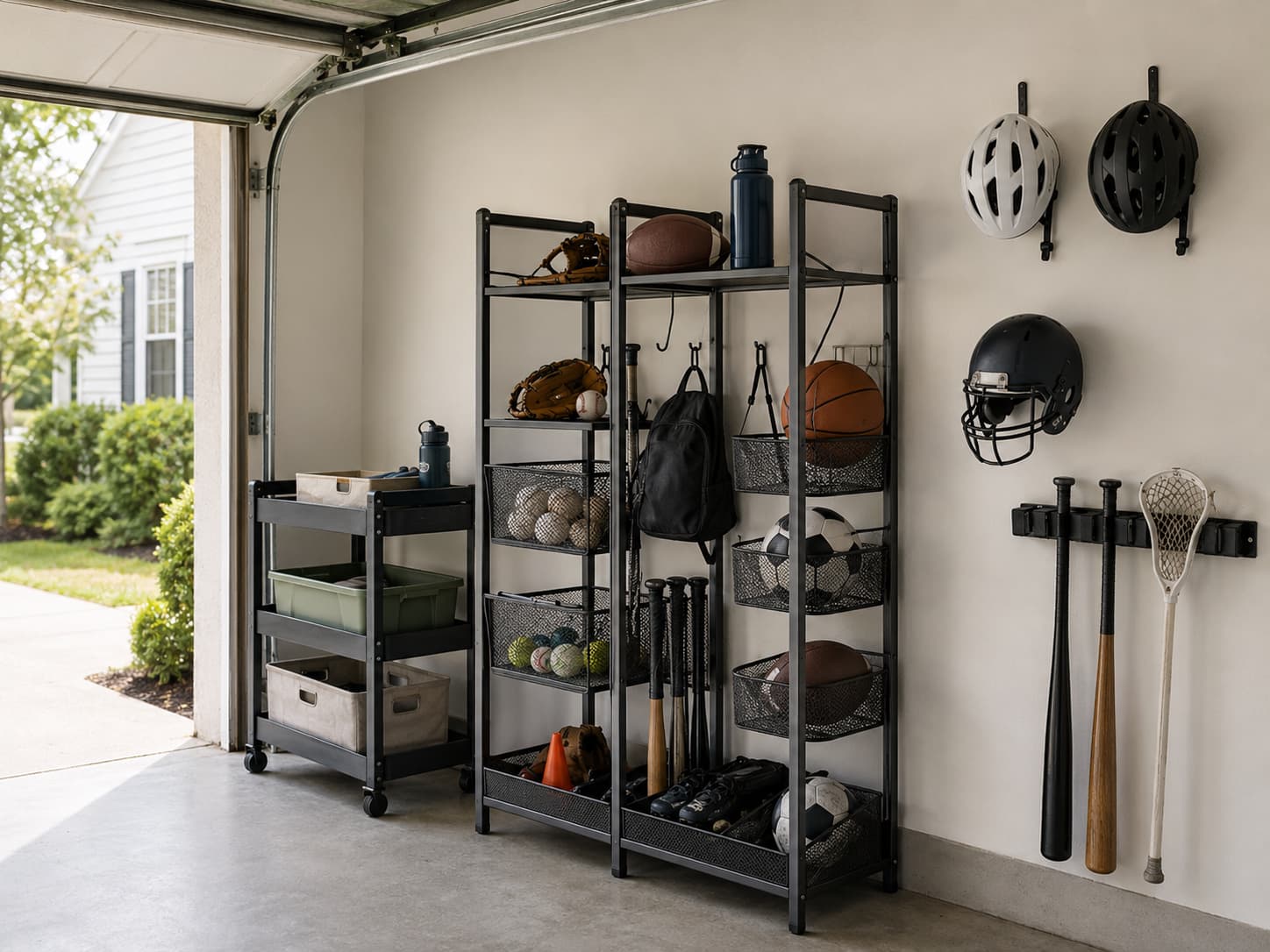
Short verdict: A well-designed multi-section organizer combines bins for small gear, a mesh basket for breathable wet kit, a tier rack for balls, and moveable hooks for helmets and bags. PLKOW does this in one free-standing unit at a residential scale.
The product page lists 2 storage bins, 1 wire mesh basket, a tier ball rack, and moveable hooks. The hooks repurpose for helmets, bike accessories, or scooter mounts as the kid’s gear changes seasonally. Same hooks work for a kid’s bike when the season turns — the same hooks can hold scooters or kids’ bikes when sports gear is cycled out for summer.
Why it stands out
The combination of bin types is the differentiator. Most multi-sport racks pick one storage style — all bins, all hooks, all mesh — and you end up with the wrong mix for half your gear. PLKOW spreads the storage across enclosed bins (small loose items), open mesh basket (wet/dirty kit), tiered ball rack (regulation balls), and hooks (helmets, bags). One unit covers most of the kit-up routine.
It can work well for:
- Households with 2 or more sports actively in season
- Mixed gear types — balls, bats, gloves, helmets, small accessories
- Garages where free-standing is preferred over drilling
- Multi-kid families sharing the same rack
Key specs to check
- Total dimensions and floor footprint
- Ball-tier rack capacity and inside diameter
- Number and size of bins / mesh baskets
- Moveable hook count and load rating
- Steel gauge and powder-coat finish
Recurring feedback patterns
Recurring positive feedback often centers on the multi-mode storage and assembly being faster than expected. Common complaints typically involve hardware quality and missing pieces — several buyers mention contacting the seller for replacement screws. Several buyers mention the ball-tier accommodates standard soccer/basketball/baseball but oversized exercise balls don’t fit cleanly.
Potential drawbacks
Free-standing means floor footprint stays committed. The unit is also harder to relocate once loaded. Generic feel for the price point — branded multi-sport racks at the same price are rare in this category.
Buyer warning
Ball-tier holds regulation soccer, basketball, baseball, and similar; oversized exercise balls and full-size playground balls overflow. Verify the ball mix you actually have before committing — if you’re storing 4+ exercise balls, this rack isn’t sized for them.
Best Rolling Cart for Kids Gear: HOME IT Rolling Sports Organizer
Best for: Practice-heavy families who load and unload gear multiple times per week, and small garages where a stationary rack would block a parked car.

Short verdict: Mobility is the differentiator. The 360° swivel wheels with brakes mean the kid rolls the cart out for practice, loads up, drives off, returns, parks the cart back into its corner. No stationary rack does this.
The manufacturer lists 43 × 16 × 45.5 inches with 2 bins, 4 wire mesh baskets, a side basket, and 4 swivel wheels with brakes. The four-wheel design with brakes is the practical detail — three-wheel carts wobble and two-wheel carts tip when loaded asymmetrically.
Why it stands out
A rolling cart converts the garage-to-field gear journey from a multi-trip hassle into a single push. For a family doing 4+ practices a week across two kids, the cart pays back its purchase price in saved minutes inside the first month. The brakes prevent the cart from drifting on a sloped or expansion-jointed garage floor — though as noted in the buyer warning, very steep slopes can override the brakes.
It can work well for:
- Practice-heavy households (4+ practices/week)
- Small garages where stationary racks block the car
- Multi-kid families where the cart doubles as everyone’s “go-bag” in physical form
- Households who travel between fields with the gear
Key specs to check
- Total dimensions (43 × 16 × 45.5 manufacturer-listed)
- Bin and basket count
- Wheel diameter and brake mechanism
- Maximum loaded capacity
- Frame material (steel gauge)
Recurring feedback patterns
Recurring positive feedback often centers on the wheels and brakes working as advertised, and on the convenience of rolling the gear cart between garage and field. Common complaints typically involve assembly being more complex than diagrams suggest and a few buyers mention bins becoming tight when the cart is fully loaded with a mix of bats and balls.
Potential drawbacks
Rolling carts have more moving parts than stationary racks — wheels, brakes, swivels — which means more long-term maintenance. The cart is also taller (45.5″) and may not fit under low garage shelves.
Buyer warning
Sloped or expansion-jointed garage floors can let the cart drift even with brakes engaged. If your garage floor has a noticeable grade toward the door (a common drainage feature), park the cart against a wall or use a wheel chock.
Best Ball Storage: Wall-Mounted Ball Storage with Elastic Rope
Best for: Households with four or more balls of mixed sizes (soccer, basketball, volleyball, football) who want them retained — not loose on a shelf where they roll.

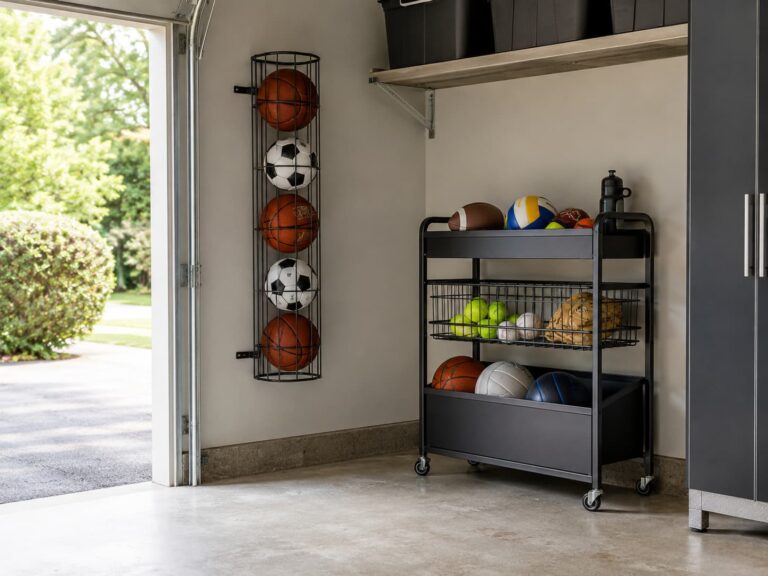
Short verdict: The elastic-rope retention is the differentiator versus open shelf racks. Balls of different sizes stay put because the rope flexes around each one. Combination wall + floor unit gives separate sections for big and small balls.
The product page positions this as a wall-mounted ball storage with an elastic rope retention system, plus a floor unit for the larger balls. The elastic-rope mechanism is what makes a generic-brand listing worth picking over a plain shelf — it solves the most common ball-storage failure where a basketball bounces out and rolls under a parked car.
Why it stands out
Most ball racks use open shelves or wide hooks that let balls roll free at the lightest bump. The elastic-rope design wraps around each ball, holding it in place without sizing the shelf to a specific ball diameter. That same flexibility means a soccer ball, a basketball, and a football all stay retained without needing separate dedicated cradles.
It can work well for:
- 4+ balls of mixed sizes in active rotation
- Garages where balls have rolled under cars or out of the garage
- Households who want the balls visible (motivating use) rather than hidden in a tote
- Wall + floor combination that uses two surfaces, not just one
Key specs to check
- Maximum ball count (wall + floor combined)
- Rope tension — should hold without forcing
- Ball-size range
- Floor unit footprint
- Hardware included (lag bolts for studs preferred)
Recurring feedback patterns
Recurring positive feedback often centers on the elastic rope keeping balls retained, and on the combination wall + floor giving more capacity than either alone. Common complaints typically involve install complexity — the wall portion needs studs to anchor the rope tension. Several buyers mention the rope tension can loosen over years of use and may need replacement.
Potential drawbacks
Generic-brand listing — no manufacturer site outside Amazon. Listing could rotate. Newer ASIN (2024) means low tenure.
Buyer warning
Generic listing without a major manufacturer site. Re-verify availability before ordering. If the listing has rotated to a different SKU at the same ASIN, consider the alternative wall-mount ball racks from established brands (Wallniture, similar) at a higher price point.
Best for Bats and Sticks: Evolution Multi-Sport Stick Rack
Best for: Multi-sport households with bats, lacrosse sticks, hockey sticks, or field-hockey sticks who need a rack that grips stick-shaped gear properly.

Short verdict: Multi-sport stick rack from a branded niche player (Evolution Lacrosse) with a 6-stick capacity and an exceptionally long-tenured Amazon listing. Designed for sticks specifically — not adapted from generic shelving.
The manufacturer lists 6-stick capacity covering lacrosse, hockey, baseball bats, field hockey, and floorball. This rack has one of the longest-tenured Amazon listings in the category — exceptional brand stability where competitor ASINs rotate frequently. Evolution Performance Sports states they are the only authorized seller of the product on Amazon, which adds reliability around what shows up under the listing over time.
Why it stands out
Stick-shaped gear (bats, lacrosse sticks, hockey sticks) doesn’t sit cleanly on shelves or in bins — it rolls, leans, falls. A wall-mount rack with dedicated stick slots solves the geometry. Evolution’s design holds 6 sticks in parallel slots, mounted to studs.
It can work well for:
- Households with 2+ sticks across any sport
- Garages where sticks have been leaning against walls and sliding
- Multi-sport families where sticks rotate seasonally
- Wall-mount installs where stud access is available
Key specs to check
- 6-stick capacity (manufacturer-listed)
- Stick diameter range — typical youth bat ~28–32″, lacrosse stick 37–42″
- Mounting hardware included (stud-grade lag bolts preferred)
- Stud-spacing fit (16″ or 24″ centers)
- Powder-coat finish for humid garages
Recurring feedback patterns
Recurring positive feedback often centers on the simple install once studs are located and on the rack holding sticks securely without slipping. Common complaints typically involve the rack being designed primarily for stick-shape gear; oversized softball bats with thicker barrels may not seat cleanly. Several buyers mention buying two units for households with 8+ sticks.
Potential drawbacks
Wall-mount only — won’t work for households without stud access or who can’t drill. Six-stick capacity is a fixed limit; if you have 7+ sticks, install a second rack.
Buyer warning
Designed for stick-shaped gear (lacrosse, hockey, field hockey, baseball bats). Oversized softball bats with wide barrels may not fit cleanly in the slots. Measure your widest bat barrel before ordering, or plan to mount this rack alongside a standard shelf for the wide pieces.
Best for Helmets: Wallniture Giro Helmet Holder
Best for: Households where helmets keep ending up on the floor — the floor habit crushes helmet liners and shortens helmet life materially. A dedicated wall mount per kid solves the problem with about 5 minutes of install per mount.
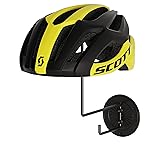
Short verdict: Single-helmet wall-mount, modular — install one per kid at appropriate height. Wallniture is an established US storage brand with its own website and warranty system.
The product page lists Wallniture Giro as a wall-mount helmet holder sized primarily for bike and motorcycle helmets. Modular install means each kid gets a dedicated helmet position, which builds a helmet-on-mount habit instead of helmet-on-floor.
Why it stands out
Helmet protection is a sleeper concern — most parents don’t realize that a helmet sitting on the floor under repeated weight (gear bag dropped on top, foot stepped on) compresses the foam liner and reduces impact protection. A modest wall mount per kid prevents the slow degradation of a much more expensive helmet over time. Branded picks from Wallniture also build gear-care habits early — kids learn that helmets get hung up, not dropped.
It can work well for:
- Households with bike, motorcycle, or scooter helmets
- Multi-kid families where each kid gets a dedicated mount
- Garages where helmets keep ending up on the floor or on a bench
- Modular installs — one mount today, two tomorrow as the family grows
Key specs to check
- Helmet size compatibility (bike helmet circumference 21–22″; motorcycle 22–24″)
- Mount projection from wall
- Mounting hardware (single screw or two for solid stud mount)
- Material (powder-coated metal)
- Color options for matching the garage finish
Recurring feedback patterns
Recurring positive feedback often centers on Wallniture’s brand quality and on the simple single-screw install per mount. Common complaints typically involve the mount being too small for football and lacrosse helmets, which are bulkier than bike/motorcycle helmets.
Potential drawbacks
Single-helmet design means you buy multiple mounts for multi-kid households. Sized primarily for bike/motorcycle helmet shape, not the wider football or lacrosse helmet profiles.
Buyer warning
Sized primarily for bike and motorcycle helmets. Football and lacrosse helmets are bulkier and may overhang or not seat. For football/lacrosse-heavy households, look at wider shelf-style helmet racks — the ladder-grade stud anchors used for those are the same anchors as for these mounts.
Side-by-Side Comparison
| Product | Storage mode | Mobile? | Wall-mount? | Best gear type | Main advantage |
|---|---|---|---|---|---|
| PLKOW Sports Organizer | Free-standing multi-section | No | No | Mixed | Bins + basket + ball rack + hooks |
| HOME IT Rolling Cart | Mobile cart | Yes | No | Mixed | Rolls between garage and field |
| Wall-Mount Ball Storage | Wall + floor combo | No | Yes | Balls (mixed sizes) | Elastic-rope retention |
| Evolution Stick Rack | Wall-mount stick rack | No | Yes | Bats, sticks | 6-stick capacity, branded |
| Wallniture Giro | Wall-mount helmet holder | No | Yes | Helmets | Modular per kid |
Choose by Sport Mix — A Decision Matrix
The right storage combination depends less on your garage layout and more on the sports your kids play. A soccer-heavy household has different gear from a hockey-heavy one, and the matrix below maps each common mix to the storage modes that matter.
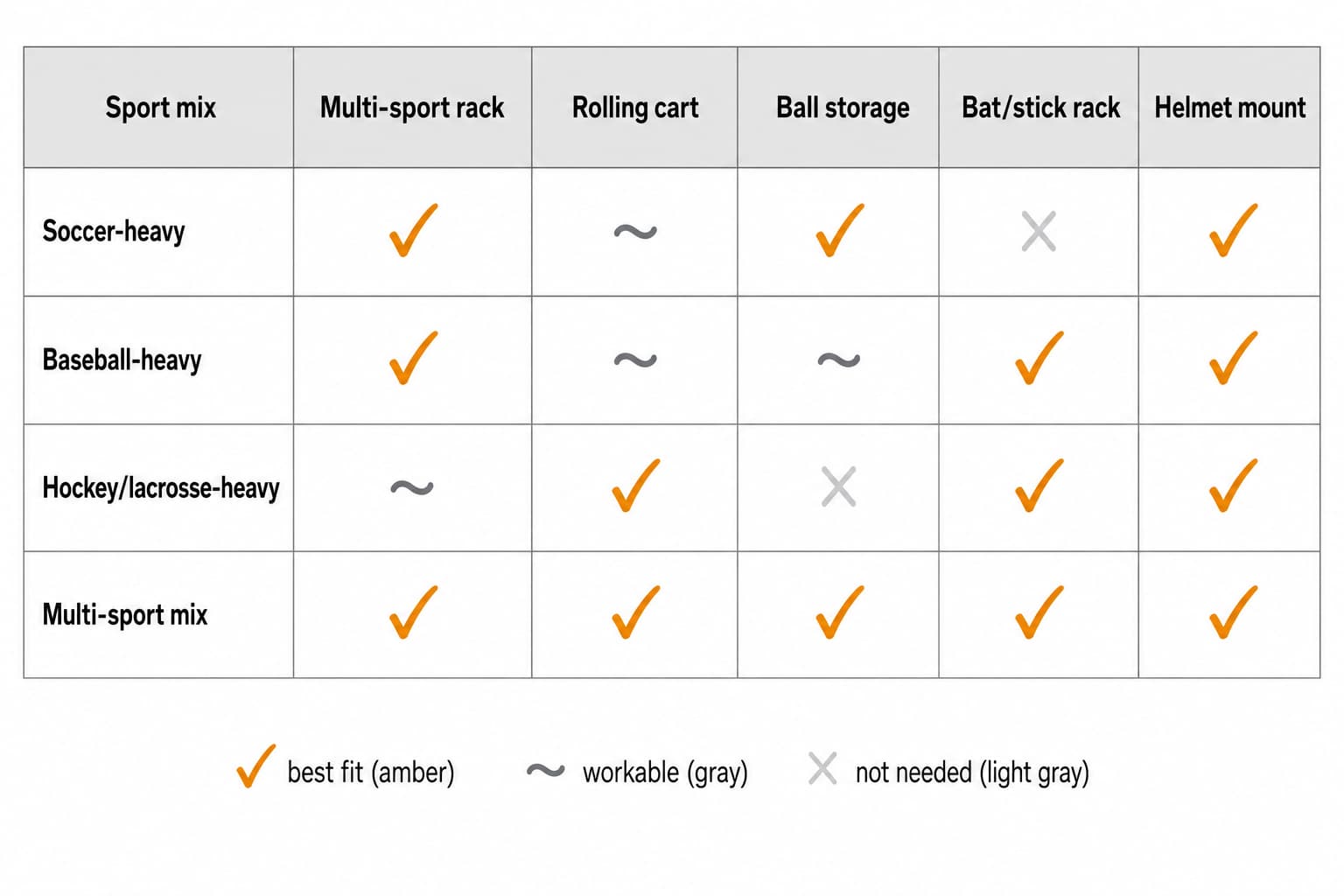
A soccer-heavy household needs ball storage and helmets but rarely uses a stick rack — soccer involves cleats, shin guards, balls, and bibs, none of which are stick-shaped. A baseball-heavy household needs the bat/stick rack and helmets, but balls are less of an issue because the household typically has one or two baseballs and a softball, not a full ball mix. A hockey-heavy or lacrosse-heavy household needs the stick rack as the centerpiece, plus helmets (which are bulkier than bike helmets — verify mount sizing), plus a rolling cart for the gear bag because hockey and lacrosse bags are too irregular for shelf storage. A multi-sport mix benefits from all five categories at once, and the order of purchase typically goes: helmet mount first (cheapest, highest impact on gear life), then multi-sport rack, then bat/stick rack, then ball storage, then rolling cart if the practice cadence justifies it.
Ball diameters that decide rack fit
Sports governing bodies publish ball circumference, but the number that decides whether a ball fits a rack slot, a bungee opening or a bin is its diameter — and nobody publishes that. This table quotes each official circumference specification and derives the diameter from it, so you can measure an opening and know what will actually go into it.
| Ball | Official circumference | Diameter (derived) | Min. clear opening | Official weight | Specification source |
|---|---|---|---|---|---|
| Basketball, size 7 (men’s / adult) | 29½–30 in | 9.4–9.5 in | 9.75 in | — (not stated in the cited source) | NCAA men’s basketball rules |
| Soccer ball, size 5 (adult) | 68–70 cm (27–28 in) | 8.5–8.8 in | 9 in | 410–450 g (14–16 oz) at the start of the match | IFAB Laws of the Game, Law 2 |
| American football, official size | 21–21¼ in around the middle; 28–28½ in end to end | 6.7–6.8 in | 7 in | 14–15 oz | Official Playing Rules of the NFL, Rule 2 |
How these numbers were produced: Diameter is derived from the governing body’s published circumference range as d = C / π, then rounded to 0.1 in. Minimum clear opening is the derived maximum diameter rounded up to the next 1/4 in — arithmetic only, not a manufacturer specification, and it assumes a rigid opening with no stretch. Circumference figures in inches are converted from the metric spec where the governing body publishes metric (1 in = 2.54 cm); where the body publishes both, its own figures are quoted.
- Sizes 6, 5, 4 and 3 balls are manufacturer conventions for youth play, not rules-body specifications, and vary between brands — measure the ball you actually own rather than assuming a nominal size.
- An American football is a prolate spheroid, so it has no single diameter: the girth figure is what a slot must clear, the long axis is what the slot depth must accommodate.
- Elastic-cord and bungee racks stretch, so a ball larger than the resting opening can still be held; the figures above are the rigid-opening case.
- A blank weight means the cited rulebook does not state one — we do not fill gaps with figures we could not source.
These are the sizes that matter for this guide. The full table, with every sport and its source, is in our ball storage rack guide.
How to Measure Your Garage and Gear Before Buying
Before drilling or ordering anything, walk the garage with a tape measure and pull out the actual gear. Skipping this step produces the regret-after-purchase outcome we’re trying to help you avoid. While you’re measuring, consider tote storage for off-season gear — last-season equipment doesn’t belong on the everyday rack.
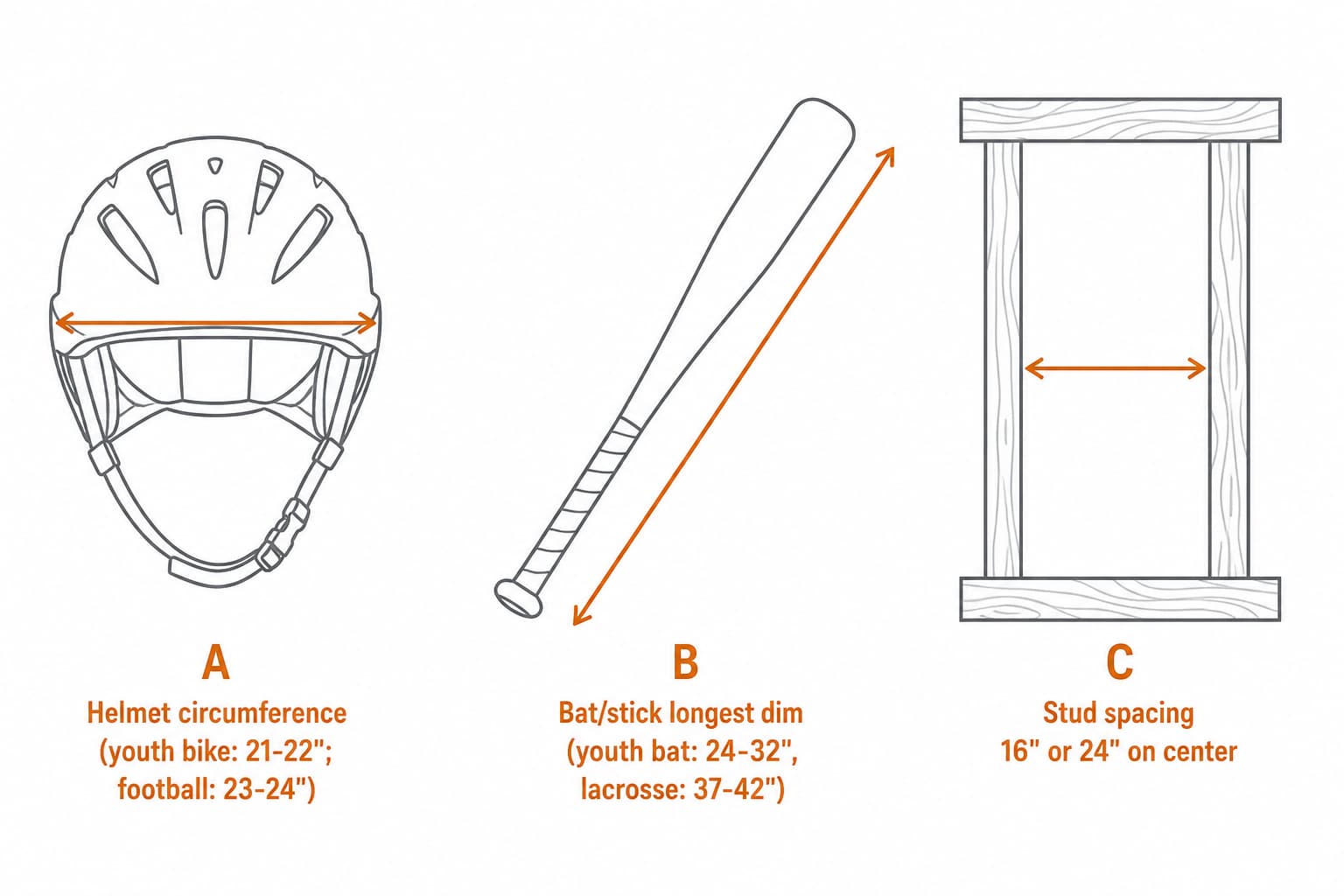
The measurement checklist:
- Wall stud spacing. Use a stud finder along the wall section you intend to mount on. Most US homes use 16-inch on-center spacing; some newer builds use 24-inch.
- Floor footprint for free-standing units. A multi-sport rack is typically 24–43″ wide. A rolling cart adds maneuvering space — 18 extra inches in front for the loaded-cart push envelope.
- Helmet size measured around the widest point. Youth bike helmets typically 21–22″; football helmets 23–24″. This is the constraint for any helmet wall mount.
- Bat or stick longest dimension for shelf clearance. Youth baseball bat 24–32″; lacrosse stick 37–42″. The wall-mount stick rack needs vertical clearance below it equal to the longest stick length.
- Ball count and size mix. Count actual balls on hand. Soccer/basketball/volleyball/football diameters fit standard ball racks; oversized exercise balls don’t.
Common Complaints and Buyer Warnings
Across the five storage modes, the same complaints recur — and they all trace back to skipped sizing checks or to confusing the storage mode with what the gear actually is.
The single most important warning: helmet liners crush under their own weight on the garage floor. A helmet sitting on the floor, then with a gear bag dropped on top, then with a foot stepped on it during practice prep, compresses the foam liner over weeks. The compressed liner doesn’t recover. Helmet protection ratings degrade. A small wall-mount investment saves a much pricier replacement helmet.
Heavy/dense load warning: catcher’s gear bags routinely exceed 30 lb fully loaded with chest protector, leg guards, mask, helmet, and a backup glove. Not all rack hooks are rated for that — check the hook capacity before hanging the bag. A 30 lb load on a 25 lb-rated hook will hold for weeks, then fail without warning. Either choose a hook with a higher rating or hang the bag from a stud-mounted heavy-duty utility hook rather than from a multi-sport rack’s accessory hook.
Who Should Avoid These Products?
These picks aren’t right for everyone. Skip the entire list if any of these apply to you:
- Single-sport households. One bat, one helmet, one ball doesn’t need a multi-sport rack. A few wall hooks cost less and do the job.
- Apartment / no-garage scenarios. Outdoor weatherproof storage is a different category we don’t cover here.
- Coaches with team gear. Commercial-grade storage racks scale to 20+ kids of equipment — different category, different price point.
- Households without stud access. The Evolution stick rack and Wallniture Giro both need stud mounts. Drywall-only walls aren’t safe anchors for any rack holding more than 10 lb sustained load.
FAQ
How do I store wet gear without growing mold?
Use mesh baskets, not enclosed bins. Airflow is the requirement. Wet shin guards, gloves, or jerseys in a closed bin grow mildew within days; in a mesh basket they dry overnight. Most multi-sport racks in this guide include at least one mesh basket for this reason.
Will a bike helmet rack fit a football helmet?
Usually no. Football helmets are 1–2 inches wider than bike helmets across the forehead and 1–3 inches deeper front-to-back. A bike helmet mount sized for 21–22 inch circumference doesn’t fit a 23–24 inch football helmet. Look for shelf-style helmet racks for football/lacrosse-heavy households.
How do I store a hockey bag that doesn’t fit on any rack?
Use a floor cubby, a mesh laundry hamper sized for hockey bags, or a dedicated hockey-bag stand. The bag is too bulky and irregularly shaped for standard rack hooks; brute-force solutions work better.
Can I put a multi-sport rack outside on a covered porch?
Most are powder-coated steel and acceptable for covered outdoor use. Verify rust resistance on the listing — humid coastal climates accelerate corrosion on lower-grade powder coats. Indoor-only is safer if you have the garage space.
What’s the right age for a kid to load their own gear?
Match the rack height to the kid. Rolling carts work earliest (age 4–5) because the kid pushes from any angle. Free-standing organizers with bins at child shoulder height work age 6–8. Wall-mount hooks above adult head height require parent help until the kid grows into them.
How often should I rotate stored gear?
Seasonally. Off-season gear belongs in a tote in long-term storage, not on the everyday rack — clutter on the active rack means kids skip putting gear back. Once-per-season rotation keeps the active rack matched to the current sport.
Does the rack need to mount into studs?
Yes for any wall mount holding more than 10 lb sustained load. Drywall anchors, even high-rated toggle bolts, degrade over time under repeated load cycles. Studs are non-negotiable for the Evolution stick rack, the Wallniture Giro, and the wall-mounted ball storage. The cost of using a stud finder before drilling is trivial compared to the cost of a fallen rack and the gear it dropped.
How do I prevent a tower of helmets from forming as kids upgrade through sizes?
Donate or sell outgrown helmets when the upgrade happens, not in batches every two years. Helmets degrade over time even when stored properly — the foam liner has a limited useful life — so an unused helmet sitting on a wall for three years is actually expired safety gear, not a backup. The cleanest workflow is: new helmet arrives, old helmet leaves the wall the same day, garage stays at one helmet per kid. Building this habit early also teaches kids that gear is a finite-life resource and worth caring for, not an accumulation pile that stays around regardless of fit. The same principle applies to outgrown bats, sticks, and shin guards — the rack stays matched to the active gear, not the historical inventory of every sport played.
Sources Reviewed
For this guide, we reviewed manufacturer product information from Wallniture, Evolution Lacrosse, HOME IT, and PLKOW (Mythinglogic family); retailer specifications on Amazon listings; product documentation from manufacturer websites where available; and recurring patterns in public customer feedback. We focused on product details that matter for youth-sports gear storage, including manufacturer-listed capacity, gear-type compatibility, mounting requirements, and material durability under typical garage humidity.
Related Guides
- Best garage storage for bikes and scooters
- Best garage shelves for storage bins
- Best garage hooks for ladders
- How to plan a garage organization system
- How to Choose Garage Storage
- How to Organize Christmas Decorations in Your Garage
- How to Rotate Seasonal Items in Your Garage
- wall vs freestanding bike rack garage