
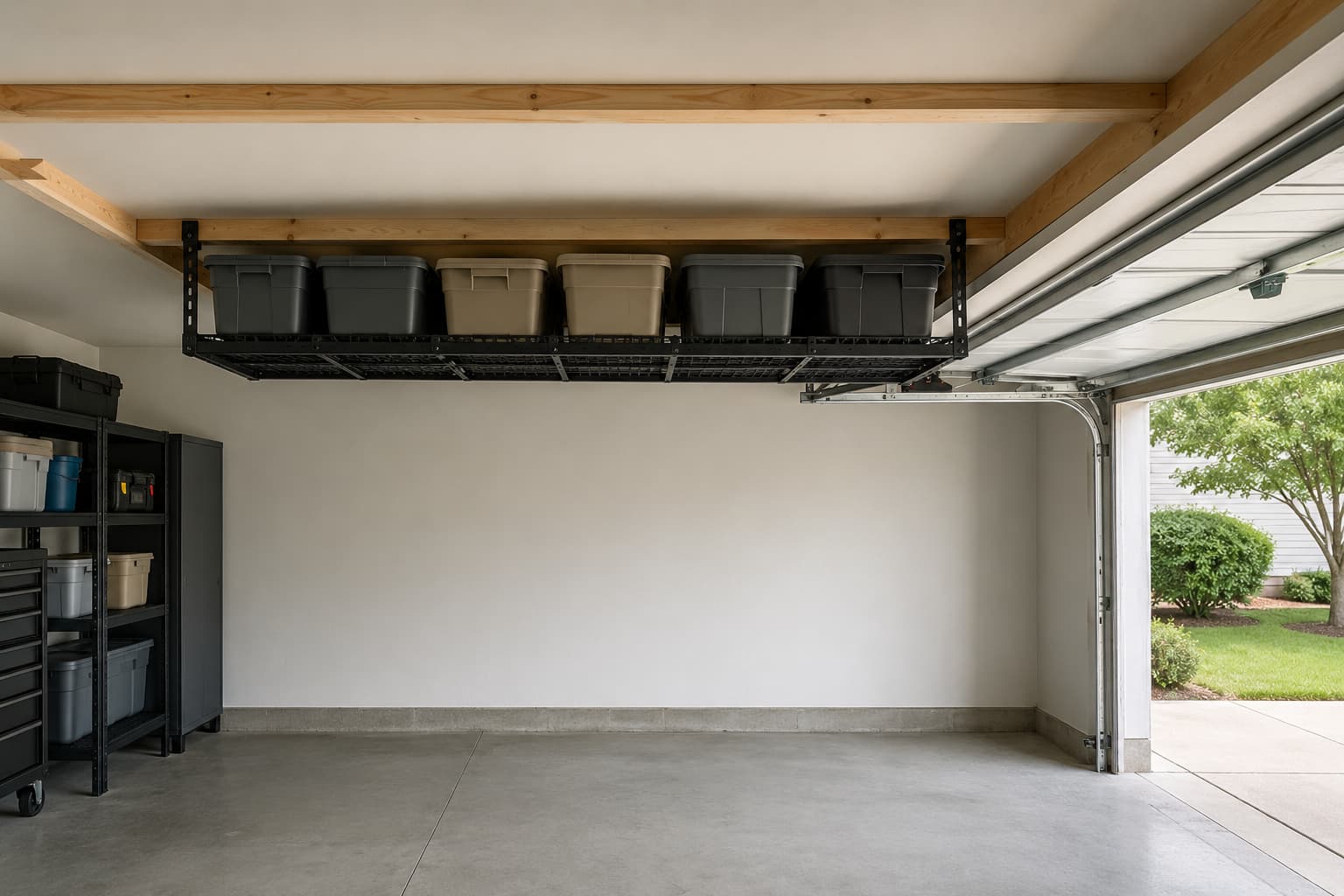
Best Overhead Garage Storage for Low Ceilings (2026)
Disclosure: This article contains affiliate links. If you buy through these links, we may earn a commission at no extra cost to you. We do not claim hands-on testing unless clearly stated.
Most overhead garage storage racks start their drop range at 22 to 24 inches from the ceiling. On an 8-foot ceiling, that lands the rack platform at 6 feet — fine for most adults walking under it. On a 7-foot ceiling, the same rack lands the platform at 5 feet, which is unworkable. The buyer with a low-ceiling garage who orders a standard rack discovers this after assembly, and the rack ends up returned. Low ceilings need racks engineered for the constraint, not standard racks lowered as far as they’ll go.
This guide covers five picks specifically for 7-to-8-foot ceiling residential garages. The picks include the shortest mass-market drop racks (12 inches), a smaller-footprint 4-by-6 alternative for tighter ceilings, the narrow 2-by-6 designed to fit above a garage-door header, and a wall-mounted alternative for buyers whose ceilings can’t hold an overhead rack at all. For the broader treatment of overhead storage across all ceiling heights, see our broader overhead-rack pillar.
This article does not cover standard overhead racks for 9-foot-plus ceilings, motorized hoists, or DIY-built ceiling shelves — those are covered elsewhere or fall outside our scope.
Quick Picks
| Pick | Product | Best for | Type | Min drop | Capacity | Watch out for | |
|---|---|---|---|---|---|---|---|
| Best Low-Drop Rack | SafeRacks 4×8 12″-21″ White | 7-8 ft ceilings, full footprint | Fixed ceiling rack | 12″ | 600 lb | Joist-only mounting | View on Amazon |
| Best Adjustable Height | SafeRacks 4×8 12″-24″ Hammertone | Buyers wanting wider drop range | Fixed ceiling rack | 12″ | 600 lb | Hammertone shows scratches | View on Amazon |
| Best for 7-Foot Ceilings | MonsterRax 4×6 12″-21″ Hammertone | Tight 7-ft ceilings, smaller footprint | Fixed ceiling rack | 12″ | 500 lb | 4×6 holds less than 4×8 | View on Amazon |
| Best Wall/Ceiling Hybrid | VEVOR 2-Pack 2×4 Wall Shelving | When ceiling can’t hold a rack | Wall-mounted | n/a | 250 lb/shelf | Wall-mounted, not overhead | View on Amazon |
| Best for Above Garage Door | SafeRacks 2×6 24″-45″ White | Narrow space above door header | Fixed ceiling rack | 24″ | 300 lb | Drop range too tall for flat 7-ft ceilings | View on Amazon |
Read This First — The Drop Math
The single most important thing a low-ceiling buyer should understand is the drop arithmetic. Standard overhead racks list ceiling drops of 22 inches, 24 inches, 36 inches, or 45 inches. Subtract the drop from your ceiling height to find where the rack platform actually lands.
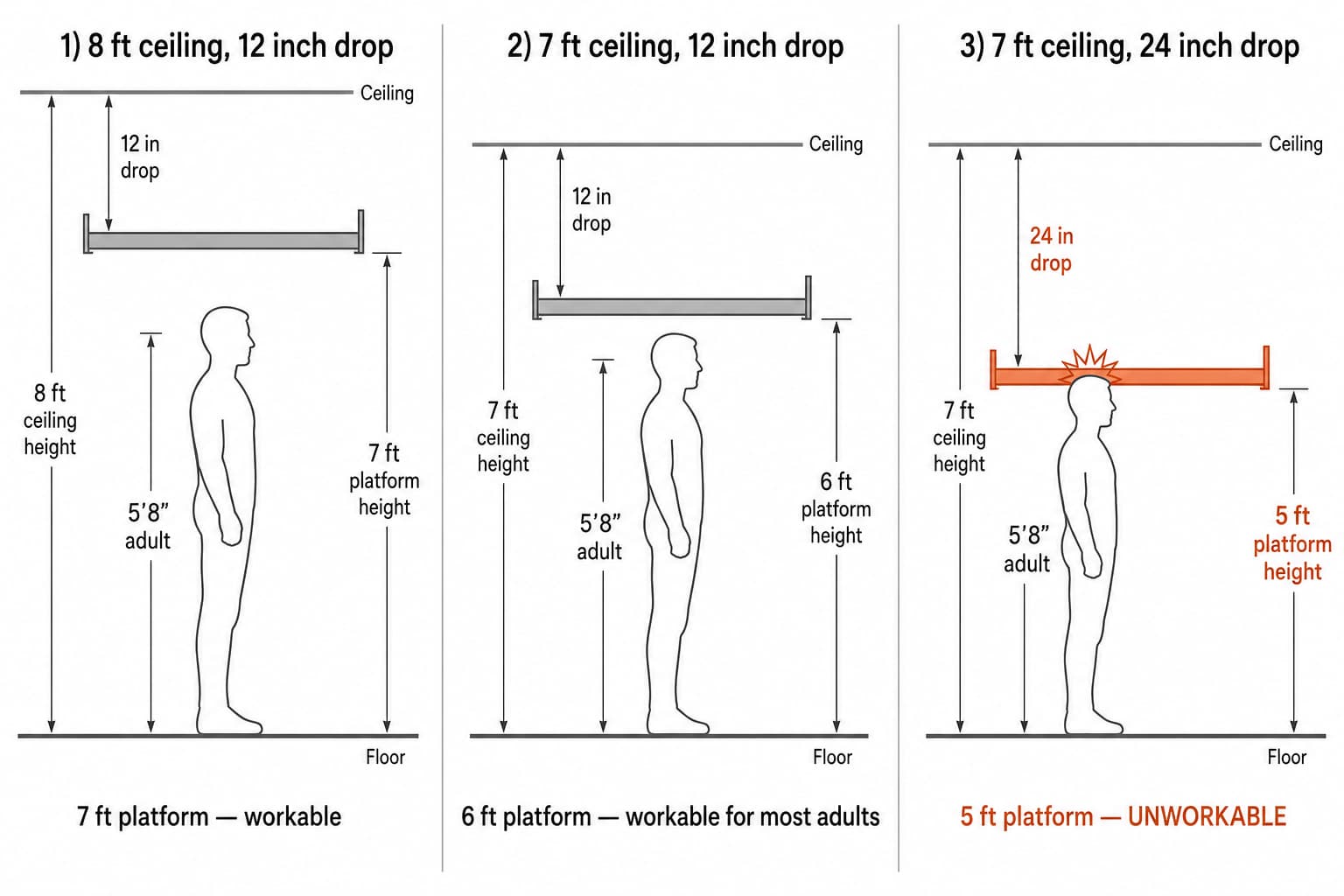
On an 8-foot ceiling: a 12-inch-drop rack lands the platform at 7 feet, clear for most adults. A 24-inch-drop rack lands at 6 feet, which is the lower bound — average male head height is roughly 5’10” with shoes on, so 6 feet leaves only a couple of inches of clearance.
On a 7-foot ceiling: a 12-inch-drop rack lands at 6 feet — workable for most adults walking through, with care. A 24-inch-drop rack lands at 5 feet, which is below the head height of every adult and is the wrong product for the space. This is the most common low-ceiling buyer mistake — ordering a standard 24-45 drop rack and discovering after assembly that the platform is at chest height.
Every rack in this guide is also designed to be lag-bolted into wood ceiling joists. If your ceiling is concrete, steel-joist, or a finished room above, the structural picture is different — see our broader joist-mount safety framing treatment for the full discussion. The wall-mounted alternative on this list (VEVOR Slot 4) sidesteps the joist requirement entirely.
The garage-door track also matters. When a sectional garage door rolls up, the door panels track horizontally along rails that mount to the ceiling. A rack mounted under or near the door track must clear the panels with margin — typically 14 inches between rack edge and the closest track. This is why “above the garage door” is a separate use case: the space above the door header is often taller than the rest of the ceiling and needs a different rack profile.
How We Selected These Racks
We do not claim hands-on testing unless clearly stated. For this guide, we reviewed manufacturer specifications, retailer product pages, product documentation, and recurring patterns in public customer feedback.
Because the low-ceiling constraint is the editorial point of this article, we prioritized products with a manufacturer-listed minimum ceiling drop of 12 inches (or, for the above-door use case, a narrow depth that fits the header space). Standard 22-45-inch drop racks were dropped from consideration even when their other specs were strong — they don’t solve the problem this article addresses.
Selection criteria:
- A 12-inch minimum ceiling drop where applicable, OR a footprint engineered for narrow above-door installations
- Joist-mount-only specification on the listing or manufacturer page
- Available on Amazon
- Capacity figure that names the installation condition (joist-mounted, evenly distributed)
- A buyer-feedback pattern that addresses low-ceiling-specific concerns rather than general overhead-rack issues
What to Look for Before Buying
The four specs below are what determine fit in a low-ceiling garage. The first three are stricter than for a standard ceiling; the fourth is the alternative path when overhead isn’t possible at all.
The actual ceiling drop number — 12″ minimum is the floor
For a 7-to-8-foot ceiling, 12 inches of drop is the practical floor. Below 12 inches, the rack would mount tight to the ceiling and lose vertical storage room above the platform; above 12 inches, the platform starts pushing into headroom faster than buyers expect. The 12-inch number gives roughly 6 feet of usable space below the rack on a 7-foot ceiling, which is the minimum workable clearance for adults walking through.
Platform size vs ceiling area — 4×6 vs 4×8 trade-off
The standard residential overhead rack is a 4-by-8 platform. On low-ceiling garages, the larger 4-by-8 can feel visually heavy and may exceed what the ceiling joists can comfortably hold given the lower ceiling typically correlates with older construction (which often has narrower joist spans). The 4-by-6 alternative trades 8 square feet of platform for less visual mass and lower load on marginal joists. For most low-ceiling garages, a 4-by-6 is enough; the 4-by-8 is the right call only when you’re certain the joists can take the additional load.
Garage-door track interaction at low drops
Sectional garage doors track horizontally along rails when open, ending up flush with (or close to) the ceiling. A rack mounted near the door’s path can interfere with door operation if the drop or position isn’t right. Two scenarios: the rack mounts behind the door’s open position (most common, easier — track and rack don’t conflict), or the rack mounts above the door’s open position (above the header — the rack sits in the wall-cavity space above the open door, where the ceiling is often taller). The above-door case is what the SafeRacks 2-by-6 in this guide addresses.
When overhead isn’t possible — the wall-mount alternative
Some low-ceiling garages can’t have an overhead rack at all. Concrete ceilings, steel-joist ceilings, drywall-only finished ceilings, and rentals where ceiling drilling isn’t permitted all rule out the overhead category. For these buyers, the right answer is a wall-mounted shelf high on the wall — the VEVOR 2-by-4 in this guide. It’s not literally a hybrid (it’s a pure wall-mount), but it solves the same square-footage-reclaim problem at wall-stud level.
What a good product page should specify clearly
If the listing doesn’t tell you the minimum ceiling drop with a number (not just “adjustable”), the joist-only mounting requirement, the platform dimensions, and the capacity figure with installation conditions named, treat it as incomplete. Low-ceiling buyers cannot afford to discover after install that the rack is 22-45 drop instead of 12-21. The good listings spell this out in the title or first paragraph.
Best Low-Drop Rack: SafeRacks 4×8 12″-21″ White
Best for: 7-to-8-foot ceiling residential garages where the buyer wants the full 4-by-8 platform area at the shortest practical drop

Short verdict: The headline pick — 12-inch minimum drop is the shortest mass-market overhead rack, and the 4-by-8 white-finish version ships as a 2-pack with everything to install both racks side-by-side.
SafeRacks publishes a 600-pound listed capacity for the 4-by-8 platform with the installation requirement explicitly stated as wood joists only. This 12″-21″ variant is the same 14-gauge C-channel construction as the brand’s standard 24″-45″ rack — only the drop tubes are shorter. The 12-inch minimum lands the platform at 7 feet on an 8-foot ceiling and 6 feet on a 7-foot ceiling, which is the workable threshold for most low-ceiling residential garages, and the 21-inch maximum gives a 9-inch adjustment window for buyers who want flexibility within the low-drop range.
Why it stands out
The arithmetic is the differentiator. Most overhead racks in the 4-by-8 size class start at 22-inch or 24-inch minimum drops; SafeRacks’ 12-inch variant gets the platform 10 to 12 inches closer to the ceiling, buying back the headroom that low-ceiling garages don’t have to spare. The white finish blends with white drywall ceilings, making the rack visually less imposing in a small space.
It can work well for:
- 7-to-8-foot ceiling garages with confirmed wood joists at 16-inch on-center
- Buyers who want the full 4-by-8 platform area
- Two-rack installations along a single garage wall
- Garages where the existing ceiling is white drywall
Key specs to check
- 12-inch minimum ceiling drop (21-inch maximum)
- 600-pound listed capacity per rack, joist-mounted, evenly distributed
- 4-foot by 8-foot platform
- 14-gauge industrial steel C-channel beams
- Wood joist mounting only
Buyer warning
Even at the 12-inch minimum drop, the rack still needs ceiling-to-rack-bottom clearance for the items you intend to store on it. Measure your tallest stored tote with the lid on, add 1-2 inches for slide-out clearance, and confirm that height plus the rack’s 4-inch frame thickness fits within the ceiling-drop budget you have. On a 7-foot ceiling, the 12-inch drop leaves the platform at 6 feet — items taller than 1 foot push into walking headroom.
Best Adjustable Height: SafeRacks 4×8 12″-24″ Hammertone
Best for: buyers who want a 12-inch minimum drop but slightly more flexibility on the upper end of the range, in a darker finish that hides garage grime

Short verdict: Same low-drop floor as the white variant, with a 12-to-24-inch range that gives a 12-inch maximum-drop window — useful when you want flexibility to shift the rack lower for taller stored items, then back up when storage changes.
SafeRacks’ 12″-24″ Hammertone variant is functionally identical to the 12″-21″ White on capacity, frame design, and joist-mount requirement — the difference is the upper end of the drop range and the finish. The Hammertone is the same finish profile used on SafeRacks’ premium Hammertone variants and matches the visual of a workshop-style garage better than white drywall blending.
Why it stands out
The 12-inch maximum-drop window above the floor lets you adapt the rack as your storage changes. A buyer storing tall holiday-decor totes one season and shorter clothing totes the next can drop the rack lower (24 inches) when the totes are short to maximize vertical space above, or raise it back up (12 inches) when the totes are tall and headroom matters more. Most racks are a one-time install-and-forget; this one isn’t.
It can work well for:
- 7-to-8-foot ceiling garages with seasonal storage that varies in height
- Workshop-style garages with darker palettes where Hammertone matches the visual
- Buyers who want adjustability without giving up the 12-inch low-drop floor
- Two-rack installations where one rack runs at 12″ drop and the other at 24″ for items needing more vertical clearance underneath
Key specs to check
- 12-to-24-inch ceiling drop range (wider on the upper end vs the 12-21 White variant)
- 600-pound listed capacity per rack, joist-mounted
- 4-foot by 8-foot platform
- Hammertone powder coat finish
- Wood joist mounting only
Buyer warning
Hammertone shows scratches more visibly than white over time, especially under direct overhead lighting where the texture catches the light. If the rack will sit in a high-visibility spot near the garage entrance, the white variant (Slot 1) is the cleaner long-term look. The 24-inch maximum drop also means: if you mistakenly install at 24 inches on a 7-foot ceiling, you’ve recreated the 5-foot-platform problem. Set drop to 12 inches and only raise to 24 if storage explicitly requires it.
Best for 7-Foot Ceilings: MonsterRax 4×6 12″-21″ Hammertone
Best for: tight 7-foot-ceiling garages where a 4-by-8 platform feels visually heavy or where the joists may not comfortably hold a full-size rack’s load

Short verdict: The smaller-footprint pick — 4-by-6 platform (24 sq ft, vs 4-by-8’s 32 sq ft) with the same 12-inch minimum drop, designed for tighter low-ceiling garages.
MonsterRax’s 4-by-6 12″-21″ rack trades 8 square feet of platform area for less visual mass and lower joist loading. The 500-pound capacity is meaningful — 100 pounds less than the SafeRacks 4-by-8, which is roughly proportional to the area difference (32 sq ft × 600 lb/32 = 18.75 lb/sq ft vs 24 sq ft × 500 lb/24 = 20.8 lb/sq ft, so the MonsterRax is actually slightly more dense).
Why it stands out
The 4-by-6 size matters in two situations. First, in a small garage where every wall is at a premium, a 4-by-8 rack against one wall fills 8 feet of linear ceiling, which can crowd the visual. Second, in older homes with marginal joist spans (joists undersized for modern code), a 4-by-6 puts less concentrated load on the joists than a 4-by-8 carrying the same total weight. For 7-foot-ceiling garages — which are usually older homes — the smaller rack is often the safer call.
It can work well for:
- 7-foot-ceiling garages in older homes with marginal joist spans
- Small-footprint garages where 8 feet of linear ceiling is too much
- Buyers who don’t have 32 sq ft of seasonal storage and don’t need the larger platform
- Two-rack installations where two 4×6 racks together (48 sq ft) cover what one 4×8 would (32 sq ft) with less concentrated load per rack
Key specs to check
- 4-foot by 6-foot platform (24 square feet of usable storage)
- 12-to-21-inch ceiling drop range
- 500-pound listed capacity per rack
- Heavy-duty steel construction, hammertone finish
- Wood joist mounting only
Buyer warning
A 4-by-6 holds less than a 4-by-8 — buyers with seasonal storage exceeding 24 square feet at floor level will need either two 4-by-6 racks or one 4-by-8. Calculate your tote count and footprint before ordering: ten 27-gallon totes at typical 24″ by 16″ footprint = 26 sq ft, just over the 4×6 limit. If you have the joists to support a 4-by-8, the larger rack is more efficient on a per-rack basis.
Best Wall/Ceiling Hybrid: VEVOR 2-Pack 2×4 Heavy Duty Wall Shelving
Best for: buyers whose ceilings can’t safely hold an overhead rack — concrete or steel-joist ceilings, finished-room-above ceilings, or rental garages where ceiling drilling isn’t permitted

Short verdict: The wall-mounted alternative — two 2-by-4 wall shelves that mount high on a stud wall and provide overhead-class storage area when the ceiling itself can’t be used.
VEVOR’s 2-pack 2-by-4 wall shelving isn’t an overhead rack — it’s a pair of wall-mounted shelves designed to anchor into wall studs at 16-, 24-, or 32-inch on-center spacing. Each shelf is 24 inches deep and 48 inches wide, with a 250-pound listed capacity per shelf and 500 pounds total across the pair. Mounted high on the wall (typically 6 feet up or higher), they free up the same floor square footage that an overhead rack would.
Why it stands out
The editorial point of this slot is honesty: when overhead isn’t safe, wall is the next best answer. Buyers with concrete ceilings or steel-joist ceilings cannot safely use the racks in Slots 1-3 and Slot 5; they need an alternative path to free up floor space. Two VEVOR 2-by-4 shelves give 16 square feet of high-wall storage, which approaches what a single overhead rack would deliver. Renters who can’t drill ceilings often can drill wall studs (with permission), making this the renter-friendly pick too — see our renter-friendly storage without ceiling drilling guide for more.
It can work well for:
- Garages with concrete or steel-joist ceilings (where overhead racks are not rated)
- Rental garages where ceiling drilling is not permitted
- Finished-room-above garages where lag-bolting into engineered I-joists isn’t safe
- Buyers consolidating ceiling-mounted ambition into wall-mounted reality
Key specs to check
- 24-inch by 48-inch per shelf (16 square feet across the 2-pack)
- 250-pound listed capacity per shelf, 500-pound total
- Wall stud mounting at 16-, 24-, or 32-inch on-center spacing
- Hooks included on the bottom edge for hanging tools
- Compatible with sheet-metal screws and lag screws into studs (NOT drywall anchors)
Buyer warning
This is wall-mounted, not overhead — the framing is honest. The 250-pound-per-shelf rating assumes installation directly into wall studs, not drywall anchors alone. Drywall-only mounting fails here too, just like overhead racks. For buyers who genuinely have wall studs accessible (most modern construction), this is the safe answer when the ceiling isn’t an option. For buyers without stud access (some apartment garages with metal-frame walls), neither overhead nor wall-mount is safe; pick a floor-standing solution instead.
Best for Above Garage Door: SafeRacks 2×6 24″-45″ White
Best for: the narrow space above the garage door header, where the ceiling is often taller than the rest of the garage and a 4-foot-deep rack would conflict with door clearance

Short verdict: A narrow 2-foot depth for the above-door wall cavity — the only profile that fits the space above a sectional garage door’s open position without conflicting with the door track.
SafeRacks’ 2-by-6 rack has a 2-foot platform depth — half the depth of a standard overhead rack — designed specifically for the wall cavity above a garage door header. In most residential garages, the ceiling above the garage door is taller than the rest of the garage (the door header creates a step in the ceiling profile), and that taller cavity is otherwise dead space. This rack reclaims that cavity. The 6-foot width matches typical single-car garage door widths.
Why it stands out
The above-door cavity is one of the few unused storage volumes in a typical garage, and most buyers never realize it’s available because standard overhead racks don’t fit the shape. A 2-by-6 with a 24-inch minimum drop hangs from the taller above-door ceiling and lands the platform roughly at the level of the garage’s main ceiling — clear of the open door panels but using vertical space the rest of the garage doesn’t have.
It can work well for:
- Garages with a step in the ceiling profile above the garage door (common in residential construction)
- Single-car garages where the door is 6 feet wide
- Storing items used infrequently — the above-door rack is harder to access than a standard overhead rack
- Buyers consolidating long-term storage above the door so the main garage stays clear
Key specs to check
- 2-foot by 6-foot platform (narrow depth for above-door fit)
- 24-to-45-inch ceiling drop range
- 300-pound listed capacity, joist-mounted
- White powder coat finish
- Wood joist mounting only
Buyer warning
The 24-inch minimum drop is wider than the other low-ceiling picks here. This rack works best when the ceiling above the garage door is HIGHER than the rest of the garage — the taller above-door cavity gives you room for the 24-inch drop without losing headroom underneath. On a flat 7-foot ceiling (no header step), the 24-inch drop pushes the platform too low. If you need both the 2-foot depth AND a low drop on a flat ceiling, the MonsterRax 4-by-6 mounted with the long edge perpendicular to the door will give you a similar narrow profile at the 12-inch minimum drop.
Side-by-Side Comparison
| Product | Best for | Min drop | Max drop | Capacity | Footprint | Mounting | Main advantage | Main drawback |
|---|---|---|---|---|---|---|---|---|
| SafeRacks 4×8 12″-21″ White | 7-8 ft ceilings, full footprint | 12″ | 21″ | 600 lb | 4 × 8 | Wood joists | Shortest mass-market drop, full platform | 4×8 may overload marginal joists |
| SafeRacks 4×8 12″-24″ Hammertone | Wider drop range, darker finish | 12″ | 24″ | 600 lb | 4 × 8 | Wood joists | 12-inch flexibility window | Hammertone shows scratches |
| MonsterRax 4×6 12″-21″ Hammertone | Tight 7-ft ceilings, smaller footprint | 12″ | 21″ | 500 lb | 4 × 6 | Wood joists | Less load on joists, less visual mass | 24 sq ft vs 32 |
| VEVOR 2-Pack 2×4 Wall | When ceiling can’t be used | n/a | n/a | 250 lb/shelf | 24″ × 48″ × 2 | Wall studs | Sidesteps joist requirement | Wall-mounted, not overhead |
| SafeRacks 2×6 24″-45″ White | Above garage door | 24″ | 45″ | 300 lb | 2 × 6 | Wood joists | Narrow depth for above-door cavity | 24″ minimum drop too tall for flat low ceilings |
Ceiling Drop Math — How to Pick the Right Drop Range
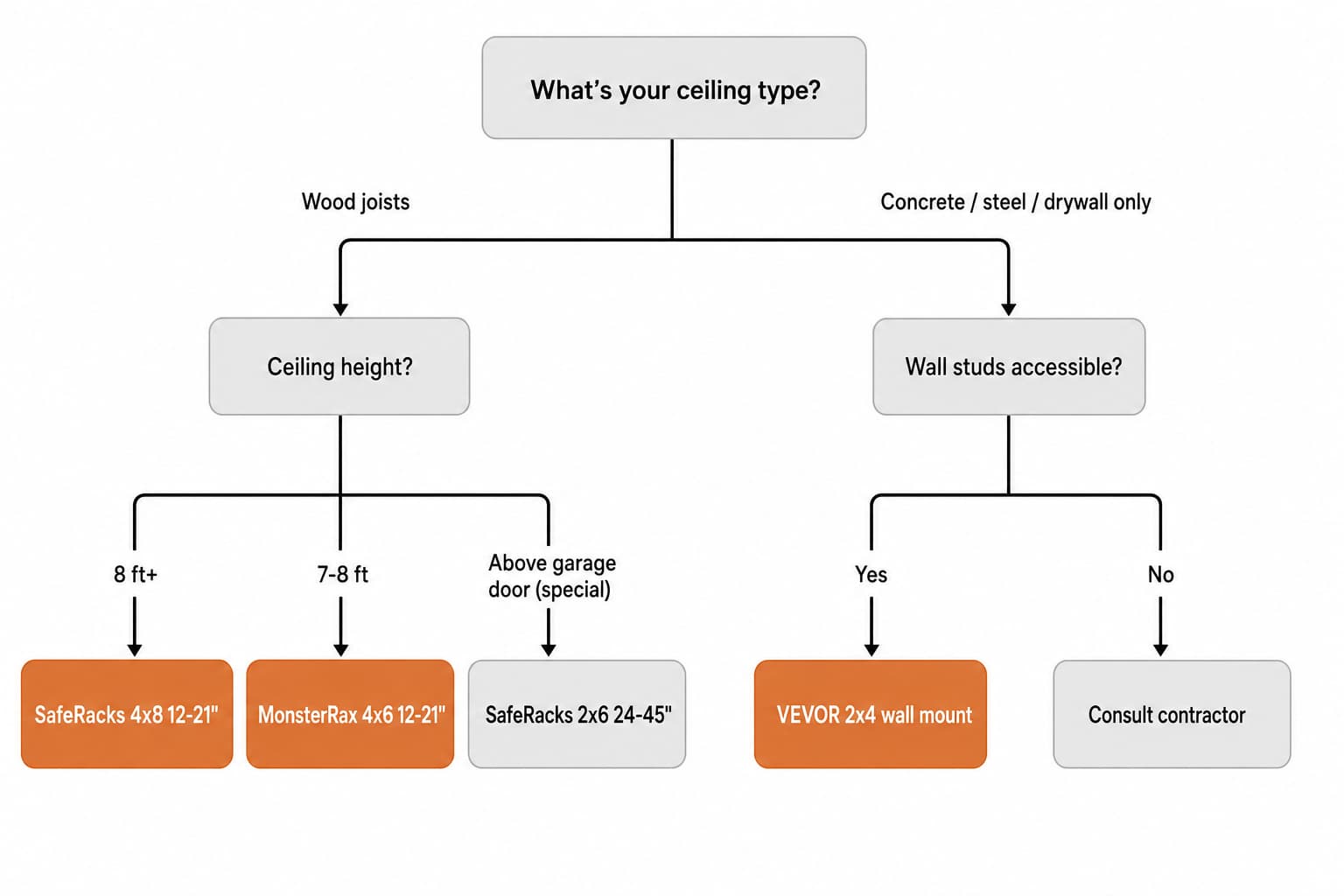
The decision in this category is mostly mechanical: subtract the rack’s planned drop from your ceiling height and confirm the result clears the head height of everyone walking under the rack. If the result is below 6 feet, the rack is wrong for the space.
| Ceiling height | Min drop required | Recommended pick |
|---|---|---|
| 8 ft and above | 24″ max acceptable | SafeRacks 4×8 12-21 (overshoots — drop more if you have room) |
| 7-8 ft | 12-21″ only | SafeRacks 4×8 12-21 OR MonsterRax 4×6 12-21 |
| Exactly 7 ft | 12″ only | MonsterRax 4×6 12-21 (smaller load on joists) |
| Below 7 ft | overhead not recommended | VEVOR 2×4 wall (or floor-standing alternative) |
| Above garage door (header step) | 24-45″ works in the taller cavity | SafeRacks 2×6 24-45 |
The matrix above is a starting point — your specific stored-item heights, joist depth, and garage door track position all modify the answer. The next section walks through the measurements.
How to Measure Your Garage’s Ceiling Constraint
Skipping these measurements is the most common low-ceiling buyer mistake. Five minutes with a tape measure avoids returning a rack that’s the wrong drop for your ceiling.
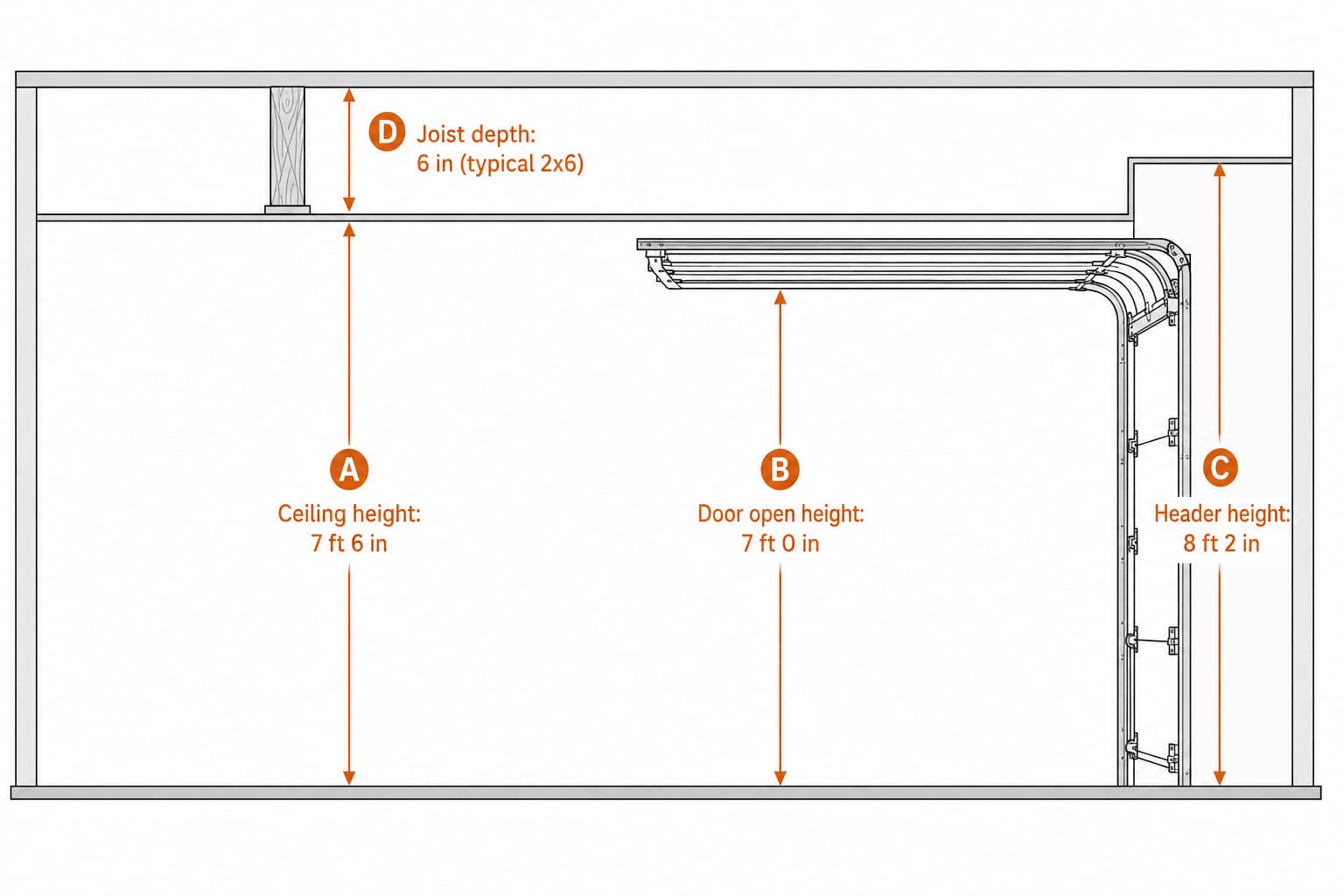
- Measure your main ceiling height — floor to ceiling at the centre of the garage, not at the door.
- Measure the height of the garage door when fully open. The door panels track horizontally at the top, ending up flush with the ceiling or just below.
- Measure the header height above the garage door — the ceiling above the door opening is often higher than the main ceiling. This is where the SafeRacks 2×6 fits.
- Locate ceiling joists with a stud finder. Note joist on-center spacing (16 inches or 24 inches) and joist depth (typical 2×6 or 2×8).
- List the items you intend to store on the rack and measure the tallest. Add 1-2 inches for slide-out clearance.
- Calculate: ceiling height minus rack drop minus item height = floor clearance. If this is less than 6 feet, the configuration won’t work.
Common Complaints and Buyer Warnings
Recurring feedback patterns in the low-ceiling segment cluster around three issues. First, buyers ordering standard 22-45″ drop racks for 7-foot ceilings is the most common — the listing says “adjustable” and the buyer assumes that includes a 12-inch minimum, when in fact the minimum is 22 inches. Second, drywall-only mounting fails the same way it does on standard ceilings — joists are non-negotiable, regardless of how short the drop is. Third, buyers underestimate the garage-door-track interference; the rack mounts behind the door’s open position fine, but anything closer to the door overlaps with the track when the door rolls up.
The single most important warning in this category: read the minimum drop number, not the “adjustable” label. If the listing says “Adjustable 22-45 inches”, the minimum is 22 inches — too tall for a 7-foot ceiling. The picks in this guide all start at 12 inches except Slot 5 (which is the above-door exception). For broader low-storage planning that doesn’t depend on ceiling structure, see our compact garage shelving guide.
Who Should Avoid Low-Ceiling Overhead Storage?
Renters who can’t drill into ceiling joists are first — even if your ceiling has joists, drilling without permission is the wrong call. Garages with concrete or steel-joist ceilings are second — these structures aren’t rated for the racks in Slots 1-3 and Slot 5; only the wall-mounted VEVOR (Slot 4) sidesteps this. Households storing tall items (kayaks, ladders, long lumber) on a 7-foot-ceiling garage are third — the overhead solution doesn’t have headroom for the items themselves. Below-grade or basement garages with ceilings under 6.5 feet are fourth — the math doesn’t work even at 12-inch drop, since 6.5 – 1 = 5.5 feet of platform clearance isn’t usable.
For these cases, a floor-standing rack or a low-wall-mounted shelf is the right alternative.
FAQ
What’s the minimum ceiling height for overhead storage?
For a workable overhead rack with the racks in this guide, 7 feet is the practical minimum. At 7 feet ceiling minus 12-inch drop, the platform sits at 6 feet — clear for most adults. Below 7 feet, the math breaks down even at the shortest mass-market drop, and a wall-mounted alternative becomes the right answer.
Why does 24-inch drop seem too low?
Because most racks are designed for 9-foot or higher ceilings, where 24 inches of drop still leaves 7 feet of headroom underneath. On a 7-foot ceiling, 24 inches lands the platform at 5 feet — below average adult head height. The “adjustable” label on standard racks usually means a 22-45-inch range, not a 12-21-inch range. Read the minimum drop number explicitly.
Can I use a standard 4×8 rack on a 7-foot ceiling?
Only if the rack’s drop range starts at 12-21 inches like the SafeRacks variants in Slots 1 and 2. A standard 22-45-inch drop rack on a 7-foot ceiling lands the platform at 5 feet, which doesn’t clear adult head height. Don’t try to “lower” a standard rack manually — the drop tubes are sized for specific ranges.
How do I store overhead if my ceiling is concrete?
Standard residential overhead racks are not rated for concrete ceilings. The wall-mounted VEVOR 2-by-4 shelving in Slot 4 is the alternative. Engineered concrete-anchor systems exist but require contractor specification, drilled inserts, and higher-load anchors than what ships with these racks. Don’t try to retrofit a wood-joist-rated rack onto concrete.
Will an overhead rack block my garage door?
Only if it’s mounted in the door’s open path. A garage door, when open, tracks horizontally along the ceiling. Mount your rack behind the door’s open position (closer to the rear wall), or use the SafeRacks 2-by-6 above-door rack in Slot 5 to put storage in the cavity above the open door. Confirm the door track location and the rack’s planned position before installing.
4×6 vs 4×8 — when should I downsize?
Downsize to 4-by-6 when (a) you don’t have 32 square feet of seasonal storage to put up, (b) the joists are marginal (older home, narrower spans), or (c) the visual mass of an 8-foot rack is too much for a small garage. For most 7-foot-ceiling garages, the 4-by-6 is the safer and more proportional pick.
How do I install above the garage door?
Locate the joists in the cavity above the door (often perpendicular to the door opening), measure the cavity height, and confirm the SafeRacks 2-by-6 fits with the 24-inch minimum drop without conflicting with the open door’s clearance. The above-door installation is more involved than a standard overhead install — most buyers either DIY with help or hire SafeRacks’ installation service for this specific case.
Sources Reviewed
For this guide, we reviewed manufacturer product information, retailer specifications, Amazon product listings, public customer feedback patterns, and overhead-storage-specific discussions. We focused on product details that matter for low-ceiling installations, including manufacturer-listed minimum ceiling drop, platform dimensions, joist-mount requirements, the structural ceiling types each product is rated for, and the garage-door-track-clearance specifications.
Related Guides
- Best Overhead Garage Storage Racks
- Best Ceiling Storage Racks for Garage
- Best Garage Shelving for Low Ceilings
- Best Garage Storage for Renters
- Best Shelving for Small Garages