Open Shelving vs Closed Cabinets in a Garage: Which Wins?
Last updated:
Disclosure: This article contains affiliate links. If you buy through these links, we may earn a commission at no extra cost to you. We do not claim hands-on testing unless clearly stated.
Most garage owners haven’t bought either yet — they’re at zero, deciding what to install first. The choice shapes years of garage organization downstream, because the system you commit to first anchors what you add next.
This guide compares both options through three decision variables and recommends two products per side. It does not cover ceiling racks, free-standing tool chests, or pegboard — separate categories.
Quick Answer
For high visibility, ventilation, and maximum capacity per dollar, open shelving usually wins. For concealment, dust protection, lockability, and a finished look, closed cabinets usually win. The decision often comes down to one question: do you ever need to lock or hide what’s inside?
Best Choice by Situation
| Situation | Better choice | Why |
|---|---|---|
| Heavy bins and totes you reach for weekly | Open shelving | No door to open, no swing clearance needed |
| Hazardous items (paint, solvents, sharp tools) with kids around | Closed cabinets | Lockable doors keep children out |
| Dusty garage or active workshop | Closed cabinets | Doors block dust and sawdust on stored items |
| Tight wall with limited swing clearance | Open shelving | No door arc into the walkway |
| Garage doubles as a living or entertainment space | Closed cabinets | Finished look hides clutter visually |
| You’ll change your storage layout every few years | Open shelving | Adjustable shelves move tool-free |
If you want a broader comparison frame, our shelving vs cabinets pillar comparison walks through the same decision from scratch with more category context.
Open Shelving — Pros, Cons, Best Use Cases
What it is
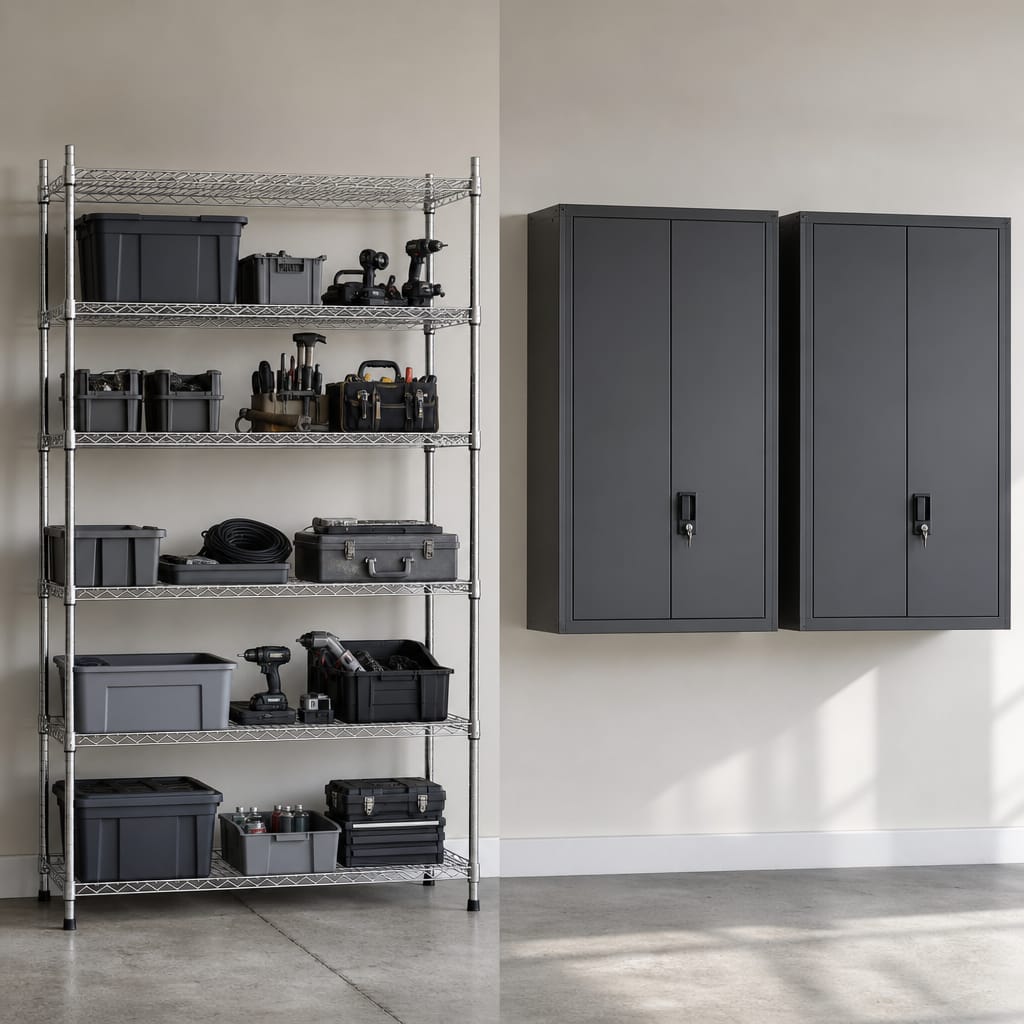
Open shelving is freestanding or wall-mounted storage with no doors and no enclosing body. Common formats are wire shelving (plated steel, sometimes NSF-certified) and solid-deck steel. The defining attribute is unobstructed access from any side and full visibility of contents.
Where it works best
- High-turnover items: bins of seasonal gear, sports equipment, household overflow
- Bulky totes accessed weekly — a cabinet door becomes unnecessary friction
- Tools you grab without thinking — drills, extension cords, leaf blowers
- Tight aisles where a cabinet door swing would block the path
- Damp or humid garages where airflow matters
Where it falls short
- Zero dust protection
- Visual clutter is the cost of visibility
- No lock for hazardous items
- Items can shift or slide off under vibration if not bin-contained
What manufacturers and retailers typically specify
A good open-shelving product page lists per-shelf capacity in two configurations: on leveling feet and on casters. Capacity often drops 80 to 90 percent when shelves move to casters. The page should also specify shelf depth (the binding constraint for tote storage) and whether the unit is NSF-certified.
Buyer warnings specific to open shelving
- Depth matters more than people think. A 14-inch wire shelf is too shallow for most 18-gallon and 27-gallon totes — they overhang at the front edge. Measure your bins first; 18-inch depth is the residential-garage minimum for tote storage.
- Casters and leveling feet swap the load math entirely. If the manufacturer-listed capacity is 800 lb per shelf “on leveling feet,” that figure does not apply once you wheel the unit around the garage.
Closed Cabinets — Pros, Cons, Best Use Cases
What it is
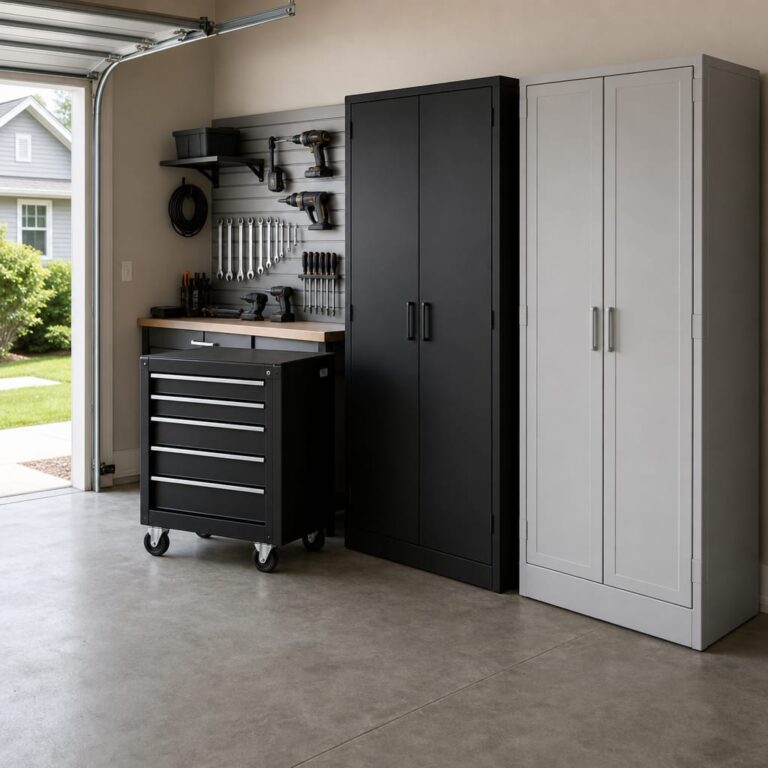
Closed cabinets are enclosed steel boxes with hinged doors, wall-mounted or floor-standing. Most have a keyed lock or padlock loop. The defining attribute is concealment plus access control.
Where it works best
- Hazardous items with kids or pets at home: paint, solvents, sharp tools
- Dust-sensitive items: electronics, paperwork, anything where coating equals damage
- Visual cleanup of a multi-use garage (home gym, hangout space)
- Lockable storage for theft-vulnerable gear or insurance-required safe storage
The full case for closed cabinets, including modular system options, is laid out in our best garage storage cabinets roundup.
Where it falls short
- Significantly lower per-shelf capacity than open shelving in the same footprint
- Higher cost per cubic foot of usable storage
- Door swing eats clearance — a 28-inch cabinet door swings 28 inches into the aisle
- Less flexible — most have fixed shelf spacing
What manufacturers and retailers typically specify
Cabinet listings should specify total capacity AND per-shelf capacity (the per-shelf number is often much lower than the total divided by shelf count), steel gauge (lower number means thicker metal), welded vs ready-to-assemble (RTA) construction, locking mechanism, and mounting style.
Buyer warnings specific to closed cabinets
- RTA cabinets and welded cabinets share a category label but not engineering. RTA serves light-to-medium loads; welded handles heavier gear. Read the manufacturer-listed per-shelf capacity, not the marketing tier name.
- Wall-mounted cabinets need stud anchoring at every fastener point. Drywall-only anchoring voids the manufacturer-listed capacity rating regardless of what the cabinet weighs empty.
- Cabinet locks deter casual access but are not security-grade. A determined teenager or thief gets through a standard cabinet lock in seconds.
Side-by-Side Comparison
Where the two systems differ in practice, not just on paper:
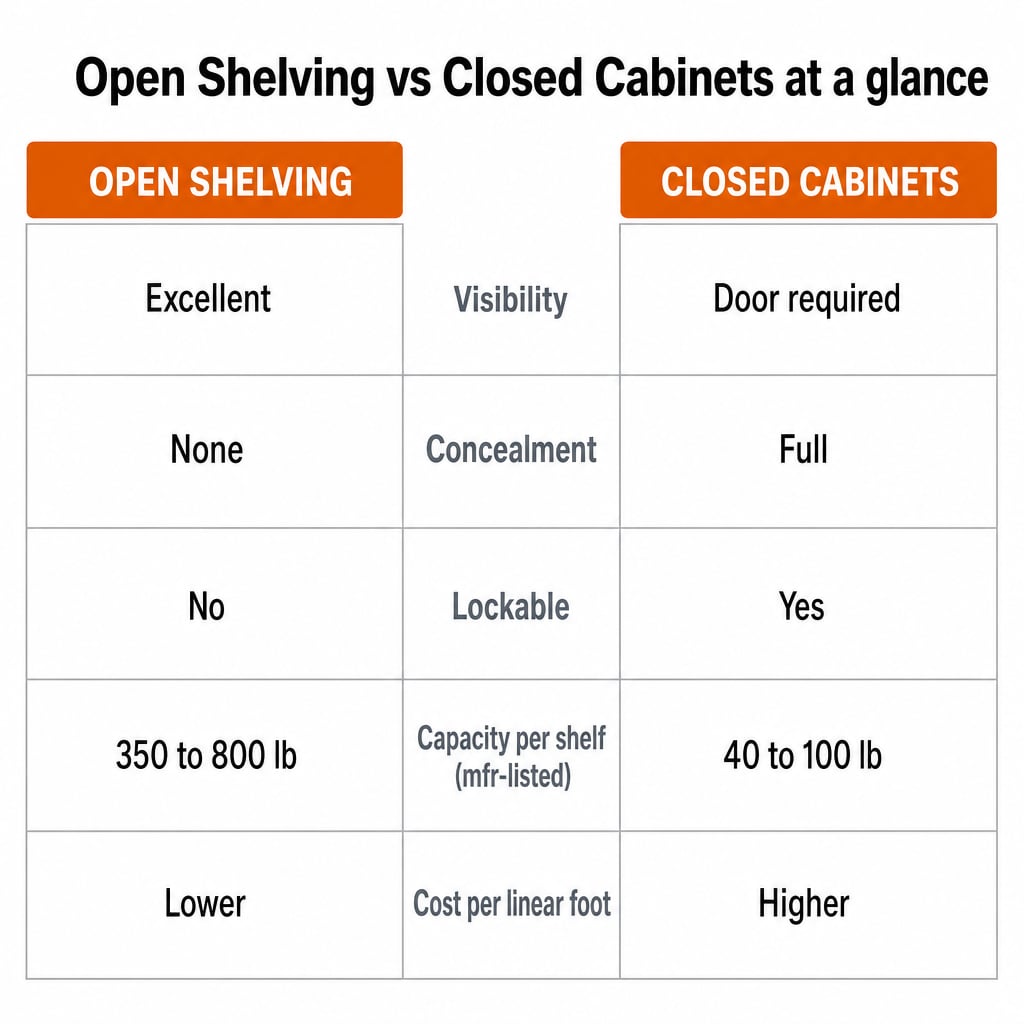
| Factor | Open Shelving | Closed Cabinets |
|---|---|---|
| Visibility / instant access | Excellent | Requires opening a door |
| Concealment / aesthetics | Low (everything visible) | High (clean wall surface) |
| Dust and debris protection | None | Good (with door seal on better models) |
| Lockable | No | Yes (most have keyed or padlock loops) |
| Max manufacturer-listed capacity per shelf | 350–800 lb typical | 40–100 lb typical |
| Cost per linear foot of usable storage | Lower | Higher |
| Reconfiguration effort | Adjust shelves tool-free | Fixed shelf spacing typically |
The per-shelf capacity gap is the headline number. Open shelving routinely runs five to ten times more weight capacity per shelf than a wall cabinet of comparable footprint, because the cabinet body itself consumes engineering capacity an open frame doesn’t pay. For dense items (full toolboxes, paint cans, batteries), open wins on payload almost regardless of price.
How to Decide for Your Garage
The decision usually clarifies after three sequential questions. Run them in order — the answer to the first sometimes makes the others moot.
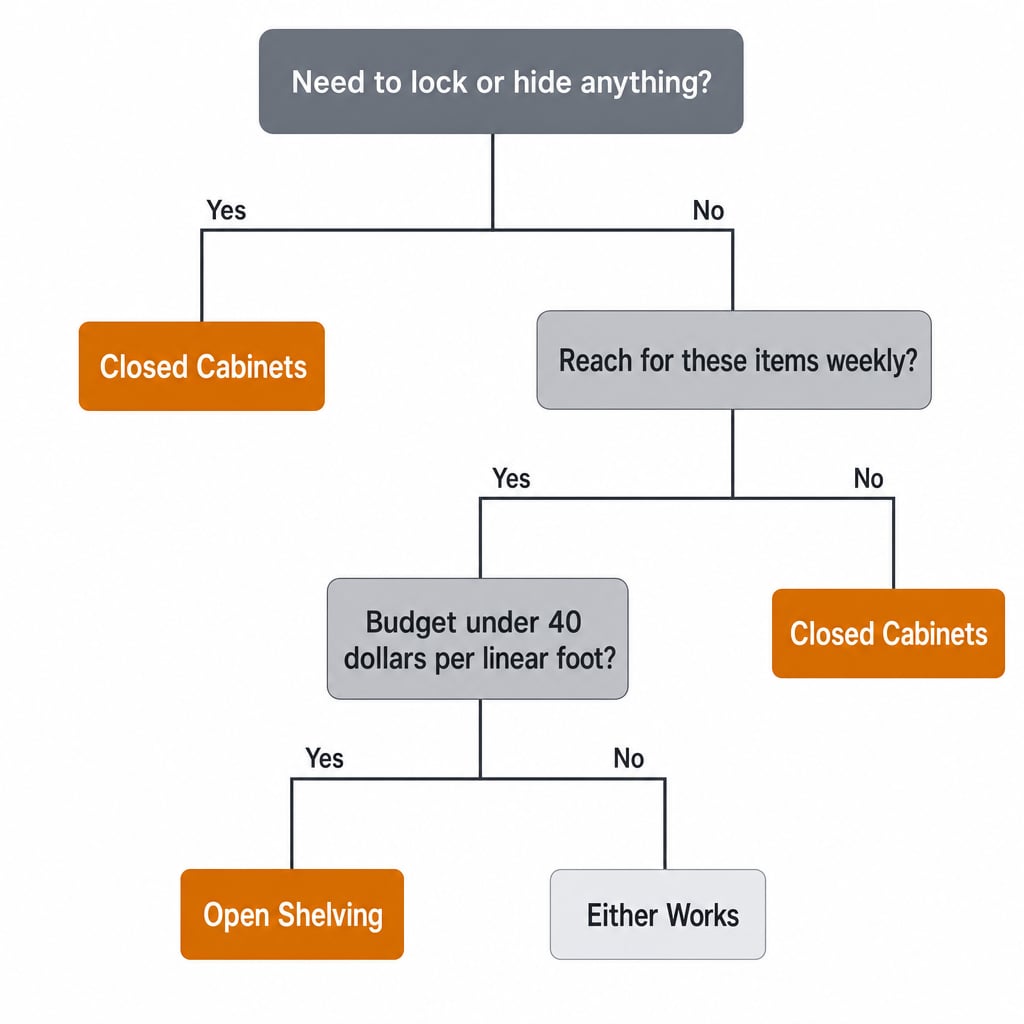
- Are you storing anything that needs to be locked away from kids, pets, or visitors? Yes → closed cabinets win for those items, even if you keep open shelves for everything else. Hazardous chemicals, sharp tools, anything an insurance policy would call “reasonable care” storage.
- Will you reach for these items multiple times a week? Yes → open shelving usually wins. No → cabinets are fine; the cleaner look matters more than access friction.
- What’s your budget per linear foot of usable storage? At entry-level pricing (under roughly 40 dollars per linear foot), open shelving wins. At mid-tier (60 dollars per linear foot or more), either works. In between, consider a hybrid.
Most garages end up with a hybrid: open shelving for bins and tools, closed cabinets for the hazardous or sensitive items. If you’re starting from scratch, see the best garage shelves for bins for the open side.
Common Mistakes
Mistake: Buying cabinets for items that don’t need concealment. Reader sees cabinets in a magazine, buys them, then realizes most of what’s inside is just totes and tools grabbed daily. Doors add friction for no benefit. Cabinets earn their cost for items that need locking or hiding, not general storage.
Mistake: Assuming open shelving means weak storage. A 5-tier NSF wire shelving unit holds significantly more weight per shelf than most wall cabinets in the same footprint. The cabinet body consumes engineering capacity that isn’t there in an open frame.
Mistake: Ignoring depth on open shelving. 14-inch shelves are common at the budget end. 18-gallon and 27-gallon totes do not fit on a 14-inch shelf without overhang. Measure the totes you plan to store before ordering; depth, not width, is usually the binding constraint.
Mistake: Treating RTA cabinets as equivalent to welded. Ready-to-assemble and welded steel cabinets share a category label but not engineering. RTA serves light-to-medium loads; welded handles heavier gear. Read the manufacturer-listed per-shelf capacity, not the marketing tier name.
Recommended Products for Each Side
Two open-shelving picks and two closed-cabinet picks, chosen for clear use-case fit. Each pick represents a distinct point on the open-vs-closed spectrum.
For open shelving (commercial-grade NSF): Seville Classics UltraDurable 5-Tier NSF-Certified Wire Shelving with Wheels, 36″ W x 18″ D x 72″ H
The open-shelving exemplar for readers who want maximum payload and depth for totes. Manufacturer-listed 800 pounds per shelf on leveling feet, with 18-inch depth that fits 27-gallon totes flush.
For open shelving (mainstream value): Amazon Basics 5-Shelf Heavy Duty Steel Wire Storage Shelves, 36″ x 14″ x 72″

A widely-stocked wire shelving option on Amazon at an entry-point price, manufacturer-listed at 350 pounds per shelf. Read the depth carefully: 14 inches is too shallow for 18-gallon and 27-gallon totes. Choose this for small-to-medium bins, hand tools, and supplies — not large totes.
For closed cabinet (mainstream RTA wall): Gladiator GAWG28KDYG Ready-to-Assemble 28-Inch 3/4 Door Wall GearBox

Long-running Gladiator wall cabinet in the ready-to-assemble line. Manufacturer-listed 150 pounds total, 40 pounds per shelf. Lockable; mounts to wall studs or directly to Gladiator GearWall and GearTrack channels — flexible enough to be the foundation for a coordinated multi-cabinet system later. The three-quarter door leaves a pass-through for power cords.
For closed cabinet (welded steel wall): Husky 29 in. H x 28 in. W x 12 in. D Steel Garage Wall Cabinet (G2802W-US)

The welded-steel contrast to Gladiator’s RTA pick. No knock-down assembly — arrives fully built. Lockable. The welded construction reads as a step up in build feel and durability for readers who plan to load the cabinet hard. For maximum loads, Husky also makes a 20-gauge Heavy Duty Welded line as an upgrade.
How many totes actually fit on a garage shelf
Tote makers publish dimensions and shelving makers publish dimensions, but nobody puts the two together — so people buy shelving, then discover their totes overhang it. This table takes the published external size of the common Sterilite totes and works out how many fit per shelf on the two garage shelving depths you can actually buy, 18 in and 24 in.
| Tote | Published dimensions (L × W × H) | Footprint | Height | Fits an 18 in deep shelf? | Per 48 × 18 in shelf | Per 48 × 24 in shelf | Specification source |
|---|---|---|---|---|---|---|---|
| Sterilite 27 Qt. ClearView Latch Box | 17" x 11 1/8" x 12 3/4" | 17 in × 11⅛ in | 12¾ in | Yes | 4 | 4 | Sterilite 27 Qt. ClearView Latch Box |
| Sterilite 66 Qt. ClearView Latch Box | 23 5/8" L x 16 3/8" W x 13 1/4" H | 23⅝ in × 16⅜ in | 13¼ in | Yes | 2 | 2 | Sterilite 66 Qt. ClearView Latch Box |
| Sterilite 106 Qt. Latching Box | 33 7/8" x 18 3/4" x 13" | 33⅞ in × 18¾ in | 13 in | No — it overhangs | 0 | 1 | Sterilite 106 Qt. Latching Box |
How these numbers were produced: External dimensions are quoted from Sterilite’s own product pages on the date shown. The counts are computed, not estimated: totes are placed in a single layer, all in the same orientation, with no overhang and no gap; both orientations are tried and the better one is kept. Shelf width is 48 in in both cases — the two depths correspond to real Husky configurations (48 × 18 in and 48 × 24 in). Round the result down again if your shelving has corner posts that intrude, and leave room to get a hand in.
- A tote that fits the shelf footprint still needs vertical room: check the tote height against your shelf spacing, and leave clearance to lift it in and out rather than sliding it flush.
- Counts assume a flat, full-depth shelf. Wire shelving with a lip, or posts at the corners, will cost you the last tote in a row.
- Lids overhang the base on most totes; the figures here are the manufacturer’s overall assembled dimensions, which already include the lid.
- Capacity in quarts tells you nothing about whether it fits — the 106 qt and the 66 qt are within a quarter-inch of each other in height, but 10 in apart in length.
- A blank cell means the manufacturer does not publish that figure — we do not fill gaps with numbers we could not source.
These are the entries that matter for this guide. The full table, with every row and its source, is in our guide to garage shelves for storage bins.
How to Measure Before Buying
Run this checklist before ordering either system:
- Wall length (cabinets) or floor footprint (shelving) — measure the run clear of windows, outlets, and door swings
- Vertical clearance — to garage door tracks, light fixtures, and existing storage
- Door swing clearance (closed cabinets only) — a 28-inch wide cabinet door swings 28 inches into the aisle
- Tote dimensions — 27-gallon totes are 20.5 inches wide; 14-inch shelves do not fit them
- Stud locations — wall-mounted cabinets and wall-anchored shelves need stud anchoring at every fastener
- Load math — total weight planned, multiplied by 1.3 safety factor, compared to manufacturer-listed per-shelf capacity
FAQ
Can I combine open shelving and closed cabinets in the same garage?
Yes — most garages benefit from a hybrid. Cabinets for hazardous, lockable, or dust-sensitive items; open shelves for high-turnover bins and tools. Pick brands based on wall-system compatibility. Gladiator wall systems, for instance, accept both cabinets and shelving rails on the same channel.
Are closed cabinets really safer for chemicals and paint?
Yes, if locked. The lock matters more than the steel. Storing paint, solvents, and similar items in a locked cabinet meets most homeowners’ insurance “reasonable care” expectations and keeps children out. An unlocked cabinet offers the same safety as an open shelf.
What’s the cheapest way to store totes — shelves or cabinets?
Open shelving, almost always. A 5-tier 36″×18″ wire shelving unit holds significantly more cubic feet of totes per dollar than a wall cabinet of equivalent footprint. For pure tote storage, shelves built for storage totes win the cost-per-cubic-foot calculation.
Do open shelves tip over more easily than cabinets?
No. Both are equally stable when anchored. Open shelves can tip if loaded asymmetrically with heavy items high up; cabinets the same. Anchor the top of any tall freestanding unit to a wall stud as a baseline.
Will a wall cabinet hold a full ladder or bike?
No. Wall cabinets are sized for boxes, tools, and supplies — not long-handled items or bicycles. Those belong on wall hooks or rails, separate categories from both shelving and cabinets.
What about hybrid systems like NewAge or Gladiator that combine cabinets and shelves?
Excellent option if you’re starting from scratch and want a coordinated look. Modular systems let you mix cabinets, shelves, and workbench in one finish. Buy them as a system; mixing brands later loses the visual coherence that justified the premium.
Sources Reviewed
For this comparison, we reviewed manufacturer pages and retailer specifications for Seville Classics and Amazon Basics on the open-shelving side and Gladiator and Husky on the closed-cabinet side. We also reviewed product listings, recurring patterns in public customer feedback, and discussions where homeowners shared real-world experiences choosing between open and closed garage storage. We do not claim hands-on testing of any product.
Related Guides
- Garage Shelving vs Garage Cabinets: Which Is Better? — the wider pillar comparison spanning both categories at the system level
- Best Garage Storage Cabinets for Cluttered Garages — full cabinet roundup with multiple price tiers
- Best Garage Shelves for Storage Bins and Totes — the open-shelving side, focused on bin compatibility