How to Choose Garage Cabinets
Last updated:
Disclosure: This article contains affiliate links. If you buy through these links, we may earn a commission at no extra cost to you. We do not claim hands-on testing unless clearly stated.
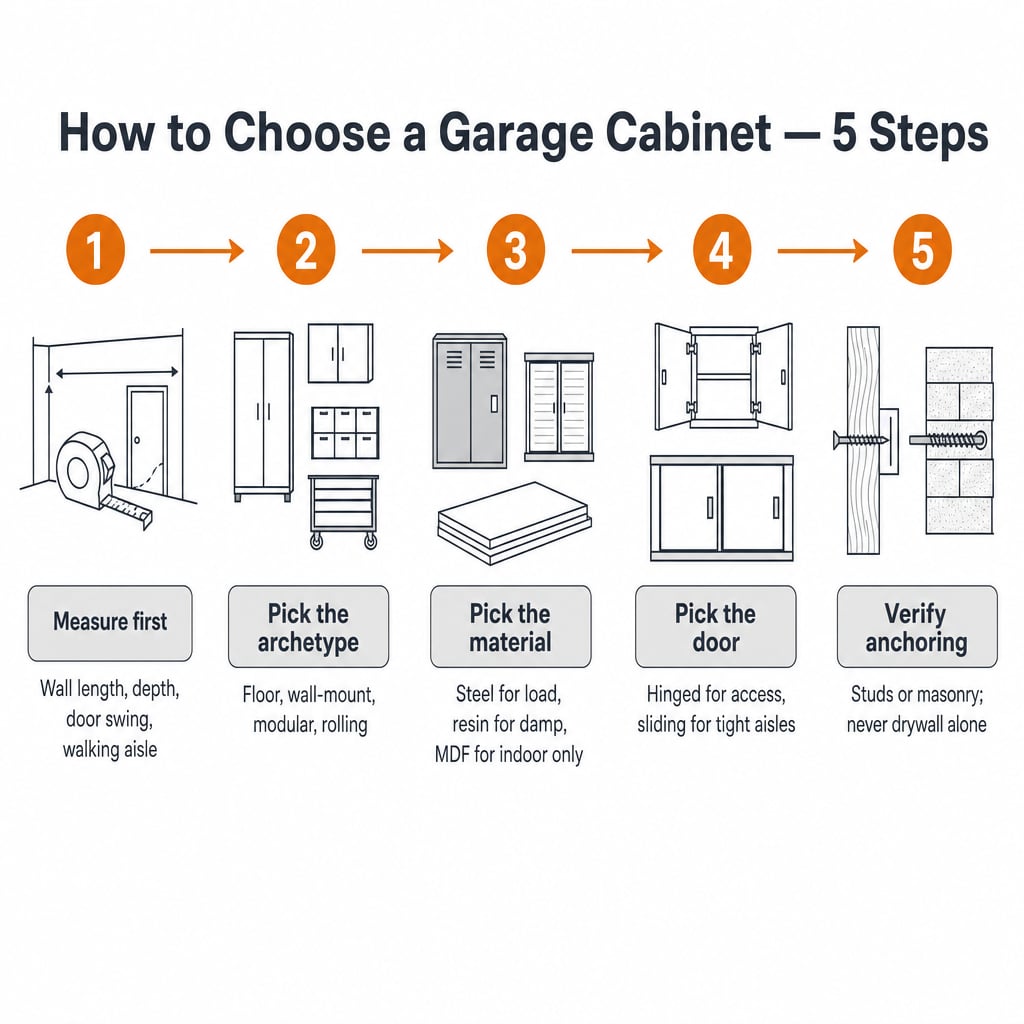
Garage cabinets are the step up from open shelving when you want dust, kids, or visitors kept out of paint, lawn chemicals, and power-tool batteries. The decision isn’t a single product choice — it’s four smaller decisions stacked: cabinet archetype (floor-standing, wall-mounted, modular, rolling), material (steel, resin, MDF), door type (hinged, sliding, open-front), and anchoring path (studs, masonry, or none). Each rules out some products and points you at others. This guide walks through the four decisions, the measurements to take first, and three picks that anchor the most common cases. If you’re still deciding between open shelving and closed cabinets, start with our shelving vs cabinets comparison and come back once you’ve settled on closed storage.
Quick Recommendation by Use Case
| Use case | Best cabinet type | Why |
|---|---|---|
| Renter, no drilling allowed | Floor-standing or rolling tool cabinet | Freestanding; no wall anchoring required |
| Damp or humid garage | Floor-standing resin cabinet | Won’t rust; tolerates water tracked in from cars |
| Lockable steel with adjustable shelves | Floor-standing welded steel | Integrated lock; shelves move for tall items |
| Mobile workshop, move it where the work is | Rolling tool cabinet on casters | Locking casters; lockable drawers; rolls out and back |
| 2-car shared garage, want floor clear | Wall-mounted cabinet above the bench | Floor stays clear; needs stud or masonry anchoring |
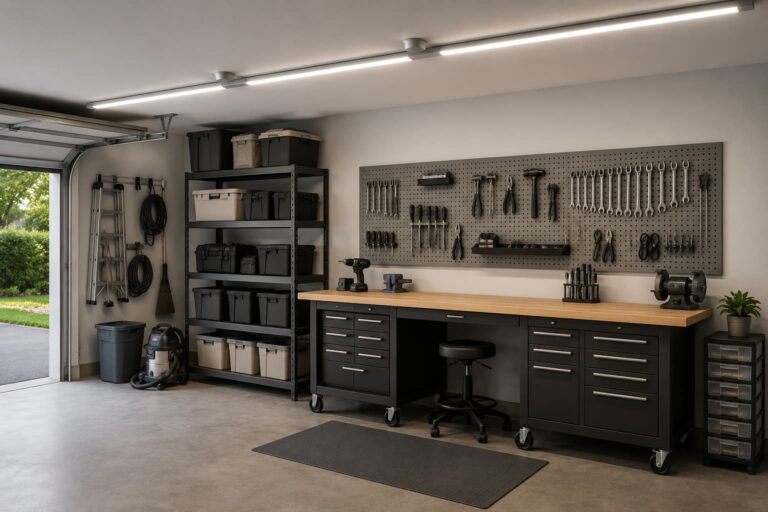
| Tools above work area, no enclosed doors needed | Modular wall system (pegboard or slatwall) | Verticalises tools; not technically a cabinet |
If you only read one section, read the measurement checklist below. The most common mistake is ordering a cabinet before measuring the wall, the depth, and the parked-car door swing — and discovering at delivery that the doors hit the car.
Key Factors to Consider
Wall-mounted vs floor-standing vs modular vs rolling
The first decision is the archetype, because everything else flows from it.
- Floor-standing cabinets sit on the floor like furniture. They need leveling feet on uneven concrete (most garage floors slope toward the door). They don’t need wall anchoring for the structural load, though manufacturers recommend an anti-tip strap into a stud at the top.
- Wall-mounted cabinets hang above the floor, typically 18 to 24 inches above the bench surface. They MUST be anchored into structural framing — studs, or masonry anchors in block/concrete. Drywall toggles alone are not safe for cabinet weight.
- Modular wall systems are kits of matched units (cabinet boxes, drawer modules, hutch, side panels) that bolt together along a wall. Branded systems (NewAge, Gladiator) are flexible but expensive, and SKUs rotate frequently — verify which pieces ship in the bundle.
- Rolling tool cabinets are floor cabinets on casters. The trade-off is mobility for static capacity — rated for the caster load (about 1,000 lb manufacturer-listed on typical five-inch casters), not per-shelf load.
Material (steel, resin, MDF)
Three materials cover most of the residential market.
- Welded steel (powder-coated) is the workshop default. Highest per-shelf capacity, carries hand tools, batteries, and paint cans without bowing. The trade-off is rust — bare-edged steel near humidity will eventually corrode. Powder-coat helps but doesn’t eliminate the risk.
- Resin (high-density polyethylene-equivalent plastic) tolerates damp without rusting. The cost is lower per-shelf capacity — typically about 75 lb per shelf manufacturer-listed. Right answer in humid garages, garages that see water tracked in, or storage of garden chemicals.
- MDF and finished plywood appear in some listings but don’t tolerate humidity. MDF swells, delaminates, and fails at the screw points. Treat MDF cabinets as indoor-only storage — fine in a climate-controlled garage, a poor fit otherwise.
Door type (hinged, sliding, open-front)
- Hinged double doors are the standard. Full unobstructed access when open. The cost is door swing — a 36-inch cabinet with 18-inch doors each needs about 18 inches of clear floor in front for the doors to open.
- Sliding doors save the door swing footprint, which matters in tight aisles or near a car door swing. The trade-off is access — only half the cabinet open at a time.
- Open-front cabinets are technically a wire-shelving frame with a closed back. Closer to shelving than cabinets; fast access, no door swing, no privacy or dust protection. Right answer for high-turnover storage.
Per-shelf capacity (manufacturer-listed)
The capacity number on the listing is the manufacturer-listed value under ideal conditions: assembled correctly, level floor, even weight distribution, hardware tightened to spec. Real-world capacity is usually lower because at least one condition is imperfect.
Capacity varies by material:
- Welded steel cabinets typically list 50 to 200 lb per shelf depending on shelf gauge and span
- Resin cabinets list about 50 to 100 lb per shelf
- Rolling tool cabinets list per DRAWER (typically 75 to 100 lb manufacturer-listed), not per shelf
Anchoring requirements (especially for wall-mounted)
Wall-mounted cabinets are where anchoring is non-negotiable. The manufacturer’s install manual specifies the wall requirement — wood studs at 16-inch on-center spacing, masonry anchors for block or concrete, or specific drywall-toggle hardware rated for the loaded weight. Drywall alone with generic toggle bolts is not safe for cabinet load.
If you can’t identify the wall framing — for example, you rent and don’t know whether the wall has studs, blocking, or only drywall — the safer path is a floor-standing cabinet or a rolling cabinet. For ambiguity beyond that (older homes, finished basements, walls with HVAC or wiring behind them), consult a contractor before drilling.
Cabinet Types Explained
Floor-standing cabinets
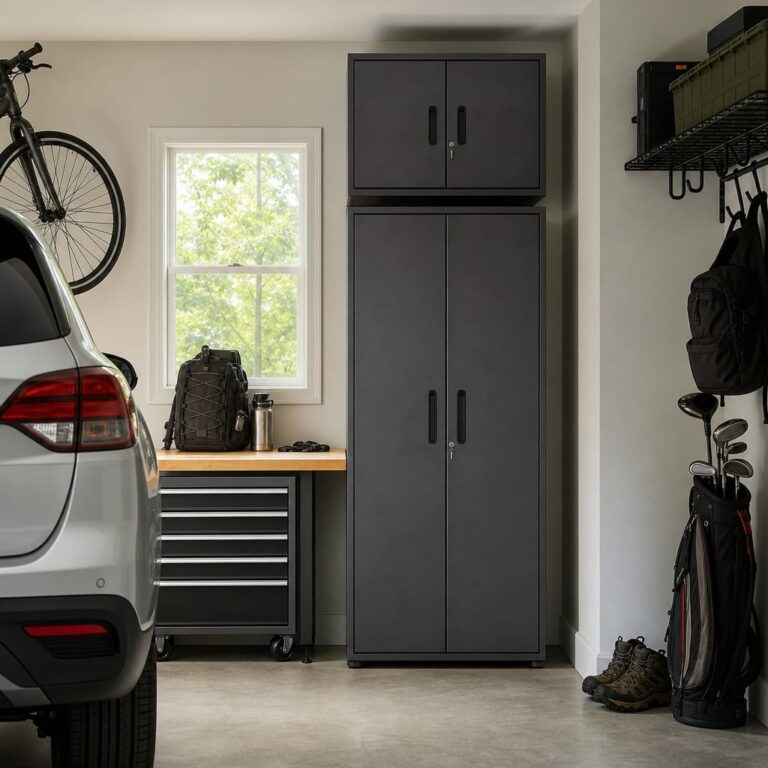
The default archetype. 4 to 5 shelves, hinged doors, sits on the floor. Best for: garages with floor space along a wall, especially uneven concrete. Limitations: takes 18 to 24 inches of depth. What to look for: leveling feet, adjustable shelves, anti-tip strap point.
Wall-mounted cabinets
Cabinets that hang above the floor, leaving floor space clear. Best for: 2-car garages where the wall above the bench is available. Limitations: must anchor into studs or masonry. What to look for: manufacturer’s specified hardware, stud spacing assumptions, total loaded weight rating. For deeper picks, see our small-garage cabinet roundup.
Modular wall cabinet systems
Kits of matched cabinets that bolt together along a wall. Best for: building a full wall of garage storage in one purchase. Limitations: expensive; SKUs rotate — verify which pieces ship in the bundle. What to look for: stud-mount rail systems, modular drawer inserts.
Rolling tool cabinets
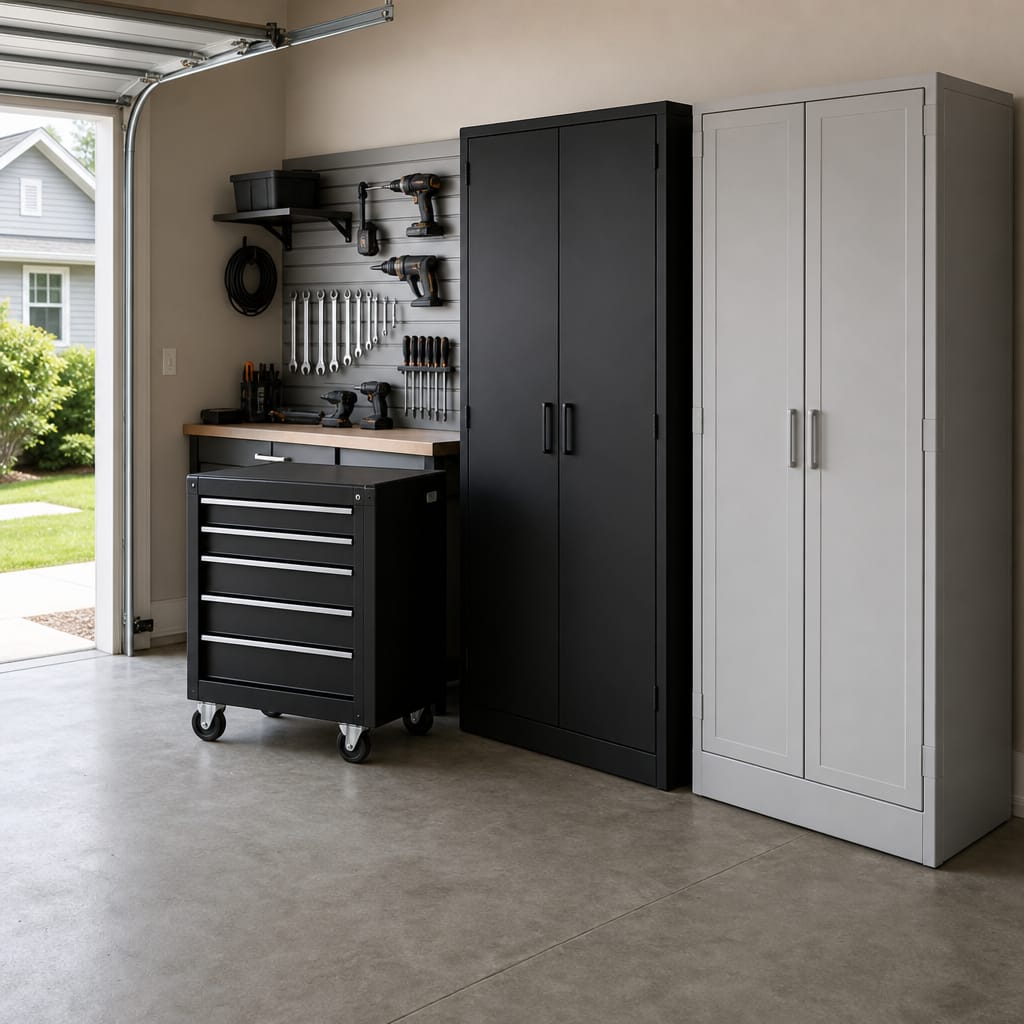
Floor cabinets on casters, typically drawer-based. Best for: workshop areas where the cabinet has to roll to the work, and renters who want lockable storage without anchoring. Limitations: capacity rated per drawer, not per shelf. What to look for: locking casters, soft-close slides, per-drawer capacity. For workbench organization once you’ve picked a rolling cabinet, see our guide to organizing a garage workbench.
When to Choose Each Type
The decision comes down to garage conditions plus your constraints. The matrix below maps four common scenarios to the four archetypes.
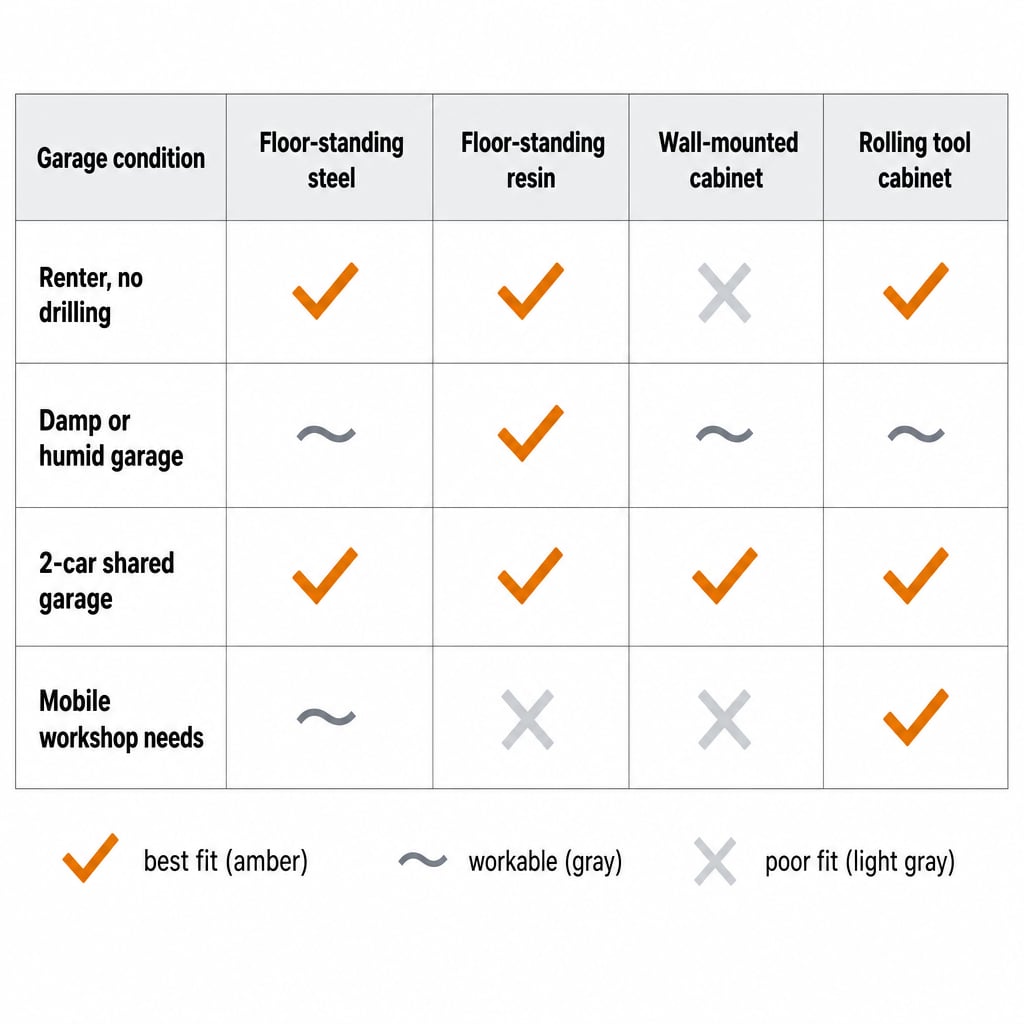
- Renter, no drilling → floor-standing or rolling. Wall-mounts need anchoring.
- Damp or humid garage → floor-standing resin. Steel works but invites rust over years.
- 2-car shared garage → any archetype works. Wall-mount opens the floor; floor-standing is simpler to install.
- Mobile workshop needs → rolling tool cabinet. Static cabinets are wrong for this case.
For the broader decision between cabinet types and open shelving, see our shelving vs cabinets comparison.
Measurement Checklist
Before ordering any cabinet, measure the garage. Start with the wall section and end with the door swing.
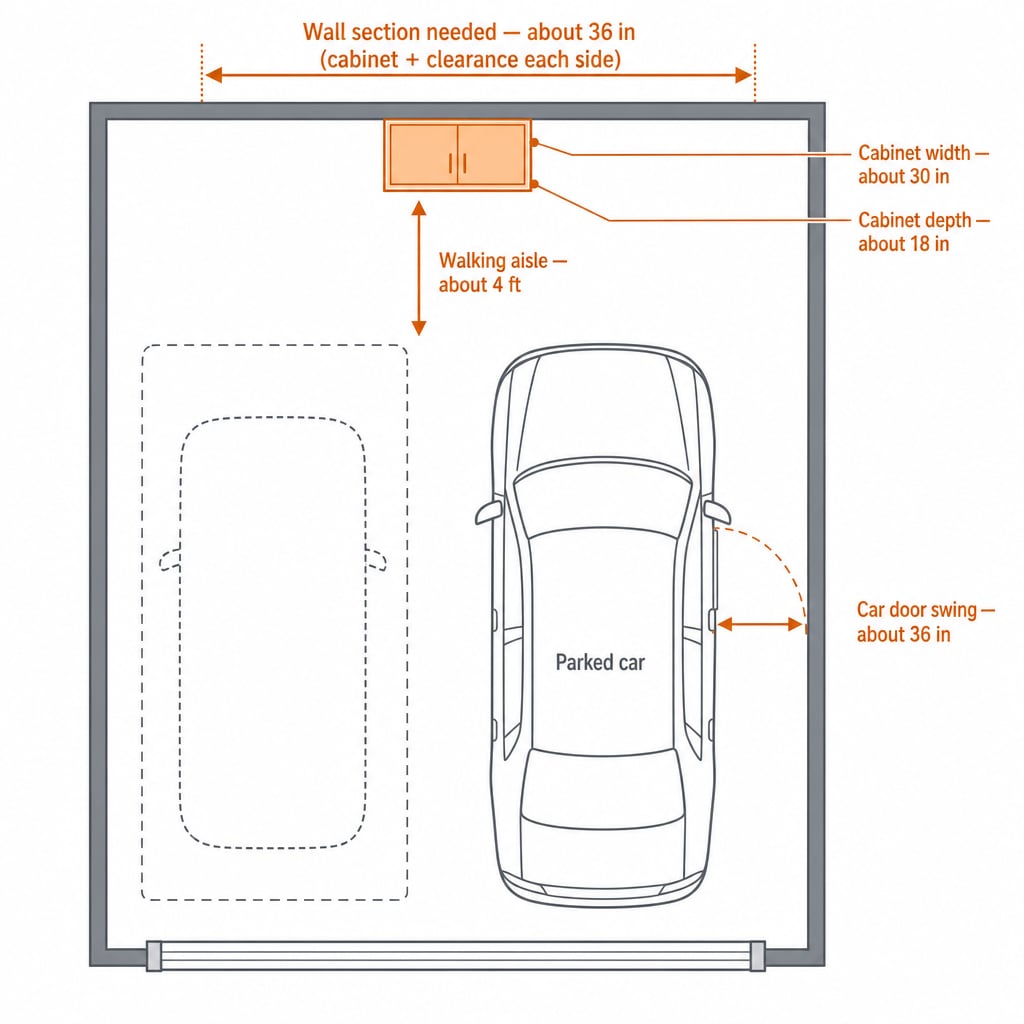
- Wall section. Mark the cabinet width on the wall with painter’s tape. Add 6 inches of clearance on each side.
- Cabinet depth. Floor cabinets are typically 18 inches deep; wall-mounts 12 to 16 inches. Measure how far the cabinet projects and whether the parked car will fit alongside.
- Walking aisle. At least 36 inches between the cabinet face and the parked car. Tighter than that and you scrape paint.
- Car door swing. With the car door fully open, does it hit the cabinet? Most sedans need about 36 inches of swing clearance. SUVs and trucks need more.
- Cabinet door swing. Hinged double doors take about half the cabinet width on each side. Verify the arc doesn’t hit anything.
- Ceiling clearance (wall-mounted only). Top of cabinet plus hardware needs clearance from the garage-door opener bracket and any low joist.
- Stud locations (wall-mounted only). Stud finder, painter’s tape mark, pilot drill before lag screws. US garage walls typically have studs at 16-inch on-center spacing.
- Floor slope (floor cabinets). Set a 4-ft level at the planned spot. If slope exceeds half an inch across the footprint, plan on leveling feet — and pick a cabinet that has them.
For totes that will live inside the cabinet, measure the tote with the lid on; latches add about an inch to the height.
Mistakes to Avoid
Most cabinet mistakes trace back to one of four patterns.
Mistake 1: Ordering before measuring the wall AND car door swing. A 36-inch cabinet looks small online and crowds a 1-car garage in person. Painter’s tape the cabinet outline on the floor; open the car door fully; verify nothing collides.
Mistake 2: Mounting a wall cabinet to drywall alone. Drywall toggles cannot carry cabinet weight reliably. Hit the studs with lag bolts, or use masonry anchors for block/concrete. If the framing isn’t identifiable, a floor-standing cabinet is the safer default.
Mistake 3: Assuming all “garage” cabinets tolerate damp. MDF cabinets advertised for the garage exist; they don’t tolerate humidity well. Resin or powder-coated steel is the safer choice for any garage that sees water tracked in, summer humidity, or cold-weather condensation.
Mistake 4: Buying a rolling tool cabinet and expecting per-shelf cabinet capacity. Rolling tool cabinets are drawer-based — capacity is listed per drawer (commonly 75 to 100 lb manufacturer-listed), not per shelf. A rolling cabinet won’t hold a 50-lb tote on a shelf the way a static cabinet will.
Safety and Installation Notes
Three rules apply across all four archetypes:
- Hit a stud or masonry, never just drywall, for any wall-mounted cabinet. Lag bolts into wood framing is the minimum; masonry anchors for block/concrete.
- Install the anti-tip hardware on floor-standing cabinets. Manufacturers include a strap that anchors the top to a stud — install it.
- For walls where the framing is uncertain (older homes, finished basements, walls with wiring or HVAC behind them), consult the cabinet’s install manual first and a contractor if anything is ambiguous. Drilling into an unknown wall risks both the install and what runs behind the drywall.
Featured Picks
Below are three starting points — one per cabinet archetype. For deeper picks within a category, follow the link to the matching roundup.
Best resin floor cabinet for damp garages: Suncast Tall Resin Storage Cabinet
A floor-standing resin cabinet, the listing states approximately 30 by 20.25 by 72 inches, with double hinged padlock-ready doors and adjustable shelves. Manufacturer-listed at about 75 lb per shelf. The right pick when the garage sees humidity, condensation, or water tracked in — resin doesn’t rust the way bare-edged steel does over years.
Best lockable steel cabinet with adjustable shelves: Letaya Tall Metal Storage Cabinet

A welded-steel floor-standing cabinet, the listing notes 5 adjustable shelves, integrated lock with 2 keys, and a powder-coated black finish. About 31.5 by 15.7 by 70.9 inches per the listing. The 15.7-inch depth is shallower than many floor cabinets, which helps in narrow garages.
Best rolling tool cabinet on casters: Husky 27″ 5-Drawer Mobile Tool Cabinet

A 27-inch rolling tool cabinet with 5 drawers on soft-close ball-bearing slides, manufacturer-listed at 100 lb per drawer. Welded steel with rust-resistant powder-coat. The five-inch casters (two stationary, two swivel with toe locks) carry a manufacturer-listed 1,000 lb total. Locking front pair stabilises the cabinet in use.
FAQ
How deep should a garage cabinet be?
Floor-standing garage cabinets are typically 18 to 22 inches deep. That holds gallon paint cans, standard totes, and most power tools. Wall-mounted cabinets are 12 to 16 inches deep so they don’t project into the walking aisle. Anything deeper than 24 inches starts to eat the parking spot.
Should I get hinged doors or sliding doors?
Hinged double doors give full unobstructed access but need about half the cabinet width as swing clearance on each side. Sliding doors save the swing footprint but only open half the cabinet at a time. Pick hinged when the cabinet sits in an open area; pick sliding when the cabinet is in a tight aisle or near a car door swing.
Do I need to anchor a floor-standing cabinet?
The cabinet doesn’t need wall anchoring for the structural load — it sits on its own feet. Manufacturers do include or recommend an anti-tip strap that screws into a stud at the top to prevent tipping if a heavy object on a top shelf shifts. Install it; the strap takes ten minutes.
Are resin cabinets durable enough for a workshop?
For paint, garden chemicals, sports gear, and seasonal items: yes. For heavy hand tools, batteries, and metal parts: the manufacturer-listed per-shelf capacity (commonly about 75 lb for resin) is the constraint. If your storage list includes anything dense, steel is the safer pick.
Can I lock a garage cabinet without a key?
Most steel garage cabinets ship with an integrated lock and 2 keys. Resin cabinets are usually padlock-ready — they have a hasp that accepts a separate padlock you supply. The padlock-ready design is more flexible (re-key without replacing the cabinet) but requires buying a padlock separately.
How tall a garage cabinet fits in a typical residential garage?
Most residential garages have 8 to 9 ft ceilings. A 72-inch (6-ft) cabinet leaves clearance for the garage-door opener bracket and low joists. A 96-inch (8-ft) cabinet only fits if the ceiling is at least 8.5 ft and clear of overhead obstruction. Measure ceiling height at the planned spot before ordering anything taller than 6 ft.
Sources Reviewed
For this buying guide, we reviewed manufacturer documentation for Suncast, Letaya, and Husky, the corresponding Amazon product pages for the three featured picks, and recurring patterns in public buyer discussions about garage cabinet selection. Product picks were cross-referenced against their Amazon listings during fact-check. We do not claim hands-on testing.