Wall vs Freestanding Bike Rack: Which for Your Garage?
Last updated:
Disclosure: This article contains affiliate links. If you buy through these links, we may earn a commission at no extra cost to you. We do not claim hands-on testing unless clearly stated.
The garage has the bikes, but the wall has questions. Drill and commit, or stay reversible? Both work — in different situations — and the wrong pick wastes either a Saturday or the floor space you were reclaiming.
This article compares wall-mount and freestanding bike racks head-to-head, with four picks (two per side) and a four-input decision frame. For the wider category overview first, see the broader decision frame for bike storage. Ceiling-hoists and outdoor storage are out of scope.
Quick Answer
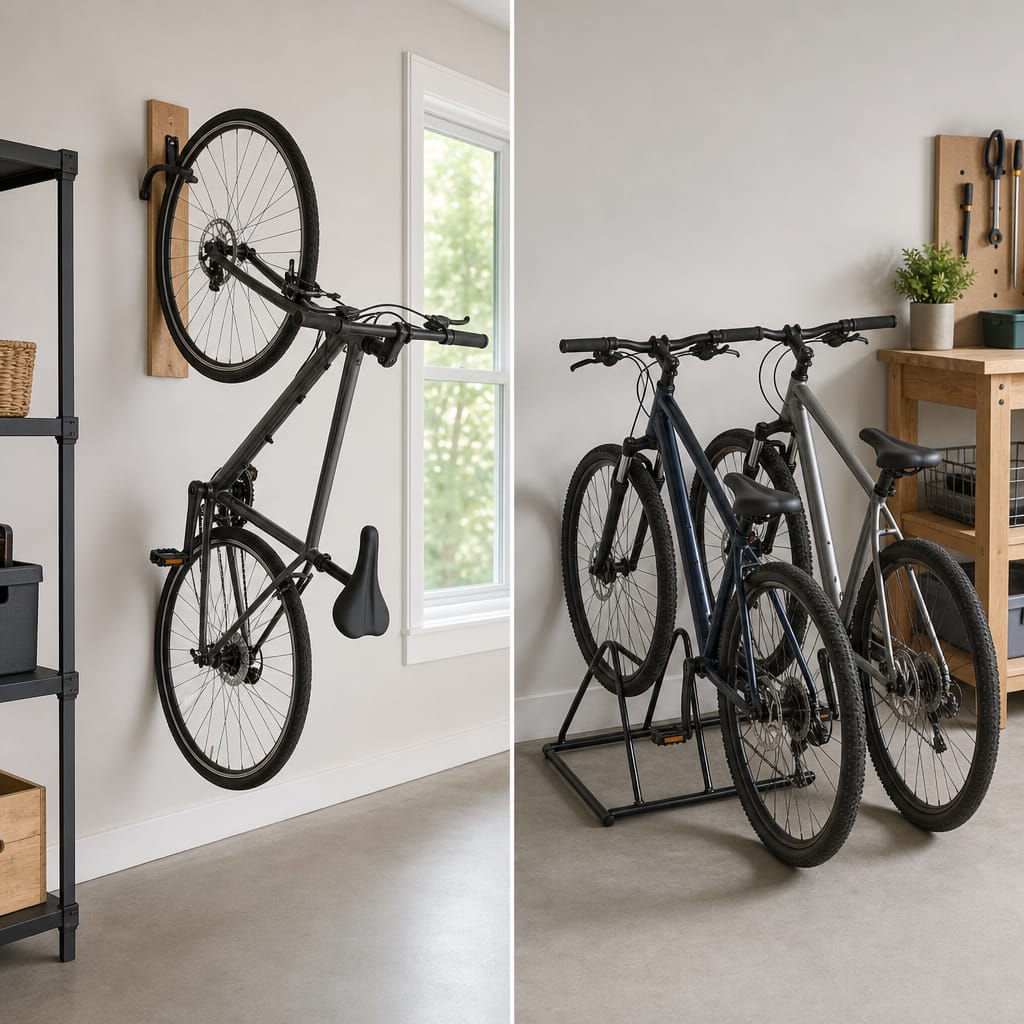
For homeowners with stud-accessible walls who want their floor back, wall-mount is usually the better pick — zero floor footprint, higher manufacturer-listed per-bike capacity. For renters, finished-drywall hesitancy, or anyone moving in the next year or two, freestanding is usually the better pick — no holes, fully reversible, comes with you. The decision often comes down to two inputs: drilling permission and ceiling type.
Best Choice by Situation
| Situation | Better choice | Why |
|---|---|---|
| You rent and your lease forbids drilling | Freestanding | No holes, fully reversible at move-out |
| You own and have a stud-accessible wall | Wall-mount | Higher per-bike capacity, zero floor cost |
| You own but have finished drywall and are anchor-shy | Freestanding (gravity) | Works against any flat solid wall, no drilling |
| Heaviest bike is over 50 lb (typical ebike) | Wall-mount, stud-anchored | Freestanding gravity racks list 50 lb per bike |
| Ceiling is drop-tile or unfinished | Freestanding (gravity, NOT tension) | Tension stands need real structural ceiling |
| Two adult bikes, one parking spot | Freestanding (2-bike) | One footprint serves two bikes |
| You will move in the next 1–2 years | Freestanding | Transports with you, no anchor decisions |
Wall-Mounted Bike Rack — Pros, Cons, Best Use Cases
What it is
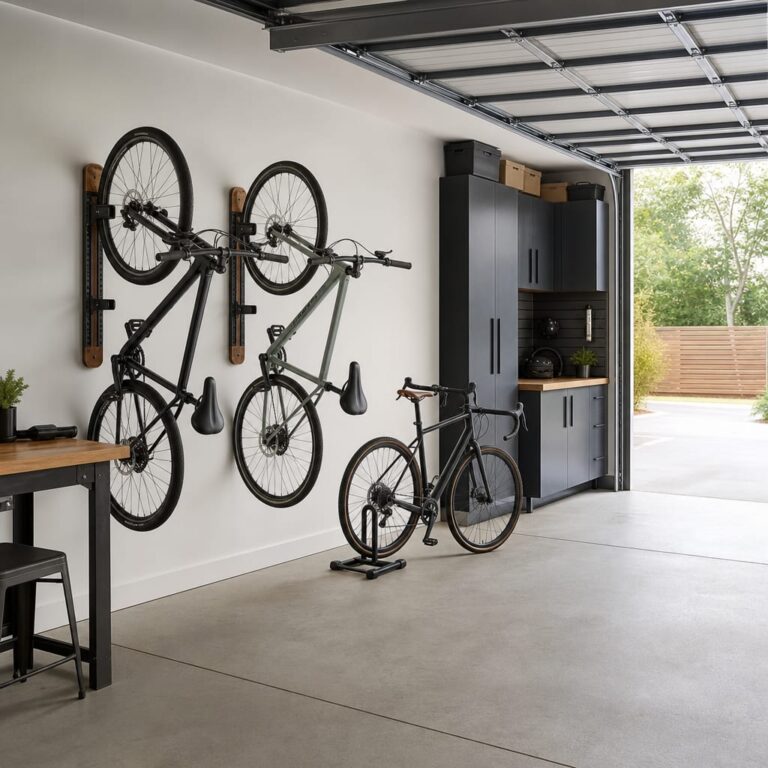
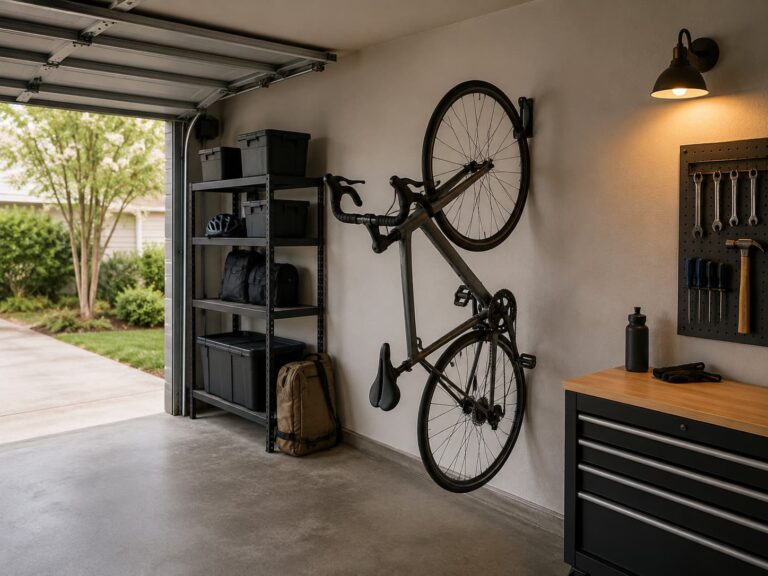
A wall-mount bike rack attaches to the wall and holds the bike off the floor — sub-categories include fixed hooks, pivot racks that swing the bike out, and vertical hangers. All require fasteners into a stud or masonry. Anchor strength decides whether the manufacturer-listed capacity is realistic.
Where wall-mount works best
- Stud-accessible walls (timber-frame with studs at 16- or 24-inch centers)
- Owned homes where wall holes are a non-issue
- Tight garages where the floor is doing double duty
- Heavier bikes once anchored correctly (up to 75–80 lb per hook on better racks)
- Long-term setups where install commitment is amortized over years
Where wall-mount falls short
- Rental units with finished drywall the landlord will charge to repair
- Awkward geometries: fenders, fat-tire bikes that exceed the tire-width cap
- Unknown wall structure — no stud finder, or studs not where you need them
- Commitment cost: holes and layout choice are permanent
What product pages typically specify
A well-built wall-mount listing gives four numbers: manufacturer-listed capacity, tire-width cap, mounting hardware, and clearance for any swing motion. If only a top-line capacity is quoted without anchor type, treat it as the best-case figure — drywall without a stud will fail at a much lower load.
Buyer warnings specific to wall-mount
- Anchor type matters more than the rack’s rated capacity — a 75-lb rated rack on drywall anchors is not a 75-lb rack
- Tire-width cap blocks fat-tire bikes; many wall hooks max out around 2.1 to 2.5 inches
- Pivot models need horizontal clearance to swing the bike out — measure before buying
Wall-Mount Recommended Picks
For the pivot use case: Steadyrack Classic Bike Rack
![Steadyrack Swivel Bike Wall Mount, Vertical Bike Rack for Garage Storage Classic Rack Road Bike Rack - Zinc [S]](https://m.media-amazon.com/images/I/51SxL6GQGvL._SL160_.jpg)
Steadyrack is the long-standing exemplar of the swing-out pivot mechanic: the bike rotates against the wall, freeing the floor in front for a car or workbench. The manufacturer lists a 77 lb per-bike capacity (stud-mounted) and a tire-width cap of 2.1 inches — fits standard road and hybrid bikes, excludes fat-tire and many newer ebike builds. Check the ProFlex variant if you need wider tire compatibility.
For the simplest fixed-hook use case: Delta Cycle Leonardo Single Bike Storage Rack

The Leonardo is the opposite end of wall-mount — a single fixed hook with a rear tire tray, no pivot. The product page lists a 40-lb capacity, appropriate for kids’ bikes, lightweight road bikes, and second-bike storage rather than a primary heavy commuter. Lower capacity, fewer moving parts, lower install commitment. For more options across capacity tiers, see our vertical wall-mount picks for small garages.
Freestanding Bike Rack — Pros, Cons, Best Use Cases
What it is
A freestanding bike rack stands on the floor without permanent mounting. Two mechanics dominate: leaning-gravity racks that lean against a flat wall, and floor-to-ceiling tension stands that wedge between floor and ceiling via a telescoping pole. Both are renter-friendly and reversible — but they need either a flat wall or a real ceiling, and they take floor footprint.
Where freestanding works best
- Rental units where drilling is forbidden or discouraged
- Finished-drywall homes where the operator is anchor-shy
- Multi-bike storage in a single footprint (most 2-bike stands list a small base)
- Households planning to move in 1–2 years
- Quick setup, no hardware install needed
Where freestanding falls short
- Gravity racks need a flat solid wall to lean against; they slip on uneven walls under heavier loads
- Tension stands need a structural ceiling (joists or solid drywall over joists), not drop-tile or exposed truss alone
- Floor footprint cost — about 2 by 4 feet of garage floor for the base
- Per-bike capacities are typically lower than stud-mounted wall racks
What product pages typically specify
A complete freestanding listing specifies three numbers: total capacity, per-hook capacity, and ceiling-height range (tension) or base footprint (gravity). Watch listings showing only total capacity — a 100-lb total split across two bikes leaves you with 50 lb per bike, which may not cover an ebike.
Buyer warnings specific to freestanding
- Gravity racks fail on uneven floors or uneven walls — the lean angle matters
- Tension stands cannot work against drop-tile ceilings; the tile compresses and the pole loses tension
- Bike arms may not accommodate unusual frames (step-through, full-suspension mountain bikes)
Freestanding Recommended Picks
For the gravity-leaning, renter-friendly use case: Delta Cycle Rugged 2-Bike Gravity Stand
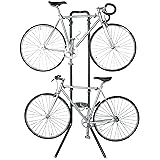
The Rugged is Delta Cycle’s freestanding flagship. The product page lists 100 lb total capacity (50 lb per bike) and the rack leans against any flat solid wall — no drilling, no anchors. Adjustable arms fit most adult bike styles, though step-through and full-suspension can be finicky. The default pick for renters and anyone who wants to move the rack to a different wall next year. See our roundup of garage bike racks across all mechanic types for ceiling-hoist alternatives.
For the floor-to-ceiling tension use case: Topeak Dual-Touch Bike Storage Stand

The Dual-Touch uses a telescoping aluminum pole that tensions between the floor and ceiling, holding bikes on two adjustable hooks. The manufacturer lists 158.7 lb per-stand total and 39.7 lb per hook, with an extension range fitting ceilings from roughly 62 to 144 inches. Premium build, but the ceiling requirement is non-negotiable — drop-tile or unfinished ceilings without solid joists will not tension correctly.
Side-by-Side Comparison
The two mechanics differ on a small number of dimensions that map directly to the decision inputs.
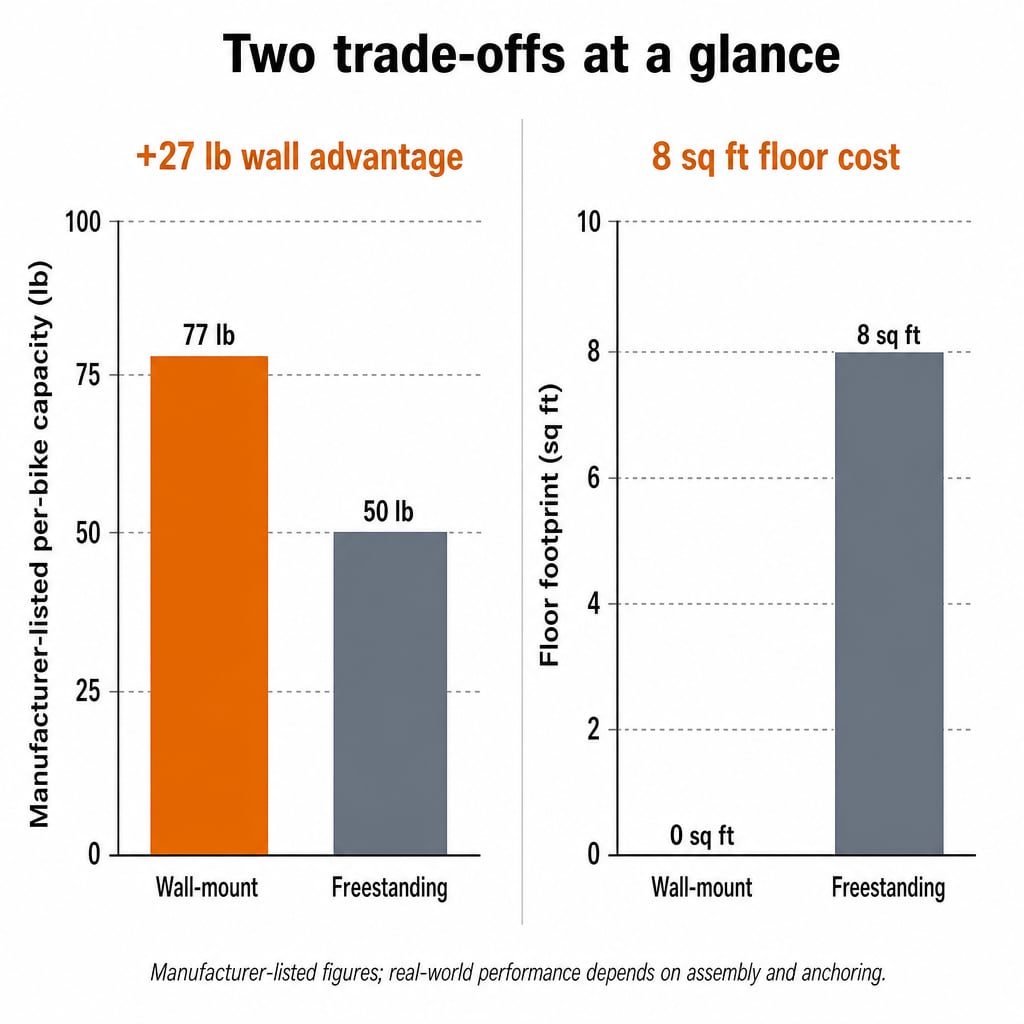
| Dimension | Wall-mount | Freestanding |
|---|---|---|
| Drilling required | Yes (stud or masonry) | No |
| Per-bike capacity (manufacturer-listed, typical) | 40–80 lb | 40–50 lb per bike |
| Bikes per unit (typical) | 1 | 2 |
| Floor footprint | 0 sq ft | ~8 sq ft (2 by 4 ft base) |
| Reversible install | No (holes remain) | Yes (lift and move) |
| Renter-friendly | Rarely (lease-dependent) | Yes |
| Wall/ceiling dependency | Stud or masonry | Flat wall (gravity) OR real ceiling (tension) |
| Works with fenders or fat tires? | Often no (check tire-width cap) | Often yes (arms adjust wider) |
How to Decide for Your Garage
Walk through these four inputs in order. The first that gives a clear answer ends the decision.
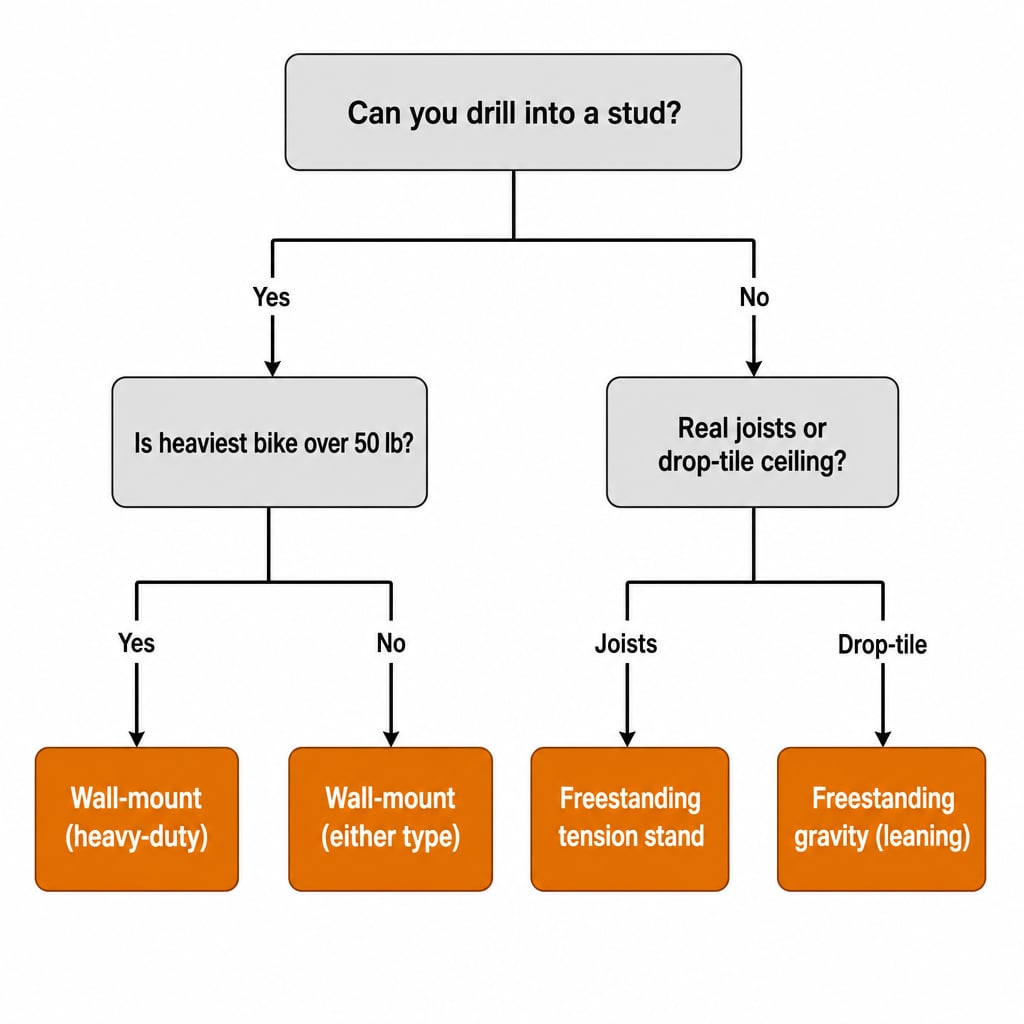
- Can you drill into a stud? If you rent and the lease forbids it, or if you own but do not want holes in finished drywall, stop here — you want freestanding. Skip to input 3.
- Is the heaviest bike over 50 lb? If yes and you can drill, wall-mount is the strong recommendation. Gravity racks cap at 50 lb per bike, so a 60-lb ebike will exceed that.
- What is your ceiling structure? If you cleared to step 3 because drilling is off the table, ceiling type matters. Real joists or solid drywall over joists support a tension stand. Drop-tile, exposed-truss-only, or unsure means gravity, not tension.
- How many bikes? One bike points to either side; two bikes per spot points toward a 2-bike freestanding or two wall-mount racks. Three or more starts pushing toward a ceiling-hoist mechanic this article does not cover. For step-by-step bike storage selection covering three-plus bikes, see the higher-level pillar.
Worked example: renter, two adult bikes, drop-tile ceiling -> inputs 1 and 3 force gravity freestanding. Result: Delta Rugged.
Worked example: homeowner, one 55 lb ebike, finished drywall with stud finder -> input 2 forces wall-mount. Result: Steadyrack Classic on a confirmed stud anchor.
Common Mistakes
Mistake: assuming wall-mount works in any wall. Drywall without a stud is not a structural anchor for an adult bike. Hollow-wall anchors rated for 25-lb static loads will not hold an active bike. Find a stud, or use masonry with manufacturer-recommended anchors.
Mistake: buying a tension stand without verifying the ceiling. Drop-tile ceilings compress and the pole loses grip. If you cannot see solid joists overhead, choose gravity instead. Tension stands are not a fallback for unknown ceiling structure.
Mistake: buying a gravity rack assuming any wall works. Gravity racks need a flat solid wall to lean against. Heavily textured walls or uneven plaster can cause the rack to sit at the wrong lean angle, transmitting load incorrectly to the floor.
Mistake: forgetting the tire-width cap. Most wall hooks cap at 2.1 to 2.5 inches. Fat-tire bikes (3.0 to 4.8 inches) and many ebikes will not fit — choose freestanding if you have one.
FAQ
Can I put a wall-mount bike rack on drywall without a stud?
You can install the bracket, but you should not trust it with a real adult bike. Manufacturer-listed capacities (40 to 80 lb) assume a stud anchor or masonry. Bikes generate dynamic loads when mounted, so find a stud or pick freestanding.
Will a freestanding tension rack damage my ceiling?
Depends on the ceiling type, not the tension force. Solid drywall with joists overhead handles tension racks fine, usually with a foam pad spreading the load. Drop-tile compresses or loses grip. If unsure about ceiling structure, choose gravity-leaning instead.
How much weight can wall-mount vs freestanding hold?
Manufacturer-listed capacities: branded wall-mount lists 40–80 lb per hook (Steadyrack 77 lb, Delta Leonardo 40 lb). Gravity freestanding lists around 50 lb per bike (Delta Rugged 100 lb total). Tension stands sit between (Topeak Dual-Touch 39.7 lb per hook). Treat all as best-case assuming correct assembly and anchoring.
Do I need a stud for wall-mount?
Yes, for any capacity you would trust an adult bike to. Drywall anchors are not a substitute. On masonry, use manufacturer-recommended sleeve or wedge anchors instead of wood-screw fasteners. If you cannot locate a stud, freestanding is the better pick.
Can freestanding racks hold ebikes?
Rarely without exceeding the per-bike rating. Most ebikes weigh 50 to 80 lb; gravity-rack listings are typically 50 lb per bike, tension stands lower per hook. For ebikes, wall-mount with a stud anchor is the standard pick.
What if I rent — is wall-mount ever allowed?
Sometimes, with explicit landlord permission. Some accept small-bracket installs if patched at move-out; others forbid all drilling. Read your lease. If permission is unclear or denied, freestanding is the default.
Sources Reviewed
For this comparison, we reviewed manufacturer pages for Steadyrack, Delta Cycle, and Topeak; Amazon product listings for the four featured ASINs; manufacturer-listed capacity and dimension figures; and recurring patterns in public buyer feedback. We do not claim hands-on testing.
Related Guides
- Best Garage Bike Racks for Home Storage — the broader roundup covering wall, vertical, ceiling, and freestanding mechanics
- Best Vertical Bike Racks for Small Garages — vertical wall-mount picks across capacity tiers
- How to Choose Bike Storage for a Garage — the higher-level pillar on bike storage selection