How to Choose Bike Storage for a Garage
Last updated:
Disclosure: This article contains affiliate links. If you buy through these links, we may earn a commission at no extra cost to you. We do not claim hands-on testing unless clearly stated.
Most readers shopping for bike storage start with the rack and treat the garage as a variable. Reverse the order. Four numbers determine which archetype will actually fit: ceiling height, stud spacing in your walls, bike count, and whether you can drill at all. This guide walks through each, gives you a measurement checklist that starts at the garage rather than the bike, and routes you to five starting points across the common archetypes — wall vertical, wall horizontal, ceiling hoist, freestanding gravity, and multi-bike rail. We do not cover bike repair stands or outdoor racks here — see related guides at the end.
Quick Recommendation by Use Case
| Use case | Best archetype | Why |
|---|---|---|
| Single road or hybrid bike, average garage | Wall-mounted vertical (swing) | Smallest wall footprint, flush parking |
| Garage with 10+ ft ceiling, occasional rider | Ceiling pulley hoist | Gets the bike fully out of the way |
| Renter, no drilling allowed | Freestanding gravity rack | No wall or ceiling anchors needed |
| Bike plus helmet, gloves, and gear in one spot | Wall horizontal with shelf | Adds a storage tier above the bike |
| 3+ bikes (family with kids, multi-rider household) | Multi-bike wall rail | One install handles the whole fleet |
| Apartment garage with full-suspension MTB | Wall vertical (wide variant) or freestanding gravity | Frame shape limits some standard racks |
If you only read one section, read the measurement checklist further down. The single most common buyer mistake is picking a rack by its photo and discovering at install time that the garage geometry does not match the rack’s assumptions. For a deeper comparison of the two most common families, see our wall-mounted vs freestanding bike rack comparison.
Key Factors to Consider
Ceiling height
A ceiling hoist needs roughly 4-6 feet of clearance above the raised bike, so a 9 ft ceiling barely works for a road bike and is too low for a full-suspension MTB. Under 8 ft, a hoist is not feasible. Wall-mounted vertical racks need the bike’s top wheel to clear the ceiling when parked — roughly wheel diameter (27-29 inches) above the highest hook point. Wall horizontal and freestanding gravity racks work at 8 ft or lower.
Wall stud spacing and material
Most US garages use 16-inch on-center stud spacing in drywall, giving lag-screw anchor points every 16 inches. Multi-bike rails need 2-3 stud anchor points across their length, so verify the wall has continuous studs (no stud-free header section). Block and concrete walls need masonry anchors instead of wood lags. For a renter who cannot drill, freestanding gravity is the only safe option.
Number of bikes and household mix
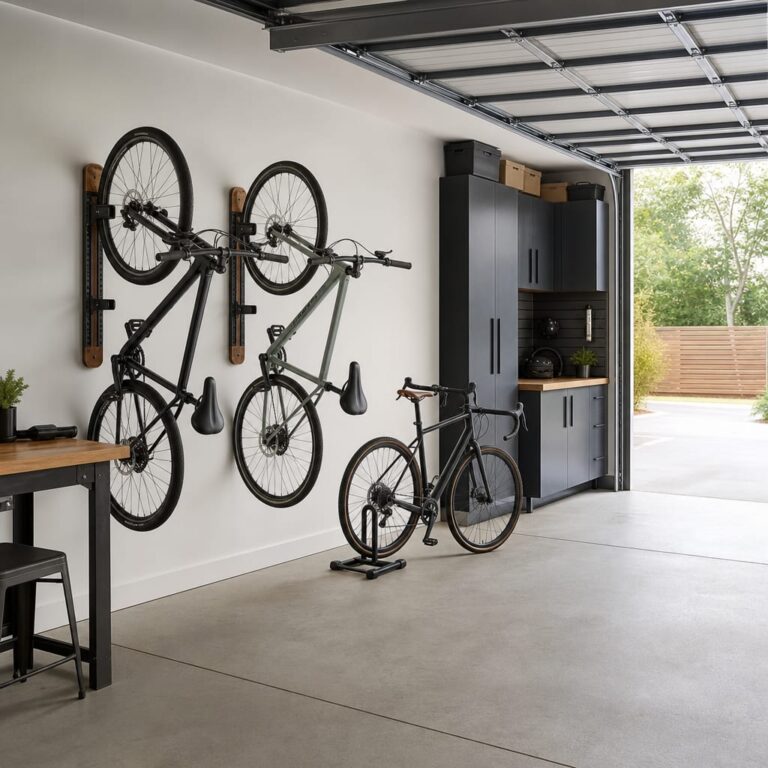
A single rider has the most archetype options. A two-rider household typically does well with two single-bike wall racks side by side, which preserves bike-specific clearance. Three or more bikes favor a multi-bike rail because hand-installing 4 or 5 separate racks eats up time and aligns hardware imperfectly. With kids, account for hook height: a low hook means the kid can reach the rack themselves.
Frame compatibility
Standard wall-mount vertical racks (Steadyrack Classic, Delta Cycle Leonardo) accept tires up to about 2.1 in (53 mm), per Steadyrack’s published spec — fine for road, hybrid, and most cross-country MTB, but unsafe for fat-tire bikes. The fix is a wide variant (Steadyrack ProFlex Wide, Delta Cycle Fat Bike) accepting tires up to about 5 inches. Full-suspension bikes work in most racks, but the rear linkage can foul horizontal arms — check the frame-clearance diagram. See our roundup of best vertical bike racks for variant-by-variant detail.
Manufacturer-listed weight capacity
Listed capacities are typically 50-100 lb per single-bike rack, 100 lb for a hoist, and 200-300 lb for a multi-bike rail. Treat the listed figure as an upper bound under controlled conditions: anchored hardware, level wall, distributed weight. For rails, divide the total by hook count and verify each hook is not loaded past its share — a 300 lb rated rail with 5 hooks averages 60 lb per hook, fine for adult bikes but tight for cargo bikes or e-bikes.
Temperature inside the garage
An unheated garage with humid summers can degrade rubber pads on hook arms and the rope on pulley hoists. Cold winters reduce friction in pulley brakes, which can let a hoisted bike drop if the rope-lock relies on temperature-stable friction. If your garage swings 40 degrees or more across seasons, pick a mechanical-lock hoist instead of a friction-lock one.
Storage Types Explained
Wall-mounted vertical (swing-pivot)
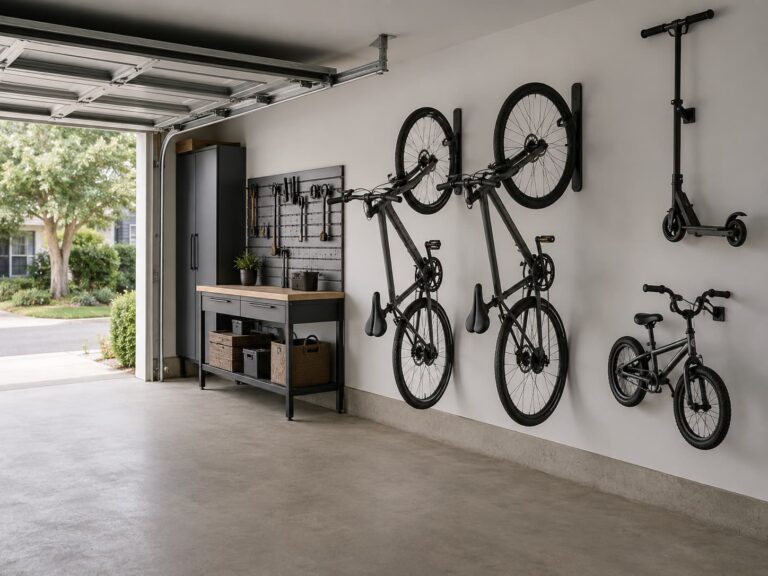
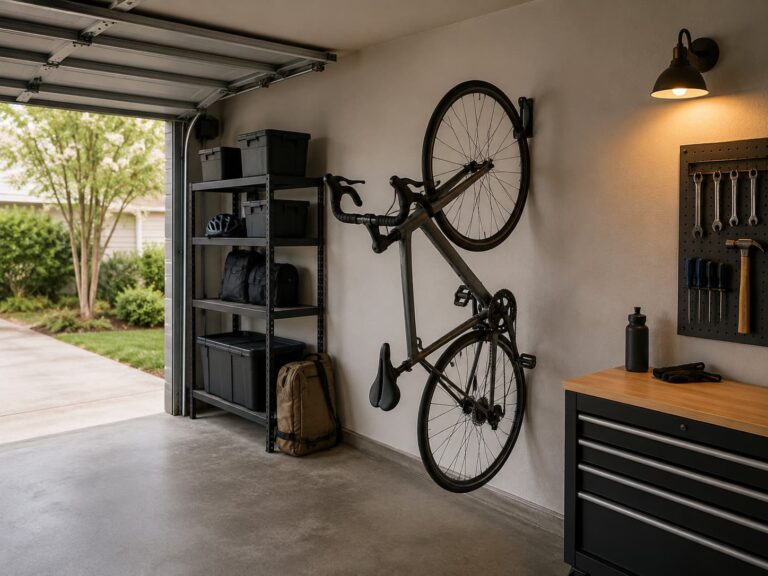
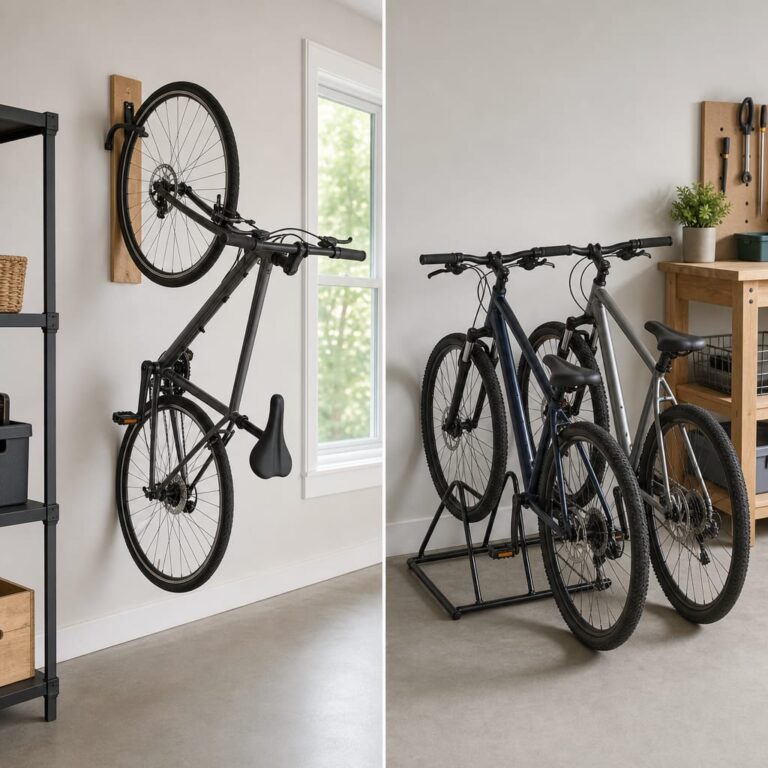
The bike hangs by its front wheel from a hook that pivots side-to-side. Best for: single-bike or two-rider households with 8+ ft ceiling and stud-anchorable wall. Limitations: standard variants do not accept fat tires; the rack sits about 11 inches off the wall when parked. What to look for: swing range of at least 160 degrees, manufacturer-listed capacity of at least 60 lb, and a tire-width range that fits your bike.
Wall-mounted horizontal with shelf
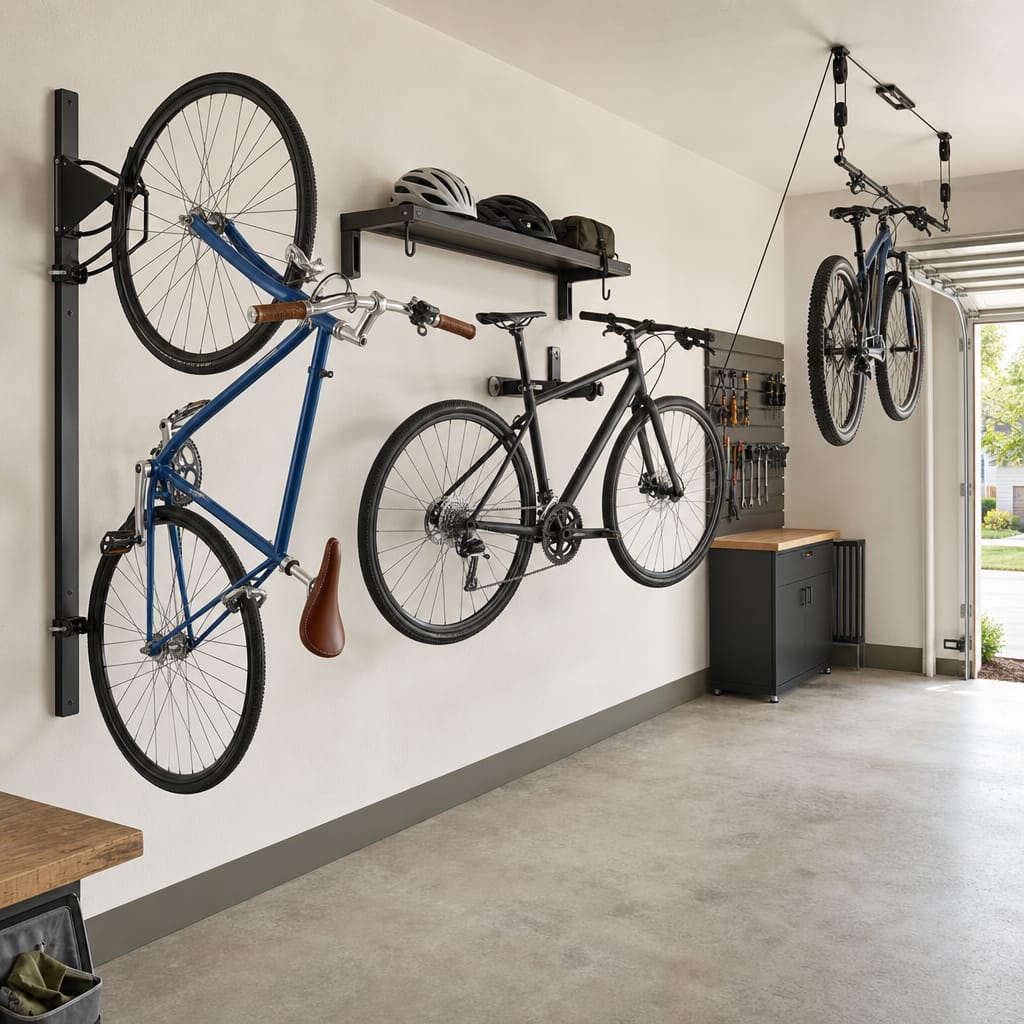
The bike hangs by its top tube from a padded arm, with a shelf above for helmets and gear. Best for: single-bike household wanting accessory storage in the same wall footprint. Limitations: takes more wall width than vertical (bike’s full length, 5-6 ft); the arm must align with a stud. What to look for: shelf depth of at least 6 inches, padded contact points, and lag-screw hardware specified.
Ceiling pulley hoist
A rope-and-pulley system that lifts the bike to within a foot of the ceiling. Best for: high-ceiling garages (10+ ft) and bikes used infrequently. Limitations: needs joist anchoring, not drywall; rope and pulley wear over years; full-suspension bikes are harder to balance from two hook points. What to look for: listed capacity at least 50% above your bike’s weight, auto-locking pulley brake, and rope length suited to ceiling height.
Freestanding gravity (no-drill)
A pole or leaning rack that holds bikes by gravity, no wall or ceiling anchor. Best for: renters who cannot drill, and temporary setups. Limitations: needs a solid floor (not carpet) and a wall to lean against — the lean angle keeps it stable. What to look for: rubber-tipped legs, listed total capacity of at least 60 lb, and adjustable height range fitting your ceiling.
Multi-bike wall rail
A horizontal rail with 4-5 adjustable hooks hanging bikes vertically by front wheels. Best for: 3+ bike households where one install replaces several racks. Limitations: rail length spans multiple studs (typically 2-3 anchors); ceiling must accommodate bikes spaced about 12-14 inches apart. What to look for: total listed capacity of at least 250 lb, adjustable hook spacing, and integrated helmet shelf if you want consolidation.
When to Choose Each Type
The decision boils down to garage geometry plus household. The matrix below maps the four most common garage conditions to the five archetypes.
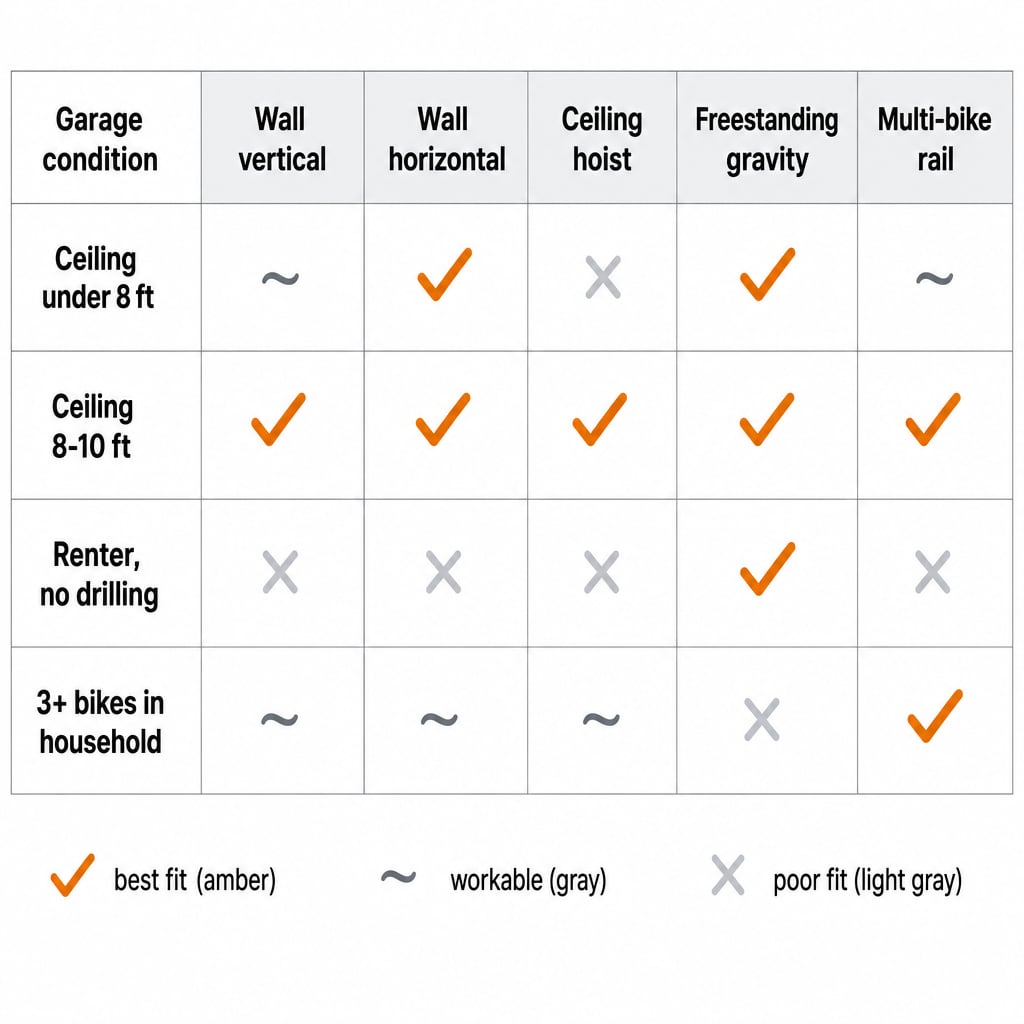
- Ceiling under 8 ft → wall horizontal or freestanding gravity. Avoid ceiling hoist; wall vertical may work if your bike has small wheels.
- Ceiling 8-10 ft → all five archetypes work. Choose by household and stud access.
- Renter, no drilling allowed → freestanding gravity is the only safe option. Everything else needs anchors.
- 3+ bikes in household → multi-bike wall rail. A 5-hook rail in one install is faster and cleaner than 5 separate racks across the wall.
For a deeper version of the same decision when the choice is binary between wall and freestanding, see our wall vs freestanding bike rack guide.
Once the matrix above points you to a wall-mounted vertical or horizontal rack, the next question is which model fits the bike you own. The table below covers published tyre, wheel, and weight limits for wall-mounted racks only — it does not apply to ceiling hoists, freestanding gravity racks, or multi-bike rails, which are sized differently and covered in their own sections above.
What wall bike racks actually accept — published limits
Rack makers publish their tyre limits in inches, but the number printed on your tyre’s sidewall is in millimetres, and the two are almost never compared. This table restates each rack’s published limits, converts the tyre width to the millimetre figure you can read off the tyre, and puts the weight ceilings side by side — so you can check a rack against the bike you own before you drill anything.
| Rack | Tyre width (as published) | Tyre width (mm, derived) | Wheel diameter | Max bike weight | Clearance / mounting | Specification source | Source checked |
|---|---|---|---|---|---|---|---|
| Steadyrack Classic | 2.1 in maximum | up to 53 mm | 20–29 in | 35 kg / 77 lb | min. 15 mm (½ in) downtube-to-tyre; racks as close as 350 mm apart | Steadyrack Classic Rack | 2026-08-14 |
| Steadyrack Classic MTB | 2.1–2.8 in | 53–71 mm | 24–29 in | 35 kg / 77 lb | min. 15 mm (½ in) downtube and tyre clearance | Steadyrack Classic MTB Rack | 2026-08-14 |
| Steadyrack Classic Fat | 2.8–4.5 in | 71–114 mm | 20–29 in | 35 kg / 77 lb | min. 15 mm (½ in) downtube and tyre clearance | Steadyrack Classic Fat Bike Rack | 2026-08-14 |
| Steadyrack ProFlex (Narrow / Wide / Fat) | 2.1 in max, 2.1–2.8 in, or 2.8–4.5 in by size | 53 / 53–71 / 71–114 mm | 20–29 in (Wide: 24–29 in) | 55 kg / 121 lb | fender compatible with min. 20 mm (¾ in) between tyre and stays | Steadyrack ProFlex Rack | 2026-08-14 |
| Feedback Sports Velo Wall Rack (horizontal, two cradles) | — (no tyre limit published) | — | — (no wheel size limit published) | 31.8 kg / 70 lb | cradles sit 12 in (30.5 cm) from the wall, adjust vertically 7 in; mounts to a wall stud | Feedback Sports Velo Wall Rack | 2026-08-14 |
| Feedback Sports Velo Hinge 2.0 (vertical hook) | 700C × 23 mm up to 29 × 3.0 in | 23–76 mm | 700C to 29 in | 22.7 kg / 50 lb | must be mounted into a wood-framed wall stud for the stated capacity | Feedback Sports Velo Hinge 2.0 | 2026-08-14 |
How these numbers were produced: Every figure is quoted from the manufacturer’s own product page on the date shown. The millimetre tyre width is arithmetic only: inches × 25.4, rounded to the nearest millimetre, matching the ETRTO width printed on a tyre sidewall. Where a manufacturer publishes no limit for a dimension, the cell says so instead of carrying an estimate.
- Published limits are the manufacturer’s, not ours — real-world holding also depends on the wall, the fixings used, and whether the rack is mounted into a stud or into masonry with the right anchors.
- Weigh the bike you actually own before trusting a capacity figure: batteries, racks, mudguards and cargo accessories add up, and an e-bike can weigh more than double a road bike.
- Tyre width printed on a sidewall is the ETRTO section width; a knobbly tyre can measure wider once inflated on a wide rim, so leave margin at the top of a range.
- A blank cell means the manufacturer does not publish that figure — we do not fill gaps with numbers we could not source.
Download the data (CSV) · last updated 2026-08-14 · version 1.0 · CC BY 4.0, attribution to Garage Space Guide.
Measurement Checklist
Before ordering anything, measure the garage. Reverse the typical online-shopping order — start at the wall and floor, end at the rack.
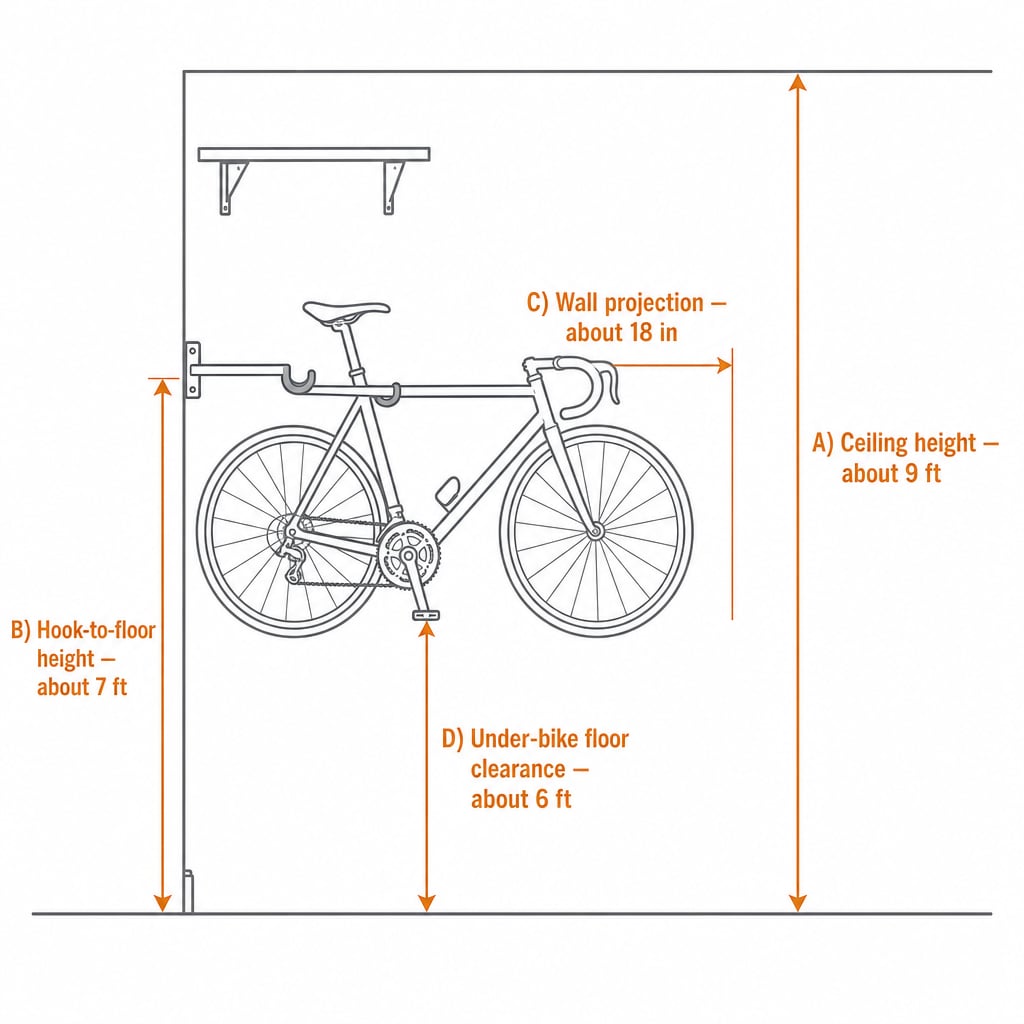
- Ceiling height at the spot where the rack will go. Note the lowest point (sometimes a duct or door track drops 6-8 inches below the rest of the ceiling).
- Hook height — the height on the wall where you want the bike to hang. Typical sweet spot is about 7 ft from the floor for a wall vertical, leaving the bottom wheel about waist height for the rider.
- Wall projection — how far the bike will stick out from the wall when parked. About 11 inches for a Steadyrack-style vertical, about 18 inches for a horizontal arm, about 24 inches for a leaning gravity rack.
- Under-bike floor clearance — the height under the lowest point of a hanging bike. Check that this leaves walking room under the rack, especially if the rack is along a path between the car and the garage door.
- Stud locations along the planned mounting line. Use a stud finder; mark with painter’s tape; verify with a test drill bit before sinking lag screws.
- Car door swing arc with the car parked in its usual spot. If the door swings into the path of a wall-mounted bike, the bike will get hit eventually.
For a stronger view of bike-storage method choices independent of specific products, see how to store bikes in your garage.
Mistakes to Avoid
Most buyer mistakes in bike storage trace back to one of four patterns.
Mistake 1: Buying without checking ceiling height for the bike’s parked profile. A wall vertical needs 75-80 inches from floor to hook for a typical adult bike. A ceiling hoist needs 4-6 feet above the lifted bike. Measure with a tape, not a memory.
Mistake 2: Anchoring into drywall alone. Drywall toggles are not safe for a bike’s static plus dynamic load when lifted onto the hook. Always hit a stud, or use masonry anchors for block/concrete walls.
Mistake 3: Picking a standard wall vertical for a fat-tire MTB. Standard hooks accept up to about 2.1 in (53 mm) of tire width. A fat tire (4-5 inches) does not seat — pick a wide variant designed for fat tires.
Mistake 4: Treating manufacturer-listed capacity as a static guarantee. A 100 lb listed hoist is rated under controlled conditions: anchored joists, fresh rope, level lift. An older hoist with frayed rope is no longer at 100 lb. Inspect annually.
Safety and Installation Notes
Three install rules apply to almost every archetype:
- Hit a stud or a joist, never just drywall. Wood frame anchoring is the minimum for any wall- or ceiling-mounted rack. Masonry anchors are the equivalent for block/concrete walls.
- Pre-drill at the correct bit size for the lag screw. Lags split studs when driven without a pilot hole; a split stud loses anchor strength.
- Test the rack with a low-stakes load before the full bike weight. Hang a backpack with about half the bike’s weight on the rack first; check the wall for any cracks or pull. A small failure under a backpack is recoverable. The same failure under a bike is not.
Featured Picks
Below are five starting points — one per archetype. For deeper picks within an archetype, follow the link to the matching roundup.
Wall-mounted vertical (swing): Steadyrack Classic
![Steadyrack Swivel Bike Wall Mount, Vertical Bike Rack for Garage Storage Classic Rack Road Bike Rack - Zinc [S]](https://m.media-amazon.com/images/I/51SxL6GQGvL._SL160_.jpg)
The reference vertical rack. Manufacturer-listed at 77 lb capacity, swings 160-180 degrees, fits tires up to 2.1 in (53 mm) wide. For fat-tire compatibility, look at the ProFlex Wide variant. For a deeper view of vertical-rack options, see our roundup of best vertical bike racks for garage.
Wall-mounted horizontal with shelf: Mount-It! Bike Wall Mount Rack with Shelf

A single-bike horizontal arm with an integrated wood-style shelf above for helmets and gear. The shelf is the real value-add over a bare hook. Stud anchoring is non-negotiable.
Ceiling pulley hoist: RAD Sportz Bicycle Hoist

Manufacturer-listed at 100 lb, auto-locking pulley brake, rope long enough for ceilings up to about 12 ft. Joist anchoring is critical — never drywall.
Freestanding gravity (no-drill): Delta Cycle Rugged 2

A leaning floor-to-wall pole that holds two bikes vertically. Manufacturer-listed total capacity 100 lb. The fit for renters and anyone who cannot drill.
Multi-bike wall rail: StoreYourBoard 5-Bike Storage Rack with Shelf

Five adjustable hooks on a long horizontal rail with an integrated helmet shelf above. Manufacturer-listed total capacity is 300 lb. One install handles a whole family’s fleet — provided the wall has enough studs to anchor the rail. For more multi-bike and kids-bike options, see our roundup of best garage storage for bikes and scooters.
FAQ
How much ceiling height do I need for a ceiling pulley hoist?
For a road or hybrid bike, plan for 9-10 ft minimum so the lifted bike clears walking space. For a full-suspension MTB or cargo bike, plan for 10-12 ft. Measure from the floor to the lowest ceiling obstacle (duct, beam, garage door track), not the highest ceiling point.
Can I install bike storage if I rent and cannot drill into walls?
Yes — pick a freestanding gravity rack. It leans against a wall and is held by rubber-tipped legs on the floor. No anchors, no holes. Avoid ceiling hoists and wall-mounted hooks entirely if you cannot drill.
What if my bike has fat tires or full suspension?
Standard wall vertical racks fit tires up to about 2.1 in (53 mm). For fat-tire bikes (4-5 inch tires), pick a wide variant like Steadyrack ProFlex Wide or Delta Cycle Fat Bike. Full-suspension bikes generally work, but check the listing’s frame-clearance diagram — some horizontal arms foul rear linkages.
How many studs do I need for a multi-bike rail?
A 5-bike rail typically spans 4-5 feet across the wall, crossing 3-4 stud bays at 16-inch spacing. Manufacturers typically call for 2-3 stud anchor points minimum. Use a stud finder and confirm every anchor lands in a stud before drilling.
Is it safe to hang an e-bike from a wall rack?
E-bikes weigh 50-70 lb, well above the 30-35 lb of a typical road bike. Match the rack’s listed capacity to the e-bike’s weight with at least 30% margin. A 100 lb listed rack handles a 70 lb e-bike with margin; a 77 lb rack does not. Confirm the hook diameter accepts the e-bike’s tire width (often 2.4-3 inches).
Where should I place the rack in the garage?
Along the wall opposite the car door swing arc, ideally above an area you do not walk through daily. Wall projection is the constraint — about 11 inches for vertical, 18 inches for horizontal. Avoid placing the rack where the bike will get bumped by a car door or a person walking past with hands full.
Sources Reviewed
For this buying guide, we reviewed manufacturer documentation for Steadyrack, RAD Sportz, Delta Cycle, Mount-It!, and StoreYourBoard, plus the corresponding Amazon product pages, plus recurring patterns in public buyer discussions about garage bike storage. Product picks were cross-referenced against their Amazon listings during fact-check. We do not claim hands-on testing.