Garage Hook Load Ratings Database — Sourced Weight Limits
You’re about to hang a bike, a ladder, or a coiled extension cord on a hook — pegboard, slatwall, rail, or adhesive strip — and the only number in hand is whatever the packaging or listing printed. That number means something different depending on what’s behind the hook: a screw-in hook’s rating already accounts for everything holding it up, but a pegboard or rail hook’s rating is only half the story until you know what the panel or rail can carry too. This table lists both halves, hook by hook, and works out where the panel or rail — not the hook — becomes the real limit. Last checked 2026-09-15.
How to read this table
Each row is one hook, sourced from one manufacturer page.
- Hook — the exact product name and variant, so the row is checkable against a real listing.
- System it mounts to — pegboard, rail, slatwall, adhesive strip, or direct screw-in, since the mounting system changes what the rating is actually protecting against.
- Published rating — the manufacturer’s own number, quoted as a range where the manufacturer publishes a range rather than a single figure.
- Backing capacity — the panel’s or rail’s own published total, where one exists for that specific product line and length.
- Fully loaded hooks before the backing is the limit — that total divided by the top of the hook’s own rating, rounded down, so the count already assumes the worst case.
- Specification source — the manufacturer page the row is quoted from.
“Not applicable” appears in the last two columns wherever the manufacturer’s own rating already is the full-system limit — slatwall hooks rated by the panel maker, adhesive strips, and direct screw-in hooks. Dividing a separate panel total in those cases would misstate a number nobody actually publishes that way. A blank cell (none currently in this table) means the manufacturer does not publish that figure — it is never filled in with an estimate.
What a garage hook actually holds — and what the wall behind it holds
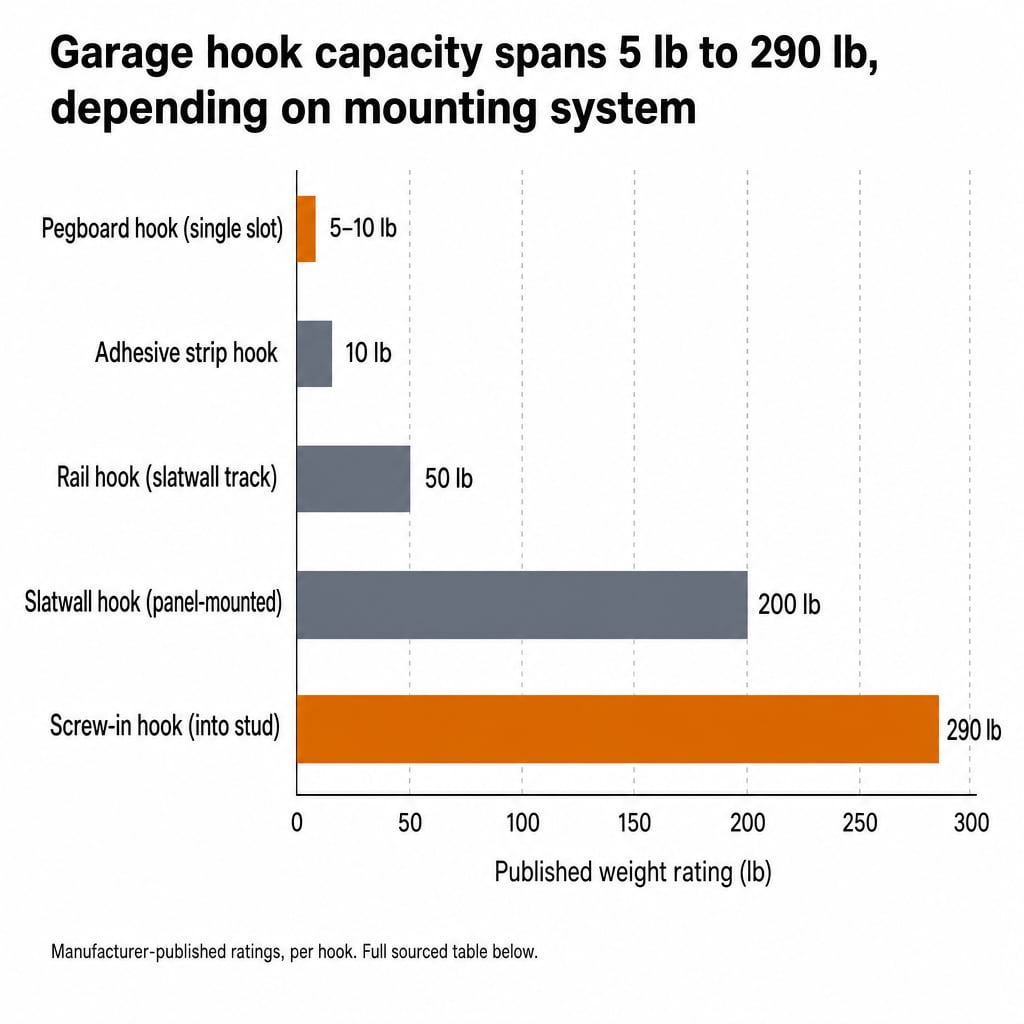
A pegboard hook, a slatwall hook, an adhesive strip hook and a screw-in hook all look like the same idea and are rated wildly apart: Wall Control publishes 5–10 lb for a single-slot pegboard hook, National Hardware publishes 290 lb for a heavy-duty screw hook driven into a joist. This table puts the published per-hook (or per-fastener) ratings side by side. Where the backing system also publishes its own total capacity, we work out how many hooks it takes before the panel or rail — not the hook — becomes the limit; where the backing is a distributed per-square-foot rating, an adhesive strip, or a screw driven straight into wood, that comparison does not hold up and the table says so instead of forcing one.
| Hook | System it mounts to | Published rating | Backing capacity | Fully loaded hooks before the backing is the limit | Specification source | Source checked |
|---|---|---|---|---|---|---|
| Wall Control pegboard hook, single slot | Pegboard (Wall Control metal panel) | 5–10 lb per hook | 200 lb — 16 × 32 in panel into studs | 20 hooks | Wall Control pegboard how-to | 2026-09-17 |
| Wall Control pegboard hook, two slots | Pegboard (Wall Control metal panel) | 10–15 lb per hook | 200 lb — 16 × 32 in panel into studs | 13 hooks | Wall Control pegboard how-to | 2026-09-17 |
| Wall Control pegboard shelf assembly | Pegboard (Wall Control metal panel) | 10–20 lb per shelf | 200 lb — 16 × 32 in panel into studs | 10 hooks | Wall Control pegboard how-to | 2026-09-17 |
| Gladiator Scoop Hook | Rail / slatwall (Gladiator GearTrack, GearWall) | 25 lb per unit | 300 lb — 4 ft GearTrack channel at 75 lb per linear foot | 12 hooks | Gladiator Scoop Hook | 2026-09-17 |
| Gladiator Deep Hook | Rail / slatwall (Gladiator GearTrack, GearWall) | 30 lb | 300 lb — 4 ft GearTrack channel at 75 lb per linear foot | 10 hooks | Gladiator Deep Hook | 2026-09-17 |
| Gladiator Utility Hook | Rail / slatwall (Gladiator GearTrack, GearWall) | 50 lb per unit | 300 lb — 4 ft GearTrack channel at 75 lb per linear foot | 6 hooks | Gladiator Utility Hook | 2026-09-17 |
| Proslat 4 in. Single Hook | Slatwall (Proslat PVC Classic panel) | 15 lb weight capacity | 75 lb per sq ft, Proslat PVC Classic panel — no fixed panel-level total published | Not applicable — Proslat’s panel rating is a distributed per-square-foot figure, not a fixed total comparable to a single-point hook count | Proslat 4 in. Single Hook product page | 2026-09-17 |
| Proslat Heavy Duty U-Hook | Slatwall (Proslat PVC Classic panel) | 50 lb weight capacity | 75 lb per sq ft, Proslat PVC Classic panel — no fixed panel-level total published | Not applicable — see method | Proslat Heavy Duty U-Hook product page | 2026-09-17 |
| Proslat Super Duty Bike Hook | Slatwall (Proslat PVC Classic panel) | 50 lb per hook | 75 lb per sq ft, Proslat PVC Classic panel — no fixed panel-level total published | Not applicable — see method | Proslat Super Duty Bike Hook product page | 2026-09-17 |
| storeWALL 5 in. Single Hook | Slatwall (storeWALL panel with InstallStrips) | 35 lb maximum recommended weight capacity (manufacturer’s system-inclusive rating) | Not separately published — this rating already assumes InstallStrip-mounted panel | Not applicable — the published rating is already the full-system limit for one hook | storeWALL 5 in. Single Hook product page | 2026-09-17 |
| storeWALL Heavy Duty Box Hook | Slatwall (storeWALL panel with InstallStrips) | 110 lb maximum recommended weight capacity (manufacturer’s system-inclusive rating) | Not separately published — this rating already assumes InstallStrip-mounted panel | Not applicable — see method | storeWALL Heavy Duty Box Hook product page | 2026-09-17 |
| storeWALL Cradle Hook | Slatwall (storeWALL panel with InstallStrips) | 200 lb maximum recommended weight capacity (manufacturer’s system-inclusive rating) | Not separately published — this rating already assumes InstallStrip-mounted panel | Not applicable — see method | storeWALL Cradle Hook product page | 2026-09-17 |
| Command X-Large Utility Hook | Adhesive strip (no panel or rail) | 10 lb per hook | Not applicable — mounts by adhesive strip directly to the wall surface | Not applicable — the 10 lb rating is the full-system limit; there is no separate backing to divide against | Command X-Large Utility Hook (product packaging, via retailer listing) | 2026-09-17 |
| National Hardware Large Storage Screw Hook (N112-022) | Direct screw-in (into stud or joist, no panel or rail) | 50 lb safe working load | Not applicable — screws directly into wood, no separate backing panel | Not applicable — the rating already is the fastener’s own limit | National Hardware Large Storage Screw Hook product page | 2026-09-17 |
| National Hardware Heavy Duty Screw Hook (N220-830 / 2154BC) | Direct screw-in (into stud or joist, no panel or rail) | 290 lb safe working load | Not applicable — screws directly into wood, no separate backing panel | Not applicable — see method | National Hardware Heavy Duty Screw Hook product page | 2026-09-17 |
How these numbers were produced: Per-hook ratings are quoted from the manufacturer’s own page or published guidance on the date shown. Where the backing system publishes a fixed total capacity for a specific panel or rail length, the last column divides that total by the top of the hook’s rating range, rounded down: pegboard hooks against one 16 × 32 in Wall Control panel fixed into studs (200 lb); rail hooks against a 4 ft Gladiator GearTrack channel at its published 75 lb per linear foot (300 lb). Slatwall hook ratings (Proslat, storeWALL) are quoted as the manufacturer’s own ‘maximum recommended weight capacity’ — a figure that already assumes correct panel or InstallStrip installation — so no separate panel-level division is done for these; dividing a per-square-foot distributed rating by a single point-load hook would overstate what the panel is actually rated for, so we don’t. Adhesive strip hooks (Command) and screw-in hooks (National Hardware) mount with no separate backing panel or rail to divide against, so the published rating is the full-system limit as-is.
- Ranges are published as ranges for a reason. Wall Control states outright that it will not publish ‘specific and idealistic laboratory load ratings’ because real capacity depends on installation quality, substrate, hook choice and load distribution — treat the top of a range as a ceiling you should not design against.
- Into studs or into drywall changes everything: Wall Control publishes 200 lb per panel into studs against 100 lb on drywall anchors. Halve the last column accordingly if you did not hit a stud.
- The panel/rail counts assume every hook is loaded to its maximum at the same time, which is the worst case and the one worth planning for.
- A hook rating says nothing about leverage. A long-handled tool hung by its head puts far more load on the fixing than its weight suggests.
- Not every hook in this table mounts to a panel or rail. Where the manufacturer’s own number is already the full-system limit — slatwall hooks, adhesive strip hooks, screw-in hooks — the ‘before the backing is the limit’ column says so rather than inventing a panel-level count the published spec doesn’t support.
- Slatwall hook ratings from Proslat and storeWALL assume the panel is installed the way the manufacturer specifies (Proslat’s own panel hardware; storeWALL’s InstallStrips). Mounting the same panel by screwing through its face into studs instead is documented by storeWALL as reducing capacity — check the manufacturer’s own installation guidance before relying on the number in this table.
- Adhesive strip hooks (Command) depend entirely on the mounting surface — the published rating assumes a clean, smooth, properly primed surface at room temperature. Painted cinderblock, textured drywall, cold garages, and previously-used adhesive spots all reduce real-world hold.
- A blank cell means the manufacturer does not publish that figure — we do not fill gaps with numbers we could not source.
Download the data (CSV) · last updated 2026-09-17 · version 1.2 · CC BY 4.0, attribution to GarageSpaceGuide.
How these numbers were produced
Numbers come from manufacturer product pages first: Wall Control, Gladiator GarageWorks, Proslat, storeWALL, and National Hardware each publish a per-hook or per-fastener rating directly on the product or how-to page cited in Sources below. One row is weaker by design and says so: the Command X-Large Utility Hook’s rating is quoted from a retailer’s reproduction of the packaging text, because Command’s own product pages did not load when this was checked.
A worked example shows the method. Wall Control rates a single-slot pegboard hook at 5–10 lb, and rates a 16 × 32 in. panel fixed into studs at 200 lb. Dividing 200 by the top of the range (10) gives 20 hooks before the panel itself — not any individual hook — becomes the limit.
Rubbermaid FastTrack and several additional Command and National Hardware variants were attempted and left out: their source pages returned repeated 403 or timeout errors, and a number pulled from a search-result summary instead of the page itself isn’t something this table will publish. The panel and rail totals used as denominators here — the Wall Control panel, the Gladiator GearTrack channel — are documented in full, with their own installation caveats, in the companion wall and rail system capacities database. This table is extended as new hooks are verified from a primary source; it was last fully checked 2026-09-15.
How to use it — three decisions
How many pegboard hooks can one panel actually carry before the panel is the limit?
Against a single 16 × 32 in. Wall Control panel fixed into studs — rated 200 lb by Wall Control — the three pegboard rows in this table work out to very different hook counts. A single-slot hook (5–10 lb) allows 20 hooks before the panel is the limit; a two-slot hook (10–15 lb) allows 13; a shelf assembly (10–20 lb per shelf) allows 10. The panel doesn’t know which hook style occupies each slot — it only knows total load — so mixing styles means adding each hook’s own rating rather than assuming the highest count applies across the board. And if the panel is mounted on drywall anchors instead of studs, Wall Control’s own published total drops to 100 lb, which halves every count above.
Will a hook rated for a ladder or a bike actually hold it?
Gladiator rates its Deep Hook — the one aimed at ladders and hoses — at 30 lb, on a GearTrack rail published at 75 lb per linear foot. Proslat’s Super Duty Bike Hook is rated 50 lb on its slatwall system, and storeWALL’s Cradle Hook tops this table’s slatwall rows at 200 lb. The distinction that matters for a bike or a ladder specifically: a bike hook’s rating is a point-load figure for the wheel or frame member it actually grips, not a promise about the bike’s total weight. Check what the bike or ladder actually weighs against the hook’s own published number before assuming a 50 lb rating covers it.
Is a screw-in hook or an adhesive hook enough for what’s being hung?
National Hardware’s Large Storage Screw Hook is rated 50 lb safe working load driven into a stud or joist; its Heavy Duty Screw Hook is rated 290 lb under the same condition — the highest number in this table. Command’s X-Large Utility Hook, by contrast, is rated 10 lb (per a retailer’s reproduction of the packaging text — see note above), and that number depends entirely on the adhesive strip and the wall surface it’s stuck to, not on any stud behind it. For anything past a light-duty item, a screw driven into solid wood outperforms an adhesive strip by a wide margin, and the difference is published, not assumed.
What this table does not tell you
Every caveat above turns into a real number if you ignore it. Miss the stud on that 16 × 32 in. Wall Control panel and its 200 lb rating becomes 100 lb — the 20-hook count from the first decision above drops to 10. Load a long-handled tool by its head instead of its handle, and the fixing feels more than the tool’s plain weight, no matter what the hook is rated. Skip a slatwall panel’s specified install hardware, and the manufacturer’s published number stops applying to what you actually built. None of this shows up as a number to look up — it only shows up when the install doesn’t match the condition the rating was tested under. A blank cell means nobody has published a figure yet, not that the hook can’t hold weight.
FAQ
How much weight can a garage hook hold?
There’s no single number — this table spans 5 lb for a single-slot pegboard hook up to 290 lb for a heavy-duty screw hook driven into a stud. Look up the specific mounting system in the table above rather than a general figure.
How much weight can a bike hook hold?
Proslat’s Super Duty Bike Hook is rated 50 lb by the manufacturer. That figure is a point-load rating for the wheel or frame member the hook grips, not a guarantee about the bike’s total weight — check the bike’s actual weight against the hook’s rating first.
What’s the real difference between a screw-in hook and a hook that clips onto a panel or rail?
A screw-in hook’s published rating is already the full-system limit — there’s nothing else to divide against. A panel or rail hook shares a published total capacity with every other hook mounted to the same panel or rail length, which is why this table works out a hook count for those systems.
Why do some rows say “not applicable” instead of a hook count?
Those systems — slatwall, adhesive, and direct screw-in — publish a rating that is already the full-system limit. Inventing a panel-level division for them would overstate or understate a number the manufacturer never actually published that way.
Guides that use this data
- Best garage hooks overall — the site’s main hooks roundup, built on this table’s numbers.
- Best ladder hooks for a garage wall — picks a hook against the ladder-weight math worked out above.
- Best garden tool organizers for a garage — hook-based organizers sized for long-handled garden tools.
- Best garage hooks for garden tools — a narrower roundup on the same category, picked against the same ratings.
- Best garage storage for lawn tools — broader lawn and garden tool storage that references hook capacity.
- Best extension cord organizers for a garage — cord-reel hooks sized against this table.
- How to organize extension cords in a garage — the how-to companion to the cord-organizer roundup above.
Sources
- Wall Control — pegboard how-to page (wallcontrol.com)
- Gladiator GarageWorks — Scoop Hook, Deep Hook, and Utility Hook product pages
- Proslat — Single Hook, Heavy Duty U-Hook, and Super Duty Bike Hook product pages
- storeWALL — 5 in. Single Hook, Heavy Duty Box Hook, and Cradle Hook product pages
- Command (via a Staples retailer listing reproducing packaging text — not a manufacturer page)
- National Hardware — Large Storage Screw Hook and Heavy Duty Screw Hook product pages