How to Organize Sports Equipment in Your Garage (Family Guide)
Last updated:
Disclosure: This article contains affiliate links. If you buy through these links, we may earn a commission at no extra cost to you. We do not claim hands-on testing unless clearly stated.
Every active family’s garage hits the same wall. Balls roll under the car. Helmets pile up on a shelf and collect scratches. Cleats dry inside a sealed bin and start to smell. Fifteen minutes before practice, somebody is yelling about a missing shin guard.
The fix is not “buy a bigger bin”. The fix is a category-first system that matches each kind of gear to the storage type it actually needs. This guide covers the gear-category × storage-type matrix, the kid-reach height rule that makes the system stick, and three representative products for the three common reader setups. For wider product options, see our best garage sports equipment organizers roundup.
What this does not cover: sport-specific lockers like hockey-bag towers, team-equipment-scale storage, or outdoor sheds. Those are different problems.
Quick Answer — The Family Sports-Gear System in 4 Steps
Four moves get a typical family garage from chaos to working system:
- Sort by category. Balls, helmets, long-handled gear, footwear, soft goods. Five categories cover almost everything.
- Match each category to a storage type. Balls go in baskets or cages. Helmets sit on individual cradles. Long-handled gear hangs on vertical hooks. Cleats need ventilated shelves. Pads live in labeled bins.
- Install at kid-reach height. The lowest hook should be reachable by your youngest user.
- Label everything. Sport name plus the kid’s name on each bin. Labels are what keep the system intact past month one.
The matrix below shows the category-to-storage pairings.
The Gear-Category × Storage-Type Matrix
Five gear categories on the rows, four storage types on the columns, best-fit cells highlighted. Use it as a glance reference before you buy anything.
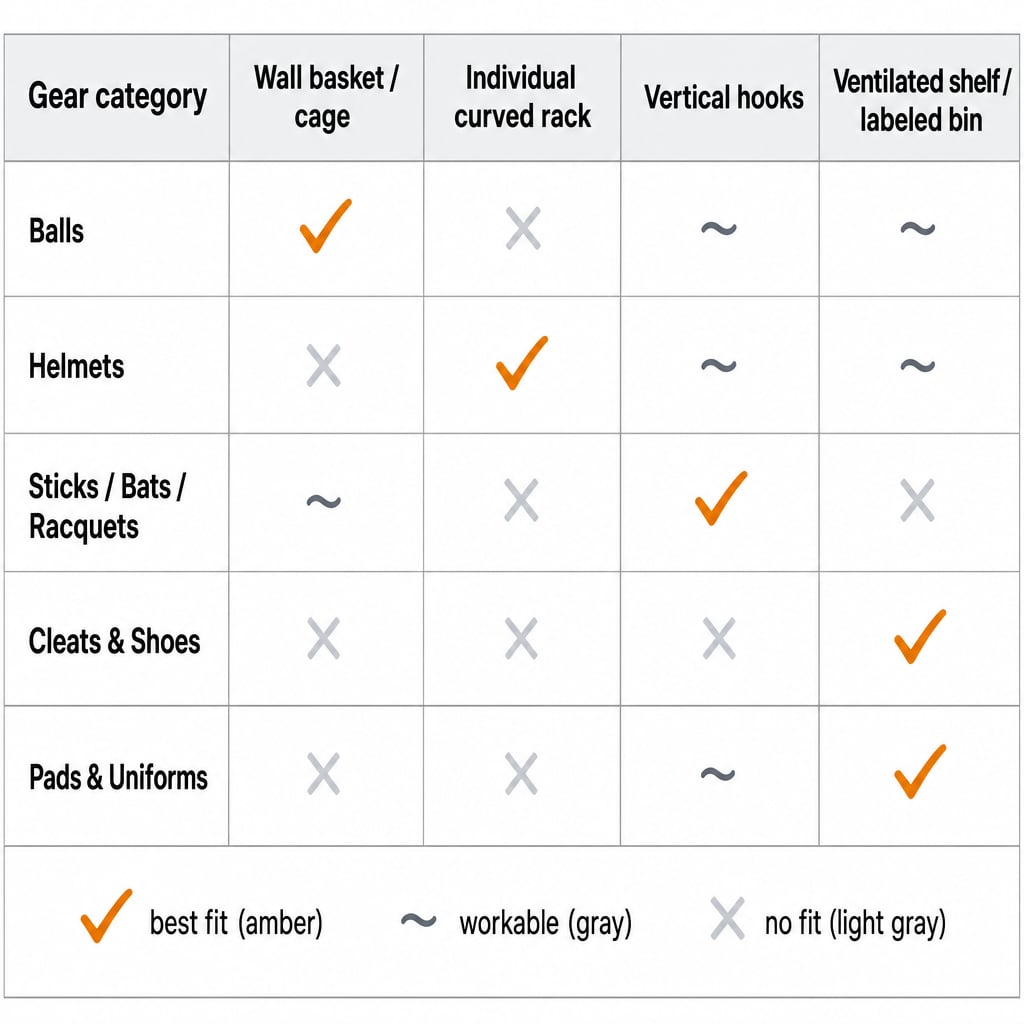
The common mistake the matrix replaces is “one bin for everything”. A single sports bin holds balls and helmets and cleats and pads, which means every category ends up worse off — helmets get banged up by balls, cleats stay wet, and finding a specific item means dumping the whole thing on the floor.
Step 1 — Sort the Pile by Category
Before you buy storage, sort what you already own.
Five categories that cover 95% of family sports gear
- Balls — basketballs, soccer balls, footballs, baseballs, tennis balls, kickballs.
- Helmets — bike, batting, skating, lacrosse, motorcycle. Treat each helmet as a single item, never stacked.
- Sticks, bats, racquets — long-handled gear. Lacrosse sticks, baseball bats, tennis racquets, hockey sticks.
- Footwear — cleats, athletic shoes, skates. Often wet or damp after practice.
- Soft goods — uniforms, pads, gloves, mouthguards, sweat-bands.
What to throw out before sorting
- Helmets past the expiration date (look for a sticker inside; most manufacturers recommend replacement within about 3–5 years of the manufacture date — guidance compiled by the Bicycle Helmet Safety Institute — or immediately after any meaningful impact).
- Outgrown cleats and shin guards.
- Broken straps, snapped sticks, deflated balls that won’t hold air.
- Single shoes whose mate hasn’t appeared in 6 months.
Seasonal rotation
Front-of-garage zones for in-season gear. Back-of-garage zones for off-season. Skis live in the back in July; bats live in the back in January. The system stays sized to the gear actually being used. For broader storage tactics, see our guide to best storage racks for kids’ sports gear.
Step 2 — Match Each Category to a Storage Type
This is where the matrix turns into action.
Balls
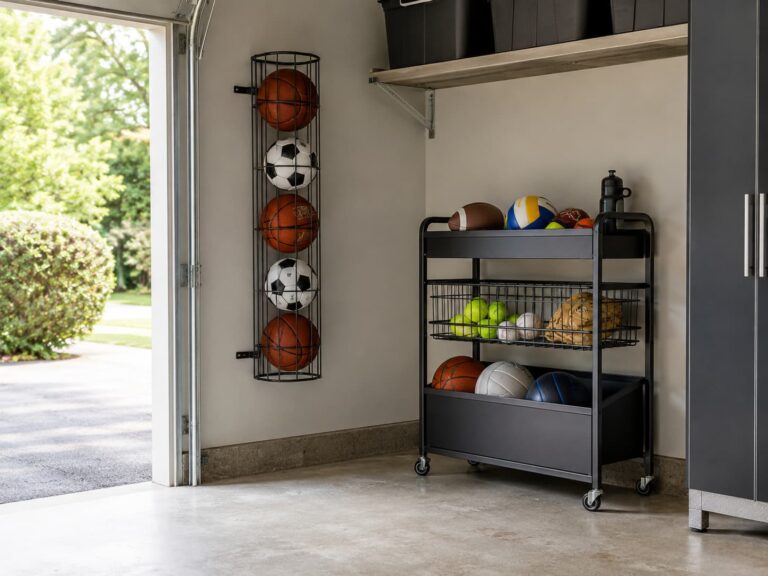
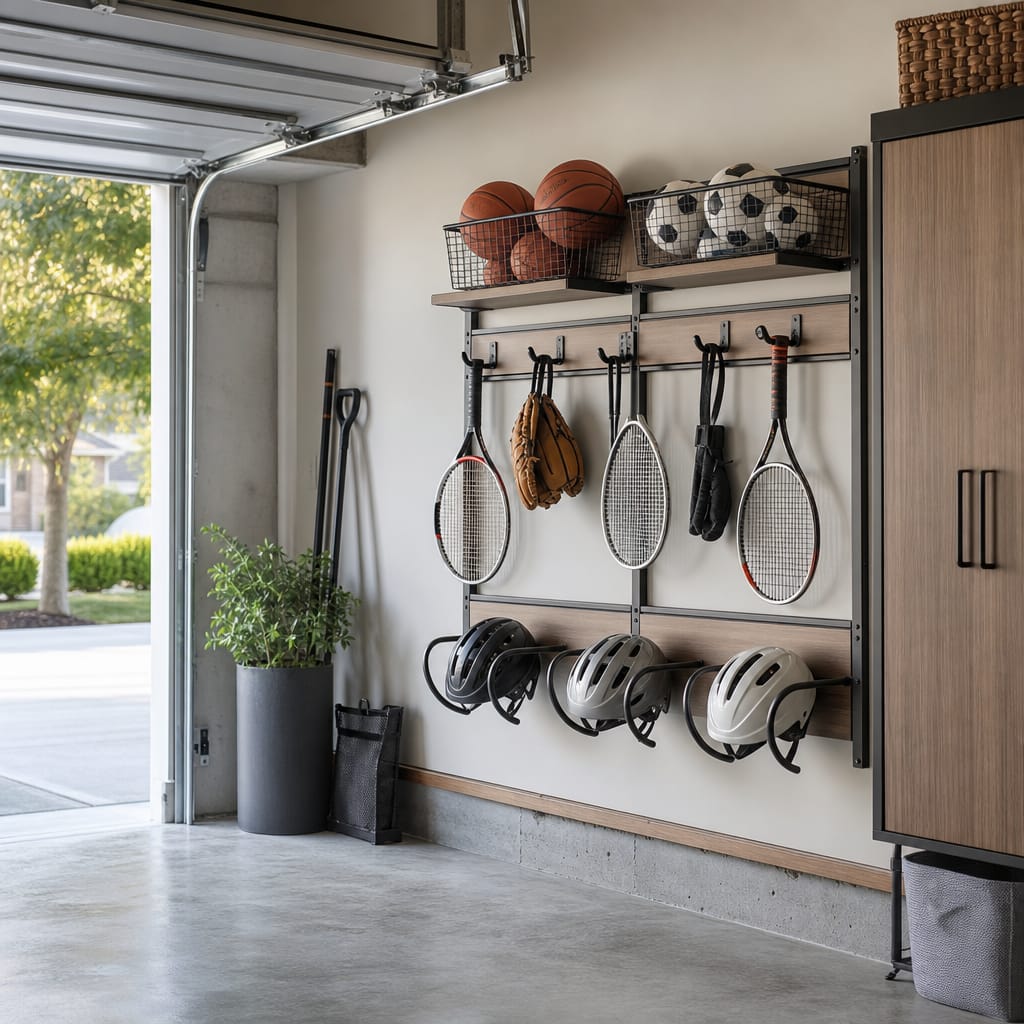
A wall-mounted basket or a freestanding cage is the right fit for most families. Open mesh prevents the slow-flat problem (balls in sealed plastic bins lose pressure faster). Volume drives the choice — as a rough guide, not a measured standard: a small collection (roughly under 8 balls) fits a single basket, a fuller multi-sport mix (roughly 8–20) fits a freestanding cage, and a large multi-kid haul (roughly 20+) calls for a rolling cart you can move indoor or outdoor. Check the specific basket or cage’s own listed capacity before buying. For specific picks, see best ball storage racks.
Helmets
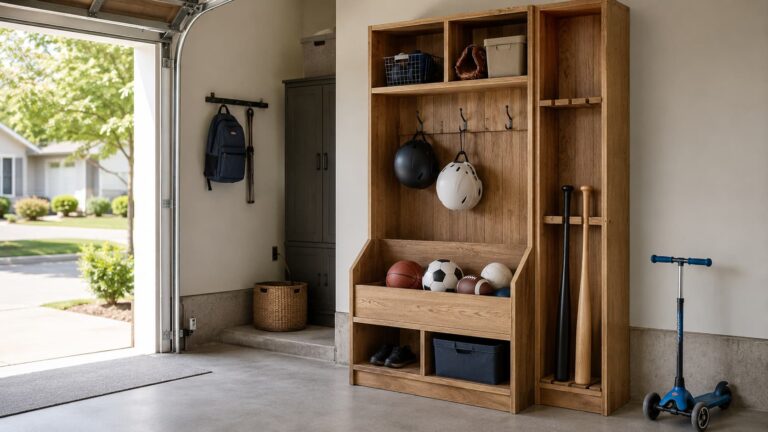
Individual curved cradles, one per helmet. Never stack helmets on a shelf. Foam liners compress under stack pressure, straps tangle, and shells pick up scratches that hide micro-cracks. A row of curved helmet racks at kid-reach height is the right pattern. Families with 3+ helmets either buy multiples of a single-helmet rack side-by-side or step up to a multi-helmet bar.
Sticks, bats, racquets
Vertical hooks on a wall, or a freestanding bat rack. Lacrosse sticks (40+ inches) need vertical clearance most shelves don’t have. Bats benefit from being upright (handle down keeps the grip dry). Two hooks per item keep them from spinning out of the rack.
Cleats and shoes
A ventilated shelf — wire shelf, slatted shelf, or open hooks — beats a sealed bin every time. Wet cleats need airflow to dry; a sealed bin grows mildew within a week. For households with chronic-wet-cleat issues, a slatted floor mat under the shelf catches drips.
Pads and uniforms
Labeled bins on a shelf, one bin per sport per kid. Soft goods compress and don’t need ventilation. As a starting point, not a universal fit: a 12-quart bin suits a single kid’s smaller kit (gloves, mouthguard, shin guards) and a 27-quart bin suits a bulkier multi-piece kit — measure your own gear pile against a bin’s listed dimensions before buying, since kit size varies by sport and age. Label both ends so the bin is identifiable when you only see one face.
Step 3 — Install at Kid-Reach Height
The most common reason these systems break is wrong mounting height. Hooks installed at adult height become parent-only storage, and the kid stops using the system within a week.
Rule of thumb, not a measured standard: the lowest hook should be reachable by your youngest gear-user. As a rough guide, a 7-year-old’s overhead arm reach runs around 60 inches and a 10-year-old’s around 70 inches, but kids vary a lot at the same age — the reliable method is to have your youngest gear-user stand at the wall, reach up, and mark the spot. Mount the kid’s gear at or below that mark. Mount adult and seasonal gear above 70 inches.
If you have a mixed-age household, install in two horizontal bands — lower band for kids, upper band for adults. The matrix doesn’t change; only the mounting height does.
This single rule prevents the most common system failure: parents ending up as the lookup service for their own kid’s cleats.
Step 4 — Label Everything
Labels are what keep the system intact past month one. Without them, a younger kid puts soccer balls in the basketball basket, the rotation breaks, and the pile reasserts itself.
What to label:
- Every bin — both ends.
- Every hook — small label below the hook works fine.
- Every shelf — a strip of painter’s tape with the category name lasts a season.
Suggested labeling: sport name plus the kid’s name, not just sport name. “Soccer — Mia” not “Soccer”. When two kids share a sport, the name disambiguates whose bin is whose. For a deeper labeling system, see our best storage racks for kids’ sports gear guide.
Tools and Products That Help
One representative product per setup — starting points, not exhaustive “best of” picks. For a wider comparison, see the best storage racks for kids’ sports gear roundup.
For a wall-mount multi-purpose station — Mythinglogic Sports Equipment Storage System. A modular wall-mount grid with 2 racks, 1 ball basket, and 6 hanging hooks. Mounts on studs; install horizontally or vertically depending on your wall layout. The 6 hooks reposition along the grid, which suits mixed gear (helmets on one row, racquets on another). The right pick if you can drill and want a single station for balls + hooks + gear.

For a no-drill freestanding station — HOME IT Garage Sports Equipment Organizer. A rolling steel cart with basket storage and locking wheel brakes. No drilling, so it works for renters, masonry walls, and households unwilling to drill. Best loaded with heavier items lower and the wheels locked — freestanding wheeled units tip more easily than wall-mounted ones if loaded asymmetrically.

For dedicated helmet storage — Wallniture Casco Helmet Rack. A curved wall-mount cradle for a single helmet plus an under-hook for a strap or glove. Buy one per helmet and mount them in a row. Better than any shelf solution because helmets don’t compress against each other.

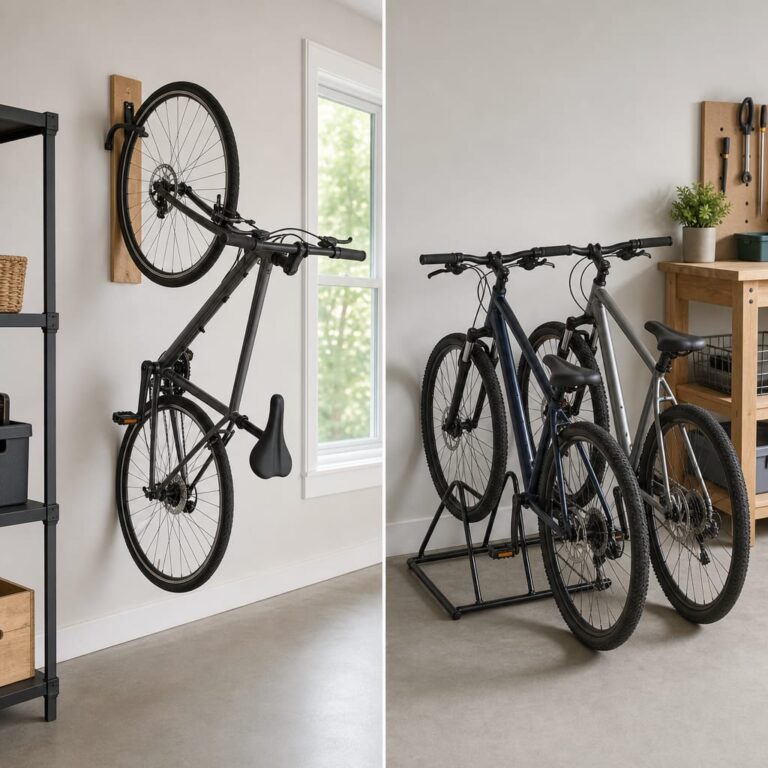
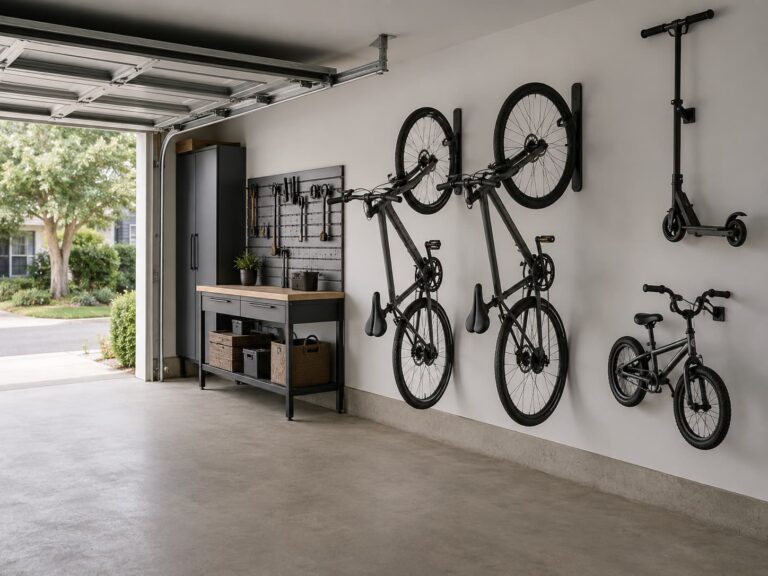
If your family also has bikes in the same garage, the bikes companion is how to store bikes in your garage — the gear storage system above intentionally excludes bikes because they need their own method. For a broader category overview, see how to choose bike storage for your garage.
Ball diameters that decide rack fit
Sports governing bodies publish ball circumference, but the number that decides whether a ball fits a rack slot, a bungee opening or a bin is its diameter — and nobody publishes that. This table quotes each official circumference specification and derives the diameter from it, so you can measure an opening and know what will actually go into it.
| Ball | Official circumference | Diameter (derived) | Min. clear opening | Official weight | Specification source | Source checked |
|---|---|---|---|---|---|---|
| Basketball, size 7 (men’s / adult) | 29½–30 in | 9.4–9.5 in | 9.75 in | — (not stated in the cited source) | NCAA men’s basketball rules | 2026-09-20 |
| Soccer ball, size 5 (adult) | 68–70 cm (27–28 in) | 8.5–8.8 in | 9 in | 410–450 g (14–16 oz) at the start of the match | IFAB Laws of the Game, Law 2 | 2026-09-20 |
| Volleyball, indoor | 65–67 cm (25.6–26.4 in) | 8.1–8.4 in | 8.5 in | 260–280 g (9–10 oz) | USA Volleyball Indoor Rules 2025-2027, Rule 3.1 | 2026-09-20 |
How these numbers were produced: Diameter is derived from the governing body’s published circumference range as d = C / π, then rounded to 0.1 in. Minimum clear opening is the derived maximum diameter rounded up to the next 1/4 in — arithmetic only, not a manufacturer specification, and it assumes a rigid opening with no stretch. Circumference figures in inches are converted from the metric spec where the governing body publishes metric (1 in = 2.54 cm); where the body publishes both, its own figures are quoted.
- Sizes 6, 5, 4 and 3 balls are manufacturer conventions for youth play, not rules-body specifications, and vary between brands — measure the ball you actually own rather than assuming a nominal size.
- An American football is a prolate spheroid, so it has no single diameter: the girth figure is what a slot must clear, the long axis is what the slot depth must accommodate.
- Elastic-cord and bungee racks stretch, so a ball larger than the resting opening can still be held; the figures above are the rigid-opening case.
- A blank weight means the cited rulebook does not state one — we do not fill gaps with figures we could not source.
These are the entries that matter for this guide. The full table, with every row and its source, is in our ball storage rack guide.
How to Measure Your Garage Sports Zone Before You Mount Anything
Ten minutes of measurement prevents most install regrets.
- Wall length available for the sports zone
- Stud spacing in that wall (16 or 24 in. on center) confirmed with a stud finder
- Ceiling height (matters for long-handled gear clearance)
- Reach height of your youngest gear user (arm-extended)
- Length of your longest item (lacrosse stick is typical at ~42 inches)
- Helmet count per family member
- Approximate ball count by sport (for basket sizing)
- Airflow at the cleat-storage location (open shelf area, near a vent, not in a corner)
If any number rules out a storage type for a category, the matrix shows what to switch to.
Common Mistakes
Mistake 1: Stacking helmets on a shelf
What it looks like: Three or four helmets in a stack on a high shelf, oldest at the bottom.
Why it’s a problem: Stacked helmets compress the foam liners that protect the head in a crash. Straps tangle. Shells pick up scratches that can hide micro-cracks. After enough stacking, a helmet that looks fine cosmetically is structurally degraded.
What to do instead: One helmet per cradle. A row of single-helmet racks at kid-reach height. If you need to store off-season helmets, hang each on its own hook inside a labeled storage bag rather than stacking.
Mistake 2: One bin for everything (the “sports bin”)
What it looks like: A 27-gallon tote full of balls, helmets, pads, and cleats mixed together.
Why it’s a problem: Everything in the bin ends up worse off — helmets get banged by balls, wet cleats grow mildew next to dry pads, and finding a specific item means dumping the bin on the floor. The act of looking for one thing scrambles the rest.
What to do instead: Sort by category and give each category its own storage type per the matrix. Five categories, four storage types, one quick reference.
Mistake 3: Installing hooks at adult height when kids use the system
What it looks like: A row of wall hooks at 68 inches because that was eye-level for the adult installing them.
Why it’s a problem: Kids can’t reach. They drop gear in a pile on the floor instead. The system becomes parent-only.
What to do instead: Lowest hook at the youngest user’s arm-extended reach. Upper band for adult and seasonal. If you’ve already installed at adult height, mount a lower bar of hooks under the existing row rather than redrilling.
Mistake 4: Sealed bins for wet cleats
What it looks like: Cleats and athletic shoes in a covered plastic tote after practice.
Why it’s a problem: Wet leather and synthetic linings don’t dry in a sealed bin. Mildew sets in within days. The bin starts to smell, and the cleats degrade faster than they should.
What to do instead: A ventilated shelf or open hooks. Wire shelves and slatted shelves both work. For chronic-wet households, a slatted floor mat under the shelf catches drips without trapping moisture.
If sorting sports gear is part of a larger garage reset, the broader sequence is in our guide to organizing a garage for a family of four — particularly the zone-by-zone breakdown that puts the sports zone next to the most-trafficked door.
FAQ
What’s the right age to give kids responsibility for their own sports gear storage?
Around age 6–7 is when most kids can manage a labeled system reliably if hooks and bins are at their reach height. Younger than that, expect to do the put-away yourself but let the kid place items on the correct hook — the routine forms early even if the execution is imperfect. The labels and the reach height do most of the work.
How do I store a hockey or lacrosse bag without it taking over the garage?
Hockey and lacrosse bags are an exception to the matrix — they’re large, they’re often damp, and they have their own internal sorting. Park the bag on a wheeled luggage cart or a low-profile dolly so it can roll out for air-drying. Hang the stick separately on a vertical hook, not inside the bag, so the bag’s contents can air out. For very-active hockey families, a dedicated bag tower is worth the floor space.
Can I store helmets in a sealed bin?
For off-season storage, a clean cloth bag or single-helmet box is fine. Sealed plastic bins trap moisture from sweat-damp liners, which encourages mildew on the foam. If you must use a sealed bin, make sure the helmet is fully dry first and add a desiccant pouch.
How do I keep balls from rolling out of an open basket?
Tilt the basket back 5–10 degrees toward the wall, or pick a basket with a front lip at least 6 inches tall. Wall-mounted versions usually have the back-tilt built in; freestanding versions vary. A lip alone (no tilt) lets balls bounce out when one is removed.
Do I need different storage for in-season vs out-of-season gear?
Same storage type, different location. Move out-of-season gear to a back zone of the garage or to upper shelves above 70 inches. The matrix categories don’t change — only the geography. Rotating in October and April handles most US sports calendars.
Sources Reviewed
This guide synthesizes manufacturer product pages for the three featured organizers (Mythinglogic, HOME IT, Wallniture), Amazon retailer listings for spec confirmation, industry helmet-replacement guidance compiled by the Bicycle Helmet Safety Institute, and recurring patterns in public buyer discussions for the common mistakes and rotation tactics. We do not claim hands-on testing. Capacity figures are reported as “manufacturer-listed” throughout; the child reach-height figures, ball-count thresholds, and bin-size suggestions are editorial rules of thumb, not measured or manufacturer-sourced standards — measure your own gear and your own kid before relying on them. Real-world performance depends on correct installation, balanced loading, and the structural details of your garage.