Best Ball Storage Racks for Garage Sports Gear (2026)
Last updated:
Disclosure: This article contains affiliate links. If you buy through these links, we may earn a commission at no extra cost to you. We do not claim hands-on testing unless clearly stated.
Sports balls don’t stack. They don’t sit on shelves. They roll under cars and out of any open bin. A garage with a handful of large and small balls turns into an obstacle course inside a year, and a plastic bin makes balls harder to grab, not easier.
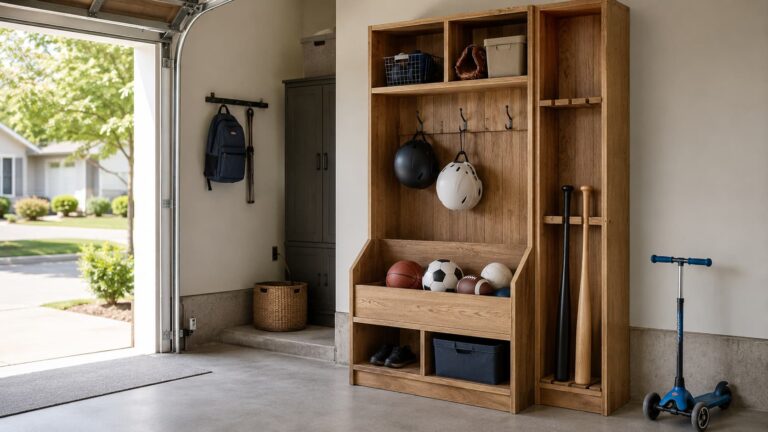
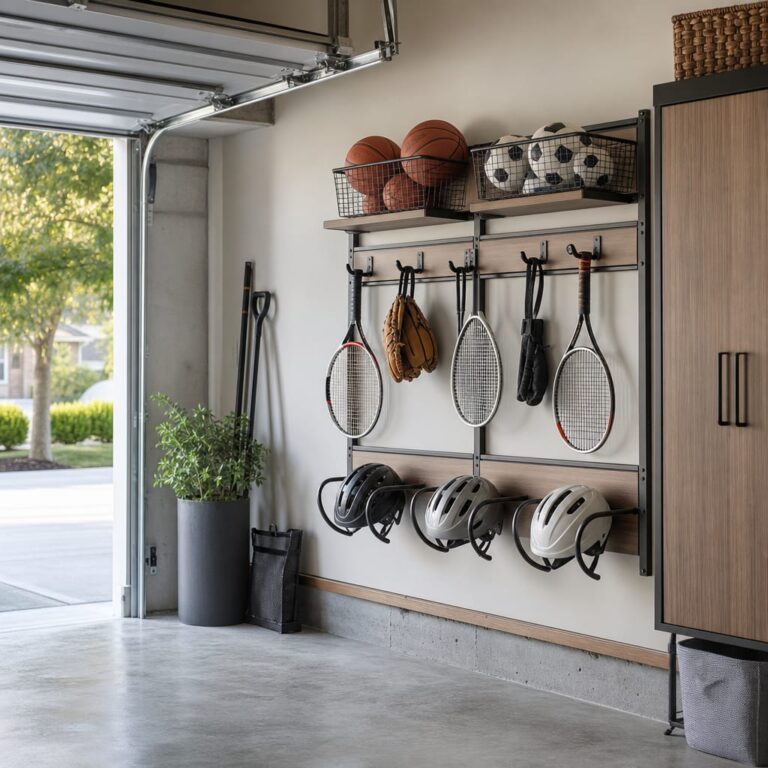
This guide narrows the field to six ball-storage racks across six distinct form factors: wall-mounted, rolling cart, vertical elastic column, 4-tier multi-rack, compact small-ball stand, and heavy-capacity mixed-gear cart. We organize by form factor on purpose — picking a rolling cart vs. a wall-mount is a different decision than picking between two carts. We do not cover broader sports gear organizers (see our broader sports equipment organizers guide) or kids-specific bundles (kids’ sports gear storage).
Quick Picks
| Pick | Product | Best for | Type | Main advantage | Watch out for | |
|---|---|---|---|---|---|---|
| Best Wall-Mounted | AIDILI Garage Ball Storage Rack | Garage owners reclaiming floor space | Wall-mount, vertical, elastic cord | Cord adjusts 31.5″–43.31″ | Drywall-only mounts often fail under load | View on Amazon |
| Best Rolling Cart | Mythinglogic Rolling Ball Storage Cart (Extra Large) | Households who move balls outdoors | Rolling cart, lockable casters | Bins, baskets, mobility | Wide footprint — measure the lane | View on Amazon |
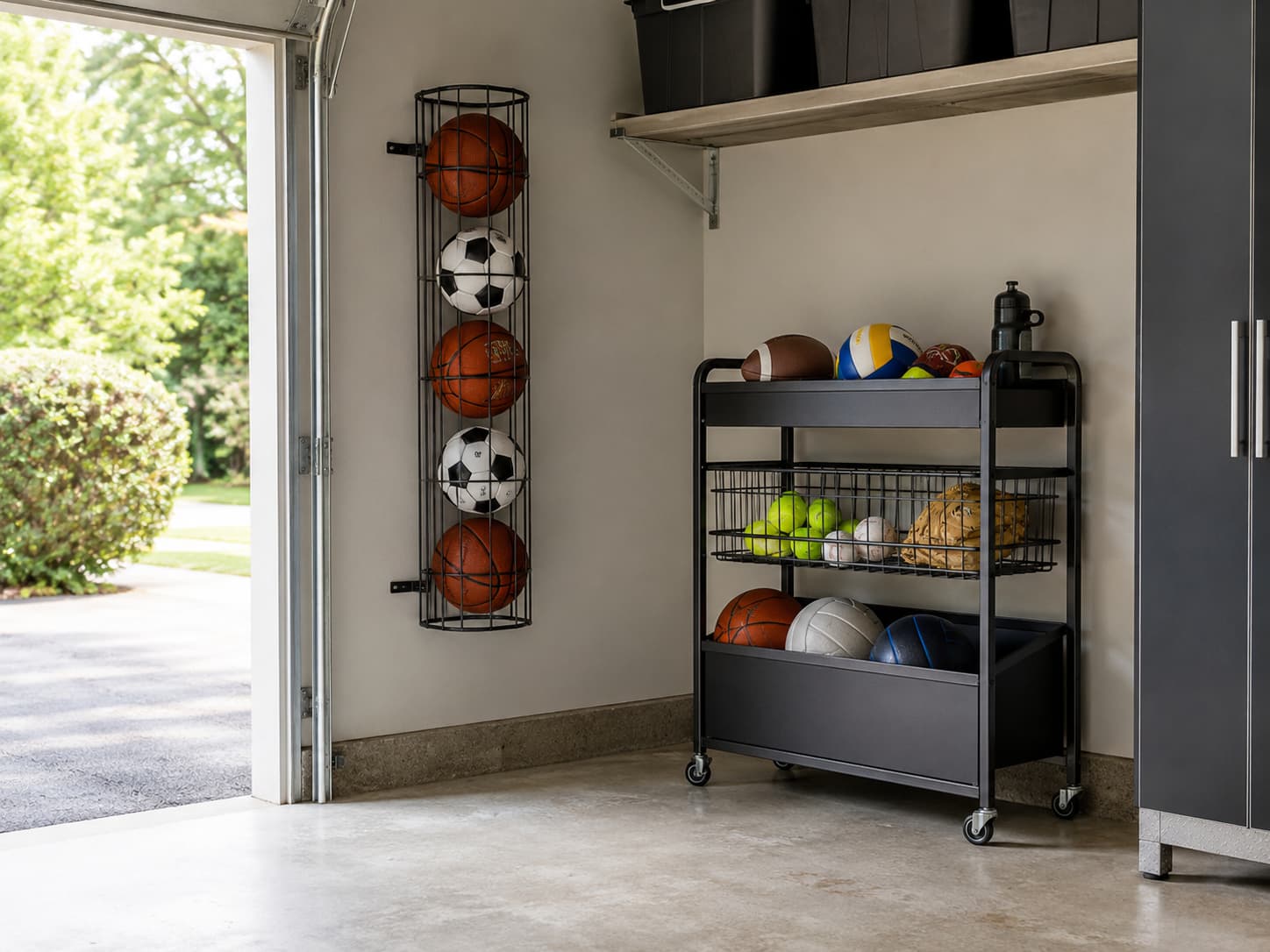
| Best Elastic Vertical Holder | URMMIY Garage Ball Storage Rack | Quick mid-stack ball access | Wall-mount, 3 elastic cords | 3-cord design — grab any ball | 4–5 ball ceiling per column | View on Amazon |
| Best Multi-Tier | Vobzolite 4-Tier Ball Storage Rack | Storing many ball types in one unit | Rolling, 4 tiers, side hooks | Highest variety per square foot | Newer brand — sparse manufacturer docs | View on Amazon |
| Best for Small Balls | Sports Equipment Organizer (Small) | Tennis/baseball/softball households | Compact floor stand, elastic + 3 hooks | Solves the small-ball blind spot | Unbranded — confirm dimensions | View on Amazon |
| Best Mixed-Gear Cart | HOME IT Garage Sports Equipment Organizer | Mix of balls + accessories | Rolling steel cart with multi-baskets | Most baskets in the lineup | Older listing — verify configuration | View on Amazon |
For households whose primary problem is not balls specifically but a mix of bats, pads, and bags, see our broader sports equipment organizers guide — that article covers the multi-sport organizers that handle balls as one of several gear types, while this article focuses on dedicated ball-first racks.
How We Selected These Ball Storage Racks
We do not claim hands-on testing unless clearly stated. For this guide, we reviewed manufacturer specifications where available, retailer product pages, product documentation, current Amazon listings, and recurring patterns in public customer feedback.
Because ball-storage products vary heavily in form factor (and because the wrong form factor for a household creates more frustration than the wrong brand), we prioritized products that occupy distinct slots — wall-mount vs. rolling vs. multi-tier — over picking the “best” within a single form factor. Capacity claims for ball racks also vary widely between large balls and small balls, so we flagged where listings only specify large-ball capacity.
Selection criteria:
- Distinct form factor. Each pick covers a different slot — no two are the same kind of product.
- Listed capacity that is verifiable on the product page. We avoid products whose capacity is implied but not stated.
- Reasonable mounting and assembly story. No products requiring contractor-level installation.
- Available in the US Amazon marketplace at the time of writing.
- Brand or seller traceable to a manufacturer page where possible. For unbranded picks, we frame numeric claims as “the listing states” rather than “manufacturer-listed”.
What to Look for in Garage Ball Storage Before Buying
Capacity — count your actual balls before you shop
The single most useful pre-purchase step is to physically count every ball in the garage and group by size: large (basketball, soccer, volleyball, football), small (tennis, baseball, softball, golf, lacrosse), and odd (rugby, medicine ball, etc.). Most listings quote “holds 8 balls” or “holds 12 balls” — but those numbers usually assume large-ball-only collections. A household with 6 basketballs and 12 tennis balls is shopping for a different rack than a household with 18 basketballs.
Form factor matches your walls and floor space
Wall-mounted racks reclaim floor area but demand wall depth and a sound mounting surface. Rolling carts reclaim wall space but eat floor footprint and walking lane. Vertical elastic columns are space-efficient but cap out at 4–6 large balls. Multi-tier racks store the most variety but are bulky. Match the rack to the dominant constraint in your garage, not to the brand you recognize.
Wall material — drywall, plaster, masonry, garage stud spacing
Most published “weight ratings” for wall-mounted racks assume the mount is anchored into wall studs or into masonry with proper anchors. Drywall-only mounting (using plastic anchors into hollow drywall) regularly fails under full ball-rack load. If you cannot identify your wall type or you are renting and cannot drill into studs, default to a rolling or floor-standing pick.
Adjustability for ball size mix
If your collection includes both large and small balls, prioritize racks with elastic adjustability or with separate small-ball baskets. A rigid 4-ball-pipe rack at one diameter does not work for tennis balls and basketballs at the same time.
Mobility — does it leave the garage?
If you wheel balls out to the driveway or yard often, rolling carts win on workflow. If balls stay in the garage, wall-mounts and verticals are better. Be honest about this — buyers who picked rolling carts “in case” often regret the floor footprint when the cart never moves.
Best Wall-Mounted Ball Rack: AIDILI Garage Ball Storage Rack
Best for: Garage owners who want balls off the floor entirely and have at least one usable wall section with stud or masonry mounting points.

Short verdict: A wall-mounted vertical ball cage with an adjustable elastic cord that expands as the collection grows, sized for households with a mid-range ball count.
The AIDILI ball rack mounts vertically against a wall and uses a single adjustable elastic cord to retain balls. The product page indicates the cord adjusts in a range that suits collections from a handful of balls up to a moderately full cage. Because the cord adjusts rather than running fixed, the same unit accommodates a growing collection without a re-buy — a useful trait when a younger child gathers more balls year over year.
Why it stands out
Most wall-mounted ball racks ship with a fixed elastic configuration calibrated for either a sparse or packed cage. The AIDILI’s adjustable cord covers both ends, so the same unit accommodates a growing collection without re-buying.
It can work well for:
- Households reclaiming floor space after a move-in
- Garages with a clear stretch of wall between the door and a workbench
- Rentals where stud-mounted picture hooks are already installed and can be reused
- Two-kid households with a mid-range ball count
Key specs to check
- Cord adjustment range — confirm the upper bound matches your full-cage scenario
- Mounting hardware — confirm stud-spacing tolerance matches your wall framing
- Cage internal width — confirm it clears your largest ball (basketball ~9.5″ diameter)
- Material — verify the listing’s stated frame before assuming weather resistance
Recurring feedback patterns
Recurring positive feedback often centers on the simplicity of the design and the ease of pulling balls in and out without unstacking. Common complaints typically involve mounting failures on drywall-only installs — buyers who anchored into studs report durable hold. Several buyers mention the elastic cord gradually loses tension after extended sun exposure near a garage window.
Potential drawbacks
The single-cord design means the entire stack must be slightly disturbed when grabbing a ball from the bottom — a minor friction point compared to multi-cord designs. There’s no integrated small-ball basket, so a household with many tennis balls or baseballs will still need a secondary storage solution.
Buyer warning
The listing’s implied weight tolerance assumes the rack is anchored into studs or into masonry with proper concrete anchors. Mounting into hollow drywall with plastic expansion anchors is a frequent failure mode in this category. Verify your wall type before ordering — and if you cannot drill into studs, look at the rolling-cart picks below instead.
Best Rolling Ball Storage Cart: Mythinglogic Rolling Ball Storage Cart (Extra Large)
Best for: Active households who move balls between garage, driveway, and yard, and who have at least 36 inches of clear floor lane to wheel the cart through.
Short verdict: Mythinglogic’s extra-large rolling variant — bigger than the standard model — combining storage bins, baskets, and lockable casters into a single mobile unit.
The Mythinglogic XL rolling cart is built around a powder-coated steel frame with lockable casters at the base, integrated bins for balls, and additional baskets and hooks for ancillary gear. It is intentionally distinct from Mythinglogic’s standard-size rolling cart that we cover in our broader sports equipment organizers guide — the XL is sized for households who want the entire ball collection on one platform, not split across two units.
Why it stands out
Among rolling carts, this XL variant is one of the few that combines true ball-rack capacity (multiple large balls in dedicated bins) with the basket inventory needed for gloves, helmets, cleats, and pumps. Lockable casters keep the cart stationary on sloped floors.
It can work well for:
- Households that wheel balls to a driveway hoop or a backyard goal
- Sports families with mixed gear (balls plus pads, bats, gloves)
- Garages with sloped floors (lockable casters prevent drift)
- Buyers who want one unified piece rather than two separate units
Key specs to check
- Overall footprint — measure the parking spot before ordering
- Caster lock mechanism — confirm all four casters lock, not just two
- Bin and basket dimensions — confirm internal sizes accommodate your ball mix
- Listed total weight capacity — frame as listing-stated, not performance-tested
Recurring feedback patterns
Recurring positive feedback often centers on the build quality of the steel frame and the convenience of moving balls between locations on casters. Common complaints typically involve the assembly time, footprint surprises by buyers who didn’t measure first, and occasional caster-squeak after extended use. Several buyers mention the XL is genuinely larger than expected — a plus for capacity, a minus for narrow garages.
Potential drawbacks
The footprint is the main constraint — at extra-large dimensions, this cart eats walking lane and may not fit between a parked car and the garage wall. The lockable casters add cost over a fixed-frame unit but are essential for any cart that doesn’t live on a perfectly level floor.
Buyer warning
Measure the narrowest walking lane in your garage (typically between the parked car and the wall) before ordering. The XL doesn’t fit the standard 24-inch walking lane that wall-mounted racks accommodate. If your garage gives up only 24 inches of clear floor lane, drop down to the standard Mythinglogic model or pick a wall-mount instead.
Best Elastic Vertical Ball Holder: URMMIY Garage Ball Storage Rack
Best for: Households who want quick mid-stack access — kids who need to grab a soccer ball without dislodging the basketballs above it.
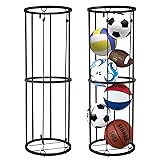
Short verdict: A wall-mounted vertical column with three independent bungee cords, sized for 4–5 large balls per the listing, with a 13-inch column diameter that clears most adult-size balls.
The URMMIY rack is a vertical cage with three separate bungee cords spaced down the column. The product page lists dimensions of 13 inches in column diameter and 38.4 inches in height. The three-cord configuration is the editorial differentiator — instead of one long elastic spanning top to bottom, three separate cords mean a buyer can release the middle cord and grab the middle ball without disturbing the top or bottom positions.
Why it stands out
In the elastic-vertical category, single-cord designs dominate. The 3-cord layout solves a real friction point: kid-height ball retrieval without unstacking the entire column. For households with younger children who can’t reach the top of a vertical rack, this matters more than total capacity.
It can work well for:
- Households with younger children who need ground-level access
- Garages with limited wall width (the 13″ diameter is space-efficient)
- Buyers who want a vertical solution without the rolling-cart footprint
- Two-kid households with 4–5 large balls total
Key specs to check
- Column internal diameter — listing states 13 inches; confirm clears your largest ball
- Total height — listing states 38.4 inches; confirm ceiling clearance and reachable height for kids
- Number of cords and spacing — confirm the 3-cord configuration in current listing photos
- Mounting hardware — drilled wall mount; confirm stud or anchor compatibility
Recurring feedback patterns
Recurring positive feedback often centers on the kid-friendly mid-stack access and the small wall footprint. Common complaints typically involve the limited capacity (4–5 large balls hits the ceiling for active families), and occasional concerns about cord tension loosening over months of daily use. Several buyers mention that the assembly is straightforward and the unit feels solid once mounted.
Potential drawbacks
The 4–5 ball capacity is firm — this is not a household-of-five solution unless you also pair it with a rolling cart for overflow. The vertical orientation means the unit projects 38 inches up the wall, which can interfere with overhead storage shelves on the same wall.
Buyer warning
If your collection is already at 6 or more large balls, this column tops out — you’ll either overstuff it (which compromises the cord tension) or need a second unit. Buyers who underestimate their ball count regret this choice. Count balls first, then decide between this and a multi-tier or rolling option.
Best Multi-Tier Ball Rack: Vobzolite 4-Tier Ball Storage Rack
Best for: Garage owners storing many ball types in a single unit — large balls plus small balls plus accessories.

Short verdict: A 4-tier rolling rack with a top flat shelf, two ball-pipe tiers, a bottom ball bin, and 14 side hooks — the highest variety-per-square-foot in this lineup.
The Vobzolite rack stacks four functional tiers: a flat top shelf (15.7″ × 39″ per the listing), two intermediate ball-pipe tiers each holding multiple balls in a row, a ground-level ball bin, and a side hook column with 9 straight hooks plus 5 bent hooks. The result is one of the few units that meaningfully accommodates a mixed collection — basketballs in one tier, soccer balls in another, small balls in the bin, and bats or rackets on the hooks.
Why it stands out
In a category where most units commit to one storage type (vertical column OR rolling cart OR shelf), the Vobzolite combines all three. The 14 side hooks replace a separate pegboard. For households with diversified gear, the consolidation is a workflow win.
It can work well for:
- Households with mixed ball types and ancillary gear (bats, rackets, pumps)
- Garages with one dedicated corner for sports gear
- Coaches or gym owners with high-volume diversified inventory
- Buyers who prefer one large unit over several smaller ones
Key specs to check
- Per-tier ball capacity — confirm per-tier numbers, not just total
- Top shelf dimensions — listing states 15.7″ × 39″; confirm fits your gear
- Caster type — confirm casters are present and lockable
- Hook strength — 9 straight + 5 bent per listing; confirm gauge for heavy items
Recurring feedback patterns
Recurring positive feedback often centers on the storage variety and the value of getting four storage types in one unit. Common complaints typically involve assembly complexity and occasional feedback about sparse manufacturer documentation — a known issue for newer brands. Several buyers mention the unit is stable once assembled and the casters roll smoothly.
Potential drawbacks
The footprint is large — this is not a small-garage pick. The newer-brand status means warranty handling and replacement-parts availability are less predictable than with established brands, and the manufacturer page is sparse on detailed specifications.
Buyer warning
The newer-brand caveat applies: rely on the Amazon listing for the spec sheet rather than expecting a polished manufacturer site. If anything ships damaged, document via Amazon’s return process rather than assuming brand-direct support. Buyers who want a more established brand should look at the HOME IT pick in this lineup instead.
Best for Small Balls and Compact Spaces: Sports Equipment Organizer (Small)
Best for: Tennis, baseball, softball, lacrosse, and other small-ball households with limited space — apartments, small garages, or dedicated kid rooms.

Short verdict: A compact floor stand with elastic straps and three side hooks, sized for buyers whose ball collection skews small rather than to basketballs and soccer balls.
This unit fills a gap most ball-rack roundups ignore: the small-ball-dominant household. Most listings size up around the assumption of basketballs and soccer balls, leaving tennis, baseball, softball, and similar small-ball collections orphaned in oversized racks where the balls roll around. The compact organizer with elastic straps and three side hooks targets exactly this household — not as a “starter” or “downsized” version of a big rack, but as the right size for the collection.
Why it stands out
Most “ball storage” listings on Amazon assume the user has 8–12 large balls. This one acknowledges that some households have 20+ tennis balls and 6 baseballs and no basketballs at all — a collection where a wall-mounted basketball cage is useless. The compact form factor and the elastic straps suit the smaller-ball-and-equipment shape.
It can work well for:
- Households whose ball mix is mostly tennis, baseball, softball, lacrosse
- Apartments with patio or balcony storage
- Garages where the dedicated sports area is one corner
- Single-kid households with a focused-sport collection
Key specs to check
- Overall footprint — confirm fits the corner you have in mind
- Strap configuration — confirm the elastic straps suit your ball sizes
- Hook capacity — three hooks are listed; confirm they handle your bats/rackets
- Listing’s stated weight capacity — frame as “the listing states” rather than manufacturer-listed (the seller is generic)
Recurring feedback patterns
Recurring positive feedback often centers on the right-sized footprint for small-ball households, where buyers explicitly note that bigger racks would have been overkill. Common complaints typically involve the unbranded nature — sparse documentation, occasional inconsistencies between listing photos and shipped unit. Several buyers mention that for the niche it targets, the unit works as advertised.
Potential drawbacks
Unbranded products carry inherent risk: the listing photos may not match the shipped product across sellers and SKUs, and the manufacturer page generally doesn’t exist for independent verification. Capacity claims must be treated as listing-stated, not manufacturer-listed.
Buyer warning
Verify the current listing photos and dimensions match your collection before ordering. Unbranded products in this category occasionally swap supplier SKUs without updating the listing. Cross-reference the listing’s dimensions against your actual measured space — and if your collection includes 4+ basketballs, this is the wrong product. Pick the URMMIY vertical or the AIDILI wall-mount instead.
Best Heavy-Capacity Mixed-Gear Cart: HOME IT Garage Sports Equipment Organizer
Best for: Garage households with a mix of large balls, small balls, gloves, helmets, cleats, and pumps — where one cart needs to consolidate everything.

Short verdict: A long-running heavy-duty steel rolling cart with two bins, four wire mesh baskets, and one side basket — the deepest basket inventory in the lineup.
HOME IT’s organizer is one of the older and more established listings in the category, with a multi-basket configuration that the Mythinglogic family doesn’t match (Mythinglogic’s standard variants use bins more than mesh baskets). The four wire mesh baskets give a household separate compartments for tennis balls, baseballs, and small accessories without mixing them with the large balls in the bins.
Why it stands out
Most rolling carts top out at one or two baskets. HOME IT’s four wire mesh baskets plus a side basket is the highest basket count in the lineup, and mesh visibility lets kids find their own gear without tipping bins.
It can work well for:
- Households with 4+ types of small balls and accessories
- Coaches managing team gear (separate compartments per kid or drill)
- Multi-sport families (baseball + soccer + tennis simultaneously)
- Buyers who prefer mesh visibility over closed bins
Key specs to check
- Current configuration — confirm the 4-basket + 2-bin + 1-side-basket layout still ships, since the listing has been live long enough to have gone through packaging revisions
- Caster brake type — confirm which casters lock; older units often brake only the front pair, so a sloped garage floor still lets the cart drift
- Wire mesh basket dimensions — measure your largest small-ball cluster (a dozen tennis balls, a helmet) against the listed internal basket size before assuming it fits
- Bin depth vs. large-ball diameter — confirm the lower bins clear a regulation basketball (~9.5″) rather than only soccer-sized balls
- Frame gauge — the listing describes heavy-duty steel; if you intend to load it near capacity, confirm the stated frame rating rather than assuming it from photos
Recurring feedback patterns
Recurring positive feedback often centers on the basket organization and the steel build, with buyers describing it as a long-term workhorse for garage ball storage across multi-year ownership periods. The mesh-basket visibility comes up repeatedly as the reason households pick it over closed-bin carts — kids can see and grab their own gear. Common complaints typically involve assembly difficulty tied to an older-style instruction manual, occasional caster squeak after extended use, and a few mentions of wheels that feel light-duty relative to the steel frame above them. Several buyers note the cart has aged consistently across production runs.
Potential drawbacks
The older listing means the instruction manual and packaging can feel dated next to newer competitors, and buyers expecting a polished unboxing may be surprised. The casters are the weakest link reported relative to the otherwise sturdy steel frame, so a fully loaded cart on a rough floor is where wear shows first. Replacement-part availability for long-running listings is also less predictable than for newer brands with active storefronts.
Buyer warning
Confirm the current listing configuration before ordering — long-running listings sometimes ship slight variants depending on supplier batch, so the basket count in the photos is what to verify. If the listing page no longer clearly shows four wire mesh baskets plus the side basket, message the seller to confirm the exact configuration before adding to cart. Because this is the deepest-basket option here, buyers choosing it specifically for the four-basket sorting should not assume a substitute SKU carries the same layout. The Vobzolite 4-tier is the newer-brand alternative if HOME IT is mid-transition between batches.
Side-by-Side Comparison
| Product | Best for | Form factor | Mobility | Multi-ball-size friendly | Main advantage | Main drawback |
|---|---|---|---|---|---|---|
| AIDILI | Reclaiming floor space | Wall-mount, vertical | Static | Limited (large balls only) | Adjustable cord | Drywall mount fails under load |
| Mythinglogic XL | Mobile household use | Rolling cart, lockable | Mobile | Yes (bins + baskets) | Locking casters | Wide footprint |
| URMMIY | Mid-stack access | Wall-mount, 3 cords | Static | Limited (large balls) | 3-cord design | 4–5 ball ceiling |
| Vobzolite | Many ball types | Rolling 4-tier | Mobile | Yes (4 tiers + hooks) | Most variety per sq ft | Newer brand, sparse docs |
| Sports Org Small | Small-ball households | Compact stand | Static | Yes (small balls focused) | Solves small-ball blind spot | Unbranded |
| HOME IT | Mixed gear consolidation | Rolling cart, multi-basket | Mobile | Yes (4 baskets) | Most baskets in lineup | Older listing |
Wall-Mounted vs Rolling vs Vertical: Which Form Factor Fits You?
The form factor decision matters more than the brand decision. Most buyer regret in this category isn’t “I bought the wrong brand” — it’s “I bought the wrong form factor for my space and collection size”. The matrix below maps collection size to form factor recommendations.
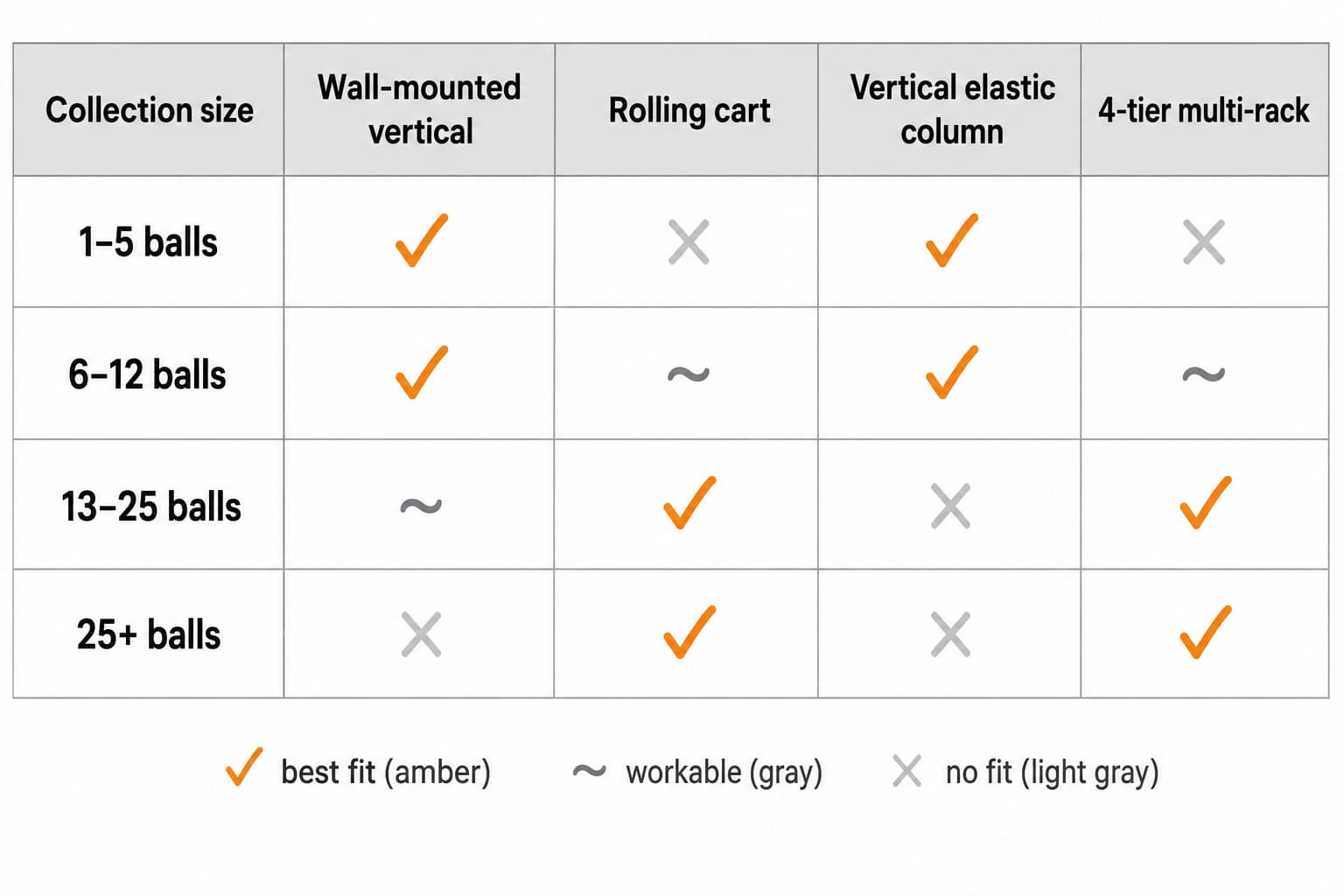
Patterns from the matrix worth highlighting:
- Small collections (1–5 balls): wall-mount or vertical elastic — rolling and multi-tier are oversized.
- Mid-range (6–12 balls): all four form factors flex; pick on space constraints.
- Larger (13–25 balls): outgrows vertical columns; rolling carts and 4-tier multi-racks are the sensible options.
- Heavy (25+ balls): rolling or 4-tier only; wall-mount and vertical-column units cap out under load.
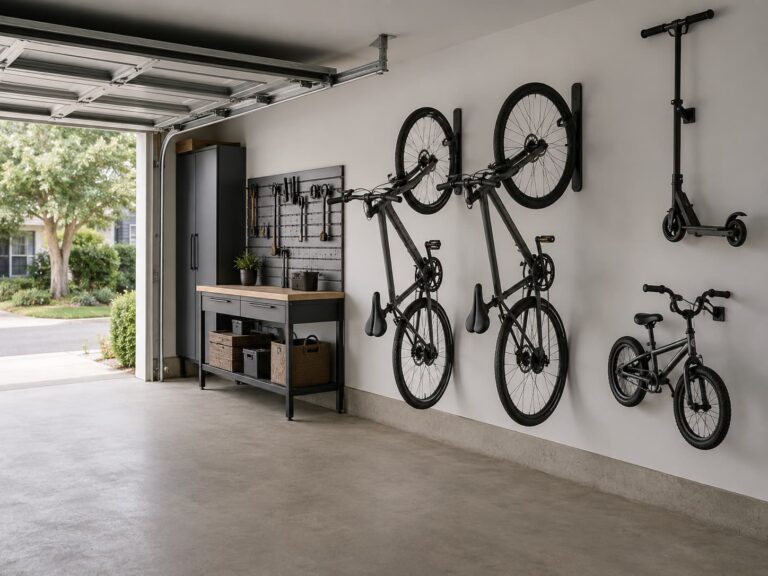
For households needing seasonal storage for off-season balls, overhead storage options complement this guide — many use a wall-mount for in-season and overhead bins for off-season. If balls share the garage with bikes competing for the same wall, our garage bike rack guide covers how to lay out both without one crowding the other.
Two alternatives we considered but didn’t main-pick — the AWZITUO single-strap variant and the Wallniture Sporta display rack — fit narrow niches: AWZITUO suits buyers wanting a thicker single-strap design, and Wallniture targets buyers prioritizing aesthetics over capacity.
Ball diameters that decide rack fit
Sports governing bodies publish ball circumference, but the number that decides whether a ball fits a rack slot, a bungee opening or a bin is its diameter — and nobody publishes that. This table quotes each official circumference specification and derives the diameter from it, so you can measure an opening and know what will actually go into it.
| Ball | Official circumference | Diameter (derived) | Min. clear opening | Official weight | Specification source | Source checked |
|---|---|---|---|---|---|---|
| Basketball, size 7 (men’s / adult) | 29½–30 in | 9.4–9.5 in | 9.75 in | — (not stated in the cited source) | NCAA men’s basketball rules | 2026-08-14 |
| Soccer ball, size 5 (adult) | 68–70 cm (27–28 in) | 8.5–8.8 in | 9 in | 410–450 g (14–16 oz) at the start of the match | IFAB Laws of the Game, Law 2 | 2026-08-14 |
| Volleyball, indoor | 65–67 cm (25.6–26.4 in) | 8.1–8.4 in | 8.5 in | 260–280 g (9–10 oz) | USA Volleyball Indoor Rules 2025-2027, Rule 3.1 | 2026-08-14 |
| American football, official size | 21–21¼ in around the middle; 28–28½ in end to end | 6.7–6.8 in | 7 in | 14–15 oz | Official Playing Rules of the NFL, Rule 2 | 2026-08-14 |
How these numbers were produced: Diameter is derived from the governing body’s published circumference range as d = C / π, then rounded to 0.1 in. Minimum clear opening is the derived maximum diameter rounded up to the next 1/4 in — arithmetic only, not a manufacturer specification, and it assumes a rigid opening with no stretch. Circumference figures in inches are converted from the metric spec where the governing body publishes metric (1 in = 2.54 cm); where the body publishes both, its own figures are quoted.
- Sizes 6, 5, 4 and 3 balls are manufacturer conventions for youth play, not rules-body specifications, and vary between brands — measure the ball you actually own rather than assuming a nominal size.
- An American football is a prolate spheroid, so it has no single diameter: the girth figure is what a slot must clear, the long axis is what the slot depth must accommodate.
- Elastic-cord and bungee racks stretch, so a ball larger than the resting opening can still be held; the figures above are the rigid-opening case.
- A blank weight means the cited rulebook does not state one — we do not fill gaps with figures we could not source.
Download the data (CSV) · last updated 2026-08-14 · version 1.0 · CC BY 4.0, attribution to Garage Space Guide.
How to Measure Your Garage Before Buying a Ball Rack
Most buyer regret in this category traces back to skipping measurement. Take five minutes and measure the four dimensions below — it saves hours of returns.
Then check what you are actually storing against the ball diameter table above: an opening sized for a size 5 soccer ball (9 in clear) will not take a size 7 basketball, which needs closer to 9¾ in.
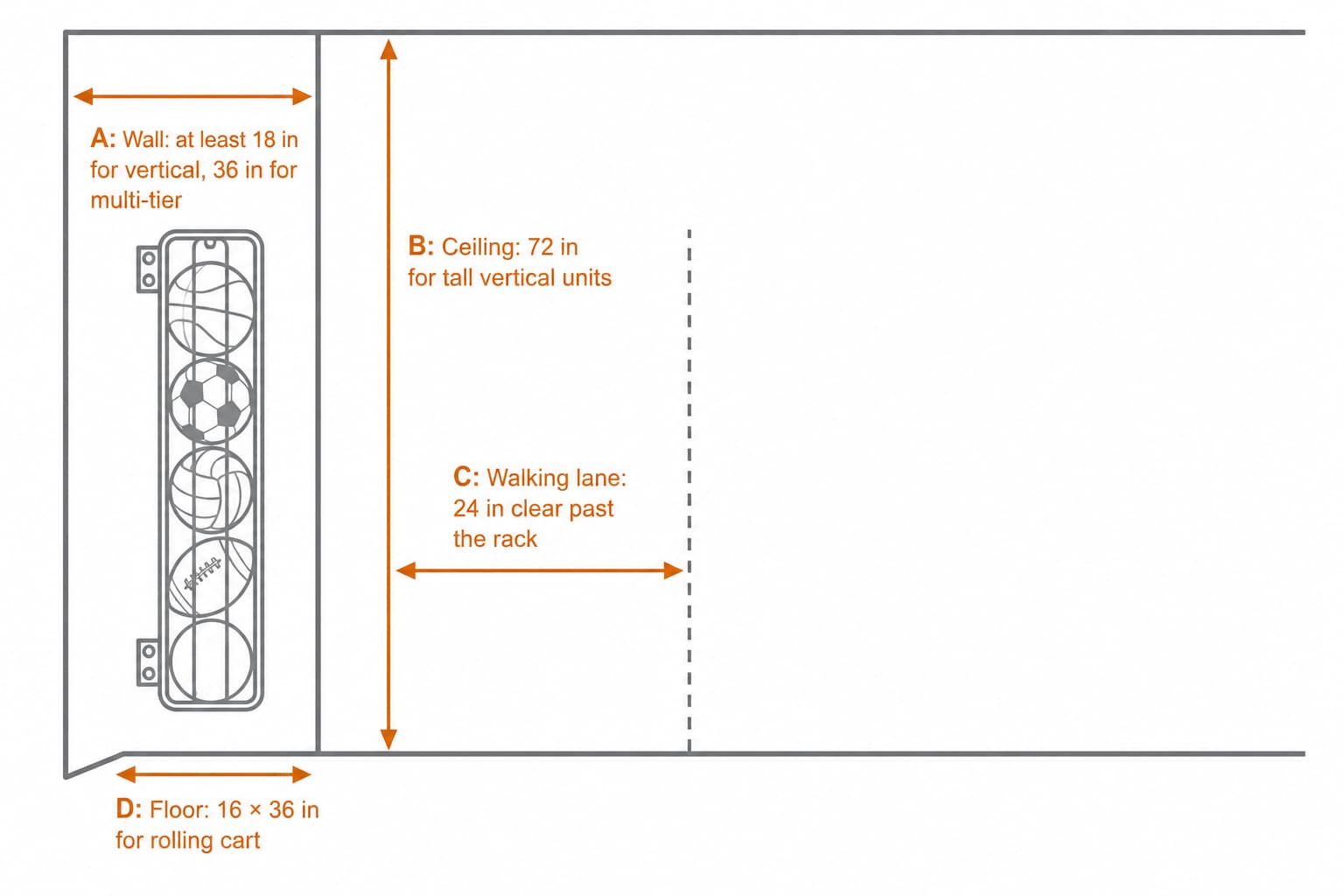
Measurement checklist:
- Free wall width. Vertical wall mounts need at least 18 inches of clear wall. Multi-tier wall-leaning racks need at least 36 inches.
- Free floor footprint. Rolling carts here typically need 16 × 36 inches minimum. Multi-tier racks need more.
- Ceiling height for vertical units. 38-inch columns need at least 72 inches of clearance.
- Walking lane. Measure the narrowest walking lane between car and wall — aim for at least 24 inches clear past the rack.
- Wall material. Drywall, plaster, masonry, wood paneling — determines mount type and weight tolerance.
- Biggest ball diameter. Basketball ~9.5″, soccer ball ~8.5″, volleyball ~8.3″ — confirm your largest ball clears the column or pipe.
- Total ball count. Group by large vs. small.
- Secondary gear count. Bats, rackets, gloves — affects which form factor consolidates everything.
For broader garage organization principles, see our small-garage organization principles guide — many buyers ultimately need to rethink the surrounding layout, not just the rack. Tight-garage owners can also pair a compact ball rack with the products in our small-garage storage guide to free up the floor lane first.
Common Complaints and Buyer Warnings
Most buyer regrets in this category cluster around three issues:
- Mounting failures. Wall-mounts anchored into drywall with plastic expansion anchors regularly pull free under full load. The listing’s stated weight tolerance assumes proper installation into studs or masonry.
- Oversized footprints. Rolling carts are bigger than buyers expect. The XL Mythinglogic and the multi-tier Vobzolite are the most likely to surprise buyers who didn’t measure first.
- Capacity claims that assume large balls only. “Holds 12 balls” usually means 12 basketballs. A household with 6 large and 12 small balls is a different sizing problem than the listing accounts for.
The single most important warning: do not trust a wall-mount load rating without verifying your wall type. If you cannot identify wood studs, metal studs, masonry, or hollow drywall, default to a rolling or floor-standing pick. The overhead storage options are a complementary fallback for buyers without sound wall-mounting surfaces.
Who Should Avoid a Dedicated Ball Storage Rack?
A dedicated ball rack isn’t right for every household. Skip the category if:
- You have 1–3 balls total. A simple wall hook or a single mesh bag does the job. A dedicated rack is overkill at small ball counts and the rack itself takes more space than the balls did.
- You don’t have garage walls or floor space to spare. Apartments, small condos, or garages already maxed out on storage may not have room. The overhead storage options sometimes work as an alternative for off-season storage.
- You need outdoor-only year-round storage. Most racks in this category are listed as indoor or covered-area products. Outdoor-rated weather resistance is rarely independently verified, despite some listings claiming so.
- Your ball collection is mostly seasonal. If you only use balls 3 months a year, a labeled bin in a closet or overhead bin storage may serve you better than a dedicated rack occupying floor or wall space year-round.
- You’re a renter who can’t drill into walls. Wall-mount picks require drilling. Rolling picks are the alternative.
If your household genuinely needs broader sports gear storage (bats, pads, helmets, balls all together), see our broader sports equipment organizers guide — the multi-sport organizers in that article handle balls as one of several gear types.
FAQ
How many balls should I plan for when buying a ball organizer for the garage?
A useful rule of thumb is to count current balls and add 30–50% headroom for the next two years. Households with growing kids accumulate balls faster than expected — a rack sized exactly to current ball count fills up within a season.
Can I mount one of these on drywall without studs?
Generally no. Drywall-only mounts using plastic expansion anchors regularly fail under full ball-rack load. Either anchor into wood studs (with screw-through-anchor hardware), use proper masonry anchors for brick or concrete walls, or pick a floor-standing rolling option instead.
Are wall-mounted ball racks better than rolling carts for kids?
It depends on kid height and access pattern. Wall-mounted vertical racks position balls at variable heights, which works for taller kids but frustrates younger kids who can’t reach the top. Rolling carts with low bins are easier for young kids — the URMMIY’s three-cord design is the middle path, with mid-stack access at kid-reachable height.
Do these work outdoors year-round?
Most are listed as indoor or covered-area products. Outdoor exposure to UV, freeze-thaw cycles, and rain shortens elastic cord life and can rust steel frames. If you need outdoor storage, treat it as a 1–2 year consumable rather than a permanent solution, and check whether the listing explicitly states weather resistance.
How do I know if my collection is more “vertical column” or “multi-tier”?
If your collection is mostly large balls (basketballs, soccer balls, volleyballs) and totals 4–6 balls, vertical columns work well. If you have multiple ball sizes, plus accessories (bats, rackets, gloves), multi-tier wins because the side hooks and shelves consolidate the auxiliaries. Count not just balls but everything you’d want stored alongside them.
Can a garage organizer for balls also hold pumps, needles, and other accessories?
Multi-basket carts (HOME IT) and multi-tier racks (Vobzolite) handle these naturally — the side baskets and bins accommodate small loose items. Wall-mounted vertical racks generally do not have a place for these; you’d need a separate small-bin or a hook for the pump.
Do any of these come pre-assembled?
None ship fully pre-assembled. Wall-mounts and rolling carts both need user assembly — typically 30–60 minutes for wall-mounts and 60–90 for rolling carts and multi-tier racks. The Vobzolite 4-tier is the most assembly-heavy; the AIDILI wall mount the lightest.
Sources Reviewed
For this guide, we reviewed manufacturer product information where available, retailer specifications, Amazon product listings, public customer feedback patterns, and ball-storage-specific discussions. We focused on product details that matter for ball storage in residential garages, including form factor, listed capacity (large vs. small balls), mounting requirements, mobility, and recurring buyer-reported issues.
Related Guides
- Best Garage Sports Equipment Organizers — broader multi-sport organizers
- Best Storage Racks for Kids’ Sports Gear in the Garage — kid-specific bundles and lower-reach designs
- Best Garage Bike Racks — cluster sibling for bike storage
- Best Overhead Garage Storage Racks — when floor and wall space is tight
- How to Organize a Small Garage — small-garage organization principles
- how to choose bike storage for garage
- How to Organize a Garage Workbench
- How to Organize Sports Equipment in Your Garage
- how to store bikes in garage
- Wall-Mounted Bike Rack vs Freestanding Bike Rack
- garage shelving vs cabinets