Best Garage Storage Ideas and Products for Small Garages
Last updated:
Disclosure: This article contains affiliate links. If you buy through these links, we may earn a commission at no extra cost to you. We do not claim hands-on testing unless clearly stated.
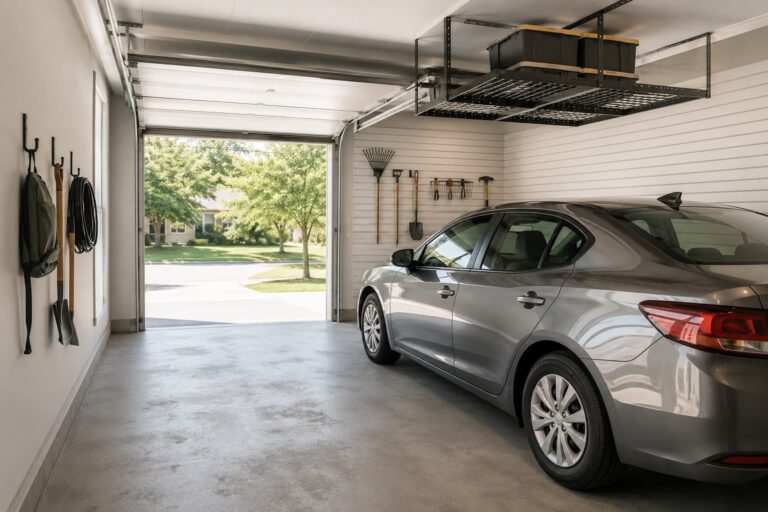
A small garage punishes every wrong purchase. A 48-inch shelf that won’t fit between the door track and the side wall. A ceiling rack with a drop too tall for an 8-foot ceiling. A static bike hook that clashes with the car door swing.
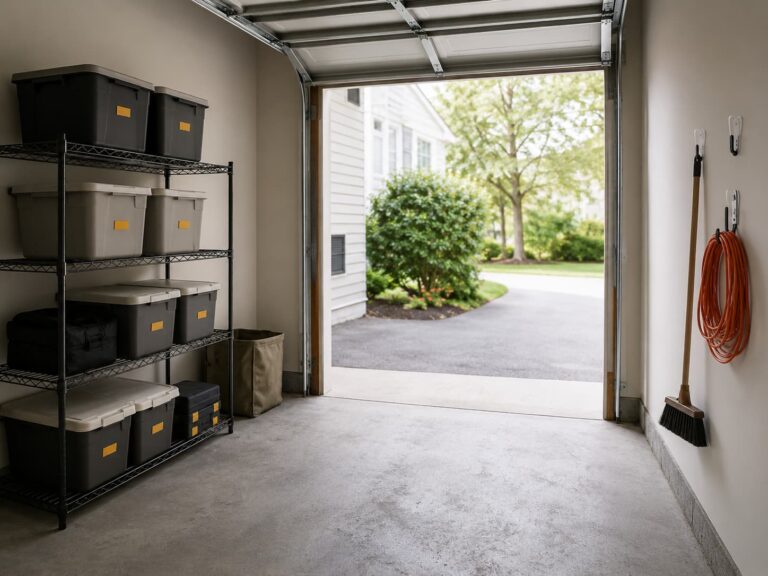
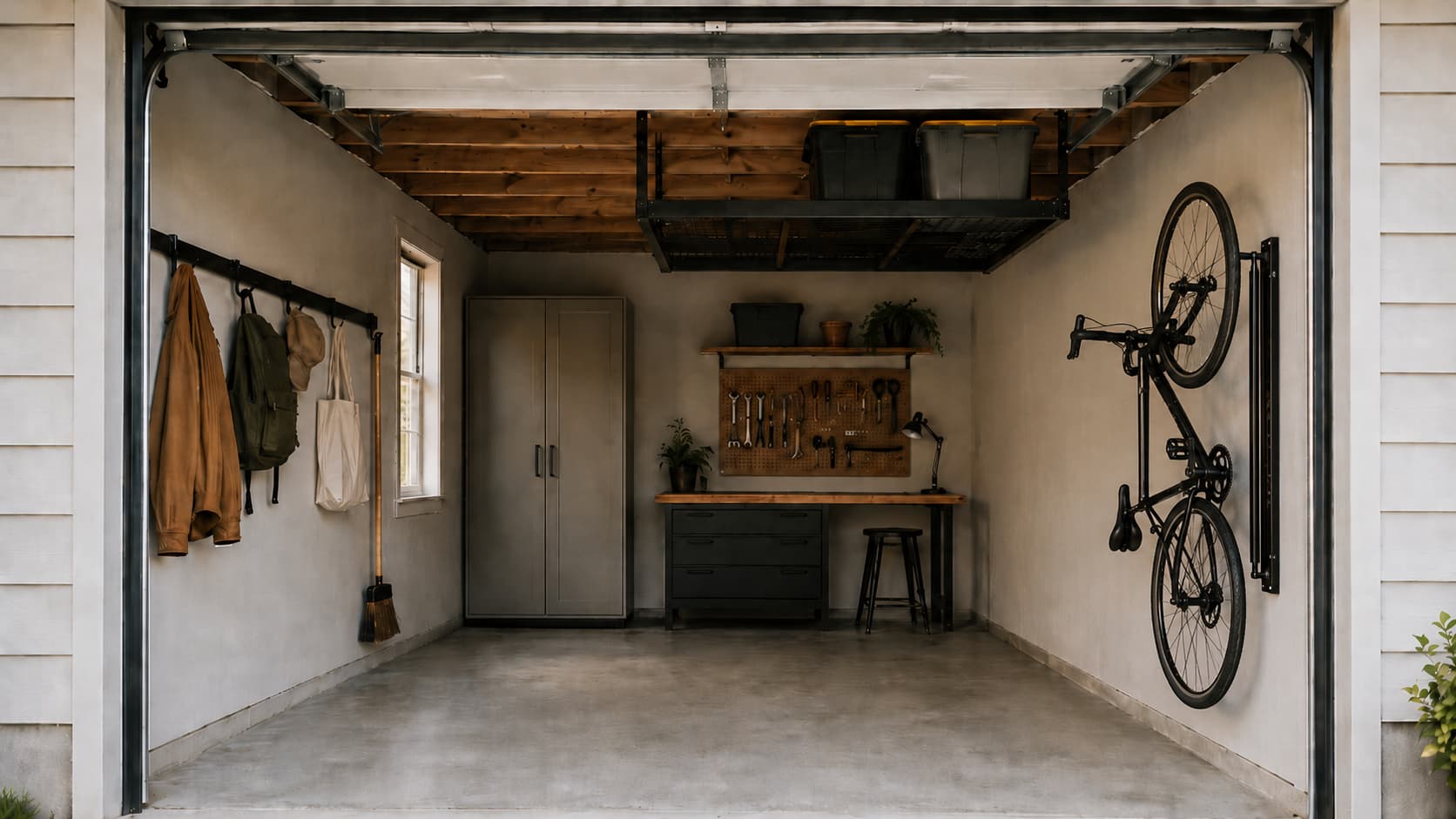
This roundup covers seven storage products picked for small or one-car garages, organized by which surface each one uses — wall, ceiling, floor corner, or single-bike vertical. Out of scope: full slatwall buildouts, freezers and fridges, paint and chemical storage codes, or workbench builds. The focus is on shelving, racks, and hangers that ship to your door and install in an afternoon.
Quick Picks
| Pick | Product | Best for | Type | Watch out for | CTA |
|---|---|---|---|---|---|
| Best Wall Storage System | Rubbermaid FastTrack 48″ Rail | Hanging tools, bikes, ladders from a single stud-mounted rail | Wall track | Rail capacity is not per-hook capacity | View on Amazon |
| Best Ceiling Rack for Low Ceilings | SafeRacks 4×6 Overhead Rack (12″–21″ drop) | Garages with 8 ft ceilings or shorter | Ceiling rack | 12-inch minimum drop is still too low for sub-7-ft ceilings | View on Amazon |
| Best Compact Free-Standing Shelving | Seville Classics 24″W x 18″D 5-Tier | Side walls and corners where 48″ shelves don’t fit | Wire shelving | ~3 sq ft per shelf — narrow surface | View on Amazon |
| Best Vertical Bike Rack | Steadyrack Classic | Garages where the car door swings through the bike’s wall position | Wall-mount swivel | 2.1-inch tire-width limit; not for fendered bikes | View on Amazon |
| Best for One-Car Garage Tote Storage | MonsterRAX 5-Tier Bin Rack | Stacking 5 totes vertically in a corner | Vertical tote rack | 50 lb per tier — light loads only | View on Amazon |
| Best Modular Tool Storage | Wall Control 4 ft Pegboard Kit | Workbench-corner tool wall in a small garage | Steel pegboard | Tools, not totes — light per-hook ratings | View on Amazon |
| Budget Vertical Bike Rack | Delta Cycle Leonardo | Wall sections outside the car door arc | Wall-mount static hook | Static hook — bike sticks 16″ from wall | View on Amazon |
How We Selected These Products for Small Garages
We do not claim hands-on testing unless clearly stated. For this guide, we reviewed manufacturer specifications, retailer product pages, product documentation where available, and recurring patterns in public customer feedback.
Because a small garage punishes oversized purchases, we prioritized products with manufacturer-listed dimensions clearly visible on the listing, adjustable or cut-to-length features that adapt to a tight footprint, and brands with stable, long-running Amazon listings so the reader buys what we recommend rather than a relabeled variant.
Selection criteria:
- Footprint of 24 inches wide or less, OR mounts to a wall or ceiling without standing on the floor
- Manufacturer-listed dimensions and capacity clearly visible on the product page
- Adjustable drop, cut-to-length channels, or swivel features that adapt to a tight space
- Brands with a long-running Amazon listing (less risk of variant chaos)
- At least one accessory or expansion path so the system can grow without re-buying
What to Measure Before You Buy Anything
The biggest mistake in a small garage is buying before measuring. The wall-to-wall dimension on the floor plan is not the dimension that matters — the dimension that matters is what’s left after the car doors, the garage door track, and the existing obstacles take their share.
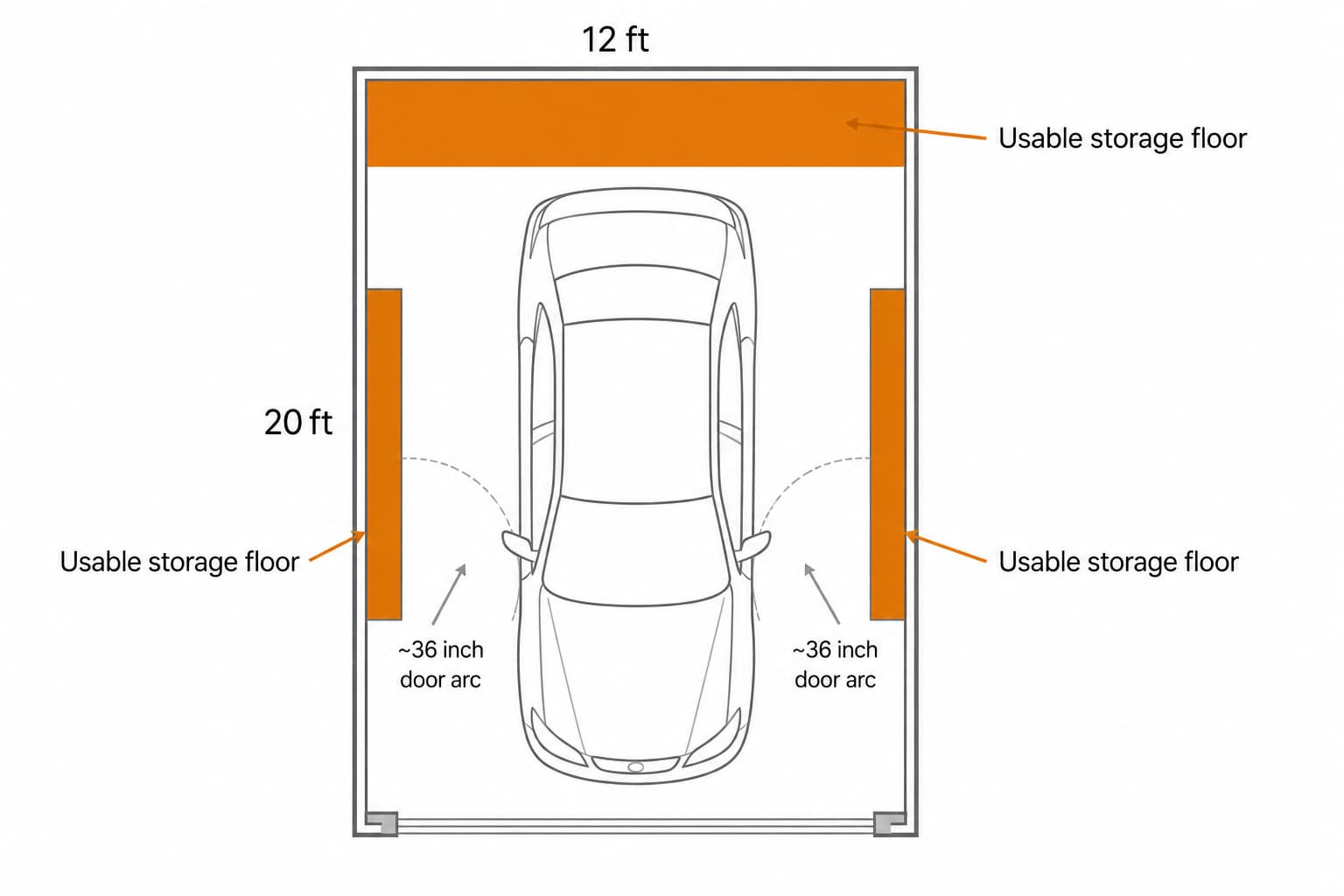
Before clicking “Buy” on anything in this article, run through this measurement checklist. For more on the broader sequencing, see how to organize a small garage step by step.
Floor footprint and door swing arc
Measure the largest open floor area, in inches, between the closed garage door and the back wall. Then park the car as you normally do and open both doors to full extension. Measure the swept arc of each door — typically about 36 inches of radius from the hinge.
The usable floor footprint for storage is whatever is left along the back wall and along each side wall outside the door arcs. In a 12-by-20-foot one-car garage, that often comes out to roughly 4–5 feet of clear depth at the back and 18–24 inches along each side wall.
Ceiling height and joist orientation
Measure floor to the lowest ceiling joist with a tape measure and a ladder. Note whether the joists run parallel or perpendicular to the garage door — this determines whether a 4-by-6 or 4-by-8 ceiling rack can mount cleanly without crossing the garage door track.
Subtract the rack’s drop range from your ceiling height. A 12-inch minimum drop on a 7-foot 10-inch ceiling leaves about 6 feet 10 inches of clearance under the rack — workable for adult standing height. A 24-inch drop on the same ceiling leaves only about 5 feet 10 inches, which is below standing height for most adults.
Wall length available for tracks and pegboard
The wall most people use is the back wall, but the side wall opposite the parked car door is often more useful because the car body doesn’t block access. Identify which wall has the longest uninterrupted run of wall surface — no electrical box, no breaker panel, no window, no garage door track interfering.
Existing obstacles
The garage door track typically runs 4–8 inches below the joists in the center of the garage, which reduces overhead clearance precisely where most ceiling racks want to live. The hot water heater, breaker panel, and attic access door each consume wall or ceiling area that won’t accept a rail or rack. Measure each obstacle’s footprint and clearance before clicking “Buy”.
Best Wall Storage System: Rubbermaid FastTrack
Best for: small-garage owners who want to keep the floor clear and hang tools, bikes, ladders, and yard gear from a single stud-mounted rail.

Short verdict: A heavy-steel rail mounted into studs, paired with a wide accessory ecosystem. The most accessible wall track on Amazon for small-garage use.
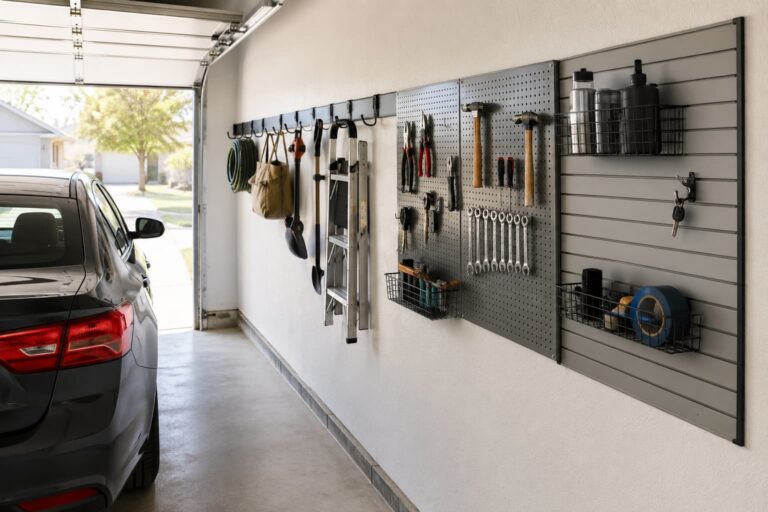
The product page lists a 48-inch standalone rail manufacturer-listed for up to 1,750 pounds when properly mounted into 16-inch or 24-inch stud spacing. Hooks, multi-position hangers, baskets, bike hooks, and shelf brackets are sold separately under the FastTrack accessory line and snap onto the rail without re-drilling. For a related deeper dive, see our overview of wall-mounted garage storage systems.
Why it stands out
Stud-mounted rail capacity sits in a different class than drywall-anchored hooks. A 48-inch rail anchored into 3–4 studs distributes weight across the wall framing instead of relying on plastic anchors in drywall. For a small garage, this turns the back wall or a long side wall into a load-bearing surface — and you can extend the system later by adding a second rail above or beside the first.
It can work well for:
- Tools and yard gear on utility hooks
- One or two bikes via the FastTrack bike hook
- Long items: rakes, shovels, ladders
- Wire baskets for sporting equipment
Key specs to check
- Rail length: 48 inches (single rail in this listing)
- Manufacturer-listed capacity: 1,750 lb when stud-mounted
- Stud spacing: works with 16″ or 24″ stud centers
- Accessory ecosystem: FastTrack hooks, baskets, hangers, bike hooks — all sold separately
Recurring feedback patterns
Recurring feedback patterns suggest the rail itself is the part buyers are most consistently satisfied with — the stamped-steel channel feels solid once it’s biting into studs, and the snap-in accessory engagement tends to be described as positive and reassuring rather than flimsy. Buyers often mention that the hang-anywhere flexibility along the rail is the feature that justifies the system over individual screwed-in hooks. Common complaints typically involve the up-front cost of building out a useful accessory set, since the rail ships bare and each hook, basket, and hanger is a separate purchase. A second recurring theme involves stud alignment: feedback patterns indicate the install goes smoothly when studs land on standard 16-inch centers and gets fiddly when a garage has irregular framing or when the reader tries to anchor into drywall between studs.
Potential drawbacks
- Rail-only listing: the headline capacity describes the rail, but a usable wall needs an accessory budget on top of the rail price.
- Per-hook ratings are far below the rail rating, so the system’s real working limit is set by the weakest accessory, not the 1,750-pound figure.
- The horizontal-rail format reclaims wall area but does nothing for ceiling or floor-corner storage, so it rarely solves a small garage on its own.
- Mounting depends entirely on solid stud contact; framing that doesn’t sit on standard centers complicates a clean install.
Buyer warning
The 1,750-pound figure is the rail-into-studs limit, not a per-hook limit. Each accessory hook has its own much lower rating — typically 25–50 pounds. Do not load a single hook to anywhere near rail capacity. Real-world performance depends on assembly, stud quality, and proper weight distribution; always follow the manufacturer’s installation instructions.
Best Ceiling Rack for Low Ceilings: SafeRacks 4×6 Overhead Rack
Best for: garages with 8-foot ceilings or shorter, where the more common high-drop racks reduce headroom too aggressively.

Short verdict: A 12-to-21-inch adjustable drop on a 4-by-6 platform — the lowest-drop variant of the popular SafeRacks family, and the right SKU when ceiling height is a constraint. For broader options at different ceiling heights, see our roundup of overhead garage storage racks.
The product page lists a 500-pound manufacturer-listed capacity, a 48-by-72-inch platform, and 14-gauge industrial steel C-channel beams with a powder-coat finish. Mounting is into ceiling joists with the included lag bolts. Hook accessory packs vary by SafeRacks SKU; verify what’s included on the listing before relying on hook accessories from this specific variant.
Why it stands out
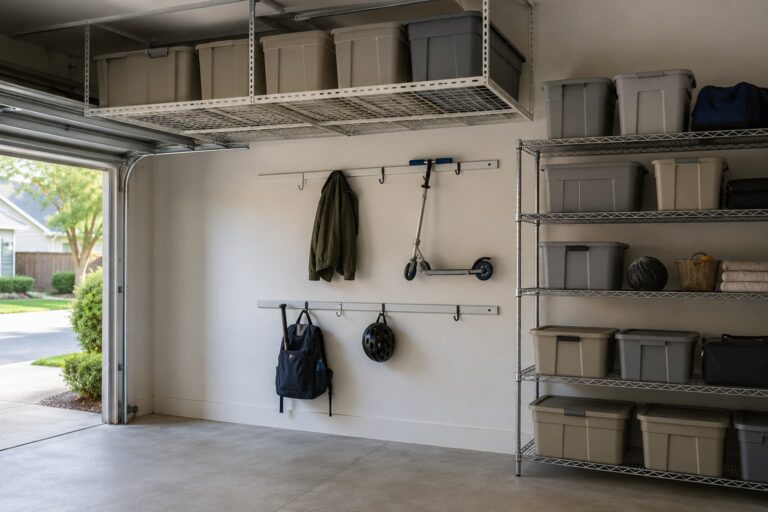
Small garages often have unfinished ceilings with joists exposed at about 7 feet 10 inches. A 12-inch minimum drop puts the rack deck at roughly 6 feet 10 inches off the floor — workable for adult standing height under the rack while still adding roughly 24 square feet of overhead storage. The 4-by-6 footprint also spans fewer joists, which makes it easier to find a clean mounting position away from the garage door track or attic access.
It can work well for:
- Holiday decorations and seasonal totes
- Camping gear, suitcases, luggage
- Lightweight bins of soft goods
- Collapsible folding chairs and similar flat items
Key specs to check
- Drop range: 12 inches to 21 inches (manufacturer-listed)
- Platform: 48 inches by 72 inches
- Manufacturer-listed capacity: 500 lb
- Mounting hardware: lag bolts into ceiling joists
- Material: 14-gauge industrial steel, powder-coat finish
Recurring feedback patterns
Recurring feedback patterns suggest the heavy C-channel steel deck is the standout — buyers often mention that the platform feels overbuilt for the loads a small garage actually puts on it, which reads as reassuring rather than wasteful. The low-drop range earns consistent positive mention from owners of 8-foot and shorter ceilings, who frame it as the reason this SKU works where taller-drop racks didn’t. Common complaints typically involve the assembly: feedback patterns point to the lag-bolt mounting step as the part that benefits most from a second person and a solid stud finder, and to instructions that some readers describe as terse. Another recurring theme is joist hunting — buyers report the install is straightforward when joists are exposed and easy to locate, and frustrating when a finished ceiling hides them.
Potential drawbacks
- Even the minimum drop steals overhead clearance, so a genuinely short ceiling can make the rack unusable for adults walking underneath.
- Lag-bolt installation into joists is permanent and physically demanding — not a job for one person on a wobbly ladder.
- Hook and accessory inclusion varies by SafeRacks SKU, so the listing has to be checked rather than assumed.
- The fixed 48-by-72-inch footprint needs a clean joist run, which the garage door track or attic hatch can interrupt.
Buyer warning
Even the minimum 12-inch drop reduces clearance to under standing height in a sub-7-foot ceiling. Measure floor to lowest joist before buying, and remember that the joist line, not the drywall line, is what the rack hangs from. The 500-pound rating assumes correct lag-bolt installation into solid joists; real-world performance depends on joist quality and proper weight distribution.
Best Compact Free-Standing Shelving: Seville Classics 24″W x 18″D 5-Tier Wire Shelving
Best for: a single side wall in a one-car garage, or behind the garage door swing, where a 48-inch-wide shelf wouldn’t fit.

Short verdict: NSF-grade wire shelving in a small footprint that still handles medium bins and gear. Same posts and wire as Seville’s larger 48-inch units, just narrower and rated lower per shelf.
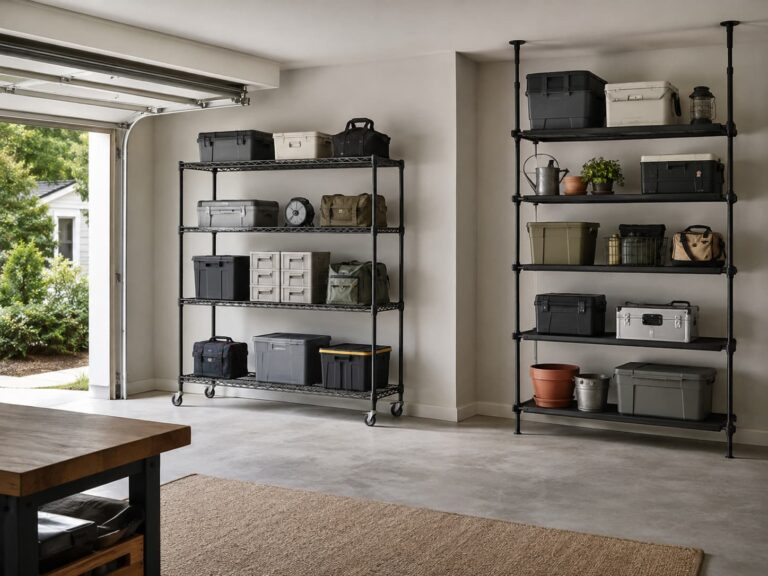
The product page lists dimensions of 24 inches wide by 18 inches deep by 72 inches tall (75 inches with casters), chrome-plated steel wire shelves on adjustable steel posts in 1-inch increments, and includes both 4 leveling feet and 4 wheels (2 of them locking). Manufacturer-listed capacity is 600 pounds per shelf on the leveling feet, with a total system capacity of 3,000 pounds on leveling feet — reduced to 500 pounds total when the included casters are used instead. For our deeper guide on this product family, see garage shelves for storage bins and totes.
Why it stands out
Seville’s 24-inch-wide variant uses the same posts, wire, and leveling feet as the 48-inch models — the construction is identical. Per-shelf capacity is somewhat lower than the wider variants (600 lb here versus 800 lb on the 48-inch models), but for a small garage where the 48-inch shelf simply won’t fit between the door track and the back wall, this is the credible main-storage option.
It can work well for:
- A side-wall shelving station in a one-car garage
- Behind a swung-open garage door
- A pantry-style overflow corner near the kitchen entry
- Automotive fluids, cleaning supplies, small bins
Key specs to check
- Dimensions: 24″ W x 18″ D x 72″ H (75″ H with casters)
- Manufacturer-listed per-shelf capacity: 600 lb on leveling feet
- Manufacturer-listed total system capacity: 3,000 lb on leveling feet, 500 lb on the included casters
- Shelf adjustment: 1-inch increments along the posts
- NSF certification (matters for any shelf used near food or pet supplies)
Recurring feedback patterns
Recurring feedback patterns suggest the chrome wire build and the 1-inch shelf adjustability are what buyers most often single out as positives — the ability to reposition a shelf to clear a tall bottle or bin gets repeated mention as the reason this beats a fixed-shelf unit. The dual leveling-feet-or-casters option also draws consistent approval from people working on sloped garage slabs. Common complaints typically involve the wire surface itself: feedback patterns indicate that small or narrow-based items can tip or fall through the wire grid unless a liner or board is added, and that the open shelving offers no dust protection. A further recurring theme is the gap between the headline total capacity and the much lower casters figure, which some buyers say they noticed only after loading the unit on its wheels.
Potential drawbacks
- The wire shelf surface lets small items tip or slip through unless the reader adds a liner or board.
- Switching to the included casters sharply lowers the total system capacity versus the leveling feet, a trade-off that is easy to overlook.
- At 24 inches wide, per-tier surface is modest — this is a compact shelf, not a bulk-storage solution.
- Open shelving gives no enclosure or dust protection, so it’s a poor fit for anything that should stay clean or locked away.
Buyer warning
At 24 inches wide you have only about 3 square feet of shelf surface per tier. Don’t expect this shelf to replace bulk tote storage — pair it with the MonsterRAX vertical bin rack below if you need to stack 27-gallon totes. Real-world capacity also depends on whether you use the included casters or the leveling feet — the wheels reduce the total system capacity from 3,000 lb to 500 lb. If your garage slab slopes toward the door (most do, for drainage), use the leveling feet aggressively before loading.
Best Vertical Bike Rack: Steadyrack Classic
Best for: small garages where a static bike hook would clash with the car door swing.

Short verdict: Pivots up to 160 degrees so the bike folds flat against the wall when the car door needs to open. The vertical bike rack that works in a narrow garage where every inch of door clearance matters.
The product page lists a manufacturer-listed capacity of 77 pounds (35 kg), a wheel diameter range of 20 to 29 inches, and a tire width limit of 2.1 inches, with a single mounting point screwed into a wall stud. The rack swings outward to load the bike, then pivots flat against the wall when not in use.
Why it stands out
This is the single biggest mistake in small-garage builds. The reader installs a static hook, hangs the bike, and then realizes the front wheel sits about 16 inches off the wall — exactly where the car door wants to open into. Steadyrack’s swivel design solves this in one move: load the bike with the rack swung out, then push it flat against the wall. The bike now occupies the wall surface, not the door swing volume.
It can work well for:
- Single-bike storage where the only available wall is on the car door side
- Multi-bike garages (1-pack and 4-pack configurations exist)
- Two-car households with limited wall length
- Renters comfortable with one drilled mounting point
Key specs to check
- Manufacturer-listed capacity: 77 lb (35 kg)
- Tire width compatibility: Classic up to 2.1″; Mountain up to 2.4″; Fat up to 5″; Fender up to 2.4″ with fenders
- Wheel diameter range: 20 to 29 inches
- Mounting: single stud screw (not drywall anchor)
- Bikes with fenders or mudguards are not compatible with the Classic — the manufacturer makes a Steadyrack Fender variant for those (different ASIN)
Recurring feedback patterns
Recurring feedback patterns suggest the fold-flat pivot is overwhelmingly the feature buyers credit for solving their space problem — owners often mention that being able to swing the bike against the wall is what finally let a bike coexist with a car door in a tight garage. The single-point mounting also draws positive comment for being less invasive than racks that need multiple anchors. Common complaints typically involve fit surprises: feedback patterns point to buyers who didn’t check tire width and discovered a wide tire won’t seat in the Classic cradle, and to confusion over which Steadyrack variant matches a fendered or fat-tire bike. A smaller recurring theme is that lifting a heavier bike up into the cradle takes some practice, especially for shorter users mounting it higher on the wall.
Potential drawbacks
- The Classic cradle is tire-width limited, so wider mountain or fat tires need a different (pricier) variant entirely.
- Fendered and mudguard-equipped bikes are excluded from the Classic, which catches buyers who assume one model fits all.
- Loading requires lifting the bike up into the cradle, which is more effort than rolling it into a floor stand.
- It holds one bike per unit, so a multi-bike garage means multiple purchases and multiple anchor points.
Buyer warning
The tire-width limit on the Classic is 2.1 inches. Modern mountain bikes with 2.4-inch or wider tires need the Steadyrack Mountain or Fat variant — different ASIN, different price. If your bike has fenders or mudguards, the Classic is not the right variant either; the Fender model is. Before clicking “Buy”, check your actual tire width (printed on the sidewall) and confirm the listing matches.
Best for One-Car Garage Tote Storage: MonsterRAX 5-Tier Bin Rack
Best for: corner-of-the-garage seasonal tote storage in a one-car layout, where horizontal shelving would consume floor area you can’t afford to lose.
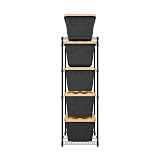
Short verdict: A tall, thin profile that stacks five totes vertically in floor space that horizontal shelving wouldn’t use efficiently. Slide-out rails on each tier so you don’t have to unstack.
The product page lists overall dimensions of 31 inches wide by 23 inches deep by 68 inches tall, zinc-plated steel construction, NSF certification, and a manufacturer-listed total capacity of 250 pounds (50 pounds per tier). The rack is sized for 27-gallon storage totes with a lid width up to 24.25 by 30.25 inches (Costco, Lowe’s, and Sam’s Club totes generally fit). For a deeper roundup on tote storage specifically, see garage shelves for storage bins and totes.
Why it stands out
A 48-inch shelf with two totes per tier consumes about 6 square feet of floor. This vertical rack consumes about 5 square feet and stores the same number of totes — just stacked vertically. In a one-car garage, that’s the difference between a usable corner and a blocked walkway.
It can work well for:
- Seasonal storage (holiday decor, summer outdoor gear)
- Soft goods that stay under 50 lb per tote
- Light kids’ toys and craft supplies
- Laundry-area overflow near the kitchen entry
Key specs to check
- Footprint: 31 inches wide by 23 inches deep
- Height: 68 inches (fits under standard 7-foot ceilings with room to spare)
- Manufacturer-listed total capacity: 250 lb / 50 lb per tier
- Tote compatibility: sized for 27-gallon totes (lid width up to 24.25″ x 30.25″); verify your existing totes match before buying
Recurring feedback patterns
Recurring feedback patterns suggest the slide-out tier design is the feature buyers value most — being able to pull a single tote forward without unstacking the whole column gets repeated mention as the reason this beats a plain shelf for seasonal storage. The narrow vertical footprint also draws consistent positive comment from one-car-garage owners who needed corner storage. Common complaints typically involve the weight limit: feedback patterns indicate that buyers who treated this like a heavy-duty rack and loaded dense bins ran into the per-tier ceiling fast, and that the rating leaves little headroom once a tote is genuinely full. Another recurring theme is tote fit — buyers report that totes outside the 27-gallon norm, or from a brand with slightly different dimensions, don’t always seat cleanly on the rails.
Potential drawbacks
- The 50-pound-per-tier limit rules out tools, dense holiday bins, and liquids — this is a soft-goods rack, not a heavy-duty one.
- The rails are tuned around 27-gallon totes, so off-size or odd-brand bins may not slide properly.
- Tall, thin vertical stacking concentrates load high up, which makes anchoring and a level floor matter more, not less.
- Total capacity across all five tiers is modest, so it complements rather than replaces a main shelving unit.
Buyer warning
The 50-pound-per-tier rating is real. Don’t load this rack with tools, dense holiday bins, or bottled liquids — those weights add up quickly past 50 pounds per tote. Best for clothing, soft seasonal goods, and light kids’ gear. Manufacturer-listed capacity assumes correct assembly, level flooring, and proper weight distribution.
Best Modular Tool Storage: Wall Control Pegboard 4 ft Standard Tool Storage Kit
Best for: a workbench-corner setup in a small garage where the reader wants tools visible and accessible.

Short verdict: Steel pegboard panels — the manufacturer positions them as significantly stronger than conventional hardboard pegboard — plus a starter accessory pack of roughly 20 hooks and brackets, covering ~10.5 square feet of pegboard surface.
The product page lists three 32-by-16-inch black powder-coated metal pegboard panels totaling roughly 10.5 square feet of pegboard surface (the “4 ft” kit name refers to the kit’s vertical height when the three panels are stacked), plus an assortment of 20 additional hooks and brackets and mounting hardware. The pegboard accepts both Wall Control’s own hooks and standard quarter-inch pegboard pegs and magnets.
Why it stands out
Most small-garage tool advice ends at “buy a pegboard from the hardware store”. Conventional hardboard pegboard sags, and hooks pop out when you pull a tool off. Steel pegboard solves both problems while still accepting cheap legacy hooks — so you don’t lock into one brand’s accessory price for life.
It can work well for:
- A wall section above a small workbench (panels can be configured horizontally or stacked vertically)
- Hand tools, drivers, pliers, hammers, small power tool accessories
- Mixing legacy quarter-inch pegboard hooks with Wall Control’s own
- A modular start that expands with additional kits later
Key specs to check
- Panel size: 32″ x 16″ each, three panels, ~10.5 sq ft of pegboard surface
- Material: powder-coated steel
- Hook compatibility: both Wall Control hooks and standard 1/4″ pegboard pegs and magnets
- Included accessories: ~20 hooks and brackets, plus mounting hardware
- Mounting: directly into studs or sheet rock with no framework required
Recurring feedback patterns
Recurring feedback patterns suggest the steel panels are the headline win — buyers often mention that the metal board doesn’t bow or flex the way hardboard pegboard does, and that hooks stay seated instead of pulling out when a tool is lifted off. The cross-compatibility with cheap standard quarter-inch pegs draws consistent positive comment from people who already owned a bin of legacy hooks. Common complaints typically involve the included accessory mix: feedback patterns indicate that the bundled hooks cover a starter layout but rarely match a buyer’s exact tool set, so a follow-up accessory order is common. A further recurring theme is mounting precision — buyers report the panels look best and sit flattest when the mounting holes are leveled carefully, and slightly off when rushed.
Potential drawbacks
- The bundled hook assortment is a starter set, so most buyers end up purchasing additional accessories to fit their actual tools.
- It’s a tool-storage surface only — nothing about it helps with totes, bins, or bulky gear.
- Per-hook ratings are light, so heavier items have to be spread across multiple hooks rather than hung from one.
- Getting multiple panels to sit flush and level takes careful layout, more so than a single hardboard sheet.
Buyer warning
Pegboard is for tools, not totes. Don’t try to hang anything bulky from a single hook — manufacturer guidance varies by accessory, but most pegboard hooks are not rated above a few pounds individually. Distribute weight across multiple hooks for anything heavier than a hand tool.
Budget Vertical Bike Rack: Delta Cycle Leonardo Da Vinci
Best for: a single-bike garage where the available wall section is outside the car door swing arc, so the swivel feature isn’t needed.

Short verdict: A simple wall hook with a rear tire tray, on a long-tenured Amazon listing. Cheaper than the Steadyrack and uses minimal wall area.
The product page lists a manufacturer-listed capacity of up to 40 pounds, a steel hook with a rubber-coated arm and a clear plastic matte tire tray, and a single-stud mounting setup. The bike hangs vertically by the front wheel with the rear wheel resting in the lower tray, and the listing notes a lifetime guarantee against defects.
Why it stands out
When the garage has a wall section clear of the car door arc — the back wall behind the parked car, or a passenger-side wall where the door doesn’t swing into the bike — Leonardo gets the bike off the floor for less. The simplicity is the feature: one hook, one tray, two mounting points.
It can work well for:
- The back wall behind the closed garage door
- A passenger-side wall outside the door arc
- A second bike paired with a primary Steadyrack
- Renters who want a low-impact single mounting point
Key specs to check
- Manufacturer-listed capacity: 40 lb
- Mounting: hook + lower tire tray, both screwed into wall studs (not drywall anchors alone)
- Bike compatibility: standard road, hybrid, and most mountain bikes with sub-2.5″ tires
- Wall projection: bike hangs roughly 16 inches off the wall when loaded
Recurring feedback patterns
Recurring feedback patterns suggest the simplicity and price are exactly what buyers come for — owners often mention that a single hook and a tire tray is all they needed, and that the install is quick once the stud is located. The long-standing reputation of the listing draws comment too, with buyers treating its tenure as a stand-in for reliability. Common complaints typically involve the static geometry: feedback patterns point to people who underestimated how far the bike projects from the wall and found it intruded on the car door arc after install. Another recurring theme is wheel and frame fit — buyers report that very wide tires or unusual frame shapes don’t always rest cleanly in the lower tray, so the geometry suits standard road, hybrid, and lighter mountain bikes best.
Potential drawbacks
- The hook is static and doesn’t fold flat, so the bike permanently occupies its ~16-inch wall projection.
- That fixed projection can collide with a car door swing if the only available wall is on the door side.
- The tray geometry favors standard tires; very wide or fat tires may not seat well.
- It holds a single bike, so additional bikes need additional hooks and additional wall space.
Buyer warning
This is a static hook. The bike hangs perpendicular to the wall and does not fold flat. In a narrow one-car garage, measure the actual swept volume of the car door before installing — if the bike sits inside the door arc, it will get scratched (or worse, the door will). When in doubt, default to the Steadyrack Classic.
Side-by-Side Comparison
| Product | Type | Footprint or wall area | Manufacturer-listed capacity | Best for | Main drawback |
|---|---|---|---|---|---|
| Rubbermaid FastTrack 48″ rail | Wall track | 48″ linear wall | Up to 1,750 lb (rail into studs) | Mixed wall storage, multiple item types | Per-hook ratings much lower than rail rating |
| SafeRacks 4×6 Overhead Rack (12″–21″ drop) | Ceiling rack | 48″ x 72″ platform overhead | 500 lb | Low-ceiling overhead storage | 12″ minimum drop is still too low for sub-7-ft ceilings |
| Seville Classics 24″W x 18″D | Free-standing wire shelving | 24″ x 18″ floor footprint | 600 lb per shelf on leveling feet (Amazon listing) | Compact main shelving | ~3 sq ft surface per tier |
| Steadyrack Classic | Vertical bike rack (swivel) | One stud, ~16″ wall projection | Up to 77 lb (manufacturer-listed) | Bike that needs to fold flat | 2.1″ tire-width limit; not for fendered bikes |
| MonsterRAX 5-Tier Bin Rack | Vertical tote rack | 31″ x 23″ floor footprint | 250 lb total / 50 lb per tier | Corner seasonal tote storage | Light per-tier rating |
| Wall Control 4 ft Pegboard | Steel pegboard | ~10.5 sq ft pegboard surface | Per-hook (varies by accessory) | Workbench-corner tools | Tools only, not bulky items |
| Delta Cycle Leonardo | Vertical bike hook (static) | One hook, ~16″ wall projection | 40 lb | Bike where door clearance isn’t an issue | Static — clashes with car door swing |
Decision Matrix — Which Surface Should You Use First?
In a small garage, the wall is the cheapest square footage to claim. The ceiling is second. The floor is last. Buying a free-standing shelf when the wall is empty is the most common small-garage mistake we see — the shelf consumes floor area you can’t get back, while the wall above it stays empty.
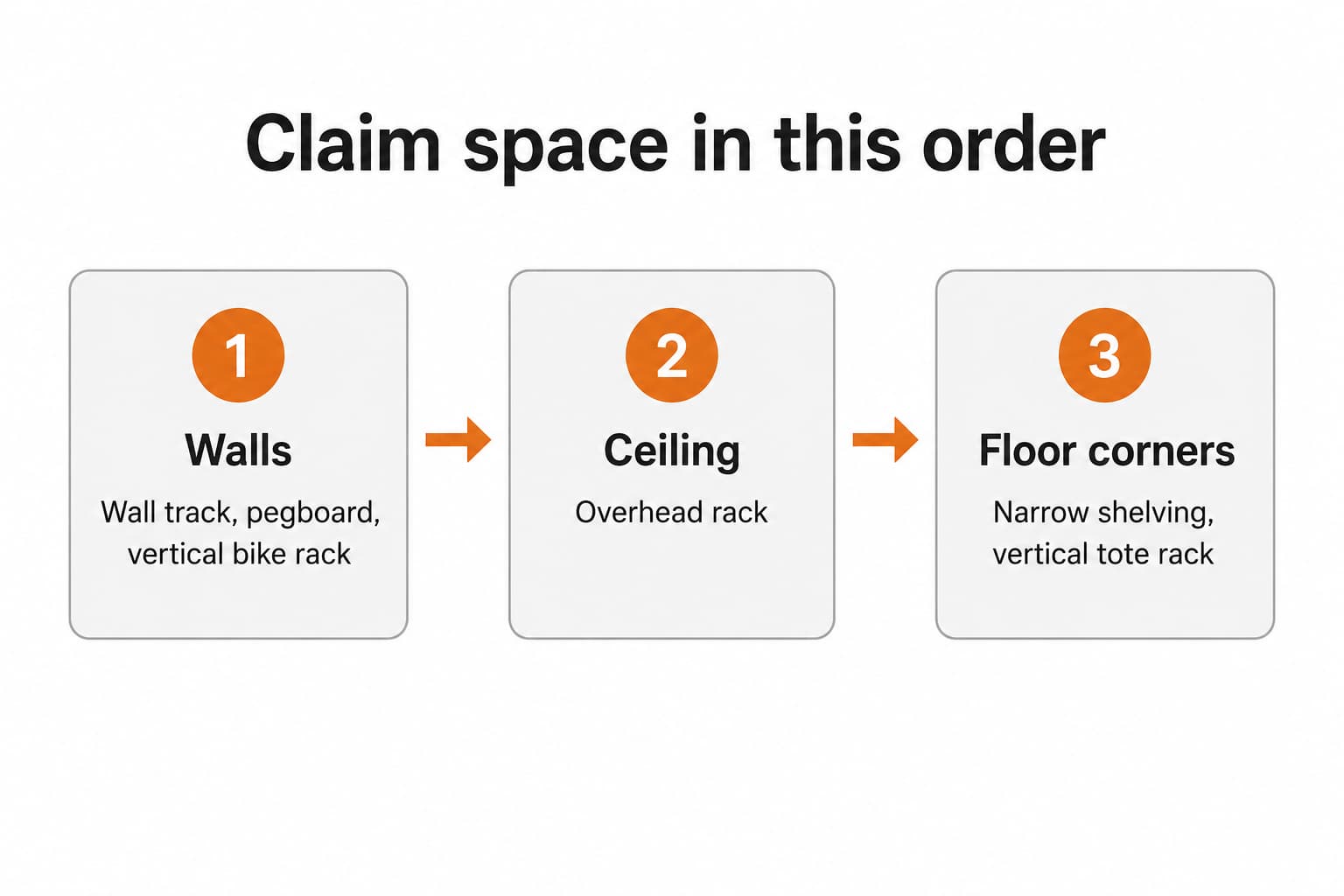
The order:
| Order | Surface | Product type from this article | Why this order |
|---|---|---|---|
| 1 | Walls | Rubbermaid FastTrack, Wall Control pegboard, Steadyrack or Delta Leonardo | Wall surface adds storage without consuming floor area; stud-mounted capacities are high |
| 2 | Ceiling | SafeRacks 4×6 (or FLEXIMOUNTS 4×8 for taller ceilings) | Overhead area is otherwise wasted, but installation requires ceiling height the wall doesn’t |
| 3 | Floor corners | Seville Classics 24″W shelf, MonsterRAX 5-Tier | Last resort — only after walls and ceiling are claimed, or for items that can’t go on a wall (large totes, pantry-style items) |
Pegboard sits inside the “walls” tier but addresses tools specifically. Bike racks sit inside “walls” too but are sometimes paired with a ceiling pulley system in larger garages — irrelevant here.
Common Complaints and Buyer Warnings
Recurring feedback patterns across this category surface a few consistent themes:
- Manufacturer-listed capacities assume correct installation, level flooring, stud or joist mounting where required, and proper weight distribution. Real-world performance can vary, sometimes significantly.
- Drop ranges on overhead racks always include the rack’s own deck thickness — a “12-inch drop” is to the top of the deck, not the bottom of the items stored on it.
- Tote and bin compatibility on tote racks is sensitive to brand. A 27-gallon tote from one retailer can be a half-inch wider or taller than a 27-gallon tote from another. Measure your existing totes before buying a tote-specific rack.
The single most important warning for this category: In a small garage, every product purchase is a real-estate decision. Buy too big once and you’ve lost storage volume permanently. Returns are possible, but the time-and-shipping cost is often more than the next attempt.
For heavy loads specifically: stud-mounted rails (FastTrack) and joist-mounted ceiling racks (SafeRacks) are the only products in this list rated for heavy loads. Free-standing shelves and tote racks have lower per-tier limits than they look at first glance — check the manufacturer page for the actual numbers, not your assumption. Pegboards are emphatically not heavy-load surfaces.
Who Should Avoid These Products?
This roundup doesn’t fit every reader. Skip it (or at least skip parts of it) if:
- You’re a renter who can’t drill into walls or the ceiling. The Rubbermaid FastTrack, SafeRacks 4×6, Steadyrack, Delta Leonardo, and Wall Control all require permanent mounting hardware. Of the seven picks, only the Seville Classics 24″W shelf and the MonsterRAX 5-Tier are usable freestanding without anchoring. For more renter-friendly options, see garage storage for one-car garages which has a renter-aware section.
- Your garage has joist clearance under 6 feet 10 inches. Skip the SafeRacks rack entirely — even the minimum 12-inch drop puts the rack deck below comfortable walking height in that scenario. Wall-only storage is your path.
- You need to store paint, pesticides, or other chemical containers safely out of children’s reach. Open shelving is the wrong product type. Consider a lockable resin cabinet (Keter Space Winner is a common option, though manufacturer-listed at only 44 pounds per shelf) instead of any pick in this article.
- You have a workshop with heavy machinery or vehicles other than a passenger car (motorcycles, classic cars, lifts, hobby boats). This article’s picks are for general storage, not workshop tooling. The math on a workshop garage is different.
How many totes actually fit on a garage shelf
Tote makers publish dimensions and shelving makers publish dimensions, but nobody puts the two together — so people buy shelving, then discover their totes overhang it. This table takes the published external size of totes from the brands people actually buy for garage storage — Sterilite, Rubbermaid Roughneck, and IRIS USA — and works out how many fit per shelf on the two garage shelving depths you can actually buy, 18 in and 24 in.
| Tote | Published dimensions (source order) | Footprint | Height | Fits an 18 in deep shelf? | Per 48 × 18 in shelf | Per 48 × 24 in shelf | Specification source | Source checked |
|---|---|---|---|---|---|---|---|---|
| Rubbermaid Roughneck 3 Gal. Storage Box | 7 in. H x 10.625 in. W x 15.687 in. D | 15.687 in × 10.625 in | 7 in | Yes | 4 | 6 | Rubbermaid Roughneck 3 gal Storage Box, Mfr# RMRT030003 | 2026-09-14 |
| Rubbermaid Roughneck 10 Gal. Storage Box | 8.875 in. H x 15.875 in. W x 23.875 in. D | 23.875 in × 15.875 in | 8.875 in | Yes | 2 | 3 | Rubbermaid Roughneck 10 gal Storage Box, Mfr# RMRT100004 | 2026-09-14 |
| Rubbermaid Roughneck 18 Gal. Storage Box | 16.375 in. H x 15.875 in. W x 23.875 in. D | 23.875 in × 15.875 in | 16.375 in | Yes | 2 | 3 | Rubbermaid Roughneck 18 gal Storage Box, Mfr# RMRT180000 | 2026-09-14 |
| Rubbermaid Roughneck 25 Gal. Storage Box | 23-5/16 in. H x 18-1/2 in. W x 28.875 in. D | 28⅞ in × 18½ in | 23 5/16 in | No — it overhangs | 0 | 1 | Rubbermaid Roughneck 25 gal Storage Box, Mfr# RMRT250002 | 2026-09-14 |
How these numbers were produced: External dimensions are quoted on the date shown per row. Sterilite rows are quoted from Sterilite’s own product pages (L x W x H order). Rubbermaid Roughneck rows are quoted from Ace Hardware’s retailer listing, which prints the manufacturer’s SKU-linked dimensions in H x W x D order on each product page. IRIS USA rows are quoted from IRIS USA’s own product pages (L x W x H order). All figures are the external/overall assembled dimensions with the lid on. The counts are computed, not estimated: totes are placed in a single layer, all in the same orientation, with no overhang and no gap; both orientations (the tote’s long side along the shelf’s 48 in run, or along its depth) are tried and the better one is kept. Shelf width is 48 in in both cases — the two depths are real Husky shelving footprints: 48 in. W x 18 in. D (Husky 86 in. H x 48 in. W x 18 in. D 6-Shelf Steel Shelving Unit, model MR481886W6B, https://www.homedepot.com/p/Husky-86-in-H-x-48-in-W-x-18-in-D-Black-Steel-6-Shelves-Shelving-Unit-MR481886W6B/306062319) and 48 in. W x 24 in. D (Husky 5-Tier Steel Shelving Unit, 48 in. W x 78 in. H x 24 in. D, model 426007, https://www.homedepot.com/p/Husky-5-Tier-Riveted-Steel-Garage-Storage-Shelving-Unit-in-Silver-48-in-W-x-78-in-H-x-24-in-D-426007/303241694); neither product page states a clear opening between posts. 48×18 and 48×24 are unobstructed reference surfaces, not guaranteed usable dimensions of every nominal 48×18 or 48×24 rack — posts and lips can reduce the clear opening (one retailer answer for a Husky 48×24 gives about 45.5 × 21.5 in between posts). Round the result down again if your shelving has corner posts that intrude, and leave room to get a hand in.
- A tote that fits the shelf footprint still needs vertical room: check the tote height against your shelf spacing, and leave clearance to lift it in and out rather than sliding it flush.
- Counts assume a flat, full-depth shelf. Wire shelving with a lip, or posts at the corners, will cost you the last tote in a row.
- Lids overhang the base on most totes; the figures here are the manufacturer’s overall assembled dimensions, which already include the lid.
- Capacity in quarts or gallons tells you nothing about whether it fits — and "27" doesn’t mean the same thing twice. The Sterilite 27 Qt. ClearView Latch Box (17 in x 11-1/8 in) fits an 18 in shelf; the Sterilite 108 Qt. Stacker Box (25-3/4 in x 18-3/8 in) — 27-gallon-equivalent by volume (108 qt = 27 gal), though Sterilite sells it as "108 Qt.," not "27 Gal." — does not.
- Manufacturers and retailers don’t all publish dimensions in the same order. Ace Hardware lists Rubbermaid Roughneck as Height x Width x Depth, where Sterilite and IRIS USA publish Length x Width x Height. This table normalises every row to footprint (the two horizontal dimensions) and height so they compare directly regardless of the order they were published in.
- Rubbermaid Roughneck’s 10 gal and 18 gal totes share the same footprint (23⅞ in x 15⅞ in) — only the height changes, so stepping up in capacity in that range costs no extra shelf space, only vertical clearance.
- A blank cell means the manufacturer does not publish that figure — we do not fill gaps with numbers we could not source.
These are the entries that matter for this guide. The full table, with every row and its source, is in our How many totes actually fit on a garage shelf.
FAQ
How do I know if my garage is “small”?
Roughly 200 to 400 square feet of floor area, often paired with a ceiling under 9 feet. A typical one-car garage fits. A two-car garage with a wide but shallow footprint can also qualify — what matters is the usable space after the car doors and obstacles.
Can I install ceiling racks if my garage door track is in the way?
Sometimes. The track typically runs 4 to 8 inches below the joists in the center of the garage. A 4-by-6 rack can often be positioned in the bay between the track and the wall; a 4-by-8 rack often can’t. Sketch the joist layout with the track position before buying.
Do I need a stud finder for the wall-mounted picks?
Yes. Every wall-mounted pick here requires stud mounting for safe load. Drywall anchors alone aren’t adequate for the manufacturer-listed capacities — they may hold light items briefly, but the failure mode is sudden. A basic magnetic or electronic stud finder is non-optional for these installs.
What if I’m a renter who can’t drill?
Free-standing only. The Seville Classics 24″W shelf and the MonsterRAX 5-Tier rack are the two picks that work without permanent mounting. Skip everything else.
How do I keep a small garage organized once I install all this?
Labeling and a routine. Label every tote on visible sides — not just the top, because totes get rotated. Set a quarterly check: anything sitting on the floor that isn’t a vehicle, bike, trash bin, or recycling has to find a wall, ceiling, or shelf home or get donated. For a deeper system, see how to organize a small garage step by step.
Will a 4×8 ceiling rack work instead of the 4×6?
Yes, if the ceiling is 9 feet or taller and the joist orientation allows an 8-foot mounting span without crossing the garage door track. The FLEXIMOUNTS 4×8 overhead rack is the common 4-by-8 alternative. For an 8-foot ceiling, the 4-by-6 SafeRacks is the safer pick — the smaller footprint gives more positioning options.
Can I mix the Steadyrack and the Delta Leonardo in the same garage?
Yes — and in a multi-bike household this is often the right answer. Put the Steadyrack on the wall that intersects with the car door swing, and the Delta Leonardo on a wall that doesn’t. They serve different positions, not different bikes.
Sources Reviewed
For this guide, we reviewed manufacturer product information, retailer specifications, Amazon product listings, public customer feedback patterns, and small-garage organization discussions in homeowner forums. We focused on product details that matter for tight-footprint installs — including dimensions, mounting requirements, manufacturer-listed capacity, drop ranges, swivel/cut-to-length features, and tote/tire compatibility. For broader category buying advice that applies beyond small garages, see our pillar guide on how to choose a garage storage system.