How to Organize Cleaning Supplies in Your Garage
Last updated:
Disclosure: This article contains affiliate links. If you buy through these links, we may earn a commission at no extra cost to you. We do not claim hands-on testing unless clearly stated.
Cleaning supplies in the garage are a safety problem before they’re an organization problem. Solvents next to oxidizers, pet treats next to fertilizer, ammonia near bleach — none of these belong in the same shelf, and most readers store them that way by default. The fix is a hazard-first sort: tier-1 hazardous items (solvents, fuel) go in a locked cabinet, tier-2 mildly hazardous items (bleach, ammonia, separately) go in closed cabinets, tier-3 low-hazard items (spray cleaners, brushes) go in open caddies at reachable height. The method takes one afternoon and protects kids, pets, and your respiratory system at the same time.
What this guide does not cover: bulk paint storage (treat paint as tier-1 if solvent-based, tier-3 if water-based), or fertilizer/pesticide storage (different regulatory category — see local agricultural extension for guidance).
Quick Answer: The Three Hazard Tiers
- Tier 1 (hazardous) — solvents, gasoline, mineral spirits, oxidizers, oil-based paint. Locked cabinet, separated from food/pet items, ventilated.
- Tier 2 (mildly hazardous) — bleach, ammonia (NEVER stored where vapors could mix), drain cleaners, oven cleaners. Closed cabinet, away from kids, separated by chemistry.
- Tier 3 (low-hazard) — general spray cleaners, microfiber cloths, brushes, water-based paints in sealed containers. Open caddy at reachable working height.
The tiers determine the storage format. The decision matrix below maps each tier to the format that works.
Step-by-Step
Step 1: Inventory and sort by hazard tier
Pull every cleaning supply out of the garage and lay it on the floor. Sort into three groups using the tier definitions above. If a product label has hazard pictograms (flame, exclamation mark, skull-and-crossbones), assume tier 1 or tier 2 — read the label.
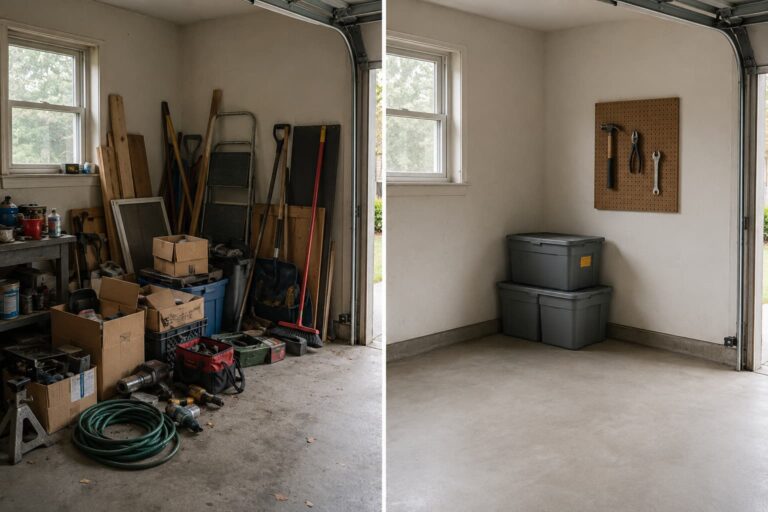
As a rough illustration rather than a measured figure: most households end up with a handful of tier-1 items, somewhat more tier-2 items, and considerably more tier-3 items than either — spray cleaners, wipes, and brushes accumulate fastest. The mismatch is usually that tier-3 items are getting prime storage (eye-level shelves) while tier-1 items are stuffed in random corners.
Step 2: Identify dangerous pairings
Two pairings are absolute: never store ammonia products and bleach products where their vapors could mix. The combination produces chloramine gas — toxic at low concentrations. “Sealed in a cabinet” is not safe enough — vapors leak around lids over time.
Other pairings to separate: oxidizers (pool chlorine, certain stain removers) from fuels (gasoline, kerosene). Acidic cleaners (toilet bowl cleaner, descaler) from basic cleaners (most degreasers). When in doubt, store the pair in different cabinets.
Step 3: Choose storage by tier
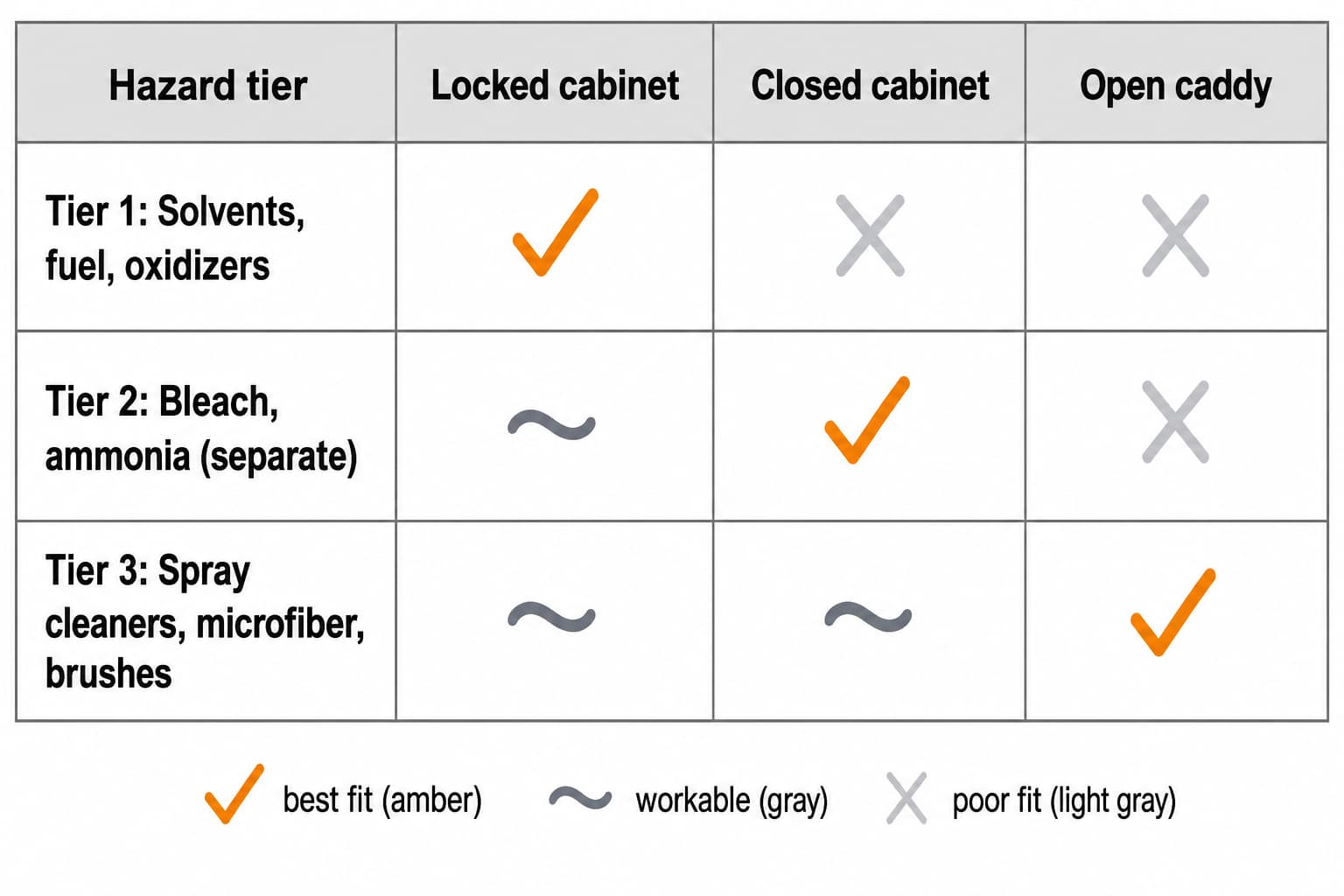
Match each tier to its format:
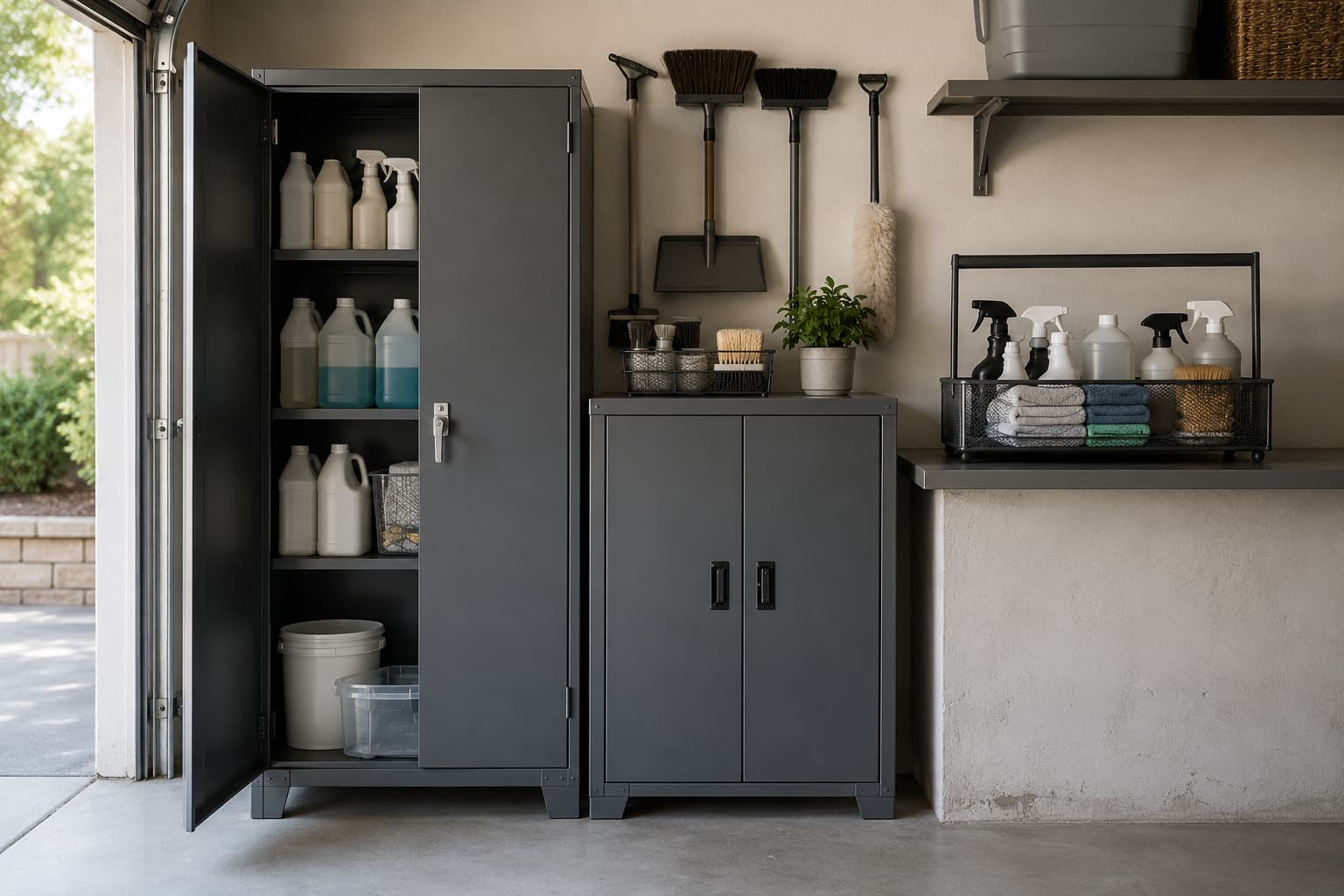
- Tier 1 — locked cabinet. Lockable doors prevent kid/pet access. Closed structure contains spills. Tall units keep items above pet height. The featured pick below is one option; for broader cabinet comparison, see our utility storage buying guide.
- Tier 2 — closed cabinet, separated by chemistry. Bleach products in one section, ammonia products in another (different cabinet ideal; if same cabinet, opposite ends with sealed lids). Drain cleaners locked away from everything.
- Tier 3 — open caddy at working height. Spray cleaners and microfiber cloths need to be reachable — they’re the items you grab daily. Open caddies on a shelf, a rolling cart, or a dedicated wall bin work well.
Step 4: Label everything
Decanted spray bottles (the ones you refill from a concentrate) are the labeling failure mode. The original concentrate label tells you the product; the empty spray bottle does not. Use a label maker, a piece of waterproof tape with the chemical name + concentration, or pre-printed bottle labels.
This isn’t about organization — it’s about safety. An unlabeled bottle of clear liquid in a garage could be water, mineral spirits, vinegar, or muriatic acid. Don’t make that guess.
For broader labeling discipline that applies across utility storage, see how to organize extension cords in your garage — the labeling approach is the same idea applied to cords.
Step 5: Position by ventilation
Tier 1 items need ventilation — even sealed containers off-gas over time. Position the locked tier-1 cabinet near a window, vent, or door that opens. Don’t put tier-1 storage in the back corner of a sealed garage.
Tier 2 cabinets also benefit from ventilation, especially for ammonia-based cleaners. Tier 3 open caddies are fine anywhere — these are products designed for indoor air. For broader thinking on where the chemical-storage zone should sit relative to the rest of your garage layout, see how to plan garage organization zones.
Tools and Products That Help
For the locked tier-1 cabinet, the featured pick covers the dominant residential use case:
Best for tier-1 lockable storage: GarveeHome 71-inch Metal Locker Storage Cabinet

Tall locking cabinet with adjustable shelves — fits solvents, paint cans, automotive fluids. The locking doors are the differentiator over open shelving for the chemicals tier. Generic-brand listing — confirm the ASIN still points to the documented configuration at purchase time (this product line has rotated SKUs).
For tier-2 closed cabinets and tier-3 caddies, see our utility storage buying guide for product comparison across formats.
Common Mistakes
- Storing solvents above eye-level. A bottle of mineral spirits dropping from a top shelf onto a face is a real injury. Tier-1 storage belongs at chest height or lower, with the cabinet anchored against tipping if tall.
- Mixing ammonia and bleach storage. Even sealed bottles release small amounts of vapor over months. Stored in the same enclosed cabinet, the vapors can produce chloramine — toxic. Separate cabinets, or opposite ends of one cabinet with airtight outer bags.
- Forgetting ventilation. A closed cabinet of solvents in a sealed garage concentrates fumes. Position storage near a vent, window, or door. If the garage is fully sealed, run an exhaust fan when handling tier-1 chemicals.
- Using food-contact bins for chemical storage. Plastic bins meant for food storage may leach if used for solvents (and vice versa for the food side). Dedicate chemical bins; never re-use them for food.
- No labels on decanted spray bottles. An unlabeled clear liquid in a spray bottle is a poisoning waiting to happen, especially if kids are around. Label every decanted container.
Safety and Installation Notes
Local fire codes restrict the volume of flammable liquids stored in attached garages. The 2015 International Fire Code (§5704.3.4.2.7), which many U.S. jurisdictions adopt with local amendments, caps attached-garage storage at 10 gallons of flammable liquid (30 gallons total on the property, none in a basement). Check which code edition and amendments your local jurisdiction has adopted before stockpiling gasoline, mineral spirits, or paint thinner — the exact limit varies by jurisdiction and liquid class.
Tall locked cabinets benefit from anti-tip anchoring (strap to a stud or weighted base) so reaching for top-shelf items doesn’t tip the cabinet onto kids or pets nearby.
FAQ
Can I store gasoline in the garage?
Yes, in an approved metal or plastic gasoline container, in a locked cabinet, in volumes within your local fire code limit — many jurisdictions follow the 2015 International Fire Code’s 10-gallon cap for attached garages (§5704.3.4.2.7), but confirm the limit your local code has actually adopted. Never store gasoline in glass containers or in containers that previously held food. Keep away from ignition sources (water heater pilot lights, electrical outlets, etc.).
How do I separate bleach and ammonia products?
Best practice: different cabinets entirely. Acceptable: same cabinet but opposite ends with each product sealed in its original container plus an outer airtight plastic bag. Never store both in the same shelving compartment open or unsealed.
Where should I store paint cans?
Water-based latex paint cans: tier 3 (closed cabinet, away from freezing). Oil-based paint cans: tier 1 (locked cabinet with ventilation). Both should be stored upside down briefly during sealing to verify the lid is airtight, then stored right-side up.
Are plastic caddies safe for solvent storage?
For tier-3 spray cleaners, yes. For tier-2 bleach (which can degrade some plastics over time), use HDPE plastic or metal. For tier-1 solvents (which can dissolve some plastics), use metal containers and metal caddies only. Read the cleaning product label for compatible storage materials.
What about cleaning supplies in a hot garage in summer?
Tier-3 products (spray cleaners, microfiber) tolerate heat fine. Tier-1 products (especially aerosols and solvents) lose effectiveness AND become more dangerous in heat — aerosol cans are required to carry a warning against storage above 120°F (21 CFR 740.11), since internal pressure rises with temperature. In hot climates, store tier-1 inside the house (if local code permits) or in a shaded, ventilated section of the garage.
Sources Reviewed
For this guide, we reviewed manufacturer documentation for cleaning supply storage, fire-safety references for flammable-liquid storage, and recurring patterns in public discussions about garage cleaning supply organization.