Metal vs Plastic Garage Shelving: Which Is Better?
Last updated:
Disclosure: This article contains affiliate links. If you buy through these links, we may earn a commission at no extra cost to you. We do not claim hands-on testing unless clearly stated.
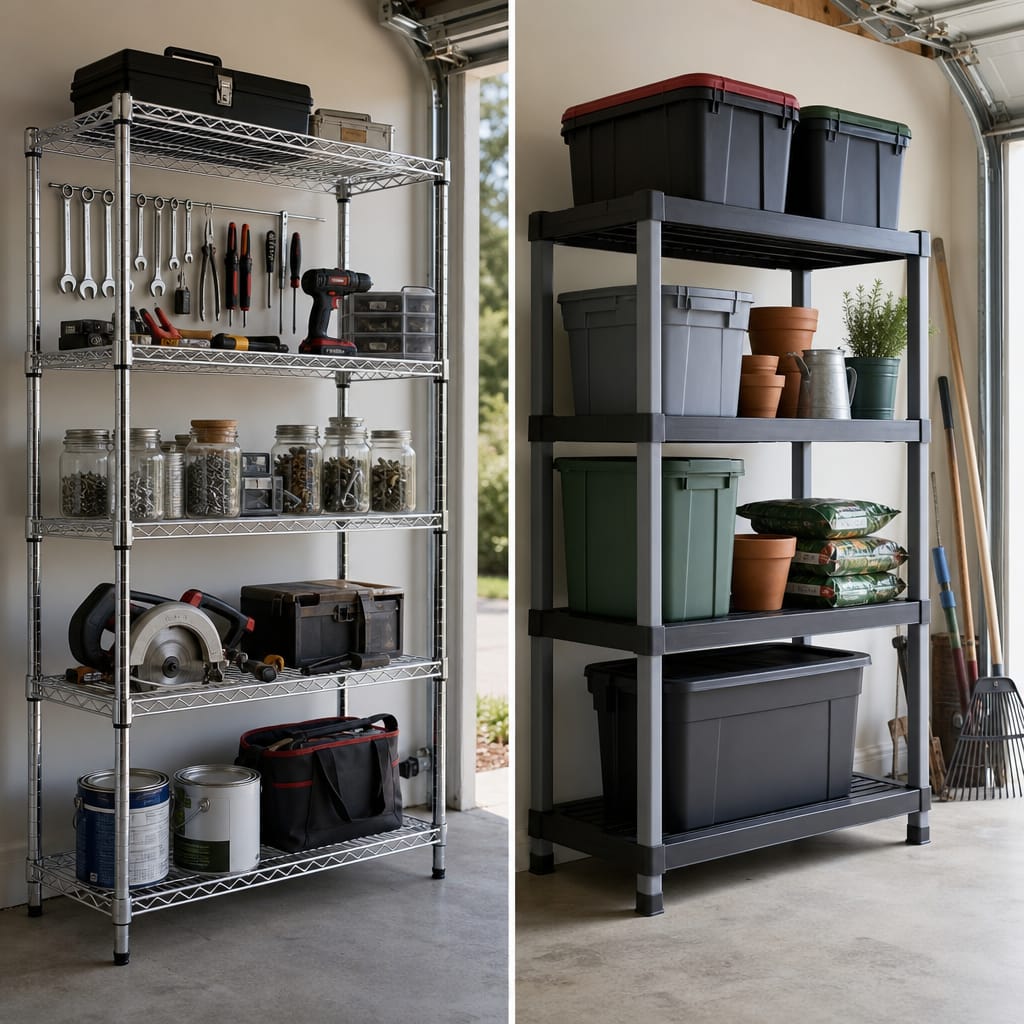
Most readers landing here are standing in a shelving aisle with two units in front of them — a chrome wire rack on one side, a black-and-yellow plastic unit on the other. The metal one feels serious. The plastic one is “rated to 200 lb per shelf” on the label, which sounds too generous for the price. So which is the right call for your garage?
The honest answer: it depends on your garage. Metal wins for raw capacity and long-term install. Plastic wins for humidity, chemical exposure, and unheated spaces. This guide walks through six concrete situations, breaks down what each material is actually good at, and recommends two products per side.
Out of scope: full-room modular systems and overhead racks. Those are separate decisions.
Quick Answer
For dry, climate-controlled garages with heavy tools and dense gear: metal wins because per-shelf capacity is typically 2-4x higher. For humid garages, unheated spaces, or chemicals nearby (paint, fertilizer, pool supplies): plastic wins because it doesn’t rust, doesn’t get ice-cold in winter, and weighs a fraction of metal. The single variable that flips most decisions is summer humidity in your garage. If you can feel it, plastic is the safer call.
Best Choice by Situation
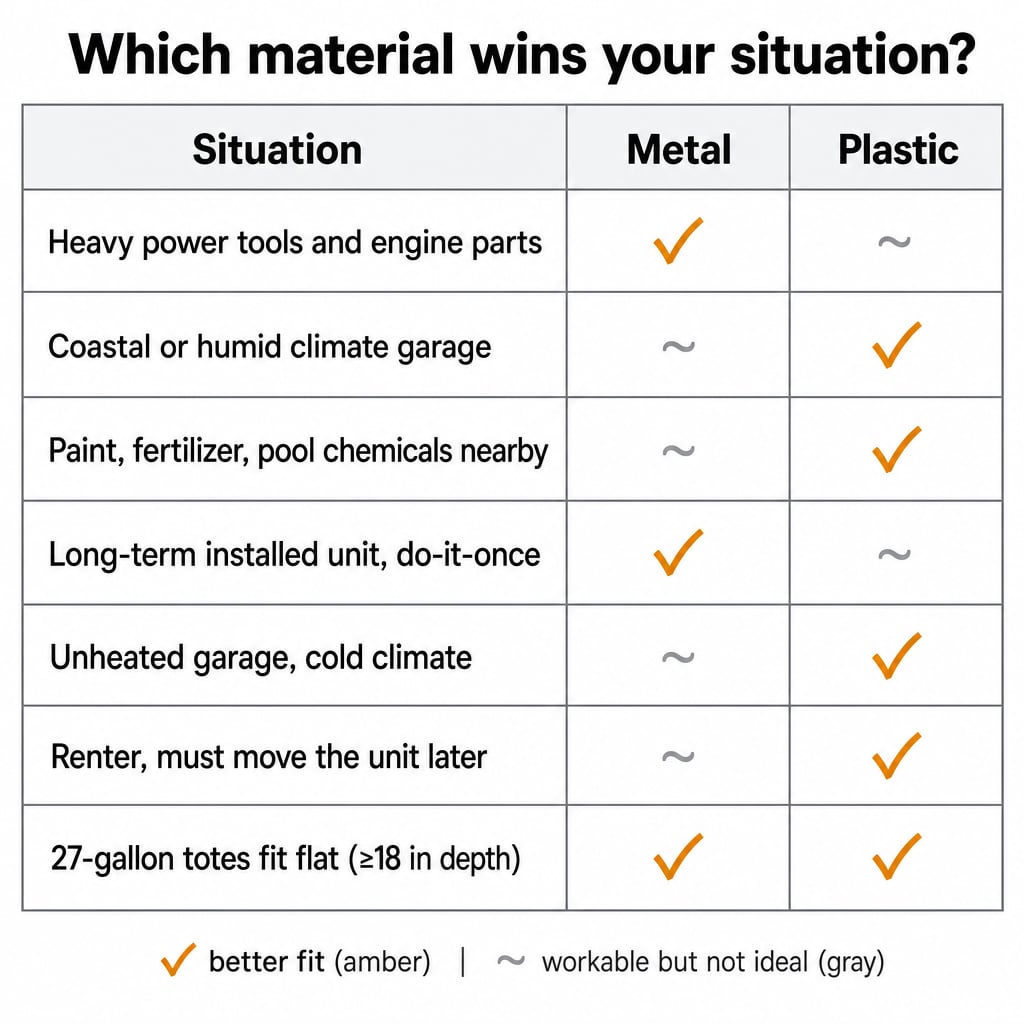
This is the at-a-glance answer. Match your situation to a row and read off which material to lean toward.
| Situation | Better choice | Why |
|---|---|---|
| Heavy power tools, engine parts, dense gear | Metal | Per-shelf capacity is 2-4x plastic |
| Coastal or humid climate garage | Plastic | Doesn’t rust, doesn’t pit |
| Storing paint, fertilizer, pool chemicals nearby | Plastic | Inert to most household chemicals |
| Long-term installed unit, do-it-once | Metal | Lifespan in a dry garage is decades |
| Unheated garage in a cold climate | Plastic | Stays workable in winter; metal gets uncomfortably cold |
| Renter who must move the unit later | Plastic | Weighs a fraction of metal; easier to disassemble |
| 27-gallon totes need to fit flat | Either, if depth is ≥ 18″ | Both materials offer suitable depths |
If two rows pull in different directions for your situation, use the How to Decide for Your Garage section below to break the tie.
Metal Garage Shelving — Pros, Cons, Best Use Cases
What it is
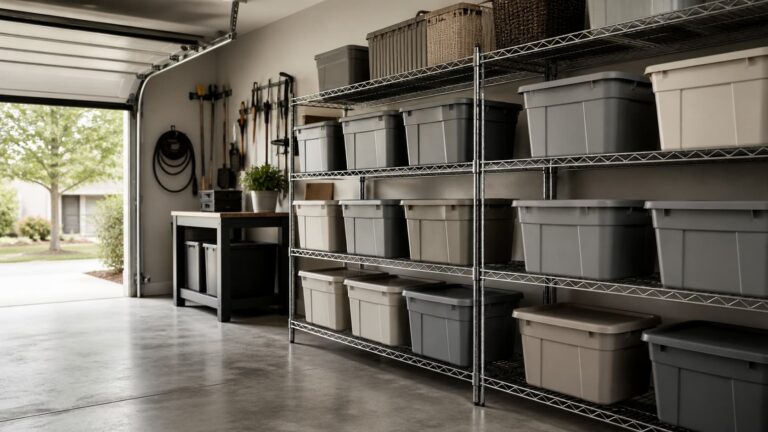
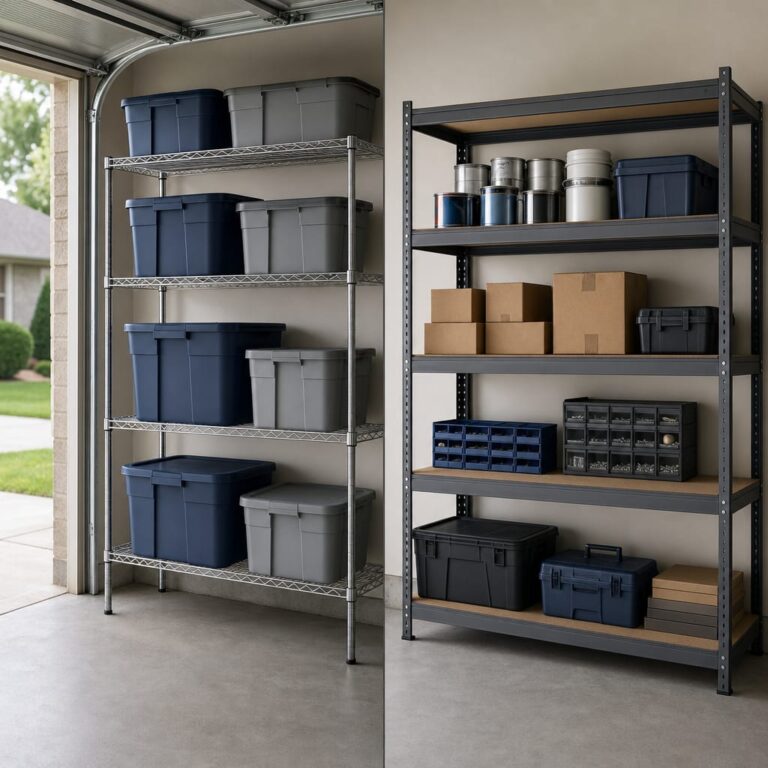
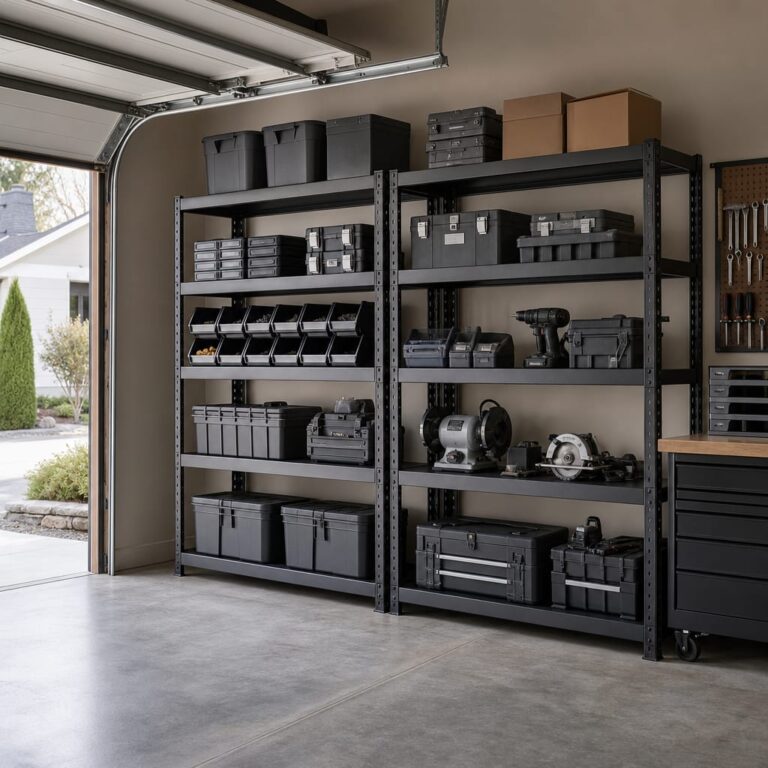
Metal garage shelving usually means chrome-plated steel wire (commercial style) or powder-coated steel wire (budget consumer). Both are freestanding, adjustable in 1-inch increments, and rated by per-shelf capacity. Premium versions carry NSF certification and ship with leveling feet plus optional casters.
Where it works best
- Climate-controlled or dry garages
- Heavy power tools, engine parts, dense hardware
- Long-term setups where you’ll install once and use for 10-15 years
- Workshop corners where wire shelving’s see-through visibility helps
For a deeper roundup of options on this side, see our metal shelving roundup.
Where it falls short
- Humid garages — rust appears at the welded joints first, then spreads
- Cold-weather garages — gets genuinely cold to the touch, condensation pools in winter
- Anything you need to move regularly — 50-80 lb empty unit assembled
- Garages near saltwater or with road-salt tracking — corrosion accelerates
What manufacturers and retailers typically specify
Look for: per-shelf capacity on leveling feet (the headline number), per-shelf capacity on casters (usually half or less), shelf depth (14″ vs 18″ vs 24″ is the key spec for fitting 27-gallon totes), wire diameter, and NSF certification (signal of structural quality, not actual food relevance for your garage).
Buyer warnings specific to metal
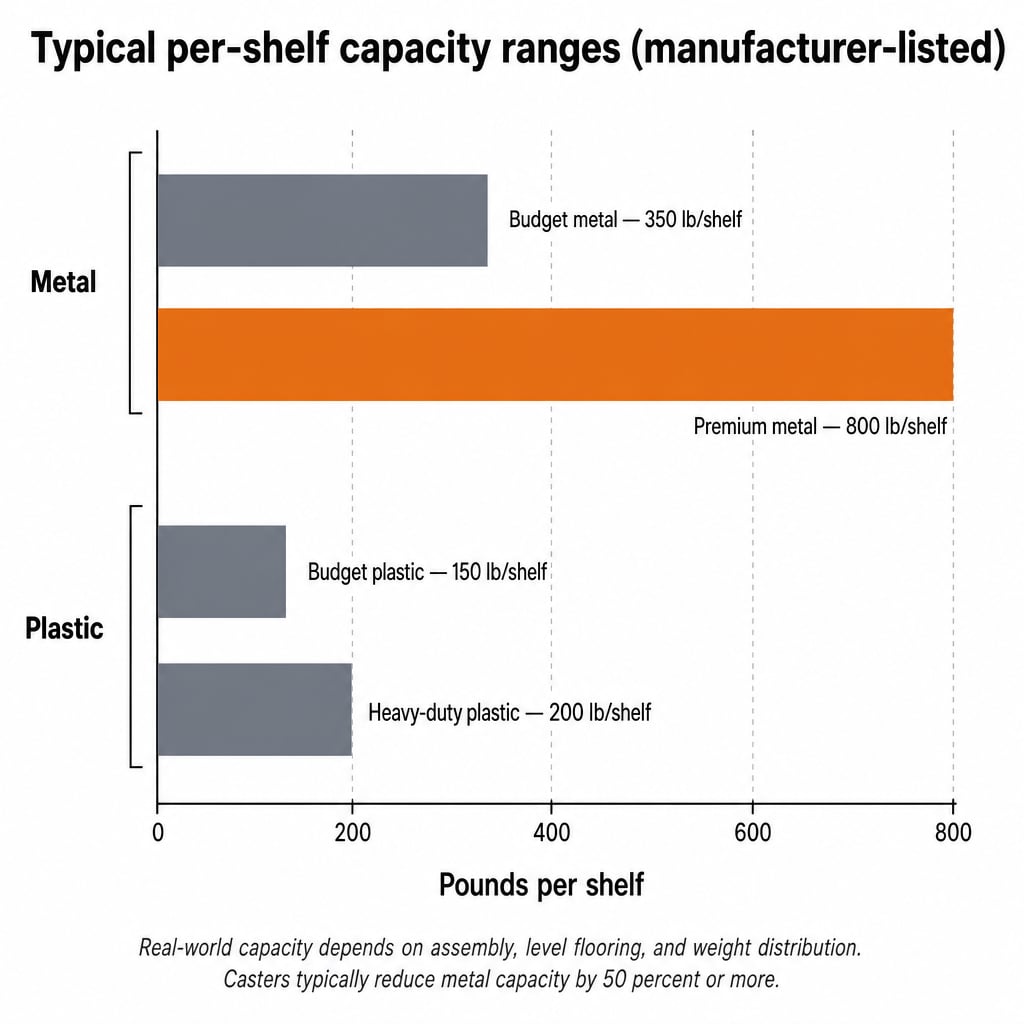
Manufacturer-listed capacity numbers almost always assume leveling feet, not casters. Adding wheels typically reduces per-shelf capacity by 50% or more. Verify the spec on the variant you’re actually buying.
Chrome-plated wire resists rust longer than powder-coated steel, which is more prone to chipping at the welds. Neither is rustproof — both are rust-resistant.
Many budget metal units come at 14″ depth, too shallow for 27-gallon totes (which need around 18-20″). If your plan includes those totes, confirm the depth before buying. The wire shelving sized for totes guide goes deeper on this trap.
Plastic Garage Shelving — Pros, Cons, Best Use Cases
What it is
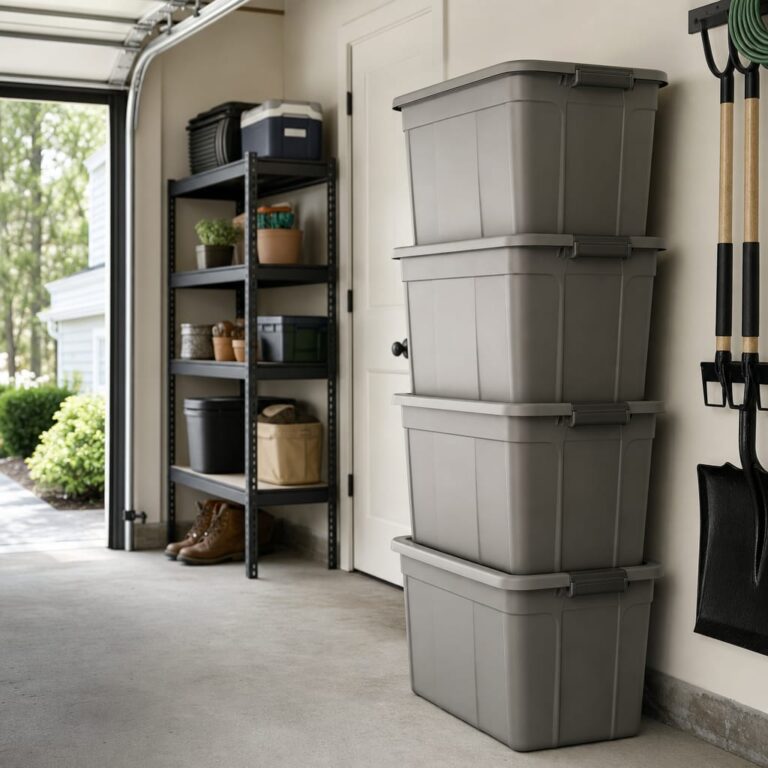
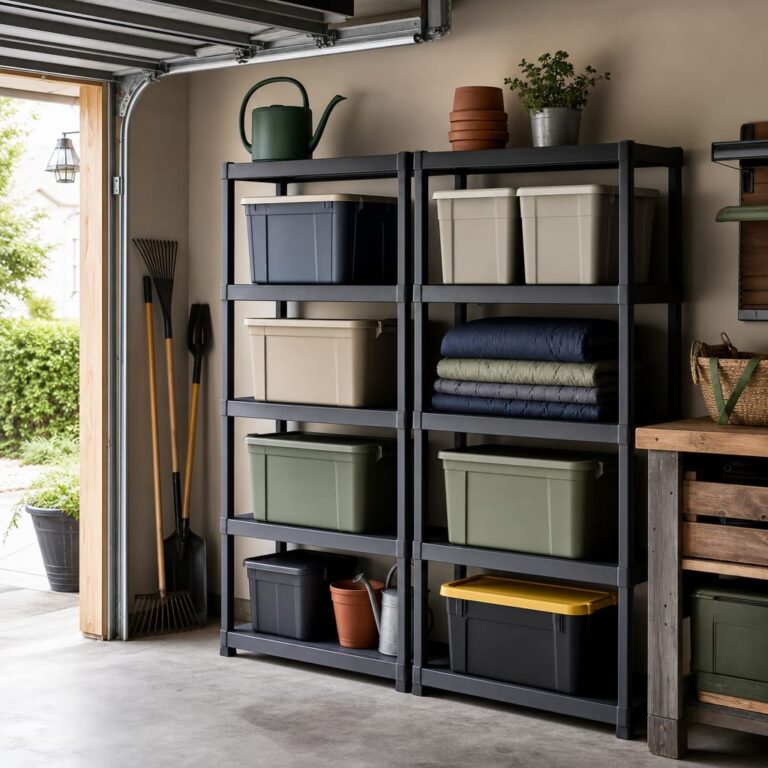
Plastic garage shelving usually means injection-molded recycled plastic with interlocking corner posts. Shelves are either solid or ventilated. Per-shelf capacity tops out around 200 lb on the strongest consumer-grade options; budget units list 100-150 lb. Many include wall-mount brackets and adjustable feet, and some are modular.
Where it works best
- Humid garages — plastic doesn’t rust
- Garages near stored chemicals (paint, pool supplies, fertilizer) — plastic is inert to most household chemicals
- Unheated garages in cold climates — doesn’t get painfully cold, doesn’t condense
- Renters and short-term setups — light, easy to disassemble, ships in flat boxes
- Storage of bagged goods, totes, sports equipment, seasonal items
If plastic is your direction, see our plastic shelving picks.
Where it falls short
- Heavy loads — even “200 lb per shelf” plastic flexes measurably under that load
- Long-term creep — plastic deforms under sustained heavy load over years
- UV exposure — embrittles over a few years in front of a sunny garage door window
- Appearance — less polished than wire metal
What manufacturers and retailers typically specify
Look for: per-shelf capacity (read with skepticism), total unit capacity, shelf depth, recycled-content claims, BPA/phthalate-free certifications, and whether wall-mount hardware is included.
Buyer warnings specific to plastic
Plastic flex under listed maximum capacity is real. A shelf rated at 200 lb will visibly bow under 200 lb of evenly distributed weight. Leave 20-30% headroom — 150 lb on a 200-lb shelf is the comfortable working load.
“Heavy duty” branding on plastic is generous compared to metal. The strongest consumer-grade plastic carries 200 lb per shelf, which is roughly the budget-tier figure for metal. They are not equivalent ratings.
Sun-exposed plastic embrittles over time. If your garage has a south-facing window or translucent panel, the shelf nearest to that light degrades faster. Branded plastic with a stated warranty is the safer pick when UV exposure is a concern.
Side-by-Side Comparison
Same factors, ranked head-to-head. Use this to see where the gaps are biggest.
| Factor | Metal | Plastic |
|---|---|---|
| Per-shelf capacity (consumer range) | ~350-800 lb manufacturer-listed | ~100-200 lb manufacturer-listed |
| Total unit capacity (consumer range) | ~1,500-4,000 lb manufacturer-listed | ~600-1,000 lb manufacturer-listed |
| Resistance to humidity | Moderate (chrome) to poor (powder-coat) | Excellent — doesn’t rust |
| Resistance to chemicals (paint, fertilizer, pool) | Moderate — splashes can pit finish | Excellent — inert to most |
| Cold-weather behavior | Cold to the touch; condenses | Stays workable; no condensation |
| Weight to move (empty) | Heavy — 50-80 lb assembled | Light — 25-45 lb assembled |
| Look | Industrial, polished if chrome | Plain, utilitarian |
| Lifespan in unheated garage | 5-10 years (rust accelerates) | 15-20 years (UV-dependent) |
| Lifespan in conditioned garage | 15-25 years | 15-20 years |
| Typical price tier | Mid to high | Low to mid |
The biggest gap is on per-shelf capacity (metal wins by 2-4x). The next biggest is on humidity resistance (plastic wins decisively). Everything else is closer.
How to Decide for Your Garage
A five-step framework keyed on the variables that actually move the answer:
1. List what you’re storing. Heavy hand tools, power tools, engine parts, paint can collections, dense boxes → metal-friendly. Bins, sports equipment, seasonal decorations, gardening supplies, holiday lights → plastic-friendly.
2. Humidity filter. Coastal, near a river, basement-converted garage, or noticeably humid in summer? Plastic-friendly. Dry desert or climate-controlled? Either — defer to step 4.
3. Climate-control filter. Heated/cooled garage? Either material works. Unheated in a cold climate (think Minnesota or Maine winters)? Plastic-friendly — metal gets uncomfortable, and condensation is real.
4. Weight filter. Need to hold 300+ lb on a single shelf? Metal — there is no consumer-grade plastic shelf that matches that. Need 100-200 lb per shelf? Either works.
5. Mobility filter. Will the unit move (rental, layout experiments, moving day)? Plastic, or metal with casters and lighter loads.
Choose metal if: dry garage, heavy gear, want a do-it-once install, value the look of industrial wire.
Choose plastic if: humid garage, chemicals nearby, unheated space, lighter load, plan to move the unit, or you’re renting.
If your situation pulls in both directions, buy one of each — most readers eventually do. Use plastic for chemicals and lighter bins; the metal shelving guide covers the heavier side.
Common Mistakes
Mistake: Picking metal in a coastal or humid garage with no humidity control. The unit spot-rusts at the welded joints within 1-2 years, then spreads. Powder coating delays this but doesn’t prevent it. If you feel humidity year-round and aren’t running a dehumidifier, plastic is the more honest pick.
Mistake: Picking plastic for heavy engine parts because “200 lb per shelf” reads like enough. That is the manufacturer-listed maximum, not a comfortable working load. Dense point-loads (an engine block, a stack of toolboxes) accelerate creep. For dense gear, metal is the right tool.
Mistake: Picking metal at 14″ depth and discovering 27-gallon totes don’t sit flat. A 27-gallon tote needs around 18-20″ depth. Measure your totes’ short side before buying — see our tote size and shelf fit chart for exact dimensions, or follow our shelves that fit 27-gallon totes guide.
Mistake: Picking plastic for a sunny garage with a south-facing door window. UV exposure embrittles plastic over a few years. Position the unit against a shaded wall or pick metal if your garage gets direct sunlight inside.
Recommended Products for Each Side
Four picks — two metal, two plastic — calibrated to cover the budget-to-premium spread on each side.
For metal — premium: Seville Classics UltraDurable NSF 5-Tier Steel Wire Shelving
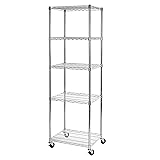
The premium reference for metal. 18″ depth (fits 27-gallon totes flat), manufacturer-listed 800 lb per shelf on leveling feet, NSF/ANSI 2 certified. Buyer warning: per-shelf capacity drops sharply with optional casters. Stay on leveling feet for the full rated load.
For metal — budget: Amazon Basics 5-Shelf Heavy Duty Steel Wire Storage Shelves

The common budget metal pick. Manufacturer-listed ~350 lb per shelf, 14″ depth, powder-coated steel wire in black. Buyer warning: 14″ depth is the real constraint, not weight — confirm your bin dimensions. If you store 27-gallon totes, skip this and go to the Seville or a wider unit.
For plastic — heavy-duty: CX Black & Yellow 4-Tier Heavy Duty Plastic Shelving

The strongest branded plastic on Amazon. Made in USA from recycled plastic, manufacturer-listed 200 lb per shelf, 20″ depth (handles 27-gallon totes), modular interlock + wall-mount brackets included. Buyer warning: this is a 4-tier unit, not 5 — overall height is 55″, not 72″. If ceiling height isn’t the constraint, the lower profile is a plus for visibility.
For plastic — budget: HDX 5-Tiered Ventilated Plastic Storage Shelving Unit
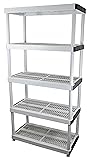
The common entry-level plastic pick, Home Depot’s house brand. Manufacturer-listed ~150 lb per shelf, ventilated shelf surface, tool-free assembly, raised feet. Buyer warning: 150 lb is the upper bound on a level floor with weight centered. Off-center or dense loads cause measurable flex. Not for engine parts, paint can stockpiles, or toolbox towers.
FAQ
Can metal garage shelving rust if I keep it in a dry garage?
Eventually, but slowly. Chrome-plated wire shelving in a dehumidified garage can last 15-25 years before visible rust. Powder-coated steel may show chipping at joints earlier (5-10 years). Spot maintenance with touch-up paint extends life further.
Does plastic shelving really hold 200 lb per shelf in real-world use?
The 200 lb figure is a manufacturer-listed maximum on level flooring with weight evenly distributed. A shelf at that load will visibly bow but not fail. Practical working load is 150-160 lb for zero flex. Dense point-loads accelerate plastic creep over time.
Can I put metal shelving on a damp concrete floor?
Yes, but use leveling feet and check periodically for moisture pooling underneath. Plastic shelving with raised feet handles damp floors more gracefully.
Is plastic shelving safe for storing paint cans, pesticides, or gasoline?
Plastic is inert to most household chemicals and won’t rust around them — that is its main advantage in a chemical-storage corner. Store flammables, pesticides, and hazardous chemicals in a locked cabinet or dedicated flammables cabinet per the product labels, not on open shelving regardless of material.
How long does plastic shelving last in an unheated garage?
Branded plastic shelving typically lasts 15-20 years in an unheated garage if it’s not in direct sunlight. UV exposure shortens that significantly. White-label plastic often degrades visibly within 5-10 years.
Can I mix metal and plastic shelving in the same garage?
Often the right answer. Metal where the weight lives (workbench wall, tools, parts), plastic where the bins and chemicals live (back wall, chemical corner). The metal shelving guide pairs well with this split approach.
Sources Reviewed
For this comparison, we reviewed manufacturer pages and retailer specifications for both metal and plastic garage shelving options, current Amazon product listings for each of the four picks, recurring patterns in public customer feedback for each product family, and discussions where homeowners shared real-world experiences choosing between the two materials.