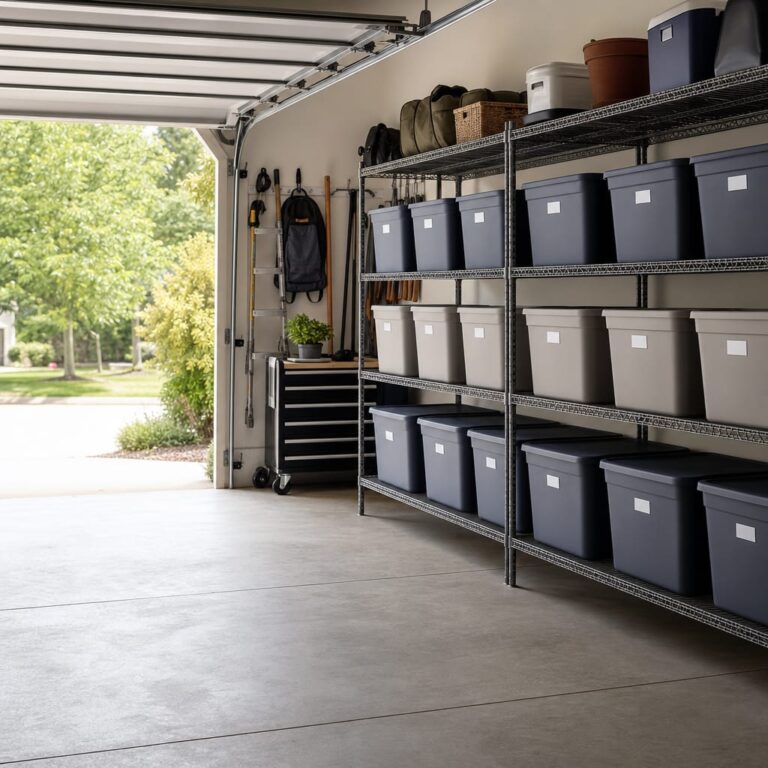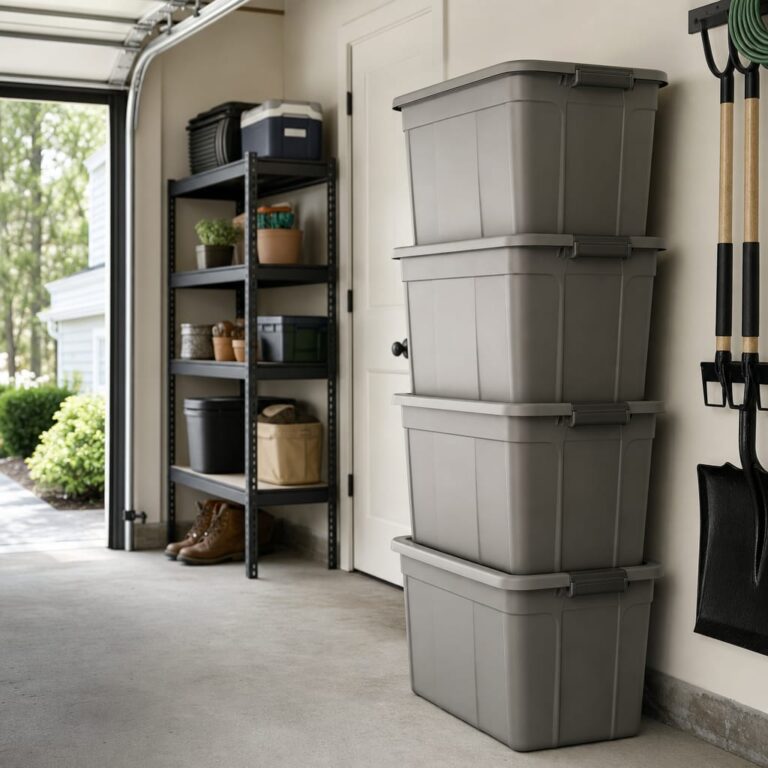
Clear Bins vs Opaque Bins for Garage Storage
Last updated:
Disclosure: This article contains affiliate links. If you buy through these links, we may earn a commission at no extra cost to you. We do not claim hands-on testing unless clearly stated.
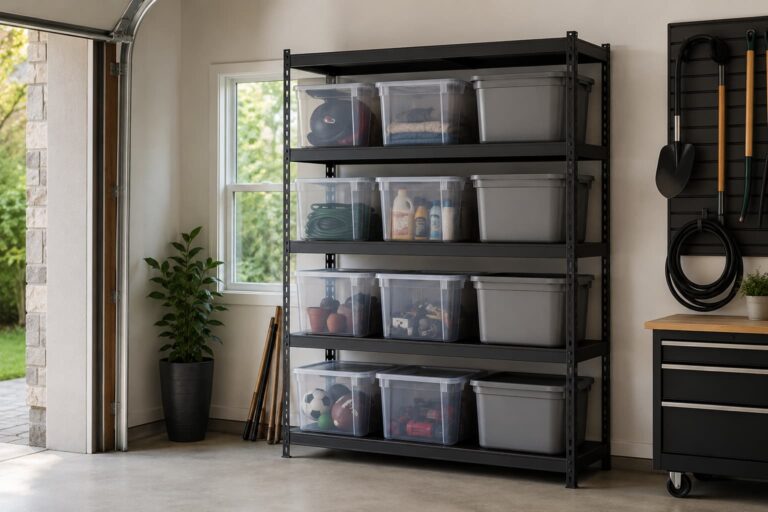
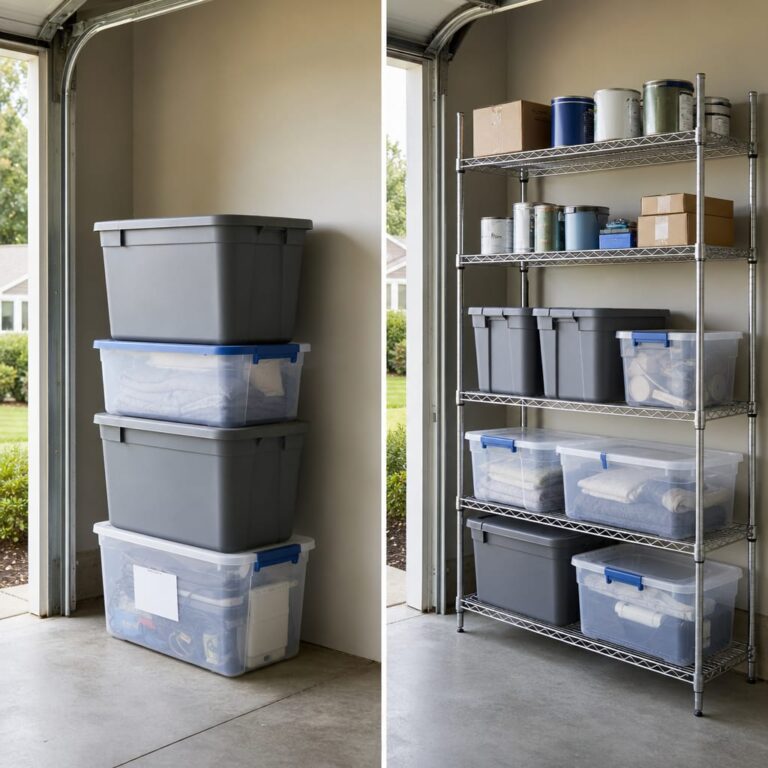
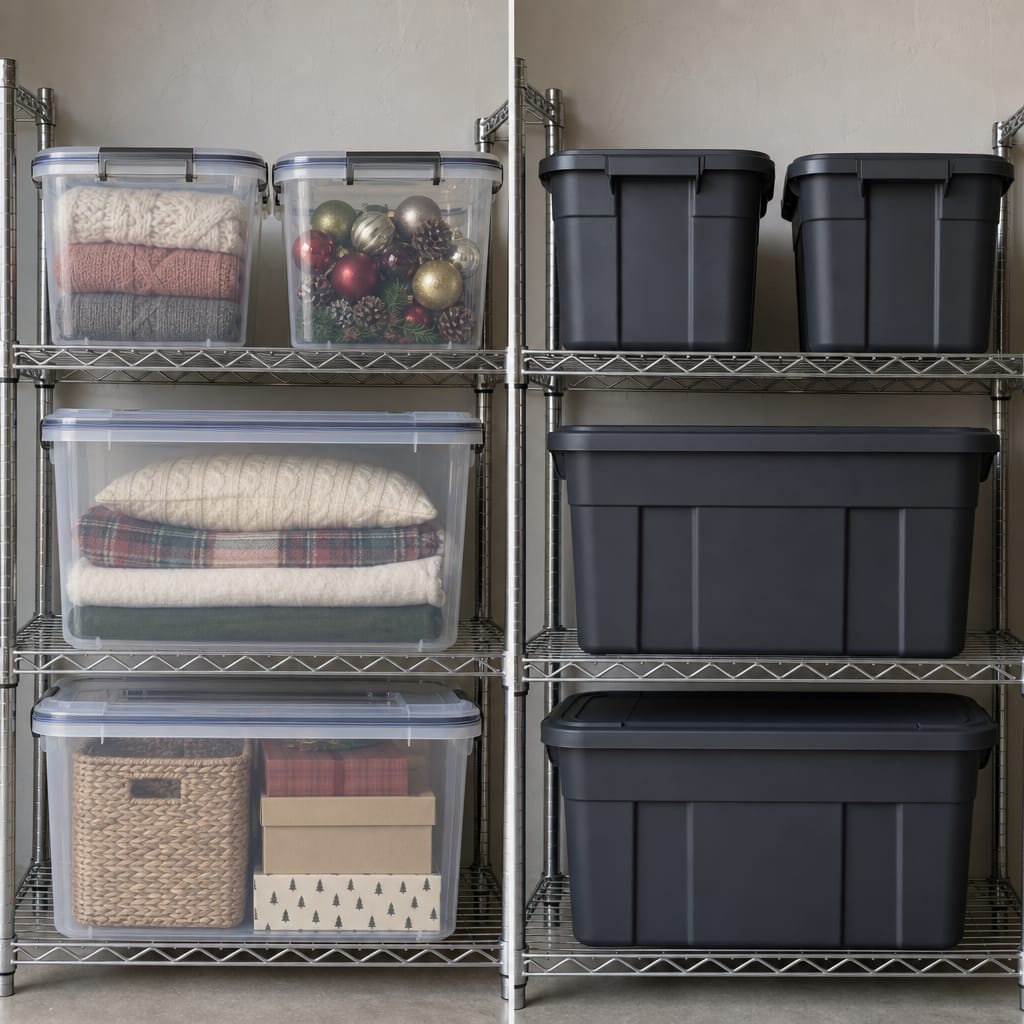
A clear bin shows you what is inside without opening it; an opaque bin hides the contents from view. That single difference cascades into a real set of trade-offs around moisture sealing, visual organization speed, UV exposure to fade-sensitive contents, and price. Most garages do not need an all-clear or all-opaque approach — a mix is usually the right answer. This guide walks through both sides honestly, with the products that anchor each side and the real decisions buyers face when stocking a garage shelf. For the broader bin roundup, see our Best Garage Storage Bins for Shelves and Racks. For clear bins specifically, see Best Clear Storage Bins for Garage Storage. For buying criteria on stackable bins, see Best Stackable Storage Bins for Garage Organization.
Quick Answer
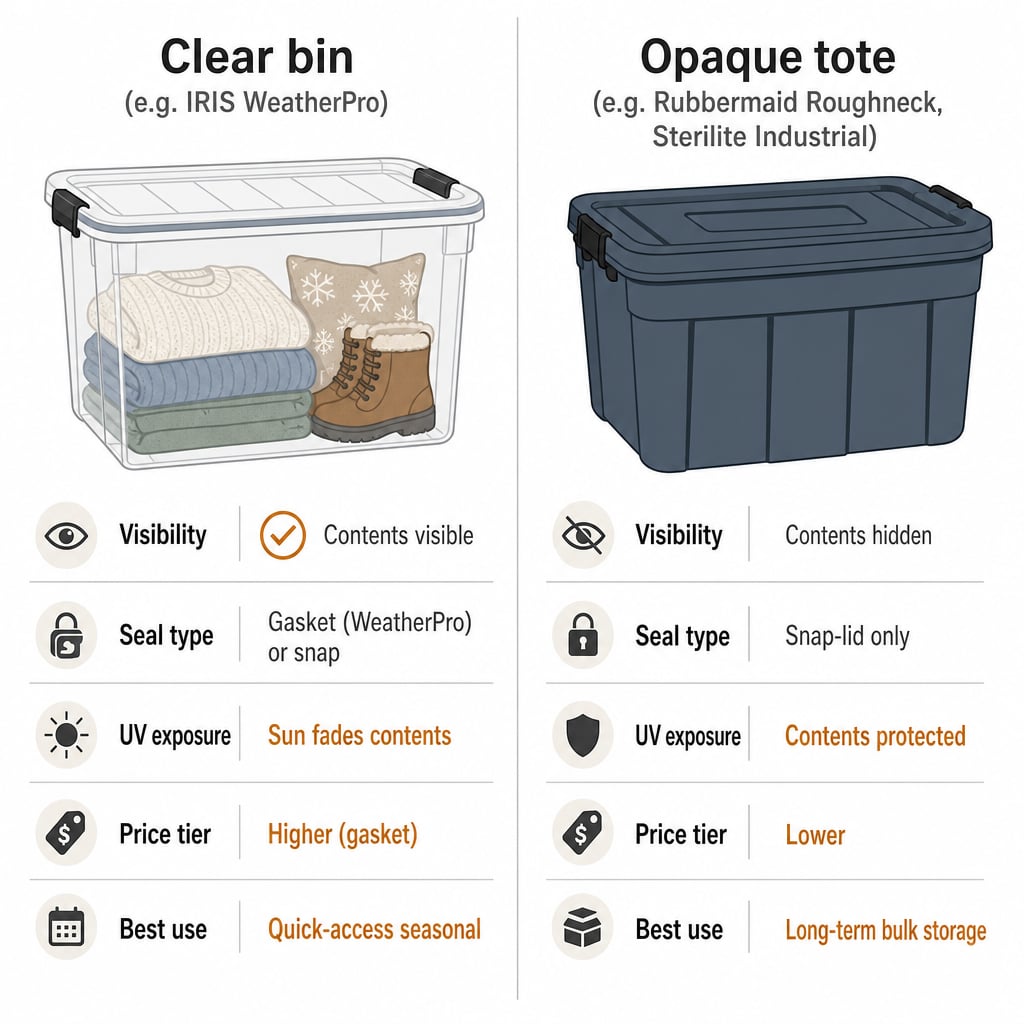
For seasonal items you access often (holiday decorations, sports gear by season, kid-grown clothing), clear gasket-sealed bins like the IRIS WeatherPro line let you find what you need without opening every container — and the gasket seal protects against garage moisture and dust. For bulk long-term storage where contents do not need to be visible (paper records, household overflow, items in original packaging), opaque totes like Rubbermaid Roughneck or Sterilite Industrial are meaningfully cheaper per gallon, hide contents from view, and protect light-sensitive items from UV. Most garages benefit from a mix: clear bins for the “I might need this” tier, opaque for the “I will need this once” tier.
Best Choice by Situation
| Situation | Better choice | Why |
|---|---|---|
| Holiday decorations rotated yearly | Clear (gasket-sealed) | Fast visual sorting + moisture protection for ornaments and lights |
| Paper records and photo albums | Opaque | UV protection + privacy; gasket-sealed clear works but is overkill if shelf is shaded |
| Tools and small parts | Either, with labels | Visibility helps but labels suffice; opaque is cheaper for bulk |
| Items in damp or unconditioned garage | Clear gasket-sealed | Moisture barrier is the deciding factor regardless of visibility need |
| Kids’ clothing being grown out of | Clear | Quick size check without opening |
| Items used once per year (camping, ski gear) | Opaque | Volume + cost; mark the side with a label |
Clear Bins — Pros, Cons, Best Use Cases
What clear bins are
Clear storage bins use transparent or translucent polypropylene walls so contents are visible from outside the bin. The gasket-sealed variants (IRIS WeatherPro is the dominant residential line on Amazon) add a rubber gasket around the lid and multi-buckle latches to create a moisture and dust barrier — the seal is the differentiator vs cheaper snap-lid clear bins.
Where they work best
- Seasonal items rotated multiple times per year (holiday decor, sports equipment by season)
- Kid clothing waiting to be grown into or out of — quick size check without opening
- Items in unconditioned garages where dust and humidity accumulate
- Items that benefit from visual inventory at a glance
- Bins on lower shelves where bending over to read labels is awkward
Where they fall short
- Sun exposure fades contents over months — clear bins do not block UV
- Visible contents can look cluttered or messy if the bin is not packed neatly
- Gasket-sealed variants cost meaningfully more per gallon than opaque totes
- Plastic walls can yellow with age — older clear bins are less transparent than new ones
- Latches and gaskets are wear items — buckles fail before the bin walls do
What manufacturers and retailers typically specify
For clear bins, look for: capacity in quarts or gallons (manufacturer-listed), whether the lid is gasket-sealed or snap-lid only, multi-buckle latch count, lid material (matched plastic vs softer overlay), and dimensions (footprint × height). The IRIS USA WeatherPro line lists the gasket spec on the product page; non-gasket clear bins typically just specify “snap-lid”.
Buyer warnings specific to clear bins
- Clear bins still need a label even when contents are visible — items shift, contents change, and a label gives a quick reading from across the garage
- Gasket-sealed bins do not eliminate moisture if the bin was sealed wet — let contents dry before closing
- UV exposure on garage walls with windows or skylights will fade clear bin contents within a year or two; place clear bins on shaded shelves or shelves away from direct sun
Opaque Bins — Pros, Cons, Best Use Cases
What opaque bins are
Opaque storage totes use solid-colored (dark indigo, black, beige, gray) polypropylene walls. Contents are hidden from view. The dominant residential lines on Amazon are Rubbermaid Roughneck (workhorse 18-gal format) and Sterilite Industrial (heavy-duty 27-gal format). Both use snap-lid retention rather than gasket sealing — the lids stay closed under shelf movement but do not seal against moisture.
Where they work best
- Bulk long-term storage where contents do not need to be visible (paper records, household overflow)
- Light-sensitive items (photo albums, fabric, paper) protected from UV exposure
- Items the buyer wants to hide from casual view (renter inventory, valuables, gifts)
- Garages with limited shelf depth where opaque solid walls are visually less busy than transparent bins
- Buyers cost-sensitive enough that gasket sealing is not worth the premium
Where they fall short
- Cannot identify contents without opening or labeling
- Snap-lid retention is not weather-proof — moisture, dust, and pests can creep in over time
- Dark colors heat up faster in sun exposure (unlikely indoors but real on uninsulated walls)
- All-opaque shelving can become a wall of identical-looking totes without consistent labeling
- Snap-lid latches can creak or fail with cold temperatures (brittleness in unconditioned garages)
What manufacturers and retailers typically specify
For opaque bins, look for: capacity, lid type (snap-lid vs hinged), tie-down channels on the lid (Sterilite Industrial has these), integrated handles vs cutout handles (Rubbermaid Roughneck has integrated), wall channeling (rigidity), and dimensions. Rubbermaid Roughneck specifies “snap-tight” or “stay-tight” for the lid retention; gasket sealing is NOT a Roughneck feature.
Buyer warnings specific to opaque bins
- Label every bin or accept that you will open multiple bins to find a single item
- Sterilite Industrial 27-gal footprint (~30″ × 20″) exceeds standard 18″ wire shelf depth — measure before buying
- Snap-lid sealing degrades with cold temperatures — buyers in northern climates may notice latch brittleness after a few winters
- “Stay-tight” lids are not airtight — moisture-sensitive contents need gasket-sealed clear bins instead
Side-by-Side Comparison
| Attribute | Clear bin (WeatherPro) | Opaque tote (Roughneck / Sterilite Industrial) |
|---|---|---|
| Visibility | Contents visible | Contents hidden |
| Seal type | Gasket + multi-buckle (WeatherPro line) | Snap-lid only |
| UV protection | None — contents fade with sun exposure | Solid walls block UV |
| Price per gallon | Higher (gasket premium) | Lower |
| Best use case | Quick-access seasonal | Long-term bulk |
| Common capacities | 19 qt (4.75 gal), 60 qt (15 gal) | 18 gal (Roughneck), 27 gal (Sterilite Industrial) |
| Stackability | Designed to stack | Designed to stack |
| Latch wear | Gasket and latches are wear items | Snap-lid hinge can crack in cold |
How to Decide for Your Garage
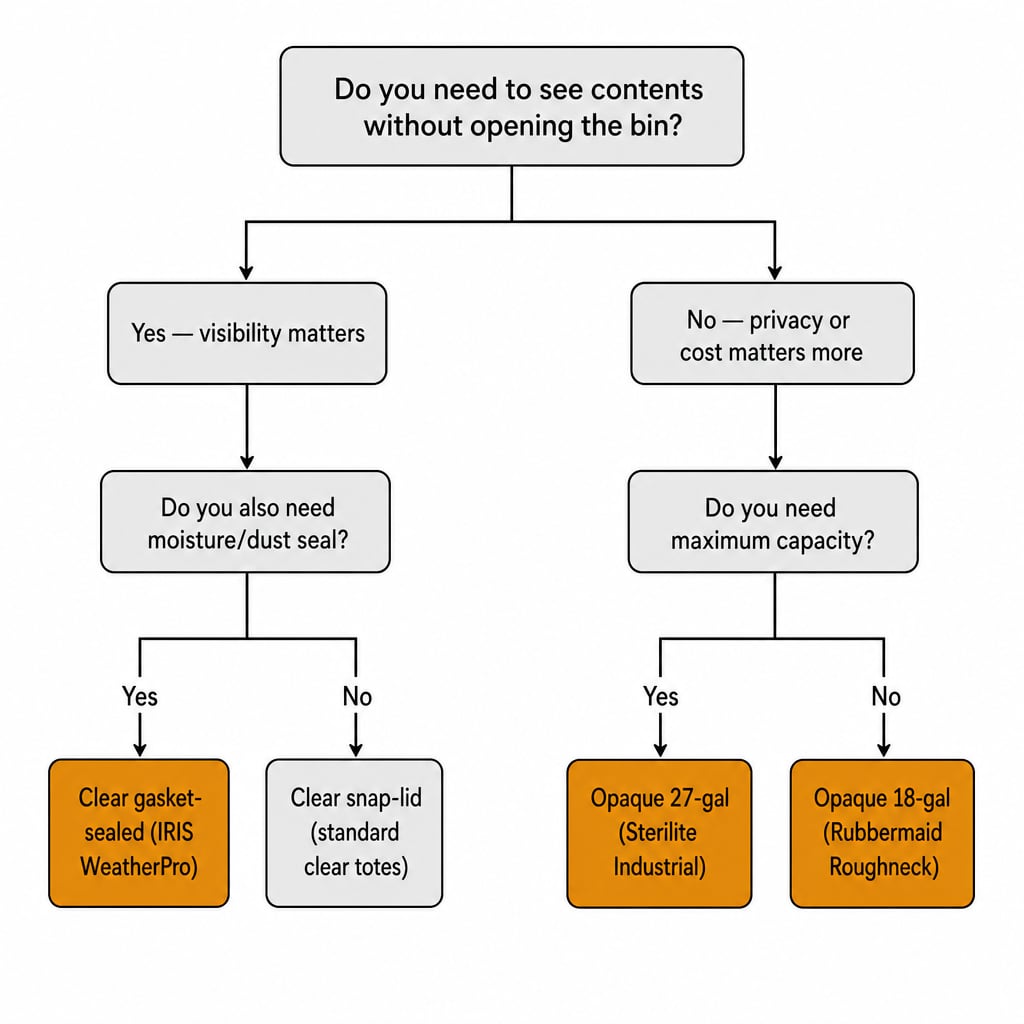
Three-step framework:
1. Sort by access frequency. Items you access more than once a year benefit from clear bins (faster visual sorting). Items you access once a year or less are candidates for opaque (cheaper, contents hidden from casual view). 2. Identify moisture-sensitive contents. Any item that would damage in damp garage conditions — paper documents, photos, fabric, electronics in original packaging — needs gasket-sealed protection. Clear gasket-sealed (WeatherPro) is the natural fit since you can also see contents. Opaque snap-lid totes are NOT moisture-sealed. 3. Account for UV exposure. If your garage has windows, skylights, or doors that let sunlight onto shelves, the contents in clear bins will fade. Place clear bins on shaded shelves; opaque bins on sun-exposed shelves.
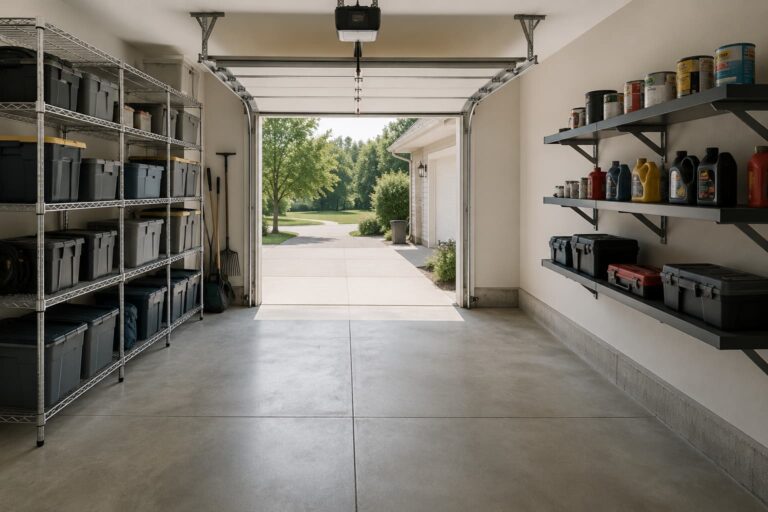
For most one-bay garages, the answer is a mix: 4-6 clear gasket-sealed bins for the high-rotation items (holiday decorations, seasonal sports gear, kid clothing) and 4-8 opaque totes for the bulk storage (paper records, items in original packaging, household overflow).
Common Mistakes
Mistake: Assuming clear equals weather-sealed
Cheap clear snap-lid bins are NOT gasket-sealed. Only specific clear-bin lines (IRIS USA WeatherPro is the dominant example on Amazon) include the gasket and multi-buckle latch combination that creates a real moisture barrier. A buyer who buys generic clear snap-lid bins expecting weather protection will be disappointed within a season.
Mistake: Opaque without labels equals no faster than clear
The whole point of opaque bins is to hide contents, which means you cannot identify items without opening. Without labels, opaque bins force you to open multiple containers to find a single item. Always label opaque bins on at least two sides (the side facing out plus the lid top) before placing on a shelf.
Mistake: Forgetting UV exposure on clear-bin shelves
Garage shelves near windows, skylights, or under-door light strips get more UV than buyers realize. Clear bin contents (fabric, paper, plastic items) will fade visibly within months of constant sun exposure. Place clear bins on shaded shelves; reserve sun-exposed shelves for opaque bins with UV-sensitive contents.
Recommended Products for Each Side
For the Clear side — small: IRIS USA WeatherPro 19 Qt Storage Bins with Lids, 6 Pack

The 19-quart gasket-sealed clear bin is the right pick for fabric, photos, electronics, decorations — items that benefit from visibility plus weather protection at a manageable capacity (4.75 gallons per bin). Six-pack format covers most starter clear-bin needs.
For the Clear side — large: IRIS USA WeatherPro 60 Qt Storage Bins with Lids, 3 Pack

The 60-quart version of the same WeatherPro line. Same gasket-seal protection at a larger 15-gallon capacity per bin. Three-pack format — fewer bins, larger volume each. Best for buyers with consolidated seasonal storage rather than many small categories.
For the Opaque side — workhorse: Rubbermaid Roughneck Tote 18 Gal, 6 Pack, Dark Indigo Metallic

The canonical garage opaque tote. 18-gallon sweet spot for shelf depth, integrated handles, USA-made. Snap-lid stay-tight retention (NOT gasket-sealed). Six-pack for full-shelf populations.
For the Opaque side — large: Sterilite 4-Pack Industrial Tote, 27 Gallon, Black
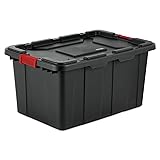
The reference large opaque tote. 27 gallons, channeled walls for rigidity, tie-down channels on the lid. Footprint (~30″ × 20″) exceeds standard 18-inch shelf depth — measure shelf depth before ordering. Best for bulk seasonal items, holiday decor in volume, or household overflow that does not need visibility.
How many totes actually fit on a garage shelf
Tote makers publish dimensions and shelving makers publish dimensions, but nobody puts the two together — so people buy shelving, then discover their totes overhang it. This table takes the published external size of totes from the brands people actually buy for garage storage — Sterilite, Rubbermaid Roughneck, and IRIS USA — and works out how many fit per shelf on the two garage shelving depths you can actually buy, 18 in and 24 in.
| Tote | Published dimensions (source order) | Footprint | Height | Fits an 18 in deep shelf? | Per 48 × 18 in shelf | Per 48 × 24 in shelf | Specification source | Source checked |
|---|---|---|---|---|---|---|---|---|
| Rubbermaid Roughneck 3 Gal. Storage Box | 7 in. H x 10.625 in. W x 15.687 in. D | 15.687 in × 10.625 in | 7 in | Yes | 4 | 6 | Rubbermaid Roughneck 3 gal Storage Box, Mfr# RMRT030003 | 2026-09-20 |
| Rubbermaid Roughneck 10 Gal. Storage Box | 8.875 in. H x 15.875 in. W x 23.875 in. D | 23.875 in × 15.875 in | 8.875 in | Yes | 2 | 3 | Rubbermaid Roughneck 10 gal Storage Box, Mfr# RMRT100004 | 2026-09-20 |
| Rubbermaid Roughneck 18 Gal. Storage Box | 16.375 in. H x 15.875 in. W x 23.875 in. D | 23.875 in × 15.875 in | 16.375 in | Yes | 2 | 3 | Rubbermaid Roughneck 18 gal Storage Box, Mfr# RMRT180000 | 2026-09-20 |
| Rubbermaid Roughneck 25 Gal. Storage Box | 23-5/16 in. H x 18-1/2 in. W x 28.875 in. D | 28⅞ in × 18½ in | 23 5/16 in | No — it overhangs | 0 | 1 | Rubbermaid Roughneck 25 gal Storage Box, Mfr# RMRT250002 | 2026-09-20 |
How these numbers were produced: External dimensions are quoted on the date shown per row. Sterilite rows are quoted from Sterilite’s own product pages (L x W x H order). Rubbermaid Roughneck rows are quoted from Ace Hardware’s retailer listing, which prints the manufacturer’s SKU-linked dimensions in H x W x D order on each product page. IRIS USA rows are quoted from IRIS USA’s own product pages (L x W x H order). All figures are the external/overall assembled dimensions with the lid on. The counts are computed, not estimated: totes are placed in a single layer, all in the same orientation, with no overhang and no gap; both orientations (the tote’s long side along the shelf’s 48 in run, or along its depth) are tried and the better one is kept. Shelf width is 48 in in both cases — the two depths are real Husky shelving footprints: 48 in. W x 18 in. D (Husky 86 in. H x 48 in. W x 18 in. D 6-Shelf Steel Shelving Unit, model MR481886W6B, https://www.homedepot.com/p/Husky-86-in-H-x-48-in-W-x-18-in-D-Black-Steel-6-Shelves-Shelving-Unit-MR481886W6B/306062319) and 48 in. W x 24 in. D (Husky 5-Tier Steel Shelving Unit, 48 in. W x 78 in. H x 24 in. D, model 426007, https://www.homedepot.com/p/Husky-5-Tier-Riveted-Steel-Garage-Storage-Shelving-Unit-in-Silver-48-in-W-x-78-in-H-x-24-in-D-426007/303241694); neither product page states a clear opening between posts. 48×18 and 48×24 are unobstructed reference surfaces, not guaranteed usable dimensions of every nominal 48×18 or 48×24 rack — posts and lips can reduce the clear opening (one retailer answer for a Husky 48×24 gives about 45.5 × 21.5 in between posts). Round the result down again if your shelving has corner posts that intrude, and leave room to get a hand in.
- A tote that fits the shelf footprint still needs vertical room: check the tote height against your shelf spacing, and leave clearance to lift it in and out rather than sliding it flush.
- Counts assume a flat, full-depth shelf. Wire shelving with a lip, or posts at the corners, will cost you the last tote in a row.
- Lids overhang the base on most totes; the figures here are the manufacturer’s overall assembled dimensions, which already include the lid.
- Capacity in quarts or gallons tells you nothing about whether it fits — and "27" doesn’t mean the same thing twice. The Sterilite 27 Qt. ClearView Latch Box (17 in x 11-1/8 in) fits an 18 in shelf; the Sterilite 108 Qt. Stacker Box (25-3/4 in x 18-3/8 in) — 27-gallon-equivalent by volume (108 qt = 27 gal), though Sterilite sells it as "108 Qt.," not "27 Gal." — does not.
- Manufacturers and retailers don’t all publish dimensions in the same order. Ace Hardware lists Rubbermaid Roughneck as Height x Width x Depth, where Sterilite and IRIS USA publish Length x Width x Height. This table normalises every row to footprint (the two horizontal dimensions) and height so they compare directly regardless of the order they were published in.
- Rubbermaid Roughneck’s 10 gal and 18 gal totes share the same footprint (23⅞ in x 15⅞ in) — only the height changes, so stepping up in capacity in that range costs no extra shelf space, only vertical clearance.
- A blank cell means the manufacturer does not publish that figure — we do not fill gaps with numbers we could not source.
These are the entries that matter for this guide. The full table, with every row and its source, is in our How many totes actually fit on a garage shelf.
FAQ
Do clear bins fade in sun? Contents fade, yes — paper, fabric, plastic items exposed to direct sunlight through clear bin walls will visibly fade within months. The bins themselves resist UV reasonably well (polypropylene formulations include UV stabilizers), but anything inside them is exposed. Place clear bins on shaded shelves or shelves not facing direct sunlight.
Are gasket-sealed clear bins worth the price premium? For moisture-sensitive contents (paper, fabric, electronics in original packaging, photos), yes — the gasket seal makes a real difference in damp or unconditioned garages. For items not moisture-sensitive (most tools, bulky outdoor gear), a snap-lid clear bin is adequate at lower cost.
Can I mix clear and opaque bins on the same shelf? Yes, and most garages benefit from this. The visual variety is minor compared to the functional benefit of right-bin-for-right-content. Group by content type rather than bin type when stacking.
Which is cheaper, clear or opaque? Opaque is typically cheaper per gallon. Rubbermaid Roughneck and Sterilite Industrial are positioned as workhorse opaque at accessible price points. Gasket-sealed clear (IRIS WeatherPro) carries a meaningful premium versus snap-lid opaque, though entry-tier snap-lid clear is competitive with opaque on price.
Are there UV-blocking opaque alternatives if I want privacy and sun resistance? Yes — opaque totes block UV by virtue of their solid walls. If your concern is UV protection plus privacy without paying for gasket sealing, opaque snap-lid (Rubbermaid Roughneck, Sterilite Industrial) is the right choice. For moisture protection AND UV blocking, opaque gasket-sealed bins exist in some lines (IRIS WeatherTight is the opaque sibling of WeatherPro) but are less commonly featured in residential garage roundups.
Sources Reviewed
For this comparison, we reviewed manufacturer pages and retailer specifications for both clear (IRIS USA WeatherPro line) and opaque (Rubbermaid Roughneck, Sterilite Industrial) storage bins, product listings, recurring patterns in public customer feedback, and discussions where homeowners shared real-world experiences choosing between these options in residential garages.