How to Choose Garage Storage for Tools and Supplies
Last updated:
Disclosure: This article contains affiliate links. If you buy through these links, we may earn a commission at no extra cost to you. We do not claim hands-on testing unless clearly stated.
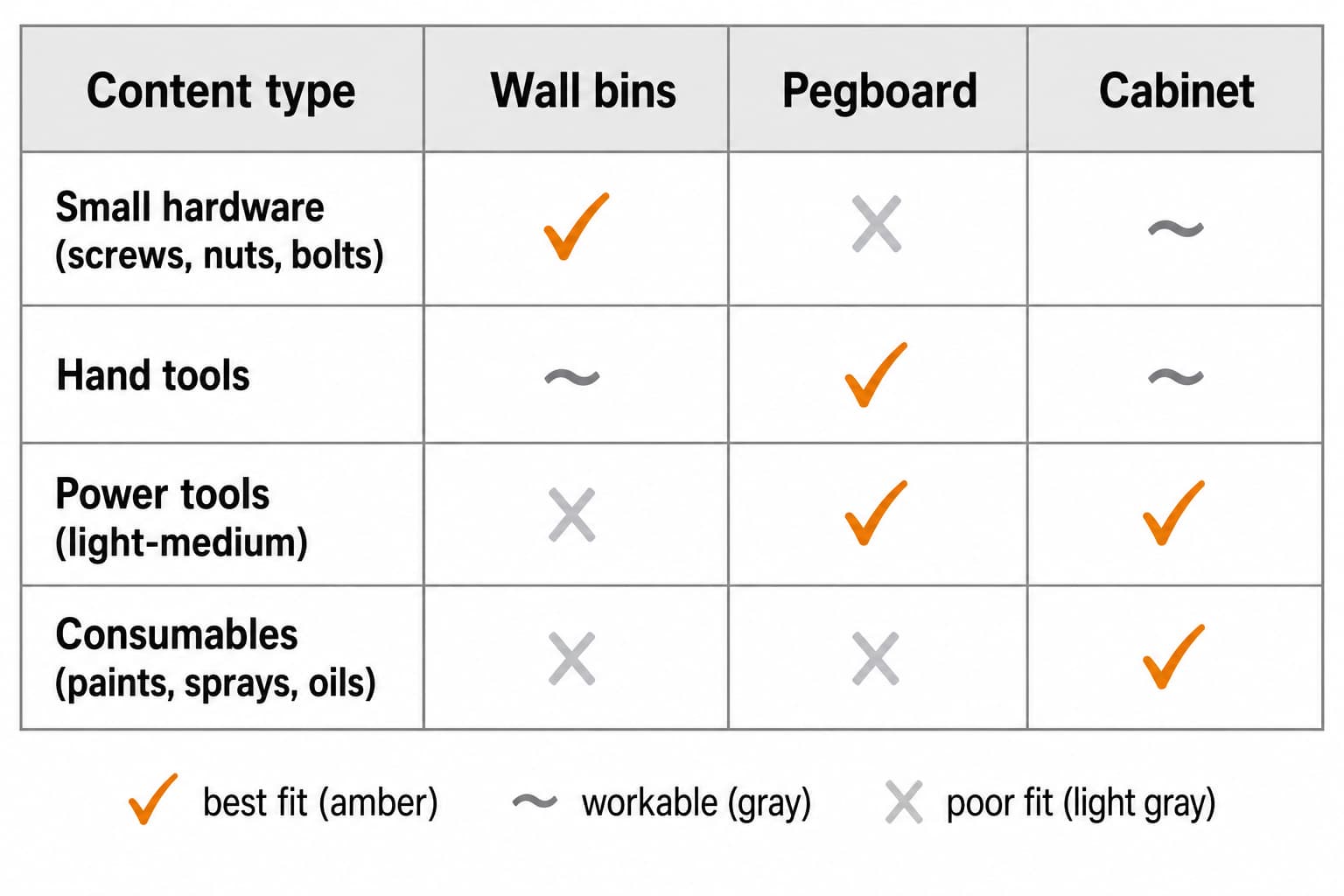
Most garages collect four very different kinds of stuff in the same pile: small hardware (screws, nuts, bolts), hand tools (wrenches, screwdrivers, hammers), power tools (drills, sanders, jigsaws), and consumables (paints, sprays, lubricants, cleaners). One tall shelving unit does not solve any of these problems well — it gives you a single open shelf where everything still ends up in a heap. This guide explains how to match each content type to the right storage format, what to measure before you buy, and which three starter products cover the most common configurations.
What this guide does not cover: shelving for plastic storage totes (see our roundup of garage shelving units), bike and sports gear (covered separately under the small-garage planning guide), and overhead ceiling racks (a different load-and-safety category entirely).
Quick Recommendation by Use Case
| Your situation | Best format | Why |
|---|---|---|
| Loose screws, nuts, bolts, drill bits | Wall-mounted bin system | Visible, indexed, easy to grab one type at a time |
| Hand tools — wrenches, screwdrivers, pliers | Metal pegboard | Hang format keeps the working set visible and reachable |
| Light-to-medium power tools | Pegboard with shelves, or cabinet with adjustable shelves | Pegboard for items under ~5 lb, cabinet for everything heavier |
| Paints, sprays, lubricants, automotive fluids | Lockable cabinet | Containment, child/pet safety, dust protection |
| All of the above in one garage | All three formats | One unit cannot serve four content types well |
The last row is the one most buyers miss. You can absolutely build a system over time, but the right starting point is “which one format is the biggest pain point today?” — not “which one unit can replace all four piles?”
The Three Storage Formats (and What They’re For)
The garage storage market sells dozens of products, but the real choices reduce to three formats. Each one wins decisively at one content type and loses at the others.
Wall-mounted bin systems
A grid of small open-front plastic bins, mounted on either a pegboard or a horizontal rail. The bins are graduated by size (small for screws, larger for hose clamps or assorted hardware), and the open front means you can scoop out what you need without lifting the bin off the wall.
Wins at: small loose hardware that you sort by type — screws, nuts, washers, drill bits, dowels, picture-hanging hardware, fishing tackle, electrical connectors.
Loses at: anything with a handle (hand tools won’t sit flat in a bin), anything with significant weight (the bins themselves don’t carry much), and anything you need to keep contained (paint cans, sprays — the open front means evaporation and dust).
Single-line rule: if you’d describe the item as “a fastener”, a bin probably wins.
Pegboard
A perforated panel — metal in the durable versions, MDF or hardboard in the cheap ones — mounted to the wall, with hooks of various shapes inserted into the holes to hold tools. Better systems accept both their proprietary slotted hooks and standard 1/4″ pegboard hooks, so the hook collection grows with the tool collection. For a hub view of which pegboard variant fits which tool collection, see the tool-system-specific buying guide.
Wins at: hand tools and light power tools that benefit from being visible — wrenches, screwdrivers, pliers, smaller cordless drills, sanders. The “visible” part is editorial: tools you can see, you use; tools in a closed drawer, you forget.
Loses at: small loose hardware (screws fall through hooks or off the bin lips), heavy power tools (a 12-lb circular saw will deform a cheap pegboard panel), and consumables (cans and bottles don’t hang).
Single-line rule: if the tool has a handle or a hook-friendly hole, pegboard wins.
Storage cabinet
A closed steel cabinet, freestanding or wall-mounted, often with adjustable shelves and a lock. Sizes range from small wall-mounted units (limited capacity, preserves floor space) to tall 71″ lockers (high capacity, takes a footprint).
Wins at: consumables that should be contained (paints, lubricants, automotive fluids, household chemicals), items you want to keep away from kids or pets (lockable), and anything that should stay dust-free. Closed cabinets also work for power tools you don’t use weekly — a circular saw lives fine on an interior shelf.
Loses at: active hand tools (you’ll stop opening the door after the third project), and small loose hardware (one wide shelf is the wrong format — you need bins inside the cabinet, which is the system we explicitly avoided buying).
Single-line rule: if the item is in a bottle, a can, or rarely used, a cabinet wins. For the specific cleaning-supplies workflow, see the cleaning-supplies how-to.
Key Factors to Consider Before Buying
Six factors decide whether a given product will actually work in your space.
Mounting surface and wall material
Drywall alone cannot hold a heavy cabinet or a loaded pegboard. You need to find studs (typically 16″ on center in residential US construction) and screw into them. Block walls need masonry anchors. If your garage has finished drywall with no exposed studs, a stud finder is the first tool to buy — before any storage product. For broader layout thinking that informs where to mount what, see garage zone planning.
Weight capacity — per shelf vs. per hook
Cabinet specs are usually listed as “per shelf” (e.g. 50 lb per adjustable shelf) plus a “total” figure that assumes balanced load. Pegboard specs are usually “per hook” or “total system” (e.g. an Ultrawall panel set lists up to 1200 lb total — a manufacturer-listed figure that depends on correct mounting into studs and balanced load distribution). Read both numbers, and assume real-world capacity is lower than the listed maximum.
Lockable vs. open access
If you have kids, pets, or shared garage access with someone who shouldn’t be in the chemicals, lockable doors aren’t a luxury — they’re the only safe format for paints, solvents, and automotive fluids. Open shelving and pegboard cannot solve this problem.
Footprint cost
Freestanding cabinets take floor space (often 18-24″ of depth plus walking clearance). Wall-mounted cabinets and pegboard take no floor space but require usable wall. Rolling cabinets take floor space but can be moved when you need the bay clear. Pick based on what’s the scarce resource in your garage: floor area or wall area.
Modularity
Can the system grow? A pegboard system that accepts both proprietary and standard hooks scales with your tool collection. A cabinet with adjustable shelves accommodates new bottle heights without buying a second unit. Avoid fixed-shelf cabinets that lock you into one layout.
Visibility
Open formats (bins, pegboard) mean you see what you have — useful for active tools and frequently-used hardware. Closed formats (cabinets) mean things are dust-free but easy to forget. The “I forgot I owned this” problem applies to whatever ends up behind a closed door for a year.
Measurement Checklist Before You Buy
The number-one returnable-product mistake is buying something that physically doesn’t fit. Measure these five things first, on paper, before opening any tabs.
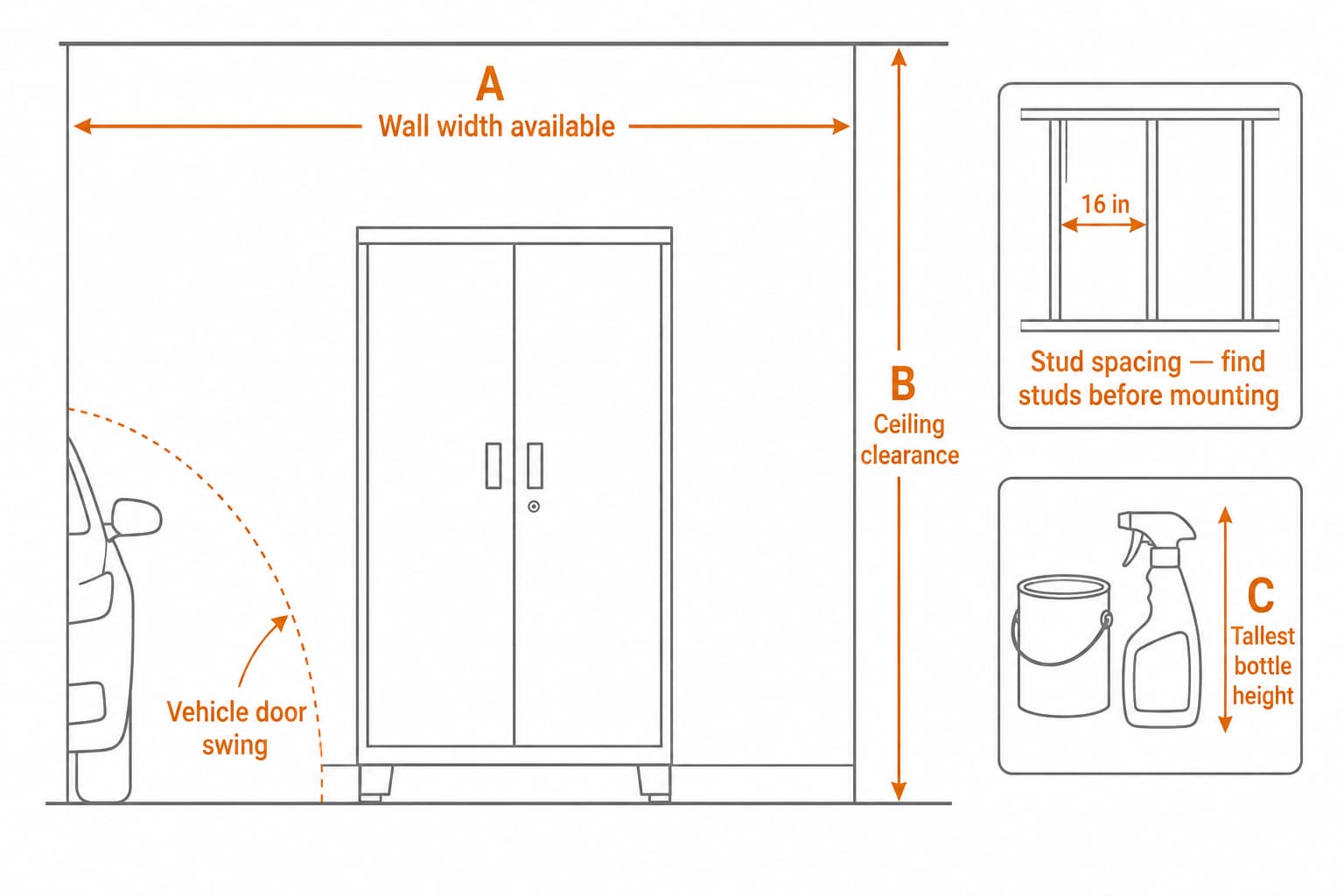
- Wall width available — the horizontal run of usable wall, excluding window frames, outlets, and corners.
- Ceiling clearance — floor to ceiling, then subtract overhead lighting drop and garage door track clearance.
- Stud spacing — find studs with an electronic stud finder. In US construction, expect 16″ on center; in older homes, 24″ is possible. This determines whether a 32″-wide cabinet can mount across two studs.
- Vehicle door swing radius — sit in the driver’s seat with the door fully open. The arc traced by the outer door edge is the no-storage zone for that wall.
- Tallest consumable bottle or can — measure the tallest paint can, gallon jug, or spray canister you plan to store. Cabinet shelf spacing must accommodate this height plus an inch.
For totes (if you’re combining storage formats), measure with the lid on.
Common Mistakes to Avoid
Five mistakes show up over and over in buyer feedback.
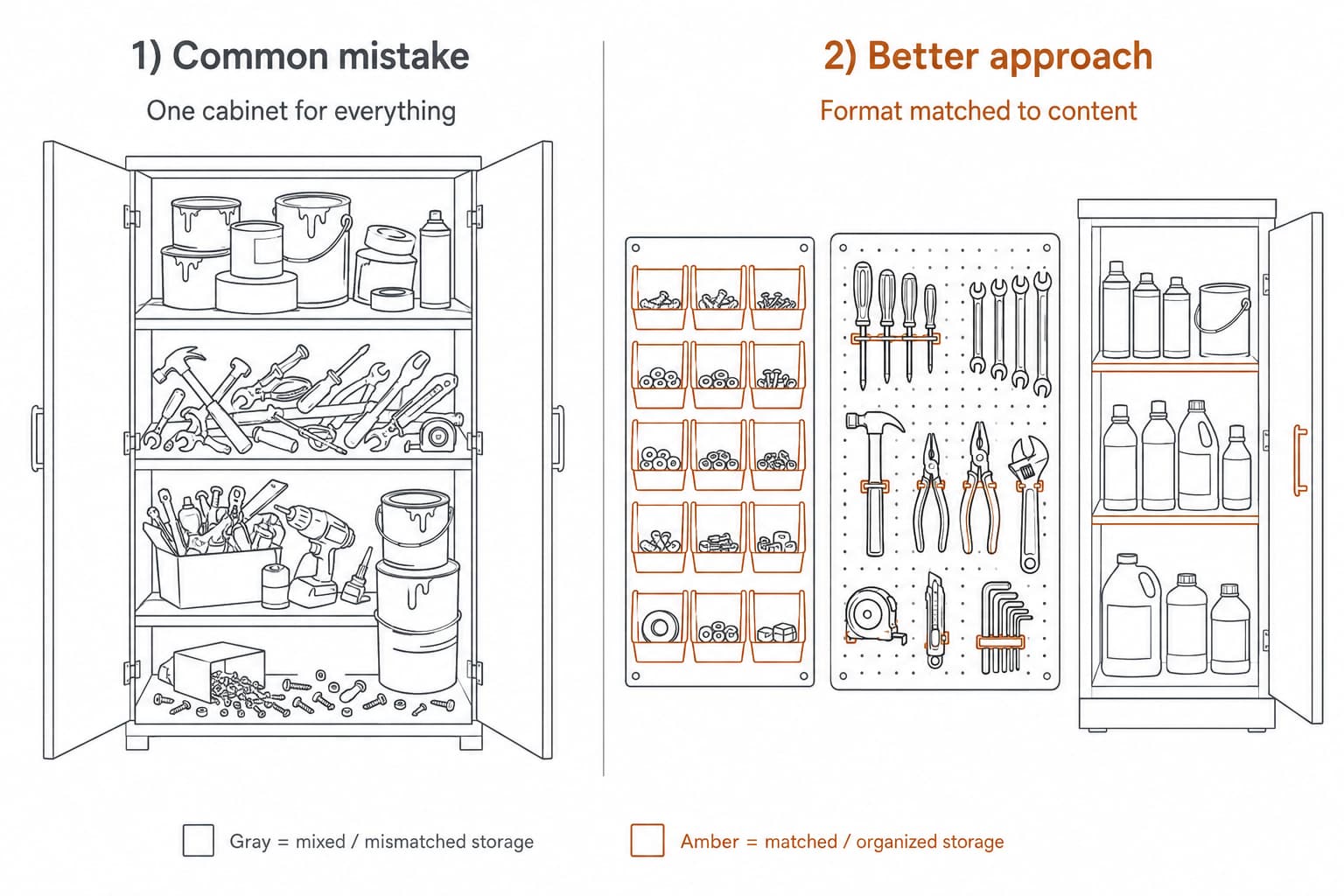
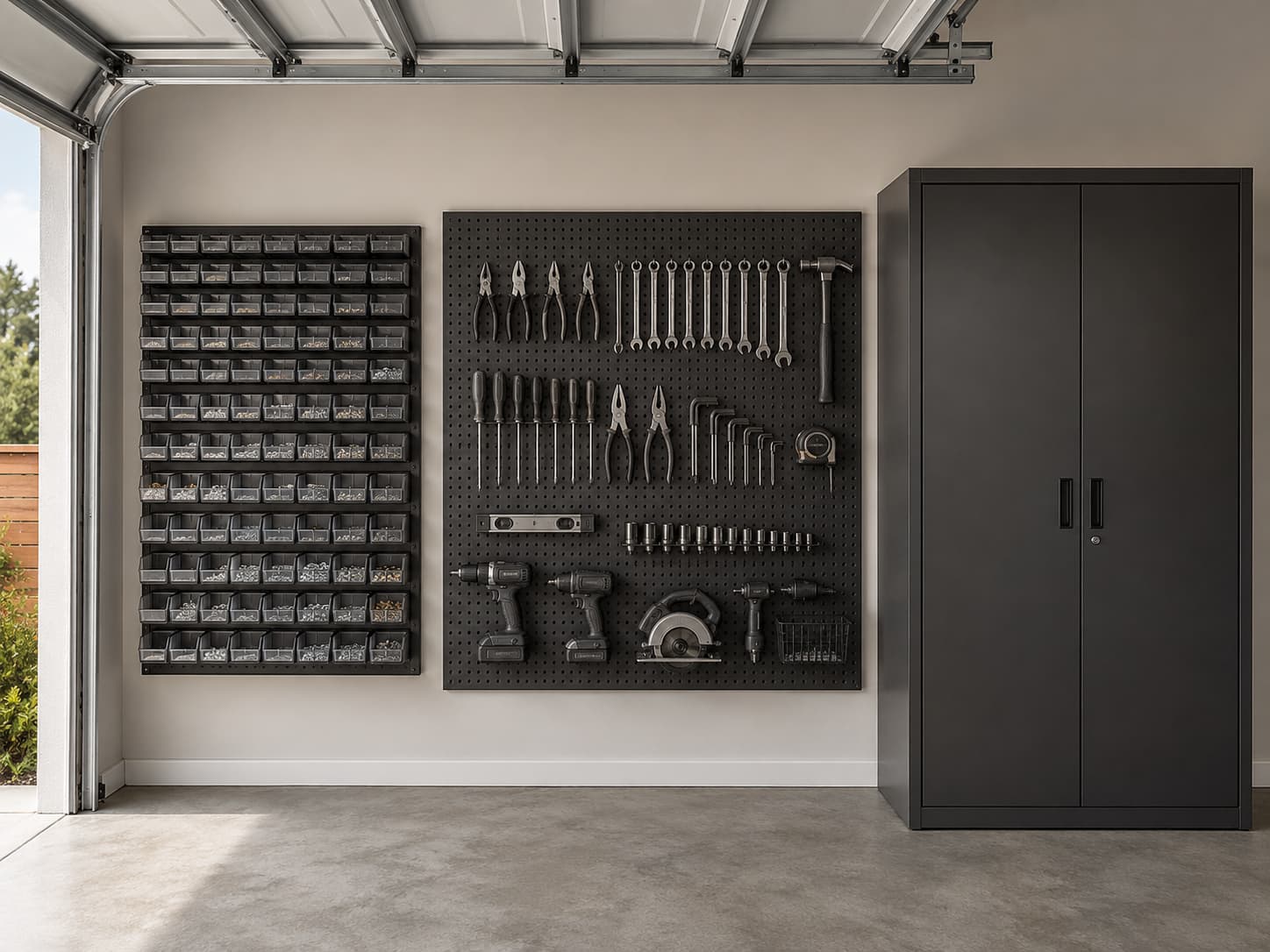
- Buying one big cabinet for everything. A single 71″-tall cabinet does not magically organize loose screws, active hand tools, and chemicals. Each content type wants a different format — the diagram above shows the contrast.
- Using pegboard for small hardware. Screws and nuts fall through hooks, off bin lips, or out of the small pegboard cups. Bins are made for fasteners; pegboard is made for handle-bearing tools.
- Forgetting chemicals need closed storage. Open shelving is the wrong format for solvents, paints, and automotive fluids — both for containment (spills, evaporation) and for safety access control. For the chemicals-specific workflow, see the cleaning-supplies how-to.
- Mounting heavy into drywall. A loaded cabinet plus drywall anchors alone will fail under sustained load. Find the studs first; if your planned mounting position doesn’t hit studs, either reposition or use a freestanding unit instead.
- Trusting the capacity claim alone. Manufacturer-listed capacities (300 lb per shelf, 1200 lb total system) assume correct assembly, balanced load distribution, level flooring, and full mounting into structural framing. Real-world capacity in a non-ideal install is materially lower. Always read the capacity claim as a ceiling, never as a guarantee.
Safety and Installation Notes
For the cabinet picks, the locking feature is the differentiator vs. open shelving — but the lock only helps if the cabinet itself is anchored to a wall (for tall units) or sits on level flooring (for shorter freestanding units). Read the manufacturer’s installation manual for the specific anchoring requirement.
For mounted systems (pegboard, wall-mounted bins, wall-mounted cabinets), confirm stud locations before drilling. A loaded pegboard or cabinet mounted into drywall alone will eventually fail.
Featured Picks — Starter for Each Format
These three products are a starter set covering the three formats. For each format, the corresponding cluster roundup has 5+ alternatives with side-by-side comparison — these picks are the editorial entry point, not the only choices.
For small hardware: HORUSDY 30PC Wall-Mounted Storage Bins Parts Rack

Color-graduated bins (9 small red, 9 small blue, 12 large orange) on two mounting panels. Best for readers building their first indexed hardware system. The bin format is fixed-position — bins don’t lift off cleanly with one hand, so plan for a “walk to the wall” workflow rather than “carry the bin to the bench”. For multi-format comparisons with rail-based alternatives, see the extension cord how-to which uses a similar bin philosophy.
For hand and power tools: Wall Control Pegboard Organizer 4 ft. Metal Tool Storage Kit

Metal substrate (not MDF) handles heavier hand and small-power-tool weight without sagging. Accepts both Wall Control’s slotted hooks and standard 1/4″ peg hooks, so the hook collection grows with your tool collection. Branded manufacturer with an independent website — the lowest ASIN-attrition risk among the pegboard candidates. Not the right choice for small loose hardware (use bins for that).
For consumables and supplies: GarveeHome 71″ Metal Locker Storage Cabinet

Tall locking cabinet for lubricants, paints, automotive fluids, and other items that should be kept away from kids or daily reach. Adjustable shelves accommodate varied bottle heights. The locking doors are the differentiator vs. open shelving for chemicals. The brand is a generic Amazon listing — confirm the ASIN still points to the documented configuration at purchase time, since this product line has rotated SKUs historically.
For the full roundup with multiple alternatives per format, see the dedicated tool organizer roundup and the upcoming cabinet roundup.
How many totes actually fit on a garage shelf
Tote makers publish dimensions and shelving makers publish dimensions, but nobody puts the two together — so people buy shelving, then discover their totes overhang it. This table takes the published external size of totes from the brands people actually buy for garage storage — Sterilite, Rubbermaid Roughneck, and IRIS USA — and works out how many fit per shelf on the two garage shelving depths you can actually buy, 18 in and 24 in.
| Tote | Published dimensions (source order) | Footprint | Height | Fits an 18 in deep shelf? | Per 48 × 18 in shelf | Per 48 × 24 in shelf | Specification source | Source checked |
|---|---|---|---|---|---|---|---|---|
| Sterilite 6 Qt. Storage Box | 13 5/8" x 8" x 4 5/8" | 13⅝ in × 8 in | 4⅝ in | Yes | 6 | 9 | Sterilite 6 Qt. Storage Box | 2026-09-14 |
| Sterilite 16 Qt. Storage Box | 17 1/8" x 11 7/8" x 6 3/4" | 17⅛ in × 11⅞ in | 6¾ in | Yes | 4 | 4 | Sterilite 16 Qt. Storage Box | 2026-09-14 |
| Sterilite 27 Qt. ClearView Latch Box | 17" x 11 1/8" x 12 3/4" | 17 in × 11⅛ in | 12¾ in | Yes | 4 | 4 | Sterilite 27 Qt. ClearView Latch Box | 2026-09-14 |
How these numbers were produced: External dimensions are quoted on the date shown per row. Sterilite rows are quoted from Sterilite’s own product pages (L x W x H order). Rubbermaid Roughneck rows are quoted from Ace Hardware’s retailer listing, which prints the manufacturer’s SKU-linked dimensions in H x W x D order on each product page. IRIS USA rows are quoted from IRIS USA’s own product pages (L x W x H order). All figures are the external/overall assembled dimensions with the lid on. The counts are computed, not estimated: totes are placed in a single layer, all in the same orientation, with no overhang and no gap; both orientations (the tote’s long side along the shelf’s 48 in run, or along its depth) are tried and the better one is kept. Shelf width is 48 in in both cases — the two depths are real Husky shelving footprints: 48 in. W x 18 in. D (Husky 86 in. H x 48 in. W x 18 in. D 6-Shelf Steel Shelving Unit, model MR481886W6B, https://www.homedepot.com/p/Husky-86-in-H-x-48-in-W-x-18-in-D-Black-Steel-6-Shelves-Shelving-Unit-MR481886W6B/306062319) and 48 in. W x 24 in. D (Husky 5-Tier Steel Shelving Unit, 48 in. W x 78 in. H x 24 in. D, model 426007, https://www.homedepot.com/p/Husky-5-Tier-Riveted-Steel-Garage-Storage-Shelving-Unit-in-Silver-48-in-W-x-78-in-H-x-24-in-D-426007/303241694); neither product page states a clear opening between posts. 48×18 and 48×24 are unobstructed reference surfaces, not guaranteed usable dimensions of every nominal 48×18 or 48×24 rack — posts and lips can reduce the clear opening (one retailer answer for a Husky 48×24 gives about 45.5 × 21.5 in between posts). Round the result down again if your shelving has corner posts that intrude, and leave room to get a hand in.
- A tote that fits the shelf footprint still needs vertical room: check the tote height against your shelf spacing, and leave clearance to lift it in and out rather than sliding it flush.
- Counts assume a flat, full-depth shelf. Wire shelving with a lip, or posts at the corners, will cost you the last tote in a row.
- Lids overhang the base on most totes; the figures here are the manufacturer’s overall assembled dimensions, which already include the lid.
- Capacity in quarts or gallons tells you nothing about whether it fits — and "27" doesn’t mean the same thing twice. The Sterilite 27 Qt. ClearView Latch Box (17 in x 11-1/8 in) fits an 18 in shelf; the Sterilite 108 Qt. Stacker Box (25-3/4 in x 18-3/8 in) — 27-gallon-equivalent by volume (108 qt = 27 gal), though Sterilite sells it as "108 Qt.," not "27 Gal." — does not.
- Manufacturers and retailers don’t all publish dimensions in the same order. Ace Hardware lists Rubbermaid Roughneck as Height x Width x Depth, where Sterilite and IRIS USA publish Length x Width x Height. This table normalises every row to footprint (the two horizontal dimensions) and height so they compare directly regardless of the order they were published in.
- Rubbermaid Roughneck’s 10 gal and 18 gal totes share the same footprint (23⅞ in x 15⅞ in) — only the height changes, so stepping up in capacity in that range costs no extra shelf space, only vertical clearance.
- A blank cell means the manufacturer does not publish that figure — we do not fill gaps with numbers we could not source.
These are the entries that matter for this guide. The full table, with every row and its source, is in our How many totes actually fit on a garage shelf.
FAQ
Do I really need three different storage systems for one garage?
You need three different formats — not necessarily three full units on day one. Pick the format that solves your biggest pain point first (most readers start with whichever pile is in the way of the car), use it for six weeks, then add the next format. Trying to solve everything with one unit is the most common buying mistake; trying to solve everything in one weekend is the second.
Can I mount heavy cabinets directly into drywall?
No. Drywall alone, even with toggles or anchors, does not safely support a loaded cabinet over time. The mounting screws need to go into wall studs (or masonry anchors, for block walls). If your planned position doesn’t align with studs, either reposition the cabinet, use a freestanding unit instead, or install a horizontal mounting cleat (a board screwed across multiple studs that the cabinet then attaches to).
What’s the difference between a pegboard and a wall bin system — aren’t they the same?
They look similar but they hold different things. Pegboard uses hooks for tools with handles or hangable holes. A wall bin system uses open-front plastic bins for loose items. Some products combine both (bins hung on a pegboard), which is a legitimate hybrid — but the two formats solve genuinely different problems.
How do I store chemicals safely in a garage cabinet?
Three rules: (1) closed and lockable (kids, pets, ventilation control); (2) cool, away from direct sun on the cabinet exterior; (3) original containers with labels intact. Never decant solvents into food-grade containers. Some local fire codes restrict the volume of flammable liquids stored in attached garages — check your jurisdiction if you’re storing more than a few quarts of solvent or gasoline.
Will a rolling cabinet hold up to garage-floor use?
If the casters are rated for the load and the floor is reasonably level, yes. Issues show up with two patterns: cheap casters under heavy load (caster bearings fail or the wheel detaches from the frame), and uneven concrete (the cabinet rocks, drawers don’t sit flat). For uneven floors, look for cabinets that combine wheels with adjustable leveling feet so you can switch modes.
How much wall area do I need before pegboard makes sense?
A starter pegboard (32″ x 16″ panel) takes about 3.6 square feet. Below that, you’re better off with a small wall-mounted tool rail or a dedicated tool roll. The 4-ft kit pick above is about 4 ft wide x 32″ tall — roughly 11 square feet of wall, which is the practical minimum for a system worth installing.
Sources Reviewed
For this buying guide, we reviewed manufacturer documentation, retailer product pages, installation manuals where available, and recurring patterns in public buyer discussions about garage storage cabinets, pegboard systems, and wall-mounted bin organizers.