How to Choose a Garage Tool Organization System
Last updated:
Disclosure: This article contains affiliate links. If you buy through these links, we may earn a commission at no extra cost to you. We do not claim hands-on testing unless clearly stated.
Most readers’ first thought is “I’ll get pegboard”. That’s the right answer about 60% of the time. The other 40% is when slatwall or magnetic storage wins by a wide margin — and getting it wrong locks low-to-mid three figures into the wrong format, plus a Saturday afternoon you don’t get back. This guide explains which of the three system types fits which tool collection, what to measure before buying, and three starter picks covering the dominant formats.
What this guide does not cover: storage for non-tool items like consumables and supplies (covered in the broader utility-storage buying guide), overhead ceiling racks, or storage totes.
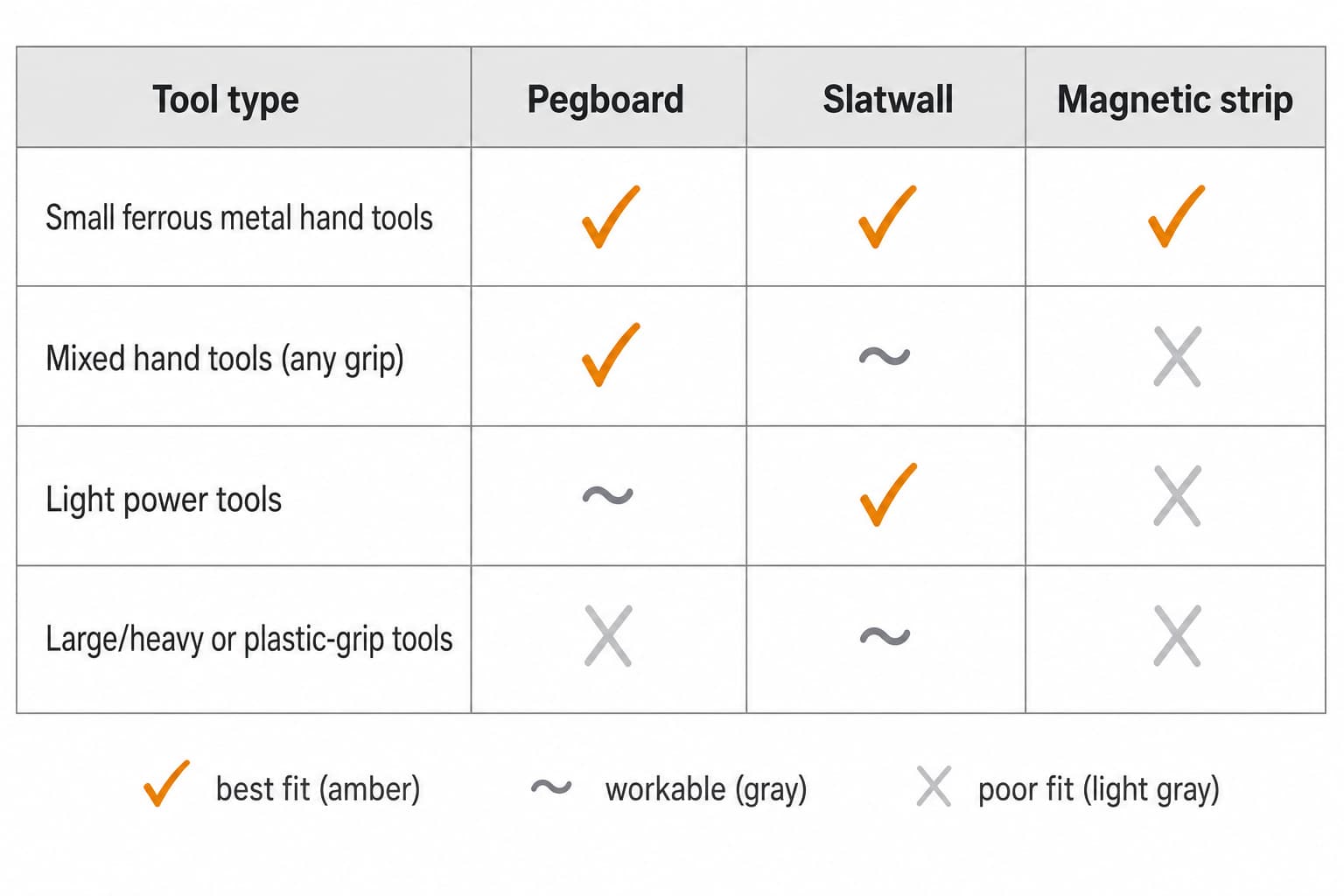
Quick Recommendation by Use Case
| Your situation | Best system | Why |
|---|---|---|
| Hand tools, fixed collection, tight budget | Metal pegboard | Cheapest per square foot, accepts standard hooks |
| Mixed hand + power tools, will reorganize over time | PVC or steel slatwall | Hooks slide horizontally — no re-drilling when layout changes |
| Metal hand tools used daily at a workbench | Magnetic tool strip | Reach-and-place is faster than any hook system |
| Heavy power tools (8-plus lb each) on the wall | Steel slatwall or wall cabinet | Pegboard and PVC slatwall both struggle above ~5 lb per hook |
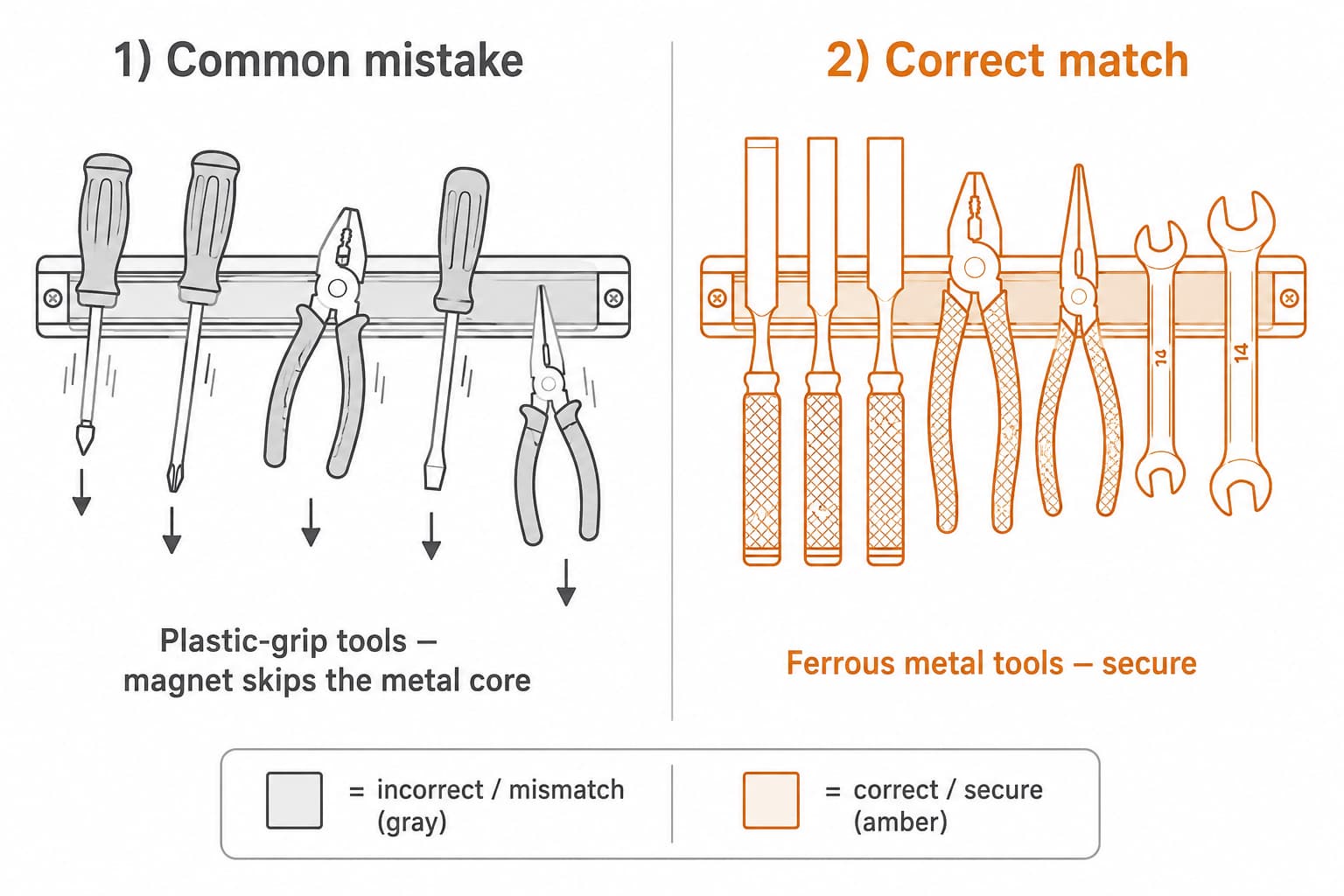
| Plastic-grip-only tools | Pegboard or slatwall, NOT magnetic | The magnet only grips the ferrous metal — plastic-grip tools have nothing to bond to |
The last row is the one that traps the most buyers. A 24-inch magnetic strip looks like the answer for a dense rack of screwdrivers — until you mount it and discover that your plastic-grip screwdrivers don’t have enough internal metal to hold.
The Three System Types (and What Each Does Best)
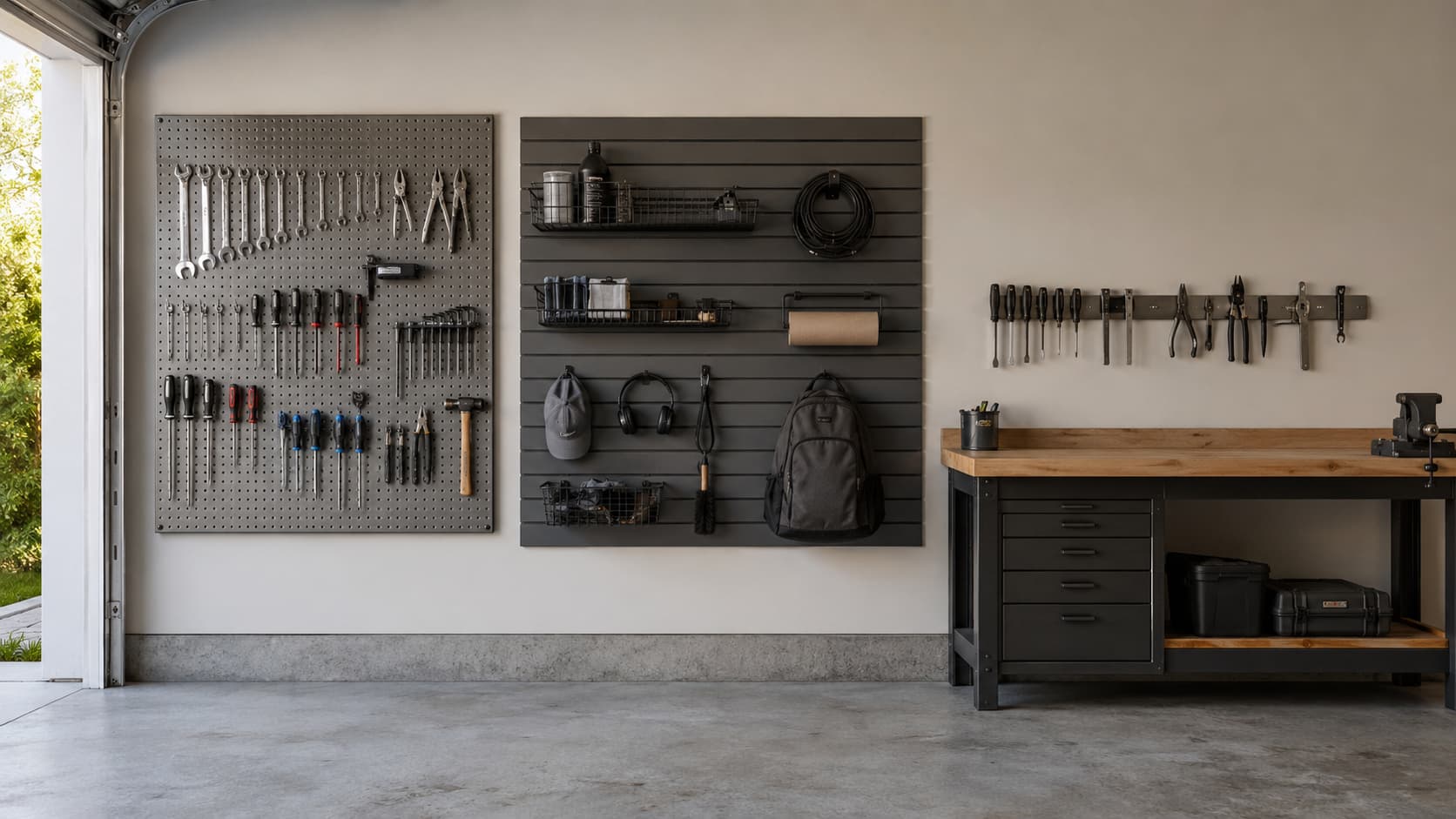
The residential tool-wall market reduces to three system types, regardless of brand. Each one wins decisively at one tool profile and loses at the others.
Pegboard
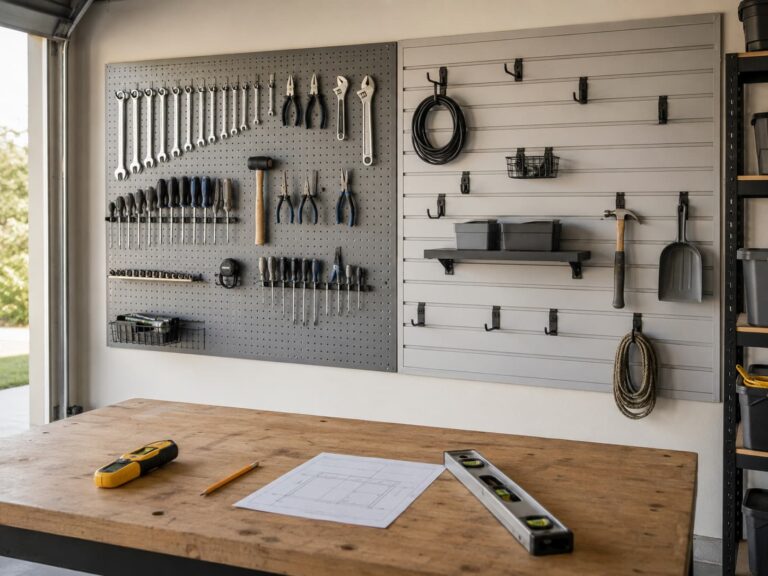
A perforated panel — metal in the durable versions, MDF or hardboard in the cheap ones — that accepts hooks for tools with handles or hangable holes. Metal pegboard with both proprietary slotted hooks AND standard 1/4-inch peg hook compatibility is the most flexible format because the hook collection grows independently of the panel. For the dedicated roundup of metal pegboard product organizers, see the tool organizer roundup.
Wins at: hand tools and light power tools (under ~5 lb each), readers who want the cheapest cost-per-square-foot of wall coverage, situations where the tool layout is mostly fixed once set.
Loses at: heavy power tools (a 12-lb circular saw will deform a cheap pegboard panel), small loose hardware (screws fall through hooks), and readers who reorganize frequently (every layout change means unscrewing and re-positioning hooks).
Single-line rule: if you’d describe your tool collection as “mostly hand tools, mostly fixed”, pegboard wins.
Slatwall
Horizontal slats — PVC for the affordable versions, steel for the heavy-duty ones — that accept modular hooks, shelves, baskets, and bins. The defining feature is that hooks SLIDE horizontally without unscrewing, which makes layout iteration cheap. Slatwall is also the only format where you can mount a shelf and a hook on the same horizontal line without compromise. For step-by-step installation, see how to install garage slatwall.
Wins at: readers who reorganize often, collections with mixed item types (hand tools + shelves + baskets together), walls that will see new tools added over a 2-3 year horizon.
Loses at: budget-constrained installs (slatwall panels are 2-3x the cost of metal pegboard, and the accessories add up), and very heavy single items (PVC slatwall capacity drops sharply above ~5 lb per hook).
Single-line rule: if your tool collection is going to change shape, slatwall wins.
Magnetic tool strip
A linear bar (typically 12 to 24 inches) with an embedded high-strength magnet that holds ferrous metal tools by direct attraction. Mounts to a wall, a workbench edge, or even the side of a steel cabinet. Density is unmatched — a 24-inch strip can hold 20-plus small metal hand tools in the space a single pegboard hook would occupy. For the broader no-pegboard alternative discussion, see how to organize garage tools without pegboard.
Wins at: small metal hand tools used daily (chisels, screwdrivers with metal cores, pliers, small wrenches, files), bench-side workflow where reach-and-place beats reach-and-hang.
Loses at: anything plastic-grip-only (the magnet has nothing to grip), anything aluminum or non-ferrous, anything over the manufacturer-listed per-strip capacity (typically 10-25 lb total — verify on the specific listing).
Single-line rule: if your tools are small, ferrous, and constantly in motion, magnetic wins.
Key Factors to Consider
Six factors decide whether a chosen system will actually work in your space.
Tool collection size
A 20-tool collection fits on a single 32-by-16-inch pegboard panel. A 100-tool collection needs the 4-foot kit or a full slatwall wall. Estimate your collection before sizing the system — under-buying means a second purchase six months later, over-buying wastes wall area.
Tool types (ferrous metal share)
Walk through your tool collection and count the percentage that is ferrous metal vs. plastic-grip vs. aluminum. If 80-plus percent is plastic-grip cordless tools, magnetic storage is wrong for the bulk of the collection. If 80-plus percent is metal hand tools, magnetic storage could replace a significant chunk of the pegboard.
Modification frequency
Be honest: will the layout change? If you’re adding new tools every quarter (active project workshop), slatwall pays for itself in saved re-drilling. If the layout is set-and-forget (occasional weekend use), pegboard is the better economic choice.
Wall material and stud locations
Drywall alone won’t hold a loaded system long-term. Find studs (typically 16 inches on center in residential US construction) and mount into them. Block walls need masonry anchors. For broader wall-planning context, see garage zone planning.
Per-hook vs. per-board vs. per-strip capacity
The capacity claim format differs by system:
- Pegboard lists “per board” (e.g. Wall Control rates 200 lb per board, manufacturer-listed, on correct mounting).
- Slatwall lists “per linear foot” or “per hook” (PVC slatwall typically tops out around 5-8 lb per hook; steel slatwall can carry 20-plus lb per hook).
- Magnetic strips list “per strip” or “per linear inch” (a 24-inch magnetic strip is typically listed at 10-25 lb total).
Read the claim format — and the conditions it assumes — before you compare numbers across systems.
Budget tier
Pegboard is the cheapest entry point — affordable starter range. PVC slatwall sits in a mid-tier price range. Steel slatwall and magnetic strips have wider price spreads — magnetic strips have modest unit cost, but you may need several to match a pegboard’s coverage.
Measurement Checklist Before You Buy
The five measurements that prevent the most common returnable-product mistake.
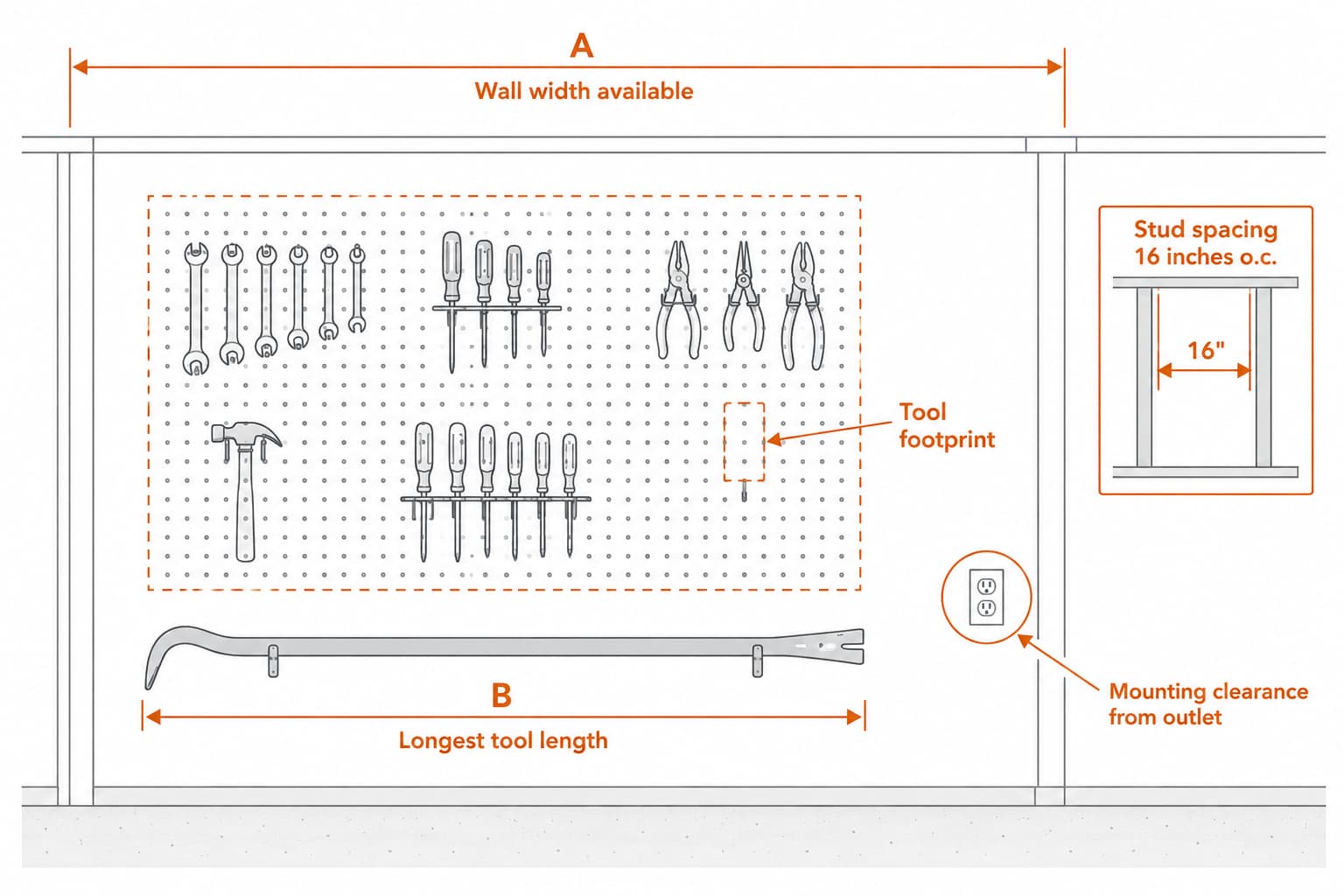
- Wall width available — the horizontal run of usable wall, minus window frames, electrical panels, and corners.
- Longest tool length — measure your longest hangable tool (often a pry bar, level, or long-handled shovel). The system must accommodate this length with hooks plus clearance.
- Stud spacing — find studs with an electronic stud finder. 16 inches on center is standard; 24 inches possible in older construction. This determines whether a panel can mount across two studs.
- Mounting clearance from outlets and switches — leave at least 2 inches around outlets and light switches so the panel doesn’t interfere with future electrical work.
- Tool footprint — for each tool, measure how much wall area it occupies (a 12-inch wrench occupies about 12 inches wide by 4 inches tall when hung). Sum these to estimate how much board area you actually need.
Common Mistakes to Avoid
Five mistakes show up over and over in buyer feedback.
- Buying pegboard when you wanted modularity. If you know your collection will change quarterly, slatwall is the right answer despite the higher upfront cost — the saved re-drilling pays for itself.
- Buying magnetic for plastic-grip tools. This is the single most common system-type mismatch. A magnetic strip holds the metal in the tool, not the plastic grip around it. Verify magnetic attraction by holding a small magnet to each tool BEFORE you buy a strip.
- Underestimating slatwall accessory cost. Slatwall panels are cheap; the hooks, shelves, and baskets that go on them add up fast. Budget the accessories separately — a baseline slatwall install often becomes a fully-accessorized install at roughly double the panel-only outlay. For practical wall buildout that mixes formats, see how to set up a tool wall in garage.
- Mounting heavy slatwall to drywall. PVC slatwall manufacturers publish their capacity ratings for stud-mounted installs — Proslat specifies 16-inch stud centers, NewAge specifies wood studs (or drywall over wood studs) — not drywall alone. Find the studs first.
- Using one 24-inch magnetic strip for 50-plus tools. The manufacturer-listed capacity is real. If a strip is listed at 22 lb total and your 50 small metal tools sum to 30-plus lb, the strip will fail — slowly first, then suddenly. Two strips placed side by side is the correct answer.
Safety and Installation Notes
Magnetic strips have a per-strip capacity that depends on the specific magnets and the tool weight distribution along the strip. The capacity claim assumes balanced load — concentrating heavy tools at one end of the strip reduces effective capacity.
For mounted systems (pegboard, slatwall, wall-mounted magnetic strips), confirm stud locations before drilling. A loaded system mounted into drywall alone will eventually fail.
Featured Picks
These three products represent the starter recommendation for each system type. For each system, the corresponding cluster roundup has 5-plus alternatives with side-by-side comparison.
For visible-by-default hand tool walls: Wall Control 4 ft. Metal Pegboard Standard Tool Storage Kit

Galvanized metal substrate handles heavier hand tool weight without sagging. Accepts both Wall Control’s proprietary slotted hooks and standard 1/4-inch peg hooks — your hook collection grows independently of the panel. Wall Control also maintains its own website outside Amazon, which tends to signal an established manufacturer rather than a reseller likely to discontinue this listing or swap it for a different product without notice.
For modular tool walls that change over time: FRAYSCENT 8’x4′ Slatwall Paneling
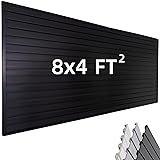
PVC slatwall covering a full 32 square feet, with 15 accessories included to start. Hooks slide horizontally without unscrewing — the format pays for itself if you reorganize even once a year. PVC keeps cost down vs. steel slatwall, but caps per-hook capacity at the lower end (fine for hand tools and light power tools; not for 10-lb-plus items). Confirm the SKU still ships with the documented accessory bundle — PVC slatwall lines rotate variants on Amazon.
For bench-side metal hand tools: HMmagnets 24-inch Heavy-Duty Magnetic Tool Holder

A 24-inch magnetic strip mounted at the back edge of a workbench creates ultra-dense storage for chisels, screwdrivers, pliers, and small wrenches you touch hourly. Manufacturer-listed pull force is high — verify the specific lb rating on the listing for your tool weight before mounting. Only works for ferrous metal tools; plastic-grip-only tools and aluminum tools don’t grip. Test each tool with a small magnet before purchase.
For the full roundup with multiple alternatives per system type, see the dedicated tool organizer roundup and the broader utility-storage buying guide.
What garage wall systems actually hold, compared fairly
Pegboard is rated per panel, rails per linear foot, slatwall per square foot. Three different units means the published numbers cannot be compared as they stand — so nobody compares them, and a 200 lb figure on one product looks like a 200 lb figure on another. This table quotes each manufacturer’s rating and converts them all to pounds per linear foot of a 4 ft high wall run, with the arithmetic shown. Normalised values are comparison figures, not safe point-load limits. A system rated for 1,200 lb distributed across a wall section does not support a 1,200 lb hook.
| System | Type | Rating as published | Rating type | Same rating, per linear foot of a 4 ft wall | Working | Stud requirement | Specification source | Source checked |
|---|---|---|---|---|---|---|---|---|
| Wall Control metal pegboard (16 × 32 in panel) | pegboard | 200 lb per panel into studs (100 lb on drywall anchors) | panel recommendation | 225 lb per linear foot | 200 lb ÷ (16 in × 32 in panel = 3.56 sq ft) = 56.25 lb per sq ft; 56.25 × 4 ft high = 225 lb per linear foot (equivalently: a 4 ft × 4 ft section fits 3 panels across × 1.5 high = 4.5 panels × 200 lb = 900 lb ÷ 4 ft) | mounting holes on 16 in stud centres | Wall Control 16 × 32 in Metal Pegboard | 2026-09-14 |
| Proslat Classic PVC slatwall | slatwall | 75 lb per square foot | distributed panel load | 300 lb per linear foot | 75 lb/sq ft × 4 ft high | installs on 16 in stud centres | Proslat PVC Slatwall | 2026-09-14 |
| Proslat PROCORE aluminium-core slatwall | slatwall | 200 lb per square foot | distributed panel load | 800 lb per linear foot | 200 lb/sq ft × 4 ft high | engineered for 24 in stud centres, compatible down to 16 in | Proslat PROCORE PVC Slatwall | 2026-09-14 |
| Flow Wall panel (¾ in PVC) | slatwall | 100 lb per square foot | distributed panel load | 400 lb per linear foot | 100 lb/sq ft × 4 ft high | not stated in this source | Flow Wall FAQ | 2026-09-14 |
How these numbers were produced: Each published rating is quoted from the manufacturer’s own page on the date shown. Conversion to pounds per linear foot assumes a 4 ft high run of wall: a per-square-foot rating is multiplied by 4. A per-panel rating is first converted to an equivalent per-square-foot rate, using the panel’s own published width and height, then multiplied by 4 the same way — scaling a per-panel rating sideways only, at the panel’s own height, would normalise it to a taller or shorter slice of wall than the 4 ft reference every per-square-foot row uses, so the two steps (per-panel → per-sq-ft → per-4-ft-run) keep every row on the same footing. A per-foot-of-rail rating is different in kind: the manufacturer publishes a rate per channel, and this table doubles it to show a common two-channel install — that doubling is our own installation assumption, not a manufacturer-stated rate; the sourced figure is the single-channel rate. Where a manufacturer publishes a single fixed capacity for a whole pre-sized unit rather than a rate per foot or per square foot, that figure is quoted as published and left out of the per-linear-foot column rather than converted with an invented rate.
- These are manufacturer maximums for a correctly installed system, not a promise. Every one of them depends on hitting studs, using the specified fasteners, and spreading the load rather than hanging it all off one hook.
- The comparison assumes a 4 ft high run. A rail system does not gain capacity from wall height the way a panel does — it gains it from adding channels, which is why its normalised figure moves when you change the channel count, not the height.
- Stud spacing is a hard constraint, not a suggestion. Proslat’s PROCORE is the only system here with a published compatibility range — engineered for 24 in centres, rated compatible down to 16 in. Check whether your own system publishes a similar range before assuming it.
- Drywall anchors are not studs: Wall Control publishes 100 lb per panel on anchors against 200 lb into studs — a real number for that one product, not a ratio to assume for other systems here that don’t publish their own stud-vs-anchor split.
- Capacity drops the further a load sits from the wall: storeWALL publishes 250 lb per sq ft as a distributed rating at the panel surface, but only 115 lb as a point measurement 4 in out. That lever-arm principle is a reasonable general caution for hooks and brackets on any system, but storeWALL is the only brand here that publishes a number for it.
- A blank cell means the manufacturer does not publish that figure — we do not fill gaps with numbers we could not source.
- This list favors brands whose own specification pages state a capacity figure in a form we could verify directly. Some well-known brands are not yet in this table because their published pages did not state a load rating we could confirm on this pass — that is a sourcing gap, not a signal that the product is weaker.
These are the entries that matter for this guide. The full table, with every row and its source, is in our What garage wall systems actually hold, compared fairly.
FAQ
Pegboard vs. slatwall — which is cheaper to start?
Pegboard, by a wide margin. A starter metal pegboard kit (panel plus 30-50 hooks) runs roughly half what an equivalent slatwall starter does. Slatwall recovers the cost over time only if you actually reorganize — for a set-and-forget install, pegboard stays ahead economically.
Can magnetic strips hold a circular saw?
No. Magnetic strips are designed for small metal hand tools (chisels, pliers, screwdrivers). A typical circular saw is 8-12 lb, exceeds the per-strip capacity, and the housing is often plastic anyway. Circular saws belong on a wall hook with a dedicated saw bracket or in a cabinet.
Do I need metal pegboard or is plastic enough?
For hand tools under 3 lb each, plastic and MDF pegboard work — but they sag over years of loaded use, and the hook holes wear out. Metal pegboard is the longevity answer if you’re building a system you expect to use for 5-plus years. The cost difference is modest at the kit level.
How much wall do I need before slatwall is worth it?
A full slatwall install starts paying off around 16-20 square feet of wall coverage. Below that, you’re paying the slatwall premium for capability you won’t use — pegboard’s per-square-foot cost wins decisively. Above 20 square feet, slatwall’s modularity advantage compounds.
Can I combine systems (some pegboard and some slatwall)?
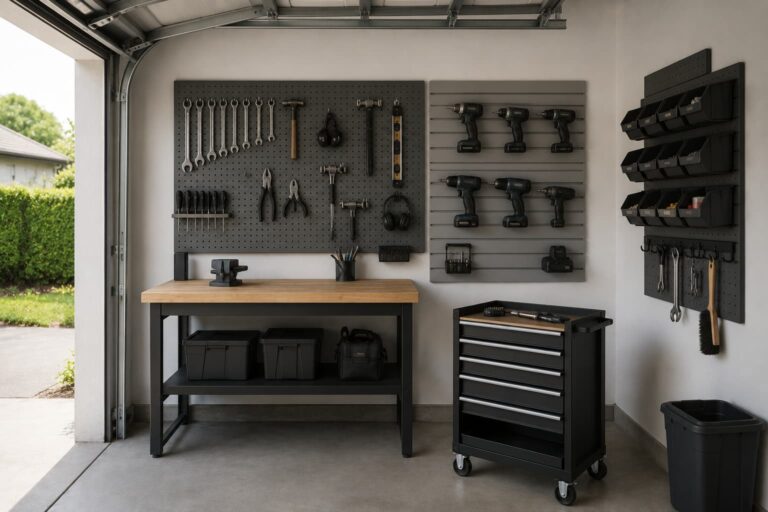
Yes. The hybrid pattern is common: pegboard for the fixed-position hand tools (wrenches, screwdrivers), slatwall for the tool types that rotate or need shelves (smaller power tools, accessories), magnetic strips at the workbench edge for daily-use metal items. The three formats don’t conflict — they cover complementary use cases.
Do PVC slatwall panels really last in a garage?
PVC handles garage temperature swings and humidity well — better than MDF pegboard, which can swell or warp. The PVC concern is per-hook capacity (the panels stay rigid but the hooks bend out of the slot under heavy load). For garages that hold light-to-medium tools, PVC slatwall lasts indefinitely. For shop environments with 10-lb-plus items per hook, steel slatwall is the durability answer.
Sources Reviewed
For this buying guide, we reviewed manufacturer documentation, retailer product pages, installation manuals where available, and recurring patterns in public buyer discussions about pegboard kits, PVC and steel slatwall systems, and magnetic tool holder strips.