Best Metal Shelving Units for Garage Storage
Last updated:
Disclosure: This article contains affiliate links. If you buy through these links, we may earn a commission at no extra cost to you. We do not claim hands-on testing unless clearly stated.
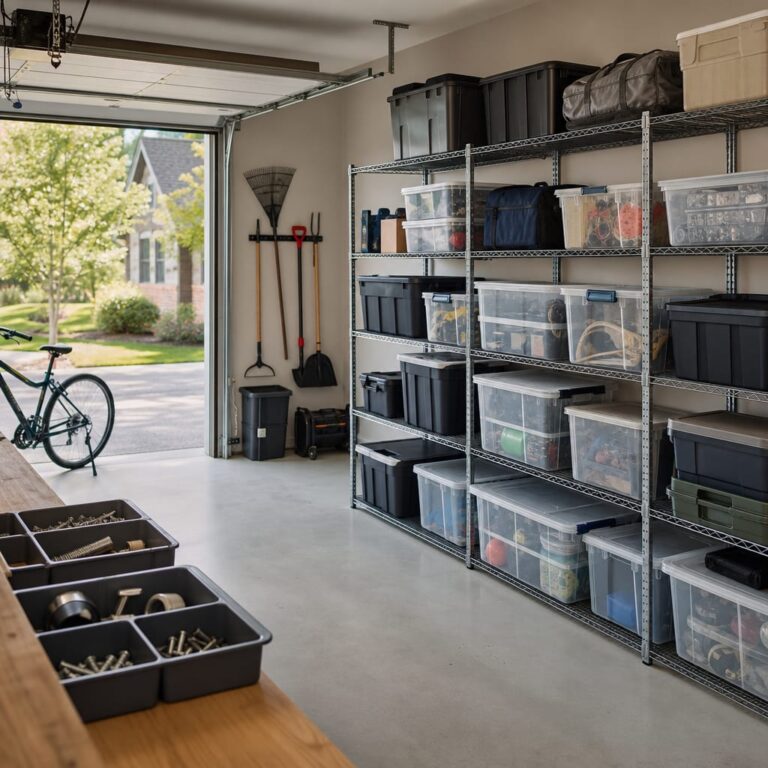
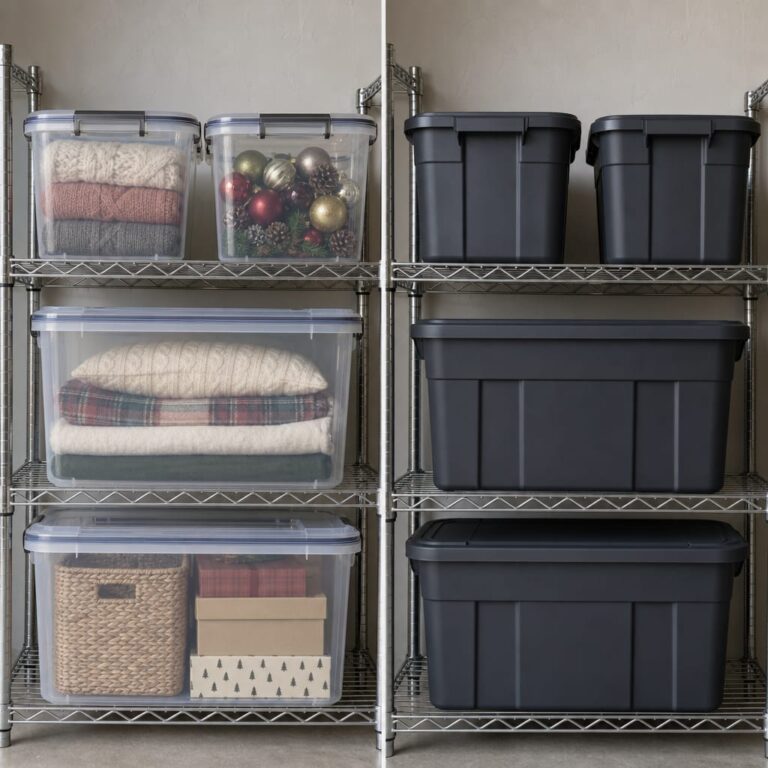
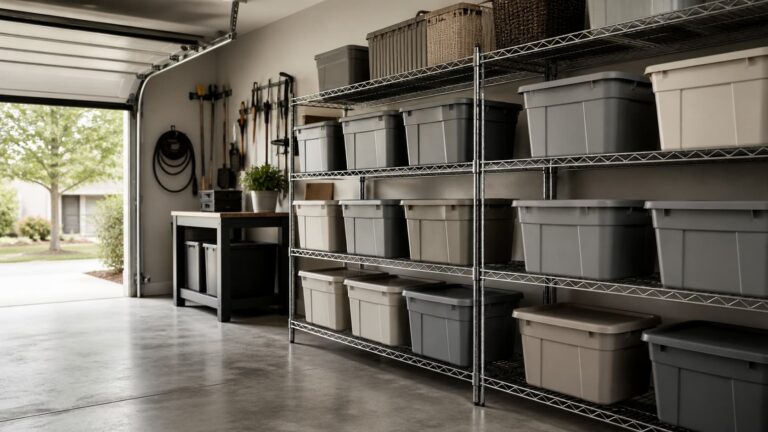
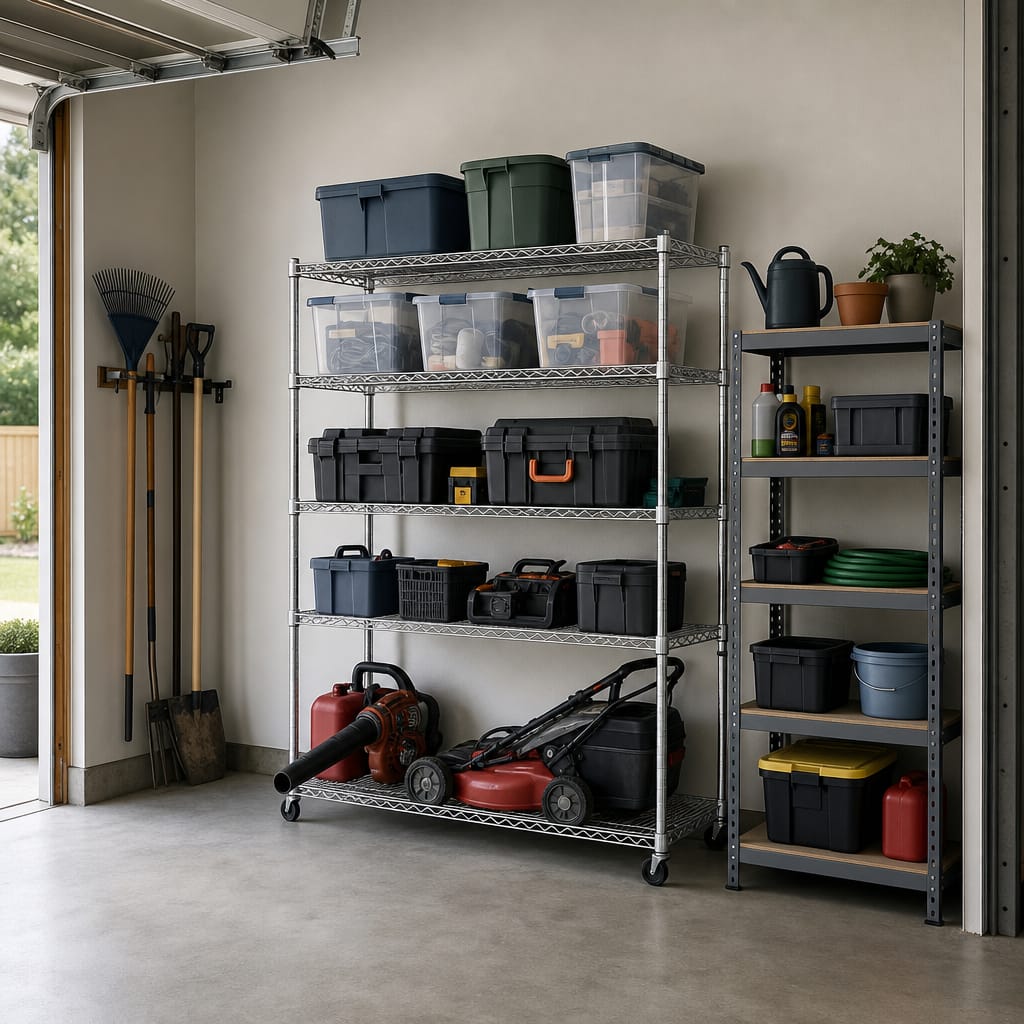
Metal shelving is the default residential garage answer when the load goes above what plastic can hold. But “metal shelving” splits into two real categories that behave very differently: wire NSF (Seville, TRINITY — see-through, airflow, food-grade chrome) and solid-deck steel (FLEXIMOUNTS, Muscle Rack — particleboard or MDF decks on a steel frame). The decision between them governs what you can store cleanly, what you can stack on the top tier without sagging, and what price tier you end up in. This guide segments five metal shelving units by use case, with manufacturer-listed capacity figures, NSF certification status, and the install considerations that determine whether those figures hold. For heavier-duty-only picks see our Best Heavy-Duty Garage Shelves roundup; for tote-focused shelving see Best Garage Shelves for Storage Bins; and if you’re still deciding between metal and plastic, read Metal vs Plastic Garage Shelving.
Quick Picks
| Pick | Product | Best for | Type | Watch out for | CTA |
|---|---|---|---|---|---|
| Best heavy-duty | Seville UltraDurable Commercial-Grade 36×18 NSF | Mature workhorse, 4,000 lb total | Wire chrome NSF | Capacity on casters lower than on leveling feet | View on Amazon |
| Best wire metal | TRINITY EcoStorage 36×18 Chrome with Wheels | Mobile NSF wire, workshop use | Wire chrome NSF mobile | Caster-rated capacity is the lower figure | View on Amazon |
| Best for small garage | Seville UltraDurable 24×18 NSF | Narrow footprint, one-car garages | Wire chrome NSF | Significantly less shelf surface than 48″ models | View on Amazon |
| Best adjustable | FLEXIMOUNTS 5-Tier 60×24 Heavy Duty | Deeper deck + 1″ adjustable | Steel + MDF, 1,500 lb capacity | MDF flexes under point loads | View on Amazon |
| Best budget | Muscle Rack UR361872PB5P-SV Boltless 36×18 | Industrial warehouse aesthetic, no fasteners | Steel + particleboard | Particleboard deflects under heavy concentrated loads | View on Amazon |
How We Selected These Metal Shelving Units
We do not claim hands-on testing unless clearly stated. For this guide, we reviewed manufacturer specifications (sevilleclassics.com, trinityii.com, fleximounts.com, musclerack.com / edsal.com), retailer product pages, Amazon product listings, and recurring patterns in public customer feedback.
Because metal shelving capacity depends heavily on base type (leveling feet vs casters), assembly quality, and deck material, we prioritized products with clearly stated manufacturer figures verifiable on the brand’s own site.
Selection criteria:
- Manufacturer-listed per-shelf and total capacity stated clearly
- NSF certification where applicable (signals food-grade chrome and a manufacturing standard, even for non-food applications)
- Adjustability documented (1-inch increments preferred for tote-height layouts)
- Brand stability — branded products with manufacturer pages and review history over 100
- Mounting documented (leveling feet, casters, or both — published capacity for each base)
What to Look for Before Buying
Wire vs solid deck — visibility, airflow, point loads
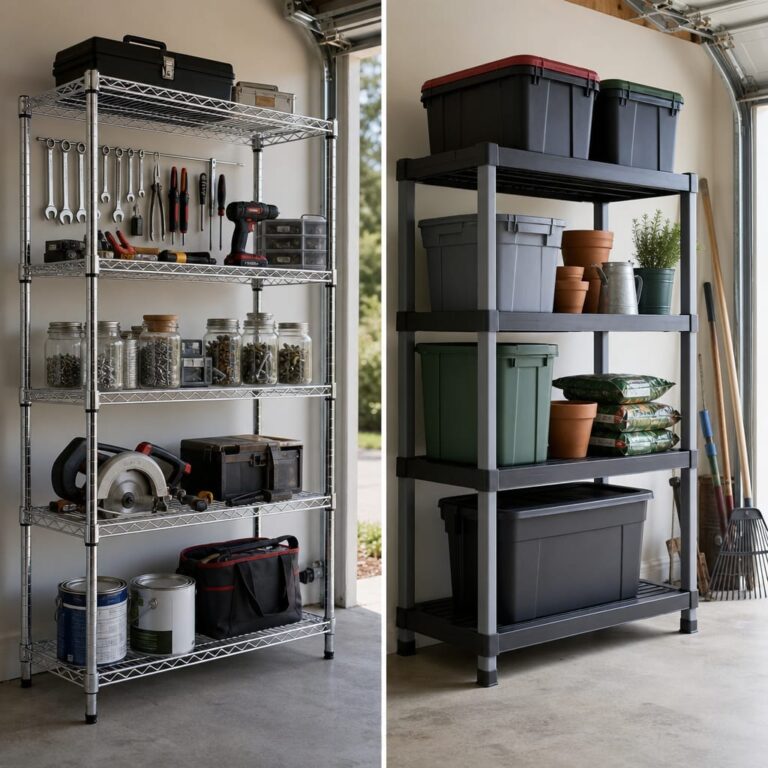
The single biggest decision is wire versus solid deck. Wire shelving (Seville UltraDurable, TRINITY EcoStorage) lets you see what’s on lower shelves at a glance, provides airflow that keeps damp items from mildewing, and stays clean because dust falls through rather than collecting. The trade-off is that small parts fall through wire grids, and concentrated point loads (engine blocks, anvils) can deform the wire. Solid-deck shelving (FLEXIMOUNTS, Muscle Rack) distributes loads better and contains small parts naturally; the trade-off is no visibility, no airflow, and decks made of MDF or particleboard that flex under enough weight.
Manufacturer-listed capacity — per shelf vs total vs caster-derated
Three numbers appear on metal shelving listings: per-shelf capacity (e.g., 800 lb each shelf), total capacity on leveling feet (e.g., 4,000 lb total), and total capacity on casters (typically 500-1,500 lb depending on caster rating). All three are manufacturer-listed; none is universally interchangeable. The caster-derated figure is the one buyers most often miss — a “4,000 lb” rack on casters carries roughly one-eighth that load. Pick the base before you pick the rack if mobility matters.
NSF certification — what it actually signals
NSF certification is a third-party manufacturing standard originally developed for food-service environments. For garage use, NSF doesn’t change anything functional — but it does signal that the manufacturer publishes traceable specs, that the steel meets a documented purity standard, and that the chrome plating is food-grade. Seville UltraDurable and TRINITY EcoStorage both carry NSF; cheaper wire shelving often does not.
Adjustability — 1-inch vs 1.5-inch vs fixed
Most quality metal shelving adjusts in 1-inch increments (Seville UltraDurable, TRINITY EcoStorage, FLEXIMOUNTS). Muscle Rack boltless racks adjust in 1.5-inch increments. Fixed-shelf budget units don’t adjust at all. For storing totes of varying heights, 1-inch increments are meaningfully more useful than 1.5-inch.
Assembly type — boltless rivet vs tool-required vs interlocking
Boltless rivet (Muscle Rack) and interlocking-pole (Seville, TRINITY) assemble in 15-30 minutes with no tools or just a mallet. Tool-required steel racks take 60-90 minutes and one or two extra hands. FLEXIMOUNTS uses an interlocking design that splits the difference. Plan assembly time before buying.
Best Heavy-Duty Metal Shelving: Seville UltraDurable Commercial-Grade 5-Tier NSF 36″×18″
Best for: Buyers who want the mature workhorse NSF wire shelving with leveling feet for maximum load and casters available for occasional repositioning.
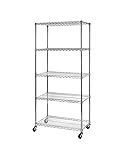
Short verdict: The benchmark NSF wire shelving for residential garages. 36″W × 18″D × 72″H, 800 lb per shelf on leveling feet, 4,000 lb total. Ships with both leveling feet AND 3″ casters (2 locking) — buyer chooses at install.
Seville Classics UltraDurable Commercial-Grade is the long-tenured Seville line that residential garage buyers cross-shop everything else against. The B00-series ASIN, the NSF certification, the published 4,000 lb total on leveling feet — all three signal mature product with verifiable specs. The listing includes both leveling feet and casters in the box, which is unusual: most competitors force a choice at purchase.
Why it stands out
The 4,000 lb total on leveling feet is the headline figure. Per shelf, that’s 800 lb — enough for a loaded engine cradle, a stack of full-size totes, or a set of heavy power-tool cases. Chrome wire construction means small parts need bins (they fall through the grids), but you see at a glance what’s on the lower tier without bending down. The 1-inch shelf height adjustment matches the spacing most 27-gallon totes require with lid clearance.
It can work well for:
- Workbench-area shelving holding power-tool cases and parts
- Heavy seasonal items (holiday decorations in totes, sports equipment in season)
- Garage-to-basement shared inventory rotation
- Buyers who want occasional mobility (casters in box) without committing to caster-rated capacity
Key specs to check
- Material: zinc-plated steel wire (UltraZinc finish), NSF certified
- Dimensions: 36″W × 18″D × 72″H (up to 75″H with casters)
- Capacity: 800 lb per shelf, 4,000 lb total on leveling feet (sevilleclassics.com)
- Base options: leveling feet AND 3″ casters (2 locking) — both included
- Adjustability: 1-inch increments, no tools required
Recurring feedback patterns
Recurring positive feedback often centers on the perceived rigidity of the 800-lb-per-shelf wire grid and the convenience of leveling feet plus casters in the same box. Common complaints typically involve buyers confusing per-shelf capacity (800 lb) with total capacity (4,000 lb) or with the caster-derated figure (lower). Several buyers mention assembly being fast but recommending two people for the upper shelves.
Potential drawbacks
Small parts fall through wire grids — buyers needing parts containment add shelf liners or use bins. Wire grids show on items stored directly (cardboard boxes get marked); use cardboard sheets or a liner. The chrome finish, while NSF-grade, can spot in humid garages — wipe-down maintenance is occasional.
Buyer warning
Confirm the base type matches your load plan. On leveling feet the unit carries 4,000 lb total; on casters that figure drops dramatically (the rack must be rolled, not loaded statically). For maximum capacity, install on leveling feet and accept that repositioning means full unload first.
Best Wire Metal Shelf: TRINITY EcoStorage 5-Tier NSF Wire 36″×18″ Chrome with Wheels
Best for: Buyers who want NSF chrome wire shelving with locking casters as the default base — for workshop floors where repositioning is part of the workflow.

Short verdict: TRINITY’s flagship mobile NSF wire. 36″W × 18″D × 72″H, chrome finish, ships with 4 wheels (2 locking) as the primary base. Manufacturer-listed 800-4,000 lb capacity range.
TRINITY EcoStorage is Seville’s main NSF competitor in residential garages. The 5-tier 36×18 chrome variant is positioned for buyers who treat mobility as the primary use case rather than the optional one. Storage hooks ship included, which differentiates it from competitor wire shelving where hooks are a separate purchase.
Why it stands out
The mobile-first positioning. While Seville UltraDurable ships with both leveling feet and casters, TRINITY EcoStorage assumes you want it rolling — caster-rated capacity is the headline figure, and the bundle includes accessory hooks for hanging extension cords, brooms, or air hoses off the rack edge. Chrome NSF finish brightens the wall behind it.
It can work well for:
- Workshop layouts where the rack moves between tasks
- Garages doubling as utility/laundry overflow (kitchen-style NSF heritage)
- Buyers who want hooks for cords/brooms included
- Smaller-load mobile storage where 800 lb per shelf is plenty
Key specs to check
- Material: chrome-plated steel wire, NSF certified
- Dimensions: 36″W × 18″D × 72″H
- Capacity: 800 lb per shelf, 4,000 lb total on leveling feet; 160 lb per shelf, 800 lb total on wheels (manufacturer-listed, trinityii.com)
- Base: 4 wheels included (2 locking, 2 non-locking swivel)
- Included accessories: storage hooks for side hanging
Recurring feedback patterns
Recurring positive feedback often centers on the mobility — TRINITY buyers reposition the rack between projects without unloading entirely (within caster-rated capacity). Common complaints typically involve the same caster-rated-vs-total-capacity confusion as Seville. Several buyers mention SKU rotation on TRINITY’s variants — the chrome 36×18 is the long-tenured listing.
Potential drawbacks
Caster-rated capacity is meaningfully lower than leveling-feet rating — buyers loading heavy items must understand which figure applies at install time. The chrome finish shows fingerprints more than zinc-plated; aesthetic preference matters here. Wire grid issue same as Seville — small parts need bins.
Buyer warning
If your load plan exceeds the caster-rated capacity, install on leveling feet and forfeit the mobility advantage (or pick Seville UltraDurable which ships both bases). The TRINITY product line has rotated SKUs historically — verify at purchase time that the listing matches the 36×18 chrome 5-tier you intend to buy.
Best Metal for Small Garage: Seville UltraDurable 5-Tier NSF Wire 24″×18″
Best for: Buyers with one-car garages or narrow side walls who need NSF wire shelving in a tighter footprint than the standard 36″ or 48″ units.

Short verdict: Seville UltraDurable in the small-garage form factor. 24″W × 18″D × 72″H, NSF chrome wire, 600 lb per tier, 3,000 lb total on leveling feet. Same product line as the heavy-duty overall pick above, in a narrower footprint.
The 24-inch width is the differentiator. Most metal shelving comes in 36″ or 48″ widths, sized for two-car-garage walls. The 24″ UltraDurable is sized for side walls, single-car garages, and corner installs where width is constrained. Same construction quality and NSF certification as the larger Seville UltraDurable — just less shelf surface per tier.
Why it stands out
Narrow footprint without sacrificing per-shelf rating. 600 lb per tier is still heavy-duty — enough for full-size totes, tool cases, lawn equipment — at a wall-friendly 24″ width. The 3,000 lb total on leveling feet is competitive with 48″ units when normalized for shelf area. Same NSF certification, same UltraZinc finish, same 1-inch height adjustment as the 36″ workhorse.
It can work well for:
- One-car garages with side-wall storage
- Two-car garages with corner installs
- Apartment garage spaces where 48″ units don’t fit
- Buyers wanting two narrow units side-by-side (total 48″ width with vertical seam) instead of one 48″ unit
Key specs to check
- Material: zinc-plated steel wire (UltraZinc), NSF certified
- Dimensions: 24″W × 18″D × 72″H (75″H with casters)
- Capacity: 600 lb per tier, 3,000 lb total on leveling feet, 500 lb total on wheels
- Adjustability: 1-inch increments
- Includes: 4 wheels (2 locking), 4 leveling feet, 20 slip sleeves, limited 10-year warranty
Recurring feedback patterns
Recurring positive feedback often centers on the fit in tight garage corners and the same Seville-line build quality as the larger models. Common complaints typically involve buyers under-estimating how much less shelf surface 24″ provides — many tote sizes don’t fit cleanly on a 24″-wide shelf. Several buyers mention pairing two 24″ units side-by-side for a 48″ total when one unit feels too narrow.
Potential drawbacks
Significantly less shelf surface per tier than 36″ or 48″ Seville UltraDurable variants — a 27-gallon tote that fits cleanly on 48″ overhangs noticeably on 24″. The narrower frame is also less stable side-to-side when loaded high; wall-anchor the top tier if storing heavy items at full height.
Buyer warning
Measure your storage items before assuming the 24″ width fits them. Many tote sizes need the 36″ or 48″ Seville UltraDurable instead. For buyers who fit on 24″ and need the heaviest possible load, the per-tier rating is still 600 lb — verify your contents stay under that per shelf.
Best Adjustable Metal: FLEXIMOUNTS 5-Tier 60″×24″ Heavy Duty Garage Shelving
Best for: Buyers who want a deeper deck (24″ vs Seville’s standard 18″) with solid surfaces and 1-inch adjustability for tote-and-workbench-area layouts.
FLEXIMOUNTS Garage Shelving, 60" W x 72" H x 24" D, Black, 5 Tier | Heavy Duty
Short verdict: FLEXIMOUNTS’s garage-specific 5-tier with 24-inch deep decks. 60″W × 24″D × 72″H, 1,500 lb manufacturer-listed capacity. Steel frame with MDF/particleboard decks. Adjustable in 1-inch increments.
The 24-inch depth differentiates FLEXIMOUNTS from Seville’s 18-inch standard. Wider tote bases sit cleanly without overhang, and the solid decks contain small parts that fall through wire. The trade-off: MDF/particleboard decks under concentrated point loads can sag, and the steel frame is heavier to move than wire alternatives.
Why it stands out
Workshop-area dimensions with garage-specific positioning. The 24″ depth handles standard 27-gallon totes lengthwise where Seville’s 18″ forces them sideways or overhanging. Solid decks contain dropped hardware, screws, and small parts that wire grids drop through. Adjustability in 1-inch increments matches Seville’s flexibility. Garage-specific branding (fleximounts.com publishes garage-focused product line) signals manufacturer attention to the use case.
It can work well for:
- Workbench-area walls behind a benchtop
- Storing tote sizes that exceed 18″ depth (long-side resting on the shelf)
- Hardware-and-parts storage where solid decks contain spillage
- Garages where the 5-tier replaces or complements a workbench
Key specs to check
- Material: powder-coated steel frame + MDF/particleboard decks
- Dimensions: 60″W × 24″D × 72″H
- Capacity: 1,500 lb (manufacturer-listed; listing does not break out a per-shelf figure)
- Adjustability: 1-inch increments
- Assembly: interlocking, no tools required (mallet recommended)
Recurring feedback patterns
Recurring positive feedback often centers on the depth (24″) fitting bin sizes that 18″ wire racks don’t and on the matched-look solid decks for workshop aesthetics. Common complaints typically involve the MDF/particleboard decks visibly sagging under heavy concentrated loads — buyers occasionally add plywood overlays or upgrade to steel-deck racks. Several buyers mention the assembly being fast but requiring a mallet for the interlocking joints.
Potential drawbacks
MDF/particleboard decks distribute loads but deflect under concentrated point loads. For engine blocks, anvils, or heavy single-item storage, the deck sags visibly. Solution: add a 24″ × 60″ plywood overlay sheet on the load-bearing tier. Weight (loaded) is meaningfully more than a wire alternative — moving FLEXIMOUNTS once installed means unloading first.
Buyer warning
FLEXIMOUNTS’s 1,500 lb capacity rating assumes distributed load across the unit. A single 300-lb engine block concentrated on one MDF deck can sag that deck even though the unit’s overall rating is higher. Distribute the load, or add a plywood overlay to spread the contact area. For genuinely concentrated heavy loads, see Best Heavy-Duty Garage Shelves for steel-deck alternatives.
Best Budget Metal: Muscle Rack UR361872PB5P-SV 5-Shelf Boltless 36″×18″
Best for: Buyers wanting boltless industrial-style metal shelving at a value price tier — the Edsal warehouse rack archetype in residential garage form.

Short verdict: Muscle Rack’s industrial 5-shelf in 36″×18″×72″. Boltless rivet assembly — no fasteners needed. Manufacturer-listed 4,000 lb total capacity (800 lb per shelf). Particleboard decks on a Silver Vein steel frame.
The Muscle Rack UR361872PB5P-SV is the residential version of the warehouse rack you’ve seen in any small-business stockroom. Boltless rivet assembly means it goes together without nuts, bolts, or fasteners — slot the rivets into the steel uprights, lay down the particleboard decks, and you’re done in 20-30 minutes. The 4,000 lb total at the budget tier is the headline number.
Why it stands out
Boltless assembly at industrial capacity. Most budget metal shelving requires tool-assisted assembly with dozens of small fasteners; Muscle Rack uses interlocking rivets that snap into the steel uprights. The Silver Vein finish reads industrial rather than residential — buyers wanting the warehouse aesthetic get it without commercial pricing. Particleboard decks contain small parts naturally and accept plywood overlays for heavier point loads.
It can work well for:
- Industrial-aesthetic workshops and shop spaces
- Bulk storage where deck flexing under spread load isn’t an issue
- Buyers wanting boltless setup without paying premium NSF prices
- Garages where the rack will not relocate (heavier loaded weight than wire)
Key specs to check
- Material: Silver Vein steel uprights + particleboard decks
- Dimensions: 36″W × 18″D × 72″H
- Capacity: 800 lb per shelf, 4,000 lb total (manufacturer-listed)
- Adjustability: 1.5-inch increments (vs Seville’s 1-inch)
- Assembly: boltless rivet, no tools required
- Configurations: assembles as 5-tier shelving or horizontally as a workbench
Recurring feedback patterns
Recurring positive feedback often centers on the boltless assembly speed and the industrial-warehouse aesthetic that buyers actively want. Common complaints typically involve particleboard decks sagging visibly under concentrated point loads — buyers occasionally lay plywood sheets on the load-bearing tier. Several buyers mention the 1.5-inch adjustment increment being coarser than Seville’s 1-inch, which can complicate tote-height layouts.
Potential drawbacks
Particleboard decks deflect more than MDF and dramatically more than steel — for engine blocks or anvils, plan a plywood overlay from day one. The 1.5-inch adjustment increment limits fine-tuning for tote-height layouts. Silver Vein finish is durable but reads more “warehouse” than “workshop” — aesthetic preference matters.
Buyer warning
The 800 lb per shelf rating assumes a fully distributed load across the entire deck. A single heavy item concentrated in the center of a particleboard deck can deflect or even crack the deck well below the 800 lb threshold. Plan plywood overlays for any single-item load over 200 lb. For genuinely heavy concentrated loads, step up to a steel-deck rack or pick a wire shelving model where load distributes naturally.
Side-by-Side Comparison
| Product | Best for | Material | Section size | Manufacturer-listed capacity | Main drawback |
|---|---|---|---|---|---|
| Seville UltraDurable 36×18 | Mature heavy-duty workhorse | Zinc chrome wire NSF | 36″W × 18″D × 72″H | 800 lb/shelf, 4,000 lb total | Caster-derated capacity is much lower |
| TRINITY EcoStorage 36×18 | Mobile NSF wire | Chrome wire NSF + wheels | 36″W × 18″D × 72″H | 800-4,000 lb range | Caster-rated cap is the lower figure |
| Seville UltraDurable 24×18 | Small garage / side wall | Zinc chrome wire NSF | 24″W × 18″D × 72″H | 600 lb/tier, 3,000 lb total | Less shelf surface than 36″+ models |
| FLEXIMOUNTS 60×24 | Deeper deck + adjustable | Steel + MDF/particleboard | 60″W × 24″D × 72″H | 1,500 lb capacity | MDF deflects under point loads |
| Muscle Rack 36×18 boltless | Industrial budget | Silver Vein steel + particleboard | 36″W × 18″D × 72″H | 800 lb/shelf, 4,000 lb total | Particleboard sags under concentrated load |
Wire vs Solid Deck — Choosing by What You Store
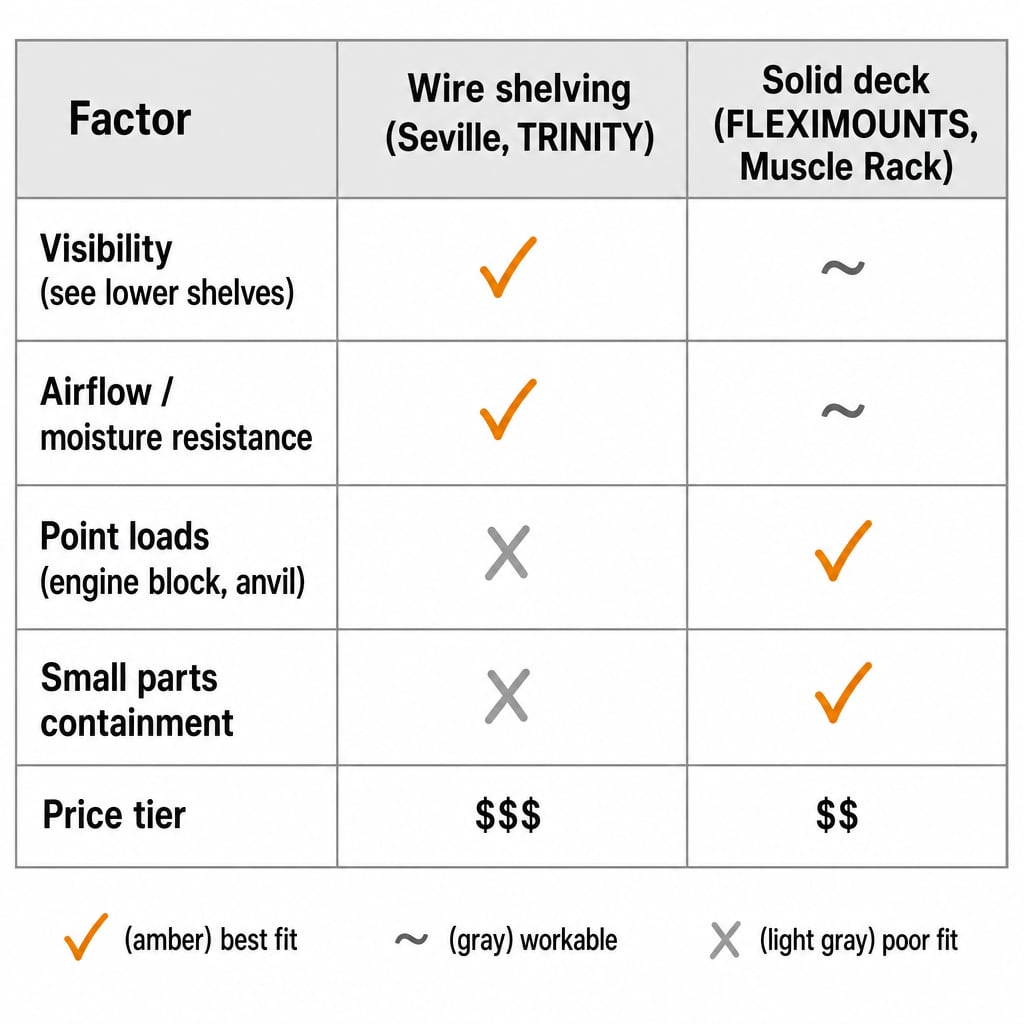
This is the article’s primary editorial decision. The wire-vs-solid axis governs more than aesthetics — it determines what storage works cleanly on each.
Pick wire shelving (Seville, TRINITY) if: – You want to see contents on lower shelves without bending down – You store items that benefit from airflow (damp gear, sports equipment after use, paint cans before rust) – You want NSF certification (food-grade chrome signals manufacturer rigor) – Your loads are distributed across the shelf surface, not concentrated in one spot
Pick solid-deck shelving (FLEXIMOUNTS, Muscle Rack) if: – You store small parts, hardware, or items that fall through wire grids – Your loads include concentrated point items (engine cradles, anvils, single heavy objects) – You prefer a workshop or warehouse aesthetic over kitchen-NSF chrome – You’re cost-sensitive — solid-deck steel is cheaper per linear foot than NSF wire
Hybrid approach: many garages run a wire unit for visibility-priority storage (totes, seasonal items) and a solid-deck unit for parts/workbench-area storage. The two complement each other.
How many totes actually fit on a garage shelf
Tote makers publish dimensions and shelving makers publish dimensions, but nobody puts the two together — so people buy shelving, then discover their totes overhang it. This table takes the published external size of totes from the brands people actually buy for garage storage — Sterilite, Rubbermaid Roughneck, and IRIS USA — and works out how many fit per shelf on the two garage shelving depths you can actually buy, 18 in and 24 in.
| Tote | Published dimensions (source order) | Footprint | Height | Fits an 18 in deep shelf? | Per 48 × 18 in shelf | Per 48 × 24 in shelf | Specification source | Source checked |
|---|---|---|---|---|---|---|---|---|
| Sterilite 6 Qt. Storage Box | 13 5/8" x 8" x 4 5/8" | 13⅝ in × 8 in | 4⅝ in | Yes | 6 | 9 | Sterilite 6 Qt. Storage Box | 2026-09-14 |
| Sterilite 16 Qt. Storage Box | 17 1/8" x 11 7/8" x 6 3/4" | 17⅛ in × 11⅞ in | 6¾ in | Yes | 4 | 4 | Sterilite 16 Qt. Storage Box | 2026-09-14 |
| Sterilite 27 Qt. ClearView Latch Box | 17" x 11 1/8" x 12 3/4" | 17 in × 11⅛ in | 12¾ in | Yes | 4 | 4 | Sterilite 27 Qt. ClearView Latch Box | 2026-09-14 |
How these numbers were produced: External dimensions are quoted on the date shown per row. Sterilite rows are quoted from Sterilite’s own product pages (L x W x H order). Rubbermaid Roughneck rows are quoted from Ace Hardware’s retailer listing, which prints the manufacturer’s SKU-linked dimensions in H x W x D order on each product page. IRIS USA rows are quoted from IRIS USA’s own product pages (L x W x H order). All figures are the external/overall assembled dimensions with the lid on. The counts are computed, not estimated: totes are placed in a single layer, all in the same orientation, with no overhang and no gap; both orientations (the tote’s long side along the shelf’s 48 in run, or along its depth) are tried and the better one is kept. Shelf width is 48 in in both cases — the two depths are real Husky shelving footprints: 48 in. W x 18 in. D (Husky 86 in. H x 48 in. W x 18 in. D 6-Shelf Steel Shelving Unit, model MR481886W6B, https://www.homedepot.com/p/Husky-86-in-H-x-48-in-W-x-18-in-D-Black-Steel-6-Shelves-Shelving-Unit-MR481886W6B/306062319) and 48 in. W x 24 in. D (Husky 5-Tier Steel Shelving Unit, 48 in. W x 78 in. H x 24 in. D, model 426007, https://www.homedepot.com/p/Husky-5-Tier-Riveted-Steel-Garage-Storage-Shelving-Unit-in-Silver-48-in-W-x-78-in-H-x-24-in-D-426007/303241694); neither product page states a clear opening between posts. 48×18 and 48×24 are unobstructed reference surfaces, not guaranteed usable dimensions of every nominal 48×18 or 48×24 rack — posts and lips can reduce the clear opening (one retailer answer for a Husky 48×24 gives about 45.5 × 21.5 in between posts). Round the result down again if your shelving has corner posts that intrude, and leave room to get a hand in.
- A tote that fits the shelf footprint still needs vertical room: check the tote height against your shelf spacing, and leave clearance to lift it in and out rather than sliding it flush.
- Counts assume a flat, full-depth shelf. Wire shelving with a lip, or posts at the corners, will cost you the last tote in a row.
- Lids overhang the base on most totes; the figures here are the manufacturer’s overall assembled dimensions, which already include the lid.
- Capacity in quarts or gallons tells you nothing about whether it fits — and "27" doesn’t mean the same thing twice. The Sterilite 27 Qt. ClearView Latch Box (17 in x 11-1/8 in) fits an 18 in shelf; the Sterilite 108 Qt. Stacker Box (25-3/4 in x 18-3/8 in) — 27-gallon-equivalent by volume (108 qt = 27 gal), though Sterilite sells it as "108 Qt.," not "27 Gal." — does not.
- Manufacturers and retailers don’t all publish dimensions in the same order. Ace Hardware lists Rubbermaid Roughneck as Height x Width x Depth, where Sterilite and IRIS USA publish Length x Width x Height. This table normalises every row to footprint (the two horizontal dimensions) and height so they compare directly regardless of the order they were published in.
- Rubbermaid Roughneck’s 10 gal and 18 gal totes share the same footprint (23⅞ in x 15⅞ in) — only the height changes, so stepping up in capacity in that range costs no extra shelf space, only vertical clearance.
- A blank cell means the manufacturer does not publish that figure — we do not fill gaps with numbers we could not source.
These are the entries that matter for this guide. The full table, with every row and its source, is in our How many totes actually fit on a garage shelf.
How to Measure Your Garage Before Buying Metal Shelving
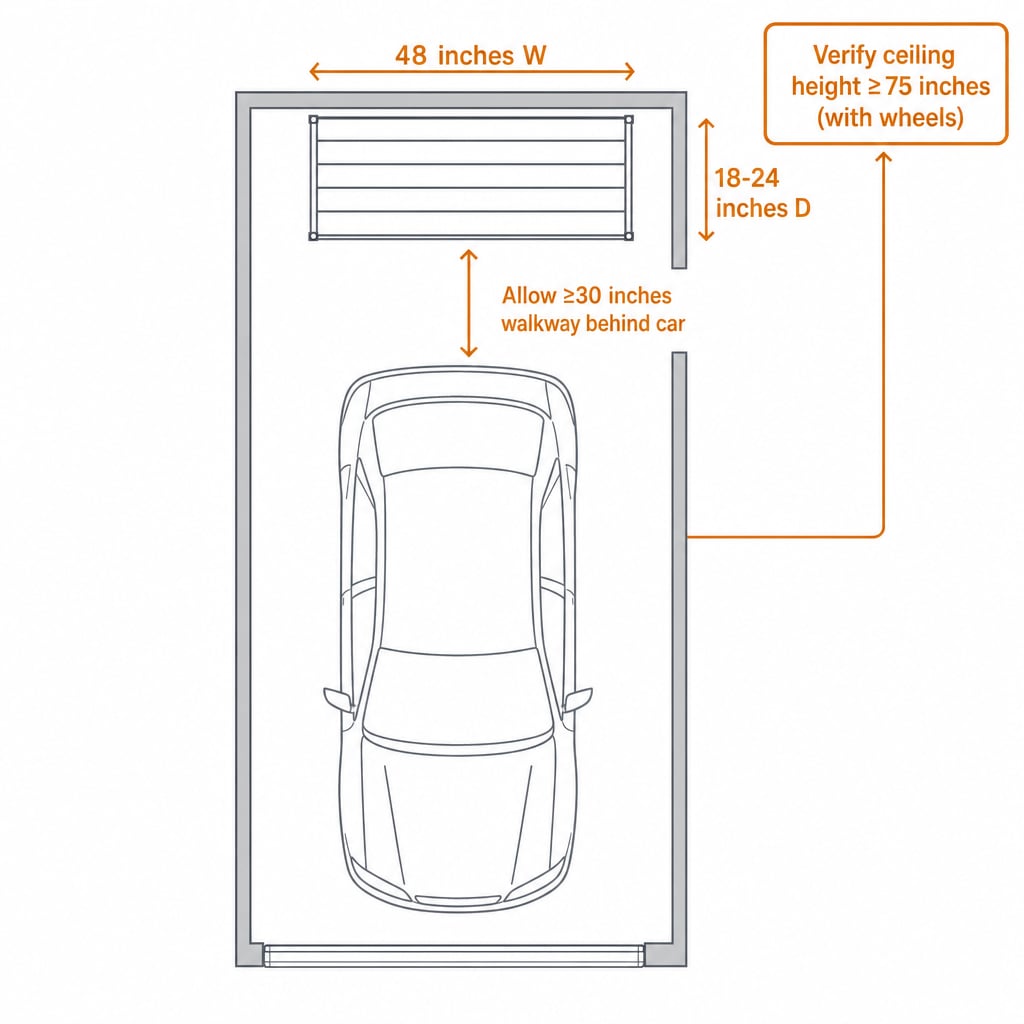
Walk through this checklist before ordering. Metal shelving sized wrong gets returned more often than any other garage purchase.
- Measure usable floor footprint. Wall length + depth. Account for any wall obstructions (outlets, light switches, pre-existing wall storage).
- Measure ceiling-to-floor clearance. Most 5-tier units are 72-75″ tall (taller with casters). Verify ceiling height accounts for any overhead obstructions (door tracks, lights, vents).
- Measure your stored items. 27-gallon totes are ~30″L × 20″W — they fit cleanly on 36″W shelves but overhang 24″ shelves. Measure your specific totes before assuming.
- Plan walkway clearance. Allow at least 30 inches between car (when parked) and shelving for comfortable access. Tight walkways turn shelving into a trip hazard.
- Decide on base before purchase. Leveling feet maximize capacity; casters maximize mobility. Some units (Seville UltraDurable) ship both; others force a choice.
- Verify wall-anchor compatibility. Tall heavy-loaded shelving benefits from a top-tier wall anchor for tip resistance. Confirm stud spacing in your garage wall.
Common Complaints and Buyer Warnings
The single most important warning: the “total capacity” figure is the leveling-feet figure, not the casters figure. A 4,000-lb-total rack on casters carries roughly 1,000-1,500 lb depending on caster rating. Buyers loading “to spec” without checking which base they installed routinely overload caster-rated assemblies.
General warnings:
- Capacity figures assume distributed loads. Concentrated point loads (engine blocks, single heavy items) can deflect or fail a deck even at half the rated capacity.
- Particleboard and MDF decks need plywood overlays for concentrated heavy loads. Source overlay sheets before assembly.
- NSF certification signals manufacturing rigor, not capacity. NSF and non-NSF wire shelving at the same per-shelf rating both hold the same weight; NSF means the spec is verified.
Capacity-on-casters trap
The most common Amazon-review complaint in this category: buyer installed on casters, loaded to the published total capacity, and the rack collapsed or tipped. The published total typically refers to leveling-feet installation. Casters are rated separately — usually one-third to one-half the leveling-feet figure. Decide which base you want, then load to that base’s specific rating.
Particleboard and MDF point load risk
Wire shelving distributes loads across the grid; solid-deck shelving distributes across the deck surface. Both fail at concentrated point loads, but in different ways. Wire grids deform locally where the point load sits; particleboard and MDF decks sag and can crack. For concentrated heavy items, plywood overlay sheets are the standard fix — a 1/2″ plywood sheet matched to the shelf dimension distributes the point load across the entire deck.
“Industrial” aesthetic vs residential clean
Muscle Rack’s Silver Vein finish reads “warehouse stockroom”; Seville’s UltraZinc chrome reads “kitchen-grade NSF”. FLEXIMOUNTS’s powder-coated steel reads somewhere in between. The aesthetic match to your garage matters less than the load profile — but if you want a particular visual, brand selection matters.
Who Should Avoid Metal Garage Shelving?
- Damp/unconditioned garages with active rust risk. Even chrome and zinc-plated finishes show spot rust in actively damp conditions. Plastic shelving tolerates moisture indefinitely — see our Metal vs Plastic Garage Shelving comparison.
- Renters. Free-standing metal shelving doesn’t require drilling, but the wall-anchor option for tall loaded units does. Lease restrictions matter.
- Buyers needing wall-mounted alternatives. Floor-standing metal racks occupy floor space; if floor is at a premium, see Best Wall-Mounted Garage Storage Systems.
- Buyers who haven’t decided between shelving and cabinets. Read Garage Shelving vs Cabinets first to compare exposed shelving vs closed cabinets.
FAQ
How much weight can metal garage shelving hold? Per-shelf manufacturer-listed figures range up to 800 lb (Seville, TRINITY, Muscle Rack); FLEXIMOUNTS’s listing states a 1,500 lb overall capacity rather than a per-shelf figure. Total capacity on leveling feet ranges from 1,500 lb (FLEXIMOUNTS) to 4,000 lb (Seville, TRINITY, Muscle Rack). Caster-rated total is typically one-third to one-half the leveling-feet figure. All numbers assume distributed loads.
Wire vs solid deck — which is better for a garage? Wire is better for tote/seasonal storage (visibility, airflow) and for items that benefit from air circulation. Solid deck is better for small parts, hardware, and concentrated heavy loads. Many garages run both — wire for storage, solid for workbench/parts area. See the Wire vs Solid Deck section above for the full decision framework.
Do I need NSF certification for garage shelving? No, not for garage use specifically. NSF certification is a manufacturing-rigor signal — it means the spec is verified by a third party. For garage applications, a non-NSF rack at the same per-shelf rating holds the same weight. NSF matters if you’re cross-shopping with kitchen/restaurant use, or if you want the documented quality signal.
Can I roll my metal shelving on garage concrete? Yes, with caveats. Caster-rated capacity is lower than leveling-feet capacity (typically 500-1,500 lb total vs 2,000-4,000 lb). Roll the rack within its caster-rated load, not the leveling-feet figure. Lock the casters when stationary to prevent drift on slightly uneven concrete.
How tall should garage shelving be for low ceilings? Standard 5-tier units are 72-75″ tall (taller with casters). For ceilings under 78″, check clearance carefully — door tracks and overhead lighting reduce usable height. See Best Garage Shelving for Low Ceilings for shorter-profile alternatives.
Are boltless metal shelving units less stable? Properly assembled boltless units (Muscle Rack) are as stable as bolted units at the same capacity rating. The boltless advantage is assembly speed; the disadvantage is the rivets can loosen over years of repeated loading/unloading. Wall-anchor the top tier for tall heavy-loaded boltless racks.
Should I bolt my shelving to the wall? For tall (72″+) heavy-loaded units, yes — a top-tier wall anchor prevents tipping if the load shifts unexpectedly. Most quality metal shelving includes wall-anchor mounting hardware; budget units don’t. For renters, free-standing operation works at moderate loads, but distribute weight low and don’t stack heavy items on the top tier.
Sources Reviewed
For this guide, we reviewed manufacturer product information (sevilleclassics.com, trinityii.com, fleximounts.com, musclerack.com / edsal.com), retailer specifications, Amazon product listings, and public customer feedback patterns. We focused on details relevant to metal garage shelving buyers: per-shelf and total capacity figures across leveling-feet and caster bases, NSF certification status, deck material (wire, MDF, particleboard, steel), adjustability increments, and assembly type.