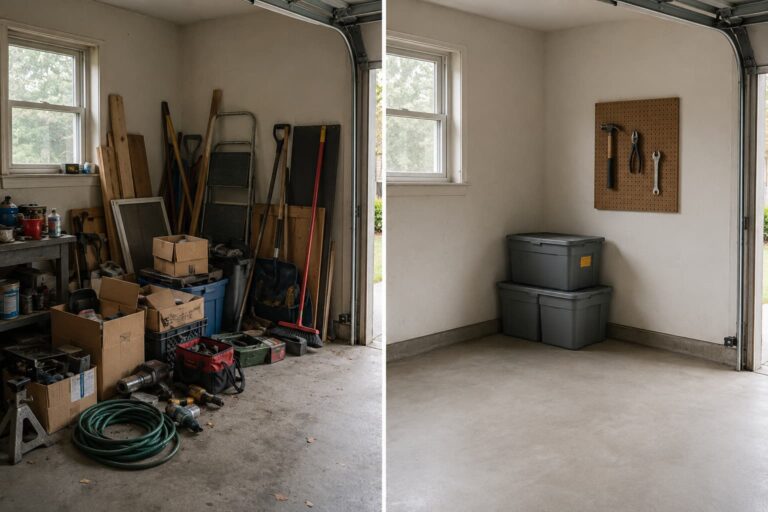
Freestanding vs Wall-Mounted Garage Storage: Which Is Right for You?
Last updated:
Disclosure: This article contains affiliate links. If you buy through these links, we may earn a commission at no extra cost to you. We do not claim hands-on testing unless clearly stated.
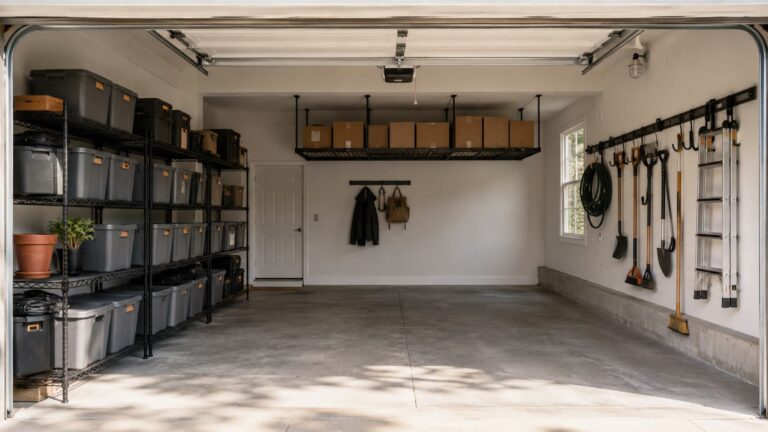
Most “freestanding vs wall-mounted” articles pick a side and crown a winner. That framing is wrong. The right answer depends on five concrete variables about your garage and your situation — variables you can answer in under a minute. This guide walks you through that decision, gives you fair editorial weight on both sides with two example picks each, and ends with a clean “your situation → this approach” output. We do not cover overhead/ceiling-mounted racks here — that’s a separate decision worth its own guide — and we leave specialty mounts for bikes or sports gear to their dedicated articles.
Quick Answer
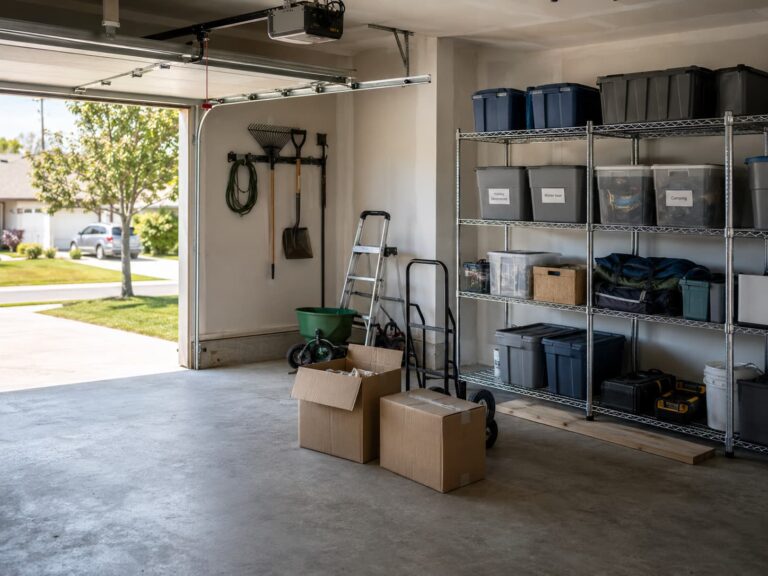
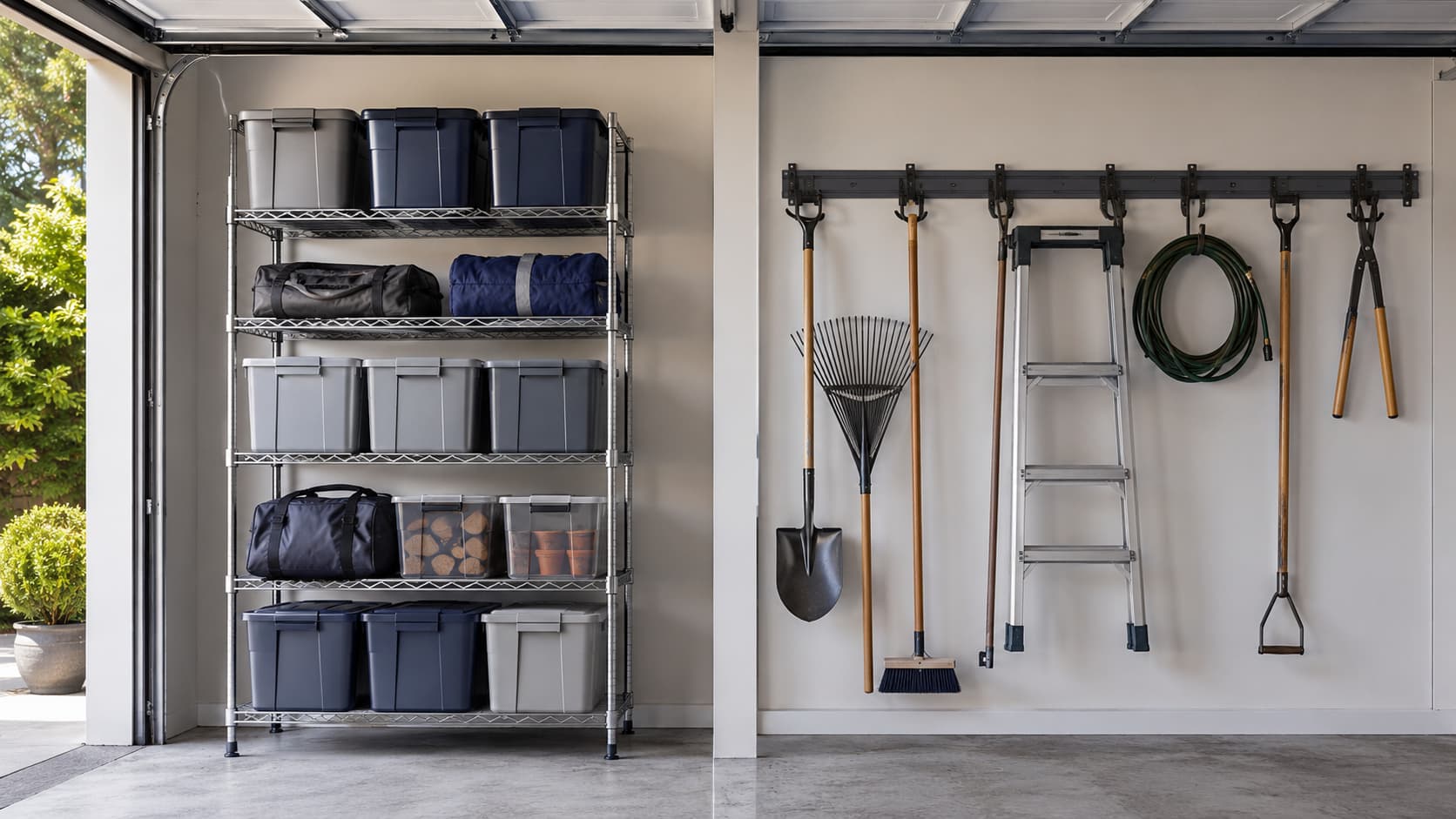
For most renters, anyone with finished/painted walls they’d rather not drill, or anyone who wants to set up fast and reconfigure later, freestanding shelving wins. For owners with bare studs, mostly daily-access gear, low ceilings worth recovering, or a long time horizon in this garage, wall-mounted systems win. The decision hinges on five variables: rental status, wall finish, ceiling height, the kind of items you store, and how long you’ll stay. Many real garages end up using both — freestanding for heavy or bulk storage, wall-mounted for daily-access tools — and that’s a perfectly valid outcome.
Best Choice by Situation
| Situation | Better choice | Why |
|---|---|---|
| You’re renting | Freestanding | No holes in walls; moves with you |
| Finished/painted walls you don’t want to drill | Freestanding | Avoids patch-and-repaint risk later |
| Bare-stud walls (drywall not yet up) | Wall-mounted | Strongest, cheapest anchoring; easy to plan |
| Drywall but ready to drill into studs | Either | Lean wall-mount if floor space matters |
| Heavy seasonal totes, dense static storage | Freestanding (heavy-duty welded steel) | Per-shelf capacity far exceeds per-hook limits |
| Mostly daily-use hand tools and gear | Wall-mounted | Faster grab-and-go, visible inventory |
| Ceiling under 8 ft, tight floor plan | Wall-mounted | Recovers floor space the freestanding unit would have taken |
Freestanding Garage Storage — Pros, Cons, Best Use Cases
What it is
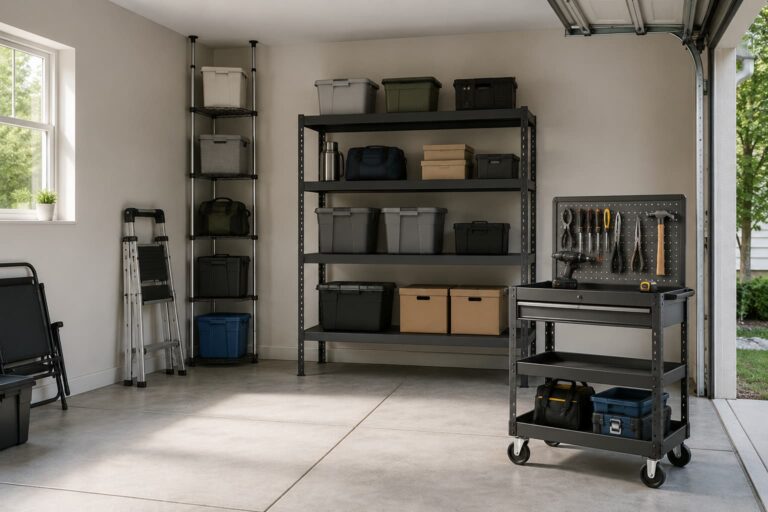
Freestanding storage units sit on the floor and don’t attach to your walls. The two main residential sub-types are chrome wire shelving (NSF-rated wire decks on a steel frame with leveling feet — Seville Classics is the canonical example) and welded-steel industrial shelving (heavier-gauge frames with riveted or welded joints, typified by Husky and similar Home Depot-distributed brands). Plastic resin shelving exists but sits in a different decision tree — we leave it aside here.
Where freestanding works best
- You’re renting, or you might move in the next two years
- Your garage walls are finished and you don’t want to commit to drilling
- You want to test your layout before locking it in — freestanding units move easily
- Your storage skews heavy and static: holiday totes, off-season gear, bulk pantry overflow
- You don’t want to think about studs, anchors, or hardware
For more on the freestanding category specifically, see our roundup of the best metal shelving units for garages.
Where freestanding falls short
- It takes floor space — typically 18-24″ of depth per unit consumed
- Tall, narrow, fully-loaded units can tip if not anchored — a real risk in earthquake zones or with toddlers
- Cleaning under a freestanding unit means moving it
- Standard residential shelf depth is 18″, which leaves some larger totes (27-gallon and up) overhanging the front edge
What manufacturers and retailers typically specify
A good freestanding product page lists per-shelf load capacity (with a clear note on whether the figure assumes leveling feet or casters — these are very different), total unit capacity, individual shelf dimensions, steel gauge, finish, and NSF rating if it’s a wire shelf. The product page should also state assembled dimensions vs. shipping dimensions so you can plan the move from driveway to garage.
Buyer warnings specific to freestanding
- Per-shelf capacity drops sharply when you swap leveling feet for casters — sometimes by 5-10x. If you want the unit to roll, check the casters-specific capacity, not the listing’s headline number
- An 18″-deep shelf is the residential standard and will not fit 27-gallon (≈20″-wide) totes flush — the totes overhang. Either pick a 24″-deep shelf or accept the overhang and the reduced stack stability
- Stacking totes two-deep is a common compaction trick that doubles capacity but destroys daily-access speed — you end up pulling the front row to reach the back
Wall-Mounted Garage Storage — Pros, Cons, Best Use Cases
What it is
Wall-mounted storage anchors directly into wall studs (rails) or into a stud-attached backer (slatwall, pegboard). Three subtypes cover most of the residential market: rails like Rubbermaid FastTrack and Gladiator GearTrack, panel systems like Proslat slatwall, and pegboard like Wall Control’s galvanized steel panels. This article focuses on rails and panels — the broad-storage subtypes. If you’re weighing pegboard vs slatwall vs rail specifically, the wall storage buying guide walks through that decision.
Where wall-mounted works best
- Your walls are unfinished (bare studs) — drilling into wood studs is cheap, strong, and easy to plan
- You’re trying to recover floor space in a tight garage — wall-mounted gives you the wall back from 4 ft up
- Most of your storage is daily-access: hand tools, gardening equipment, sports gear, cords, hoses
- You want visible inventory so you stop buying duplicates of things you can’t find
- You have ceiling height under 8 ft and need to lift storage off the floor
For more on the wall-mounted category, see our roundup of the best wall-mounted garage storage systems.
Where wall-mounted falls short
- Renters typically can’t drill — even small patches add up at move-out
- Finished walls become a planning problem: every relocation means a patch and repaint
- Heavy concentrated loads stress per-hook capacity (15-50 lb typical), not per-rail capacity — and that math is invisible to most buyers
- A “starter rail” is just the spine: hooks, baskets, and shelves are separate purchases, and the cumulative cost rises faster than the rail price suggests
What manufacturers and retailers typically specify
A good wall-mount product page lists rail length and gauge, stud-spacing requirements (16″ OC vs 24″ OC), per-rail total capacity, per-hook or per-accessory capacity, required hardware (typically 3″ lag bolts), and accessory compatibility. The per-rail and per-hook numbers are different specs — read both.
Buyer warnings specific to wall-mounted
- Per-hook capacity is much lower than per-rail. A rail rated for 1,750 lb total still only holds 15-50 lb per hook. Hanging a 60-lb bag from a single 25-lb hook fails the hook, not the rail
- Mounting into drywall alone — without hitting a stud — fails for any meaningful load. Find studs first; plan rail length to span studs at 16″ OC
- Steel-stud construction or finished walls with no accessible studs change the cost calculus entirely. You’ll need plywood backing or stud-finder confirmation before buying
Side-by-Side Comparison
The table below summarizes the trade-offs across 8 dimensions. For a visual version of this comparison, see the infographic below.

| Aspect | Freestanding | Wall-Mounted |
|---|---|---|
| Footprint | Takes 18-24″ of floor depth | Almost zero floor footprint |
| Wall impact | No holes, no commitment | Drilling into studs, patches if removed |
| Renter-friendly | Yes | Usually no (lease + patch costs) |
| Heavy loads | Excellent — welded steel ~2,500 lb per shelf manufacturer-listed | Per-hook limits 15-50 lb |
| Daily-access tools | Slower — totes block view | Grab-and-go, visible |
| Reconfigurability | Move the unit anytime | Fixed once mounted; relocating means patches |
| Upfront cost | Lower start, especially for one unit | Higher start once hooks are added |
| Long-term commitment | Short-term ok | Long-term reward — invests in wall |
How to Decide for Your Garage
Run through these five questions in order. The first “yes” gives you your answer.
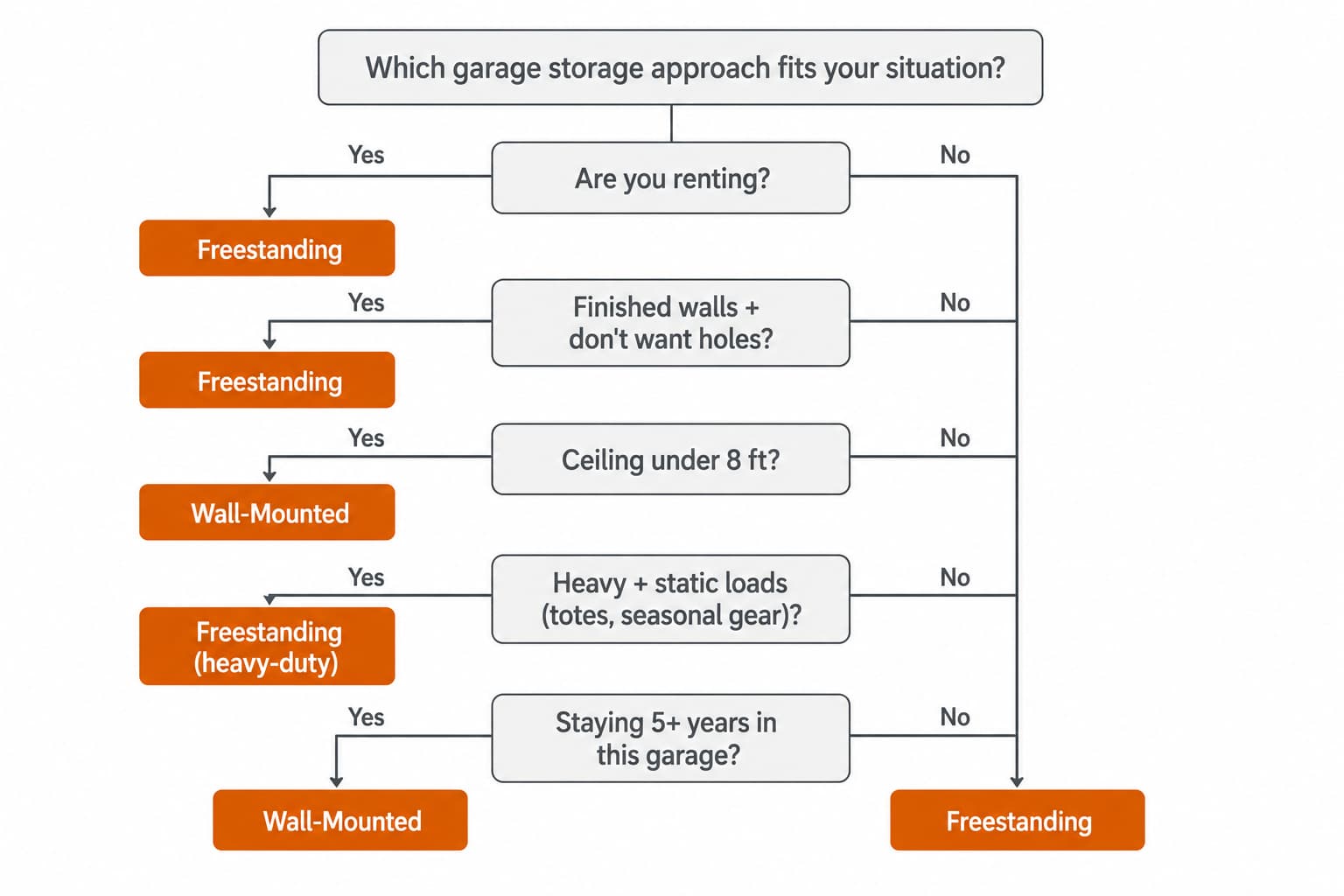
- Are you renting? Yes → freestanding. Patching drywall at move-out is rarely worth a rail system. For deeper coverage of this scenario, see our guide for renters.
- Are your walls finished, and do you want to keep them that way? Yes → freestanding. The “small holes” of a rail install become real patches when you reconfigure.
- Is your ceiling under 8 ft, or your floor plan tight enough that the 18-24″ depth of a freestanding unit hurts? Yes → wall-mounted. Small-space planning covers this trade-off in more depth.
- Are most of your items heavy and static (totes, seasonal gear, dense storage)? Yes → freestanding heavy-duty. Welded-steel shelving handles loads that would overwhelm per-hook capacities on a rail.
- Are you staying in this garage 5+ years? Yes → wall-mounted is worth the upfront effort and finish trade-off. Less than 2 years → freestanding.
If you got past all five with no clear single answer, your garage probably benefits from a mix — freestanding for the heavy/bulk side of the room, wall-mounted for the daily-access side.
Common Mistakes
Mistake: Drilling into finished walls without planning the layout first. Wall-mounted regret almost always traces to “I put the rail here, then I changed my mind”. Sketch the layout (or tape the rail outline on the wall) before drilling. If you’re not sure, freestanding gives you a low-cost trial run.
Mistake: Choosing wall-mounted because it “looks cleaner” without checking stud spacing. Wall-mounted only works at full strength when bolts hit studs. Steel-stud construction, finished walls with no accessible studs, or non-standard spacing change everything. Find studs before buying.
Mistake: Buying freestanding shelving that’s too shallow for your totes. An 18″ shelf and a 20″ tote leaves a 2″ overhang at the front. Either commit to 24″-deep shelves, or accept the visual and the slight stack instability — but make the decision deliberately.
Mistake: Confusing per-rail capacity with per-hook capacity. A rail rated for 1,750 lb total still only holds 15-50 lb on a single hook. If you’re hanging concentrated heavy loads, the rail is fine but the hook isn’t — match the hook to the load.
Recommended Products for Each Side
These four picks come from the canonical freestanding and wall-mounted entries already verified across the GSG corpus. Each is illustrative — the goal is not to crown one product as best, but to show what each side actually looks like at the buying decision.
For freestanding (default): Seville Classics UltraDurable 5-Tier Wire Shelving (24″ × 18″)

The default freestanding pick for most residential garages, in the narrow 24″-wide footprint that suits single-car bays and tight side walls. NSF-certified chrome wire decks, with a manufacturer-listed per-shelf capacity of approximately 600 lb on leveling feet. Fits 18-gallon totes flush; 27-gallon totes will overhang. The listing ships with both casters and leveling legs — capacity assumes leveling feet, not wheels. Seville sells the same UltraDurable line in multiple widths (36″, 48″, 60″); confirm the 24″×18″×72″ variant before clicking.
For freestanding (heavy-duty): Husky Industrial Duty Steel Garage Shelving Unit

The heavy-duty answer when freestanding has to do the work that wall-mounted would otherwise handle. Welded-steel frame (no joint bolts to loosen), with a manufacturer-listed 2,500 lb per-shelf capacity. The Amazon listing umbrellas several sub-models in the Husky industrial line — confirm exact width and height before clicking. Freight delivery is typical; the welded frame doesn’t ship flat-packed.
For wall-mounted (rail): Rubbermaid FastTrack 48″ Steel Hang Rail

The most accessible wall-mount entry point. A single 48″ rail spans three studs at standard 16″ OC spacing, and the FastTrack hook ecosystem lets you add or remove accessories anytime. Manufacturer-listed rail capacity is 1,750 lb total; individual hook capacities range from 15 to 50 lb depending on the hook. Rail-only — hooks sold separately.
For wall-mounted (panel): Proslat 88102 Heavy Duty PVC Slatwall (8′ × 4′ Section, White)

The panel alternative when you want continuous wall coverage instead of a single rail line. Roughly 32 square feet of slatwall per section, with a manufacturer-listed 75 lb per square foot — normalized to roughly 300 lb per linear foot of a 4 ft wall run in the comparison table below. Bare panels — hooks and baskets sold separately. Installation typically needs two people, and drywall-only mounting requires a plywood backer if you can’t anchor every panel into studs.
What garage wall systems actually hold, compared fairly
Pegboard is rated per panel, rails per linear foot, slatwall per square foot. Three different units means the published numbers cannot be compared as they stand — so nobody compares them, and a 200 lb figure on one product looks like a 200 lb figure on another. This table quotes each manufacturer’s rating and converts them all to pounds per linear foot of a 4 ft high wall run, with the arithmetic shown. Normalised values are comparison figures, not safe point-load limits. A system rated for 1,200 lb distributed across a wall section does not support a 1,200 lb hook.
| System | Type | Rating as published | Rating type | Same rating, per linear foot of a 4 ft wall | Working | Stud requirement | Specification source | Source checked |
|---|---|---|---|---|---|---|---|---|
| Wall Control metal pegboard (16 × 32 in panel) | pegboard | 200 lb per panel into studs (100 lb on drywall anchors) | panel recommendation | 225 lb per linear foot | 200 lb ÷ (16 in × 32 in panel = 3.56 sq ft) = 56.25 lb per sq ft; 56.25 × 4 ft high = 225 lb per linear foot (equivalently: a 4 ft × 4 ft section fits 3 panels across × 1.5 high = 4.5 panels × 200 lb = 900 lb ÷ 4 ft) | mounting holes on 16 in stud centres | Wall Control 16 × 32 in Metal Pegboard | 2026-09-14 |
| Gladiator GearTrack channel (rail) | rail | 75 lb per linear foot of channel | rail/channel rating | 150 lb per linear foot | 75 lb/ft per channel (published) × 2 channels (assumed common install) | mounts to bare wood studs or drywall over wood studs | Gladiator 4′ GearTrack Channels | 2026-09-14 |
| Gladiator GearWall slatwall panel | slatwall | 50 lb per square foot | distributed panel load | 200 lb per linear foot | 50 lb/sq ft × 4 ft high | not published on the product page | Gladiator 4′ GearWall Panels | 2026-09-14 |
| Proslat Classic PVC slatwall | slatwall | 75 lb per square foot | distributed panel load | 300 lb per linear foot | 75 lb/sq ft × 4 ft high | installs on 16 in stud centres | Proslat PVC Slatwall | 2026-09-14 |
How these numbers were produced: Each published rating is quoted from the manufacturer’s own page on the date shown. Conversion to pounds per linear foot assumes a 4 ft high run of wall: a per-square-foot rating is multiplied by 4. A per-panel rating is first converted to an equivalent per-square-foot rate, using the panel’s own published width and height, then multiplied by 4 the same way — scaling a per-panel rating sideways only, at the panel’s own height, would normalise it to a taller or shorter slice of wall than the 4 ft reference every per-square-foot row uses, so the two steps (per-panel → per-sq-ft → per-4-ft-run) keep every row on the same footing. A per-foot-of-rail rating is different in kind: the manufacturer publishes a rate per channel, and this table doubles it to show a common two-channel install — that doubling is our own installation assumption, not a manufacturer-stated rate; the sourced figure is the single-channel rate. Where a manufacturer publishes a single fixed capacity for a whole pre-sized unit rather than a rate per foot or per square foot, that figure is quoted as published and left out of the per-linear-foot column rather than converted with an invented rate.
- These are manufacturer maximums for a correctly installed system, not a promise. Every one of them depends on hitting studs, using the specified fasteners, and spreading the load rather than hanging it all off one hook.
- The comparison assumes a 4 ft high run. A rail system does not gain capacity from wall height the way a panel does — it gains it from adding channels, which is why its normalised figure moves when you change the channel count, not the height.
- Stud spacing is a hard constraint, not a suggestion. Proslat’s PROCORE is the only system here with a published compatibility range — engineered for 24 in centres, rated compatible down to 16 in. Check whether your own system publishes a similar range before assuming it.
- Drywall anchors are not studs: Wall Control publishes 100 lb per panel on anchors against 200 lb into studs — a real number for that one product, not a ratio to assume for other systems here that don’t publish their own stud-vs-anchor split.
- Capacity drops the further a load sits from the wall: storeWALL publishes 250 lb per sq ft as a distributed rating at the panel surface, but only 115 lb as a point measurement 4 in out. That lever-arm principle is a reasonable general caution for hooks and brackets on any system, but storeWALL is the only brand here that publishes a number for it.
- A blank cell means the manufacturer does not publish that figure — we do not fill gaps with numbers we could not source.
- This list favors brands whose own specification pages state a capacity figure in a form we could verify directly. Some well-known brands are not yet in this table because their published pages did not state a load rating we could confirm on this pass — that is a sourcing gap, not a signal that the product is weaker.
These are the entries that matter for this guide. The full table, with every row and its source, is in our What garage wall systems actually hold, compared fairly.
FAQ
Can I mix freestanding and wall-mounted in the same garage?
Yes — many well-organized garages do exactly this. A common layout: freestanding wire shelving along one wall for totes and bulk storage, wall-mounted rails along another wall for daily-use tools and gear. The mix lets each approach do what it does best.
What if I rent but really want a wall-mounted system?
Talk to your landlord first. Some are open to lag-bolt installs if you patch on the way out; others aren’t. Removable command-strip alternatives don’t hold real garage weight — assume 5 lb max, not 25. If your landlord says no, freestanding is the path; you can still get visible inventory using clear plastic totes on open wire shelves.
How heavy can a freestanding shelf actually hold?
Read the manufacturer-listed per-shelf capacity, and check whether it’s stated for leveling feet or casters (casters often cut the number by 5-10x). Manufacturer-listed capacity assumes correct assembly, level flooring, and proper weight distribution. Real-world performance depends on those conditions plus how you stack — concentrated loads at the front edge stress the unit more than evenly distributed loads.
How do I find wall studs through finished drywall?
A magnetic stud finder picks up drywall screws (which go into studs) reliably for around ten dollars. Electronic stud finders work too but need a flat hand pass on flat drywall. Studs are typically 16″ on center in residential framing — once you find one, the next is usually 16″ left or right. Note that steel-stud construction (common in some newer or commercial-grade homes) requires a different anchor strategy; if your magnet pulls everywhere, you have steel studs.
Is slatwall worth the cost compared with just buying more freestanding shelving?
Depends on whether your wall is “dead space” today. If your floor is already full and you have empty walls from 4 ft up, slatwall converts that dead space into accessible storage without taking floor area. If your floor still has room, freestanding is cheaper and faster. The break-even point shifts toward slatwall the smaller and more cluttered your garage is.
What about ceiling-mounted overhead racks?
Overhead racks are a third category and live in a separate decision tree — they’re best for low-frequency, long-term storage (holiday decor, off-season gear) that you only touch twice a year. They don’t compete directly with wall-mounted (which is for daily-access) or freestanding (which is for medium-frequency, bulk). We cover overhead racks in their dedicated article rather than crowd this comparison.
Sources Reviewed
For this comparison, we reviewed manufacturer pages and retailer specifications for both freestanding shelving (Seville Classics, Husky) and wall-mounted systems (Rubbermaid FastTrack, Proslat), the Amazon product listings for each featured ASIN, recurring patterns in public customer feedback for both categories, and discussions in homeowner communities where readers shared real-world experience choosing between these approaches. We do not claim hands-on testing.