How to Set Up a Trash and Recycling Station in Your Garage
Last updated:
Disclosure: This article contains affiliate links. If you buy through these links, we may earn a commission at no extra cost to you. We do not claim hands-on testing unless clearly stated.
Most garage waste stations grow by accident. A trash can lands wherever it was first put down, the recycling bag leans against a wall, and by year two the floor has a permanent ring of grime. A planned station beats an accidental one, and the planning takes about an hour.
This guide is a six-step setup: measure, size the curbside can, choose the indoor sorter, protect the floor, label the flow, set a maintenance rhythm. Hazardous waste — paints, oil, solvents — belongs in a lockable utility cabinet and is a separate plan.
Quick Answer: What a Working Garage Waste Station Looks Like
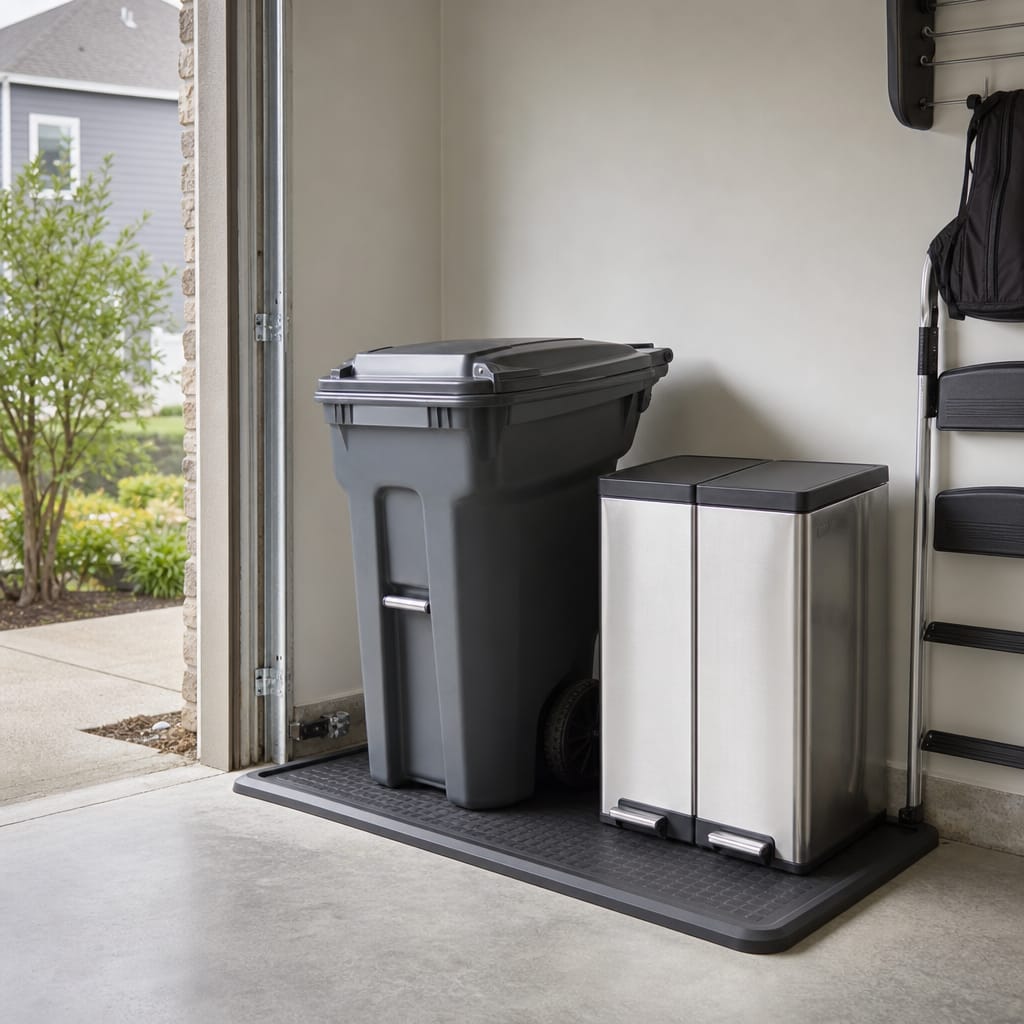
A working station has four pieces inside a three-foot-wide zone:
- A wheeled 32-gallon curbside trash can with a lid that closes fully
- A matching recycling can — or a single municipal cart if your city uses one
- An indoor two-compartment sorter near the kitchen-to-garage door
- Roughly three feet of clear floor, with a wipeable rubber mat under the cans
Labels, the maintenance rhythm, and the mat keep the station working three months from now instead of reverting to a pile by the door.
Step 1 — Measure Before You Buy Anything
Three measurements decide where the station goes, and most readers skip the third one and regret it.
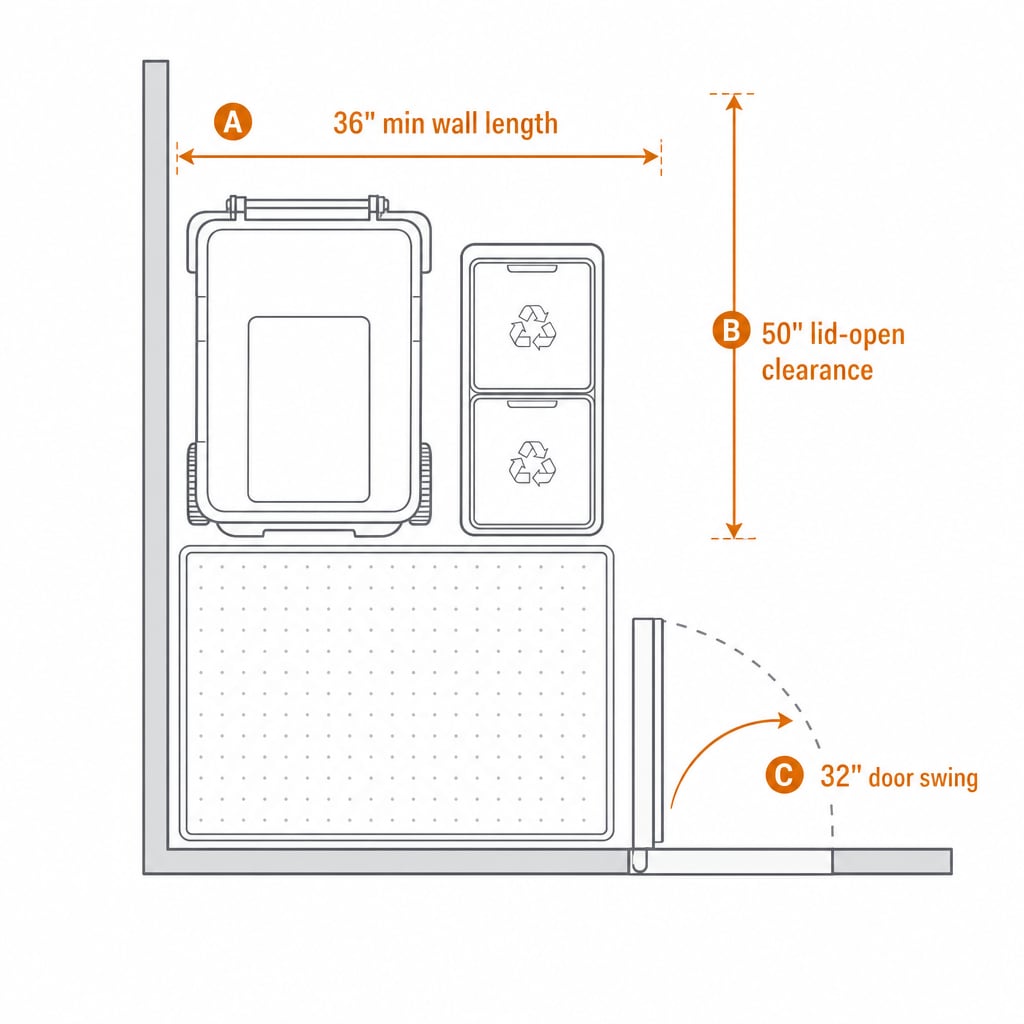
- Wall length available. Aim for 36 inches (3 feet) minimum. A 32-gallon wheeled can runs ~22 inches wide and an indoor dual sorter another 14–16 inches, so 36 inches gives both with a slim handle clearance between.
- Vertical clearance. Indoor sorter lids open up, not just back. Plan for 50 inches of clear vertical space so the lid clears overhead shelves.
- Door swing radius. A standard 32-inch interior door arc cuts straight through the space where your indoor sorter wants to live — you’ll discover this the first time you fling the door open carrying a recycling bin.
For a broader layout walkthrough, see our guide on small-garage layout planning.
Step 2 — Size Your Wheeled Trash Can
Match the can to your household, not to whatever was on the shelf:
- 2-person household: 20-gal or 32-gal works for weekly curbside pickup.
- 4-person household: 32-gal is the standard for weekly; bi-weekly pickup pushes to 50–65.
- 4+ people: 50–65 gallons, or a municipal-issued cart.
Two warnings before you buy. First, check your municipality’s curbside requirements — some cities mandate city-issued carts and refuse private cans, so a private can in a city-cart-only district is the wrong product. Second, wheels matter even inside the garage. You will reposition the can to fill from the car, to sweep behind it, to move it for a guest — a no-wheels can means lifting a full bag.
The default for the curbside role is the Rubbermaid BRUTE 32-gallon vented variant — covered below. The Made-in-USA Suncast Commercial 32-gallon is a credible alternative; verify the wheeled SKU before buying since the stationary variant is more common on Amazon listings.
For readers who want a mobile cart in addition to fixed bins, see our guide on wheeled garage carts for moving heavy loads.
Step 3 — Choose Your Indoor Recycling Sorter
The indoor sorter solves a behavioral problem: nobody walks to the curbside bin for a single soda can. Put a two-compartment sorter inside the garage near the kitchen-to-garage door and the whole household starts pre-sorting without thinking.
Two decisions matter. Compartment count: most cities use a single-stream recycling cart, which maps cleanly to a two-compartment indoor sorter. Cities requiring paper-versus-container separation push to a three-compartment unit — check before buying. Pedal versus motion sensor: a step pedal works in any temperature, needs no batteries, and tolerates garage humidity. Motion sensors add a battery and a sensor that drifts in cold. For a garage, pedal wins.
The default pick is the Step N’ Sort 16-gallon two-compartment in stainless — covered below. Readers whose garage doubles as a mudroom can step up to the simplehuman 58-liter dual recycler for roughly three times the price.
Step 4 — Protect the Floor
Concrete is porous. Concrete plus the slow drip from a not-quite-sealed bag is a permanent stain within six months. Three options:
- A wipeable rubber containment mat — the cheapest viable answer. Pull the cans off, hose or wipe, slide it back.
- A plastic containment tray — raised edges contain leaks; works if you have a known leaker product.
- A small tiled floor section dedicated to the cans — most expensive, longest-lived; worth it only if you are doing other floor work.
A 24×36 inch rubber mat under both cans is the right tradeoff for most readers. If your garage doubles as a workshop with chemicals nearby, our guide on utility storage that holds up in a working garage covers cabinet pairing.
Step 5 — Label and Route the Flow
Labels matter even in a two-person household. Visitors mix streams, family members in a hurry mix streams, and at the end of a long evening you will mix streams unless the labels are obvious.
Label each compartment of the indoor sorter, the curbside cans, and the kitchen-to-garage door with the curb-out-day reminder (a small printed card at eye height works).
Route the flow so the path is: kitchen-to-garage door → indoor sorter → curbside cans by the exterior garage door. Don’t make the household cross the garage twice. If layout forces the curbside cans across the room, you’ll carry a small bag two or three times a week instead of dragging a large bag once.
Step 6 — Set a Maintenance Rhythm
A planned station drifts back into a pile-by-the-door within a month if nobody maintains it. The rhythm is light:
- Weekly: empty the indoor sorter into the curbside cans; replace liners.
- Monthly: rinse curbside cans, wipe the floor mat — five minutes total.
- Twice a year: deep clean, re-label worn compartments, check wheels and lid hinge.
It works because the indoor sorter cycles weekly — nothing sits long enough to start smelling.
Common Mistakes to Avoid
Mistake 1: Oversizing the curbside can
A 50-gallon BRUTE for a two-person household feels generous on day one. Six months in, the bottom layer holds food scraps for an extra week because the volume is too big to fill weekly. Match the can to your weekly output, not to the biggest size you can afford.
Mistake 2: Putting the indoor sorter on bare concrete
The first time a leak happens — and there will be a leak — the concrete absorbs it and the stain is permanent. A rubber mat under the sorter avoids this for the entire life of the product. There is no scenario where skipping the mat saves money.
Mistake 3: Skipping the lid on the curbside can
The lid is the difference between a clean garage and one that smells like trash every July. Summer heat plus uncovered organic waste plus a closed garage door is a problem. Buy the lid and use it.
Mistake 4: Not labeling anything
You can tell recycling from trash. Visitors can’t, and you’ll spend Sunday night pulling cereal boxes out of the trash. Label everything, including the curbside cans. For broader context, see our walkthrough on planning a small-garage layout.
Tools and Products That Help
Two products do most of the work.
The wheeled curbside trash can: Rubbermaid Commercial BRUTE 32-Gallon
Rubbermaid Commercial Products Vented Wheeled Brute Trash Container, 32 Gal Gray
The BRUTE line is the commercial-fleet default — restaurants, hotels, and municipalities have used the same units for decades. The vented wheeled 32-gallon variant lists rubber wheels for outdoor-grade durability, vented channels along the inside wall that break the bag-suction problem when you pull liners out, and a heavy-duty polyethylene body that handles freeze-thaw cycles. The 32-gallon size matches most US household curbside programs. Verify your municipality accepts private cans before buying — some cities require city-issued carts.
The indoor recycling sorter: Step N’ Sort 16-Gallon 2-Compartment

A steel frame with two removable eight-gallon inner buckets — one for trash, one for recycling — operated by a single step pedal. The stainless finish wipes down after spills, and the recycled-plastic inner buckets pull out for emptying without lifting the unit. No batteries to fail in cold or humid garage conditions.
The product family ships in two-compartment, three-compartment, and motion-sensor variants. Two-compartment stainless is the right default. Step up to three-compartment if your municipality requires paper-versus-container sorting. Skip the motion-sensor model for garage use — battery dependency is a reliability liability. For pairing with other garage storage carts, see the linked guides.
FAQ
What size trash can do I need for a 4-person household in the garage?
A 32-gallon wheeled can is the standard for weekly pickup at this household size. Bi-weekly pickup pushes you to 50–65 gallons. If the city issues mandatory carts, use what they provide — a private can in that situation is redundant.
Can I keep my trash can in the garage without it smelling?
Yes, with three conditions: a fitted lid, weekly emptying even if not full (time is the issue, not volume), and a monthly hose rinse. Double-bagging organic waste handles the rest.
Do I need a separate recycling can if my city picks recycling from one cart?
Outdoors, no — the city’s single cart is your curbside container. Indoors, a two-compartment sorter still pays for itself by pre-sorting at the point of disposal, which is what keeps the household actually recycling instead of defaulting to trash.
How do I keep pests out of garage trash cans?
A tight-fitting lid stops most of the problem. Double-bagging organic waste cuts the scent. Persistent rodent problems point to a structural issue (gap under the garage door), not a trash-can issue.
Should I store hazardous waste in the same area?
No. Paints, motor oil, and solvents need a lockable, ventilated cabinet — not a curbside trash workflow. They introduce chemical-exposure risk and most municipalities won’t accept them in curbside pickup. Plan a separate location with lockable utility storage for chemicals.
How wide should the trash and recycling zone be in the garage?
36 inches is the workable minimum for a 32-gallon wheeled can plus a slim indoor sorter side by side. 4-person-plus households needing 50–65 gallon containers should plan for 48 inches.
Sources Reviewed
We reviewed manufacturer documentation, retailer listings, and public buyer-discussion patterns. Featured-product sources: Rubbermaid Commercial’s BRUTE product family page on rubbermaidcommercial.com; Step N’ Sort’s family page on stepnsort.com; and the active Amazon listings for both products. We did not buy or test either product. We do not claim hands-on testing unless clearly stated.