How to Rotate Seasonal Items in Your Garage
Last updated:
Disclosure: This article contains affiliate links. If you buy through these links, we may earn a commission at no extra cost to you. We do not claim hands-on testing unless clearly stated.
Seasonal items are a continuous flow problem. Every three months, what was active becomes inactive — the snow shovel that lived by the door in February is dead weight by July, and the beach umbrella that worked all summer blocks access to winter coats by October. Without a rotation system, the garage devolves into strata.
This guide is a two-zone framework (Active in front, Parked in back) with four calendar triggers and three tools that make the swap fast — a tote, a label maker, and an overhead rack. It does not cover structural overhead-rack installation safety or Christmas-decor organization.
The Two-Zone Framework
The garage has exactly two zones for seasonal items, and naming them is what makes rotation work.
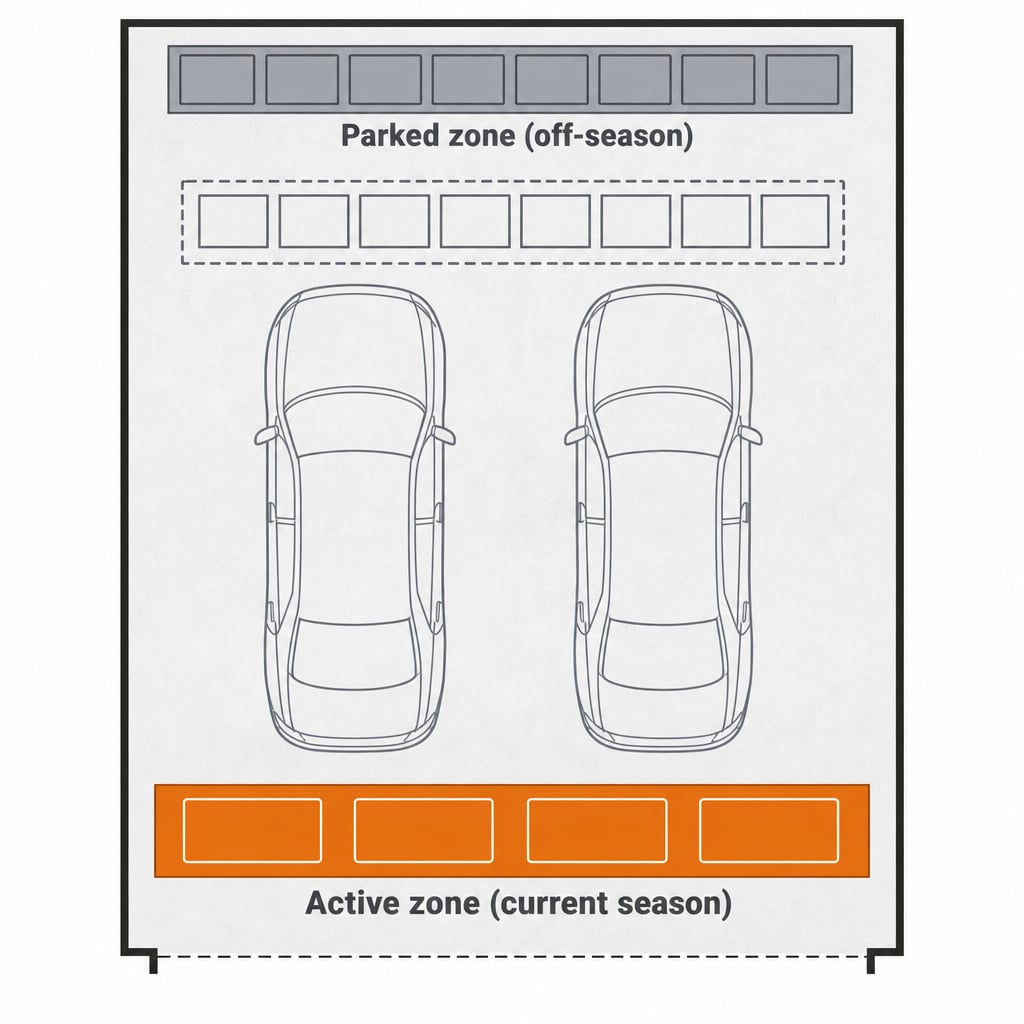
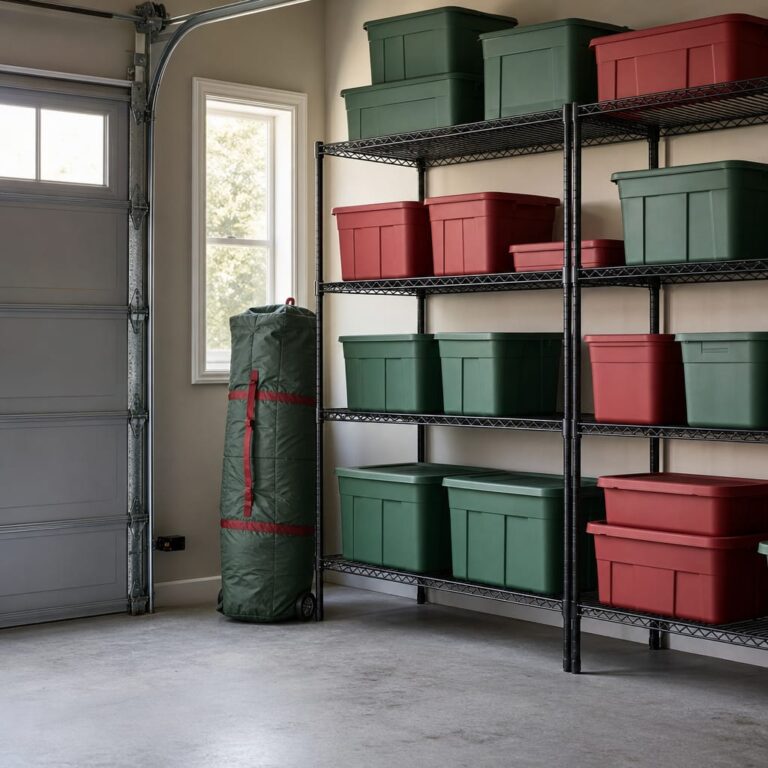
- Active zone — front, eye-level, on accessible shelving. Holds the current season’s items. Anything here should be reachable in under 10 seconds.
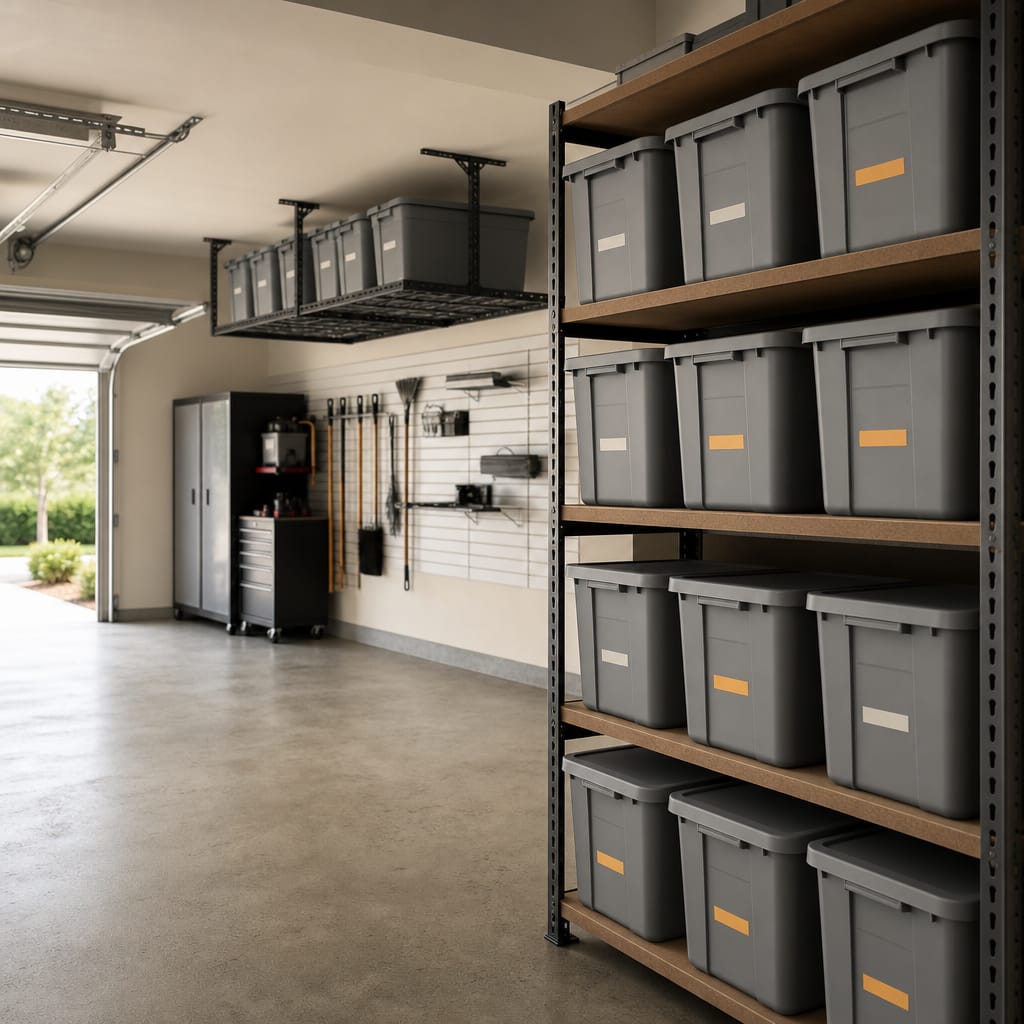
- Parked zone — back wall and overhead ceiling. Holds off-season items. Less accessible by design — touched only four times a year.
Rotation is the act of swapping totes between these zones on a calendar trigger.
The Four Calendar Triggers
Pick four weekends, one per season transition, and put them on the calendar now.
- Late February / Early March — Winter to Spring. Park winter coats, snow shovels, sleds. Activate garden tools and rain boots.
- Late May / Early June — Spring to Summer. Park rain gear. Activate beach gear, camping equipment, pool toys.
- Late August / Early September — Summer to Fall. Park summer items. Activate rakes, fall decor, Halloween costumes, school sports gear.
- Late October / Early November — Fall to Winter. Park fall items. Activate winter coats, snow shovels, holiday decor staging.
Mild-climate households can collapse to twice a year. Less than twice a year is not a system — just a pile that turns over by accident.
Tool 1 — The Rotating Tote
The tote is the unit of rotation. One tote equals one seasonal slice (one season’s worth of one category — winter coats, beach gear, fall decor). It must survive six months in an unheated garage and the lift-and-carry motion twice a year. A gasket-sealed buckle-latched tote earns this job; a snap-on lid bin does not, because snap-on lids wick humidity at the seam over a 6-month rest.
Best for Round-Trip Seasonal Storage: IRIS USA WEATHERTIGHT SIA-760 87.4 Quart Storage Box
Best for: Households running a full four-season rotation that need one durable container per seasonal slice.
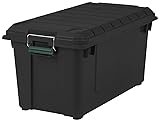
Short verdict: The gasket seal and buckle latches make this tote survive a 6-month garage rest — humidity, dust, and pests get blocked at the lid line.
Why it stands out
Many “storage tote” listings sell snap-on lid bins under the same name as gasketed totes, burying the gap that matters for rotation: snap-on lids work for organization, not for storage. WEATHERTIGHT is one of the few branded SKUs where the gasket is a documented feature, not an upsell. At 87.4 quart, it’s the right size per slice — small enough to lift overhead, large enough that one tote covers most categories. For broader options, see our seasonal-storage solutions buying guide.
Key specs and buyer warning
The product page lists 87.4-quart capacity under the model name SIA-760, polypropylene body with EPDM gasket lid seal, and two buckle latches. Stackable when fully latched. This SIA-760 WEATHERTIGHT SKU is a different IRIS product from the 82-quart WeatherPro box shown in the shelf-fit table below — the two aren’t interchangeable, so don’t borrow that row’s dimensions for this tote. Open the tote indoors before stacking in a hot garage; buckle latches stiffen under heat-cold cycles, and forcing a frozen latch is the most common cause of crack failures. IRIS doesn’t publish external dimensions for the SIA-760 next to its capacity figure, so measure your shelf depth against the tote itself before ordering — don’t assume it matches either row in the table below.
Tool 2 — The Labeling System
Rotation collapses when you can’t tell what is in a tote without opening it. Three shortcuts fail predictably: tape peels in summer humidity, Sharpie fades under fluorescent light, and stick-on labels lose adhesion after one freeze-thaw cycle. By year two, every tote reads “MISC.” Color-coding (covered in the Christmas decoration organization guide) complements single-holiday slices but cannot carry contents detail on its own.
Best for Garage-Durable Labels: Brother P-touch PT-H110 Label Maker
Best for: Households running a multi-category rotation where each tote needs a contents callout that survives temperature swings.

Short verdict: Brother TZe laminated thermal tape is the industry standard for labels that hold up to heat, cold, abrasion, and humidity — the PT-H110 is the entry-tier handheld that runs the full TZe tape family.
Why it stands out
TZe-laminated thermal tape is not the same as inkjet-printed adhesive labels. The lamination encapsulates the ink, which is what makes the label survive a humid summer garage and a cold winter one — manufacturers list these labels for outdoor and industrial use. The PT-H110 runs 3.5 mm through 12 mm TZe widths.
Key specs and buyer warning
The listing states it prints on Brother TZe laminated tape (3.5, 6, 9, and 12 mm widths), runs on 6 AAA batteries, and uses an alphabet keyboard layout. Batteries are typically not included. The starter tape included with the unit has varied between vendors — confirm tape width on the listing before ordering. Skip import-brand alternatives that take generic D-series tape; those lack the laminate and fail within a year in garage conditions.
Tool 3 — The Parked Zone
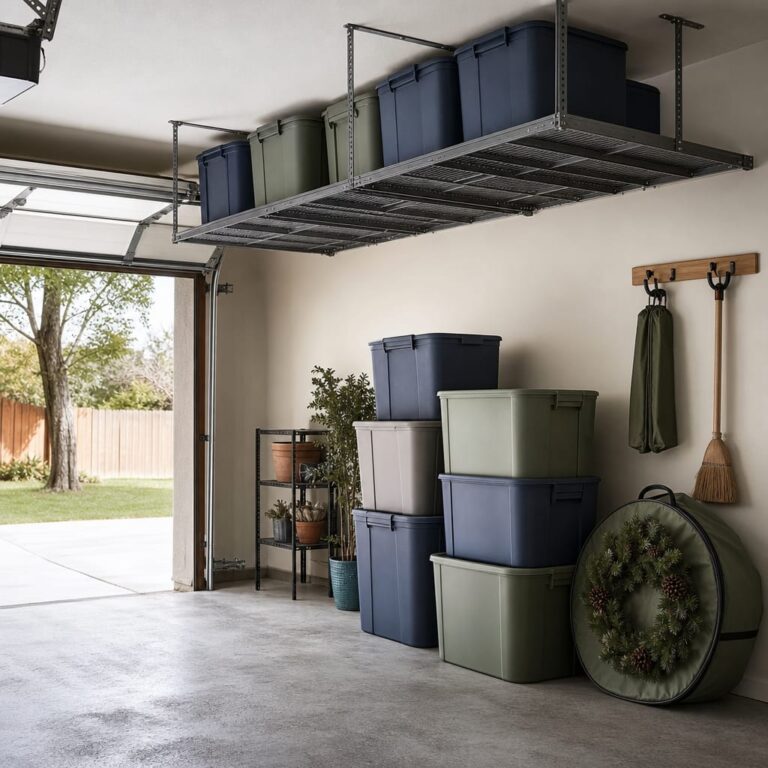
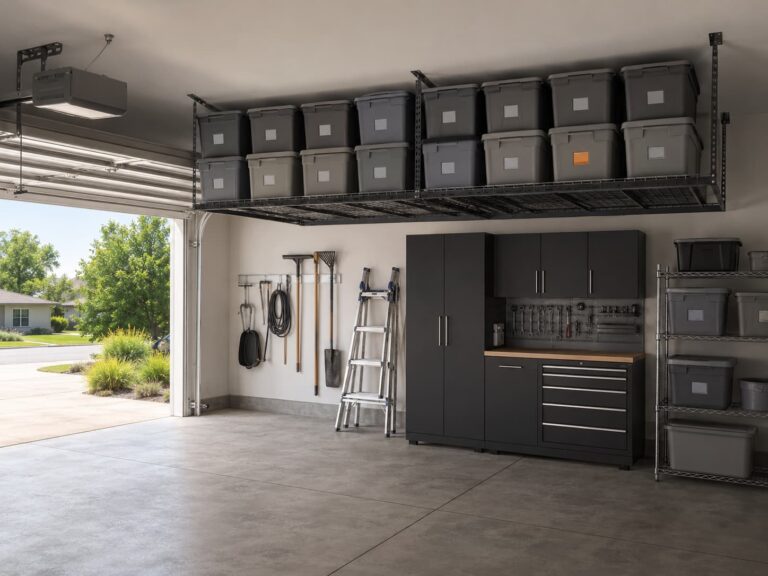
The Parked zone needs to be physically real, not “wherever there is space.” Floor space disappears in most garages once two cars are inside; the ceiling is the only viable parking zone. Four totes per season times four seasons is roughly 16 totes — a 4-by-8-foot overhead rack parks six to eight at once.
Best for Overhead Off-Season Parking: FLEXIMOUNTS GR48 4 x 8 ft Overhead Storage Rack
Best for: Households with full four-season rotation needing to park six or more totes overhead while the active set sits on wall shelving.

Short verdict: The 4-by-8-foot platform parks six to eight standard 27-gallon totes overhead with adjustable drop height — the platform size that makes a four-season rotation physically possible.
Why it stands out
Most overhead-rack listings come in 2-by-4 or 2-by-8 footprints — fine for a single slice, not for a full rotation. A 4-by-8 platform is the smallest format that holds an entire off-season load (6-8 totes) without needing two racks. Drop height between 22 and 40 inches covers nearly every US garage ceiling (8 ft through 12 ft). For joist verification, see our seasonal items storage how-to.
Key specs and buyer warning
The product page lists a 4-by-8-foot platform, cold-rolled steel construction with powder-coat finish, adjustable drop height 22 to 40 inches, and manufacturer-listed capacity of 750 pounds total — Amazon and the FLEXIMOUNTS product page agree on this figure. Mounts into ceiling joists with the included lag hardware; drywall anchors and truss-only ceilings are not supported, and joists must be spaced at 24 inches on-center or less, or exactly 48 inches on-center. Manufacturer-listed capacity assumes correct assembly, level mounting, suitable hardware, and proper weight distribution. Follow the manufacturer’s installation instructions.
What to Measure Before You Start
Most rotation systems fail at the first swap because the totes do not fit the space. Take five measurements before buying anything.
- Available ceiling height — decides whether a 4-by-8 overhead rack fits (22-to-40-inch drop works for 8-to-12-foot ceilings).
- Joist spacing — must be 24 inches on-center or less, or exactly 48 inches on-center.
- Active-zone shelf depth — decides bin width. A tote hanging two inches off the front gets knocked off.
- Number of seasonal slices in your household — decides how many totes you need (typical: 8-12 slices).
- Path from garage door to the parked zone — decides whether you can carry, or need a wheeled cart.
Common Rotation Mistakes
Skipping the swap this year because nothing seems broken
Rotation hygiene is preventive. The tote you did not open this season had a slow gasket failure all year, and you only find out at the next swap when the contents are damp. The swap costs 30 minutes; skipping it costs a season’s worth of damaged contents.
Using one tote for camping gear and Christmas decor
One tote equals one seasonal slice. Mixing slices destroys the “open the right tote first” advantage and creates two failure modes: fragile items crushed under heavy gear, and dirty gear ruining soft-goods stored alongside.
Storing non-rotating items in the parked zone
The parked zone is for items that rotate back in three-to-six months. Items that never rotate (or never belong in a garage, like paint cans and yard chemicals) clog the parked zone and push seasonal items to floor-level chaos.
How many totes actually fit on a garage shelf
Tote makers publish dimensions and shelving makers publish dimensions, but nobody puts the two together — so people buy shelving, then discover their totes overhang it. This table takes the published external size of totes from the brands people actually buy for garage storage — Sterilite, Rubbermaid Roughneck, and IRIS USA — and works out how many fit per shelf on the two garage shelving depths you can actually buy, 18 in and 24 in.
| Tote | Published dimensions (source order) | Footprint | Height | Fits an 18 in deep shelf? | Per 48 × 18 in shelf | Per 48 × 24 in shelf | Specification source | Source checked |
|---|---|---|---|---|---|---|---|---|
| IRIS USA Remington Weathertight Storage Tote, 19 Qt. | 17.50" L x 11.75" W x 7.88" H | 17.5 in × 11.75 in | 7.88 in | Yes | 4 | 4 | IRIS USA Remington Weathertight Heavy Duty Storage Tote, 19 Qt. (6-pack) | 2026-09-14 |
| IRIS USA WeatherPro Storage Container, 30 Qt. | 19.70" L x 15.75" W x 7.75" H | 19.7 in × 15.75 in | 7.75 in | Yes | 2 | 3 | IRIS USA WeatherPro Storage Container, 30 Qt. — Gasket Box | 2026-09-14 |
| IRIS USA WeatherPro Storage Container, 74 Qt. | 23.6" L x 17.8" W x 14.5" H | 23.6 in × 17.8 in | 14.5 in | Yes | 2 | 2 | IRIS USA WeatherPro Storage Container, 74 Qt. — Gasket Box (3-pack) | 2026-09-14 |
| IRIS USA WeatherPro Storage Box, 82 Qt. | 30.00" L x 16.00" W x 15.40" H | 30 in × 16 in | 15.4 in | Yes | 1 | 1 | IRIS USA Heavy-Duty Storage Box WeatherPro, 82 Qt. — Gasket Box | 2026-09-14 |
How these numbers were produced: External dimensions are quoted on the date shown per row. Sterilite rows are quoted from Sterilite’s own product pages (L x W x H order). Rubbermaid Roughneck rows are quoted from Ace Hardware’s retailer listing, which prints the manufacturer’s SKU-linked dimensions in H x W x D order on each product page. IRIS USA rows are quoted from IRIS USA’s own product pages (L x W x H order). All figures are the external/overall assembled dimensions with the lid on. The counts are computed, not estimated: totes are placed in a single layer, all in the same orientation, with no overhang and no gap; both orientations (the tote’s long side along the shelf’s 48 in run, or along its depth) are tried and the better one is kept. Shelf width is 48 in in both cases — the two depths are real Husky shelving footprints: 48 in. W x 18 in. D (Husky 86 in. H x 48 in. W x 18 in. D 6-Shelf Steel Shelving Unit, model MR481886W6B, https://www.homedepot.com/p/Husky-86-in-H-x-48-in-W-x-18-in-D-Black-Steel-6-Shelves-Shelving-Unit-MR481886W6B/306062319) and 48 in. W x 24 in. D (Husky 5-Tier Steel Shelving Unit, 48 in. W x 78 in. H x 24 in. D, model 426007, https://www.homedepot.com/p/Husky-5-Tier-Riveted-Steel-Garage-Storage-Shelving-Unit-in-Silver-48-in-W-x-78-in-H-x-24-in-D-426007/303241694); neither product page states a clear opening between posts. 48×18 and 48×24 are unobstructed reference surfaces, not guaranteed usable dimensions of every nominal 48×18 or 48×24 rack — posts and lips can reduce the clear opening (one retailer answer for a Husky 48×24 gives about 45.5 × 21.5 in between posts). Round the result down again if your shelving has corner posts that intrude, and leave room to get a hand in.
- A tote that fits the shelf footprint still needs vertical room: check the tote height against your shelf spacing, and leave clearance to lift it in and out rather than sliding it flush.
- Counts assume a flat, full-depth shelf. Wire shelving with a lip, or posts at the corners, will cost you the last tote in a row.
- Lids overhang the base on most totes; the figures here are the manufacturer’s overall assembled dimensions, which already include the lid.
- Capacity in quarts or gallons tells you nothing about whether it fits — and "27" doesn’t mean the same thing twice. The Sterilite 27 Qt. ClearView Latch Box (17 in x 11-1/8 in) fits an 18 in shelf; the Sterilite 108 Qt. Stacker Box (25-3/4 in x 18-3/8 in) — 27-gallon-equivalent by volume (108 qt = 27 gal), though Sterilite sells it as "108 Qt.," not "27 Gal." — does not.
- Manufacturers and retailers don’t all publish dimensions in the same order. Ace Hardware lists Rubbermaid Roughneck as Height x Width x Depth, where Sterilite and IRIS USA publish Length x Width x Height. This table normalises every row to footprint (the two horizontal dimensions) and height so they compare directly regardless of the order they were published in.
- Rubbermaid Roughneck’s 10 gal and 18 gal totes share the same footprint (23⅞ in x 15⅞ in) — only the height changes, so stepping up in capacity in that range costs no extra shelf space, only vertical clearance.
- A blank cell means the manufacturer does not publish that figure — we do not fill gaps with numbers we could not source.
These are the entries that matter for this guide. The full table, with every row and its source, is in our How many totes actually fit on a garage shelf.
FAQ
How often should I actually rotate?
Four times per year is the maximum useful cadence — one swap per calendar season. Mild-climate households can collapse to twice a year. Less than twice a year is a pile, not a system.
Do I need separate totes for each family member?
Per category, not per person. One “winter coats” tote covering the whole family is more efficient than a tote per person.
Can I rotate in and out of the basement instead of the garage?
Yes, if the basement is dry and temperature-controlled — those conditions are friendlier than a garage. The framework is identical; only the zone location changes.
What about bikes, scooters, or kayaks that do not fit in a tote?
Those need a different system entirely. For camping gear specifically, garage racks for camping gear is the canonical destination.
How do I know when I’ve over-bought totes?
When you have an empty tote at the end of every swap. That tote is the answer to “I might need this next year” — kill the tote, donate the items, reclaim the shelf space.
Sources Reviewed
We reviewed manufacturer product pages and Amazon listings for the three featured products (IRIS USA, Brother, FLEXIMOUNTS) and synthesized recurring patterns in publicly-visible buyer feedback. We do not claim hands-on testing. Capacity and dimension figures are framed as manufacturer-listed; real-world performance depends on how containers are loaded, ceiling joist type for overhead racks, and the garage’s climate.