Pegboard Hooks vs Rail Hooks for Garage Tools
Last updated:
Disclosure: This article contains affiliate links. If you buy through these links, we may earn a commission at no extra cost to you. We do not claim hands-on testing unless clearly stated.
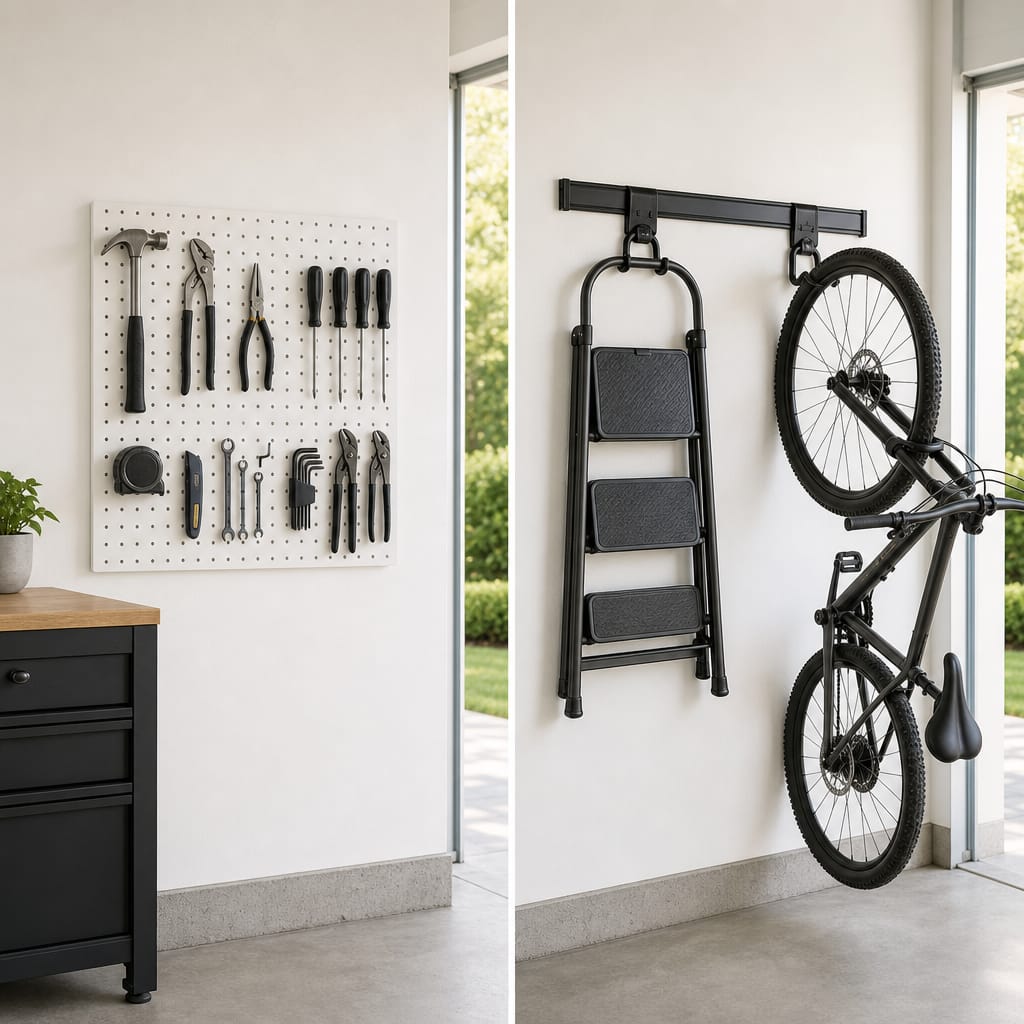
Most readers facing the wall behind their workbench have the same argument: pegboard panel plus an assortment of hooks, or a horizontal rail kit at three to four times the cost. Both work. The right answer depends on what you want to hang.
This article compares the two hook systems head to head — how each carries weight, how each mounts, what each is genuinely good at. We are not comparing pegboard panels vs slatwall panels at the system level (that’s pegboard vs slatwall at the panel level) or walking through installing a pegboard panel. Just the hooks.
Quick Answer
For light hand tools you’ll reorganize often, pegboard hooks usually win on cost and flexibility. For heavier dedicated items (ladders, bikes, long-handled gear), rail hooks usually win on per-hook capacity and purpose-built geometry. Pegboard-panel maker Wall Control publishes per-hook ratings of 5-10 lb for a single-slot hook up to 10-20 lb for a shelf assembly — the clearest sourced benchmark, since the generic hook assortments compared here don’t publish a per-hook figure of their own; a single Rubbermaid FastTrack rail hook is manufacturer-listed at 50 lb. The decision often comes down to two questions: how heavy is the heaviest thing you’ll hang, and how often will you reconfigure?
Best Choice by Situation
| Situation | Better choice | Why |
|---|---|---|
| Hanging hand tools under 10 lb each | Pegboard hooks | Lowest cost per slot, highest geometry variety |
| Hanging a step ladder or extension ladder | Rail hooks | Manufacturer-listed 50 lb, padded contact |
| Hanging a bike vertically by the wheel | Rail hooks | Bike-specific geometry, frame clearance |
| Wall is studded, you’ll reconfigure monthly | Pegboard hooks | Hooks pop in and out without re-drilling |
| Drywall over studs, items heavy and stay put | Rail hooks | Single anchor into studs carries the load |
| Mixed loads on one wall | Both | Small rail section for heavy items, pegboard for tools |
Pegboard Hooks — Pros, Cons, Best Use Cases
What pegboard hooks are
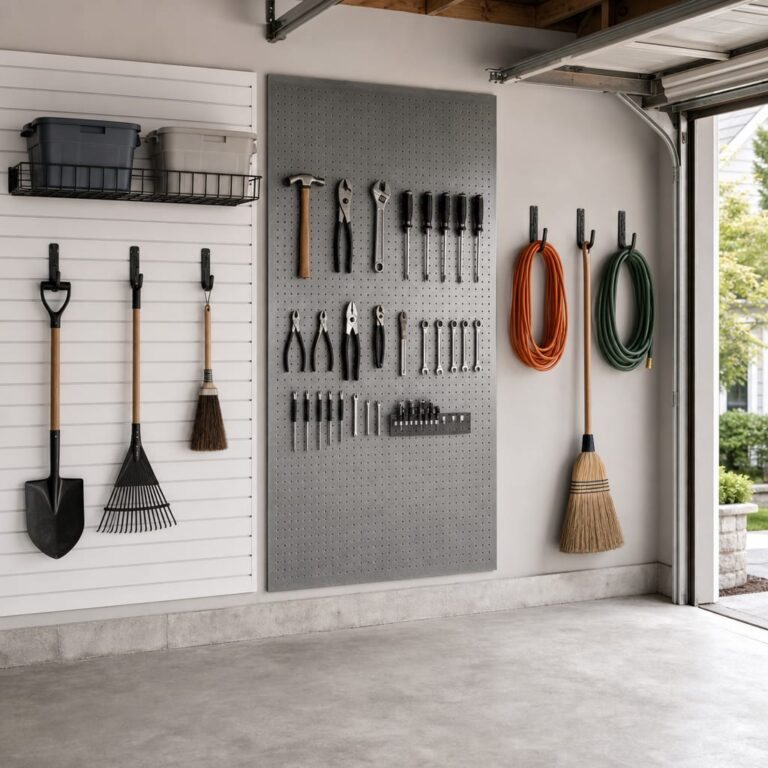
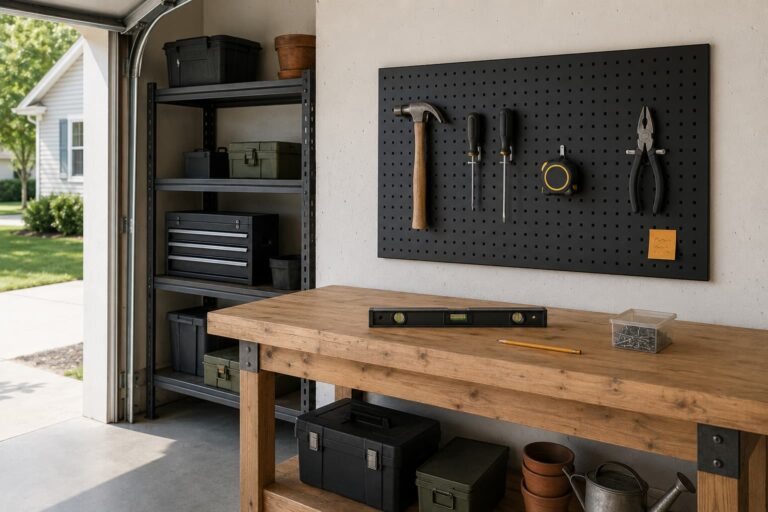
Pegboard hooks are metal hooks that slot into the standard 1/4-inch holes of a pegboard panel. The geometry varies — single peg, double peg, U-hook, ring hook, basket hanger — and you mix and match. Most assortments include eight to twelve geometries in a single kit, and the kits are not tied to one brand of panel.
Where they work best
- Hand tools, drivers, wrenches, pliers — anything under roughly 10 lb each
- Workshops where the wall layout changes often
- Mix-and-match setups (screws in baskets, drivers on double-pegs, a hammer on a J-hook, all on one panel)
- Low-budget starts — a hook assortment runs a fraction of a comparable rail-hook set
Where they fall short
- Per-hook capacity ceiling — pegboard maker Wall Control publishes 5-10 lb for a single-slot hook, up to 10-20 lb for a shelf assembly; most generic hook assortments don’t publish a per-hook rating at all
- Hook pop-out is the recurring complaint — pulling a tool sometimes pulls the hook with it, especially on hardboard with worn holes
- Hook prongs scratch tools that get pulled in and out daily
- Bike, ladder, and long-handled gear do not fit available pegboard geometries safely
What product pages should clearly specify
A good pegboard hook listing tells you the peg diameter (1/4 inch is the US standard; some imports use 1/8-inch holes), the manufacturer-listed lb capacity per geometry, and whether the hook has a secondary “lock” against fall-out. Listings with only a glamour photo and a piece count are softer purchases.
Buyer warnings specific to pegboard hooks
- Hole-size mismatch — buying 1/4-inch hooks for a 1/8-inch panel leaves them loose or unfittable
- Panel material matters — hardboard pegboards wear at the holes; metal pegboards do not
- “Extra thick” pegs (0.22-inch diameter) reduce pop-out but only fit panels with the standard 0.25-inch hole
- Loading the panel past what the panel itself can hold is its own failure mode — the hook may be fine, but the panel pulling off the wall is not
Rail Hooks — Pros, Cons, Best Use Cases
What rail hooks are
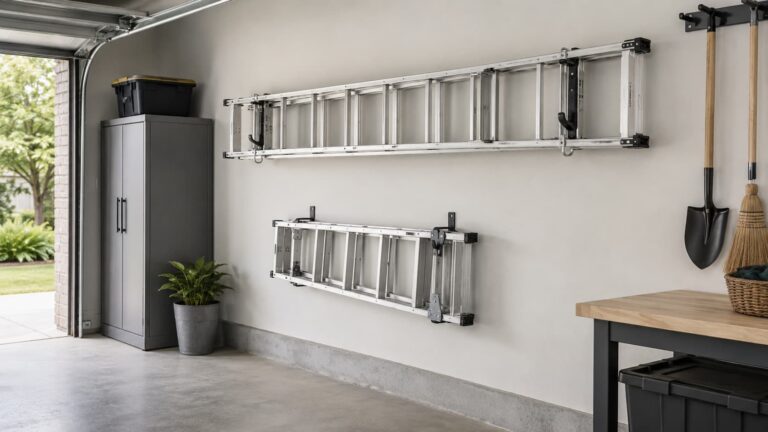
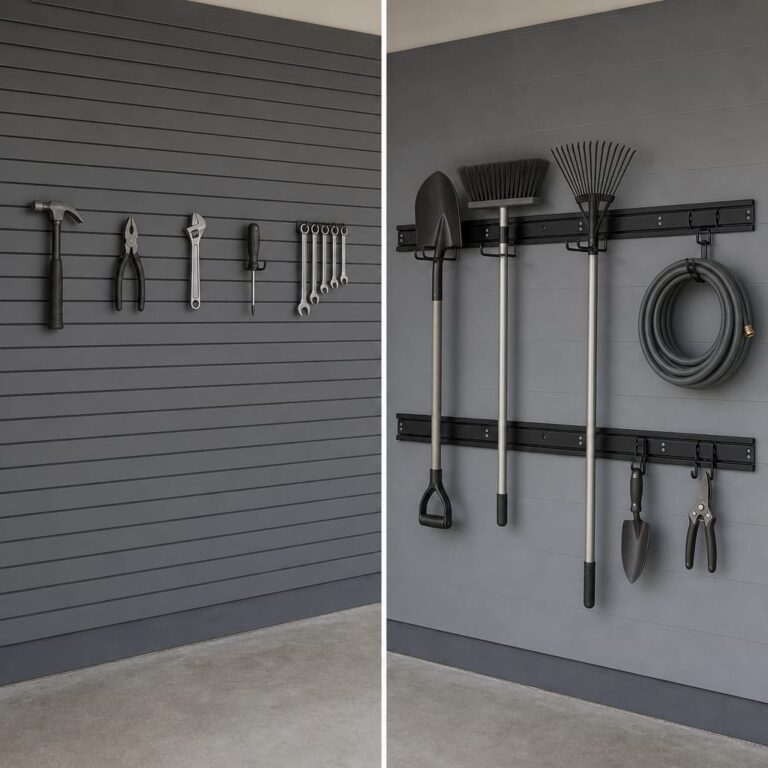
Rail hooks are accessories that snap into a proprietary horizontal storage rail — Rubbermaid FastTrack, Gladiator GearTrack, and a few smaller systems. Each hook has a cast-aluminum or steel gripper engineered for its rail’s channel and a load-bearing arm built for one job: ladders, bikes, hoses, long-handled tools. Most rail systems also let you mount the same hooks directly to a wall stud if you skip the rail.
Where they work best
- Heavy single items — manufacturer-listed 50 lb per hook on most FastTrack accessories
- Dedicated geometries — a bike hook cradles a wheel rim differently than a ladder hook holds a ladder rail
- Padded contact surfaces, which protect bike rims and ladder rails
- Fold-flat or low-protrusion designs when the hook is empty
- Longevity — Rubbermaid FastTrack hooks have been on Amazon since the mid-2000s as a stable product family. Our broader roundup of garage hooks covers the wider category
Where they fall short
- Cost per slot — a single rail hook runs more than the average cost-per-hook in a 100-piece pegboard kit
- The rail has to exist first — you cannot add a rail hook without a rail or a stud direct-mount
- Ecosystem lock-in — a FastTrack hook will not fit a Gladiator GearTrack rail (different channel geometry)
- Fewer improvised use cases — pegboard’s strength is solving a hanging problem with a J-hook and imagination
What product pages should clearly specify
A good rail-hook listing states the manufacturer-listed lb per hook (50 lb is the FastTrack benchmark), the rail family it fits (FastTrack vs GearTrack), and whether it direct-mounts to a stud. Listings that bury compatibility under “fits most systems” are warning signs.
Buyer warnings specific to rail hooks
- Rail-system lock-in — verify which rail family your hook fits before buying
- Stud-mount is non-negotiable for the listed capacity — drywall-only anchors will not hold 50 lb regardless of what the package says
- Single-hook vs pair math — extension ladders longer than about 6 ft typically need two hooks at spaced stud locations
- Folded position still eats some wall depth — verify clearance against nearby door swings
Side-by-Side Comparison
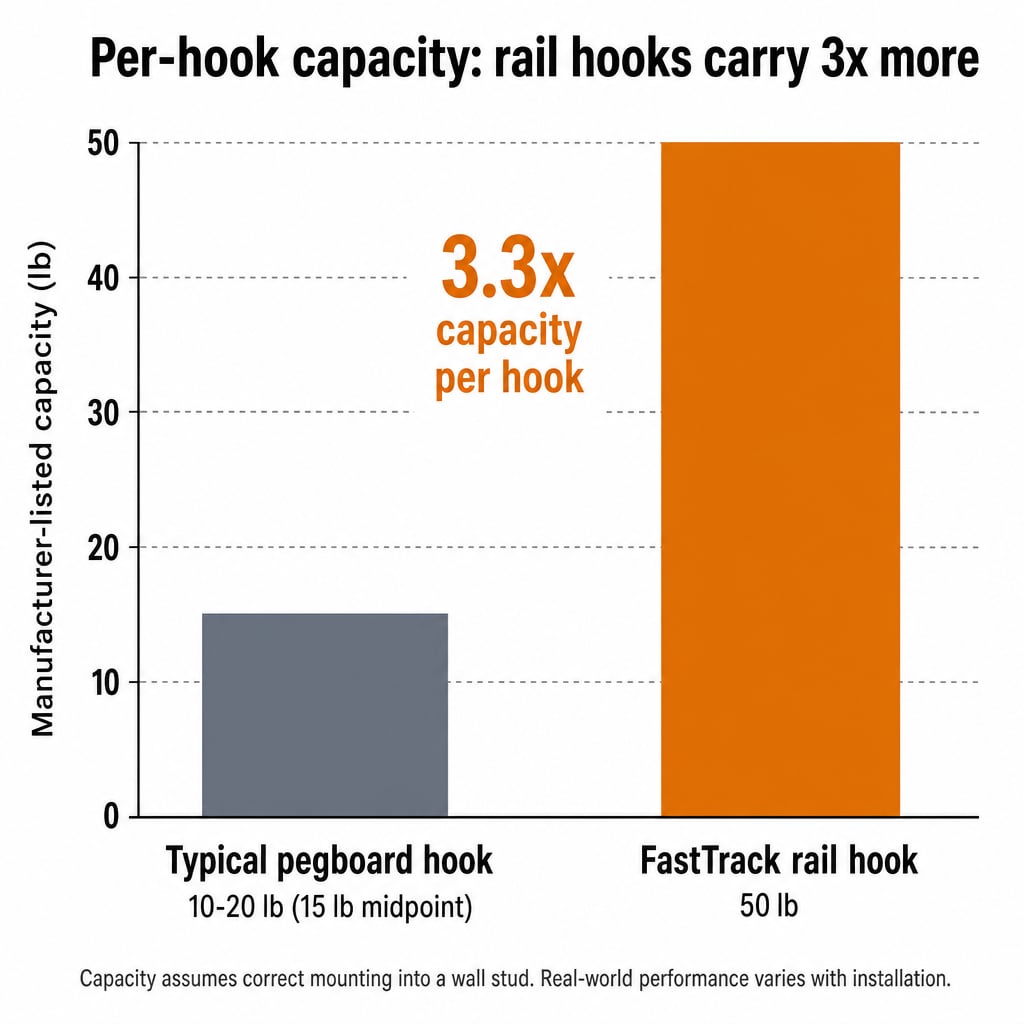
The headline trade-off is per-hook capacity. Wall Control, a pegboard-panel manufacturer, publishes per-hook ratings from 5-10 lb on a single-slot hook up to 10-20 lb on a shelf assembly; a Rubbermaid FastTrack hook is manufacturer-listed at 50 lb.
| Factor | Pegboard hooks | Rail hooks |
|---|---|---|
| Typical per-hook capacity | 5-20 lb (Wall Control benchmark: single-slot to shelf) | 50 lb (FastTrack benchmark) |
| Cost per slot | Lowest in category | 3-5x higher than pegboard |
| Install effort | Pegs slot in (panel install separate) | Rail must be mounted first OR direct-mount to stud |
| Reconfiguration speed | Seconds | Slide along rail OR re-drill if direct-mounted |
| Geometry variety in one kit | Eight to twelve geometries | One geometry per hook |
| Ecosystem lock-in | None — any 1/4″ hook fits any 1/4″ panel | Strong — FastTrack vs GearTrack are incompatible |
| Where the load goes | Onto panel, then onto panel anchors | Onto rail or stud, directly into stud |
How to Decide for Your Garage
Walk through four questions in order. The first one that gives you a clear answer is usually the deciding one.
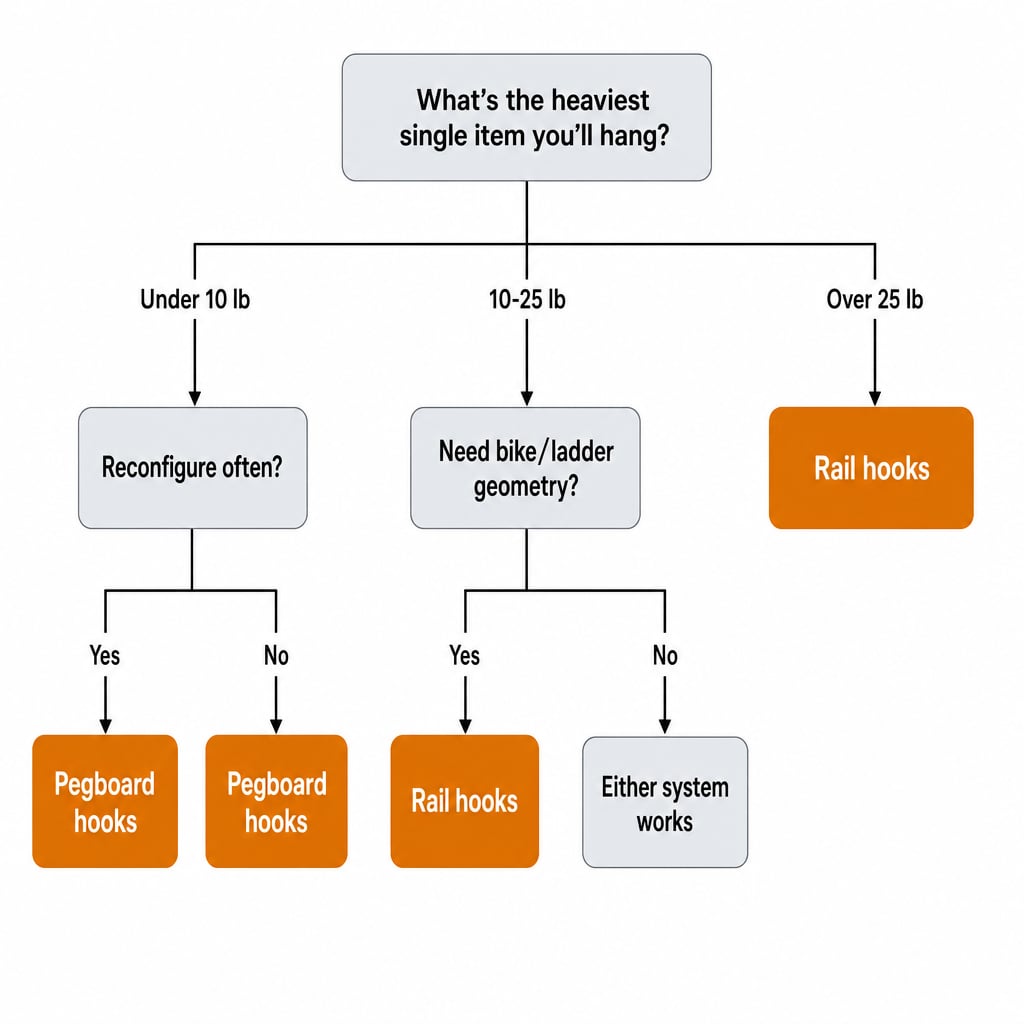
- What’s the heaviest single item you’ll hang? Under 10 lb each — pegboard hooks have you covered and cost a fraction of rails. Between 10 and 25 lb — both systems work, but a packed pegboard panel asks more of the panel anchors than a single rail hook in a stud. Over 25 lb (extension ladder, full-size bike, long-handled lawn tool) — rail hooks are the safe answer.
- How often will you reconfigure? Monthly or more — pegboard hooks pull out and reseat in seconds. Once and done — rail hooks reward the upfront install with a permanent layout.
- Is the wall studded or drywall-only? Drywall-only kills the headline capacity of either system. Find studs first. Fix the wall before fixing the storage.
- Do you need item-specific geometries? Bike, ladder, hose, long-handled lawn tools — rail hooks have dedicated shapes for each. If the answer is yes, rail wins; if the answer is no, pegboard’s mix-and-match is fine.
Common Mistakes
Mistake: Confusing direct-to-drywall heavy-duty hooks with rail hooks. Hooks like the HORUSDY 10-pack utility set look similar to rail hooks in product photos — black, beefy, garage-styled. They are not rail hooks. They mount with a single lag bolt directly into the wall, they do not snap into any rail, and the failure mode under overload is different. Useful product, different category.
Mistake: Buying rail hooks before installing the rail. Every rail hook listing assumes a rail or a stud underneath. Buying a FastTrack hook without owning a FastTrack rail (and without committing to a stud direct-mount) leaves you with an accessory that has nowhere to go.
Mistake: Anchoring a pegboard panel to drywall alone. A panel anchored to drywall behind a 30-lb pegboard kit will pull away at the corner under one or two heavy tools. The hooks are not the failure point; the panel-to-wall connection is.
Mistake: Assuming FastTrack and GearTrack are interchangeable. They are not. FastTrack channels are deeper and use a different cast-aluminum gripper than GearTrack. For the system-level decision (not just hook compatibility), our slatwall vs track rail comparison covers the broader question.
Recommended Products for Each Side
Four picks, split 2 + 2 across both sides.
For the pegboard side: Tgnazet 1/4″ Pegboard Hooks Assortment

The canonical “buy a pegboard panel, then buy this kit, hang tools the same day” purchase. Multiple hook geometries (J-hooks, U-hooks, multi-tool holders, ring hangers) for 1/4-inch peg compatibility — no baskets, just hooks. The right pick for outfitting a panel cheaply without committing to a particular layout.
For the pegboard side: INCLY 1/4″ Pegboard Accessories Kit, 100 PCS

Hooks plus three sizes of baskets, all on the same 1/4-inch peg standard. Small fasteners go in baskets, tools on hooks, drivers on double-pegs, all on one panel. The right pick for outfitting a workbench wall with mixed loads.
For the rail side: Rubbermaid FastTrack Ladder Hook
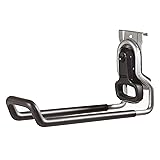
Manufacturer-listed at 50 lb on a single hook, padded ladder contact, dual-mount (snaps into the rail or direct to a wall stud), folds against the wall when not in use. The clearest example of what a rail hook does that no pegboard hook can — single-hook capacity matching what a packed pegboard would need five-plus pegs to approach.
For the rail side: Rubbermaid FastTrack Vertical Bike Hook

Bike-specific geometry, manufacturer-listed at 50 lb, fits 12-26 inch frames, soft-coated wire on a cast aluminum gripper. Pegboard does not have a hook shaped for this — its universal geometries make compromises a dedicated rail hook does not.
What garage wall systems actually hold, compared fairly
Pegboard is rated per panel, rails per linear foot, slatwall per square foot. Three different units means the published numbers cannot be compared as they stand — so nobody compares them, and a 200 lb figure on one product looks like a 200 lb figure on another. This table quotes each manufacturer’s rating and converts them all to pounds per linear foot of a 4 ft high wall run, with the arithmetic shown. Normalised values are comparison figures, not safe point-load limits. A system rated for 1,200 lb distributed across a wall section does not support a 1,200 lb hook.
| System | Type | Rating as published | Rating type | Same rating, per linear foot of a 4 ft wall | Working | Stud requirement | Specification source | Source checked |
|---|---|---|---|---|---|---|---|---|
| Wall Control metal pegboard (16 × 32 in panel) | pegboard | 200 lb per panel into studs (100 lb on drywall anchors) | panel recommendation | 225 lb per linear foot | 200 lb ÷ (16 in × 32 in panel = 3.56 sq ft) = 56.25 lb per sq ft; 56.25 × 4 ft high = 225 lb per linear foot (equivalently: a 4 ft × 4 ft section fits 3 panels across × 1.5 high = 4.5 panels × 200 lb = 900 lb ÷ 4 ft) | mounting holes on 16 in stud centres | Wall Control 16 × 32 in Metal Pegboard | 2026-09-14 |
| Gladiator GearTrack channel (rail) | rail | 75 lb per linear foot of channel | rail/channel rating | 150 lb per linear foot | 75 lb/ft per channel (published) × 2 channels (assumed common install) | mounts to bare wood studs or drywall over wood studs | Gladiator 4′ GearTrack Channels | 2026-09-14 |
| Gladiator GearWall slatwall panel | slatwall | 50 lb per square foot | distributed panel load | 200 lb per linear foot | 50 lb/sq ft × 4 ft high | not published on the product page | Gladiator 4′ GearWall Panels | 2026-09-14 |
How these numbers were produced: Each published rating is quoted from the manufacturer’s own page on the date shown. Conversion to pounds per linear foot assumes a 4 ft high run of wall: a per-square-foot rating is multiplied by 4. A per-panel rating is first converted to an equivalent per-square-foot rate, using the panel’s own published width and height, then multiplied by 4 the same way — scaling a per-panel rating sideways only, at the panel’s own height, would normalise it to a taller or shorter slice of wall than the 4 ft reference every per-square-foot row uses, so the two steps (per-panel → per-sq-ft → per-4-ft-run) keep every row on the same footing. A per-foot-of-rail rating is different in kind: the manufacturer publishes a rate per channel, and this table doubles it to show a common two-channel install — that doubling is our own installation assumption, not a manufacturer-stated rate; the sourced figure is the single-channel rate. Where a manufacturer publishes a single fixed capacity for a whole pre-sized unit rather than a rate per foot or per square foot, that figure is quoted as published and left out of the per-linear-foot column rather than converted with an invented rate.
- These are manufacturer maximums for a correctly installed system, not a promise. Every one of them depends on hitting studs, using the specified fasteners, and spreading the load rather than hanging it all off one hook.
- The comparison assumes a 4 ft high run. A rail system does not gain capacity from wall height the way a panel does — it gains it from adding channels, which is why its normalised figure moves when you change the channel count, not the height.
- Stud spacing is a hard constraint, not a suggestion. Proslat’s PROCORE is the only system here with a published compatibility range — engineered for 24 in centres, rated compatible down to 16 in. Check whether your own system publishes a similar range before assuming it.
- Drywall anchors are not studs: Wall Control publishes 100 lb per panel on anchors against 200 lb into studs — a real number for that one product, not a ratio to assume for other systems here that don’t publish their own stud-vs-anchor split.
- Capacity drops the further a load sits from the wall: storeWALL publishes 250 lb per sq ft as a distributed rating at the panel surface, but only 115 lb as a point measurement 4 in out. That lever-arm principle is a reasonable general caution for hooks and brackets on any system, but storeWALL is the only brand here that publishes a number for it.
- A blank cell means the manufacturer does not publish that figure — we do not fill gaps with numbers we could not source.
- This list favors brands whose own specification pages state a capacity figure in a form we could verify directly. Some well-known brands are not yet in this table because their published pages did not state a load rating we could confirm on this pass — that is a sourcing gap, not a signal that the product is weaker.
These are the entries that matter for this guide. The full table, with every row and its source, is in our What garage wall systems actually hold, compared fairly.
FAQ
Are pegboard hooks compatible with all pegboards?
No. The US standard pegboard hole size is 1/4 inch, but some imported panels use 1/8-inch holes and will not fit the same hooks. Always check the panel’s hole size before buying a hook kit, and prefer “extra thick” pegs (0.22-inch diameter) when your panel is 1/4 inch — they reduce pop-out.
How much weight can a single pegboard hook actually hold?
Capacity varies with hook geometry, and most generic assortments don’t publish their own per-hook rating. Pegboard-panel maker Wall Control publishes specific figures for its own hooks: 5-10 lb for a hook engaging a single slot, 10-15 lb for a hook engaging two slots, and 10-20 lb for a shelf assembly with the load spread across the shelf. Treat those as the category benchmark, not a guarantee for an unbranded kit — and real-world performance also depends on whether the panel itself is anchored into studs.
Do FastTrack hooks fit Gladiator GearTrack rails?
No. The channels are different — FastTrack uses a deeper C-channel and a cast aluminum gripper that will not snap into the shallower GearTrack profile. Verify your rail family before buying hooks.
Can I install rail hooks directly into drywall?
Only if the screw goes through the drywall and into a stud behind it. Drywall anchors will not hold the manufacturer-listed 50 lb when a 30-lb ladder swings against the hook. A stud finder is a five-dollar tool that protects the entire purchase.
Is it worth combining both systems on one wall?
Often yes. A short rail section behind the workbench for the bike and ladder, plus a pegboard panel above for hand tools, gives you per-hook capacity where it matters and mix-and-match flexibility where it matters. For the wider system-level decision, our guide on choosing a garage wall storage system covers the options.
How do I keep pegboard hooks from popping out when I pull a tool?
Three options. First, switch to “extra thick” 0.22-inch peg-diameter hooks on a panel with standard 0.25-inch holes — the snugger fit alone fixes most pop-out. Second, add peg locks (small plastic clips that snap over the back of the peg). Third, switch to slotted hooks on a metal pegboard like Wall Control — slotted hooks lock into the panel and behave more like rail hooks than like 1/4-inch pegs.
Sources Reviewed
For this comparison, we reviewed manufacturer pages and retailer specs for the pegboard hook assortments (Tgnazet, INCLY) and FastTrack rail hooks (Rubbermaid), Wall Control’s published pegboard hook load ratings (the sourced per-hook capacity benchmark used on the pegboard side), the Amazon listings for each ASIN, recurring patterns in public customer feedback, and discussions where homeowners shared their experience choosing between the two systems. We do not claim hands-on testing.
Related Guides
- Best garage pegboards
- Best garage hooks
- Pegboard vs slatwall for garage
- Slatwall vs track rail for garage
- How to install a garage pegboard
- How to choose your garage wall storage system
- How to Choose a Garage Tool Organization System
- How to Organize Extension Cords in Your Garage
- how to set up a garage workshop