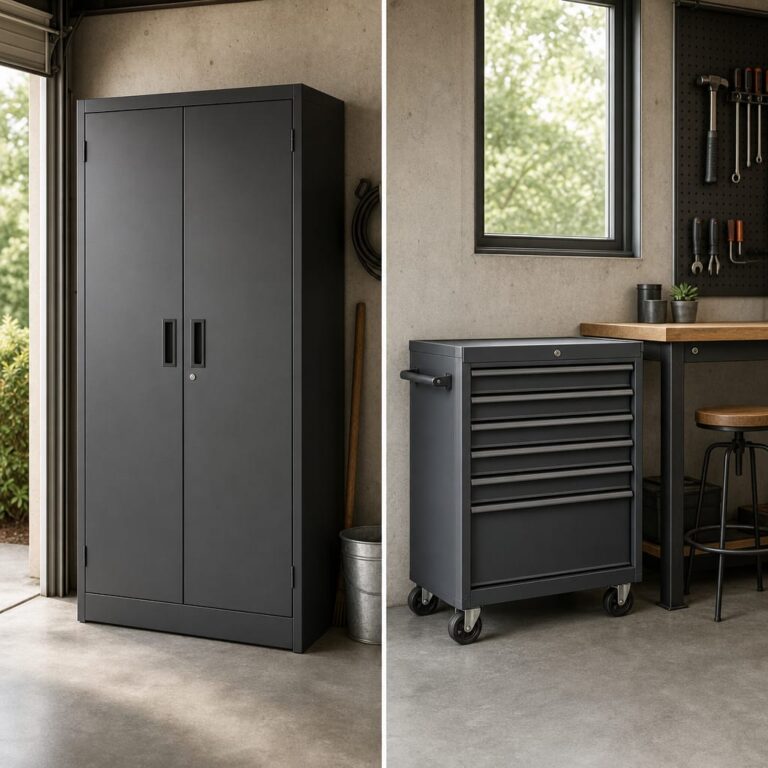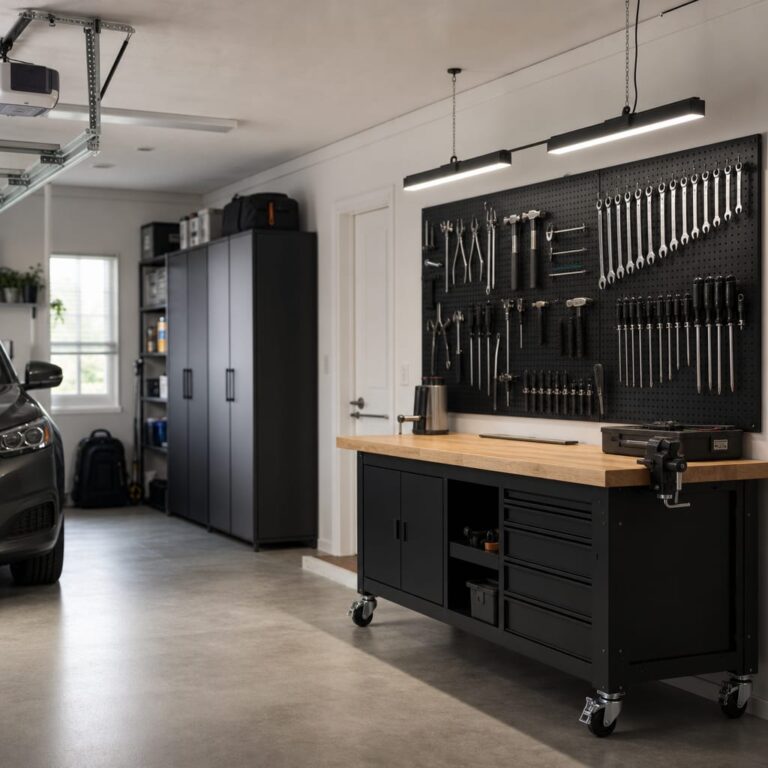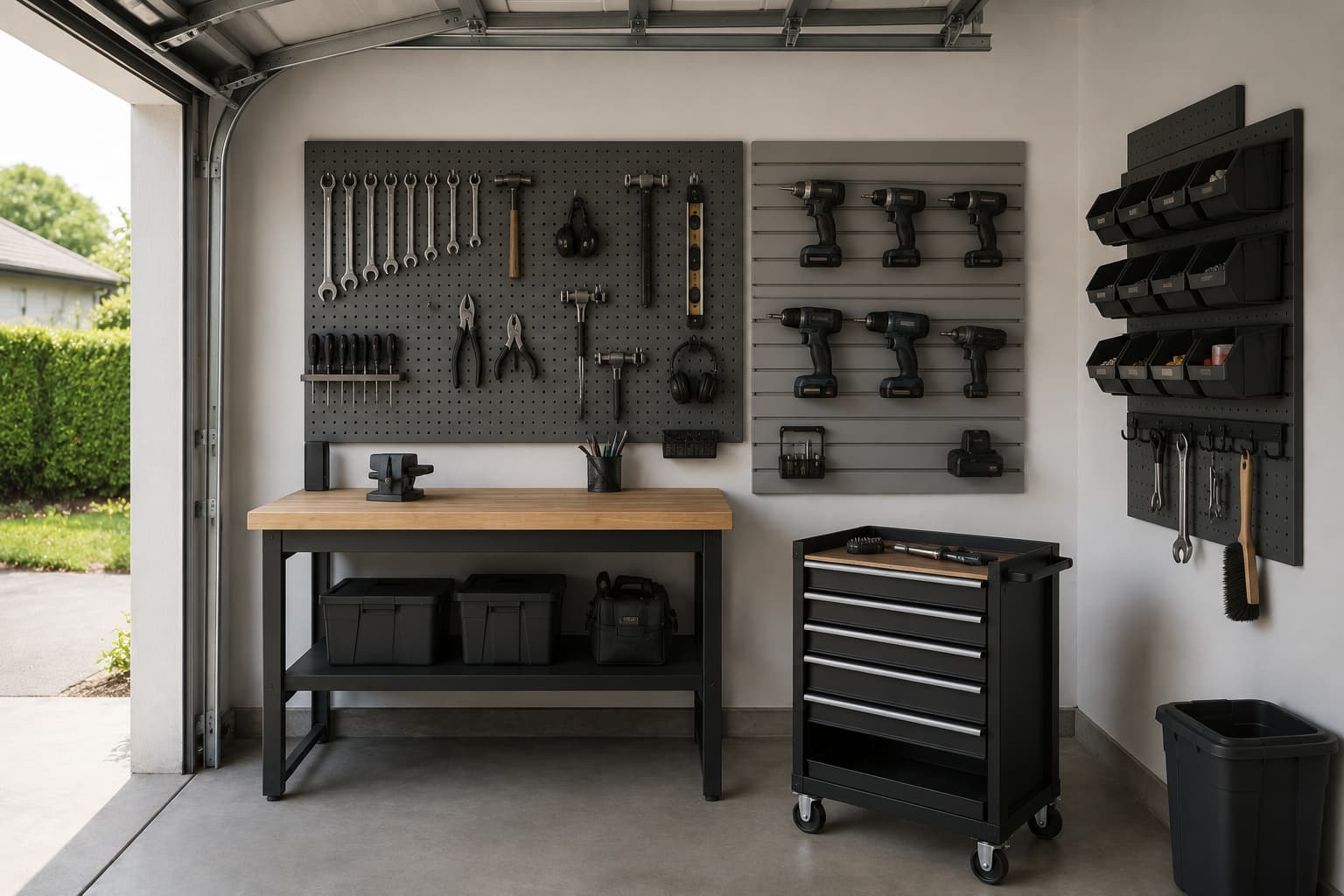
Best Garage Tool Organizers for Small Workshops (2026)
Last updated:
Disclosure: This article contains affiliate links. If you buy through these links, we may earn a commission at no extra cost to you. We do not claim hands-on testing unless clearly stated.
Small workshops are won or lost on tool organization. Wall and bench surfaces are finite, the floor cannot absorb a full-size tool chest without a fight, and the bins at the back of a shelf are where small parts go to die. The good news: a small workshop does not need a small organizer — it needs the right organizer matched to the right sub-niche.
This guide covers six organizer categories sized for a 1-car garage or smaller workshop: a pegboard kit for hand tools, a slatwall system for heavier power tools, a compact rolling cart, a 27-inch stationary tool chest, a wall-mounted drawer organizer for small parts, and a fastener drawer cabinet. Each pick is chosen for the small-workshop footprint constraint first — none of these are scaled for an industrial bay.
What this guide does not cover: full-size industrial tool chests (41 inches and wider), commercial slatwall installations that span multiple walls, or general garage clutter beyond hand and power tools. Those problems live in different categories.
Quick Picks
| Pick | Product | Best for | Type | Watch out for | |
|---|---|---|---|---|---|
| Best Compact Pegboard for Hand Tools | Wallmaster Pegboard Organizer Garage Storage Kit | Hand-tool wall | Pegboard + bins kit | Not for power tools | View on Amazon |
| Best Slatwall for Power Tools | Proslat 88107 Heavy Duty PVC Slatwall (8′ × 4′, 10 panels) | Cordless drills, drivers, smaller power tools | PVC slatwall panel system | Hooks/accessories sold separately | View on Amazon |
| Best Compact Rolling Cart | Craftsman 26-Inch 5-Drawer Rolling Tool Chest (CMST32752RB) | Mobile hand-tool storage | Rolling cabinet | Multiple Craftsman 26-inch variants exist | View on Amazon |
| Best Stationary Tool Chest | Husky 27-Inch 10-Drawer Roller Cabinet Tool Chest Combo | Full chest in a small footprint | Tool chest combo | Husky is Home Depot-primary | View on Amazon |
| Best Wall Drawer Organizer | Stalwart 75-ST6079 Wall Mountable Storage Rack | Visible small-parts wall | Wall drawer rack | Drawer count varies across the Stalwart line | View on Amazon |
| Best Fastener Drawer Cabinet | Akro-Mils 10164 64-Drawer Plastic Cabinet | Sorted, sealed small parts | Drawer cabinet | Confirm 64-drawer model | View on Amazon |
How We Selected These Organizers
We do not claim hands-on testing unless clearly stated. For this guide, we reviewed manufacturer specifications, retailer product pages, product documentation where available, current listings, and recurring patterns in public customer feedback.
Because “small workshop” is the load-bearing constraint in this roundup, we prioritized products with footprints that fit a 1-car garage or smaller — and we declined to include products that work better at industrial scale. A 41-inch rolling chest is a great chest in absolute terms; it is the wrong chest for a 12-by-20-foot garage shared with a car and a bike.
Selection criteria:
- Functional fit for a 1-car garage workshop or smaller (no industrial-scale picks)
- Manufacturer-listed dimensions and capacity that actually match the intended sub-niche (a “pegboard kit” that maxes out at 5-lb hooks is honest; one that promises power-tool weights on plastic peg-hooks is not)
- Branded products with verifiable manufacturer pages where possible — generic Amazon listings rotate ASINs frequently
- ASIN stability proxy: established review base and listing tenure
- Brand diversity across slots so no single brand takes more than one slot
What to Look for Before Buying
Six organizer categories sound like a lot until you realize each one solves a different problem. Buy the wrong category and the organizer either sits empty or overflows — neither helps. Four factors decide which category fits.
Wall area vs floor area trade-off
Small workshops have a finite wall area AND a finite floor area, and the two compete. Wall-mounted organizers (pegboard, slatwall, drawer organizer) consume zero floor space but require a wall section free of windows, doors, electrical panels, and the swing arc of the garage door. Floor-standing organizers (carts, chests, cabinets) consume floor area but free up the wall. Most small workshops need a mix — start by mapping which surface is more constrained for your specific space.
Sub-niche match
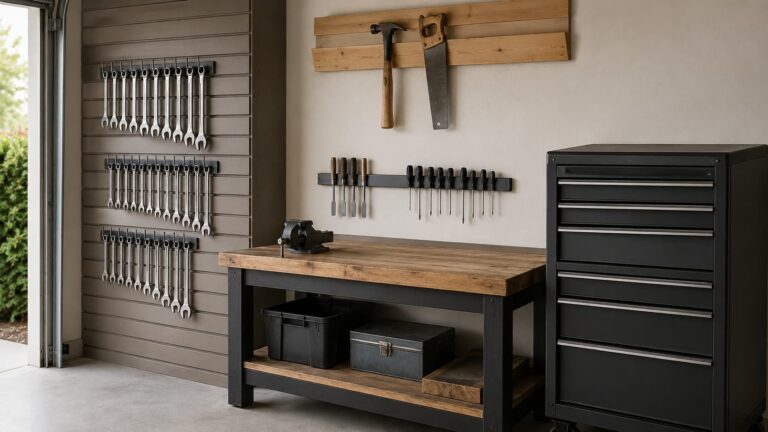
Do you actually need a tool chest, or is a pegboard the right answer? A reader with twenty hand tools and three cordless drivers does not need a 27-inch drawer chest — a pegboard plus a small magnetic strip would cost a tenth as much and store everything visibly. Conversely, a reader with a serious socket-and-wrench collection needs a chest, not a wall of hooks. Match the sub-niche to your tool inventory, not to what “looks like a real workshop.”
Mounting hardware compatibility
Drywall, plaster, masonry, and metal stud walls all require different mounting hardware. Most pegboard and slatwall kits ship with the panel hardware but not the wall fasteners — you supply lag bolts (for studs), drywall anchors (for between studs), or masonry anchors (for block walls). Small workshops often have a single viable wall, so verify what is behind the drywall before buying anything that mounts.
Drawer depth and bin granularity
Over-bin systems (a 30-bin rack with bins large enough to hold full power tools) waste shelf depth on big items that should live somewhere else. Under-drawer systems (a 64-drawer cabinet with shallow drawers) are perfect for fasteners but useless for sockets. Match the storage granularity to what you actually own — the bin-or-drawer dimension matters more than the count.
Best Compact Pegboard for Hand Tools: Wallmaster Pegboard Organizer Kit
Best for: a reader with a typical home hand-tool collection — screwdrivers, pliers, hammers, wrenches — who wants those tools visible on a single wall in a 1-car garage.

Short verdict: a compact pegboard kit that ships with hooks, storage bins, an overhead shelf, and a paper towel holder — enough to populate a small-workshop wall on day one. The right pick when your tools are mostly hand tools.
The Wallmaster pegboard organizer is a steel pegboard with a hook set, wall-mounted storage bins, an overhead shelf, and a paper towel holder bundled into a single SKU. The product page lists steel construction and a hook count covering common hand-tool shapes — open hooks for hammers, double hooks for pliers, ring holders for screwdrivers. Wall fasteners are buyer-supplied.
Why it stands out
What separates this from a generic pegboard panel is the bundled accessory mix — pegboard, hooks, bins, and shelf in one purchase. A bare pegboard is half a product; without hooks and bins, it is decorative. Buying everything together saves the second hardware-store trip and lets you populate the wall in one weekend.
It can work well for:
- Hand-tool walls in 1-car garages
- Renters who can patch holes when moving out
- DIYers replacing a chaotic drawer with a visible wall
- Workshops where the bench is the work surface
Key specs to check
- Pegboard panel dimensions (measure your wall section)
- Hook and holder count in the kit (matches your tool variety)
- Standoff depth — pegboards mount about 0.5 inches off the wall
- Wall fasteners separate — lag bolts or drywall anchors
Recurring feedback patterns
Recurring positive feedback often centers on the all-in-one bundle convenience and the inclusion of bins plus a shelf rather than just hooks. Common complaints typically involve hooks coming loose if a tool is yanked rather than lifted off, and the steel finish showing scratches over time. Several buyers mention the kit does not include wall-mounting hardware — standard across the pegboard category, but still catches first-time buyers.
Potential drawbacks
This kit is built for hand-tool weights. Hooks are not designed for power tools, and stacking heavier items on a single hook will eventually deform the hook or pull on the panel. Included accessories tend toward standard shapes — oversize wrenches or long pry bars may not have a matched holder.
Buyer warning
Measure your stud spacing and confirm what is behind your drywall before mounting. A pegboard loaded with hand tools weighs more than the panel alone, and small workshops often have one viable mounting wall — getting it wrong means re-patching drywall. For a deeper category dive, see our full guide to garage pegboards.
Best Slatwall for Power Tools: Proslat 88107 Heavy Duty PVC Slatwall
Best for: a reader with cordless drills, drivers, or smaller power tools who wants those tools on the wall — and needs a wall system that handles more weight than pegboard hooks can.
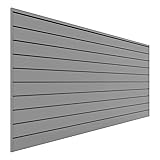
Short verdict: the Proslat 88107 is a 10-panel PVC slatwall section covering 8 feet by 4 feet of wall — the structural step up from pegboard for power-tool weight. The right pick when pegboard is not enough but a full tool chest is overkill.
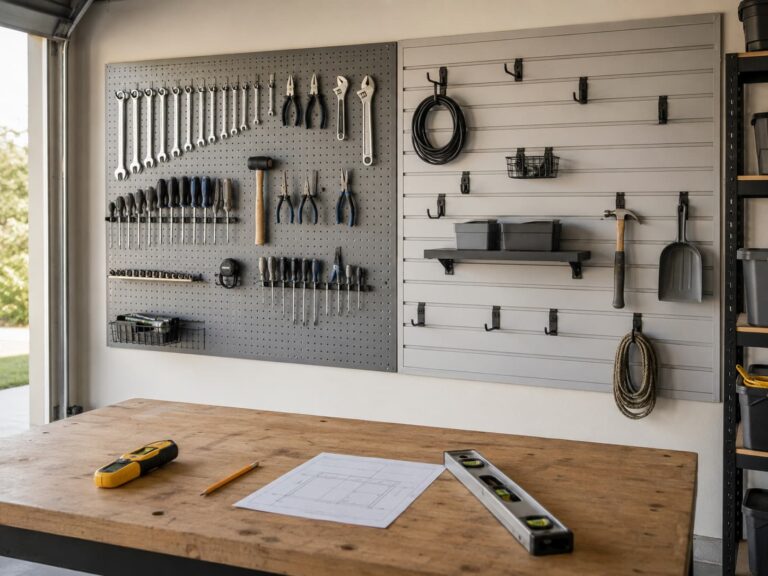
Slatwall differs from pegboard in two ways that matter in a small workshop: the panels lock together horizontally with a hidden hardware system, and slatwall accessory hooks lock into a horizontal slot rather than sitting in a 1-inch hole. Proslat lists a manufacturer-listed panel capacity of 75 pounds per linear foot, meaningfully higher than pegboard, and accessories slide laterally for layout changes without re-drilling.
Why it stands out
The 88107 covers 8 feet by 4 feet — enough wall area for a typical home workshop’s power-tool inventory in one purchase. PVC construction means the panels do not rust, and the locking-track design accepts third-party slatwall accessories from other vendors, so the system is upgrade-friendly. Hidden installation hardware keeps the wall looking clean once panels are up.
It can work well for:
- Cordless drill, driver, and oscillating-tool walls
- Workshops needing a reconfigurable single-wall layout
- A mix of hand and lighter power tools
- Finished drywall over wood studs
Key specs to check
- Total panel coverage (8 ft × 4 ft for the 88107)
- Manufacturer-listed capacity (75 lb per linear foot)
- Hook and accessory pack — NOT included; purchased separately
- PVC versus metal slatwall (Proslat 88107 is PVC, lighter to install)
Recurring feedback patterns
Recurring positive feedback often centers on the panel’s durability and the clean look once installed, plus the breadth of third-party accessories that fit the standard slatwall track. Common complaints typically involve initial installation time — panels are heavier than pegboards and most installations need two people. Several buyers mention the listing does not include hooks, which catches buyers expecting a complete starter kit.
Potential drawbacks
The Proslat 88107 is the panel system only — hooks, baskets, and shelves are sold separately. Total cost to populate a full 8×4 section with accessories is significantly more than pegboard. The PVC panels are also visually busier than a clean pegboard, which some readers find distracting where the wall is in constant view.
Buyer warning
The kit does not include lag bolts, masonry anchors, or hook accessories — expect a separate hardware run and a separate accessory purchase. Confirm what is behind your drywall before buying; mounting hardware is not interchangeable across wall types. For broader options, see our roundup of wall-mounted garage storage systems.
Best Compact Rolling Tool Cart: Craftsman 26-Inch 5-Drawer (CMST32752RB)
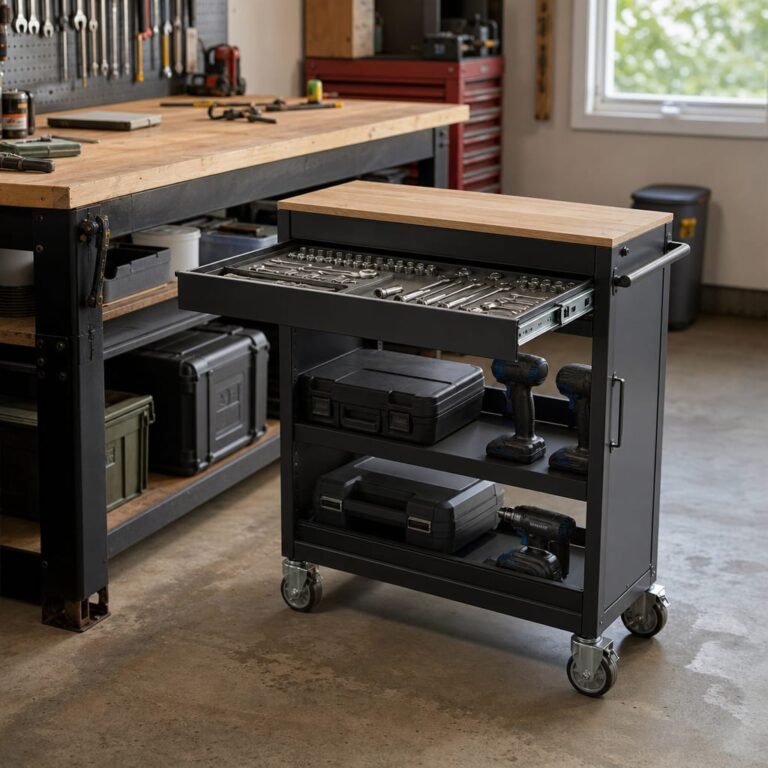
Best for: a reader who wants a mobile hand-tool unit that fits under a workbench and rolls out when needed — a “second bench” without permanent floor commitment.

Short verdict: 26 inches is the canonical “compact” rolling cabinet width and fits under most standard workbenches. The Craftsman CMST32752RB 5-drawer in this size is the reference pick — a brand with decades in the category and a stable Amazon listing.
The cabinet is powder-coated steel on four casters. A similar model in this Craftsman line lists per-drawer capacity in the 50-pound range — check the CMST32752RB’s own listing for its specific rating before assuming it matches — and the unit ships with both swivel and fixed casters for predictable steering when rolled.
Why it stands out
Craftsman’s brand longevity is the practical advantage — the listing has been on Amazon long enough to weed out variant traps. The 26-inch width fits under a 30-inch-tall workbench, so a small workshop can use the cart as auxiliary storage during the week and roll it to the project zone when needed.
It can work well for:
- Hand-tool storage that moves between bench and project
- Workshops where the cart slides under a bench when idle
- DIYers who want lockable drawers without a stationary chest
- Cart-as-parts-holder during single-day projects
Key specs to check
- Exact dimensions (26 W × ~18 D × ~32 H, manufacturer-listed)
- Per-drawer capacity — a similar model in this line lists around 50 lb; verify on this SKU’s own listing
- Total cabinet manufacturer-listed capacity
- Caster type — verify at least two swivel casters
- Drawer slide style (ball-bearing vs friction)
Recurring feedback patterns
Recurring positive feedback often centers on the size fitting standard workbench heights and the Craftsman parts-availability reputation. Common complaints typically involve drawer-slide friction after a few hundred cycles of heavy load and occasional shipping-damage reports on the powder-coat finish. Several buyers mention the casters work better on smooth concrete than on epoxy or rubber floor mats.
Potential drawbacks
The cabinet is narrower and shallower than a 41-inch chest, so storage capacity is intentionally limited — readers with large socket sets will outgrow it. Drawer slides are rated for the manufacturer’s listed per-drawer capacity, not aspirational loads — overloading shortens slide life.
Buyer warning
Craftsman sells multiple 26-inch variants (3-drawer, 4-drawer, 5-drawer) under similar listing names — pin the exact 5-drawer 26-inch CMST32752RB by checking the model number before buying. Also do not wheel the cart fully loaded across uneven floors; manufacturer guidance for this class is to move with light loads. For more rolling-cart picks, see our roundup of garage storage carts.
Best Stationary Tool Chest for Tight Spaces: Husky 27-Inch 10-Drawer Combo
Best for: a reader who wants a real tool chest — top chest plus lower cabinet — in the smallest practical footprint a “real” combo comes in, without dropping to a mobile cart alone.

Short verdict: the Husky 27-inch 10-drawer combo is the smallest stationary-style configuration that still gives both an upper chest and a lower roller cabinet — a complete sorting hierarchy in a footprint a 1-car garage can absorb.
The combo lists a top chest stacked over a lower roller cabinet, 10 drawers total. A similar Husky combo in this size class lists the lower cabinet at 500 lb — check this specific listing for its own rated capacity before assuming it matches. The unit is steel with a powder-coat finish in textured black. The lower cabinet has casters, but most small-workshop owners use it stationary against a wall.
Why it stands out
The combo format matters in a small workshop. A bare top chest sits on a bench; a bare cabinet has no top-tier sorting. Combining the two in a 27-inch footprint gives the storage logic of a 41-inch chest without the floor area.
It can work well for:
- Permanent stationary storage in a 1-car garage corner
- Readers transitioning from a cart-only setup to a real chest hierarchy
- Workshops where the chest sits against a wall and is not moved
- Socket/wrench inventories that need both shallow and deep drawers
Key specs to check
- Overall dimensions (27 W × ~18 D × ~52 H stacked, manufacturer-listed)
- Top-chest and lower-cabinet drawer counts separately (10 total)
- Lower cabinet capacity — a similar Husky combo in this size class lists 500 lb; verify on this SKU’s own listing
- Whether the top chest secures to the lower cabinet
- Lock type (tubular key — not high-security)
Recurring feedback patterns
Recurring positive feedback often centers on the storage-to-price ratio at this size and the perceived solidity of the steel construction relative to entry-tier brands. Common complaints typically involve drawer-slide quality variation between production runs and occasional reports of finish chipping where the chest meets the cabinet. Several buyers mention the lock cylinders are unsuitable for security-critical storage.
Potential drawbacks
Husky’s primary retail channel is Home Depot, so Amazon listings can be third-party fulfillment with pricing volatility — variants may not match the Home Depot SKU exactly. The 27-inch footprint, while compact for a combo, is still meaningful in a garage shared with a vehicle.
Buyer warning
Confirm the Amazon listing is active today and sold by a reputable seller before purchasing — Husky’s Amazon presence rotates more than the Home Depot equivalent. Also measure your corner: 27 inches plus drawer-pull clearance plus floor mat means about 36 inches of dedicated wall length. For workbench pairings, see how to organize a garage workbench.
Best Wall Drawer Organizer for Small Parts: Stalwart Wall Mountable Storage Rack
Best for: a reader who wants visible, scannable small-parts storage on a wall — fasteners, drill bits, accessories — without consuming bench surface or drawer space.

Short verdict: the Stalwart 75-ST6079 wall-mountable storage rack provides 47 removable drawers for small parts, mounted on a single wall section. The right pick when your fasteners are scattered across coffee cans, Ziploc bags, and the bottom of drawers right now.
The system is a wall-mounted rack with 47 small plastic removable drawers arranged in a grid. Each drawer slides out for benchtop access, and the rack bolts to the wall through pre-drilled holes. It is designed for the smallest-parts category — screws, nails, anchors, drill bits, washers, electrical hardware.
Why it stands out
What separates a drawer rack from a sealed cabinet is the combination of visibility and individual access. With 47 removable drawers in a single visual field, you can identify what you need without opening anything, then pull the single drawer you want to the bench rather than walking back and forth. The drawers are sized for small parts but deeper than open bin slots.
It can work well for:
- Fastener walls (screws, nails, bolts sorted by size)
- Drill bit and small-bit storage
- Small electrical hardware (terminals, wire nuts, fuses)
- Hobby applications where consistent sorting matters
Key specs to check
- Drawer dimensions (manufacturer-listed drawer volume)
- Rack overall dimensions
- Mounting style (some ship with wall hardware, some do not)
- Whether drawers are interchangeable across grid positions
- Drawer material — typically polypropylene
Recurring feedback patterns
Recurring positive feedback often centers on how much cleaner a fastener wall looks after sorting and the ability to scan the whole inventory at a glance. Common complaints typically involve drawers occasionally working loose if the rack is bumped, and drawer sizes being smaller than listing photos suggest. Several buyers mention the rack works best wall-mounted at eye level rather than above the bench.
Potential drawbacks
Drawers are small — designed for fasteners and drill bits, not batteries or larger accessories. The grid system does not lock individual drawers in place; if the rack is bumped or the workshop is in a high-vibration area, drawers occasionally slide out.
Buyer warning
Stalwart sells multiple wall-mounted organizers with different drawer counts — 8-drawer, 20-drawer, and 47-drawer models exist as separate SKUs and are not interchangeable. Verify the model number (75-ST6079 for the 47-drawer version) before buying. Also do not buy by piece count alone: a “47-piece” kit means 47 small drawers, a different proposition than a 20-drawer rack with larger drawers. Verify drawer volume against what you will store.
Best Fastener Drawer Cabinet: Akro-Mils 10164 64-Drawer
Best for: a reader who wants sorted, sealed small-parts storage finer than open bins — drawers prevent spillage, dust, and accidental mixing.
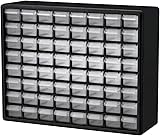
Short verdict: Akro-Mils is the industry-standard brand in the parts-drawer-cabinet category, and the 10164 64-drawer model is the right scale for a home workshop’s fastener inventory. The right pick when open bins are not enough.
The 10164 is a rigid ABS-frame cabinet with 64 polypropylene drawers in an 8-by-8 grid. Each drawer slides on a friction track, has front fingerholds, and can be subdivided with internal partitions in some configurations. Manufacturer-listed dimensions are 20 inches wide by 6 inches deep by 16 inches tall. The cabinet can sit on a benchtop or mount through rear holes.
Why it stands out
Akro-Mils has been making this line for decades, so drawers and dividers are interchangeable across model years and spare-parts availability is unusually good for a plastic product. The 64-drawer count is the practical sweet spot — fine enough to separate metric vs imperial screws, deep enough to hold meaningful quantities, and small enough to scan visually on a benchtop or wall.
It can work well for:
- Screw, nail, bolt, washer storage sorted by size and material
- Drill bit storage (steel, masonry, wood bits separated)
- Small electrical parts (terminals, connectors, fuses)
- Hobby parts (RC, model, jewelry, electronics components)
Key specs to check
- Cabinet dimensions (manufacturer-listed 20 W × 6 D × 16 H)
- Per-drawer depth (~1.5 inches — shallow)
- Drawer count (confirm 64; 10126 has 26, 10144 has 44)
- Material (ABS frame, polypropylene drawers)
- Whether the cabinet ships with dividers or drawers only
Recurring feedback patterns
Recurring positive feedback often centers on the long-term brand reliability and the satisfaction of having a sorted fastener inventory after years of disorganization. Common complaints typically involve drawer-slide friction varying within the same cabinet and occasional cracked drawer fronts from over-tightened fingerhold use. Several buyers mention the cabinet works better wall-mounted at chest height than sitting on a benchtop.
Potential drawbacks
Drawer depth is shallow — about 1.5 inches — which limits use to small fasteners, bits, and components. Anything larger than a typical wood screw will not fit comfortably. The cabinet does not lock; drawers slide on friction, so a vigorous bump can spill contents into adjacent slots.
Buyer warning
Akro-Mils sells multiple drawer counts under similar listings — the 10126 (26), 10144 (44), and 10164 (64) use comparable styling. Verify the drawer count in the title before buying. Also do not stack two cabinets without securing — the ABS frame is not designed for live load above it, and a stack can tip if a drawer is pulled while reaching for the top cabinet.
Side-by-Side Comparison
| Product | Best for | Type | Footprint | Suits power tools? | Main drawback |
|---|---|---|---|---|---|
| Wallmaster Pegboard Kit | Hand-tool wall | Pegboard + accessories | Pegboard panel + shelf | No | Not for heavy or power tools |
| Proslat 88107 Slatwall | Power-tool wall | PVC slatwall panel section | 8 ft × 4 ft wall | Yes (with separate accessories) | Hooks/accessories sold separately |
| Craftsman 26-Inch 5-Drawer (CMST32752RB) | Mobile hand tools | Rolling cabinet | 26 W × 18 D floor | Limited | Variant confusion in listings |
| Husky 27-Inch 10-Drawer Combo | Stationary chest | Tool chest combo | 27 W × 18 D floor | Yes (stored, not displayed) | Husky is Home Depot-primary |
| Stalwart Wall Drawer Organizer | Small parts wall | Wall drawer rack | Single wall section | No (parts only) | Drawers can dislodge |
| Akro-Mils 10164 | Fasteners and bits | Drawer cabinet | 20 W × 6 D × 16 H benchtop | No (parts only) | Shallow drawers (~1.5″) |
Pegboard vs Slatwall vs Magnetic: How to Pick Your Wall System
A small workshop usually has one viable wall for tool storage — pick the right system before you mount anything, because removing a pegboard or slatwall to swap it for the other leaves drywall damage either way.
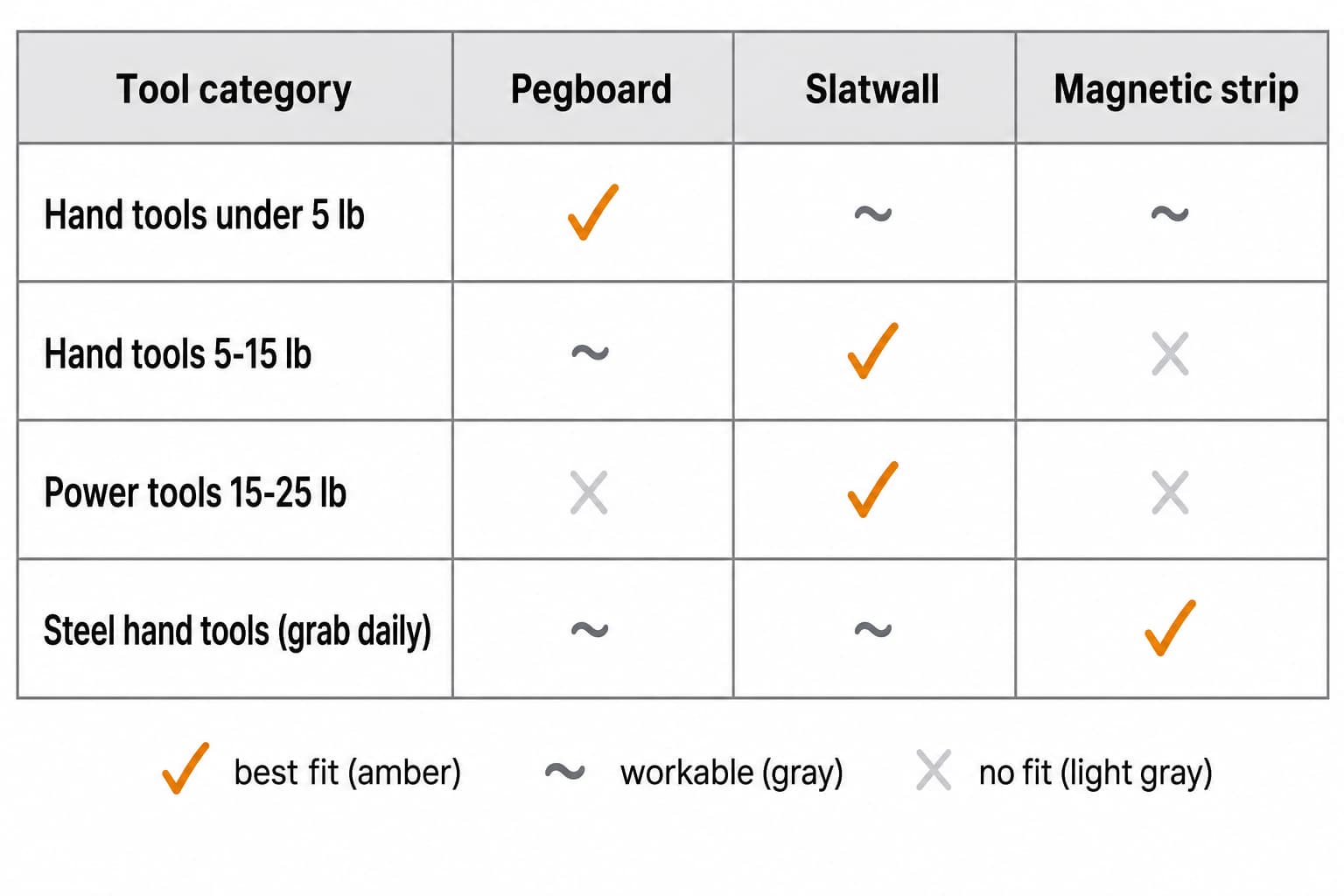
The decision matrix above maps tool category to wall system. As a general guide: pegboard suits light hand tools, slatwall suits heavier items like cordless power tools and larger accessories, and magnetic strips suit steel hand tools you grab daily — wrenches, pliers, hex keys. Manufacturers publish wall-system capacity as a panel, per-square-foot, or per-linear-foot rating rather than a per-hook figure (see the sourced capacity table below) — check your specific hook or bracket’s own rated capacity before hanging anything heavy, rather than relying on a pounds-per-hook cutoff.
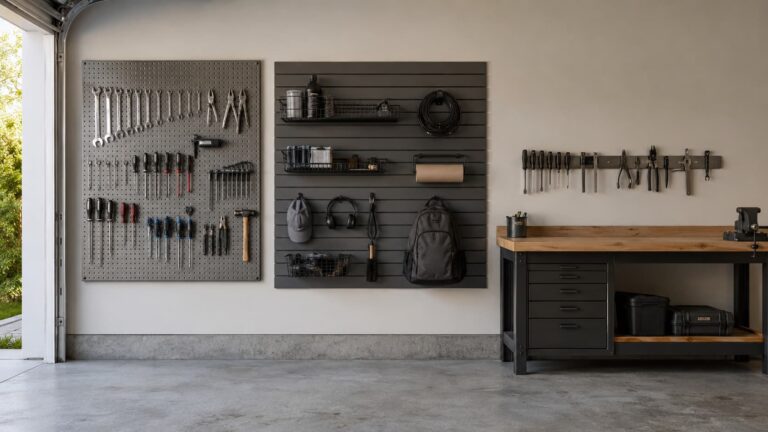
The three systems can coexist in zones on the same wall — a pegboard section for hand tools, a slatwall section for drills, and a magnetic strip near the bench for daily-use steel. What does not work is layering them in the same vertical column, because the spacing requirements differ and the wall ends up looking — and behaving — chaotically.
What garage wall systems actually hold, compared fairly
Pegboard is rated per panel, rails per linear foot, slatwall per square foot. Three different units means the published numbers cannot be compared as they stand — so nobody compares them, and a 200 lb figure on one product looks like a 200 lb figure on another. This table quotes each manufacturer’s rating and converts them all to pounds per linear foot of a 4 ft high wall run, with the arithmetic shown. Normalised values are comparison figures, not safe point-load limits. A system rated for 1,200 lb distributed across a wall section does not support a 1,200 lb hook.
| System | Type | Rating as published | Rating type | Same rating, per linear foot of a 4 ft wall | Working | Stud requirement | Specification source | Source checked |
|---|---|---|---|---|---|---|---|---|
| Proslat Classic PVC slatwall | slatwall | 75 lb per square foot | distributed panel load | 300 lb per linear foot | 75 lb/sq ft × 4 ft high | installs on 16 in stud centres | Proslat PVC Slatwall | 2026-09-14 |
| Proslat PROCORE aluminium-core slatwall | slatwall | 200 lb per square foot | distributed panel load | 800 lb per linear foot | 200 lb/sq ft × 4 ft high | engineered for 24 in stud centres, compatible down to 16 in | Proslat PROCORE PVC Slatwall | 2026-09-14 |
| Craftsman VersaTrack 4 ft rail (CMST82602VT) | rail | 75 lb per linear foot (300 lb total per 4 ft rail) | rail/channel rating | 150 lb per linear foot | 75 lb/ft per channel (published) × 2 channels (assumed common install) | installs to drywall, wall studs, or masonry | Craftsman VersaTrack 4-Foot Storage Rail | 2026-09-14 |
How these numbers were produced: Each published rating is quoted from the manufacturer’s own page on the date shown. Conversion to pounds per linear foot assumes a 4 ft high run of wall: a per-square-foot rating is multiplied by 4. A per-panel rating is first converted to an equivalent per-square-foot rate, using the panel’s own published width and height, then multiplied by 4 the same way — scaling a per-panel rating sideways only, at the panel’s own height, would normalise it to a taller or shorter slice of wall than the 4 ft reference every per-square-foot row uses, so the two steps (per-panel → per-sq-ft → per-4-ft-run) keep every row on the same footing. A per-foot-of-rail rating is different in kind: the manufacturer publishes a rate per channel, and this table doubles it to show a common two-channel install — that doubling is our own installation assumption, not a manufacturer-stated rate; the sourced figure is the single-channel rate. Where a manufacturer publishes a single fixed capacity for a whole pre-sized unit rather than a rate per foot or per square foot, that figure is quoted as published and left out of the per-linear-foot column rather than converted with an invented rate.
- These are manufacturer maximums for a correctly installed system, not a promise. Every one of them depends on hitting studs, using the specified fasteners, and spreading the load rather than hanging it all off one hook.
- The comparison assumes a 4 ft high run. A rail system does not gain capacity from wall height the way a panel does — it gains it from adding channels, which is why its normalised figure moves when you change the channel count, not the height.
- Stud spacing is a hard constraint, not a suggestion. Proslat’s PROCORE is the only system here with a published compatibility range — engineered for 24 in centres, rated compatible down to 16 in. Check whether your own system publishes a similar range before assuming it.
- Drywall anchors are not studs: Wall Control publishes 100 lb per panel on anchors against 200 lb into studs — a real number for that one product, not a ratio to assume for other systems here that don’t publish their own stud-vs-anchor split.
- Capacity drops the further a load sits from the wall: storeWALL publishes 250 lb per sq ft as a distributed rating at the panel surface, but only 115 lb as a point measurement 4 in out. That lever-arm principle is a reasonable general caution for hooks and brackets on any system, but storeWALL is the only brand here that publishes a number for it.
- A blank cell means the manufacturer does not publish that figure — we do not fill gaps with numbers we could not source.
- This list favors brands whose own specification pages state a capacity figure in a form we could verify directly. Some well-known brands are not yet in this table because their published pages did not state a load rating we could confirm on this pass — that is a sourcing gap, not a signal that the product is weaker.
These are the entries that matter for this guide. The full table, with every row and its source, is in our What garage wall systems actually hold, compared fairly.
How to Measure Your Workshop Before Buying
Buying an organizer that does not fit is more expensive than the organizer itself, because returns on heavy items are punitive. Five measurements decide everything.
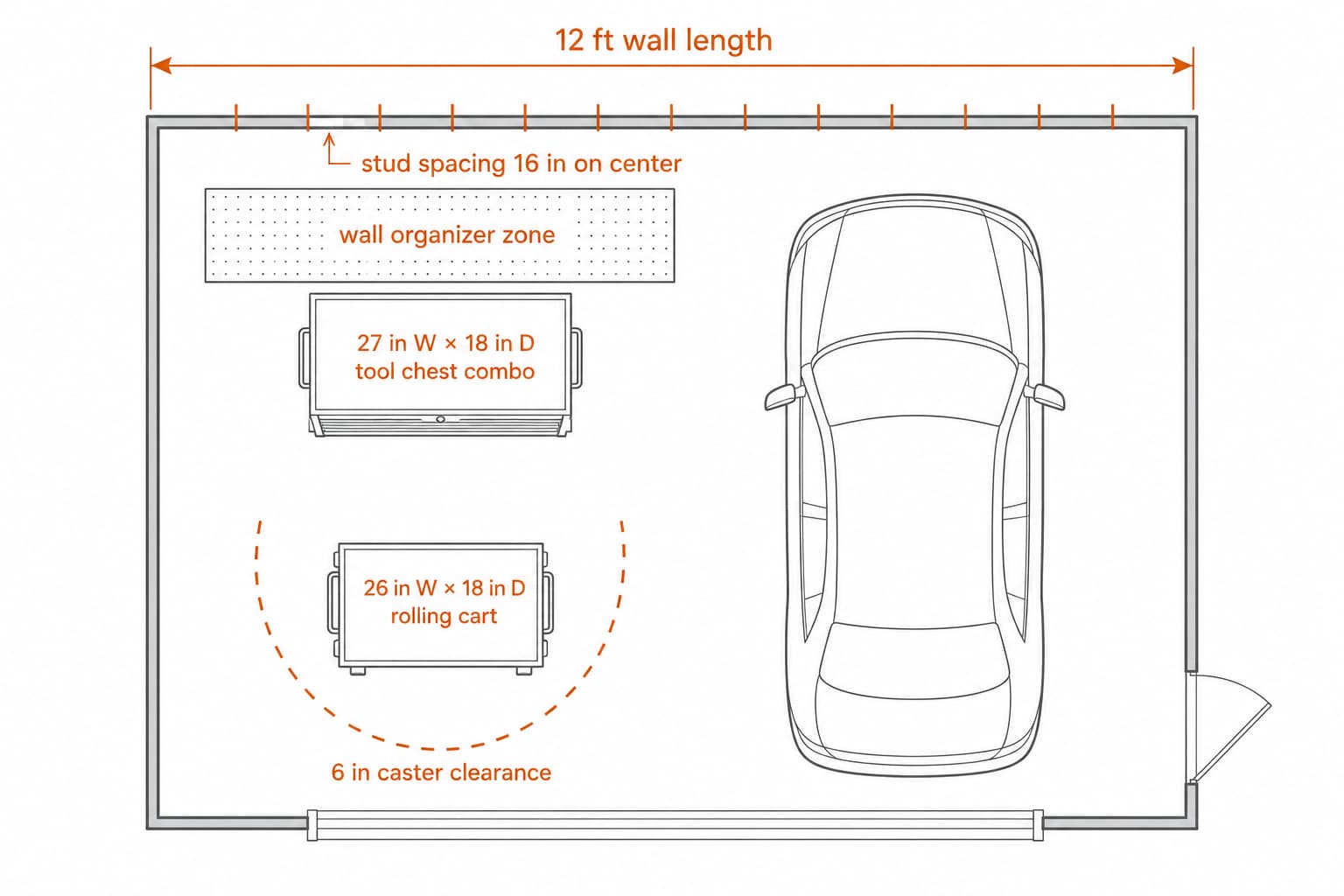
Measurement checklist:
- Available wall length. Measure the wall section minus door swings, window framing, electrical panels, and the swing arc of the garage door if applicable. Note the maximum continuous run.
- Stud spacing. Tap or use a stud finder — 16-inch on center is typical residential, 24-inch on center is older or budget construction. Stud spacing tells you what panel widths mount cleanly without needing additional blocking.
- Floor footprint. For carts and chests, measure the floor space available accounting for caster swing radius (typically a 6-inch buffer around the unit). A 26-inch cart needs about 32 inches of clear floor to roll into.
- Ceiling clearance. Stacked combos (top chest + lower cabinet) often reach 52 inches tall — confirm the corner you intend to place the combo has at least 60 inches of unobstructed vertical to allow loading.
- Outlet locations. A rolling cart parks where your chargers and lights need to plug in. Map outlet positions before deciding where the cart’s home base will be.
Common Complaints and Buyer Warnings
The most common failure mode across all of these categories is under-mounted wall storage pulling away from the drywall when overloaded — a pegboard rated for 50 pounds total will not survive 60 pounds of tools no matter how good the hooks are, because the failure point is the wall, not the panel. Always mount to studs for any wall system that will carry more than a few pounds.
The single most important warning: do not buy by piece count. A “47-drawer kit” can mean 47 small, marginally-useful drawers or 20 well-sized bins plus an assortment of clips. Read the included accessory list, not the headline number.
Heavy/dense load warning for tool chests on casters: manufacturer guidance for compact rolling chests is to move with light loads or empty. Wheel them empty, populate at rest. A fully loaded 26-inch chest at 300 pounds rolling across uneven concrete is hard on the casters AND on the floor.
Who Should Avoid Each Organizer Type?
- Pegboard: avoid if your tools are mostly power tools or other heavy items — pegboard capacity is published per panel, not per hook, so check the specific hook’s rated capacity rather than assuming a weight cutoff
- Slatwall: avoid if you rent and cannot drill into the wall (slatwall is not panel-mount-reversible the way pegboard sometimes is)
- Rolling cart: avoid if floor space is your binding constraint — go wall-mount instead
- Tool chest: avoid if you cannot dedicate roughly 5 square feet of floor permanently
- Wall drawer rack: avoid if you need sealed storage to keep dust out — go drawer cabinet instead
- Drawer cabinet: avoid if you need to grab a part one-handed without opening anything — go wall drawer rack instead
FAQ
How big is “small workshop” for this article?
A 1-car garage or smaller — roughly 12 by 20 feet or less of total interior space, often shared with a vehicle, bike, or seasonal storage. The picks here are sized for that scope. Larger garages have more options.
Can I mix pegboard and slatwall on the same wall?
Yes, but split them into discrete zones — a pegboard section for hand tools and a slatwall section for power tools, side by side or top-and-bottom with a clear separator. Do not mount slatwall track and pegboard panel in the same vertical column expecting the hooks to interlock; they do not.
What is the right hook spacing on a pegboard?
Standard pegboard uses 1-inch hole spacing. Hook spacing on the panel is driven by tool size — a row of screwdrivers needs hooks every 2-3 inches; a row of hammers needs hooks every 4-6 inches. Lay out your tools before mounting and let the tool sizes dictate the hook positions.
Can I mount a tool chest combo against a wall?
Most combos sit directly against a wall. Verify drawer pull clearance — most drawers extend 18 inches when fully open, so the chest plus open drawer plus walking clearance needs about 4 feet of total floor depth.
Do magnetic strips damage tools?
No for ordinary steel hand tools — wrenches, pliers, screwdrivers, hex keys. Magnetic strips are not appropriate for precision measurement tools (digital calipers, indicators) or anything with magnetic-sensitive electronics (electronic scales, certain battery chargers). Keep magnetic strips at least 6 inches from such tools.
How many bins do I really need for fasteners?
Most home shops fit comfortably into 30 to 50 drawer or bin slots once sorted by size and type. Larger-count kits become genuinely useful only if you sort by both dimension (size) AND material (steel vs stainless vs brass) — which most home shops do not. Buy for the inventory you actually have, not aspirational.
Sources Reviewed
For this guide, we reviewed manufacturer product information, retailer specifications, Amazon product listings, public customer feedback patterns, and small-workshop-specific discussions in DIY communities. We focused on product details that matter for small-garage scope, including footprint dimensions, manufacturer-listed capacity, sub-niche fit (pegboard vs slatwall vs magnetic vs cart vs chest vs wall drawer rack vs drawer cabinet), mounting hardware requirements, and recurring patterns in buyer feedback about the trade-offs between wall-mounted and floor-standing storage in tight spaces.