Wire Shelving vs Solid Shelving for Garage Storage
Last updated:
Disclosure: This article contains affiliate links. If you buy through these links, we may earn a commission at no extra cost to you. We do not claim hands-on testing unless clearly stated.
At a glance, wire and solid shelves look like the same product with different decks. They are not. The deck choice changes how the shelving holds small items, how it handles humidity, how much weight each shelf takes, and how easily you find what you stored two months ago. Pick the wrong one and you end up chasing screws through a wire grid or watching MDF panels swell after the first damp winter.
This guide compares wire (chrome- or epoxy-coated steel) against solid (steel frame with particle-board, MDF, or all-steel decking) and gives a decision frame by item type, climate, and work-surface need. Bolted industrial racking and overhead storage are out of scope.
Quick Answer
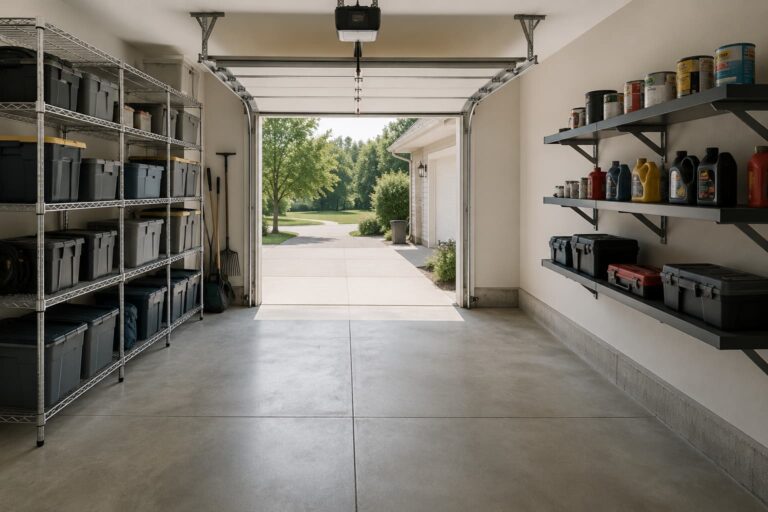
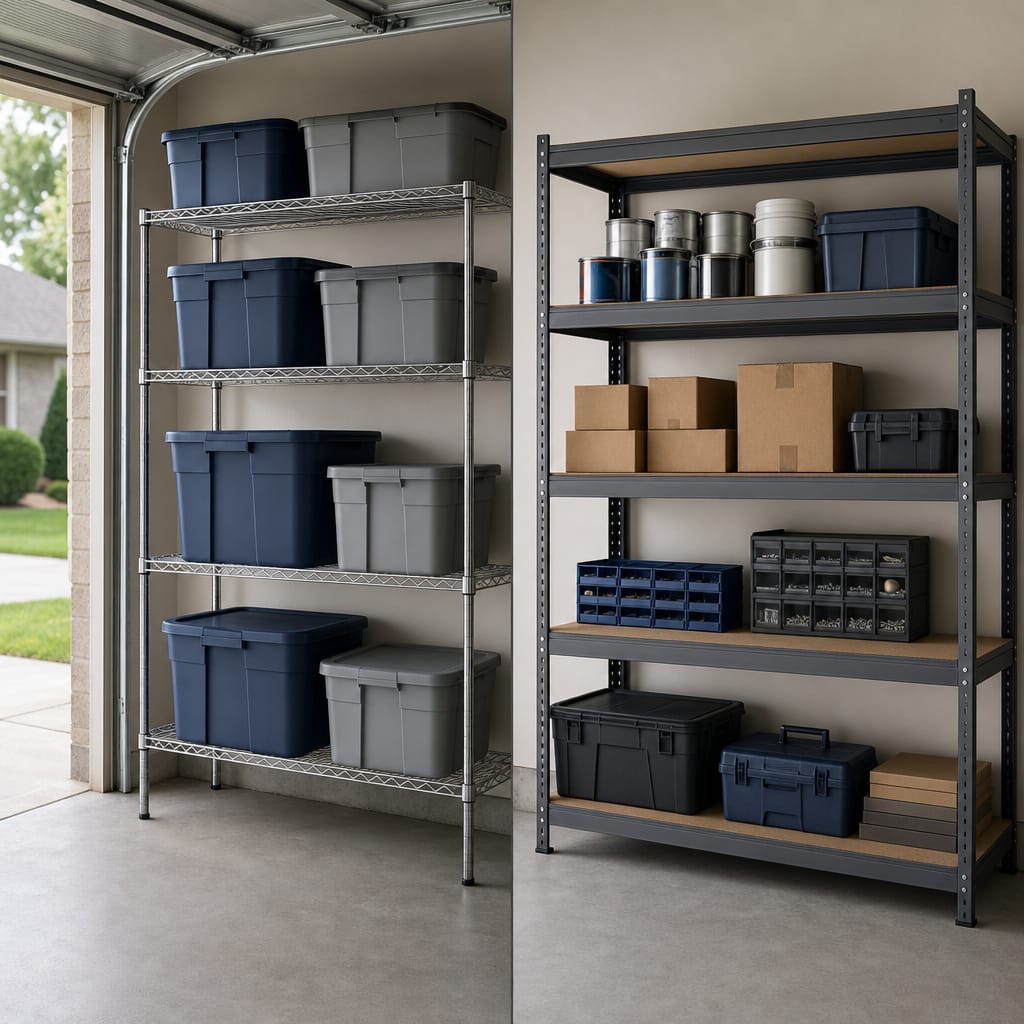
For storing large totes you load and unload often, wire shelving usually wins because of visibility, ventilation, and drip-through. For small loose items, lumpy hardware, or moisture-sensitive contents, solid shelving usually wins because nothing falls through and the surface is flat. The decision often comes down to what you actually put on the shelves — not what looks best in the showroom. Many garages benefit from one of each.
Best Choice by Situation
| Situation | Better choice | Why |
|---|---|---|
| Storing 18-27 gal totes you swap weekly | Wire | Visibility + ventilation |
| Storing small loose items (screws, fasteners, drill bits) | Solid | Nothing falls through gaps |
| Unheated/uninsulated garage with humidity swings | Wire (or all-steel solid) | No MDF swelling or warping |
| Wet items (mop, cleaning supplies, sports gear) | Wire | Drip-through, no pooling |
| Workshop-adjacent — needs a flat surface | Solid | Stable work surface |
| High dense weight (paint cans, batteries) | Particle-board solid | Highest manufacturer-listed per-shelf |
Wire Shelving — Pros, Cons, Best Use Cases
What it is
Open wire grid decks made of chrome- or zinc-plated steel, or epoxy-coated black steel, supported on adjustable corner posts. NSF-certified variants meet commercial food-prep standards — a useful stand-in for “this listing holds up to real-world use.”
Where it works best
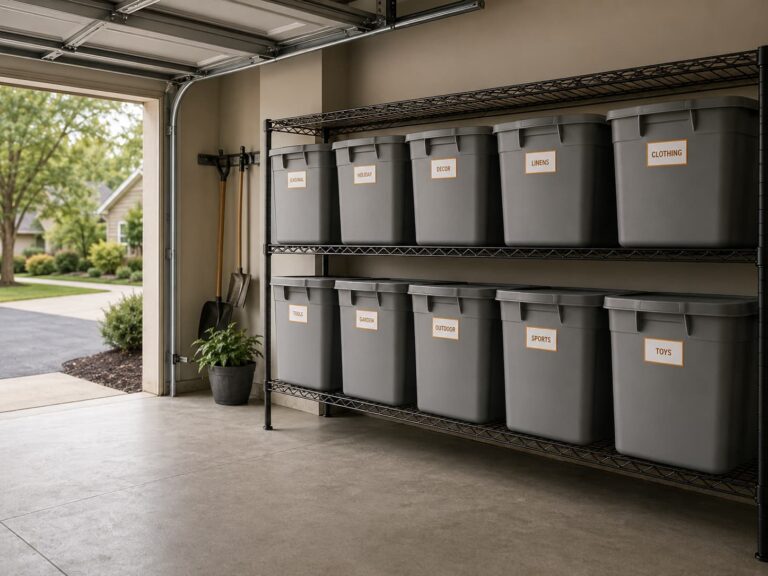
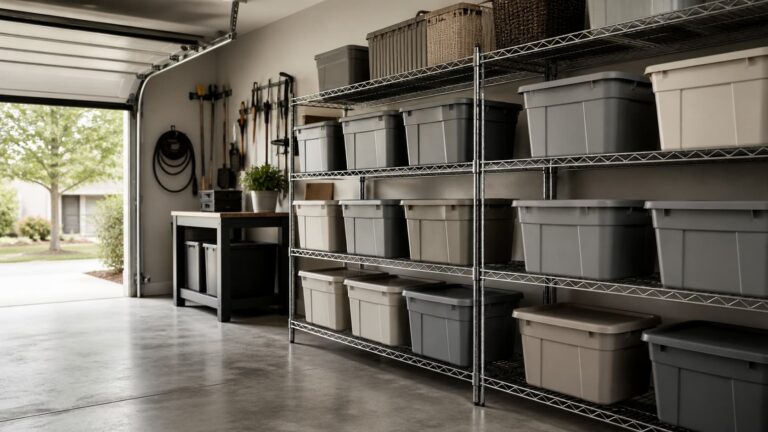
- Bin and tote storage, where seeing what is inside matters as much as the storage itself
- Damp or unheated garages where humidity would chew through composite decking
- High-traffic spots where you reach for items often
- Hose-down or quick-clean situations — the grid drains and dries fast
If your plan is mostly bins, our roundup of garage shelves designed for storage bins covers tote-specific picks.
Where it falls short
- Small loose items — screws, washers, drill bits — fall through the grid
- Soft-bottomed containers like cardboard boxes can sag through the grid pattern
- Not a flat work surface for assembly or repair
What manufacturers and retailers typically specify
Look for per-shelf capacity in the manufacturer-listed spec — and check the configuration it assumes. The same shelf often lists a much higher number on leveling feet than on casters, sometimes by 80 percent or more. Also note grid spacing (typically ~1 inch), NSF certification status, and post diameter (1 inch is standard; thinner posts mean lighter duty).
Buyer warnings specific to wire
- Manufacturer-listed capacity assumes evenly distributed load; concentrated weight on a single corner is a different problem.
- The “with wheels” configuration cuts manufacturer-listed capacity sharply — read the spec for the configuration you will actually use.
- Shelf depth matters more than width. A 14-inch deep shelf does not fit a 27-gallon tote flat.
Solid Shelving — Pros, Cons, Best Use Cases
What it is
Steel-frame shelving with continuous solid decking. Three deck types dominate: particle-board (most common, mainstream), MDF or wood-composite (similar, sometimes sealed for moisture), and all-steel panels (premium, no moisture concern). Same frame idea as wire; the deck is what changes.
Where it works best
- Small loose items — fasteners, hardware, drill bits in trays — that would fall through wire
- Workshop adjacency, where the top deck doubles as a small assembly surface
- Items in cardboard boxes or soft containers that need continuous flat support
- Climate-controlled garages where moisture is not the dominant concern (for particle-board / MDF decks)
- Damp garages — only if the deck is all-steel or explicitly sealed
For heavier continuous-deck loads, see heavy-duty garage shelves for bulky storage.
Where it falls short
- Particle-board or MDF decking is moisture-sensitive — it swells with humidity over years unless sealed
- No airflow can trap moisture under stored items, causing rust on tools or staining
- Heavier to move once assembled — the continuous deck adds weight
- All-steel-deck variants are pricier and often list lower per-shelf capacity than particle-board (steel panels are conservatively rated)
What manufacturers and retailers typically specify
Look for deck material (MDF, particle-board, wood-composite, or all-steel), per-shelf capacity manufacturer-listed, whether the deck is sealed against moisture, and frame gauge. Sealed decks last considerably longer in humid garages — look for “moisture-resistant” or “sealed.” Thinner frame gauge means lighter-duty even when the capacity number looks similar on paper.
Manufacturer-listed capacity assumes correct assembly, level flooring, suitable mounting hardware where required, and proper weight distribution. Real-world performance can vary. Always follow the manufacturer’s installation instructions.
Buyer warnings specific to solid
- Manufacturer-listed capacity assumes weight evenly spread across the deck — a single dense item (a 250 lb battery on one spot) can deform composite decking even when total load is well under spec.
- In garages without climate control, MDF or particle-board decking can swell within one to two years. Failure shows up as edge swelling first.
- Some “solid” listings have decks that are not waterproof — a spilled paint can will permanently stain and may swell the panel.
Side-by-Side Comparison
| Attribute | Wire | Solid |
|---|---|---|
| Small-item retention | Poor — falls through grid | Good — flat surface |
| Airflow / drip-through | Excellent | None |
| Moisture tolerance (typical deck) | Excellent | Poor — MDF/particle-board swells |
| Moisture tolerance (all-steel deck) | Same as typical wire | Excellent |
| Flat work surface | No | Yes |
| Per-shelf capacity (NSF commercial wire) | 600 lb manufacturer-listed | — |
| Per-shelf capacity (premium all-steel solid) | — | 400 lb manufacturer-listed |
| Per-shelf capacity (mainstream particle-board solid) | — | 800 lb manufacturer-listed |
| Per-shelf capacity (mainstream wire) | 350 lb manufacturer-listed | — |
| Visibility into stored items | Excellent — see-through | None — must label or pull bin |
| Cleaning | Hose-down or quick wipe | Wipe-only; spills absorb into MDF |
| Assembly | Fast — snap-on shelves, few fasteners | Slower — bolts + deck panels |
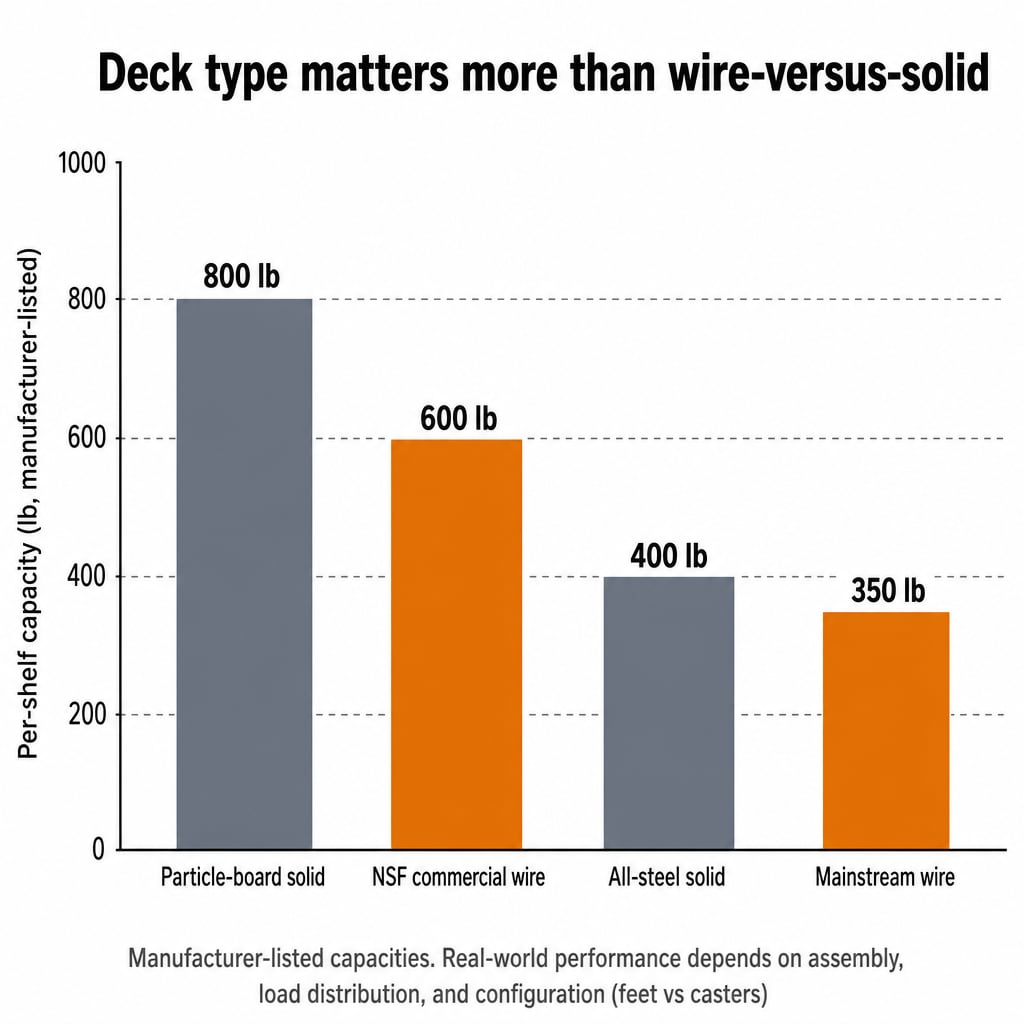
The capacity comparison surfaces a counter-intuition. Particle-board solid shelving at the mainstream tier often beats both mainstream and commercial-tier wire on listed per-shelf capacity. NSF wire is strong, but the heaviest per-shelf ratings come from particle-board solid units engineered for retail back-room loads. Premium all-steel solid decks list lower per-shelf because steel panels are rated conservatively. If maximum manufacturer-listed weight is your driver, ranking by deck type matters more than ranking by wire-versus-solid.
How to Decide for Your Garage
Two readers with the same “garage shelving problem” can need opposite answers. The decision usually collapses to three questions.
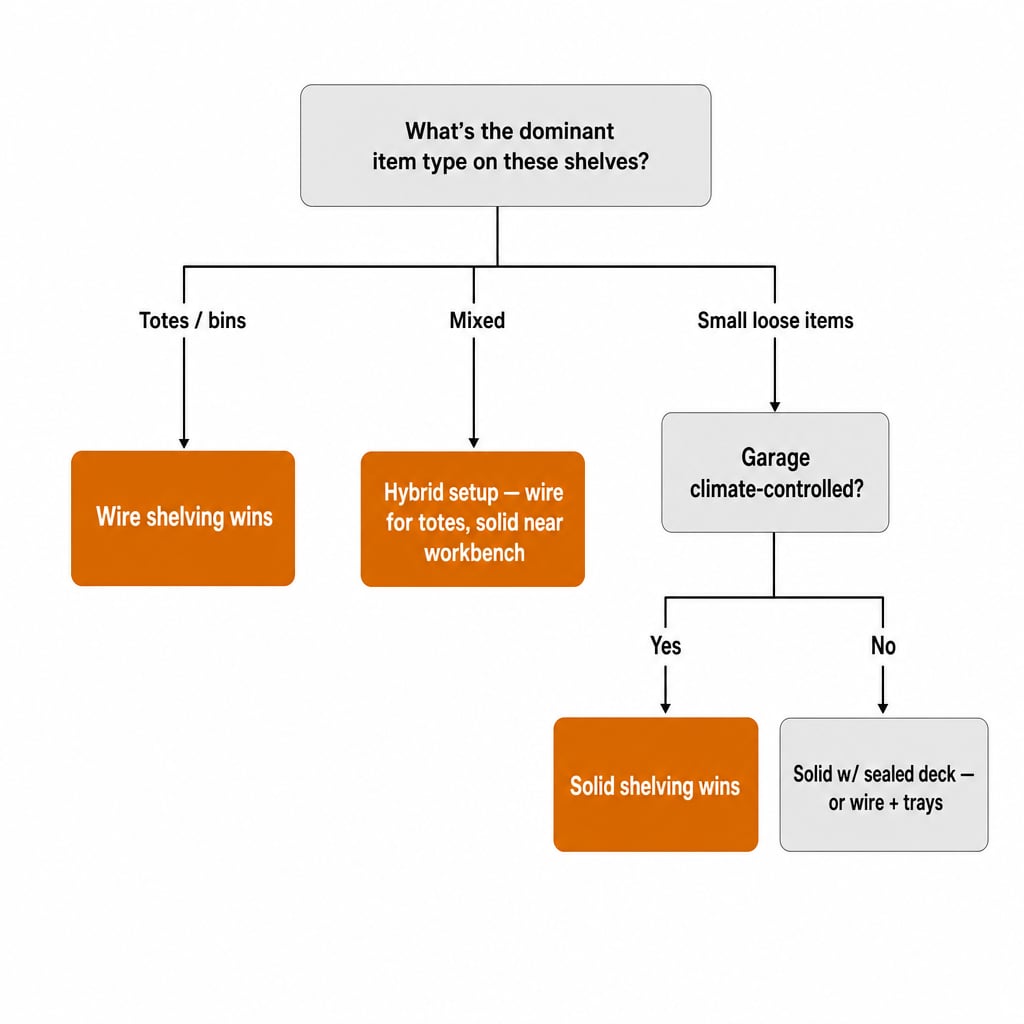
1. What is the dominant item type on these shelves? Totes and bins → wire. Loose items and small hardware → solid. Mixed → a hybrid setup. The category-level picks in our metal shelving units for garage storage roundup show both archetypes in product form.
2. Is the garage climate-controlled? If no, wire wins by default — or all-steel solid if you need the flat surface. MDF or particle-board decking in an unheated garage is borrowing trouble. For particle-board solid in an uncontrolled garage, look specifically for sealed-deck variants.
3. Will the top shelf become a work surface? If yes, pick solid. Wire cannot be a stable work surface without a covering, and improvised coverings slide. A plywood sheet on top is a workable patch — but a real solid shelf is cleaner.
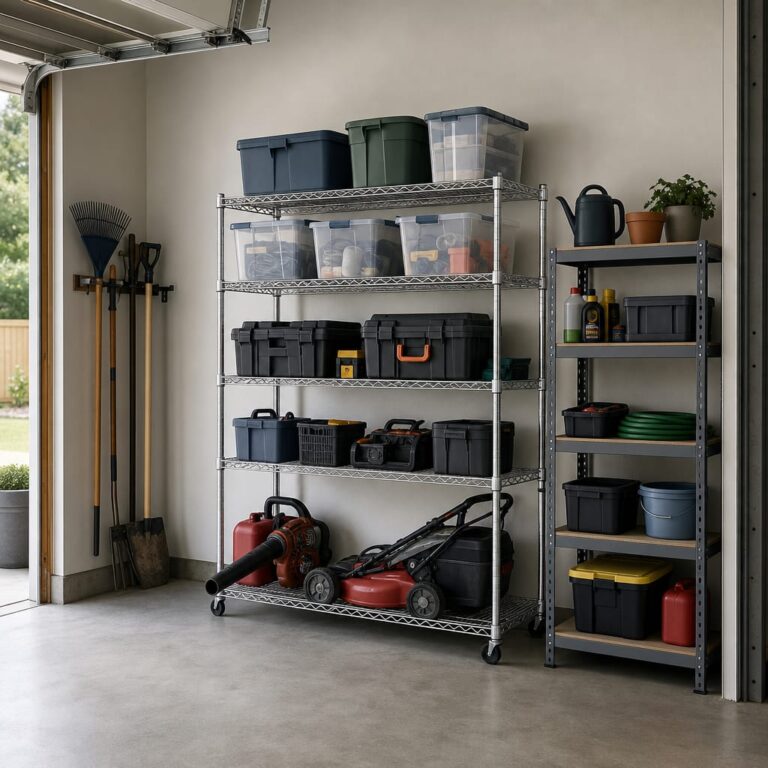
Hybrid setups are common and often optimal: wire on the long wall for totes, solid near the workshop area for small parts, paint, and hardware.
Recommended Products for Each Side
Four picks — two wire, two solid. Rationale stays tied to the comparison. For a broader list see our tote-and-bin shelving roundup.
Wire pick — Commercial-grade: Seville Classics 36×18 NSF
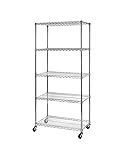
NSF-certified, 36 by 18 inch footprint, 600 lb per shelf manufacturer-listed (3,000 lb total on leveling feet; 500 lb total on casters). The 18-inch depth handles 18-gallon totes flush and 27-gallon totes with manageable overhang. Choose this when you want wire’s full benefits at a capacity ceiling few competitors match in the NSF category. Specify the 36×18 NSF with-wheels variant so you get both casters and leveling feet.
Wire pick — Mainstream value: Amazon Basics 36×14 Black Wire

Epoxy-coated black wire, 36 by 14 inches, 350 lb per shelf manufacturer-listed. Choose this when you want wire’s benefits at entry-point pricing but accept the 14-inch depth — fine for small or medium bins, but 27-gallon totes overhang. Recurring feedback patterns suggest buyers who measured their totes before ordering are satisfied; those who assumed “5-shelf shelving” meant “fits any bin” are the ones who return it.
Solid pick — Mainstream particle-board deck: Muscle Rack 48×24

Boltless steel frame with particle-board decking, 48 by 24 inch footprint, 800 lb per shelf manufacturer-listed (4,000 lb total). The widest, deepest mainstream solid here, and the per-shelf capacity ceiling on the list. Choose this when you have a climate-controlled garage and want both a flat surface and serious load capacity. Trade-off: particle-board needs a controlled environment or sealed treatment. Recurring feedback patterns suggest buyers using it workbench-adjacent love the depth; those who assemble it in a humid garage report edge swelling at the 18-to-24-month mark.
Solid pick — Premium all-steel deck: FLEXIMOUNTS 60×24
FLEXIMOUNTS Garage Shelving, 60" W x 72" H x 24" D, Black, 5 Tier | Heavy Duty
Heavy-gauge steel frame, all-steel panel decks (no MDF, no particle-board), 60 by 24 inch footprint, 1,500 lb total manufacturer-listed. Choose this when you want solid’s flat-surface advantage but need a deck that does not care about humidity. The lower total capacity versus the Muscle Rack reflects conservative steel-panel rating — the all-steel deck shrugs off conditions that destroy particle-board decks over time.
Common Mistakes
Mistake: Picking by aesthetic, not load type. Wire looks “industrial” and solid looks “neater” — people pick by vibe instead of what they will store. Spend ten minutes listing items before spending any time on which looks better.
Mistake: Ignoring grid spacing on wire. ~1 inch of spacing means anything smaller than 1.5 inches needs a tray, divider, or bin. Drill bits, small fasteners, electronic components, even some sockets fall through.
Mistake: Assuming “solid” means “waterproof.” Most budget composite decks are particle-board or MDF with a thin laminate. A paint spill or leaking bottle stains permanently and may swell the deck. Only sealed-deck or all-steel-deck variants tolerate spills without long-term damage.
Mistake: Reading per-shelf capacity at the wrong configuration. Manufacturer-listed numbers differ sharply between feet and casters — sometimes by 80 percent or more. Read the spec for the configuration you will use, and prefer the feet number if the unit stays stationary.
How many totes actually fit on a garage shelf
Tote makers publish dimensions and shelving makers publish dimensions, but nobody puts the two together — so people buy shelving, then discover their totes overhang it. This table takes the published external size of totes from the brands people actually buy for garage storage — Sterilite, Rubbermaid Roughneck, and IRIS USA — and works out how many fit per shelf on the two garage shelving depths you can actually buy, 18 in and 24 in.
| Tote | Published dimensions (source order) | Footprint | Height | Fits an 18 in deep shelf? | Per 48 × 18 in shelf | Per 48 × 24 in shelf | Specification source | Source checked |
|---|---|---|---|---|---|---|---|---|
| Sterilite 16 Qt. Storage Box | 17 1/8" x 11 7/8" x 6 3/4" | 17⅛ in × 11⅞ in | 6¾ in | Yes | 4 | 4 | Sterilite 16 Qt. Storage Box | 2026-09-14 |
| Sterilite 27 Qt. ClearView Latch Box | 17" x 11 1/8" x 12 3/4" | 17 in × 11⅛ in | 12¾ in | Yes | 4 | 4 | Sterilite 27 Qt. ClearView Latch Box | 2026-09-14 |
| Sterilite 108 Qt. Stacker Box | 25 3/4" x 18 3/8" x 19 3/8" | 25¾ in × 18⅜ in | 19⅜ in | No — it overhangs | 0 | 1 | Sterilite 108 Qt. Stacker Box | 2026-09-14 |
How these numbers were produced: External dimensions are quoted on the date shown per row. Sterilite rows are quoted from Sterilite’s own product pages (L x W x H order). Rubbermaid Roughneck rows are quoted from Ace Hardware’s retailer listing, which prints the manufacturer’s SKU-linked dimensions in H x W x D order on each product page. IRIS USA rows are quoted from IRIS USA’s own product pages (L x W x H order). All figures are the external/overall assembled dimensions with the lid on. The counts are computed, not estimated: totes are placed in a single layer, all in the same orientation, with no overhang and no gap; both orientations (the tote’s long side along the shelf’s 48 in run, or along its depth) are tried and the better one is kept. Shelf width is 48 in in both cases — the two depths are real Husky shelving footprints: 48 in. W x 18 in. D (Husky 86 in. H x 48 in. W x 18 in. D 6-Shelf Steel Shelving Unit, model MR481886W6B, https://www.homedepot.com/p/Husky-86-in-H-x-48-in-W-x-18-in-D-Black-Steel-6-Shelves-Shelving-Unit-MR481886W6B/306062319) and 48 in. W x 24 in. D (Husky 5-Tier Steel Shelving Unit, 48 in. W x 78 in. H x 24 in. D, model 426007, https://www.homedepot.com/p/Husky-5-Tier-Riveted-Steel-Garage-Storage-Shelving-Unit-in-Silver-48-in-W-x-78-in-H-x-24-in-D-426007/303241694); neither product page states a clear opening between posts. 48×18 and 48×24 are unobstructed reference surfaces, not guaranteed usable dimensions of every nominal 48×18 or 48×24 rack — posts and lips can reduce the clear opening (one retailer answer for a Husky 48×24 gives about 45.5 × 21.5 in between posts). Round the result down again if your shelving has corner posts that intrude, and leave room to get a hand in.
- A tote that fits the shelf footprint still needs vertical room: check the tote height against your shelf spacing, and leave clearance to lift it in and out rather than sliding it flush.
- Counts assume a flat, full-depth shelf. Wire shelving with a lip, or posts at the corners, will cost you the last tote in a row.
- Lids overhang the base on most totes; the figures here are the manufacturer’s overall assembled dimensions, which already include the lid.
- Capacity in quarts or gallons tells you nothing about whether it fits — and "27" doesn’t mean the same thing twice. The Sterilite 27 Qt. ClearView Latch Box (17 in x 11-1/8 in) fits an 18 in shelf; the Sterilite 108 Qt. Stacker Box (25-3/4 in x 18-3/8 in) — 27-gallon-equivalent by volume (108 qt = 27 gal), though Sterilite sells it as "108 Qt.," not "27 Gal." — does not.
- Manufacturers and retailers don’t all publish dimensions in the same order. Ace Hardware lists Rubbermaid Roughneck as Height x Width x Depth, where Sterilite and IRIS USA publish Length x Width x Height. This table normalises every row to footprint (the two horizontal dimensions) and height so they compare directly regardless of the order they were published in.
- Rubbermaid Roughneck’s 10 gal and 18 gal totes share the same footprint (23⅞ in x 15⅞ in) — only the height changes, so stepping up in capacity in that range costs no extra shelf space, only vertical clearance.
- A blank cell means the manufacturer does not publish that figure — we do not fill gaps with numbers we could not source.
These are the entries that matter for this guide. The full table, with every row and its source, is in our How many totes actually fit on a garage shelf.
FAQ
Is wire shelving stronger than solid shelving in the same price range?
It depends on the deck type. NSF-certified wire routinely lists 600 lb per shelf. Particle-board solid units in the same price tier can list 800 lb per shelf — higher than NSF wire. All-steel-deck solid units typically list around 400 lb per shelf because steel panels are rated conservatively. Always check the spec for the configuration you will use; feet versus casters changes the number significantly.
Will moisture rust wire shelving in an unheated garage?
Chrome-plated and epoxy-coated wire shelving resists surface corrosion in typical residential garage humidity. Long-term moisture, salt exposure, or standing water will eventually cause spotting on chrome variants. Epoxy-coated black wire generally handles humidity better than chrome for unheated garages — the coating is continuous rather than a plating layer that can chip.
Can I use a wire shelf as a workbench top?
Not really. The grid pattern is unstable for small tools or small parts, and improvised coverings slide. A plywood sheet cut to the shelf size works as a temporary surface, but a real solid shelf or dedicated workbench is the cleaner choice.
Do solid shelves with MDF or particle-board decking really warp in garages?
Yes, eventually, in garages with humidity swings above 30-40 percent. One to three years is typical for unsealed decks in an unheated garage. Sealed wood-composite (“moisture-resistant” or “sealed” in the listing) lasts longer. All-steel decks avoid the problem entirely. Failure shows up as swelling at panel edges first, then the deck loses its flat surface.
Can I mix wire and solid shelving in the same garage?
Yes — and it is often optimal. Wire on the long wall for totes and bulky bins; solid near the workshop area for small parts, paint, and hardware. Different shelf types for different load types is a feature, not a complication.
Sources Reviewed
For this comparison we reviewed manufacturer pages for Seville Classics, Amazon Basics, Muscle Rack (Edsal), and FLEXIMOUNTS, the NSF certification database, retailer product specifications, and recurring patterns in public customer feedback for both wire and solid garage shelving. No hands-on testing was performed. All capacity claims are framed as manufacturer-listed and assume correct assembly, level flooring, and proper weight distribution.