
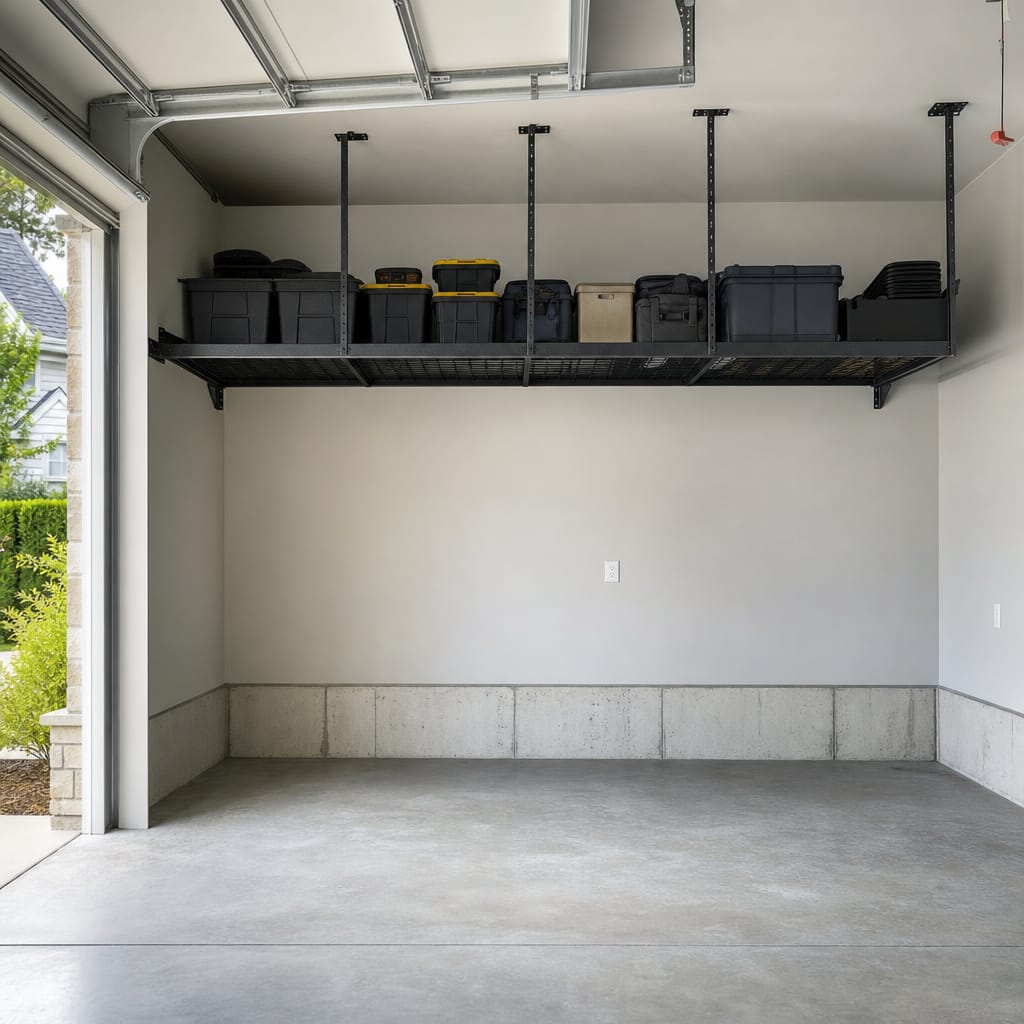
Overhead Garage Rack Clearance Guide
If you install an overhead rack, how much room is actually left underneath it — enough for your car, enough for the garage door to swing open? Manufacturers publish how far a rack’s deck hangs down from the ceiling, not the clearance left once it’s up. This table takes each rack’s own published ceiling-drop range and calculates the remaining clearance at 8 ft (96 in) and 9 ft (108 in) — the two ceiling heights most American garages have. Rows were checked between 2026-08-14 and 2026-09-15; last updated 2026-09-15.
How to Read This Table
Each row is one rack, sourced to its manufacturer’s own product page.
- Rack — model and size, as the manufacturer lists it.
- Published ceiling drop — the manufacturer’s adjustable-height range, unconverted.
- Clearance under it — 8 ft / 9 ft ceiling — this table’s figure: ceiling height minus published drop, low to high.
- Deck size — the platform’s published dimensions.
- Stated capacity — the manufacturer’s maximum for correct installation.
- Joist requirement — the mounting/spacing constraint, or noted as unstated.
- Specification source — the page each row is sourced to.
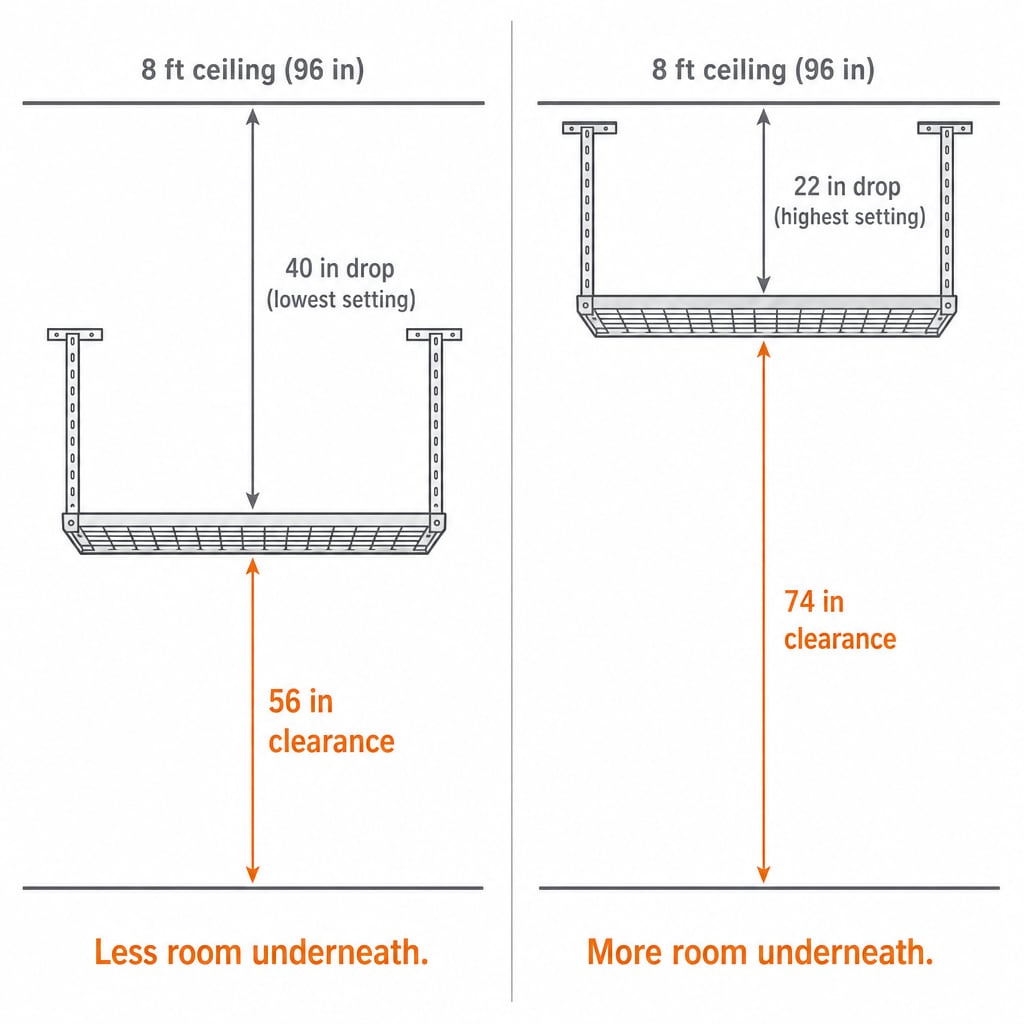
Clearance runs opposite to drop: its low end is the rack at its lowest position (deepest drop, least room); its high end is the rack raised highest (shallowest drop, most room). A bigger drop means less room underneath — stated plainly here so the numbers don’t have to imply it.
A blank cell means the manufacturer doesn’t publish that figure — true for Costway’s capacity and joist cells, SafeRacks 2×8’s capacity and joist cells, and eShelf’s joist cell. None are filled in from a similarly sized rack.
Two rows break the low–high pattern. Monkey Bars publishes only a maximum drop (48 in), so its clearance reads as a floor — “≥48 in” and “≥60 in” — not a range; there’s no low-drop setting to compute a maximum from. SafeRacks’ 2×8 ships two distinct drop settings, 12–24 in or 24–45 in, shown separately rather than merged into one span.
How much room an overhead rack leaves under it
Rack makers publish how far the unit hangs below the ceiling. What they never publish is the number you actually need: how much headroom is left underneath once it is up — which is what decides whether your car still fits, or whether the garage door can still swing open. This table restates each rack’s published drop and works out the remaining clearance for the two ceiling heights most American garages have.
| Rack | Published ceiling drop | Clearance under it — 8 ft ceiling | Clearance under it — 9 ft ceiling | Deck size | Stated capacity | Joist requirement | Specification source | Source checked |
|---|---|---|---|---|---|---|---|---|
| SafeRacks 4 ft × 8 ft | 12–45 in | 51–84 in | 63–96 in | 48 × 96 in | 600 lb | brackets span two wood joists; not for I-beams | SafeRacks 4×8 Overhead Rack | 2026-09-15 |
| FLEXIMOUNTS GR48 Classic 4 ft × 8 ft | 22–40 in | 56–74 in | 68–86 in | 96 × 48 in | 750 lb rated (1,200 lb tested) | joist spacing ≤ 24 in; if spacing > 24 in, only 48 in spacing | FLEXIMOUNTS GR48 Classic 4′ × 8′ | 2026-09-15 |
| Gladiator Overhead GearLoft 4 ft × 8 ft | 23–37 in | 59–73 in | 71–85 in | 48 W × 96 D in | 1,000 lb per unit | ceiling mounted, assembly required (spacing not published) | Gladiator Overhead GearLoft 4 × 8 | 2026-09-15 |
| Gladiator Overhead GearLoft 2 ft × 8 ft | 23–37 in | 59–73 in | 71–85 in | 96 W × 24 D in | 500 lb per unit | ceiling mounted, assembly required (spacing not published) | Gladiator Overhead GearLoft 2 × 8 | 2026-09-15 |
| Gladiator Overhead GearLoft 2 ft × 4 ft | 23–37 in | 59–73 in | 71–85 in | 48 W × 24 D in | 350 lb per unit | ceiling mounted, assembly required (spacing not published) | Gladiator Overhead GearLoft 2 × 4 | 2026-09-15 |
| MonsterRAX 4 ft × 8 ft | 18–45 in | 51–78 in | 63–90 in | 48 × 96 in | 500 lb | wood joists only; not for I-beams, steel joists, concrete, or other non-traditional materials | MonsterRAX 4×8 Overhead Garage Storage Rack | 2026-09-15 |
| NewAge Products VersaRac Pro 4 ft × 8 ft | 18–42 in | 54–78 in | 66–90 in | 48 × 96 in | 800 lb | wood or wood-engineered joists; 30 in mounting brackets accommodate irregular joist spacing | NewAge Products VersaRac Pro 4′ × 8′ | 2026-09-15 |
| StoreYourBoard 4 ft × 8 ft Garage Ceiling Shelf | 24–40 in | 56–72 in | 68–84 in | 48 × 96 in | 700 lb | fits 16 in and 24 in joist spacing; mounts parallel or perpendicular to joists | StoreYourBoard 4′ x 8′ Garage Overhead Storage | 2026-09-15 |
| VEVOR 3 ft × 6 ft Overhead Garage Storage Rack | 22–40 in | 56–74 in | 68–86 in | 36 × 72 in | 550 lb | 27 in ceiling brackets span across joists | VEVOR Overhead Adjustable Garage Storage Rack 36 × 72 in | 2026-09-15 |
| FLEXIMOUNTS GR38 Classic 3 ft × 8 ft | 22–40 in | 56–74 in | 68–86 in | 96 × 36 in | 750 lb | joist spacing ≤ 24 in; if spacing > 24 in, only 36 in spacing | FLEXIMOUNTS GR38 Classic 3′ × 8′ | 2026-09-15 |
| FLEXIMOUNTS Max Series 4 ft × 8 ft | 22–40 in | 56–74 in | 68–86 in | 96 × 48 in | 1,000 lb | joist spacing ≤ 24 in; if spacing > 24 in, only 48 in spacing | FLEXIMOUNTS Max Series 4′ × 8′ Heavy Duty Overhead Rack | 2026-09-15 |
| Monkey Bars 4 ft × 8 ft | ≤48 in (minimum drop not published) | ≥48 in (minimum drop not published, so the maximum clearance cannot be computed) | ≥60 in (minimum drop not published, so the maximum clearance cannot be computed) | 48 × 96 in (from the product name; an exact deck dimension is not published) | 750 lb free-hanging from the ceiling (1,000 lb if one side is also wall-supported) | spreads the load across up to six ceiling joists (exact required spacing not published) | Monkey Bars 4×8 Overhead Storage Platform | 2026-09-15 |
| Costway 4 ft × 4 ft Overhead Garage Storage Rack | 18–42 in | 54–78 in | 66–90 in | 48 × 48 in | Costway 4’x4′ Heavy-Duty Overhead Garage Ceiling Adjustable Hanging Rack | 2026-09-15 | ||
| eShelf 4 ft × 8 ft (White) | 22–40 in | 56–74 in | 68–86 in | 48 × 96 in (from the product name) | 750 lb | eShelf 4ftx8ft Overhead Garage Storage Rack (White) | 2026-09-15 | |
| SafeRacks 2 ft × 8 ft | 12–24 in or 24–45 in (two selectable drop configurations) | 51–84 in (72–84 in on the 12–24 in setting; 51–72 in on the 24–45 in setting) | 63–96 in (84–96 in on the 12–24 in setting; 63–84 in on the 24–45 in setting) | 24 × 96 in | SafeRacks 2′ x 8′ Overhead Garage Storage Rack | 2026-09-15 |
How these numbers were produced: Ceiling drop, deck size, capacity and joist requirements are quoted from each manufacturer’s own product page on the date shown. Clearance underneath is arithmetic: ceiling height minus the published drop, at 8 ft (96 in) and 9 ft (108 in). The range runs from the rack’s lowest setting (least clearance) to its highest. The calculation treats the published drop as the distance from ceiling to deck and ignores deck thickness, so treat the result as the optimistic figure and measure before you drill.
- Measure where you will actually mount it. The garage door track, the opener rail and the door in its open position occupy the ceiling near the door — the clearance that matters there is not the clearance mid-garage.
- Clearance is to the underside of the deck. Anything hanging below the deck, and the deck’s own thickness, eats into it.
- Joist spacing is a hard constraint, not a preference: these racks are rated only when fixed into wood joists at the spacing the manufacturer states.
- Capacity figures are the manufacturer’s stated maximum for a correctly installed rack. Real-world performance depends on assembly, the fixings used, joist condition and how the load is distributed.
- A blank cell means the manufacturer does not publish that figure — we do not fill gaps with numbers we could not source.
- For a few models, no independent manufacturer website could be located; the published specification comes from the brand’s own retailer or marketplace listing instead, noted on that row.
Download the data (CSV) · last updated 2026-09-15 · version 1.1 · CC BY 4.0, attribution to GarageSpaceGuide.
How These Numbers Were Produced
Most of this table comes from a manufacturer’s own product page: SafeRacks (two models), FLEXIMOUNTS (three), Gladiator GearWorks (three), MonsterRAX, NewAge Products, StoreYourBoard, VEVOR, and Costway. Two rows are exceptions: Monkey Bars has no independent manufacturer site we could locate, so its figures come from an authorized dealer’s page repeating the brand’s own copy; eShelf has no manufacturer site at all, so its figures come from the seller’s Amazon listing.
Clearance is arithmetic, not a manufacturer claim: ceiling height minus published drop, at 8 ft (96 in) and 9 ft (108 in), using the rack’s lowest and highest settings. Worked example: FLEXIMOUNTS’ GR48 Classic publishes a 22–40 in drop, so at 8 ft that’s 96 − 40 = 56 in at its lowest setting, up to 96 − 22 = 74 in at its highest — the “56–74 in” in the table. The calculation treats drop as ceiling-to-deck distance and ignores the deck’s own thickness, so every clearance figure is the optimistic case, not a guarantee.
Several brands — HyLoft, Rubbermaid’s FastTrack line, Husky — aren’t in this table yet because no checkable figure could be sourced this pass; a sourcing obstacle, not a judgment on the product. Every row is a point-in-time capture: FLEXIMOUNTS’ GR48 capacity was corrected once, on 2026-09-14, when a re-check of the same page turned up 750 lb rated (1,200 lb tested) where an earlier pass had recorded 600 lb — the pages change without notice.
How to Use It — Three Decisions
Which rack leaves the most headroom on an 8 ft ceiling?
SafeRacks’ 4×8 and 2×8 both go as low as a 12 in drop, the shallowest in the table, which is why they also post the highest raised-clearance figure of any row: up to 84 in at 8 ft. MonsterRAX starts at an 18 in drop, capping out at 78 in. The Gladiator GearLoft line — all three sizes — bottoms out at a 23 in minimum drop, which caps its best case at 73 in, the least “raiseable” rack of the group. If maximum headroom matters more than maximum capacity, that GearLoft floor is worth knowing before comparing on capacity alone. NewAge’s VersaRac Pro is left out of this comparison: its published minimum height and adjustable range don’t resolve cleanly into one span from the wording available, pending confirmation against the full product page.
Is there still room for a full-size vehicle with the rack at its lowest setting?
Check the low end of the range, not a product photo or a “typical” middle setting. At an 8 ft ceiling, several racks’ worst-case clearance — the rack dropped to its deepest position — falls to 51–56 in: SafeRacks’ 4×8 and MonsterRAX both bottom out at 51 in with a 45 in drop. That’s well under a typical SUV or truck roofline. If a vehicle needs to fit underneath, plan to keep the rack near its shallowest, highest-clearance setting rather than assuming the deepest one will still leave room.
Which racks fit beside the garage door track instead of across the whole bay?
Deck depth decides this. The 24 in-deep decks — Gladiator’s GearLoft 2×8 (96 × 24 in) and 2×4 (48 × 24 in), and SafeRacks’ 2×8 (24 × 96 in) — are narrow enough to sit alongside a door track rather than spanning it. The 48 × 96 in full-width decks — SafeRacks 4×8, FLEXIMOUNTS’ GR48 Classic and Max Series, MonsterRAX, NewAge, StoreYourBoard, and eShelf — span the full bay and aren’t a fit for that placement. Monkey Bars shares that nominal 48 × 96 in footprint by product name, but its deck dimension isn’t independently published, so it’s left out of this comparison rather than grouped on an unconfirmed number.
What This Table Does Not Tell You
Measure where the rack will actually go, not the middle of the garage — the door track, opener rail, and the open door itself all occupy ceiling space near the door, and that local clearance isn’t the mid-garage figure this table computes.
Clearance is measured to the underside of the deck. Anything hanging below it, plus the deck’s own thickness, eats into the number.
Joist spacing is a hard constraint, not a preference: these racks are rated only when fixed into wood joists at the manufacturer’s stated spacing.
A blank cell means the manufacturer doesn’t publish that figure — we never fill a gap we couldn’t source. This is a growing database: we add a rack when its maker publishes a verifiable figure, not on a fixed schedule.
FAQ
Can I work out a rack’s safe capacity from my ceiling’s general load (PSF) rating?
No. The capacity figures in this table are what the manufacturer rates for its specific bracket-and-joist system, tested as a unit — not a general area-load calculation you can derive from a ceiling’s PSF rating. Check the “Stated capacity” and “Joist requirement” columns together for the specific rack, not a formula.
What does “BCLL” mean, and do I need to know it before buying a rack?
BCLL stands for Bottom Chord Live Load — a truss-engineering term for temporary weight spread across the bottom of the truss (arackabove.com). If you’re unsure what your ceiling’s truss drawing specifies, that’s a question for a structural engineer or your truss manufacturer, not something a rack’s product page — or this table — can answer.
Why do some rows in this table have no listed weight capacity?
A handful of brands simply don’t publish one on the page we checked. We leave that cell blank rather than estimate from a similarly sized rack. Treat a missing figure as a reason to contact the manufacturer directly before buying, not as a zero.
Does a bigger “ceiling drop” number mean more room underneath, or less?
Less. A bigger drop means the deck hangs further down from the ceiling, which leaves less clearance underneath it — the opposite of how the number might read at a glance. See “How to Read This Table” above for the full low–high convention.
My ceiling is neither 8 ft nor 9 ft — how do I work out my own clearance?
Convert your ceiling height to inches, then subtract the rack’s published drop (from the “Published ceiling drop” column) at the setting you plan to use — clearance = ceiling height − drop, the same arithmetic behind the 8 ft and 9 ft columns above. Example: on a 7.5 ft (90 in) ceiling, FLEXIMOUNTS’ GR48 Classic (22–40 in drop) leaves 90 − 40 = 50 in at its lowest setting, up to 90 − 22 = 68 in at its highest. 8 ft and 9 ft are shown because they’re the most common US garage heights, not because the formula stops working elsewhere.
How often is this table checked?
Rows in this update were checked between 2026-08-14 and 2026-09-15. Each row also carries its own checked date, so you can see how current a specific rack’s figures are.
Guides That Use This Data
- Best Overhead Garage Storage Racks — a ranked buying guide across the overhead rack types in this table.
- Best Overhead Garage Storage for Low Ceilings — when the low-end clearance figures above point toward a shallow-drop rack specifically.
- Overhead Storage vs Wall Storage for Garage Organization — for deciding between overhead and wall-mounted placement before picking a specific rack.
- How to Choose Overhead Garage Storage Safely — the fuller buying-safety walkthrough these figures feed into.
- How to Choose Garage Storage for Small Spaces — when ceiling clearance is one factor among several small-garage constraints.
- How to Maximize Storage in a One-Car Garage — the same small-garage context, one-car specific.
- How to Install Overhead Garage Storage (Step-by-Step) — the installation walkthrough that assumes the clearance decision from this page is already made.
- How to Safely Use Overhead Garage Storage — ongoing safety guidance once a rack is installed.
Sources
- SafeRacks 4×8 Overhead Rack — SafeRacks
- SafeRacks 2×8 Overhead Garage Storage Rack — SafeRacks
- FLEXIMOUNTS GR48 Classic 4′ × 8′ — FLEXIMOUNTS
- FLEXIMOUNTS GR38 Classic 3′ × 8′ — FLEXIMOUNTS
- FLEXIMOUNTS Max Series 4′ × 8′ Heavy Duty Overhead Rack — FLEXIMOUNTS
- Gladiator Overhead GearLoft 4 × 8 — Gladiator GearWorks
- Gladiator Overhead GearLoft 2 × 8 — Gladiator GearWorks
- Gladiator Overhead GearLoft 2 × 4 — Gladiator GearWorks
- MonsterRAX 4×8 Overhead Garage Storage Rack — MonsterRAX
- NewAge Products VersaRac Pro 4′ × 8′ — NewAge Products
- StoreYourBoard 4′ x 8′ Garage Overhead Storage — StoreYourBoard
- VEVOR Overhead Adjustable Garage Storage Rack 36 × 72 in — VEVOR
- Monkey Bars 4×8 Overhead Storage Platform — The Garage Organizer (authorized Monkey Bars dealer)
- Costway 4’x4′ Heavy-Duty Overhead Garage Ceiling Adjustable Hanging Rack — Costway
- eShelf 4ftx8ft Overhead Garage Storage Rack (White) — Amazon listing (eShelf; no independent manufacturer site found)