How to Choose Garage Storage for Small Spaces
Last updated:
Disclosure: This article contains affiliate links. If you buy through these links, we may earn a commission at no extra cost to you. We do not claim hands-on testing unless clearly stated.
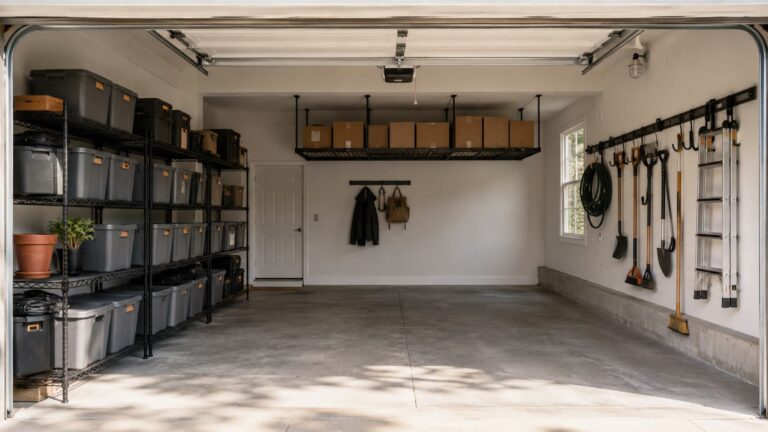
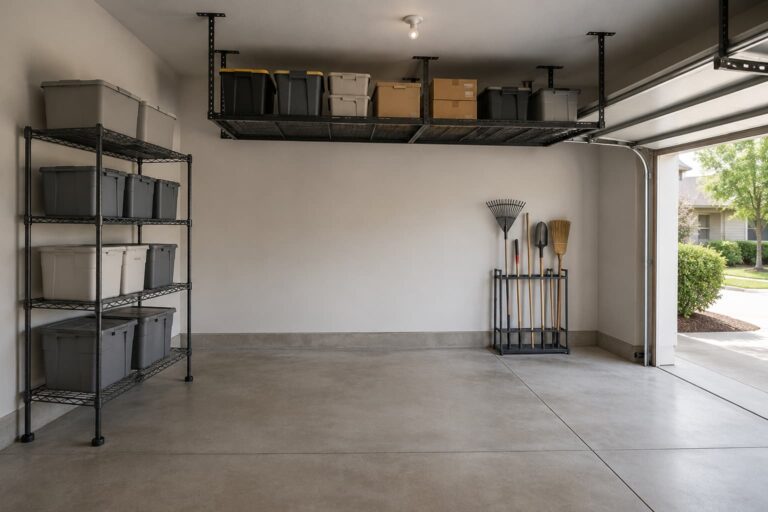
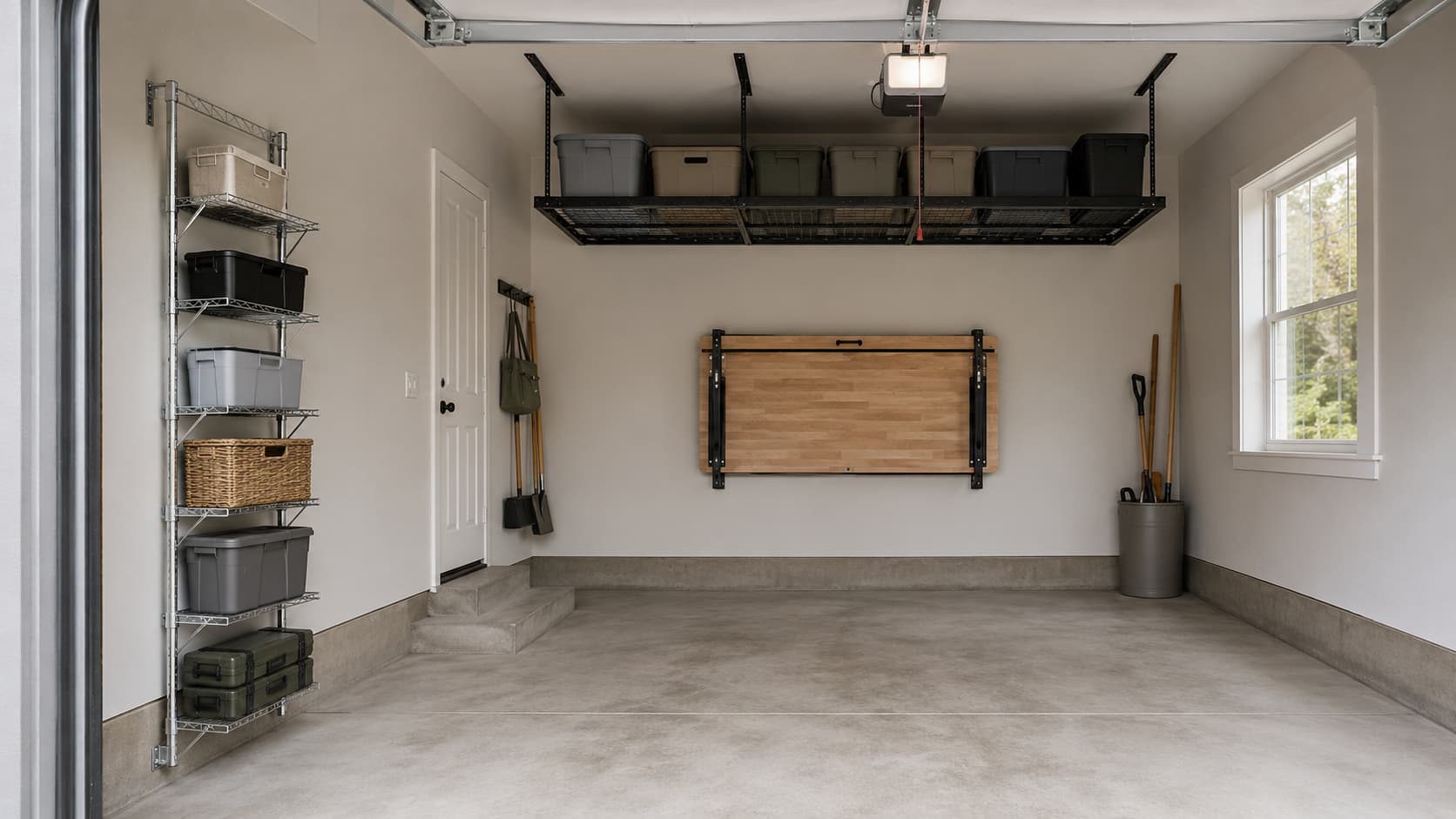
Small garages don’t have a storage problem — they have a FLOOR-SPACE problem. Buying storage that takes more floor space only makes the problem worse. The solutions that actually work in a small garage all claim a different kind of space: UP (tall narrow shelving), AWAY (wall-mounted units that fold flat), or OVERHEAD (ceiling racks for items you rarely touch). This guide explains the three vertical-space strategies, what to measure before you buy, and three starter picks that solve the typical small-garage layout.
What this guide does not cover: layout planning across multiple garage zones (covered in how to plan garage organization zones), or renter-specific no-drill constraints (covered separately under the renters guide).
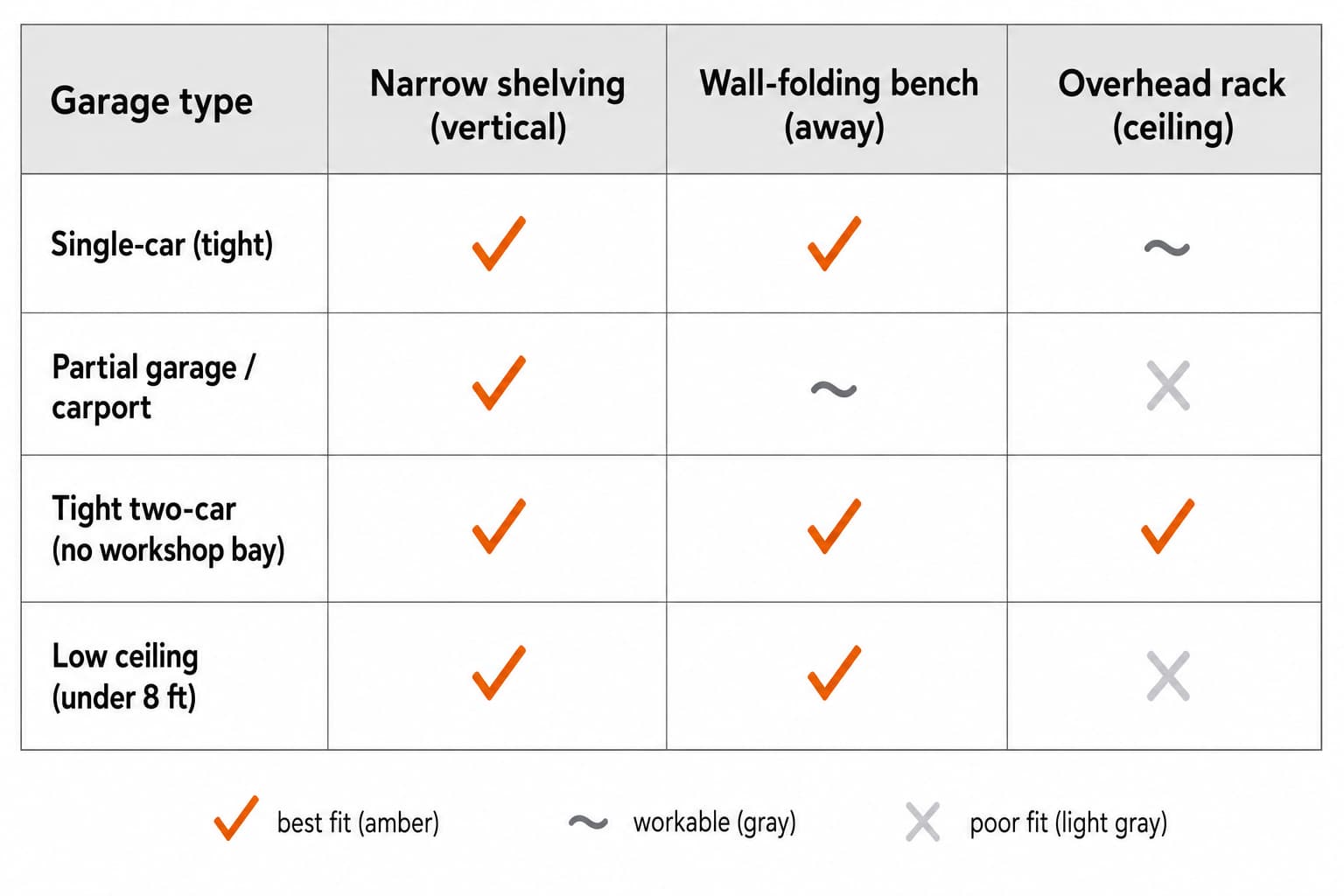
Quick Recommendation by Garage Size
| Your garage | Best first strategy | Why |
|---|---|---|
| Tight single-car | Narrow vertical shelving on the side wall | The only wall area not eaten by the car door |
| Partial garage / carport | Narrow shelving + wall-folding bench | Two strategies that work without permanent floor occupation |
| Tight two-car | All three strategies | Each car needs one wall; overhead picks up the seasonal load |
| Low-ceiling garage (under 8 ft) | Narrow shelving + wall-folding bench (skip overhead) | Overhead racks need ceiling clearance you don’t have |
| Garage with significant wall obstructions | Wall-folding bench + overhead | When wall area is fractured, vertical shelving runs out of clean wall to use |
The Three Vertical-Space Strategies
Every small-garage layout that actually works uses one or more of these three strategies. Standard floor-footprint storage (18-to-24-inch-deep shelving in the middle of the bay, freestanding cabinets) makes the floor-space problem worse, not better.
Strategy 1: Narrow vertical shelving
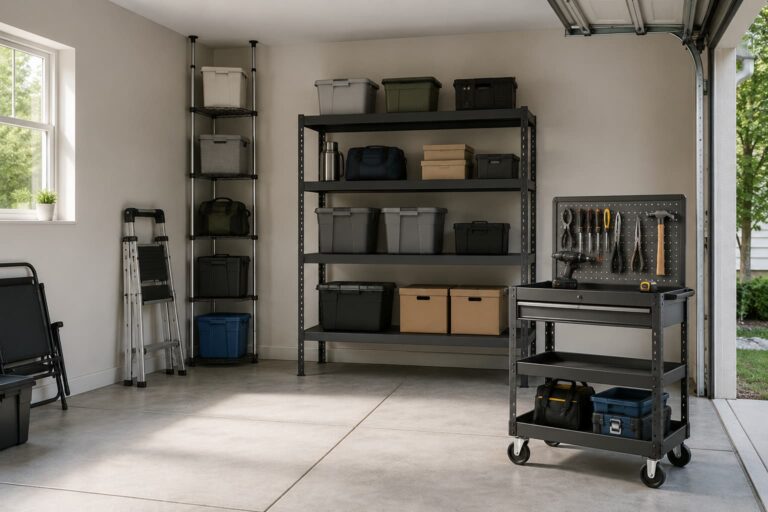
Tall (60-72 inches), narrow (10-14 inches deep) wire or steel shelving that fits in the gaps standard 18-to-24-inch shelving cannot. This claims UP space along a side wall without intruding into the car door swing arc.
Best for: boxes, bins, tools, automotive supplies, anything narrower than the shelf depth. Six-tier units commonly hold 200-plus lb total (manufacturer-listed) and split into two 3-tier units for two-zone deployment.
NOT for: standard plastic storage totes (most are 16-plus inches deep — they overhang or won’t fit). Use a deeper shelf format for totes, see our roundup of garage shelving for storage bins.
Single-line rule: if the side wall gap is under 16 inches, narrow shelving is the only freestanding option that fits.
Strategy 2: Wall-folding work surface
A wall-mounted folding workbench that deploys to a 16-to-32-inch deep work surface and folds back to under 4 inches of wall depth. This claims WALL space when needed and gives it back when the car needs the bay. Solves the small-garage paradox: you want a workbench AND you want to park. For garages where wall-mounting isn’t possible at all, see how to organize a garage with no walls available.
Best for: project work that happens for an hour or two, not all-day shop use. The deploy-fold cycle works well if you’re using the bench weekly; it gets tiresome if you’d be folding it daily.
NOT for: heavy power tools that need to stay mounted (vise, drill press, table saw) — these need a permanent bench, not a folding one.
Single-line rule: if you need a bench AND you need to park, fold-down is the only answer.
Strategy 3: Overhead ceiling rack
A ceiling-mounted platform (typically 4 ft by 4 ft to 4 ft by 8 ft) that drops down 12-to-24 inches from the ceiling and holds 400-to-800 lb (manufacturer-listed) of seasonal or long-term storage. Claims OVERHEAD space that would otherwise be empty. For installation specifics, see how to install overhead garage storage.
Best for: seasonal items (Christmas decorations, summer beach gear, camping equipment), long-term storage, anything you’d retrieve a few times a year.
NOT for: daily or weekly items (you’ll need a ladder every time), heavy concentrated loads (the rack rating assumes even distribution), or garages with ceiling height under 8 feet (the rack drop plus the storage stack plus vehicle height can run out of room fast).
Single-line rule: if you touch it less than 4 times a year and the ceiling clearance allows, overhead is the right answer.
Key Factors When Choosing for a Small Garage
Six factors decide which strategy mix works in your space.
Available depth (the dimension small garages lack)
Standard garage shelving runs 18-to-24 inches deep. Small garages routinely have side-wall gaps that are 12-to-15 inches wide. Measure the gap before you shop — buying 18-inch-deep shelving and finding it intrudes into the car door arc is the most common return scenario in this category.
Vehicle door swing arc
In a small garage, the parked car’s door swing eliminates 20-to-30% of usable wall area on the side closest to the driver. Map this arc BEFORE you decide where the shelving goes. For broader layout-planning context, see how to plan garage organization zones.
Ceiling height
Overhead racks need: ceiling height minus rack drop minus stored-item stack minus vehicle clearance. Under 8 feet of ceiling, the math gets tight. Under 7 feet, overhead is usually not viable. Measure ceiling clearance at multiple points (garage door tracks and light fixtures often eat the available height).
Drywall vs. stud-finder reality
Most garage walls are drywall over wood studs. Wall-mounted folding benches and heavy shelving need to mount INTO studs, not into drywall anchors. If you’re renting and can’t drill, see how to choose garage storage for renters for no-drill alternatives.
Frequency of access
Daily items should never go overhead (ladder every time). Weekly items work on accessible mid-height shelving. Monthly or seasonal items can go overhead or in back corners. Match the strategy to the access frequency — putting daily items overhead is the silent friction that wears down a garage user.
Modularity
Small garages reorganize more often than larger ones — a single new piece of equipment can force a layout change. Prefer storage that splits or reconfigures (the SONGMICS shelf below splits into two 3-tier units; the FLEXIMOUNTS rack has adjustable drop height) over fixed-configuration units that lock you in.
Measurement Checklist Before You Buy
Five measurements specific to small-garage planning.
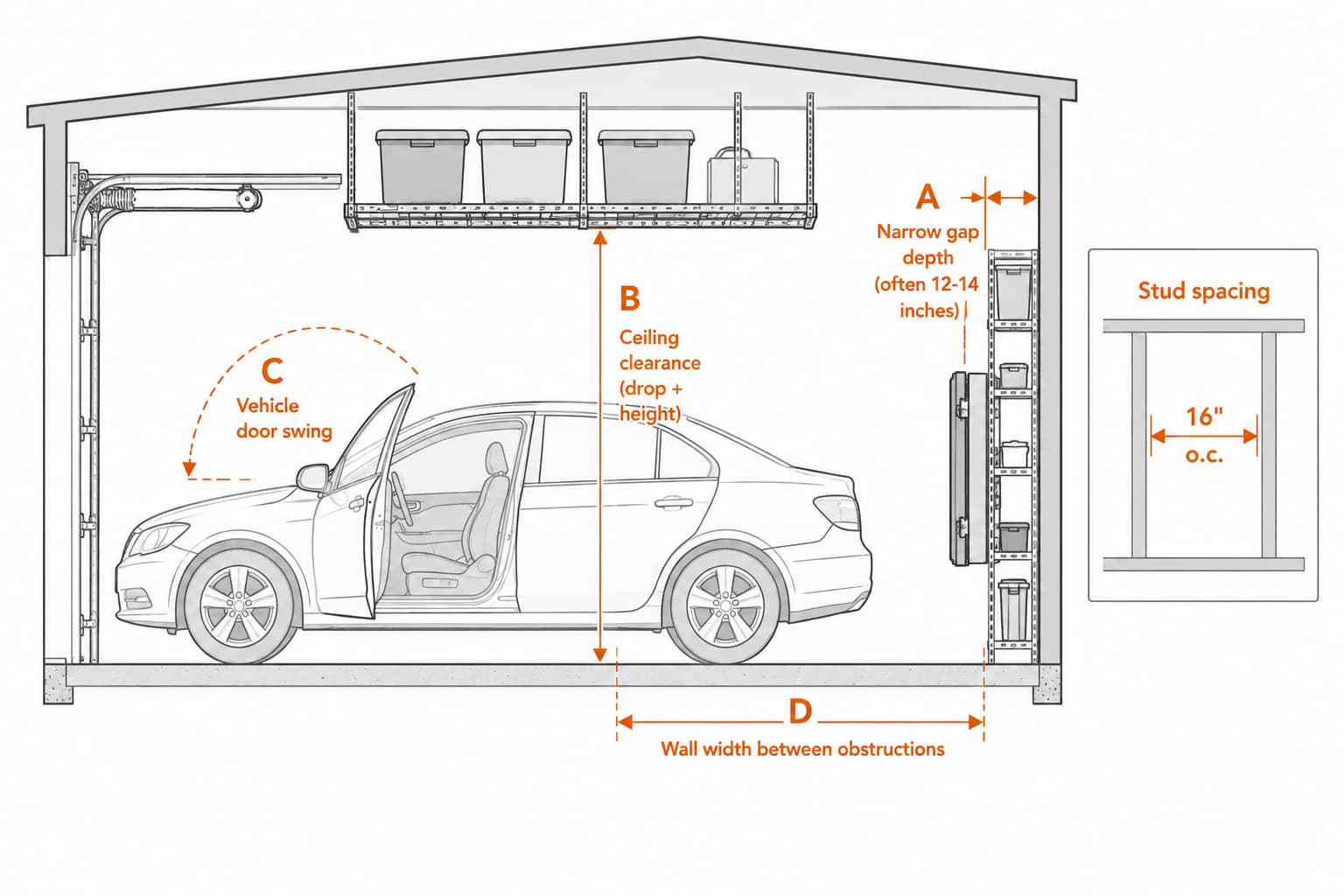
- Narrow side-wall gap depth — the depth available between the car body (parked, doors closed) and the side wall. Often 12-to-14 inches in single-car garages.
- Ceiling clearance for overhead — floor to ceiling, minus the lowest hanging obstruction (garage door track, lighting drop).
- Vehicle door swing arc — sit in the driver’s seat, open the door fully, measure the arc. This arc is the no-storage zone on the driver-side wall.
- Available wall width between obstructions — windows, electrical panels, water heaters, service doors all break up the wall. Measure each clean run separately.
- Stud spacing — find studs with an electronic stud finder. 16 inches on center is standard; 24 inches possible in older homes. Determines what can mount where.
Common Mistakes to Avoid
Five mistakes specific to small-garage storage.
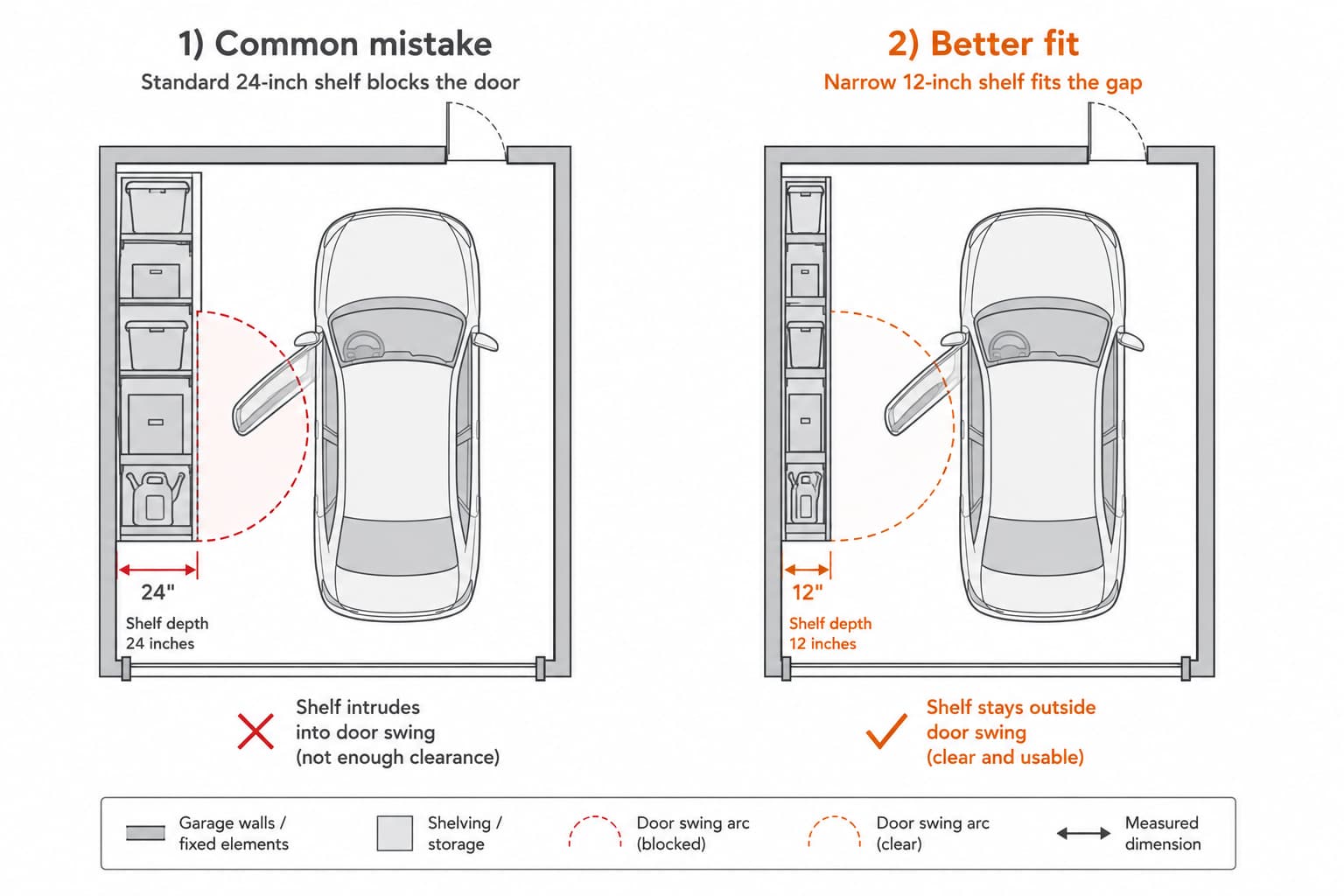
- Buying standard 18-to-24-inch-deep shelving. This is the most common mistake. It looks fine in the catalog photo; in your small garage, it intrudes into the car door arc. Measure your gap first; choose 11-to-14 inch depth if the gap is tight.
- Putting the overhead rack above the parking spot. Common assumption — wrong choice in most garages. Above the parking spot, the rack-bottom-to-vehicle-roof clearance is tight, and any drop you add reduces it further. Mount overhead racks above wall-cleared areas (the back of the garage, the front near the door) when possible.
- Drywall-anchoring a folding bench. The deployed load plus the static weight of the bench plus dynamic forces during use will pull drywall anchors out within months. Find studs first.
- Treating the back wall as primary storage. When the car parks, the back wall becomes inaccessible. Back-wall storage is for items you don’t need to grab quickly. Side-wall and overhead get the active items.
- Buying based on capacity, not on footprint. A 1500-lb-capacity shelving unit that’s 24 inches deep is worse for a small garage than a 200-lb unit that’s 12 inches deep. In small spaces, footprint trumps capacity for most use cases.
Safety and Installation Notes
Tall narrow shelving (over 60 inches) needs an anti-tip mechanism — either the manufacturer’s anti-tip kit (most SONGMICS units include this) or a strap-to-stud installation. Reaching for top-shelf items can tip narrow units.
For overhead racks, anchor only into ceiling joists — never into drywall or ceiling material alone. Use a stud finder to map joists before committing to a rack position.
Featured Picks
Three picks, one per vertical-space strategy. Each is a starter recommendation for its strategy; the cluster has roundups with more alternatives.
For narrow vertical: SONGMICS 6-Tier Wire Shelving 11.4 inch deep

11.4 inches deep by 23.2 inches wide by 63 inches tall — the depth is the differentiator. Six adjustable tiers, manufacturer-listed at 44 lb per shelf and 264 lb total. Splits into two 3-tier units for two-zone deployment, which adds future-proofing as the layout evolves. SONGMICS is an established brand with multiple SKUs in this product family. NOT a tote-shelf — 11.4 inches is too shallow for standard plastic storage bins; this is for boxes, tools, and items deeper than they are wide.
For wall-folding work surface: Ultrawall Wall-Mounted Folding Workbench 32 by 18 inch

Folds to under 4 inches of wall depth when not in use; deploys to a 32-by-18-inch work surface at 550 lb manufacturer-listed capacity. The bay stays clear for parking when the bench is folded — the small-garage paradox solved at one wall position. Must mount into wall studs (drywall anchors will not hold the deployed load over time).
For overhead seasonal storage: FLEXIMOUNTS 4×8 Overhead Garage Storage Rack

A 4 ft by 8 ft platform = 32 square feet of overhead storage that doesn’t compete for floor or wall space. 750 lb manufacturer-listed capacity. Adjustable drop-down height accommodates the lower ceilings common in small garages. FLEXIMOUNTS is the volume leader in residential overhead racks — strong brand stability. For installation method specifics, see how to install overhead garage storage.
For the broader small-garage layout playbook beyond storage products alone, see how to organize a small garage.
How much room an overhead rack leaves under it
Rack makers publish how far the unit hangs below the ceiling. What they never publish is the number you actually need: how much headroom is left underneath once it is up — which is what decides whether your car still fits, or whether the garage door can still swing open. This table restates each rack’s published drop and works out the remaining clearance for the two ceiling heights most American garages have.
| Rack | Published ceiling drop | Clearance under it — 8 ft ceiling | Clearance under it — 9 ft ceiling | Deck size | Stated capacity | Joist requirement | Specification source | Source checked |
|---|---|---|---|---|---|---|---|---|
| SafeRacks 4 ft × 8 ft | 12–45 in | 51–84 in | 63–96 in | 48 × 96 in | 600 lb | brackets span two wood joists; not for I-beams | SafeRacks 4×8 Overhead Rack | 2026-08-14 |
| FLEXIMOUNTS GR48 Classic 4 ft × 8 ft | 22–40 in | 56–74 in | 68–86 in | 96 × 48 in | 750 lb rated (1,200 lb tested) | joist spacing ≤ 24 in; if spacing > 24 in, only 48 in spacing | FLEXIMOUNTS GR48 Classic 4′ × 8′ | 2026-09-14 |
| Gladiator Overhead GearLoft 4 ft × 8 ft | 23–37 in | 59–73 in | 71–85 in | 48 W × 96 D in | 1,000 lb per unit | ceiling mounted, assembly required (spacing not published) | Gladiator Overhead GearLoft 4 × 8 | 2026-08-14 |
How these numbers were produced: Ceiling drop, deck size, capacity and joist requirements are quoted from each manufacturer’s own product page on the date shown. Clearance underneath is arithmetic: ceiling height minus the published drop, at 8 ft (96 in) and 9 ft (108 in). The range runs from the rack’s lowest setting (least clearance) to its highest. The calculation treats the published drop as the distance from ceiling to deck and ignores deck thickness, so treat the result as the optimistic figure and measure before you drill.
- Measure where you will actually mount it. The garage door track, the opener rail and the door in its open position occupy the ceiling near the door — the clearance that matters there is not the clearance mid-garage.
- Clearance is to the underside of the deck. Anything hanging below the deck, and the deck’s own thickness, eats into it.
- Joist spacing is a hard constraint, not a preference: these racks are rated only when fixed into wood joists at the spacing the manufacturer states.
- Capacity figures are the manufacturer’s stated maximum for a correctly installed rack. Real-world performance depends on assembly, the fixings used, joist condition and how the load is distributed.
- A blank cell means the manufacturer does not publish that figure — we do not fill gaps with numbers we could not source.
These are the entries that matter for this guide. The full table, with every row and its source, is in our How much room an overhead rack leaves under it.
FAQ
How small is “small” for a garage?
For purposes of this guide, “small” means a single-car garage (typically 12-by-20 ft or smaller), a partial garage, or a tight two-car garage where parking and storage compete for the same wall area. If you have a comfortably-sized two-car garage with workshop bay, the standard storage formats work — this guide is for cases where they don’t.
Can I put a workbench in a single-car garage?
Yes, but only as a wall-folding unit, not a fixed bench. A 30-by-18-inch wall-folding workbench occupies under 4 inches of wall depth when folded, which doesn’t conflict with the parked car. A fixed permanent bench (18-to-24 inches deep, freestanding) usually does conflict.
How low can a garage ceiling be to use overhead racks?
Practically, 8 feet is the minimum for most overhead racks. The math: rack drop (12-to-24 inches) + stored-item stack height (typically 12 inches) + vehicle roof clearance (typically 60 inches for a sedan, 70 inches for SUV) needs to leave room for a few inches of safety margin. Under 8 feet, overhead racks become marginal; under 7 feet, they’re usually not viable.
What’s the narrowest shelving I should buy?
About 10 inches is the practical narrow limit. Below that, the shelf can’t hold most boxes and bins reliably. The 11.4 inch SONGMICS unit above is near that minimum and works well for boxes, small bins, and tools.
How do I find studs in a finished drywall garage?
Use an electronic stud finder. Run it across the wall horizontally to locate vertical studs (typically every 16 inches in standard US construction). Mark each stud with a pencil — anything that mounts heavy needs to screw INTO the stud, not into the drywall between studs.
Will a folding workbench stay folded over years?
If the manufacturer’s hinge mechanism is steel (not plastic) and the bench is mounted into studs, yes. The Ultrawall and similar branded folding benches use steel folding mechanisms rated for thousands of deploy-fold cycles. Generic listings with plastic hinge components are the failure mode; verify the construction materials before buying.
Sources Reviewed
For this buying guide, we reviewed manufacturer documentation, retailer product pages, installation manuals where available, and recurring patterns in public discussions about small-garage storage solutions.