How to Organize a Garage for a Family of Four (Zone Plan)
Last updated:
Disclosure: This article contains affiliate links. If you buy through these links, we may earn a commission at no extra cost to you. We do not claim hands-on testing unless clearly stated.
A family of four accumulates roughly four times the gear of a single-person household in the same garage footprint. Four sets of jackets, two kids’ worth of sports rotations, holiday bins that grow every year, and the cars still need to park. This guide walks through a four-zone plan that organizes by USER and FREQUENCY rather than by item type, and it gives you the three buying priorities that actually matter — in order — so you don’t over-buy. It does not cover workshop setup or built-in cabinetry; it is squarely about shared family storage.
Why a Family Garage Is Different
A family-of-four garage has four users at different heights, two of them growing every year, and at least three competing rotations: kids’ sports, family seasonal, and adult yard gear. Two cars usually still need to park. The shared-zone problem is the one everyone misses: when no one owns a hook or shelf, no one keeps it tidy, and entropy wins. The fix is to assign ownership and access height to every zone — not items to bins, but zones to people.
The Family Garage Zone Plan
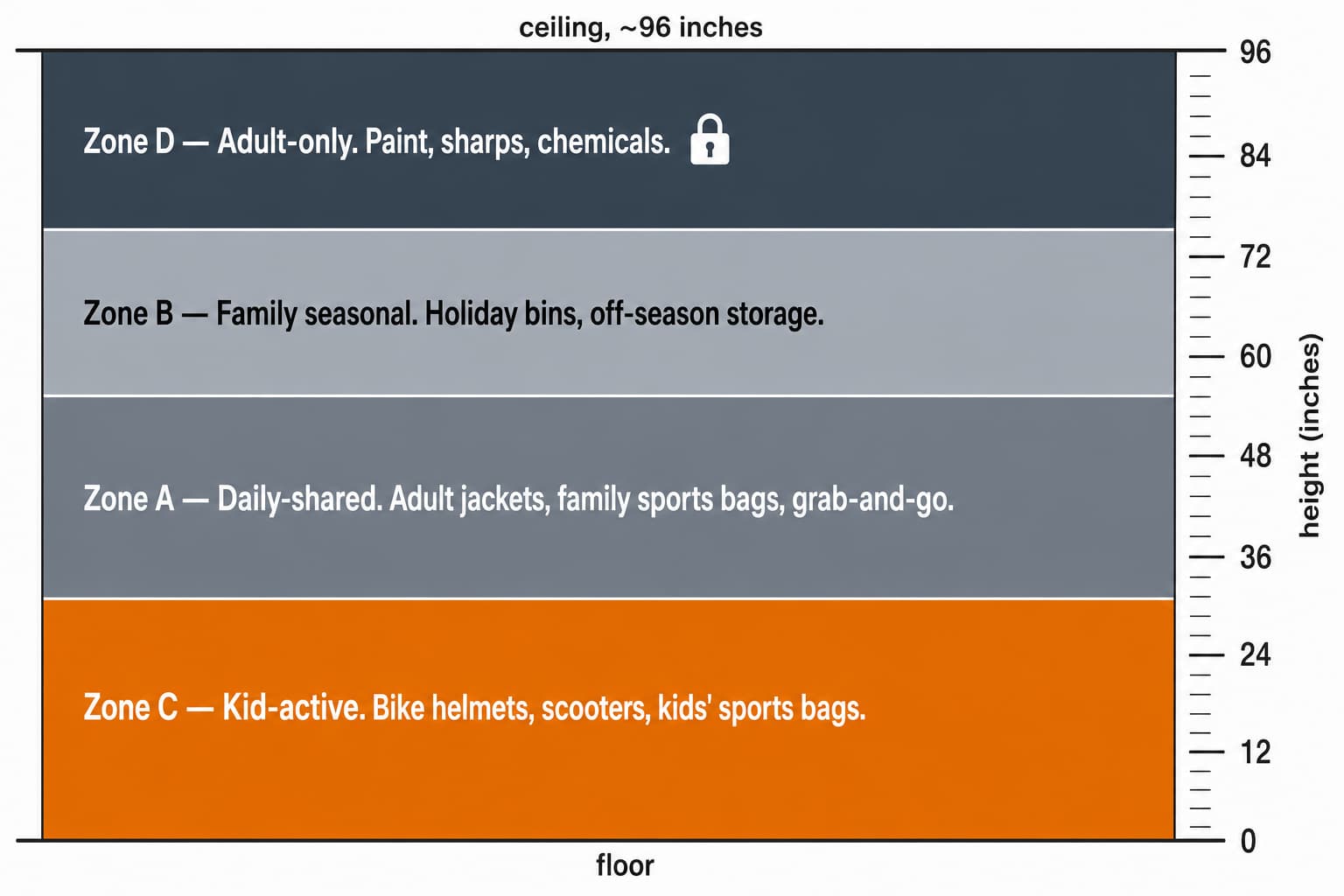
Four zones, defined by who uses them and how often. Most family garages fit on one or two walls; the rest of the space is for vehicles, the seasonal-rotation overflow, and the overhead storage layer.
Zone A — Daily-shared (36–65 inches)
The grab-and-go zone for everyone: adult jackets, the family sports bag, the dog leash, the bike helmet on the way out. Mount it at the range adults and tall teens can use without bending. Keep its capacity intentionally limited — it gets messy fastest.
Zone B — Family seasonal (60–84 inches)
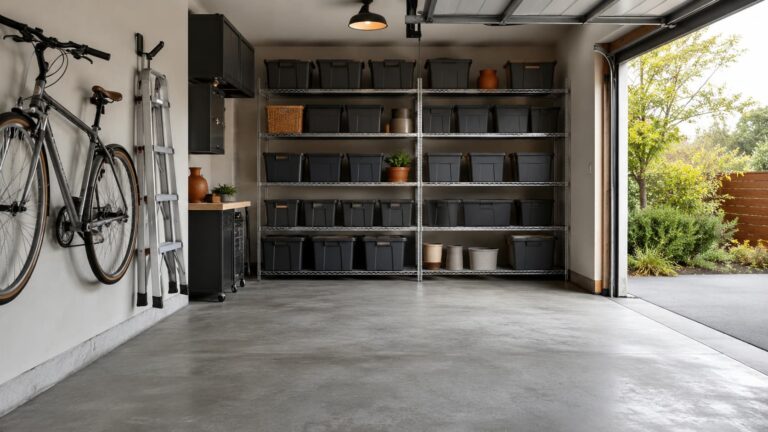
Holiday decorations, off-season clothing bins, school-year storage. High shelves and overhead racks. Touched twice a year, so accessibility matters less than density and clear labeling. The editorial mistake here is treating seasonal storage like daily storage.
Zone C — Kid-active (24–48 inches)
Current-season sports gear, scooters, bikes, kid-specific bags. A typical 8-year-old’s reach with arm up is about 65 inches, but a comfortable hook is at 48 inches or below. Most adult-organized garages put everything at 60+ inches and then complain that the kids never put their gear away. The kids would — they just can’t. For category-by-category coverage of this zone, see the dedicated sports-equipment how-to.
Zone D — Adult-only (72+ inches OR locked)
Paint cans, sharp tools, garden chemicals. Either above 72 inches or behind a locked cabinet door. The one zone with a hard child-safety constraint — don’t compromise on it.
For broader floor planning before zoning, the small-garage layout walkthrough goes deeper.
Kid-Accessible Heights — The One Rule Nobody Writes Down
Standard garage-organization articles put hooks at adult eye level (60–65 inches) and stop. For a family with kids old enough to put their own gear away, that’s the single biggest mistake. As a rough starting point, not a measured standard — every kid’s build and comfortable reach differ, so measure your own child before drilling anything:
- 6-year-old: roughly 46 inches tall, comfortable hook height roughly 36 inches
- 8-year-old: roughly 52 inches tall, comfortable hook height roughly 42 inches
- 10-year-old: roughly 56 inches tall, comfortable hook height roughly 48 inches
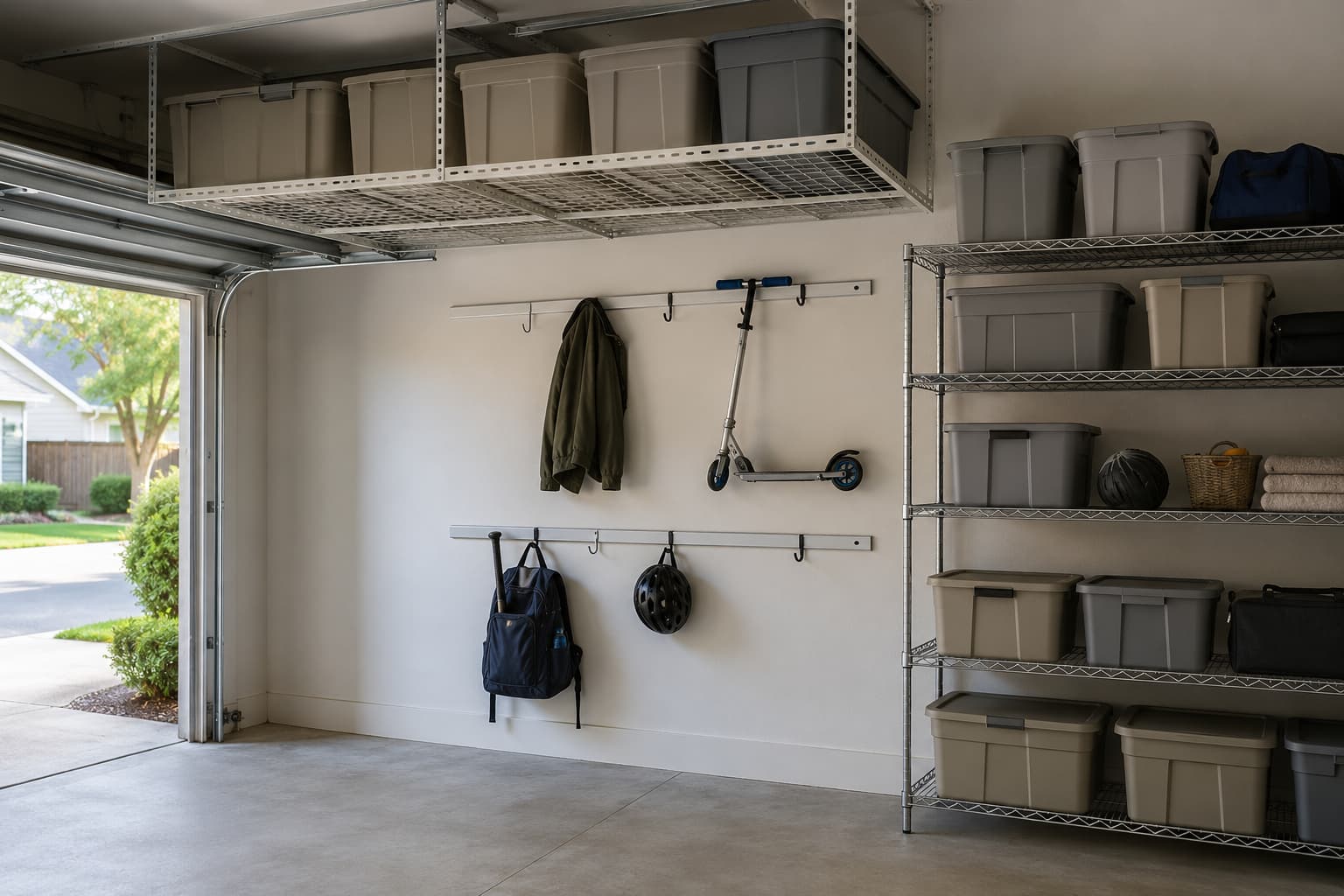
Mount one rail at 42 inches and a second at 60 inches. Both kids and adults can use the system without stretching, climbing, or skipping put-away. The two-rail system is the single highest-leverage change in a family garage — cheap, reversible, and it converts the kids from gear-droppers to gear-hangers within a week.
The Three Buys That Actually Matter
Most family-garage organization fails because parents buy too much, too early. The order below puts the cheapest, most-impactful buys first. Don’t move to buy 2 until buy 1 is installed. For an explicit measurement-before-buying perspective, the buying guide for small-space storage covers what to measure first.
Buy 1: Stackable storage bins for the seasonal rotation
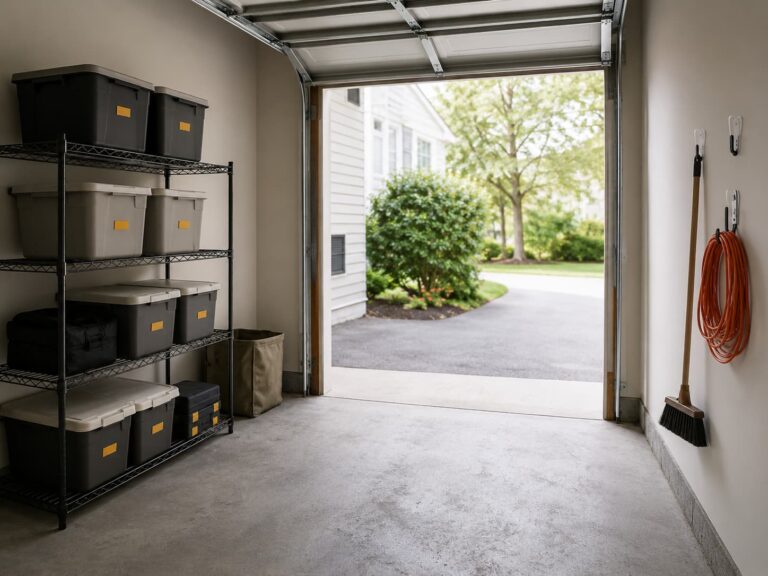
You need a place to put the stuff you’ll sort out of active zones. The Rubbermaid Roughneck 18-gallon 6-pack (View on Amazon) is the well-known durable family — snap-lid bins that stack reliably, with the 18-gallon variant fitting standard wire-shelf depths. Measure your shelf depth first: the 18-gallon Roughneck measures about 24 inches on its long side and about 16 inches on its short side (see the tote-shelf-fit table further down this page). Placed long-side-first it overhangs an 18-inch wire shelf by ~6 inches — turn it 90° so the ~16-inch side faces front-to-back and it fits an 18-inch shelf with room to spare. Orient the totes that way rather than buying deeper shelving.
Buy 2: A wall rail with hooks at two heights
Rails reconfigure as kids grow; rail anchors take the structural load. A starter kit like the Rubbermaid FastTrack 5-piece (View on Amazon) gives one rail plus four hooks — enough for one zone. Most family-of-four garages need two or three rails to cover Zone A and Zone C separately. For families with rotating sports gear, storage built for kids’ sports gear covers the rail-and-hook setups that work for ball nets, helmets, and scooter rests.
Buy 3: An overhead rack for low-frequency items
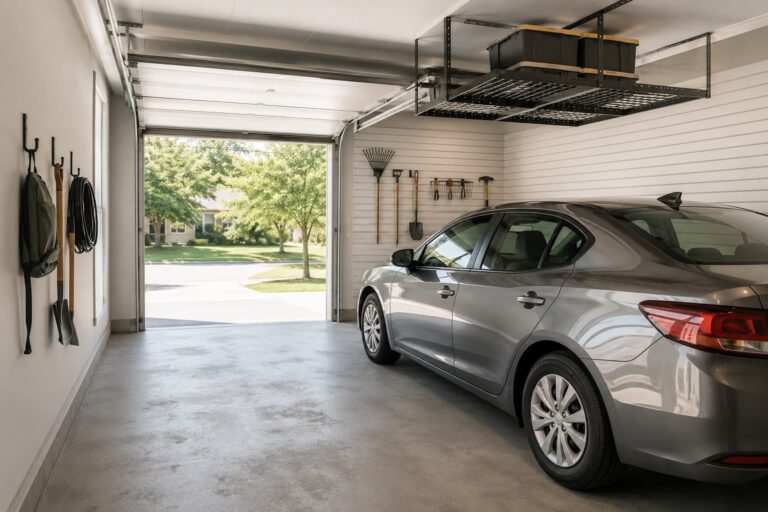
The third lever is the ceiling. A bin-rail system like the Yuleimy 27-gallon tote rack (View on Amazon) holds standard family totes overhead, each independently retrievable — unlike a platform rack where front bins block the back. The manufacturer-listed capacity assumes proper joist mounting and even weight distribution.
Skip buy 3 if you can’t drill into ceiling joists — combine buys 1 and 2 and use a tall shelving unit for the seasonal layer instead.
Seasonal Rotation Cadence
Most family-garage clutter accumulates because last summer’s pool toys never moved out of the active zone. The fix is a calendar, not more storage. A two-rotation cadence — early April and early October — keeps active zones lean. In spring, move winter clothes into Zone B and pull pool toys into Zone C. In fall, reverse. Block 15 minutes per child to own their own bin: they decide what stays active and what goes up. Kids who own the bin actually maintain the bin.
Common Family-Garage Mistakes
Mistake 1: Buying organization gear before sorting
What it looks like: A to-buy list from generic articles, hooks and bins arriving before anyone has touched the garage.
Why it’s a problem: Bin sizes, hook counts, and rail lengths all depend on inventory you haven’t taken. Generic shopping lists over-buy.
What to do instead: Sort first, into rough piles in the driveway. Count what you actually own. Then buy.
Mistake 2: Adult-only mounting heights
What it looks like: All hooks at 60+ inches because that’s where the rail looks “clean” to the adult installing it.
Why it’s a problem: Kids physically can’t reach. They drop gear on the floor and the floor becomes the de facto kid zone.
What to do instead: Two-rail system at ~42 inches and ~60 inches. Reversible, cheap, transformative.
Mistake 3: One giant “kid bin” for everything
What it looks like: A single 30-gallon tote labeled “Kids” that contains everyone’s everything.
Why it’s a problem: Whoever’s looking for an item digs through, dumps half the contents, walks away. Back to disarray within a week.
What to do instead: Per-child bins OR per-activity bins (soccer / scooter / school art). Pick the axis that matches how your kids actually look for their stuff.
Mistake 4: Sports gear stored with paint, sharps, or chemicals
What it looks like: A low shelf with a paint can next to a baseball mitt next to a box cutter.
Why it’s a problem: Cross-contamination of the gear and a child-safety hazard if the shelf is kid-accessible.
What to do instead: Zone D (adult-only or locked) gets the paint, sharps, and chemicals. Sports gear lives in Zone C only.
Sample Layouts by Garage Type
A family-zone plan adapts to whatever footprint you have. In a 2-car attached garage (~20×20 ft), Zone A lives on the entry-door wall so grab-and-go is shortest from inside the house, Zone B uses the side wall and overhead, Zone C goes on the opposite side wall where kids enter from the driveway. In a 2-car detached garage (~22×22 ft), Zones A and C share the longest accessible wall and Zone B is mostly overhead. In a 1-car shared garage (~12×20 ft), Zone A is the primary wall, Zone C overlaps with it by using the lower height band, and Zone B is overhead-only.
How many totes actually fit on a garage shelf
Tote makers publish dimensions and shelving makers publish dimensions, but nobody puts the two together — so people buy shelving, then discover their totes overhang it. This table takes the published external size of totes from the brands people actually buy for garage storage — Sterilite, Rubbermaid Roughneck, and IRIS USA — and works out how many fit per shelf on the two garage shelving depths you can actually buy, 18 in and 24 in.
| Tote | Published dimensions (source order) | Footprint | Height | Fits an 18 in deep shelf? | Per 48 × 18 in shelf | Per 48 × 24 in shelf | Specification source | Source checked |
|---|---|---|---|---|---|---|---|---|
| Rubbermaid Roughneck 3 Gal. Storage Box | 7 in. H x 10.625 in. W x 15.687 in. D | 15.687 in × 10.625 in | 7 in | Yes | 4 | 6 | Rubbermaid Roughneck 3 gal Storage Box, Mfr# RMRT030003 | 2026-09-14 |
| Rubbermaid Roughneck 10 Gal. Storage Box | 8.875 in. H x 15.875 in. W x 23.875 in. D | 23.875 in × 15.875 in | 8.875 in | Yes | 2 | 3 | Rubbermaid Roughneck 10 gal Storage Box, Mfr# RMRT100004 | 2026-09-14 |
| Rubbermaid Roughneck 18 Gal. Storage Box | 16.375 in. H x 15.875 in. W x 23.875 in. D | 23.875 in × 15.875 in | 16.375 in | Yes | 2 | 3 | Rubbermaid Roughneck 18 gal Storage Box, Mfr# RMRT180000 | 2026-09-14 |
| Rubbermaid Roughneck 25 Gal. Storage Box | 23-5/16 in. H x 18-1/2 in. W x 28.875 in. D | 28⅞ in × 18½ in | 23 5/16 in | No — it overhangs | 0 | 1 | Rubbermaid Roughneck 25 gal Storage Box, Mfr# RMRT250002 | 2026-09-14 |
How these numbers were produced: External dimensions are quoted on the date shown per row. Sterilite rows are quoted from Sterilite’s own product pages (L x W x H order). Rubbermaid Roughneck rows are quoted from Ace Hardware’s retailer listing, which prints the manufacturer’s SKU-linked dimensions in H x W x D order on each product page. IRIS USA rows are quoted from IRIS USA’s own product pages (L x W x H order). All figures are the external/overall assembled dimensions with the lid on. The counts are computed, not estimated: totes are placed in a single layer, all in the same orientation, with no overhang and no gap; both orientations (the tote’s long side along the shelf’s 48 in run, or along its depth) are tried and the better one is kept. Shelf width is 48 in in both cases — the two depths are real Husky shelving footprints: 48 in. W x 18 in. D (Husky 86 in. H x 48 in. W x 18 in. D 6-Shelf Steel Shelving Unit, model MR481886W6B, https://www.homedepot.com/p/Husky-86-in-H-x-48-in-W-x-18-in-D-Black-Steel-6-Shelves-Shelving-Unit-MR481886W6B/306062319) and 48 in. W x 24 in. D (Husky 5-Tier Steel Shelving Unit, 48 in. W x 78 in. H x 24 in. D, model 426007, https://www.homedepot.com/p/Husky-5-Tier-Riveted-Steel-Garage-Storage-Shelving-Unit-in-Silver-48-in-W-x-78-in-H-x-24-in-D-426007/303241694); neither product page states a clear opening between posts. 48×18 and 48×24 are unobstructed reference surfaces, not guaranteed usable dimensions of every nominal 48×18 or 48×24 rack — posts and lips can reduce the clear opening (one retailer answer for a Husky 48×24 gives about 45.5 × 21.5 in between posts). Round the result down again if your shelving has corner posts that intrude, and leave room to get a hand in.
- A tote that fits the shelf footprint still needs vertical room: check the tote height against your shelf spacing, and leave clearance to lift it in and out rather than sliding it flush.
- Counts assume a flat, full-depth shelf. Wire shelving with a lip, or posts at the corners, will cost you the last tote in a row.
- Lids overhang the base on most totes; the figures here are the manufacturer’s overall assembled dimensions, which already include the lid.
- Capacity in quarts or gallons tells you nothing about whether it fits — and "27" doesn’t mean the same thing twice. The Sterilite 27 Qt. ClearView Latch Box (17 in x 11-1/8 in) fits an 18 in shelf; the Sterilite 108 Qt. Stacker Box (25-3/4 in x 18-3/8 in) — 27-gallon-equivalent by volume (108 qt = 27 gal), though Sterilite sells it as "108 Qt.," not "27 Gal." — does not.
- Manufacturers and retailers don’t all publish dimensions in the same order. Ace Hardware lists Rubbermaid Roughneck as Height x Width x Depth, where Sterilite and IRIS USA publish Length x Width x Height. This table normalises every row to footprint (the two horizontal dimensions) and height so they compare directly regardless of the order they were published in.
- Rubbermaid Roughneck’s 10 gal and 18 gal totes share the same footprint (23⅞ in x 15⅞ in) — only the height changes, so stepping up in capacity in that range costs no extra shelf space, only vertical clearance.
- A blank cell means the manufacturer does not publish that figure — we do not fill gaps with numbers we could not source.
These are the entries that matter for this guide. The full table, with every row and its source, is in our How many totes actually fit on a garage shelf.
FAQ
How do you organize a garage with little kids vs teens?
Little kids (under 8) need lower hook heights (36–42 inches), simpler bin systems (per-child rather than per-activity), and Zone D enforced strictly. Teens can use adult-height hooks but need more capacity in Zone C as their sports gear bulks up. The zone framework is the same; the heights and bin counts shift.
What’s the cheapest way to start organizing a family garage?
Sort first, then buy in priority order: bins, one wall rail starter kit, then a second rail if needed. Skip the overhead rack until you can confirm joist access.
How do you handle sports gear that rotates seasonally?
Per-sport bins in Zone B for off-season; the in-season sport’s gear moves to a hook in Zone C. Set a calendar reminder for the rotation — early April and early October work for most US climates.
Should kids have their own bins or shared family bins?
Either works; pick by how your kids actually look for their stuff. Per-child if each kid has very different activities. Per-activity (soccer / scooter / school art) if siblings share sports.
How high should hooks be for a family with kids?
Two rails. Lower around 42 inches for kids age 6–10. Upper around 60 inches for adults and taller teens. Move the lower rail up by 2 inches every couple of years as the kids grow.
How often should a family reorganize the garage?
A 15-minute rotation per child twice a year keeps the active zones lean. A full re-zone every 3–5 years as the kids grow into different sports. Most families do not need to re-zone annually.
Sources Reviewed
We reviewed Rubbermaid’s manufacturer pages for the Roughneck tote line and the FastTrack rail-and-hook system, and the Yuleimy Amazon listing for the 27-gallon overhead tote rail system. The kid-accessible height figures (comfortable hook height by age) are our own editorial rule of thumb, not drawn from a specific published anthropometric or ergonomic study — we looked for one addressing hook-mounting height for children specifically and did not find a citable source, as opposed to general child height-for-age data. Treat those figures as a starting point and measure your own child’s reach before drilling. We do not claim hands-on testing of any product mentioned. The zone framework synthesizes recurring patterns from public family-garage organization discussions and our own related guides.