Garage Shelving vs Garage Cabinets: Which Is Better?
Last updated:
Disclosure: This article contains affiliate links. If you buy through these links, we may earn a commission at no extra cost to you. We do not claim hands-on testing unless clearly stated.
Most garages need both shelving and cabinets eventually, but most readers only have budget for one right now — and the choice isn’t obvious. Open shelving is cheaper and holds more weight; closed cabinets keep dust and small kids out. Neither answer is universal. This guide is a head-to-head decision frame across the eight situations garage owners actually face, plus two picks per side.
Quick Answer
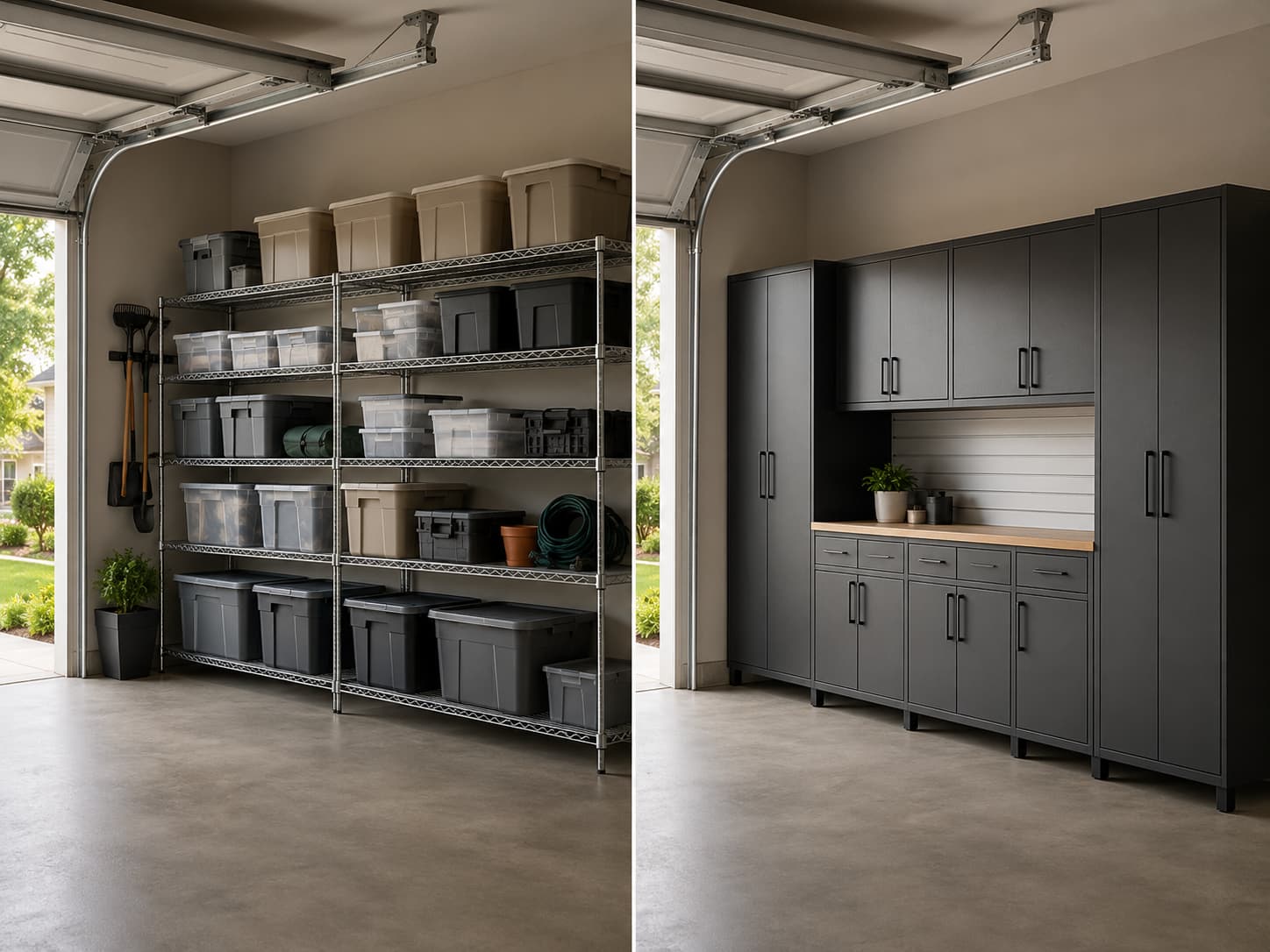
Open shelving wins on price, weight capacity, and access speed — you grab what you need without opening a door. Closed cabinets win on safety (kids, pets, chemicals), dust control, and how the garage looks at a glance. If you have a clean, dry garage and store mostly bins and tools, shelving is the better starting point. If you have small kids, run a workshop that gets dusty, or care how the space looks from the kitchen door, cabinets earn their price premium.
Best Choice by Situation
| Situation | Better choice | Why |
|---|---|---|
| Tight budget, need capacity now | Shelving | Lower cost per cubic foot, higher weight per shelf |
| Storing chemicals, paints, or sharps | Cabinets | Lockable, blocks accidental access |
| Small kids or pets in the garage | Cabinets | Doors block sight and reach |
| Damp / unheated garage | Cabinets (resin) | Resin won’t rust; bare steel will |
| Heavy bins of seasonal gear | Shelving | Manufacturer-listed shelving capacities far exceed cabinet ranges |
| Garage visible from kitchen door | Cabinets | Closed face hides clutter |
| Frequently-grabbed items | Shelving | No door to open every trip |
| Workshop tool storage | Cabinets | Tools stay dust-free and organized |
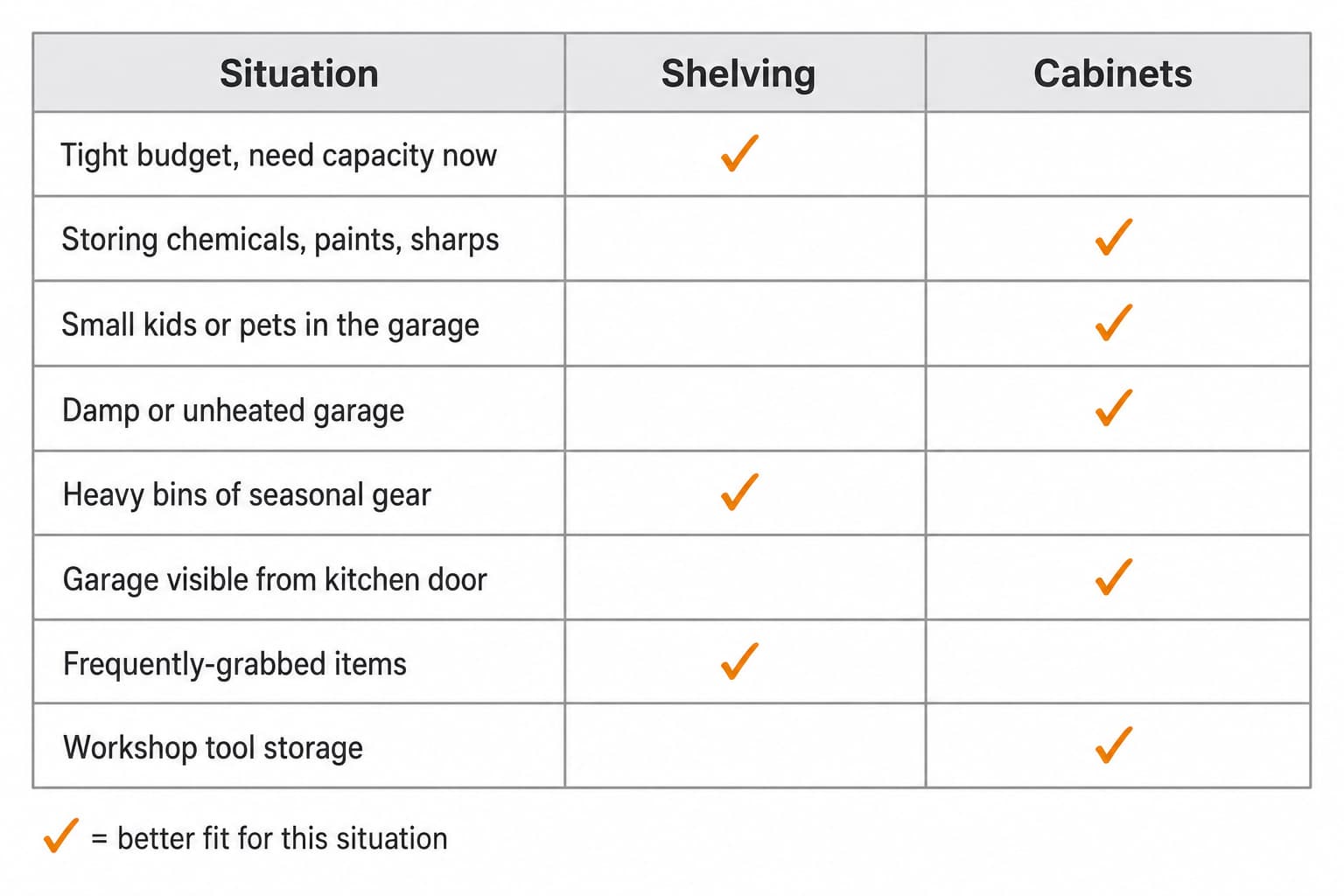
If your situation isn’t in the table, the two sections below give you the principles to figure it out yourself.
Garage Shelving — Pros, Cons, Best Use Cases
What it is
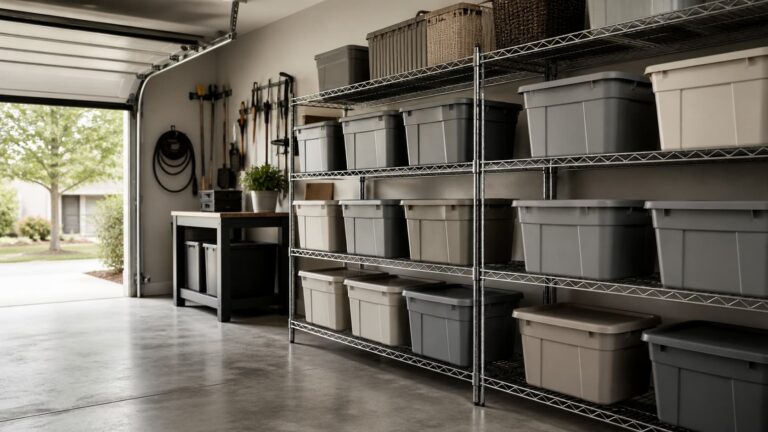
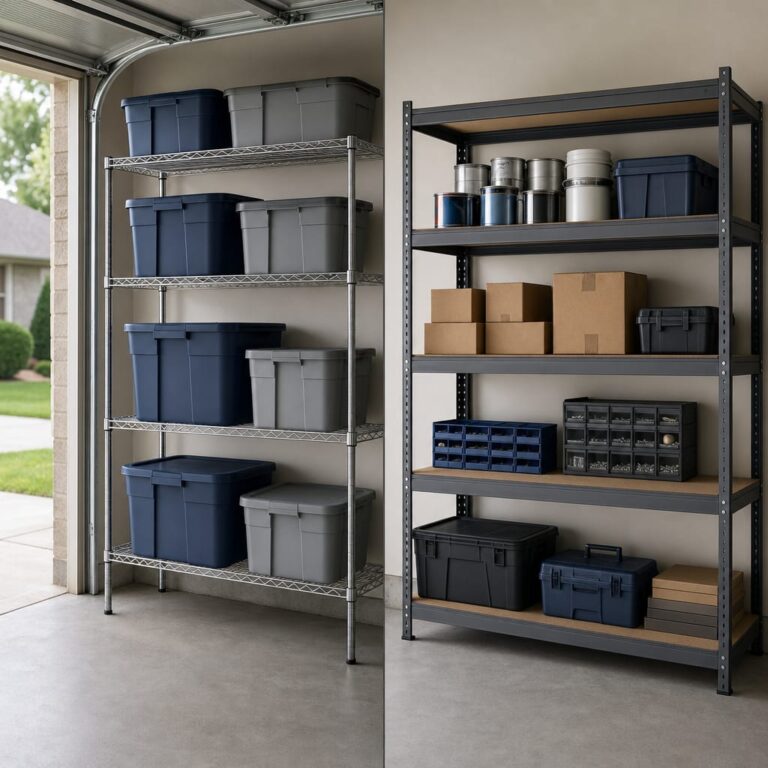
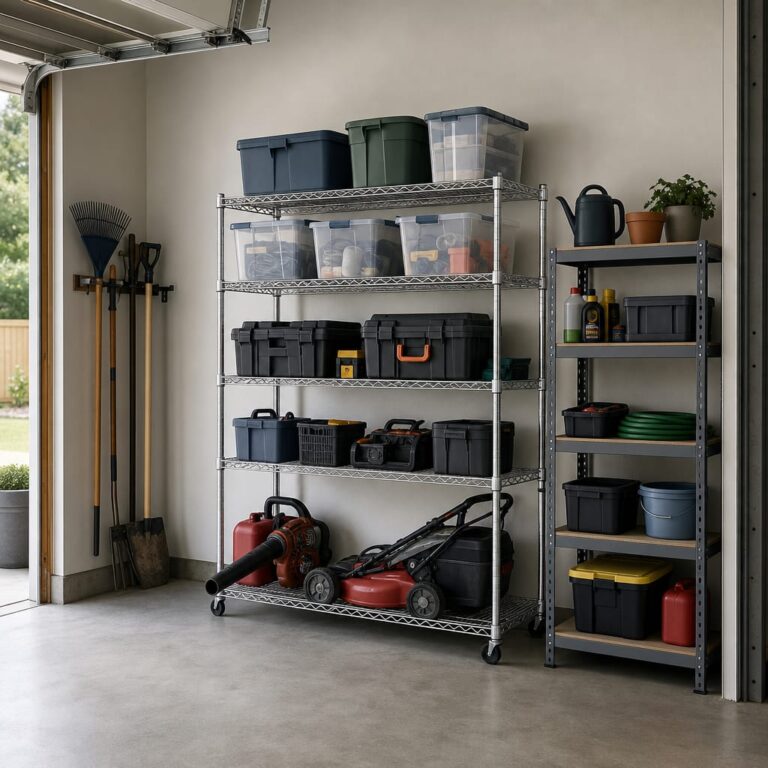
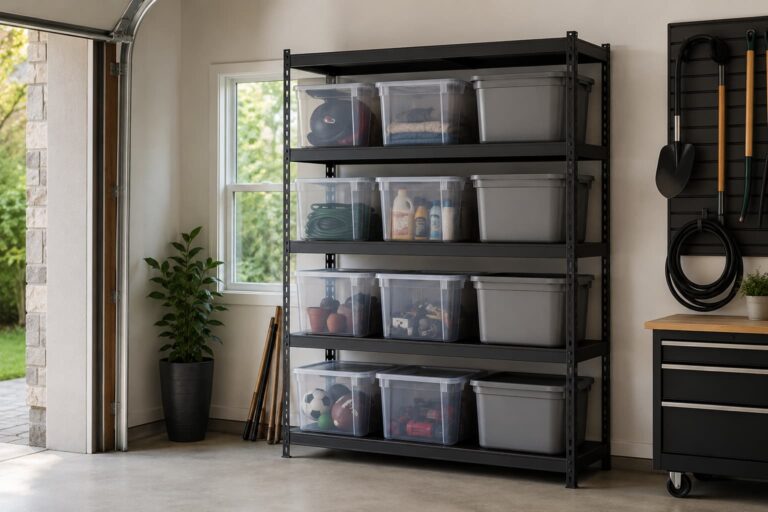
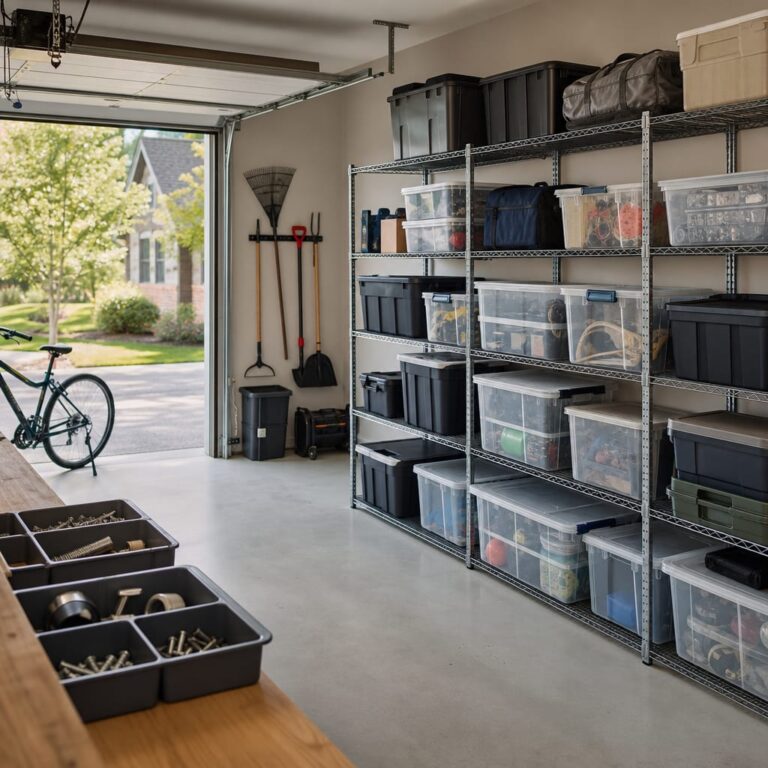
Garage shelving is open metal, wire, or plastic shelving with adjustable tiers. The whole rack is freestanding (or sometimes wall-anchored). Nothing covers the contents. You see, reach, and grab.
Where it works best
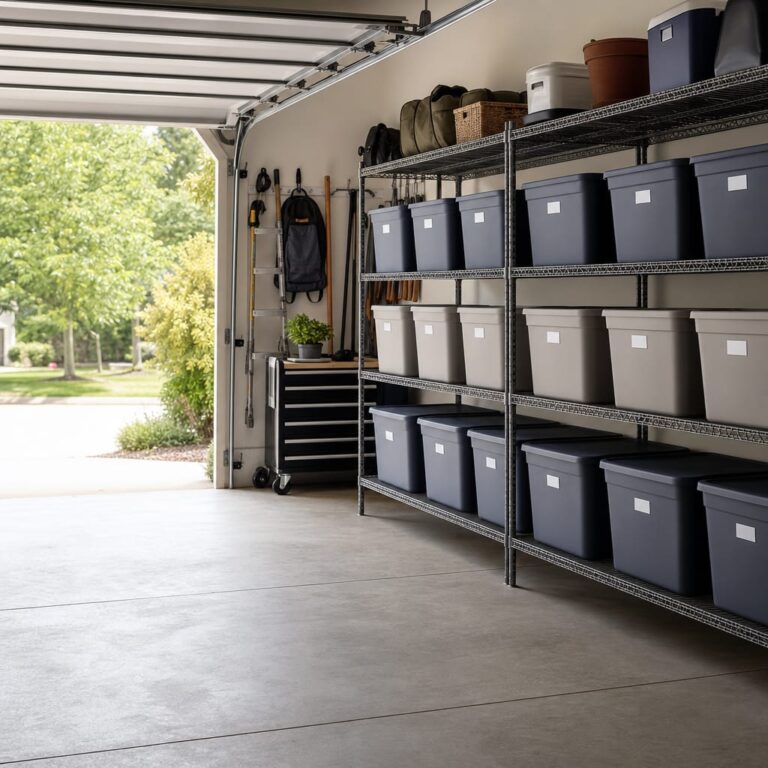
- High-capacity bin storage, especially 27-gallon plastic totes that need to sit flat without overhanging
- Frequently-accessed seasonal items where speed matters (holiday bins, sports gear)
- Tight budgets — you get more cubic feet of storage per dollar than any other format
- Workshops where you want tools visible and grabbable
For the bin-storage use case specifically, see our roundup of the best garage shelves for storage bins.
Where it falls short
Open shelving offers no protection from dust, moisture, or curious hands. Everything is on display, which means a half-organized garage looks chaotic from the kitchen door. Small items can fall through wire shelving without a liner. And nothing is lockable — if it’s on a shelf, anyone in the garage can take it.
What manufacturers and retailers typically specify
The numbers worth checking before you buy:
- Per-shelf capacity, stated separately for leveling feet vs casters — these are very different. Seville Classics lists 800 lb per shelf on leveling feet but only 500 lb total when the unit is on its included wheels.
- Shelf depth (12.6″, 14″, 18″, 24″). A 27-gallon tote’s short side is roughly 20″, so anything under 20″ deep means overhang.
- NSF certification (relevant for food/dry-goods storage).
- Wire spacing — wider gaps mean small items need a shelf liner.
Buyer warnings specific to shelving
The non-obvious mistakes are about depth and casters. A 12.6″ shelf cannot hold a standard 27-gallon tote flat; 18″ leaves the front edge overhanging; 24″ is the threshold for clean tote-on-shelf storage. See how to choose garage shelving for the full depth-to-bin matching matrix. The casters issue surprises people: the same shelf that holds 800 lb per tier on leveling feet may be rated for only 500 lb total when rolling. If you plan to move the unit, you’re cutting per-shelf capacity by more than half.
Garage Cabinets — Pros, Cons, Best Use Cases
What it is
Garage cabinets are freestanding (occasionally wall-mounted) enclosures with hinged doors and adjustable shelves inside. Common materials are welded steel, steel sheet panels, or heavy-duty resin. Most are lockable, either with a built-in key lock or a padlock-ready hasp.
Where it works best
- Locking storage for chemicals, paints, sharps, and anything kids or pets shouldn’t reach
- Households with small children where the garage is shared space
- Workshop tool storage that needs to stay dust-free between uses
- Visible or shared garages where appearance matters
For specific cabinet picks, our roundup of the best garage storage cabinets for cluttered garages is a useful next stop after this comparison.
Where it falls short
Cabinets cost roughly four to ten times more per cubic foot of storage than comparable shelving, and the per-shelf capacity is a fraction. Resin cabinets typically list 50 to 75 lb per shelf; steel cabinets vary more but rarely match what an open wire shelf carries. Top shelves are awkward to access without fully opening doors. And damaged hinges or doors are expensive to fix if you ever need to.
What manufacturers and retailers typically specify
- Steel gauge. 0.8 mm ≈ 22 gauge — moderate, fine for residential, not “industrial”. Heavier cabinets use 1.0 mm or thicker.
- Number of adjustable shelves and spacing range.
- Lock type — built-in key lock (most common) vs padlock-ready hasp.
- Material — resin vs steel — which determines damp-tolerance.
- Construction type — welded steel vs ready-to-assemble (RTA). Both are common at this price tier, but welded units (like the Letaya pick below) tend to hold up better under sustained heavy loads; RTA is fine for light-to-medium use. Listing titles don’t always say which — check the product description.
Buyer warnings specific to cabinets
Frame what you store inside as boxed goods, cleaning supplies, paint cans, and hand tools — not engine blocks. Check the per-shelf capacity for the specific model. The “heavy duty” label appears on cabinets across every price tier; the actual gauge of the steel is what matters. And resin cabinets can warp in extreme summer heat — west-facing uninsulated garages in hot climates (130°F+ at the cabinet zone) push resin past its limits, so steel is the safer pick there.
Side-by-Side Comparison
| Factor | Open shelving | Closed cabinets |
|---|---|---|
| Typical cost per cubic foot of storage | Low | 4–10× higher |
| Typical per-shelf capacity (residential tier) | 200–800 lb | 50–150 lb |
| Locking | No | Yes (most steel and many resin models) |
| Dust / pest protection | None | Strong |
| Visual appearance | Cluttered, utilitarian | Clean, finished |
| Access speed | Fastest | Slower (open and close door) |
| Best for chemicals / paints | No | Yes |
| Best for kids and pets safety | No | Yes |
| Resists damp garage | Coated steel = OK; bare steel rusts | Resin = excellent; steel = OK if dry |
| Reconfiguration | Easy (1″ increments on most units) | Limited |
| Wall space efficiency | Strong | Weaker (needs depth + door swing) |
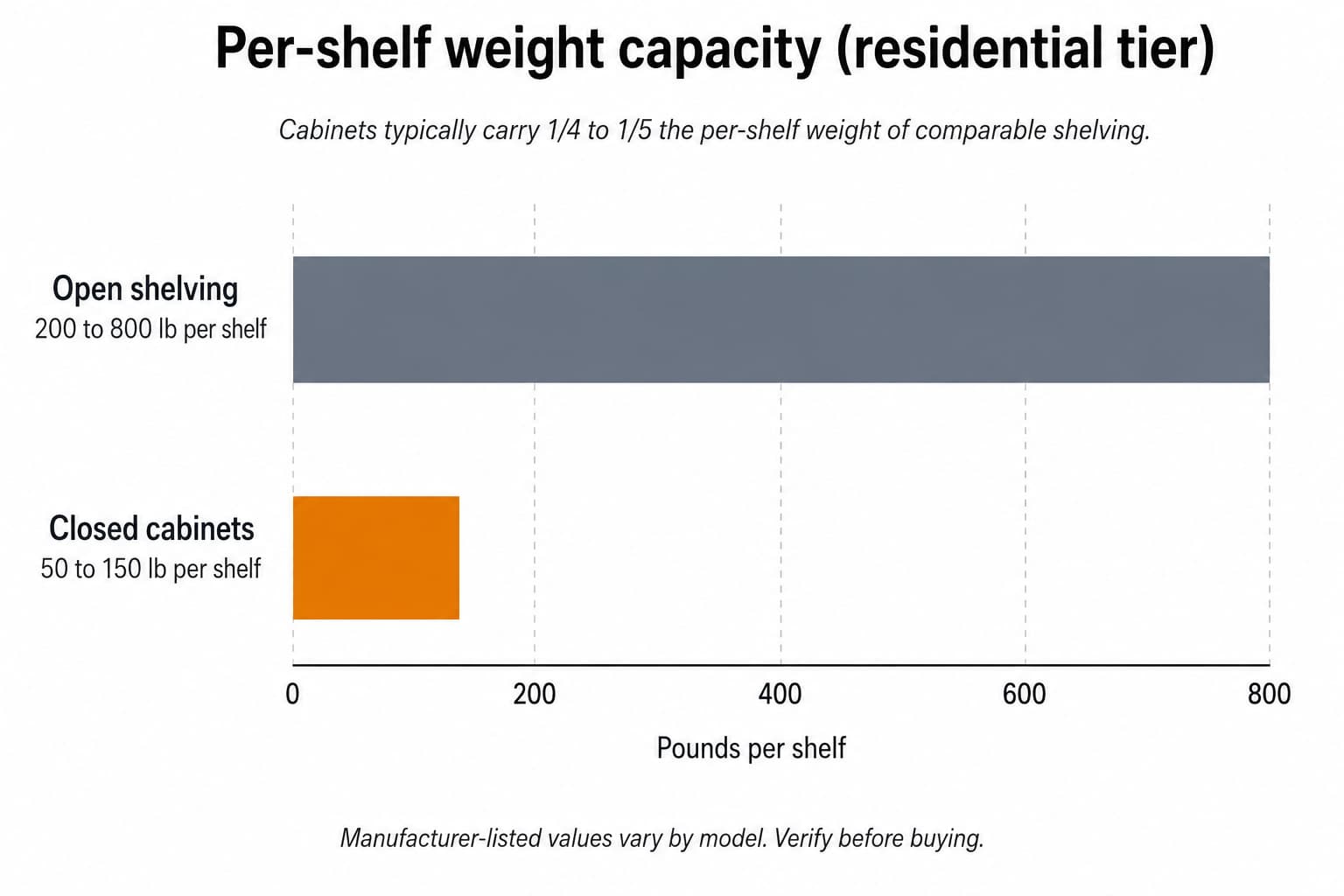
The capacity gap is the most under-appreciated trade-off in this comparison. Cabinets typically carry roughly one-fourth to one-fifth the per-shelf weight of comparable shelving. If your storage is heavy, that math has to be in your head before you commit.
How to Decide for Your Garage
The honest framework, in order:
- List what you need to store, by category. Bins, hand tools, power tools, paint, sharps, sports equipment, seasonal decorations.
- Apply the safety filter first. Anything kids or pets shouldn’t reach goes in a cabinet. Non-negotiable.
- Apply the weight filter. Items over roughly 75 lb want a shelf, not a cabinet.
- Apply the access filter. Daily items on shelves; seasonal items can live in cabinets.
- Apply the appearance filter last. It matters less than people think on day one.
Most working garages end up hybrid — one cabinet for chemicals and sharps, the rest open shelving. For the broader plan see building a full garage storage system, and for tight spaces organizing a small garage step by step.
Common Mistakes
Buying cabinets first because they look nicer. Most shoppers overweight aesthetics on day one. Six months later the garage is half-full and you wish you’d spent the same money on twice the storage volume. Shelving solves the volume problem; cabinets solve specific problems.
Treating “heavy duty” as a real spec. The phrase appears on white-label shelves rated for 200 lb per shelf and on commercial units rated for 800 lb. Look for the actual per-shelf number, on leveling feet, with a manufacturer source you can verify.
Ignoring depth on the shelving side. A 12.6″-deep shelf can’t hold a 27-gallon tote flat. An 18″ shelf overhangs at the front. 24″ is the threshold for full-tote-on-shelf storage; see our shelves that fit 27-gallon totes for verified picks.
Forgetting that cabinets reduce usable wall and floor space. A 30″-wide × 20″-deep cabinet eats more area than a 30″-wide × 14″-deep shelf, and you also need door-swing clearance. In a one-car garage that geometry matters.
Recommended Products for Each Side
Two picks per side — one premium-leaning and one budget-leaning — chosen to span the residential price/capability range without overlapping. The comparison is the article; the products are the act-on-it next step.
For shelving — commercial-grade reference: Seville Classics UltraDurable 5-Tier (48″W × 24″D, with Wheels)

The benchmark unit in the open-shelving category. NSF-certified, 24″ deep (27-gallon totes sit flat), manufacturer-listed 800 lb per shelf on leveling feet. Included casters drop total capacity to 500 lb per the listing — verify before loading. Buyer warning: wheels-or-feet is a real decision. For static storage along a wall, leave the leveling feet on.
For shelving — budget / shallow depth: Sakugi 5-Tier (33″W × 12.6″D × 72″H)
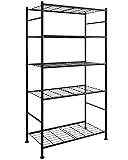
The entry tier — cheap and narrow, useful only for small bins and boxed dry goods. The listing states 1,000 lb total (about 200 lb per tier). Buyer warning: at 12.6″ deep this cannot hold a standard 27-gallon tote. Measure your bins first.
For cabinets — resin / damp-tolerant: Suncast Tall Resin Cabinet (30″W × 20.25″D × 72″H)
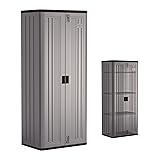
The strongest cabinet pick for unheated, damp, or unconditioned garages. Resin won’t rust; padlock-ready doors keep chemicals and sharps locked away. The listing states roughly 75 lb per shelf — adequate for boxed goods, cleaning supplies, and hand tools. Buyer warning: resin can warp in extreme summer heat. If your garage routinely exceeds 120°F, choose steel instead.
For cabinets — welded steel / lockable: Letaya Tall Metal Cabinet (5 Adjustable Shelves)

A mid-budget welded-steel cabinet with built-in key lock and five adjustable shelves. The listing notes around 0.8 mm (≈22 gauge) steel — moderate, not industrial. Buyer warning: “heavy duty” branding is generous at this tier. For genuinely industrial steel, see our how to choose garage cabinets guide for the gauge thresholds that matter.
Sizing totes to a shelf is a shelving-side question on its own — see our tote size and shelf fit chart for how many totes of each size fit per shelf.
How to Measure Before You Decide
Run this checklist before either purchase. It takes ten minutes and prevents the most expensive mistakes.
- Wall length where the unit will sit; note obstructions (outlets, breaker panels, door tracks).
- Floor depth available — for cabinets, add 24″–30″ of door-swing clearance.
- Ceiling height. Most freestanding units are 72″–78″ tall.
- Largest bin footprint. The standard 27-gallon tote is roughly 28″ × 20″.
- Items that must be locked away (chemicals, sharps, valuables) — this count drives the cabinet decision.
- Outlets near the planned location.
If your wall length is short and your storage is heavy, shelving wins by default. If your storage includes chemicals, add at least one small lockable cabinet plus shelving for the rest.
FAQ
Can I have both shelving and cabinets?
Yes — most working garages end up hybrid. A common layout is one tall cabinet for chemicals, paints, and sharps, and the rest of the wall in open shelving for bins and tools.
Do I need to anchor garage cabinets to the wall?
Most tall-cabinet manufacturers recommend anchoring to a wall stud, especially with children in the household or in earthquake zones. Treat the assembly-instruction recommendation as required, not optional.
Are open wire shelves OK for a humid garage?
Chrome- or zinc-plated wire shelves do well in dry garages. Bare steel rusts. For genuinely damp garages, resin cabinets or sealed bins on coated shelves are safer than uncoated steel.
How much weight can a typical garage cabinet shelf hold?
Listing-stated capacities for residential cabinets are usually 50–75 lb per shelf for resin and 50–100 lb for moderate-gauge steel. Verify the per-shelf number for your specific model.
Can I wall-mount a garage cabinet?
Most freestanding cabinets are not designed for wall mounting. For dedicated wall-mount picks, see wall-mounted garage storage systems.
What about overhead storage instead of either?
Overhead racks free up floor and wall space for items you rarely need (decorations, camping gear, off-season tires) but don’t solve the daily-access problem. See best overhead garage storage racks.
Are closed cabinets actually safer than open shelving for chemicals and paint?
A locked cabinet keeps chemicals, paint, and sharps out of easy reach of children and pets more reliably than an open shelf — the lock is what does the work, not the material the cabinet is made from. An unlocked cabinet offers little more protection than a shelf, so treat the lock itself as the safety feature.
Do open shelves tip over more easily than closed cabinets?
Not inherently. Both formats can tip if loaded unevenly with weight concentrated high up, and both are safer anchored to a wall stud. Tipping risk comes down to load distribution and anchoring, not whether the unit has doors.
Sources Reviewed
For this comparison we reviewed the manufacturer pages on sevilleclassics.com and suncast.com, Amazon product listings for each of the four picks, and recurring patterns in public homeowner discussions about choosing between the two formats. We do not claim hands-on testing unless clearly stated.
Related Guides
- Best garage shelves for storage bins and totes
- Best garage storage cabinets for cluttered garages
- How to choose garage shelving for your space
- How to choose garage cabinets
- How to choose a garage storage system
- How to organize a small garage step by step
- Clear Bins vs Opaque Bins for Garage Storage
- how to label garage storage bins
- How to Set Up a Garage Workshop Area
- Metal vs Plastic Garage Shelving: Which Should You Choose?
- Stackable Bins vs Shelving Units for Garage Organization
- how to organize bins on garage shelves
- How to Stack Garage Storage Bins Safely