How to Choose Garage Storage for Renters
Last updated:
Disclosure: This article contains affiliate links. If you buy through these links, we may earn a commission at no extra cost to you. We do not claim hands-on testing unless clearly stated.
Most garage organization advice assumes you own the place. Drill into joists. Mount slatwall. Anchor a ceiling rack. None of that works if you rent — your lease almost certainly prohibits structural modifications, and even small holes can cost you a security deposit at move-out. This guide flips the framing. The right product type for a renter is the one that stays freestanding, leaves with you when you move, and doesn’t touch the walls or ceiling unless you can undo it cleanly.
What this article covers: a constraint-first buying framework, six product types that pass the deposit test, the measurement steps to take before buying anything, and the honest limits of the few no-drill wall workarounds that actually exist. What it does not cover: ceiling racks, slatwall, drilled pegboard, and anything that needs stud-mounting. For the broader product roundup that pairs with this guide, see our full roundup of garage storage for renters. If you already have a written exception from your landlord allowing minor wall hardware, the renter-specific garage organization checklist covers a wider range of options.
Quick Recommendation by Use Case
| Use case | Best product type | Why |
|---|---|---|
| Bulk storage / seasonal totes (narrow garage) | Freestanding wire shelving (24″ × 18″) | Truly freestanding on leveling feet, breaks down for moving |
| Bulk storage / 27-gal totes (wider garage) | Freestanding wire shelving (48″ × 24″) | 24″ depth eliminates the tote-overhang problem |
| Power tools, automotive, heavy gear | Freestanding boltless steel rack | Higher per-shelf capacity, still freestanding |
| Hand tools / daily mobility | Rolling tool cabinet (5-drawer) | Casters mean no anchoring, ever |
| Small parts, fasteners, craft supplies | Plastic drawer tower | Cheap, light, sits on a workbench or beside a shelf |
| Light brooms, lightweight bags (wall) | Removable adhesive hooks (7.5 lb max) | The only no-drill wall option; honest about its ceiling |
Use this table as your starting filter. Each row maps to a specific product type covered below, plus a concrete Featured Pick at the end of the article.
Key Factors to Consider
Does it require drilling?
If the answer is yes, the product fails the renter test before you read any further. This applies to wall-mounted slatwall, ceiling racks, drilled pegboard, French cleat systems, and most wall-mounted bike racks. The decision filter is binary: anything that needs a hole in a stud, joist, or finished wall is out unless your lease has explicit written exception language. If bike storage is the question and your lease is silent on minor hardware, the wall-mounted vs freestanding bike racks comparison lays out the freestanding alternatives.
Is it actually freestanding, or does it need anchoring?
Manufacturers label many tall shelving units “freestanding” but include an anti-tip wall strap in the box and quietly assume you’ll install it. Read the manual before buying. Some units genuinely stand without a strap when loaded correctly; others list their full capacity only with the strap attached to a stud. Either way, treat any unit taller than about five feet as a tip hazard until you’ve decided how you’ll handle it.
Can you take it apart for moving?
Renters move every one to three years on average. The product you buy should disassemble tool-free or with one common hex tool, fit through a standard doorway in pieces, and fit in whatever vehicle you’ll use to move. Wire shelving breaks down to flat shelves and threaded posts; boltless steel racks separate at the rivets; rolling cabinets just roll out. Bolted-together MDF cabinets are the trap — they’re one-time-use.
Manufacturer-listed capacity vs how the product is anchored
This is the lease-friendly gotcha. A shelving unit’s listed total capacity often assumes specific anchoring (anti-tip strap installed) or specific configurations (leveling feet on a level floor, not casters). The number you see on the listing is the ceiling under those assumptions — not a freestanding-without-anchoring guarantee. A good product page tells you both: leveling-feet capacity AND caster-wheel capacity. If only one configuration is listed, you’re guessing about the other. When in doubt, derate by 30–40% for the freestanding-only case and keep heavy items on lower shelves.
Will it leave damage at move-out?
Three damage vectors matter: floor scuffs from leveling feet or caster wheels on bare concrete (mitigated by a small rubber mat under each foot), wall scuffs from a tall unit leaning against drywall (keep a quarter-inch gap), and adhesive residue from “removable” wall hooks on textured surfaces (sometimes they don’t come off cleanly). Plan for the move-out at the buying stage.
Product Types Explained
Freestanding wire shelving
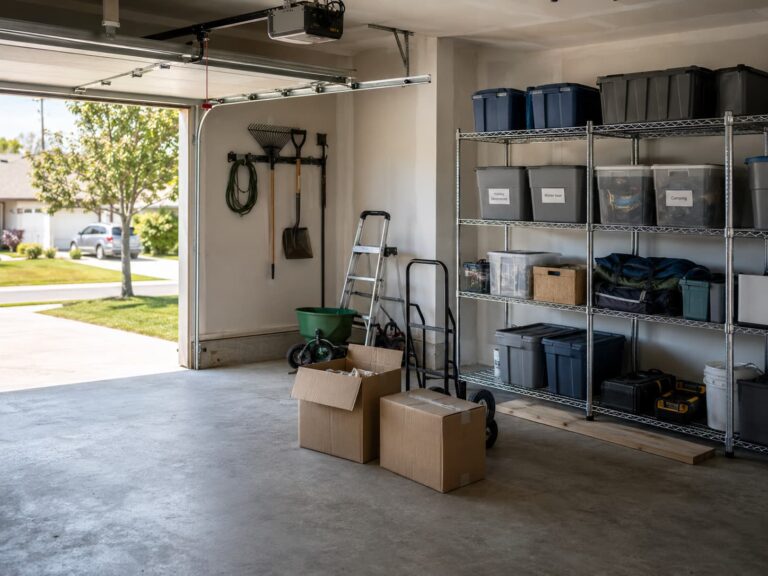
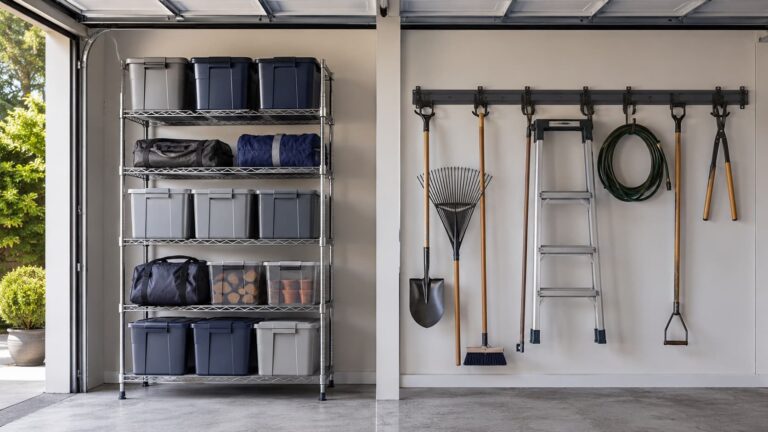
Chrome-plated steel wire shelving — Seville Classics, Trinity, Whitmor — is the renter default. Tool-free assembly, leveling feet, NSF certification on the better units, and full disassembly when you move. Wide range of sizes from 24″-wide narrow units to 48″ or 60″ wide.
Best for: Tote storage, seasonal gear, light to medium items, narrow garages where a deeper unit won’t fit.
Limitations: Wire shelves have gaps — small items fall through unless you add a liner. Depth matters: 18″-deep shelves don’t fit a 27-gallon tote without front overhang.
What to look for: Listed per-shelf capacity with leveling feet (not just total capacity), NSF certification as a build-quality signal, post diameter (1″ or larger is sturdier than 3/4″), shelf-clip system that won’t slip over time.
Freestanding boltless steel shelving
Boltless rivet-style steel shelving from brands like Muscle Rack (Edsal) handles heavier loads than wire. Particleboard or wire-mesh shelf decks slide into welded-steel upright channels — no bolts, no tools, full disassembly for moving.
Best for: Power tools, automotive supplies, paint, batteries, anything denser than seasonal totes.
Limitations: Heavier individual pieces than wire shelving. Particleboard decks degrade if wet — keep dry. More substantial disassembly time at move-out.
What to look for: Welded-rivet construction (not bolt-together MDF), per-shelf and total capacity figures with leveling feet, deck material (steel mesh outperforms particleboard if budget allows).
Rolling tool cabinets
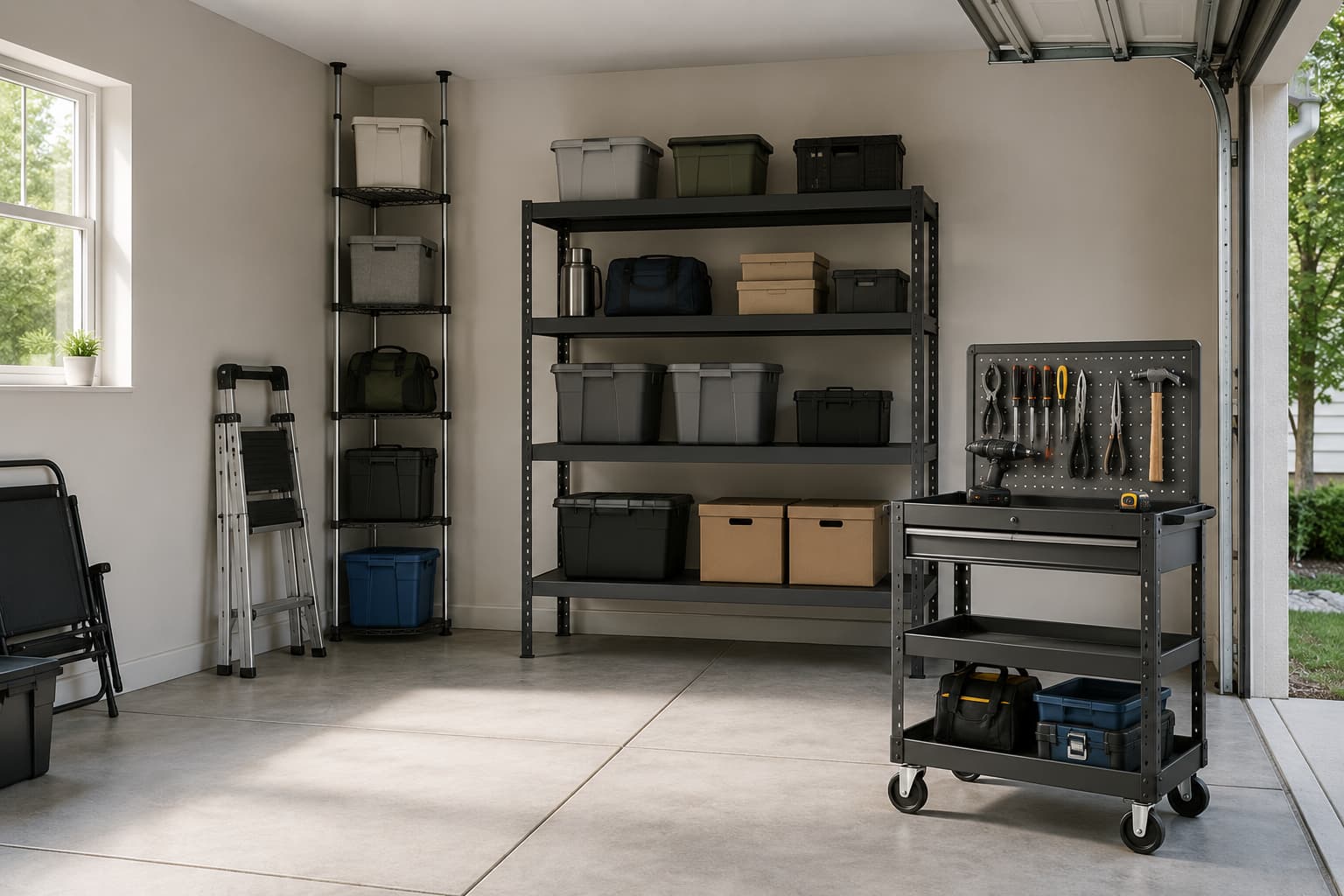
Wheeled tool cabinets from Husky, Craftsman, or DeWalt’s consumer line replace the “drilled pegboard” wall solution entirely. The cabinet rolls where the work is, then rolls back into a corner. Ball-bearing drawer slides handle real tool weight.
Best for: Hand tools, sockets, wrenches, anything that needs to stay organized and move with the user.
Limitations: Footprint is fixed; a 27″ rolling cabinet stays 27″ wide whether you need it or not. Top drawer is usually shallow — tall items need the bottom compartment.
What to look for: Locking front casters (you don’t want it rolling on a sloped floor), steel ball-bearing slides, locking drawer mechanism if security matters.
Plastic drawer towers (Sterilite, IRIS)
The honest budget pick. Sterilite and IRIS make plastic drawer towers — cheap, light, useful for small parts, fasteners, drill bits, paint supplies, batteries. Most consumer 4-drawer towers are stationary rather than rolling; some 3-drawer SKUs add casters, but the bigger 4-drawer wide towers tend to sit where you put them.
Best for: Small parts, hardware, craft supplies, lightweight items that need to be sorted into drawers.
Limitations: Capacity per drawer is low (manufacturer-listed loads are typically light, well under tool-cabinet ratings). Plastic body. Not for tools heavier than a screwdriver.
What to look for: Drawer count vs your sorting needs, drawer-interior dimensions for the items you actually want to sort, drawer stops that prevent accidental full extension.
Removable adhesive wall hooks
3M Command’s Jumbo Utility Hooks and similar adhesive lines are the only legitimate “wall hooks for renters” answer. The adhesive uses a Stretch Release mechanism that removes cleanly from painted drywall, painted wood, glass, tile, and metal when you apply it correctly and follow the removal steps.
Best for: Brooms, mops, dustpans, light hand tools, hose ends, lightweight bags, gardening gloves.
Limitations: Manufacturer-listed capacity is 7.5 lb per hook on the Jumbo Utility line — a hard ceiling, not a starting point. Will not adhere to textured walls, unpainted concrete block, raw brick, or unsealed wood. Cannot hold bikes, ladders, loaded tool bags, or anything that swings.
What to look for: Surface compatibility on the package (it’s specific), the rated weight on the package (Command sells different lines at different capacities — 5 lb, 7.5 lb, 10 lb, 15 lb), the strip type matched to the hook.
What we are skipping (and why)
Most renter garage guides include ceiling racks, slatwall panels, French cleats, and drilled pegboard. We deliberately don’t, because every one of those requires drilling into structure — joists, studs, or finished walls. Even if you can patch the holes at move-out, most leases classify drilling beyond “small picture hangers” as alterations rather than wear and tear, which means deposit risk. If your garage has no usable walls for hardware (because of texture, surface type, or lease restrictions), organizing a garage with no walls available walks through the freestanding-only patterns in depth.
When to Choose Each Type
The decision matrix below maps the renter situations from the Quick Recommendation table to specific product types. Use it as a lookup — find your row, pick the highlighted product type, then verify the corresponding Featured Pick fits your garage’s measurements.
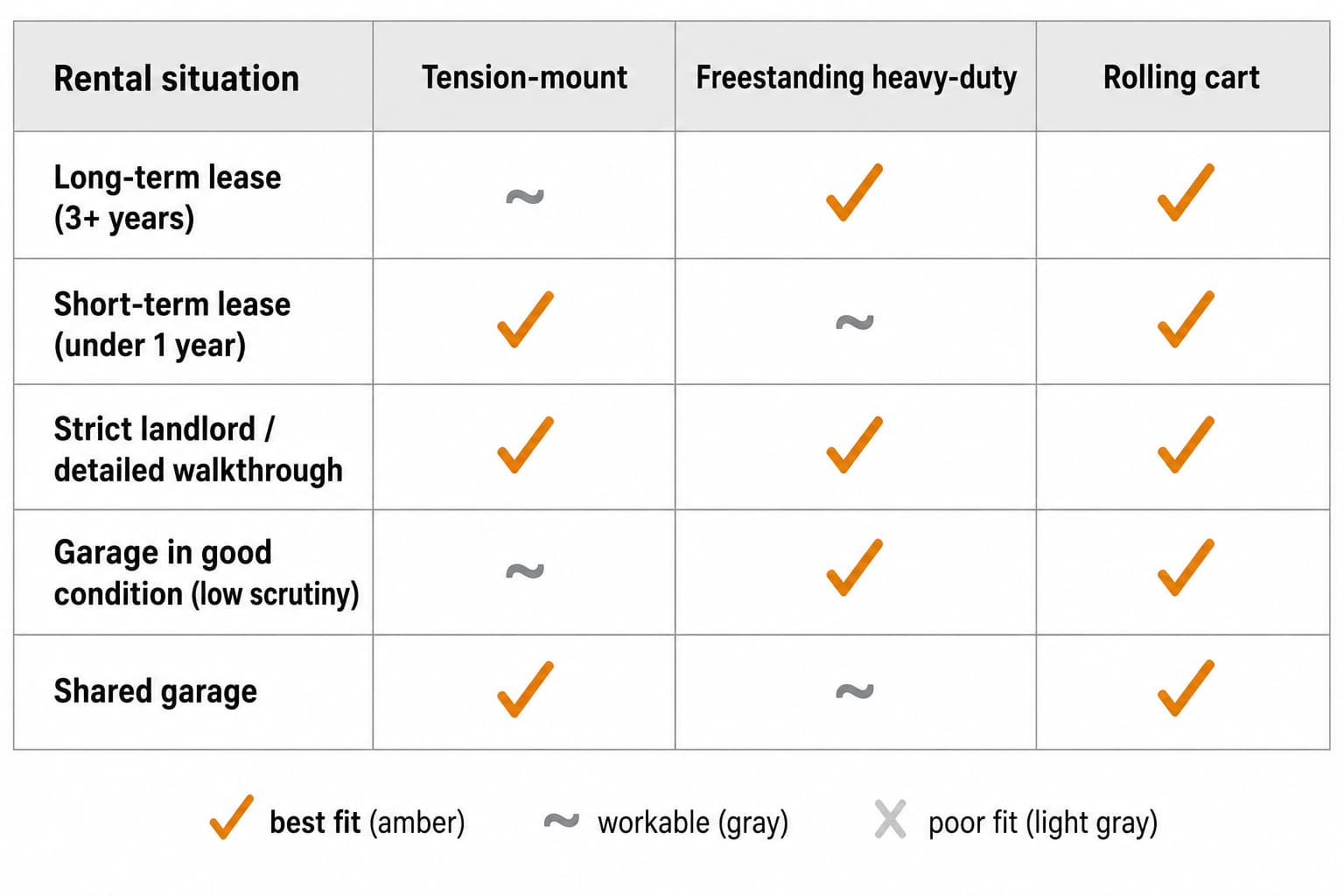
Four steps make this work in practice. First, identify your dominant storage need — totes, tools, small parts, or wall items. Second, apply the renter filter from the Key Factors section: no drilling, freestanding, portable, lease-friendly. Third, measure your garage (next section). Fourth, pick the matching product type and the specific Featured Pick at the end of this article. For renters in compact spaces, maximizing storage in a one-car garage goes deeper on layout. For renters with kids and shared gear loads, organizing a garage for a family of four covers the multi-user variant.
Measurement Checklist
Renter garages tend to be narrower, with worse lighting, uneven floors, and quirky obstructions the previous tenant left behind. Measure before you buy anything. The diagram below labels the seven points to check.
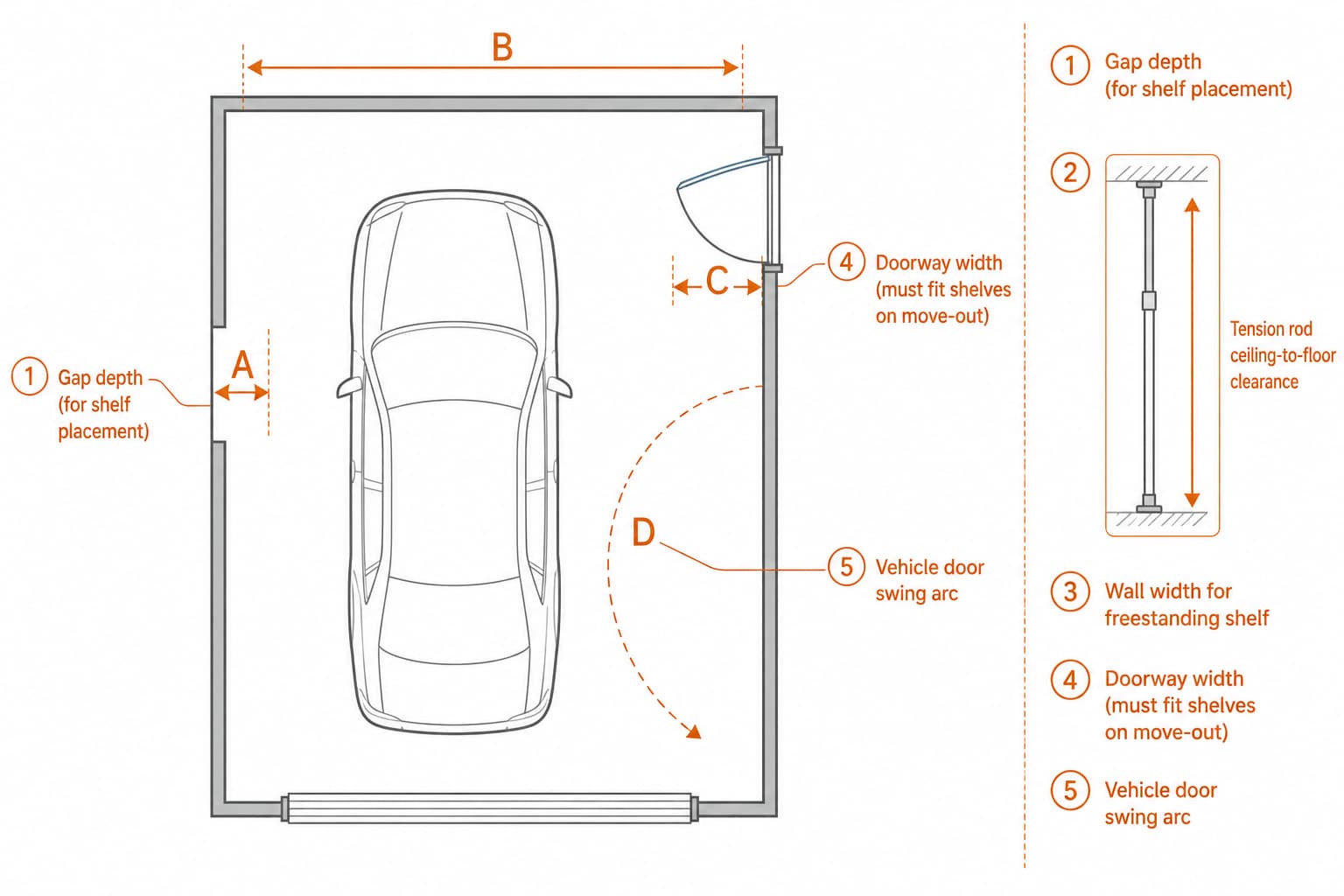
What to measure, in order:
- Floor footprint where the unit will sit (width × depth, in inches). Leave at least 2″ of clearance around any tall shelving for air circulation and to avoid wall scuffs.
- Ceiling height, and specifically the lowest point — most garage doors track along the ceiling at the door end, dropping clearance by several inches.
- Doorway clearance for moving the unit in and out. The disassembled units fit; assembled tall shelving usually does not.
- Tote dimensions with the lid on. Gallon ratings aren’t a reliable size guide — the manufacturer-listed dimensions for the Rubbermaid Roughneck 25 Gal. Storage Box are 28⅞” long by 18½” wide, and that already overhangs an 18″-deep shelf by half an inch. Check your own tote’s printed dimensions rather than assuming from its capacity rating.
- Floor slope. Many rental garages slope a half-inch or more toward the door for drainage. Freestanding shelves with leveling feet can compensate; just plan for it.
- Wall texture. Smooth painted drywall takes adhesive hooks. Orange-peel texture, textured plaster, unpainted concrete block, and raw brick do not.
- Lease-restricted zones. Water heater, electrical panel, utility meter, fuse box — all need clearance and none can be blocked or covered. Leave at least 30″ of clearance in front of an electrical panel.
Mistakes to Avoid
The five mistakes below come up in every renter-garage conversation. The infographic below summarizes them; the bullets explain.
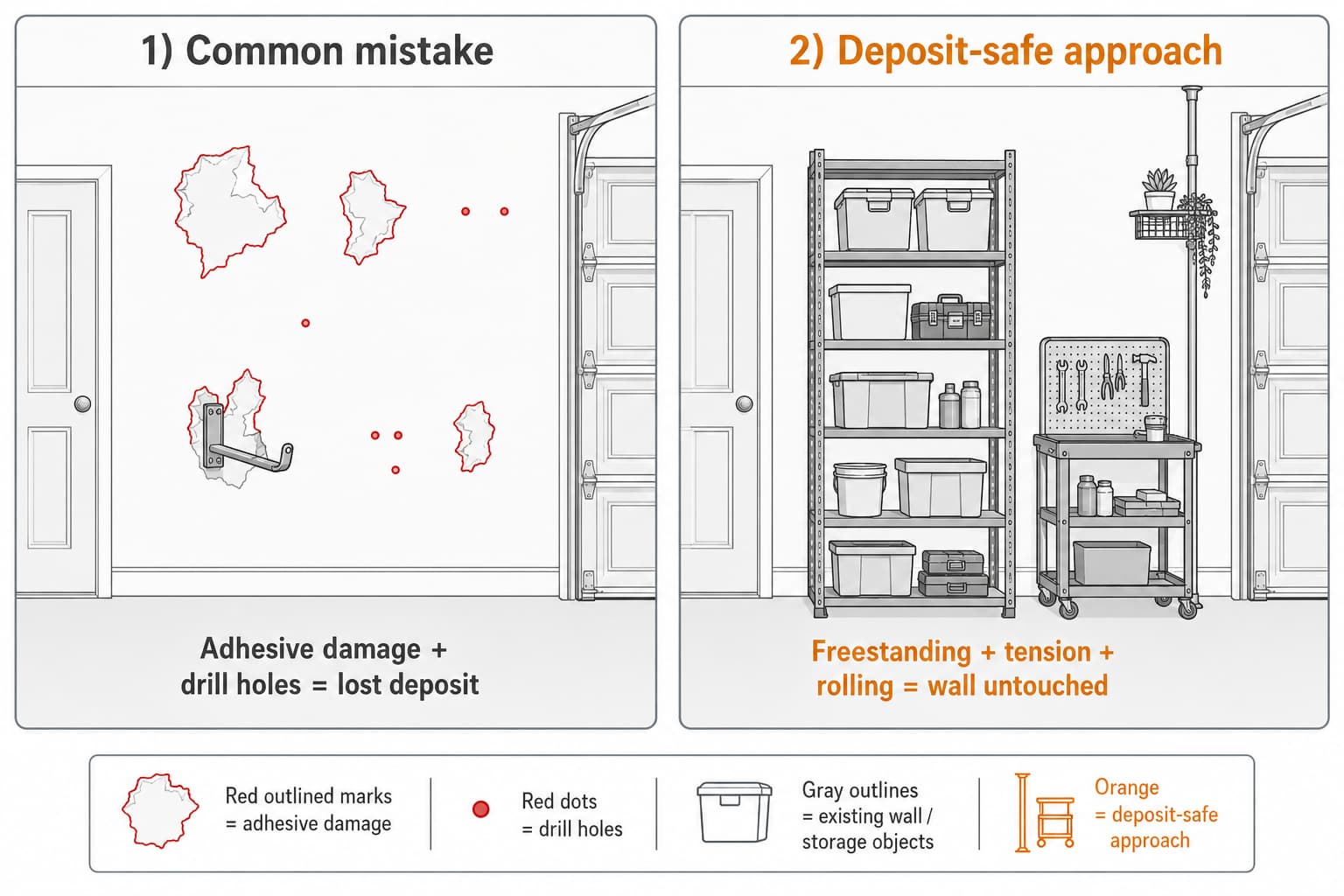
- Mistake 1 — Assuming “freestanding” means anchor-free. Tall shelving units often ship with an anti-tip strap. The manufacturer’s listed capacity may assume it’s installed. Read the manual.
- Mistake 2 — Overloading adhesive hooks. 7.5 lb is the ceiling for Command Jumbo Utility hooks. A “lightweight” tool bag often weighs 10–12 lb loaded. The number is a hard limit, not a suggestion.
- Mistake 3 — Buying a unit that fits the garage but not the doorway. Measure both, in pieces and assembled. A 48″-wide shelving unit assembled won’t make a 36″ interior door turn.
- Mistake 4 — Drilling into joists “just one screw” for a ceiling rack. Drilling structure is the line. Even one hole in a joist can be a lease violation. If wall storage is the question and your landlord has approved minor hardware, the wall storage options for narrow garages guide covers low-impact paths.
- Mistake 5 — Over-buying “just in case”. You move every one to three years. A bigger unit means longer disassembly, more moving cost, and higher disposal cost if it doesn’t fit the next place.
Safety and Anchoring Notes
Tall freestanding shelving is a real tip hazard, especially with kids or pets in the garage. The manufacturer-listed capacity for any tall unit assumes proper loading: heaviest items on the bottom shelf, weight distributed evenly across the deck, and the anti-tip strap installed where the manufacturer specifies it.
For renters specifically: some landlords allow a single small screw into a stud for an anti-tip strap, treating it as wear-and-tear if patched at move-out. Ask in writing before you assume either way. If a strap is not an option, keep the unit’s center of gravity low — never store more than light boxes above shoulder height — and park the unit in a wall corner where two perpendicular surfaces give it some natural lateral support without needing hardware.
Featured Picks
Six picks, one per use case in the Quick Recommendation table. These are starting points; the broader garage storage roundup for renters covers more options per category.
Bulk storage, narrow garage: Seville Classics 5-Tier UltraDurable Wire Shelving (24″ × 18″)
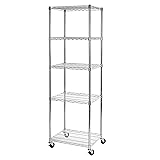
The canonical renter starter shelf. 24″-wide footprint fits a one-car garage corner, NSF certification is a real build-quality signal at this price tier, and disassembly is fully tool-free. The 18″ depth means 27-gallon totes will overhang slightly at the front — fine for smaller bins, or step up to Pick 2 for full tote support.
Verify before buying: manufacturer-listed per-shelf capacity assumes leveling feet on a level floor; caster upgrades lower it to 500 lb total.
Bulk storage, wider garage: Trinity 5-Tier NSF Wire Shelving (48″ × 24″)
Trinity 5-Tier NSF Wire Shelving Rack (48″W x 24″D)
Affiliate link pending — human review required.
The wide-format alternative. 24″ depth eliminates the 27-gallon tote overhang problem from Pick 1, and the 48″ width gives you a substantial single bay along a back wall in a two-car garage. Same freestanding, NSF-certified, leveling-feet design — just bigger.
Verify before buying: bigger footprint means longer disassembly time at move-out; plan a half hour with one other person.
Heavy-duty workshop: Muscle Rack 5-Tier Boltless Steel Storage Rack (48″ × 24″)
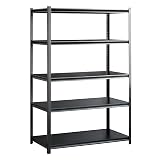
When the load is power tools, automotive fluids, batteries, or paint cans, wire shelving runs out of capacity. Muscle Rack’s boltless rivet construction takes substantially more per-shelf weight than wire, and disassembly is just as tool-free.
Verify before buying: manufacturer-listed total capacity assumes leveling feet and even weight distribution. Particleboard decks degrade if wet — keep dry.
Mobile tool storage: Husky 27″ 5-Drawer Roller Cabinet Tool Chest

The renter’s hand-tool home on wheels. Locking front casters keep it parked when you need it stable; rolling it out of the way takes seconds. Five drawers across three sizes — three shallow, one medium, one deep — sort a real socket set without forcing tools into one compartment. Leaves with you completely unchanged.
Verify before buying: Husky rotates SKUs frequently; confirm the listing shows the 5-drawer 27″ rolling cabinet in textured black, manufacturer-listed at 1,000 lb total cabinet capacity.
Budget small-parts: Sterilite 4-Drawer Wide Weave Tower

The honest budget pick for fasteners, drill bits, paint supplies, batteries, and craft hardware. Plastic, light, sized to fit on top of a workbench or beside a shelving unit. Treat it as drawer organization for small parts — not as a tool chest, and not as a mobile cart.
Verify before buying: drawer capacity is craft-tier, not tool-tier; if you need to store wrenches and sockets, go with Pick 4 instead. Note the canonical listing on Amazon is sold as a 2-pack of towers.
No-drill wall hooks (light): 3M Command 7.5 lb Jumbo Utility Hook

The only legitimate “wall hooks for renters” option. 7.5 lb manufacturer-listed per hook means brooms, mops, light hand tools, lightweight bags. The Stretch Release adhesive comes off cleanly from painted drywall, painted wood, glass, tile, and metal when you follow the removal steps.
Verify before buying: will not hold on textured walls, unpainted concrete block, raw brick, or unsealed wood. 7.5 lb is the ceiling, not a guideline.
How many totes actually fit on a garage shelf
Tote makers publish dimensions and shelving makers publish dimensions, but nobody puts the two together — so people buy shelving, then discover their totes overhang it. This table takes the published external size of totes from the brands people actually buy for garage storage — Sterilite, Rubbermaid Roughneck, and IRIS USA — and works out how many fit per shelf on the two garage shelving depths you can actually buy, 18 in and 24 in.
| Tote | Published dimensions (source order) | Footprint | Height | Fits an 18 in deep shelf? | Per 48 × 18 in shelf | Per 48 × 24 in shelf | Specification source | Source checked |
|---|---|---|---|---|---|---|---|---|
| Sterilite 6 Qt. Storage Box | 13 5/8" x 8" x 4 5/8" | 13⅝ in × 8 in | 4⅝ in | Yes | 6 | 9 | Sterilite 6 Qt. Storage Box | 2026-09-14 |
| Sterilite 16 Qt. Storage Box | 17 1/8" x 11 7/8" x 6 3/4" | 17⅛ in × 11⅞ in | 6¾ in | Yes | 4 | 4 | Sterilite 16 Qt. Storage Box | 2026-09-14 |
| Sterilite 27 Qt. ClearView Latch Box | 17" x 11 1/8" x 12 3/4" | 17 in × 11⅛ in | 12¾ in | Yes | 4 | 4 | Sterilite 27 Qt. ClearView Latch Box | 2026-09-14 |
| Sterilite 60 Qt. Wheeled Underbed Latch Box | 35 1/2" x 18 7/8" x 7" | 35½ in × 18⅞ in | 7 in | No — it overhangs | 0 | 1 | Sterilite 60 Qt. Wheeled Underbed Latch Box | 2026-09-14 |
How these numbers were produced: External dimensions are quoted on the date shown per row. Sterilite rows are quoted from Sterilite’s own product pages (L x W x H order). Rubbermaid Roughneck rows are quoted from Ace Hardware’s retailer listing, which prints the manufacturer’s SKU-linked dimensions in H x W x D order on each product page. IRIS USA rows are quoted from IRIS USA’s own product pages (L x W x H order). All figures are the external/overall assembled dimensions with the lid on. The counts are computed, not estimated: totes are placed in a single layer, all in the same orientation, with no overhang and no gap; both orientations (the tote’s long side along the shelf’s 48 in run, or along its depth) are tried and the better one is kept. Shelf width is 48 in in both cases — the two depths are real Husky shelving footprints: 48 in. W x 18 in. D (Husky 86 in. H x 48 in. W x 18 in. D 6-Shelf Steel Shelving Unit, model MR481886W6B, https://www.homedepot.com/p/Husky-86-in-H-x-48-in-W-x-18-in-D-Black-Steel-6-Shelves-Shelving-Unit-MR481886W6B/306062319) and 48 in. W x 24 in. D (Husky 5-Tier Steel Shelving Unit, 48 in. W x 78 in. H x 24 in. D, model 426007, https://www.homedepot.com/p/Husky-5-Tier-Riveted-Steel-Garage-Storage-Shelving-Unit-in-Silver-48-in-W-x-78-in-H-x-24-in-D-426007/303241694); neither product page states a clear opening between posts. 48×18 and 48×24 are unobstructed reference surfaces, not guaranteed usable dimensions of every nominal 48×18 or 48×24 rack — posts and lips can reduce the clear opening (one retailer answer for a Husky 48×24 gives about 45.5 × 21.5 in between posts). Round the result down again if your shelving has corner posts that intrude, and leave room to get a hand in.
- A tote that fits the shelf footprint still needs vertical room: check the tote height against your shelf spacing, and leave clearance to lift it in and out rather than sliding it flush.
- Counts assume a flat, full-depth shelf. Wire shelving with a lip, or posts at the corners, will cost you the last tote in a row.
- Lids overhang the base on most totes; the figures here are the manufacturer’s overall assembled dimensions, which already include the lid.
- Capacity in quarts or gallons tells you nothing about whether it fits — and "27" doesn’t mean the same thing twice. The Sterilite 27 Qt. ClearView Latch Box (17 in x 11-1/8 in) fits an 18 in shelf; the Sterilite 108 Qt. Stacker Box (25-3/4 in x 18-3/8 in) — 27-gallon-equivalent by volume (108 qt = 27 gal), though Sterilite sells it as "108 Qt.," not "27 Gal." — does not.
- Manufacturers and retailers don’t all publish dimensions in the same order. Ace Hardware lists Rubbermaid Roughneck as Height x Width x Depth, where Sterilite and IRIS USA publish Length x Width x Height. This table normalises every row to footprint (the two horizontal dimensions) and height so they compare directly regardless of the order they were published in.
- Rubbermaid Roughneck’s 10 gal and 18 gal totes share the same footprint (23⅞ in x 15⅞ in) — only the height changes, so stepping up in capacity in that range costs no extra shelf space, only vertical clearance.
- A blank cell means the manufacturer does not publish that figure — we do not fill gaps with numbers we could not source.
These are the entries that matter for this guide. The full table, with every row and its source, is in our How many totes actually fit on a garage shelf.
FAQ
Can I use ceiling storage as a renter?
Almost never. Drilling into joists is a structural modification — most leases prohibit it outright, and even landlords who permit “minor hardware” usually draw the line at ceiling penetrations. Unless your landlord explicitly approves the install in writing, skip ceiling racks. The renter-specific garage organization checklist covers the freestanding alternatives that recover the storage volume without touching the ceiling.
What is the heaviest thing I can hang with Command adhesive hooks?
7.5 lb per hook on the Jumbo Utility line, manufacturer-listed. That covers brooms, mops, light hand tools, dustpans, gardening gloves, hose ends, lightweight reusable bags. It does not cover bikes (typically 25–30 lb), loaded tool belts, ladders, hanging shelves, or any item that swings dynamically when bumped.
My garage walls are unpainted concrete block — will adhesive hooks work?
No. 3M Command’s adhesive needs a smooth, painted, dust-free surface. Unpainted concrete block, raw brick, textured plaster, orange-peel drywall, and unsealed wood are all hard incompatibilities. Treat the walls as off-limits and lean entirely on freestanding solutions.
Should I install the anti-tip strap on tall freestanding shelving?
If your landlord allows one small screw into a stud — some do, some do not — yes, and patch the hole at move-out. If a strap is not an option, keep heavy items on the bottom shelf, never store anything above shoulder height, and treat the unit as a tip hazard. The manufacturer-listed total capacity often assumes the strap is in place.
How do I move a 48″ × 24″ wire shelving unit between rentals?
Full disassembly. Shelves slide off their clips, posts unscrew at the threaded joints, leveling feet thread out of the post ends. Two adults can fit a disassembled 48″ × 24″ wire shelf in a midsize sedan trunk with the seats down. Assembled, it requires a pickup, van, or SUV with the back row folded.
What is the budget no-drill garage setup under about two hundred dollars total?
One narrow wire shelving unit (Pick 1) plus one Sterilite drawer tower (Pick 5) plus a pack of Command Jumbo Utility hooks (Pick 6) covers three storage needs at low total cost. Add a rolling tool cabinet (Pick 4) when budget allows, and step up to the wider shelf (Pick 2) at the next move if the garage allows it.
Sources Reviewed
For this guide, we reviewed manufacturer product pages for Seville Classics, Trinity, Muscle Rack (Edsal), Husky, Sterilite, and 3M Command, alongside current Amazon retailer listings for each Featured Pick. We also reviewed standard residential-lease language around “alterations” and “wear and tear” to ground the renter-specific framing. We do not claim hands-on testing; the editorial work here is synthesis from public manufacturer specifications, retailer listings, and recurring patterns in public buyer discussions.
Related Guides
- Best garage storage for renters — the broader product roundup that pairs with this buying guide
- Best wall storage for narrow garages — for renters with written permission to install minor wall hardware
- Wall-mounted vs freestanding bike racks — bike-specific freestanding options
- How to organize a garage with no walls available — companion piece on the same freestanding-only constraint
- Garage organization checklist for renters — the practical step-by-step checklist version of this framework
- How to maximize storage in a one-car garage — for renters in compact garages
- How to organize a garage for a family of four — for renting families managing shared gear loads